Perceived Problems of Being an Accounting Teacher*
Tamires Sousa Araújo
Master’s Student, Graduate Program in Accounting, Federal University of Uberlândia E-mail: [email protected]
Francielly Dornelas Correia Lima
Undergraduate Student, College of Accounting, Federal University of Uberlândia E-mail: [email protected]
Ana Clara Lacerda de Oliveira
Undergraduate Student, College of Accounting, Federal University of Uberlândia E-mail: [email protected]
Gilberto José Miranda
Ph.D Professor, Graduate Program in Accounting, Federal University of Uberlândia E-mail: [email protected]
Received on 12.06.2013 – Desk acceptance on 01.03.2014 – 3rd version accepted on 12.11.2014.
ABSTRACT
This study aims to identify the primary problems faced by accounting professors both upon entry into the profession and during later phases. Thus, it seeks to answer the following research question: what are the problems perceived by accounting professors in Brazil during each phase of the professional life cycle? The data collection instrument was constructed based on the life cycles proposed by Huberman (2000) and the problems identified by Veenman (1984) and validated by a committee of experts (Delphi technique). The sample consisted of 574 Brazilian professors. The results indicate that the main problems faced by professors were the following: “lack of student motiva-tion”; “heterogeneous classes”; “amount of administrative work”; “very large class size”; and “lack of time”. It was also found that these problems tend to be the same during all phases of the professorial life cycle. However, these problems are more intense upon entry into the career; their importance decreases in each phase. It was also found that professors working for public versus private institutions confronted different problems. The large amount of administrative work and the lack of guidance by the higher education institution (HEI) are typical problems of public institutions. The degree level achieved by professors is also sensitive to the type of problems that they face. In other words, the lack of opportunities for additional training, the lack of HEI guidance, and the knowledge of academic standards are issues that most directly affect professors with lower professional degrees, whereas the lack of time and the large amount of administrative work are problems faced with greater intensity by professors with higher degrees.
Keywords: higher education, life cycle, professors, accounting, Brazil.
DOI: 10.1590/1808-057x201512230
1 INTRODUCTION
rally and the teaching of accounting in particular. Thus, this study poses the following research ques-tion: “What are the main problems perceived by ac-counting educators in their role as professors in Brazil?”. This question leads to the following general objective: to identify the main problems faced by professors in the entry and later phases of their careers. To achieve this overall objective, the following specific objectives were established: (i) identify the main problems confronted by the professors participating in this study; (ii) identi-fy the most significant problems that afflict accounting professors along the phases of the professional life cycle; (iii) assess whether there are significant differences in the problems that affect professors according to type of institution (public or private); and (iv) assess whether a professor’s degree level has some influence on his or her perception of problems.
According to Veenman (1984), integrating existing studies on professors’ concerns over time with a study on the problems perceived by professors in the various phases of their professional life cycles may help teacher training programs to choose more appropriate content and strategies. In the accounting field, such studies are even more relevant due to the lack of studies of this na-ture, because no study with a specific focus on life cycle and problems faced by accounting professors has been identified in the literature.
In addition to the lack of studies on this subject, knowing the problems faced by professionals who choo-se academia is important the prior knowledge of such problems enables the discussion and implementation of solutions. Identifying these problems also highlights the potential to find solutions to improve education in the accounting field to meet the needs of such professionals throughout their careers.
Finally, it seems that teaching diferent areas of kno-wledge requires distinct epistemological studies accor-ding to each subject’s peculiarities (Pierre, Wilson, Ra-venscrot, & Rebele, 2009). his study, which addresses the professional life-cycle phases of professors and the problems presented to them during each phase, aims to
improve teaching in the accounting area in light of dif
e-rences among institutions (public and private) and the professors’ level of education, among professors’ other diiculties.
In addition to the matters discussed in this introduc-tion, this study contemplates a discussion of the fessorial life cycle and an analysis of studies of the pro-blems perceived by professors in their jobs, the method used for this study, the results, and final considerations. Higher education in Brazil has experienced major
changes in recent years. According to data from the National Census of higher education, the number of students enrolled in 1962 was 107,509. That number
jumped to 6,741,700 in 2011, i.e., in 50 years, there was
an approximately 62-fold increase in the number of stu-dents enrolled in higher education. The Brazilian popu-lation did not triple during the same period.
Furthermore, according to the National Education
Census, during those ive decades, the private sector has
also expanded its share of the total number of enrollments.
In 2011, 72% of higher-education enrollments were of
e-red by the private sector. In addition, distance learning is assuming an important role in student enrollment. In 2011, approximately 15% of students were enrolled in dis-tance learning courses. In short, the expansion
experien-ced in the past ive decades, combined with the processes
of inclusion and quotas, contributed to an increase in the diversity in Brazilian classrooms in terms of social class, ethnicity, gender, age, creed, learning styles, etc. (Zabalza, 2007; Cunha & Pinto, 2009; Miranda, 2011).
This changing scenario has been accompanied by problems related to the consolidation of higher educa-tion in Brazil. Major challenges include training pro-fessors to welcome new students according to their different educational needs training because student diversity is increasing, demanding professorial skills in properly managing differences in the teaching and lear-ning processes.
In the study of the training of accounting professors, it is important to know the phases of professors’ profes-sional lives. The Huberman (1989) study is a classic of the educational literature because it identifies the phases of teachers’ professional lives. Another important aspect of teacher education is to understand the main proble-ms that affect teaching. The Veenman (1984) study is another education literature classic because the author identifies teachers’ main problems in several countries as described by studies published between 1960 and 1984. Although these two authors focused more closely on teaching at the primary and secondary levels, their findings can provide important insights into teaching at higher levels.
2 THEORETICAL FRAMEWORK
of teachers’ professional life cycles. The study was con-ducted with 160 secondary teachers and identified the main phases of teachers’ professional careers; it is useful for understanding the perceptions of teachers along the life cycle.
According to Huberman, the professional education career involves several phases, beginning with training and moving to career entry, professional stabilization, and later phases. Huberman (2000, p. 38) states, “The development of a career is thus a process and not a se-ries of events”. This process consists of several phases, as shown in Figure 1.
According to the author, career entry is a time of en-thusiasm, of learning the reality of the profession and
exploring the work environment. his implies a phase of
discoveries, and it is common that the professional will experience a “reality shock”. According to Huberman (2000), this phase lasts from 1 to 3 years.
Next, the teacher undergoes the stabilization phase, which is the degree-award stage, when the educator has more autonomy in his or her decisions, with formed opi-nions and greater responsibilities. Teacher stabilization means maturity in the profession. To Huberman (2000, p. 40), “stabilization slightly precedes or is followed by a
feeling of growing educational ‘competence’”. his phase
covers the period from 4 to 6 years of professional work.
Ater the stabilization phase, the teacher begins to
analyze all of the possibilities of his or her career, which is
an experimentation and diversiication phase. Teachers
ex-periment with teaching strategies, such as diversifying both class material and student assessment models, and
demons-trate conidence in changing the classroom layout, etc. he
educator becomes more conident about his or her actions
inside and outside the classroom. To Huberman (2000, p. 42), “teachers, at this stage of their careers, would be, thus, the most motivated, dynamic, enthusiastic members of
edu-cational teams.” his phase is the one with the longest
dura-tion, starting at 7 years of work and extending to 25 years.
2.1 Professional Life Cycle.
The study of the professional life of a given area makes it possible to identify the paths taken, the pos-sibilities offered by the profession, its difficulties, its potential, and its opportunities, because the human life cycle is significantly reflected in every step the profes-sional takes. In teaching, this type of study is essential to understand the professional’s career and to seek both te-aching alternatives and better working conditions (Nó-voa, 1992).
Huberman’s (1989) Swiss study has become a refe-rence for scholars wishing to explore different aspects
Source: Adapted from Huberman (2000, p. 47).
his phase may, however, take additional forms. Instead
of stabilization, it may become the interrogation stage, i.e.,
the teacher may start questioning his or her alternatives. To Huberman (2000, p. 43), “this is a phase with multiple facets, so trying to it it to a correspondent reducing dei
ni-tion is a diicult, if not invalid task.” his phase is also one
in which the professional makes an assessment of his or her “life”, of what has been achieved and what he or she intends to achieve; uncertainty about earlier professional choices is a constant in his or her decisions. In other words, this pe-riod can be marked by the pursuit of personal development and performance of administrative functions, by interroga-tion and reduced academic commitments.
The next phase will depend on the path taken by the teacher in the previous phase. If the teacher has expe-rienced a “diversification” stage, the process of serenity and emotional detachment begins. The teacher begins to realize that he or she does not have the same energy as before and that his or her detachment from the scho-ol and its students is gradually increasing. Detachment between older teachers and students is often generated because they belong to different generations and age groups; this period is when dialogue becomes more
di-fficult (Huberman, 2000). In contrast, if in the previous phase the teacher experienced an “interrogation” phase, the conservatism phase starts, in which regrets, nostal-gia, and resistance to change are common. This period lasts between 25 and 35 years of teaching.
The final phase described by Huberman (2000) is di-sengagement, when the teacher is at the end of his or her professional life and lacks interest in new career invest-ments. In summary, it is an evolution of previous trends and can be either a serene or a bitter phase, depending on the paths previously taken.
Since the studies of Huberman (1989; 2000), the topic of professional life cycle has gained prominence in the aca-demic community and other scholars have dedicated the-mselves to exploring it (e.g., Gonçalves, 2009; Jesus & San-tos, 2004; Veenman, 1984). According to Gonçalves (2009), a teaching career is a relational and contextual, empirical and formative trajectory in which a person-teacher will de-velop along stages or phases with unique characteristics. In his study, Gonçalves (2009) analyzes the professional paths of 42 teachers in the First Cycle of Basic Education of the
Council of Olhão, Portugal, and drats a career “path-type”
consisting of ive phases or stages, as depicted in Figure 2.
According to Gonçalves (2009), the irst and second
phases have the characteristics described by Huberman
(2000), i.e., entry into the profession and its initial dii
-culties, followed by mastering teaching activities and
sta-bilization in the profession. he duration of each of these
two phases is also similar to that proposed by Huberman (2000), at 4 and 3 years, respectively.
In contrast, the third phase is characterized, according to Gonçalves (2009), as a stage of divergences, either positive or
negative—i.e., some teachers may be committed and
enthu-siastic, whereas others may be disbelievers and tired of the routine. In Gonçalves (2009), the third phase lasts for only six years, which is much shorter than in Huberman (2000), in which this phase lasts for up to 18 years (Figure 1).
Source: Adapted from Gonçalves (2009, p. 438).
the beginning of professional practice; on the contrary, they feel enthusiastic and happy .
2.2 Teaching-Career Problems Perceived by
Educators.
There are several studies that address the problems confronted by educators along their career path (Huber-man, 1989; Gonçalves, 2009; Jesus & Santos, 2004; Ma-setto, 2010; Krasilchik, 2008; Cunha, 2009). However, Veenman (1984) takes a special approach, summarizing the findings of several previous studies; accordingly, this study focuses on his work.
Veenman (1984) reviews 83 studies from several countries, including the United States, West Germany, United Kingdom, Netherlands, Australia, Canada, Aus-tria, Switzerland, and Finland. He investigates various aspects of those studies, such as geographic location, school level, number of subjects, and research method. The authors of the original studies reviewed used ques-tionnaires in which respondents were asked to rate (on a point scale) the extent of the problem that was being analyzed. To complete the data, some authors conducted interviews with part of the sample.
According to Veenman (1984), problems are seen as
di-iculties that teachers encounter, especially early in their jobs, which might hinder the pursuit of their goals. Ve-enman (1984) cites authors who have already studied this subject, for example, Ryan (1979), Müller-Fohrbrodt, Clo-etta and Dann (1978), Taylor and Dale (1971), and Lade-mann and Lietzke (1977). Most of those authors consider the beginning of a teacher’s career as the most problematic stage, usually when beginning teachers are assigned heavy
teaching loads, are asked to teach more diicult classes to
students with higher levels of learning diiculties, or are assigned to teach subjects for which they not only lack ade-quate knowledge but also are improperly trained.
The 24 most critical problems identified in Veenman (1984) are shown in Figure 3.
The fourth phase of Huberman (2000) can involve two distinct positions: serenity and emotional detach-ment or conservatism. In Gonçalves (2009), in turn, the fourth phase is one of serenity and reflection.
The fifth phase is similar for the two authors, divi-ded into renewed interest or disengagement for Gonçal-ves (2009), and serene or bitter for Huberman (2000). Again, in Gonçalves (2009), the length of the fourth and fifth phases is shorter than that presented by Huberman (2000).
Jesus and Santos (2004) performed a critical review of
the main indings on teachers’ life cycles. he authors
em-phasize that the beginning of a teaching career is conside-red by almost all scholars as the most important and po-tentially problematic stage, considering the implications of entry into the professional practice for the teacher’s
professional future in terms of perceived self-efectiveness
and professional identity. In the beginning, a so-called “reality shock” may occur, which pits the concept of the idealized stereotype of the teaching profession acquired during initial training against the reality of everyday work in the classroom (Jesus & Santos, 2004).
Even considering entry into the teaching profession as the most problematic and significant period in the professional path of the teacher, teachers can be more or less motivated at different periods of their careers, and it is possible to state that teaching career may be turbu-lent in several phases of the life cycle. Delgado, Fuen-tes, Quevedo, Salgado, Sánchez, Sanchez, Velasco, et al. (1993) highlight that the lack of practical training and excessive theoretical knowledge provided at institutions for the initial training of teachers are crucial factors in the teacher’s “reality shock” or lack of motivation at the beginning of his or her career. However, most scholars in the field argue that it is not correct to state that all of teachers’ early problems are associated with their initial training. According to Jesus and Santos (2004), many professionals are neither disappointed nor dissatisfied at
Source: Adapted from Veenman (1984).
Figure 3 Problemas percebidos por professores iniciantes.
Problems presented by Simon Veenman
1 Classroom discipline 13 School policies (rules)
2 Student motivation 14 Determining students’ learning levels
3 Managing individual differences 15 Mastering knowledge
4 Assessing student’s work 16 Excessive clerical work
5 Relationship with parents 17 Relationship with principals
6 Organization of class work 18 Inadequate school structure
7 &JOQBł?EAJPI=PANE=HO 19 Working with slow learners
8 Addressing individual students’ problems 20 Working with different students (cultures)
9 %A=RUPA=?DEJCHK=@EJOQBł?EAJPLNALPEIA 21 Effective use of educational material
10 Relationship with colleagues 22 Lack of spare time
11 Lesson planning 23 Inadequate guidance
dies have demonstrated that it is difficult to change cur-ricular and instructional practices to accommodate di-fferences among students. Krasilchik (2008, p. 14) states, “The increased number of seats leads to a high number of overcrowded classrooms, which further aggravates the difficulties faced by professors.” He also states that many beginner classes are assigned to inexperienced teachers, who often lack the necessary preparation and training.
Assessing student work is characterized as the four-th most serious problem because accumulating reliable information and assessing student performance are pro-blematic activities for teachers, especially when they are not prepared to do so. The fifth most serious problem found by Veenman (1984), the relationship with parents, has several aspects, with teachers in the early stages of their careers most often citing parents’ lack of confiden-ce in beginning teachers (this problem has little relevan-ce to higher education, a focus of this study).
According to Veenman’s (1984) analysis of the five major problems confronted by teachers at the beginning of their careers, teachers generally have greater difficul-ties with students, parents, and colleagues.
In the review conducted by Veenman (1984), the most serious problem to confront teachers early in their careers is discipline in the classroom, however, he states that the
conception of this problem can be interpreted in diferent
ways, i.e., what is called discipline or order by one teacher
may be called disorder by another and vice versa.
Krasil-chik (2008) clariies that an experienced teacher’s
perfor-mance is critical for new students because teachers should establish an environment of respect, strictness, and love
of studying, which will deine students’ relationship with
school during their formative years.
The second most serious problem reported by Veen-man (1984) is student motivation. He argues that in the early stages of their career, teachers find it more diffi-cult to engage students, especially when they are unable to motivate those students in the teaching and learning process.
The next most serious problems are as follows: mana-ging individual differences, assessing student work, and relationships with parents, which are in 3rd, 4th, and 5th
places, respectively. Veenman indicates that managing individual differences is a problem because previous
3 METHODOLOGY
This study is quantitative and is classified as descrip-tive because it aims to identify the main problems faced by professors both upon career entry and at later stages of their careers.
3.1 The Instrument.
The data-collection instrument used was the ques-tionnaire, which was divided into two parts. The first asked the professionals about their career problems as professors and the intensity with which these problems affected their activity. A 10-point Likert scale was used, for which 1 indicated complete disagreement with the problem, i.e., it did not affect their activity, and 10 in-dicated total agreement with the problem, i.e., it fully affected their activity. The second part of the instrument aimed to gather information about the respondent’s pro-file, such as gender, age, teaching experience.
The preparation of questions for the first part of the questionnaire was based on Veenman (1984). Consi-dering that Veeman reviews studies of primary and se-condary teachers, in this present study it was decided to submit the questions to a committee of 18 experts to validate the items’ significance in the context of accoun-ting courses. For this purpose, the Delphi technique (adapted) was used, which according to Vianna (1989, p. 42), is a method that “seeks to obtain consensus among experts based on anonymous answers to questionnaires and controlled feedback: it is, therefore, a structured way to obtain expert opinion”.
The term expert means an individual with
exceptio-nal knowledge, experience, and a confirmed professioexceptio-nal
degree. Following the guidelines of this technique (ac-cording to Vianna, 1989; Roque, 1998; Giovinazzo, 2001; Czinkota & Ronkainen, 2005; Grisham, 2009), the aim was to compose a committee that included both indivi-duals employed by academic institutions and professio-nals involved in teaching accounting. Thus, researchers from both the education and accounting fields were invited, along with professors employed in the private sector, such as accountants, managers, and consultants.
Twenty-nine experts from various Brazilian regions were invited. Of these, only 18 completed all stages of the Delphi technique. Their training areas were as follo-ws: accounting (13), administration (3), and education (2). This committee was established to provide a balan-ced panel of experts in terms of both impartiality and interest in the subject, as proposed by Grisham (2009).
he questions posed to the experts were available in free
access electronic form (Google Docs), which facilitated contact with and the participation of the panel members.
To reach a consensus among the expert panel
mem-bers on the items identiied as problems in the profession
of teaching accounting, two rounds of questions were
submitted, the irst in December 2012 and the second in
January 2013. To determine the end of the rounds, the
co-eicient of variation of the responses was calculated (ratio
between standard deviation and mean), which was
classi-ied as follows: (i) ratio lower than 15%, low dispersion;
(ii) ratio between 15% and 30%, medium dispersion; (iii) ratio higher than 30%, high dispersion (Martins & h e-óphilo, 2007). At the end of the second round, all of the
To define the validated items, the acceptability le-vel of the items was considered after the second round (Cunha, 2007). The items were divided into two groups: (i) low acceptability items, i.e., those that obtained less than 50% agreement among experts; (ii) medium and high acceptability items, i.e., those that obtained 50% or more agreement among the experts.
Among the 24 items identiied by Veenman (1984)
(Figure 2), 11 were validated because they had medium or high acceptability. In addition to informing the degree of agreement with the items, the experts made suggestions to change the wording of the evaluated items to adapt them to Brazil’s higher education context. Below, the 11 valida-ted items are presenvalida-ted with their respective percentages of agreement (right) and reference to the original item in
Veenman (1984) (original item number on the let):
1) Lack of student discipline (57%); 2) Lack of student motivation (57%); 3) Heterogeneous classes (54%);
4) Difficulty in determining learning level (54%); 9) Lack of time (58%);
12) Mastering different teaching methods (52%); 13) Knowledge of academic standards (52%); 15) Lack of conditions for additional training (58%); 16) Amount of administrative work (61%);
20) Very large class sizes (56%);
23) Lack of guidance by the higher education insti-tution (HEI) (51%).
After defining the items through the Delphi techni-que, the questionnaire was completed and the data col-lection process began.
3.2 Data Collection.
Before submitting the questionnaire, two procedu-res were performed to identify and contact the procedu-research subjects: (i) survey of the e-mail addresses of the pro-gram coordinators in the Ministry of Education data-base (2012), complemented by research on the websites of HEI with accounting sciences programs. After the
survey, electronic messages were sent (via personalized direct mail) to the program coordinators with a forwar-ding request to the program professors; (ii) during the visit to HEI campuses, the e-mail addresses of the pro-fessors were collected whenever such information was available, which was almost always the case at public HEIs. When only the names of the professors of the HEI were found, new Internet searches were performed to identify their e-mail addresses. Upon completion of this second survey, electronic messages were sent (via per-sonalized direct mail) to the professors themselves.
Thus, 2,321 messages were sent to institutions and professors in three separate submissions at one-week intervals. Respondents received new messages thanking them for their participation. The questionnaire was built using Google Docs. The instrument was available for responses for slightly more than one month (from January 7 to February 8, 2013). During this period, 574 valid responses were obtained.
3.3 Data Analysis.
First, the responses were consolidated and then, the characteristics of the sample were analyzed using des-criptive statistics (gender, region of origin, degree, type of institution, age and teaching experience) for identifi-cation of each professor’s stage in the life cycle.
Subsequently, the means of each problem were cal-culated according to the professorial life cycle stage. Problems were considered major when the mean was equal to or higher than 5 points on a scale from 1 to 10. The same criterion was used to identify the problems that most afflict the professors in the different stages that make up the professional life cycle.
To compare the problems confronted by the profes-sors according to degrees and type of institution (public or private), the nonparametric Mann-Whitney U test was used because the data distribution was non-normal (p<0.05) according to the Kolmogorov-Smirnov and Shapiro-Wilk tests.
4 RESULTS AND DISCUSSION
The sample consisted of 574 professors. Of these, 191 (33%) were female and 383 (67%) were male. The-se results are consistent with other studies that show a predominance of males in the accounting field. In 2011, according to the Brazilian Federal Accounting Council (Conselho Federal de Contabilidade—CFC), the total number of certified accountants and accounting techni-cians registered with the agency was 487,717; of these, approximately 59% are male and 41% are female.
With respect to the respondents’ professional degre-es, there was a predominance of master’s degrees (293),
corresponding to 51% of the total sample. There were 161 (28%) professors with doctoral degrees, with 7 pro-fessors having completed postdoctoral studies. There were 112 (20%) professors with the highest specialist de-gree or with MBAs. Eight of the respondents (1% of the sample) had only an undergraduate degree .
It was also observed that 47% of respondents have one
or more occupations in addition to teaching, i.e., more than
half the sample (53%) has no occupation other than teaching
accounting. his suggests that most of the respondents may
Ano-ther factor that reinforces this possibility relates to the type of HEI for which the professor works. It was found that 330 respondents (57%) teach at public institutions and 43% tea-ch at private institutions. In this regard, the sample does not depict Brazilian reality because the number of private ins-titutions is much higher than the number of public institu-tions (therefore, separate analyses are performed in Table 4). It is also important to mention that in general, public HEIs provide their professors’ e-mail addresses on their websites, which most likely increased the likelihood that professors at public HEIs received the questionnaire.
he Southeast region had the highest number of
res-pondents (34%), which is explained by the presence of a higher number of higher education institutions in the
re-gion. São Paulo was the state with the highest number of
respondents (18%). he participation of professors from
the Southern region represented 28% of the sample, with the participation of each of the three states of the region (Paraná, Santa Catarina, and Rio Grande do Sul) at
ap-proximately 9% each. he Northeast region ranked third,
comprising 20% of the sample, and the state of Paraíba had the highest number of respondents in the region (5.2%). Professors in the Central-West region totaled 14% of the sample. Respondents from the Northern region only accounted for 4% of the sample. Only the states of Acre, Amapá, and Maranhão had no respondents.
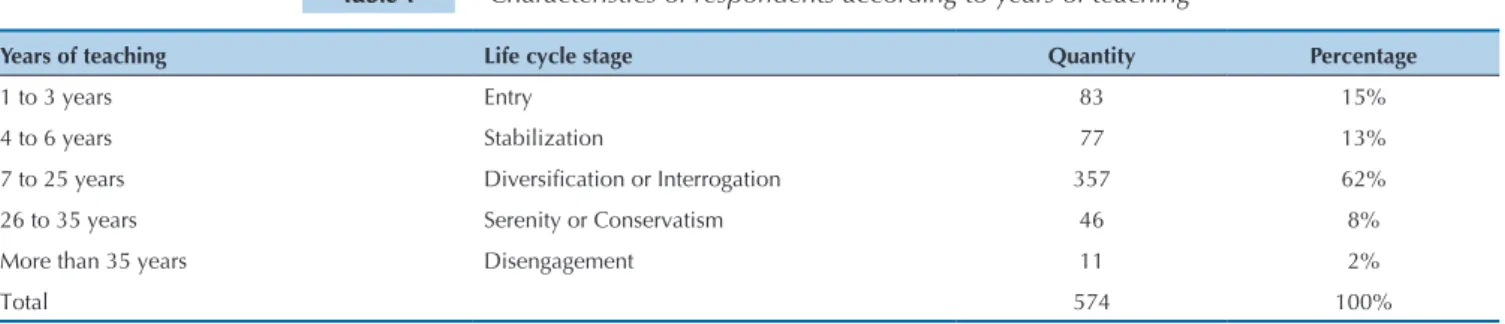
Table 1 shows the sample distribution by life cycle phase, as proposed by Huberman (2000).
ding to 25 years of experience. It can also be observed that 28% of the sample has up to 6 years of teaching experience and 10% have more than 25 years of experience.
he analysis of the gender distribution at each phase reveals surprising changes over time, as shown in Figure 4.
he sample consisted of professors from all of the life
cycle phases proposed by Huberman (2000). he phase
with the highest number of respondents (62%) is the
di-versiication or experimentation phase, which is also the
longest phase, starting at 7 years of experience and
exten-Source: Authors.
Figure 4 Gender of respondents in each life cycle phase.
In phase 5, which contains respondents with 35-40 years of practice and that is therefore the phase with the most experienced professors, 82% of respondents are male. Similarly, in phase 4 (25 to 35 years of teaching), 87% of respondents are male. In phase 3, whose
res-pondents have 7-25 years of teaching, the presence of females increase to 30%. In phase 2, which includes pro-fessors with 4-6 years of professional experience, fema-les represent 43% of the professors surveyed. Finally, in phase 1, which represents professors in the early career
Years of teaching Life cycle stage Quantity Percentage
1 to 3 years Entry 83 15%
4 to 6 years Stabilization 77 13%
7 to 25 years !ERANOEł?=PEKJKN&JPANNKC=PEKJ 357 62%
26 to 35 years Serenity or Conservatism 46 8%
More than 35 years Disengagement 11 2%
Total 574 100%
Source: Authors.
stages (1-3 years), there is a reversal in the predominant gender: 51% of the sampled professors are female. This change in terms of gender is the result of a higher num-ber of women in higher education, especially in accoun-ting sciences programs.
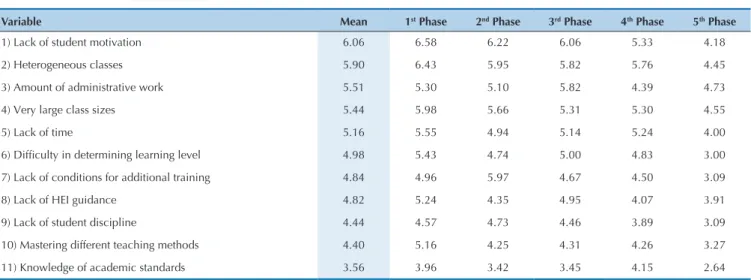
Table 2 shows the mean scores of each of the pro-blems experienced by the study participants during each of the life-cycle phases proposed by Huberman (2000),
i.e., it describes the intensity with which each problem affects the respondents.
According to Table 2, the main problems for the stu-died sample are: (1) lack of student motivation; (2) he-terogeneous classes; (3) amount of administrative work; (4) very large class sizes; and (5) lack of time.
The problem with the highest mean (6.06) was “lack of student motivation.” This result corroborates the fin-dings of Veenman (1984), according to which student motivation appears as the second-largest problem fa-ced by teachers. Next, “heterogeneous classes” appears as the second problem identified by the respondents, with a mean of 5.90. Again, this finding is in accordance with Veenman (1984), where this problem was ranked third. Heterogeneity, or diversity, is greater today due to Brazil’s expansion of access to higher education in recent decades. According to Cunha and Pinto (2009), chan-ges that have affected the university imply the admis-sion of students with increasingly diverse backgrounds, with respect to both culture and prior education, moti-vations, and expectations. Class size, which is related to the diversity problem (overcrowded classrooms), ranked fourth, with a mean of 5.44.
Third, we see “amount of administrative work”, with a mean of 5.51 points. At HEIs in general, professors as-sume numerous roles or perform numerous activities in addition to teaching (coordinator, director, supervisor, research projects, outreach projects, committees, exami-ning boards, process reports, guidance, etc.). “Lack of time” is also associated with the amount of administra-tive work, with a mean of 5.16, the fifth-largest problem identified by professors.
In addition to identifying the main overall problems, this study aimed to identify the biggest problems encoun-tered at each of the phases that comprise the professional
life cycle proposed by Huberman (2000). For this aspect, it was interesting to note that the ranking of the problems
tends to be practically the same during all ive phases.
In the first phase, entry into the profession, the main problems faced by professors are the same as in the ove-rall ranking, with the addition of one problem: “6) Diffi-culty in determining the learning level”. This is also the phase during which problems had the highest means,
i.e., when professors perceived problems with the most
intensity. This is the time during which professors are subject to “reality shock” (Huberman, 2000).
In the second phase, the item “lack of time” was not among the main problems, with another item in eviden-ce, namely, “lack of conditions for additional training”. Thus, it is noted that professors with between 4 and 6 years of teaching experience difficulties in completing their graduate studies. This is understandable in the ac-counting field because Brazil has few graduate programs.
In the third phase, which is the longest of the ive and
lasts from 7 to 25 years of practice, the top ive problems
identiied in the overall rank are retained and one is
ad-ded: “diiculty in determining the learning level”, which
obtained a mean of 5 points. It is noted that during this
period of diversiication and experimentation, professors
both seek methods of establishing appropriate assessment methods and perceive this search as inconvenient.
In the fourth phase, a period of serenity and conser-vatism, only four problems appear as relevant, namely, lack of student motivation, heterogeneous classes, very large sizes, and lack of time.
Finally, in the fifth phase, during which professors enter the retirement process (disengagement), no pro-blem seems to be important to professors, because all of
Variable Mean 1st Phase 2nd Phase 3rd Phase 4th Phase 5th Phase
1) Lack of student motivation 6.06 6.58 6.22 6.06 5.33 4.18
2) Heterogeneous classes 5.90 6.43 5.95 5.82 5.76 4.45
3) Amount of administrative work 5.51 5.30 5.10 5.82 4.39 4.73
4) Very large class sizes 5.44 5.98 5.66 5.31 5.30 4.55
5) Lack of time 5.16 5.55 4.94 5.14 5.24 4.00
!EBł?QHPUEJ@APANIEJEJCHA=NJEJCHARAH 4.98 5.43 4.74 5.00 4.83 3.00
7) Lack of conditions for additional training 4.84 4.96 5.97 4.67 4.50 3.09
8) Lack of HEI guidance 4.82 5.24 4.35 4.95 4.07 3.91
9) Lack of student discipline 4.44 4.57 4.73 4.46 3.89 3.09
10) Mastering different teaching methods 4.40 5.16 4.25 4.31 4.26 3.27
11) Knowledge of academic standards 3.56 3.96 3.42 3.45 4.15 2.64
Source: Authors.
those problems had mean scores below 50%, i.e., below 5 points. Moreover, it is worth noting that the importance
of problems tends to decrease in each of the five phases, as evidenced in Figure 5.
Source: Authors.
Figure 5 Problems perceived by professors during each life-cycle phase
Figure 5 demonstrates that the beginning of the pro-fessional career is potentially the most problematic phase because it is the period during which “reality shock” oc-curs; i.e., it is when professors face problems such as lack
of acceptance and preparation for teaching practice. h
e-se indings corroborate the argument of several authors
(Ryan, 1979; Müller-Fohrbrodt et al., 1978; Tayor & Dale, 1971; Lademann & Lietzke, 1977; Jesus & Santos, 2004).
After the career entry phase, professors gradually
overcome these problems, i.e., they begin to
accumu-late so-called experiential knowledge, as advocated by another group of authors in the education field (Tardif, 2000; Pimenta & Anastasiou, 2002; Gauthier, Martineau, Desbiens, Malo, & Simard, 1998).
his study also analyzed whether the perception of
pro-fessors who work at public institutions is diferent from the
perception of professors who work at private institutions.
hus, the median test was performed, as shown in Table 3.
As can be observed, only the variables “3) amount of administrative work” and “8) lack of HEI guidance” have significantly different medians depending on whether the employing institution is public or private, at a 5% significance level. In fact, the amount of administrative work at public institutions tends to be higher because
these institutions also have the highest number of pro-fessors who work for them exclusively and who perform tasks related to teaching, research, outreach, and prima-rily administrative activities. Likewise, lack of guidance also appears to be greater in public HEIs, perhaps becau-se the decision-making process is less centralized.
Test/variable 1) Motiv.
2) Heterog.
3) Adm. work
4) Class size
5) Time 6) Learning
level
7) Training
8) HEI guidance
9) Discipline
10) Teaching
meth.
11) Standards
Mann-Whitney U 38,745 36,717 34,877 38,389 39,131 38,156 38,967.5 32,414.5 37,479 39,002 39,459
p (two-tailed) 0.437 0.070 0.006 0.338 0.563 0.281 0.505 0.000 0.154 0.518 0.678
Source: Authors.
This study also aimed to analyze the problems per-ceived by professors according to the professional degre-es held by those profdegre-essors. Considering that profdegre-essors who had only earned an undergraduate degree and pro-fessors with postdoctoral experience represented appro-ximately 1% of the sample, the degrees were clustered into three groups, namely: (i) specialists, i.e., professors
with no more than a specialist degree; (ii) masters, i.e., professors with a master’s degree; and (iii) doctors, i.e., professors with either a doctoral degree or postdoctoral experience.
Table 4 shows the comparison between the problems faced by professors with no more than a specialist degree and those with master’s degrees.
he data reveal that the perception of some problems is
signiicantly diferent between professors with master’s and
specialist degrees. It is noted that professors with master’s
degrees are more afected by the following problems: “1) lack
of student motivation”; “3) amount of administrative work”; “4) very large class sizes”; “5) lack of time”; “6) diiculty in determining learning level”; and “8) lack of HEI guidance”.
hese results seem to contradict the trend shown in Table 2
because in principle, it is assumed that professors with spe-cialist degrees are in a life-cycle stage that is earlier than that of professors with master’s degrees. However, when the
ave-rage age of professors is observed in light of their degrees, it is noted that approximately 70% of professors with master’s degrees are aged between 31 and 50 years old and only 56% of specialists are in the same age group. In other words, it is likely that there are more professors with master’s than spe-cialist degrees in the early phases of the life cycle, therefore, these professors are more susceptible to problems related to career entry (Huberman, 2000).
Table 5 shows the comparison between the problems faced by professors with no more than a specialist degree and those with at least a doctoral degree.
he data show that ive problems have signiicantly
di-ferent perceptions among professors with no more than
a specialist degree and professors with at least a
docto-ral degree. Doctors are more afected than the specialists
by the following problems: “3) amount of administrative work” and “5) lack of time”, which is understandable wi-thin Brazil’s accounting context due to the low number of
doctors in the ield available to perform activities related
to teaching (undergraduate and graduate courses), resear-ch, outrearesear-ch, and administrative activities.
In contrast, specialists are more afected than doctors by
the following problems: “7) lack of conditions for additional training”; “8) lack of HEI guidance”; and “11) knowledge of academic standards.” As can be observed, these are problems
that afect professors in the early phases of the professional
life cycle, who have not completed their graduate studies, and who seek stability in the teaching profession.
Finally, Table 6 shows the comparison between the problems experienced by professors with no more than a master’s degree and professors with at least a doctoral degree.
Test/variable 1) Motiv. 2) Heterog. 3) Adm. work 4) Class size
5) Time 6) Learning
level
7) Training 8) HEI guidance 9) Discipline 10) Teaching meth. 11) Standards
Mann-Whitney U 14,672 16,599.5 15,022.5 15439.5 14,713.5 15,298.5 16,343.5 14,959 15,537 15,624.5 16,350.5
p (two-tailed) 0.008 0.370 0.019 0.050 0.009 0.037 0.257 0.017 0.062 0.074 0.258
Source: Authors.
Table 4 Comparison of medians between professors with specialist and master’s degrees
Test/variable 1) Motiv. 2) Heterog. 3) Adm. work 4) Class size
5) Time 6) Learning level 7) Training 8) HEI guidance 9) Discipline 10) Teaching meth. 11) Standards
Mann-Whitney U 8,844 8,631.5 7,670 9,349.5 8,236.5 9,367 5,854.5 8,160 9,648 9,033.5 8,215.5
Sig. (two tailed) 0.223 0.125 0.003 0.642 0.033 0.662 0.000 0.025 0.986 0.347 0.028
Source: Authors.
Table 5 Comparison of medians between professors with specialist and doctoral degrees
Test/variable 1) Motiv. 2) Heterog. 3) Adm. work 4) Class size
5) Time 6) Learning level 7) Training 8) HEI guidance 9) Discipline 10) Teaching meth. 11) Standards
Mann-Whitney U 22,124.5 19,422.5 21,632.5 19,701 23,358.5 19,838.5 15,675 23,330 21,030 19,597 18,700
p (two tailed) 0.271 0.002 0.142 0.003 0.864 0.005 0.000 0.847 0.054 0.003 0.000
Source: Authors.
According to Table 6, professors with master’s degrees
are more afected than those with doctoral degrees by six
problems: “2) heterogeneous classes”; “4) very large class
sizes”; “6) diiculty in determining learning level”; “7) lack
of conditions for additional training”; “10) mastering dif
e-rent teaching methods”; and “11) knowledge of academic standards”. It is noted that these are problems primarily
re-late to career entry and the lack of additional training for
teaching practice. hese results are consistent with the data
presented in Table 2, where it can be observed that these
problems afect professors less as they reach the later
pha-ses of the life cycle. In other words, professors with docto-ral degrees are certainly at more advanced life-cycle stages than those with master’s and specialist degrees.
5 CONCLUSIONS
This study identified the main problems faced by professors both upon career entry and at later stages. The findings revealed that the problems experienced by accounting professors are very similar to those iden-tified by Veenman (1984), with career entry being the most critical phase. The main problems identified in the career entry phase were the following: (1) lack of student motivation; (2) heterogeneous classes; (3) amount of ad-ministrative work; (4) very large class sizes; (5) lack of time; and (6) difficulty in determining learning levels.
When problems are analyzed according to professors’ degrees, lack of additional training, lack of guidance by the HEI, and knowledge of academic standards are
pro-blems that most directly afect professors with lower
pro-fessional degrees, whereas lack of time and large amounts of administrative work are the problems that are expe-rienced more intensely by professors with higher degrees. These findings suggest the need for educational trai-ning of accounting professors to overcome the problems that afflict those entering the profession. It is necessary
for professors to understand academic standards and to have access to guidance from their HEIs. It is also im-portant for these professionals not only to have training that in addressing student diversity but also to have the tools to motivate students.
The large amount of administrative activity and the lack of time indicated by professors with higher degrees is also a concern. In this regard, it is important to men-tion that because Brazil has few graduate programs in accounting, few professors hold doctoral degrees. The-refore, it is possible that those professors are overbur-dened. Thus, it is important for Brazil to maintain its policy to expand graduate programs.
Cunha, J. V. A. (2007). Doutores em ciências contábeis da FEA/USP: análise sob a óptica da teoria do capital humano (Tese de Doutorado). Faculdade de Economia, Administração e Contabilidade,
Universidade de São Paulo, São Paulo.
Cunha, M. D., & Pinto, M. M. (2009). Qualidade e Educação Superior no
Brasil e o desaio da inclusão social na perspectiva epistemológica e
ética. Revista Brasileira de Estudos Pedagógicos, 90(226), 571-591.
Cunha, M. I. (2009). Trajetórias e lugares da formação do docente da Educação Superior: do compromisso individual à responsabilidade
institucional. Revista Brasileira de Formação de Professores, 1(1),
110-128.
Czinkota, M. R., & Ronkainen, I. A. (2005). International business and
trade in the next decade: report from a Delphi study. Journal of
International Business Studies, 40(4), 111-123.
Delgado, A. C., Fuentes, J. M. B., Quevedo, M. P. A., Salgado, A. R., Sánchez, A. C., Sanchez, T. S., Velasco, C. A., et al. (1993). Revisión
teórica del burnout o desgaste profesional en trabajadores de la
docencia. Caesura, 2(2), 47-65.
Gauthier, C., Martineau, S., Desbiens, J. F., Malo, A., & Simard, D. (1998).
Por uma teoria da pedagogia: pesquisas contemporâneas sobre o saber docente. Ijuí, RS: Unijuí.
Giovinazzo, R. (2001). Modelo de aplicação da técnica Delphi pela internet: vantagens e ressalvas. Recuperado de http://www.fecap.br/ adm_online/art22/renata.htm
Gonçalves, J. A. (2009). Desenvolvimento proissional e carreira docente:
fases da carreira, currículo e supervisão. Sísifo: Revista de Ciências da
Educação, 8, 23-36.
Grisham, T. (2009). he Delphi technique: a method for testing complex
and multifaceted topics. International Journal of Managing Projects in
Business, 2(1), 112-130.
Huberman, M. (1989). Le cycle de vie proissionnelle des enseignants
secondaires. Résumé d’une recherche démentielle (Cahiers de la Section
des Sciences de l’Education). Genève:Université de Genève.
Huberman, M. (2000). O ciclo de vida proissional dos professores. In A.
Nóvoa (Org.), Vida de professores (2a ed., pp. 31-61). Porto: Porto Ed.
Jesus, S. N., & Santos, J. C. V. (2004). Desenvolvimento proissional e
motivação dos professores. Educação, 27(1), 39-58.
Krasilchik, M. (2008, Maio). Docência no Ensino Superior: tensões e
mudanças (Cadernos de Pedagogia Universitária USP, n. 12). São Paulo: Universidade de São Paulo.
Lademann, R. H., & Lietzke, H. (1977). Zur Berufssituation des Lehrers
jungen. Zeitschrit pele erziehungswissenschatliche Forschung, 11,
155-161.
Martins, G. A., & heóphilo, C. R. (2007). Metodologia da investigação
cientíica para ciências sociais aplicadas. São Paulo: Atlas.
Masetto, M. T. (2010, Maio). Docência no Ensino Superior voltada para a
aprendizagem faz a diferença (Cadernos de Pedagogia Universitária USP, n. 12). São Paulo: Universidade de São Paulo.
Ministério da Educação. (2012). Plataforma e-MEC. Sistema e-MEC. Recuperado de http://emec.mec.gov.br/
Miranda, G. J. (2011). Relações entre as qualiicações do professor e o
desempenho discente nos cursos de graduação em Contabilidade no Brasil (Tese de Doutorado). Faculdade de Economia, Administração e Contabilidade, Universidade de São Paulo, São Paulo.
Müller-Fohrbrodt, G., Cloetta, B., & Dann, H. D. (1978). Der Praxisschock
bei junger Lehrern. Stuttgart: Klett.
Nóvoa, A. (1992). Formação de professores e proissão docente. Lisboa:
Dom Quixote.
Pierre, K. S., Wilson, R. M. S., Ravenscrot, S. P., & Rebele, J. E. (2009,
May). he role of accounting education research in our discipline: an
editorial. Issues in Accounting Education, 24(2), 112-130.
Pimenta, S. G., & Anastasiou, L. G. C. (2002). Docência no Ensino Superior.
São Paulo: Cortez.
Roque, R. F. (1998). Estudo comparativo de metodologias de
desenvolvimento de sistemas de informação utilizando a técnica Delphi
(Dissertação de Mestrado). Universidade Federal de Santa Catarina, Florianópolis, Brasil.
Ryan, K. (1979). Para a compreensão do problema: no liminar da proissão.
In K. R. Howey, & R. H. Bents (Ed.), Para satisfazer as necessidades do
professor iniciante. [S.l.]: [s.n.].
Tardif, M. (2000). Saberes proissionais dos professores e conhecimentos
universitários. Elementos para uma epistemologia da prática
proissional dos professores e suas consequências em relação à
formação para o magistério. Revista Brasileira de Educação, 13, 5-24.
Taylor, J. K., & Dale, I. R. (1971). Uma pesquisa de professores em seu
primeiro ano de serviço. Bristol: Universidade de Bristol.
Veenman, S. (1984). Perceived problems of beginning teachers. Review of
Educational Research, 54(2), 143-178.
Vianna, N. W. H. (1989). Subjetividade no processo de previsão (Tese de
Doutorado). Faculdade de Economia, Administração e Contabilidade, Universidade de São Paulo, São Paulo.
Zabalza, M. A. (2007). O ensino universitário. Porto Alegre: Artmed.