Review of Business Management
DOI: 10.7819/rbgn.v18i59.2107
125
Received on 08/26/2014 Approved on 05/04/2016
Responsible editor: Prof. Dr. André Taue Saito Evaluation process: Double Blind Review
Third sector governance: a case study in
a university support foundation
Lucimar Antônio Cabral de Ávila
Federal University of Uberlandia, School of Accounting Sciences Uberlandia, MG, Brazil
Carlos Osmar Bertero
Getulio Vargas Foundation, Sao Paulo School of Business Administration, Sao Paulo, SP, Brazil
Abstract
Purpose – To establish a Governance Index (GOVI) to measure the relationship and inluences with economic and inancial performance and of volume of operations in a third sector entity.
Design/methodology/approach – Exploratory, documentary and bibliographic research and content analysis, in order to achieve a GOVI derived from the use of independence, accountability and transparency variables in the period between 1986 and 2010. Questionnaires, administrative and accounting information are all used to characterize economic and inancial performance indexes and determinants of the operations volume of the studied entity. Data was statistically processed through descriptive analysis, conirmatory factor analysis, and logistic regression analysis.
Findings – he research came to two conclusions: the proposed data collection instrument presented good adjustment indexes; and the GOVI has a signiicant relationship with the variables used to measure performance. his may indicate that determining the GOVI is a suitable tool for confrontation and measurement of performance of nonproit organizations. Moreover, managers’ independence should be largely used in management of third sector entities.
Originality/value – he validation of the data collection instrument and the way the GOVI was obtained is one of the contributions of this study, since similar ways of measuring third sector performance were not found in literature. Choosing economic and inancial performance and operations volume to study the relationship with the GOVI in nonproit entities also was not found.
1
Introduction
Corporate governance has emerged in response to the need for improved relationships between managers and investors in organizations, and has triggered important discussions about its impacts and efects on security during decision-making processes in the capital market. As a result, certain actions began to be required for better understanding of the relationship between the various stakeholders involved in the business ield, including investors, customers, suppliers, employees, and managers. he primary goal is to minimize the efects of stakeholders’ diferent perspectives on business – the so-called agency conlicts.
In general, comparative measures between the implementation of good corporate governance practices and performance target parameters are dealt with when observing parameters inherent to for-proit companies, especially large or publicly traded companies that harbor professional administrative staf and a clear disposition towards agency conlicts. Nevertheless, much research has focused on governance in the third sector, with emphasis on collective relationships and on coping with agency problems between third sector organization managers and donors. In such cases, the use of inancial measures is usually inadequate to assess the degree of organizations’ success or failure, because, according to Drucker (1997), it is extremely hard to establish measures to assess their results. In social, environmental or healthcare-oriented entities, where volunteers are common, investigations are necessary concerning the measurement of results or returns as a proxy of efectiveness or eiciency, especially if they are to be compared with established governance indexes. his line of reasoning can also be applied to business institutes and foundations, since they depend on resources from sponsoring companies or partners.
In foundations established to provide speciic services, institutors normally expect them
to subsist, sustain themselves and grow through self-financing, with resources management being carried out as in any private organization. Management tools in any organization, public or private, should rely on resource procurement, expense reduction and control, budget projections, and use of performance measures based on economic and financial indexes and other operational measures, and to check if managers have adopted appropriate actions that are likely to assure the sustainability of the organizations. Thus, governance indexes – better adapted to their speciic characteristics – emerge as a counterpoint to these organizations’ economic, financial and operational performances and operations, respecting the basic parameters of the best governance practices established in Brazil, as proposed by the Brazilian Institute for Corporate Governance’s (Instituto Brasileiro de Governança Corporativa, IBGC) Guide of Best Governance Practices for Business Institutes and Foundations (Guia das Melhores Práticas de Governança para Fundações e Institutos Empresariais, Gife) (2009).
Drawing on IBGC’s (2009) proposal for establishing governance indexes adapted to speciic activities, this paper reports the case study of a foundation that supports the Federal University of Uberlândia (Universidade Federal de Uberlândia, UFU), namely Uberlândia’s Educational Radio and Television Foundation (Fundação Rádio e Televisão Educativa de Uberlândia, RTU). his is a third sector organization which holds two educational broadcasting station concessions: an FM radio station and a cable and broadcast television station. It is slightly diferent, both in terms of support and services. Agency conlict is apparent, given UFU’s and its leaders’ interference and interventions in the management of RTU.
Building on the case study, the general objective of this paper is to establish a Governance Index (GOVI) that interfaces with economic-inancial performance and volume of operations in a third sector organization.
performance and the volume of operations in a third sector foundation?
To the best of the authors’ knowledge, no studies have related governance indexes with performance in the third sector. herefore, the results are expected to add to the existing theory.
2
heoretical framework
2.1
Corporate governance and agency
problems
Corporate governance became increasingly important following numerous corporate fraud scandals that led to the loss of billions of dollars by shareholders, to countless bankruptcies, to the destruction of thousands of jobs and to a great number of criminal cases (Bergamini, 2002; Monks & Minow, 2004). he authors consider that there were so many frauds that this overshadowed many small corporate scandals, mainly around the beginning of the 21st century. As an example of the beginning of concern referring to the improvement of corporate governance levels, Carlsson (2001) presented an episode involving Texaco in 1984 which caused losses to shareholders at the expense of managers’ interests.
Silveira (2002) describes the formalization process of corporate governance systems’ organization worldwide. It began in 1985, in the USA, with the establishment of the Council of Institutional Investors; with the Cadbury report, in the UK, in 1992; with changes in the German stock market, in 1997; with recommendations for corporate governance in Japan, published in 1997; and with the launch of the Vienot report in France, in 1995, and revised in 1999. Regarding Brazil, the author highlights the establishment of IBGC, in 1995, as well as the launch of the best corporate governance practices code, that same year. he fourth version of this code was released in 2009, and, according to Marinelli (2005), the Cadbury report was revised in 1995.
he increased inluence level of corporate governance is related, to a large extent, to agency conlicts. Interests can become conlicting when a part (major) depends on the decisions of another (agent), even though it is clear that the agent should make decisions that aim to beneit the major (Almeida, 2002; Arruda, Madruga, & Freitas, 2008; Band, 1992; Carvalho, 2002). According to Jensen and Meckling (1976), individuals are inherently prone to carry out activities or make decisions that are biased towards their own preferences or desires. his, in turn, besides generating diferences between managers, shareholders or majors, may lead to costs resulting, among other things, from following decision makers’ actions. hese claims are supported by Fama and Jensen (1983) and further corroborated by Eisenhardt (1989), who addresses four questions about the theory: definition, contribution, empirical validity and productivity of contexts for organizational researchers.
Berle (1968) had already shown concerns about the relationship between ownership and control, when tracing the proile of the American economic system. Berle and Means (1988), in an updated version of he modern corporation and private property, also express the clear divergence of interest between ownership and control. hey set three functions derived from companies’ issues, as follows: “to have interests in a company, to have power over it, and to act in it” (p. 123).
To Noreen (1988), the Agency heory may be used to explain detrimental ramiications arising from opportunistic behavior and lack of ethical restriction. Opportunism comes along with costs derived from mutual distrust, which requires the parties to maintain mechanisms to monitor the agents’ actions. Religion, genetics and teaching techniques are somehow related to improvement in levels of ethical conduct, notably because of their punitive efect, which contrasts with deviations of conduct in the market, where punishment is unlikely.
Drawing from studies on agency theory, which address, to a large extent, the existing conlicts between shareholders (major) and managers (agent), these concepts can be extrapolated to a nonproit organization. In such organizations, conlicts are assumed to result from clashes of opinions and interests about their directions, management or investment models to apply the available resources. In this context, governance stands as a way to control the agents participating in the decision-making process and eventually to improve the organizations’ performance.
2.2
Governance in the third sector and
agency conlicts
As described by Guimarães (2008), certain third sector deinitions date back to the defense of minorities, of the environment, of social struggles and of life itself, while others consider it a set of ineicient alternatives to replace the State. To Salamon (1998), the third sector is an “impressive network of autonomous private associations, not oriented towards distributing proits to shareholders or directors, but rather serving public purposes, although from outside the formal apparatus of the State” (p. 5). Salamon and Anheier (1992) discussed the structural traits that distinguish the third sector from other organizations, including their formal business formation, non-governmental nature, autonomy, lack of proit distribution, and volunteering work.
he Brazilian Institute of Geography and Statistics (Instituto Brasileiro de Geograia e Estatística, IBGE) (2004) characterizes the third sector as groups, movements or nonproit organizations, which are important to assure “democracy, development and citizenship” (p. 9). Montaño (2002) states that the third sector “denotes a set of private organizations and initiatives aimed at the production of public goods and services” (p. 21). Ramos (2003) emphasizes the political, democratic and economic importance of the third sector and its role in the process of building a better society while also contributing to the gross domestic product (GDP), the labor market and capital investments.
hird sector organizations may be formed as associations, entities for defense of collective interests, foundations and other types of civil society organizations of public interest. Some subdivisions can be established according to their volunteering and charitable nature, as well as their developmental, environmental and civic purposes, as described in Coelho (2000). Nearly 40 years ago, McGill and Wooten (1975) already discussed directions and management models for nonproit organizations.
Guimarães (2008) points to corporate social responsibility, which may range from improving reputation to environmental concerns, as a basis for the third sector governance, with an emphasis on the inluence and interest from various groups regarding the organizations’ actions and performance. Melo and Froes (1999) see social responsibility as a way of making the companies exercise their philanthropy while also making explicit the entrepreneur’s benefaction.
with organizations’ performances. Pinto and Junqueira (2009), who used a case study to discuss power relationships in a third sector network, presented another example. he authors concluded power was decentralized, favoring fragmentation in decision-making without afecting the structural integrity of the studied organization. Nevertheless, they still underline the great importance of the central core in maintaining cohesion of the actions.
Heckert and Silva (2008) assessed service quality in the third sector. hey concluded there are various types of stakeholders with diferent roles: several interested parties, with diferent perceptions of the services or activities carried out by the third sector organizations. he authors consider that the results obtained from the actions taken are as important as the process of service delivery.
Mendonça and Machado (2004) tapped into agency conlicts in the third sector while assessing whether the actions of nonprofit organization managers were aligned with the donors’ or founders’ interests, and whether the organization still follows its initial statutory purposes. Camera (2003) discussed the performance of boards of directors in social organizations, and also highlights the great need for alignment between management and strategic goals. Pegoraro (2008) analyzed the relationships that nonproit higher education institutions maintained with their supporters, taking as an example the University of Contestado (Universidade do Contestado, UNC), in the Brazilian states of Santa Catarina and Rio Grande do Sul. he author claims that, although little visible, these relationships bring a classic problem of agency, with conlicts of interest, and require a collective and public analysis of problems if it is to improve conditions for both parties.
Puyvelde, Caers, Du Bois e Jegers (2012) provide in-depth analyses of agency conlicts and discuss on governance in nonproit organizations in an attempt to integrate Agency heory with
the heory with Stakeholder and Stewardship heory. he authors argue that studies have been based only on the agency relationship within organizations, neglecting the importance of the stakeholders in the external environment. hey claim that Agency heory in third sector organizations should be understood in greater depth towards an evolution to the Stewardship heory, in which two analytical perspectives can be drawn: 1) to recognize the conlict between principal and agent, while assuming that the agent will seek to meet the organizations objectives; and 2) to assume that the agent’s goals are narrowly aligned with those of the principal.
Considering a development in the third sector governance, Mason, Kirkbride and Bryde (2007) presented a new model of interpretation, called Social Governance. It incorporates behavioral factors or social values, such as beliefs, meanings, and historical values, into technical analysis, overcoming and supplementing Stewardship heory. he authors believe their model is aligned with notions of citizenship, legitimacy and participation, allowing for the incorporation of informal aspects into the management of nonproit organizations.
Bridging the management bodies and the hospital routines eventually led to improvements in the governance process.
Despite advances in governance-related studies in the third sector, Cornforth (2011) warns that much attention has been paid to councils, ignoring factors such as forms of government, governance and complexity levels of the structures, as well as the evolution of this type of organization. he author states that third sector governance should be addressed more broadly, including the inluences from both internal and external environments.
In the present case study, agency conlicts are observed through the diferent understandings of how the foundation should relate to the university. In the original project, the radio and television broadcast stations were devised as a means to outreach university actions to the community and beyond. However, the project says nothing about inancial maintenance.
Meanwhile, with the establishment of a nonproit foundation to be awarded the concessions, a double understanding emerged: emotional motivations gave way to concerns about the foundation’s maintenance.
According to Correia and Amaral (2008), the central assumption of the agency theory is the existence of conlicts in any relationship between a principal (in this case, UFU) and an agent (RTU), with the irm desire to maximize its own beneits. While most of the university community believes the foundation exists to meet UFU’s needs, the foundation managers face the challenge of surviving, especially in inancial terms, to achieve its activities and legal obligations.
2 . 3
G ove rn a n c e p r i n c i p l e s a n d
mechanisms applied to the third sector
Rodrigues and Malo (2006) note the importance of establishing strategies and principles to address governance in nonproit organizations. However, they argue, in a community venture, such information should be streamlined, made
public, so there is greater mobilization and more efective engagement providing more tangible support to the decision-making due to greater participation.
To Falconer (1999), the third sector lacks observations and explanations more deeply grounded on its own management techniques: having its speciic demands, it cannot simply borrow traditional administration models of private or public organizations. The author complements that the poor management of the nonproit organizations is one of the main problems in the sector. Building on O’Neill (1998), the author provides eight categories of diferences between third sector organizations and other organizations, namely: Purpose/Mission; Values; Resource Procurement; Bottom Line (Results); Legal Environment; Labor Profile; Governance; and Organizational Complexity. he author believes that the priorities for improving management in the Brazilian third sector are transparency, accountability, sustainability, service quality, and the people and communication skills.
measuring the managers’ eiciency. However, the authors warned that their indings cannot be compared to those of other third sector organizations because of the wide range of activities carried out by them.
Pimenta and Brazil (2009) assessed organizational skills and managers in the third sector in Itabira (in the state of Minas Gerais, Brazil). Their results reinforced the lack of professionalism in the management of third sector organizations: unprepared managers used methods that did not meet the organizations’ needs and, thus, their goals and purposes.
Cruz, Quandt, Martins e Silva (2010), Silveira and Borba (2010) address the accounting measurement of indexes of good governance practices in the third sector. Silveira and Borba (2010) assessed the level of accounting evidence presented by a sample of 39 third sector organizations in 2004, 2005 and 2006. They found 67% compliance of financial statements with transparency precepts related to accountability, which showed a clear need for improvement in these statements.
To assist in the development of best conducts and guidelines for the establishment of foundations and private associations, IBGC (2009) proposed a Guide of Best Governance Practices for Business Institutes and Foundations (Gife). The guide provides a collection of actions aimed at assisting in control structuring, management optimization, accountability, transparency and compliance to legal precepts, among others. Similarly to the best practices for proit companies, the guide is built on basic third sector principles: transparency, fairness, accountability and responsibility.
Although these principles and best practices can be used by any organization, speciically those in the third sector, IBGC (2009) clearly addresses those foundations and business institutes “maintained by companies or their shareholders for direct execution of or support to public interest projects in the most diverse areas,
such as education, social development, culture, environment and healthcare” (p. 17). Still, the precepts are perfectly applicable to other third sector organizations, including foundations not maintained by companies or other public or private institutions.
Carrion (2000) believes that the constitution of nonproit organizations leads to a social commitment with problems that should be handled by the State, and philanthropy, once provided on emotional grounds, has been replaced with investments, which, if successful, can bring high returns. hird sector governance is a way to assist in the search for eiciency to maximize the likelihood of success in an organization.
According to Fernandes (2002), philanthropy isolated from the business, i.e., not structured with some link to business organizations, turns into charity, embedded with afection and personal interests.
As explained in Hudson (1999), a number of management measures should be structured in order to provide efficient administration and, consequently, the development of the organization. It should include strategies, controls, accountability, and an organization-suitable governance system.
According to Mindlin (2009), corporate foundations must be addressed as a segment different from that of a business organization or any other nonproit organization. herefore, respecting their speciicities and resorting to speciic assessment formats and governance applications will probably prove to be more eicient.
3
Methodology
his study analyzed aspects inherent to the Uberlândia’s Educational Radio and Television Foundation (RTU), sponsor of an FM radio station and a cable and broadcast television station. RTU is located within UFU, in campus Santa Monica. It is a private-law entity, with its own management performed by an Executive Director, appointed by UFU’s President with approval of the Ministry of Communications. Its advisors are as follows: General Assembly, Board of Trustees, Supervisory Board, and Programming and Production Board. While the Executive Director is responsible for the direct management, he reports to the Board of Trustees, a body that is in charge of complete foundation management.
The research approach was basically empirical and analytic. According to Martins (2000), “in common, these approaches share the use of notably qualitative techniques of data collection, treatment and analysis” (p. 26). hey also resort to: 1) content analysis to describe and/or interpret the contents of messages and documents (Bardin, 2011); document analysis, through the collection, classiication and analysis of documents; and bibliographical analysis to assess and analyze the existing theoretical contributions to the topic under scrutiny (Martins, 2000).
3.1
Hypothesis
he relationship is always narrow between a support foundation and the federal university which it supports. In many cases, university president is also the foundation’s president, which leads to a conlict of interests and a clear distortion of good governance practices.
From its conception in 1985 to 2009, RTU faced such a problem, which was solved with the total exclusion of UFU president from its direct board in 2009. RTU’s history raises insightful questions about the conlicts resulting from the alternation of managers, both within
UFU and within the foundation itself. his may have resulted in signiicant impacts on its business model and, consequently, in its performance, herein assessed through inancial and economic indexes alongside the volume of own operations and total operations, including outsourced TV and radio programs. In this context, this study investigates the hypothesis that governance is related to economic and inancial performance alongside volume of operations in a third sector organization. he aim was to understand how the governance practices related to financial and economic performance as well as volume of operations throughout RTU’s history.
This research seeks to contribute to studies concerning governance in third sector organizations. It may support the establishment of a governance index for the management of an organization and simultaneous comparison of its results with economic and inancial measures of performance and volume of operations. To date, the literature has neglected nonprofit organizations, and this research contributes to the development of the theoretical framework about these institutions.
3.2
Dependent variables
he following variables were used as proxies for economic-inancial performance: Return on Asset (ROA); Return on Equity (ROE); hird Party Capital Index (IPCT); and Net Margin (NM), as provided in Matarazzo (2010). hese variables were individually treated as dependent variables in simple regressions that aimed at establishing relationships with governance. hese indexes were obtained from the organizations’ balance sheets and statements of income from 1986 to 2010.
foundation and UFU staf. Variable volume of operations includes data only from the television station, which started operations in 1996, because the establishment and production of TV programs incur in much higher costs than those of radio programs. Similarly, to the economic and inancial performance measures, the measures of volume of operations were individually considered in simple regressions aimed at establishing relationships with governance practices.
3.3
Independent variable
Three constructs – independence, accountability, and transparency – were selected assuming that good governance practices provide improved financial performance and greater volume of operations, and bearing in mind that it is not possible to establish a general or universal measure for cross-analysis of organizations. he constructs are adaptations of IBGC’s (2009) recommendations and were used to compose a Governance Index (GOVI) for the foundation under scrutiny. he choice of constructs was based on their intense recurrence within the institution. Speciically, independent variable GOVI was established using the average of responses obtained through a research questionnaire over each period, so as to assess whether governance practices had an impact on the economic and inancial performance as well as on the volume of operations.
3.4
Data collection
he period of analysis ranges from 1986, year of foundation, to 2010, year immediately prior to the beginning of this study. Yet, the collection instrument was subdivided in order to coincide with complete or partial terms of UFU’s presidents: 1986-1988; 1989-1992; 1993-1996; 1997-2000; 2001-2004; 2005-2008; and 2009-2010. his subdivision was necessary because UFU’s president was RTU’s Executive Director,
which caused changes in the direct administration in each of these periods and, in theory, could impact on the corporate governance practices adopted by each manager.
Independent variable GOVI was built based on a closed-ended questionnaire with ifteen questions, ive for each construct, in the form of statements. Answers possibilities ranged from 0 (zero) to 10 (ten), with the highest score meaning total alignment with the statement. he questions emerged from aligning the variables selected for GOVI with actions of good governance practices for the third sector after an extensive examination of the existing management occurrences at RTU. Besides, the researchers asked for the help of founders and managers who were at the head of the foundation in any of the periods evaluated.
A pre-test was applied to professors of both UFU and Getúlio Vargas Foundation’s Business School in São Paulo, Brazil. he inal questionnaire was hosted on Survey Monkey, a specialized website for this type of data collection. However, several respondents requested the questionnaire in printed form. A population of 336 individuals was considered for data collection, including UFU public servers and foundation staf who had provided services to or at RTU’s Foundation in one or more periods for at least 90 days (maximum period of a probation contract). Following adjustments for deaths and participation refusals, the population was reduced to 266, of which 146 provided valid responses (54.89%).
3.5
Statistical procedures
Following the establishment of the GOVI, the economic-financial performance indexes, adjusted from Matarazzo (2010), the data of the independent variables, i.e., those obtained from the questionnaire, were submitted to a descriptive analysis.
Using the Statistical Package for the Social Sciences (SPSS) and the Analysis of Moment Structures (AMOS) software, data was submitted to descriptive analysis of independent variables – that is, of variables used in the questionnaire, allowing the nature of their distribution to be visualized and, later, the descriptive analysis of dependent variables to be carried out, following their transformation into dummy variables to facilitate logistic regression. hen, Conirmatory Factor Analysis (CFA) was performed to assess the relationship of the governance variables with economic and inancial performance and volumes operations. CFA built on the following: reliability and internal consistency, for Cronbach’s Alpha with values above 60% (Hair, Anderson, Tatham, & Black, 2005b; Hair, Babin, Money, & Samouel, 2005a), to assess if constructs had been properly measured; and discriminant validity, for Chi-square statistics comparison between index pairs, to assess whether the constructs were measuring diferent things. CFA also assessed modiication indexes to minimize the value of the Chi-square statistic in the models.
Following the CFA, the average of each construct was calculated, and its value was used
in logistic regression analysis as independent variables. he model was tested and its results were analyzed.
4
Results
4.1
Indexes of economic and inancial
performance and volume of operations
Following the economic-financial performance indexes selection, adapted from Matarazzo (2010), from assessment of the most appropriate criteria for measuring the performance of RTU Foundation, it allowed for the establishment of results for the period, grouped using averages between the years.
Similarly, after determining the programming hours generated within the network itself, as well as the hourly amount conveyed by the University TV, described separately in own and third-party programs, it was possible to verify that RTU experienced a considerable increase in local broadcasting hours, but a large oscillation in the hours of its own programs, which may indicate discontinuities referring to management changes (i.e., new ideas and disclosure standards were implemented in every change of managers).
4.2
Descriptive analysis
Table 1
Descriptive statistics of independent variables obtained from the study and belonging to the questionnaire
Variables n Mean Stand dev. Minimum Maximum
in1 146 3.95 3.47 0.00 10.00 in2 146 4.06 3.59 0.00 10.00 in3 146 4.38 3.58 0.00 10.00 in4 146 4.33 3.67 0.00 10.00 in5 146 4.30 3.95 0.00 10.00 ac1 146 3.53 3.65 0.00 10.00 ac2 146 3.14 3.73 0.00 10.00 ac3 146 4.34 3.96 0.00 10.00 ac4 146 2.74 3.34 0.00 10.00 ac5 146 3.76 3.79 0.00 10.00 tr1 146 4.03 3.89 0.00 10.00 tr2 146 4.84 3.97 0.00 10.00 tr3 146 4.15 3.80 0.00 10.00 tr4 146 2.57 3.31 0.00 10.00 tr5 146 3.96 3.72 0.00 10.00 Note. in: independence; ac: accountability; tr: transparency
he average of all responses, whether in the independence, accountability or transparency construct, does not reach 50% of the maximum score. This indicates low compliance to the standards established for good corporate governance practices.
Despite the large time lapse in data collection, an alignment is apparent between the responses obtained in the questionnaire for the three groups of variables and allows for drawing inferences about the use of principles of governance in RTU management. Cronbach’s Alpha adds to this analysis, but was performed after the completion of CFA.
In addition, a verification mechanism for some items presented in the questionnaire, through documentary analysis, confirms the possibility of assessing whether the average indexes of responses obtained are consistent with the foundation’s records.
Table 2
Descriptive statistics for study dependent variables
Variables n Mean Stand. dev. Minimum Maximum Median
ROA (%) 146 0.74 1.94 -0.88 6.49 0.58 ROE (%) 146 7.11 11.76 -1.74 26.49 0.15 IPCT (%) 146 0.50 2.69 -2.53 4.78 -0.35 NM (%) 146 0.06 0.49 -0.55 1.00 0.04 PHP 107 101.13 24.87 63.50 128.25 115.50 LHP 107 2,693.99 1,691.48 580.25 4,742.25 2,452.13 Contrib. 107 64.19 14.64 48.00 82.00 62.00 Note. ROA: Return on Assets; ROE: Return on Equity; IPCT: hird Party Capital Index; NM: Net Margin; PHP: Hours of Proper Programming; LHP: Hours of Local Programming; Empl: Employees.
Table 2 provides mean, standard deviation, median, minimum and maximum value for each variable. Median was used as the basis to transform the dependent variables into dummy variables for the proposed model to be assessed based on logistic regression.
Transforming all dependent variables into dummy variables allowed for estimating the parameters of the proposed regression model. However, it is necessary, irst, to check whether the independent variables are properly measured.
This was performed through the analysis of the reliability and internal consistency of the questionnaire, alongside the discriminant analysis of the constructs.
4.3
Conirmatory factor analysis (CFA)
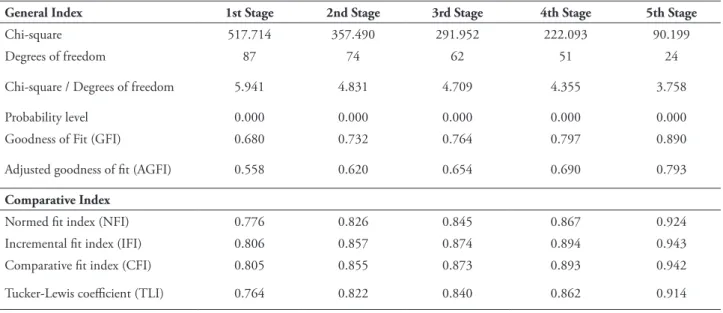
he model parameters were estimated in SPSS AMOS software, based on answers drawn from 146 questionnaires. Table 3 describes the adjustment indexes.
Table 3
Adjustment indexes for conirmatory factor analysis - adjusted model
General Index 1st Stage 2nd Stage 3rd Stage 4th Stage 5th Stage
Chi-square 517.714 357.490 291.952 222.093 90.199 Degrees of freedom 87 74 62 51 24 Chi-square / Degrees of freedom 5.941 4.831 4.709 4.355 3.758 Probability level 0.000 0.000 0.000 0.000 0.000 Goodness of Fit (GFI) 0.680 0.732 0.764 0.797 0.890 Adjusted goodness of it (AGFI) 0.558 0.620 0.654 0.690 0.793
Comparative Index
Adjustments were carried out to improve the model. To this end, the Modiication Index was analyzed to “evaluate the it of a speciied model, which are calculated for each non-estimated relationship” (Hair et al., 2005b, p. 491). However, other factors should be considered. With the adjustments, variables TR4, PC3, IN2, TR3, IN4 and PC2 were excluded.
he remaining variables in the constructs are consistent with IBGC’s (2009) prescriptions considering the present case study. However, results may be diferent in other non-private organizations. he adjustment indexes were the closest to those indicated in the literature.
Bartlett’s Sphericity Test and KMO (Kaiser-Meyer-Olkin) Extent were applied to the new questionnaire structure to assess data
adjustment to the factor analysis. he Sphericity test was signiicant at 1%, and the KMO measure was 0.899.
Cronbach’s Alpha was used to analyze reliability and internal consistency of the data collection instrument for each of the constructs. he results were: 0.776 for independence, 0.911 for accountability, and 0.930 for transparency. Since they were all above 60%, and therefore feature reliability and internal consistency, they were considered suitable for the analyses (Hair et al., 2005b, p. 90).
Despite the good adjustment indexes, discriminant validity of data collection instrument was also carried to evaluate “whether the items that relect a factor are not correlated with other factors” (Marôco, 2010, p. 176).
Table 4
Results for discriminant analysis, by constructs pairs
Pairs of constructs analyzed
Without Perfect Correlation
With Perfect Correlation
Diference (Chi-Square)
Chi-Square d.f. Chi-Square d.f. Diference Signif.
Independence (IN)
Accountability (AC) 11.056 8 60.874 9 49.818 <0.01 Transparency (TR) 17.503 8 69.565 9 52.062 <0.01 Accountability (AC)
Transparency (TR) 55.939 8 229.796 9 173.857 <0.01 Note. he diference (Chi-square) indicates the Chi-square statistic subtraction from the model, with perfect correlation between the two constructs, but no perfect correlation of any of them with the model. he signif. column indicates the signiicance level for the diference (Chi-square), with a degree of freedom.
The results in Table 4 show that the constructs used in the study may present some correlation with each other, but they do measure diferent things.
4.4
Logistic regression
he mean of the three constructs was calculated to estimate the model and measure
Table 5
Results for the logistic regression analyses between GOVI and dependent variables
Variables GOVI
ROA + ROE + IPCT +
NM +
PHP + LHP + Contrib. +
Note. +: indicates that the relationship between the variables was positive with signiicance at 5%.
-: indicates that the relationship between the variables was negative with signiicant at 5%.
n.s.: indicates that the relationship between the variables was not signiicant.
ROA: Return on Assets; ROE: Return on Equity; IPCT: Third Party Capital Index; NM: Net Margin; PHP: Hours of proper programming; LHP: Hours of Local programming; Empl: Employees.
As shown in Table 5, all variables showed a positive relationship with GOVI, indicating that the use of good governance practices favorably influenced RTU’s economic and financial performance. This supports the alternative hypothesis, that is, there is a relationship of the governance variables with the economic and inancial performance and volume of operations.
he positive relationship of GOVI with Hours of Own Programming (PHP) created and broadcast by RTU, denoting the inluence of governance, is closely related to the diiculty in maintaining resources, due to the oscillation of results and absence of investments for asset modernization. his impaired the implementation of new programs produced by RTU, because the costs are high and no records were found that a RTU program had sponsorship for implementation and maintenance.
GOVI positive relationships with ROE, MN, IPCT and Hours of Local Program (LPH) show that the foundation’s management has always been carried out with third-party resources, either in the form of loans from other UFU
support foundations or in the form of funds raised by marketing time slots for programs produced by third parties. Either way, this always interferes with the level of Return on Equity due to change in the net margin caused by oscillations of results in each period. In addition, the positive relationship of GOVI with the number of employees (Empl.) shows that more labor is needed to meet the demands created by increased marketing of time slots, especially for live broadcasts.
Aiming to identify the variables with greater inluence on the results, the analysis was performed again. However, GOVI was segregated in its three constructs. Apparently, no variable, in isolation, had a direct relationship with GOVI, which somehow contradicts the general analysis presented in Table 5.
The considerable variable oscillation over the seven periods used for this study’s analysis should be considered; it may explain the non-signiicant behavior of the variables in each term individually. However, grouped in general evaluation, it was statistically signiicant, allowing us to infer that governance interfered with economic-inancial performance and the volume of the Foundation’s operations.
As to the volume of operations in the 1997-2010 period, the indings show a downward tendency in hours of own programs despite the growing GOVI results. his is consistent with RTU’s long records of transactions related to third-party program to maintain its activities and face the high costs of creating its own programs. he results also show clearly that the growth in the number of employees follows the same behavior of the increasing hours of local programs, most notably for the use of third-party programs.
5
Final considerations
This study set out to understand the inluence of governance practices in a foundation supporting a federal university, more speciically on its economic and inancial performance and on the volume of its operations.
In analyzing the data and discussing the results, the null hypothesis was rejected, because GOVI had a positive inluence on dependent variable values.
he logistic regression results (Table 5) showed that the governance model adopted by the third sector organization had an impact on the foundation’s directions, whether perpetuating agency conlicts resulted from UFU’s interference, maintaining its inefectiveness in the search for better conditions of content production and increasing resources, or sustaining a model based on marketing time slots to outsourced programs, which caused an external dependency of a highly unstable market.
he present study has achieved several speciic goals. It has created an index of governance, which can be compared to several aspects inherent to RTU’s activities, including financial and economic performance and volume of operations. Other comparison metrics can be used, and the model herein created and validated to obtain the constructs and variables to be included in GOVI (questionnaire) may lack some adjustments to the speciics of the activities in any given third sector organization.
In drawing parallels between governance, on the one hand and economic and inancial performance and volumes of operation, on the other hand, the results point to a close relationship of the management formats adopted in each period with the dependent variables (ROA, ROE, IPCT, NM, PHP, LHP and Empl.). his may be explained by the absence of initial concern with resources for funding, using loans from other foundations, facing a phase of continual debt, together with the search for resources through the use of third-party programs, to reaching a stage of changes in the relationships and search for resources through new service contracts.
Knowing the similarity across support foundations, a similar collection instrument may be used after the establishment of equivalent variables and constructs, as well as the use of the same dependent variables. Other dependent variables may be used to measure the inluence of the governance model. In a broader sense, the questionnaire that was used, as well as its composition (constructs and variables), may be suitable to measure the level of governance of many third sector organizations, provided certain contextual adaptations be made in order to capture, with greater depth and speciicity, aspects referring to the speciic organizations’ activities. However, it is important to consider that, to use the data collection instrument, mere inclusion of new observations will lead to the need to apply CFA – as well as all the other statistical tests – once again to assure reliability and speciicity.
Performance measures different from those used in this work can be used as parameters for comparison with the GOVI (independent variable). hese may include hours devoted to the activities, level of productivity, social return or any other that can be obtained by speciic tools, such as the Balanced Scorecard, proposed by Kaplan and Norton (1992).
A contribution of this study is the validation of the collection instrument and the manner of obtaining GOVI. It adds to the literature, which lacks similar practices of performance measurement in the third sector. No other study has investigated how economic and inancial performance and volume of operations relate to GOVI, which points out the theoretical contribution in the form of investigation of the inluence of the governance model on RTU’s performance.
constructs. hus, both the original questionnaire and the adjusted questionnaire did measure the same factors (albeit implicitly and in no prejudice in the formation of GOVI). Even so, further studies should use the complete questionnaire for replication and apply CFA, combined with other factors, to assess the need for adjustments.
This study also contributes to the discussion of agency problems in third sector organizations, in which management parties may have diferent interests and agency conlicts may emerge and hinder the fulillment of the goals and purposes for which the organizations were created. he apparent dichotomy in the use of the construct independence should be observed in its use as an index of good governance practice, since it constitutes one of the greatest fears in the agent-principal relationship. The agent’s independence can run counter the principal’s interests, considering the relationship in the light of the capitalist interests, where the maximization of the proit to the shareholder is the desired goal. For nonproit organizations in the third sector, the main objective is the achievement of beneits to the community, whether it be incorporated in larger or smaller groups. hus, the managers’ independence, without the interference of individual interests, may be beneicial, because it allows for making decisions that bring collective benefits. The management boards, such as the Board of Trustees, may be accountable for measuring and correcting courses of action, avoiding those that run counter the organization’s purposes. he agency problems may also occur, but in a diferent way.
As a practical contribution, this study points to the possibility of improving techniques and management models through the use of governance precepts, which may foster professionalization in the management of third sector organizations.
his study is limited in it data cannot be generalized, because of: 1) the biases derived from a single case study; 2) the peculiarities inherent to a foundation that supports broadcasting of sounds and images; 3) a reduced sample of respondents; 4) and the time lapse of the sample.
However, new avenues have been opened for the development of new research or in-depth studies on governance, performance and management of third sector organizations. Future research should investigate the relationship and influence of GOVI with other metrics, such as those generated by the Balanced Scorecard or social indexes calculated based on the organization’s speciicities. Future studies should also try to extrapolate the present indings with the results from other nonproit organizations. his methodology may even be replicated for speciic third sector segments or used in multiple case studies within the same segment.
References
Almeida, R. J. (2002). Conflitos entre acionistas majoritários, acionistas minoritários e administradores profissionais causados por importâncias assimétricas dos direcionadores de valor das empresas. Revista de Administração, 37(1), 6-18.
Arruda, G. S., Madruga, S. R., & Freitas Jr., N. I. (2008). A governança corporativa e a teoria da agência em consonância com a controladoria. Revista de Administração da UFSM, 1(1), 71-84.
Band, D. (1992). Corporate governance: Why agency theory is not enough. European Management Journal, 10(4), 453-459.
Bardin, L. (2011). Análise de conteúdo. São Paulo: Edições 70.
Bergamini, S., Jr. (2002). A crise de credibilidade corporativa. Revista do BNDES, 9(18), 33-84.
Berle, A. A. (1968). A república econômica americana. Rio de Janeiro: Forense.
Berle, A. A., & Means, G. C. (1988). A moderna sociedade anônima e a propriedade privada (3a ed.). São Paulo: Nova Cultural.
social no âmbito dos conselhos de administração das organizações sociais. Revista de Administração Mackenzie, 4(1),73-89.
Carlsson, R. (2001). Ownership and value creation: Strategic corporate governance in the new economy. New York: John Wiley & Sons.
Carrion, R. M. (2000). Organizações privadas sem fins lucrativos. Tempo Social: Revista de Sociologia da USP, 12(2), 237-235.
Carvalho, A. G. (2002). Governança corporativa no Brasil em perspectiva. Revista de Administração, 37(3), 19-32.
Coelho, S. C. T. (2000). Terceiro setor: Um estudo comparativo entre Brasil e Estados Unidos. São Paulo: Senac.
Cornforth, C. (2011). Nonproit governance research: Limitations of the focus on boards and suggestions for new directions. Nonproit and Voluntary Sector Quarterly, 20(10), 1-20.
Correia, L. F., & Amaral, H. F. (2008). Arcabouço teórico para os estudos de governança corporativa: Os pressupostos subjacentes à teoria da agência. Revista de Gestão USP, 15(3), 1-10.
Cruz, J. A. W., Quandt, C. O., Martins, T. S., & Silva, W. V. (2010). Performance no terceiro setor – uma abordagem de accountability: Estudo de caso em uma organização não-governamental brasileira. Revista de Administração da UFSM, 3(1), 58-75.
Druker, P. F. (1997). Administração de organizações sem ins lucrativos: Princípios e práticas (4a ed.). São Paulo: Pioneira.
Eeckloo, K., Van Herck, G., Van Hulle, C., & Vleugels, A. (2004). From corporate governance to hospital governance. Authority, transparency and accountability of Belgian non-proit hospitals’ board and management. Health Policy, 68(1), 1-15.
Eisenhardt, K. M. (1989). Agency theory: an assessment and review. The Academy of Management Review, 14(1), 57-74.
Falconer, A. P. (1999). A promessa do terceiro setor: Um estudo sobre a construção do papel das organizações sem ins lucrativos e do seu campo de gestão (Dissertação de mestrado). Faculdade de Economia, Administração e Contabilidade, Universidade de São Paulo, São Paulo, SP, Brasil.
Fama, E. F., & Jensen, M. C. (1983). Agency problems and residual claims. Corporations and private property: a conference sponsored by the Hoover Institution. Journal of Law and Economics, 26(2), 327-349.
Fernandes, R. C. (2002). Privado, porém público: O terceiro setor na América Latina. 3a ed. Rio de Janeiro: Relume-Dumará.
Ferreira, L. C. M., Garcia, F. C., & Vieira, A. (2010). Relações de poder e decisão: Conlitos entre médicos e administradores hospitalares. RAM – Revista de Administração Mackenzie, 11(6), Edição Especial.
Guimarães, L. S. R. (2008). Governança no terceiro setor: estudo descritivo-exploratório do comportamento de conselhos curadores de fundações empresariais no Brasil (Tese de Doutorado). Faculdade de Economia, Administração e Contabilidade da Universidade de São Paulo. São Paulo, SP, Brasil.
Hair, J. F, Jr., Babin, B., Money, A. H., & Samouel, P. (2005a). Fundamentos de métodos de pesquisa em administração. Porto Alegre: Bookman.
Hair, J. F., Jr., Anderson, R. E., Tatham, R. L., & Black, W. C. (2005b). Análise multivariada de dados. Porto Alegre: Bookman.
Hudson, M. (1999). Administrando organizações do terceiro setor: O desaio de administrar sem receita. São Paulo: Makron Books.
Instituto Brasileiro de Geograia e Estatística. (2004). As fundações privadas e associações sem ins lucrativos no Brasil 2002. Rio de Janeiro: IBGE.
Instituto Brasileiro de Governança Corporativa. (2009). Código das melhores práticas de governança para fundações e institutos empresariais. São Paulo: IBGC.
Jensen, M. C., & Meckling, W. H. (1976). heory of the irm: Managerial behavior, agency costs end ownership structure. Journal of Financial Economics, 3(4), 305-360.
Kaplan, R. S., & Norton, D. P. (1992). he balanced scorecard: Measures that drive performance. Harvard Business Review, 70(1), 71-79.
Leal, E. A, & Famá, R. (2007, agosto). Governança nas organizações do terceiro setor: Um estudo de caso. Anais do SEMEAD – Seminários em Administração, São Paulo, SP, Brasil, 10. Recuperated from http://sistema. semead.com.br/10semead/sistema/resultado/ trabalhosPDF/400.pdf
Machado, C. A. P., Fº., Mizumoto, F. M., & Zylberstajn, D. (2006). Governança e a lógica das associações de interesse privado: Um estudo de caso da Associação Brasileira das Indústrias de Massas Alimentícias (ABIMA). Revista de Gestão USP, 13(4), 1-10.
Marinelli, M. (2005). Um estudo exploratório sobre o estágio da governança corporativa nas empresas brasileiras. Revista Brasileira de Gestão de Negócios, 7(19), 57-63.
Marôco, J. (2010). Análise de equações estruturais: Fundamentos teóricos, software e aplicações. Pêro Pinheiro: ReportNumber.
Martins, G. A. (2000). Manual para elaboração de monograias e dissertações. São Paulo: Atlas.
Mason, C., Kirkbride, J., & Bryde, D. (2007). From stakeholders to institutions: he changing face of social enterprise governance theory. Management Decision, 45(2), 284-301.
Matarazzo, D. C. (2010). Análise inanceira de balanços: Abordagem gerencial. São Paulo: Atlas.
Mcgill, M. E., & Wooten, L. M. (1975). Management in the third sector. Public Administration Review, 35(5), 444-455.
Melo, F. P., Neto, & Froes, C. (1999). Responsabilidade social e cidadania empresarial: A administração do terceiro setor. Rio de Janeiro: Qualitymark.
Mendonça, L. R.; Machado, C. A. P., Fº. (2004). Governança nas organizações do terceiro setor: Considerações teóricas. Revista de Administração, 39(4), 302-308.
Mindlin, S. E. (2009). A governança de fundações e institutos empresariais: Um estudo exploratório (Tese de Doutorado). Programa de Pós-Graduação em Administração, Universidade de São Paulo, São Paulo, SP, Brasil.
Monks, A. G., & Minow, N. (2004). Corporate governance. Oxford: Blackwell.
Montaño, C. (2002). Terceiro setor e questão social: Crítica ao padrão emergente de intervenção social. São Paulo: Cortez.
Noreen, E. (1988). he economics of ethics: A new perspective on agency theory. Accounting Organizations and Society, 13(4), 359-369.
O’Neill, M. (1998). Nonprofit management education: History, current issues, and the future. In: M. O’Neill, & K. Fletcher (Eds.), Nonproit management education: US and world perspectives (pp. 3-12). Westport: Praeger.
Pimenta, S. M., & Brasil, E. R. (2009). Gestores e competências organizacionais no terceiro setor em Itabira–MG. Gestão & Regionalidade, 22(64), 78-89.
Pinto, A. M. G., & Junqueira, L. A. P. (2009). Relações de poder em uma rede do terceiro setor: um estudo de caso. RAP – Revista de Administração Pública, 43(5), 1091-1116.
Puyvelde, S. V., Caers, R., Du Bois, C., & Jegers, M. (2012). he governance of nonproit organizations: Integrating agency theory, with stakeholder and stewardship theories. Nonproit and Voluntary Sector Quarterly, 41(3), 431-451.
Ramos, G. C. (2003). Terceiro setor: A construção de uma economia da solidariedade. Revista Gerenciais, 2, 105-111.
Rodrigues, A. L., & Malo, M. C. (2006). Estruturas de governança e empreendedorismo coletivo: O caso dos doutores da alegria. Revista de Administração Contemporânea, 10(3), 29-50.
Ross, S. A. (1973). The economic theory of agency: The principal´s problem. American Economic Association, 63(2), 134-139.
Salamon, L. (1998). A emergência do terceiro setor: Uma revolução associativa global. Revista de Administração, 33(1), 5-11.
Salamon, L. M., & Anheier, H. K. (1992). In search of the non-proit sector II: he problem of classiication. Voluntas: International Journal of Voluntary and Nonproit Organizations, 3(3), 267-309.
Silveira, A. D. M. (2002). Gover nança corporativa, desempenho e valor da empresa no Brasil (Dissertação de Mestrado). Faculdade de Economia, Administração e Contabilidade da Universidade de São Paulo, São Paulo, SP, Brasil.
Silveira, D., Borba, J. A. (2010). Evidenciação contábil de fundações privadas de educação e pesquisa: Uma análise da conformidade das demonstrações contábeis de entidades de Santa Catarina. Revista Contabilidade Vista & Revista, 21(1), 41-68.
Tsai, P. Y., Yamamoto, M. M. (2005). Governança corporativa: Análise comparativa entre o setor privado e o terceiro setor. Anais do Congresso USP de Iniciação Cientíica em Contabilidade, São Paulo, SP, Brasil, 2. Recuperated from http://www.congressousp.fipecafi.org/web/ artigos22005/589.pdf
About the authors:
1. Lucimar Antônio Cabral de Ávila, PhD in Business Administration from Getulio Vargas Foundation/ EAESP. E-mail: [email protected]
Contribution of each author:
Contribution Lucimar Ávila Carlos Bertero
1. Deinition of research problem √ √
2. Development of hypotheses or research questions (empirical studies) √ √
3. Development of theoretical propositions (theoretical Work)
4. heoretical foundation/Literature review √ √
5. Deinition of methodological procedures √ √
6. Data collection √
7. Statistical analysis √
8. Analysis and interpretation of data √
9. Critical revision of the manuscript √ √
10. Manuscript Writing √ √