© FECAP
Review of Business Management
DOI: 10.7819/rbgn.v18i59.2474
24
Received on 04/26/2015 Approved on 04/04/2016
Responsible editor:
Prof. Dr. Guilherme de Farias Shiraishi
Evaluation process: Double Blind Review
Country image effect on product assessment:
moderating role of consumer nationality
Camila Costa
¹ Brazilian Development Bank - BNDES, Risk Management Area, Rio de Janeiro, RJ, Brazil ² Pontiical Catholic University of Rio de Janeiro,
IAG Business School, Rio de Janeiro, RJ, Brazil
Jorge Carneiro
Pontiical Catholic University of Rio de Janeiro,IAG Business School, Rio de Janeiro, RJ, Brazil
Rafael Goldszmidt
Getulio Vargas Foundation, Brazilian School of Public and Business Administration, Rio de Janeiro, RJ, Brazil
Abstract
Purpose – his study investigates whether the magnitude of the efect of country image (CoI) on quality evaluation of foreign products varies across consumers from developed vs. from developing countries Design/methodology/approach – French, Argentinean and Chilean consumers responded to an online survey. We employed a within-subjects design in order to examine associate diferences in CoI with diferences in quality assessment.
Findings – In agreement with previous studies, we found a positive efect of CoI on quality evaluations of foreign products. However, we found a non-signiicant moderating efect of consumer nationality, which contrasts with Hsieh (2004), who found that CoI efects were stronger for consumers from developing markets.
Originality/value – While several studies have investigated factors that would afect consumers’ preference for domestic vs. foreign products, we took the relatively under-researched topic of whether there would be diferences across consumers from developed vs. developing markets in the impact of country image on the evaluation of foreign products.
1
Introduction
In their mental process of evaluating products, consumers may take into consideration several signals. Information about intrinsic characteristics of the products (e.g., size, color, smell etc.) as well as about extrinsic aspects (e.g., type of sales channel, price, etc.) may all be considered (Maheswaran, 1994). When the decision involves foreign products, the country of origin (that is, the country where the product was, or thought to have been, produced) may be an important cue used by the consumer (Manrai, Lascu, & Manrai, 1998).
While several studies have already ascertained that the country-of-origin (CoO) inluences the way consumers evaluate foreign products, more recent research has focused on understanding whether different component aspects of the country image (CoI) bear distinct impact on consumers’ attitudes and behaviors towards foreign products. In addition, several studies have tried to disentangle the inluences of CoI and the contingencies under which the efects tend to be stronger.
Several past studies have examined the impact of CoI on product quality assessment, the impact of the nationality of the consumer on CoI, the impact of nationality on preferences for domestic vs. foreign products (Batra, Ramaswamy, Alden, Steenkamp, & Ramachander, 2000; Ettenson, 1993; Gurhan-Canli & Maheswaran, 2000; Okechuku, & Onyemah, 1999; Reardon, Miller, Vida, & Kim, 2005; Sharma, Shimp, & Shin, 1995; Wang & Chen, 2004; Wang, & Yang, 2008; Watson, & Wright, 2000), the impact of nationality on preferences or attitudes towards certain classes of products and the direct impact of consumer’s nationality on quality evaluation of foreign products. However, little research has been conducted on whether the nationality of the consumer can modify the size of the efect of CoI on quality evaluation of foreign products. Therefore, the objective of this study is to investigate whether the magnitude of the efect of country image (CoI) on quality evaluation of
foreign products varies across consumers from developed vs. from developing countries.
This study investigates whether the nationality of the consumer (i.e., from more developed vs. less developed country) afects the strength of the efect of CoI on the evaluation of quality of foreign products. In order to provide a better understanding of the state-of-the-art regarding the impact of the nationality of the consumer on the relationship between CoI and quality evaluation of foreign products, this review of the literature is organized in three related streams of research: (i) Conceptualization of country image (CoI) and direct impact of CoI on quality assessment of foreign products; (ii) Direct impact of the nationality of the consumer on the quality evaluation of foreign products; (iii) Moderating impact of the nationality of the consumer on the efect of CoI over quality evaluation foreign products.
The present study brings one main contribution to the academic literature: Deepen our understanding about the efect of CoI on consumers’ quality evaluation of foreign products by investigating the moderating impact of the nationality of the consumer.
2
heoretical background
(i) Conceptualization of country image (CoI) and direct impact of CoI on quality assessment of foreign products
Roth and Diamantopoulos (2009) strongly suggested that CoI should be conceptualized in terms of two main dimensions: cognitions and afections. Cognitions refer to informational beliefs about a country – such as degree of economic development, level of technological advancement, political regime and level of political maturity, legal systems, historical events, demographic and social traits, culture and traditions, geography, climate etc. – and also about characteristics of its people (e.g., competence, creativity, living standards and technical qualiications, among others). Afections refer to feelings and emotions towards a country.
(ii) Direct impact of the nationality of the consumer on the quality evaluation of foreign products
Some studies have investigated whether the evaluation of, or the preference for, foreign products may vary across nationalities of consumers, but they did not consider in particular the level of development of the consumer’s country, which is our focal point.
For example, Amine and Shin (2002) argued that consumers tend to favor (products from) countries based on proximity and their knowledge of those countries. hey also argued, and found empirical support for the fact, that the level of willingness to buy a product from a given foreign country varies across the nationality of the consumer. In their study, hai students, when compared to American students, tended to present lower willingness to buy products (of a well-known Japanese brand) made in China as an alternative to products made in Japan. Note that this intended behavior may occur because hai students might perceive China in a more negative way when compared to Japan than would Americans (i.e., a direct efect of nationality of the consumer on CoI coupled with a direct efect of CoI on willingness to buy) and not because of a moderating efect of the level of development of the respondent’s country on the size of the association between CoI and quality evaluation.
Laroche, Papadopoulos, Heslop and Bergeron (2003) considered the efects of CoO at the sub-national level of consumers. hey predicted that “subcultural diferences between English and French Canadians [two sub-cultures in Canada] exist in the evaluation of culturally linked countries [Australia, Great Britain, Hong Kong, Israel and the US for English Canadians; and France for French Canadians] and their products” (Laroche et al, 2003, p. 241). hey also found evidence that there was virtually no diference in the two groups’ perception about Germany, Japan and Mexico, that is, countries not culturally linked to Canada. hey concluded, “As with English Canadians’ more positive assessment of Great Britain and British products, French Canadians gave signiicantly higher overall mean scores to France and its products than their English counterparts” (Laroche et al., 2003, p. 239). Similarly, they predicted that “English Canadians would exhibit more positive attitudes towards Great Britain’s former colonies of Hong Kong and Australia than would French Canadians” (Laroche et al, 2003, p. 239) and that “English Canadians would give higher ratings to the USA and its products than would French Canadians” (Laroche et al, 2003, p. 240). hus, their study investigated the possible existence of diferences in perceptions of foreign country images and in the respective assessments of foreign products across consumers of diferent sub-cultures of a country. he authors did not, however, examine whether the magnitude of the efect of CoI on quality evaluations may vary across subnational cultures.
(iii) Moderating impact of the nationality of the consumer on the efect of CoI over quality evaluation of foreign products
with foreign products as consumers from developed countries; as such, CoO (in general) or CoI aspects (in particular) might be a more important cue for the former than for the latter. he level of familiarity a consumer has with a product category from a foreign country may afect the impact of CoI on quality evaluation. Cattin, Jolibert and Lohnes (1982), Han (1989), Josiassen, Lukas and Whitwell (2008) and Rao and Monroe (1989) argued that the impact of CoI tends to be stronger when the consumer has less familiarity with, or less prior knowledge of, the product. In these circumstances, information about the country of origin would work as a halo efect (Han, 1989), that is, it would substitute for, and somehow summarize, information about product attributes. On the other hand, if consumers have enough experience with a given product category from a foreign country, they may use this past experience to infer the attributes of other products of similar categories from that same country without the need to explicitly consider CoI aspects (Johansson, Douglas, & Nonaka, 1985).
Also and Hsieh (2004) found evidence that the nationality of the consumer may afect the magnitude of CoI efects on purchase behavior; CoI efects were found to be weaker in highly developed markets (arguably because of greater availability of international brands) than in less developed markets. Hsieh (2004:271) argued that in highly developed markets “sufficient product attribute information is readily available” and “market players [would] tend to put more effort into product differentiations,” “while CoO information is likely to be treated as only one aspect.” he indings of the study indicate that “the relationships between favourable CoO and the brand purchased are strongest in less
developed markets such as China (5.97) and Russia (5.66), but weakest in the United States (0.24)” (Hsieh, 2004, p. 283) and that, “[a]t the national level, CoO efects seem to be more signiicant among nations where the availability of international automobile brands is lower” (Hsieh, 2004, p. 267).
From another perspective, Häubl (1996) found virtually no statistically significant diferences in CoO efects across consumers from two developed countries (Germany and France), but they did not investigate the impact of CoO across consumers from developed vs. developing markets.
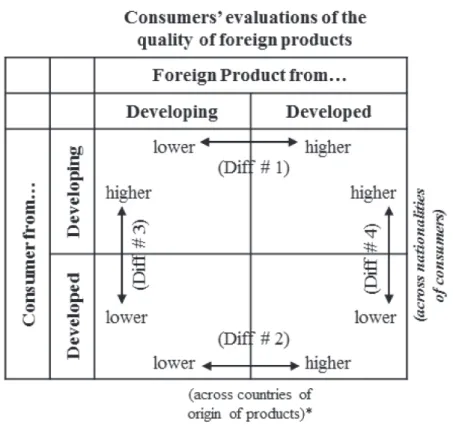
In a similar vein, prior research has indicated that consumers (both from developed markets as well as from developing countries) may present prejudice against products originated from less developed countries (cf. Good, & Huddleston, 1995; Javalgi, Cutler, & Winans, 2001) and will tend to perceive products originated from developed markets to be of higher quality when compared with those made in developing markets (Joiassen, & Harzing, 2008) – as represented by Dif # 1 and Dif # 2 in Figure 1. Additionally, such diferential preferences may be more intense for consumers from developed markets (Sharma, 2011), that is, Dif # 2 would be greater than Dif # 1.
Figure 1. Consumers’ evaluations of the quality of foreign products
Note: comparison with domestic products is not presented in this igure. Based on “Country of Origin Efects in Developed and Emerging Markets: Exploring the contrasting roles of materialism and value consciousness”, P. Sharma, 2011,
Journal of International Business Studies, 42, 285-306.
However, such state of affairs may be changing. Reduction of trade barriers, lower costs of transportation and easier access to information have (i) exposed consumers from developing markets to a greater variety of products (especially foreign), thus increasing their awareness and familiarity with these products (Usunier, 2006) and (ii) increased standardization of customer tastes and cosmopolitan behavior (Usunier, 2006). herefore, such consumers would have become more similar to their developed market counterparts. his is not to say that familiarity does not matter, but rather that there may be now less diference in the level of familiarity with foreign products across consumers from developed vs. from developing countries and, as a consequence, the potential moderating role of nationality may be less prominent.
Sharma (2011), nonetheless, contends that, “[d]espite growing evidence about diferences in the attitudes and behaviors of consumers in developing and [vs.] developed markets, there is still little research on the diferences in country of origin (CoO) efects on the evaluation, behavioral intentions (BIs), and actual purchase of imported goods” (p. 285).
his argument suggests that investigating the moderating role of nationality over the efect of CoI on quality evaluation is still warranted.
3
Study hypotheses
to the comparison between domestic vs. foreign products, might vary across consumers of diferent nationalities (e.g., from developed vs. developing markets), this study takes a diferent, seldom-researched, path: to investigate whether the nationality of the consumer moderates the efect of CoO (and, in particular, of facets of CoI) on consumers’ responses (speciically, quality assessment) regarding comparisons of foreign products from two diferent countries.
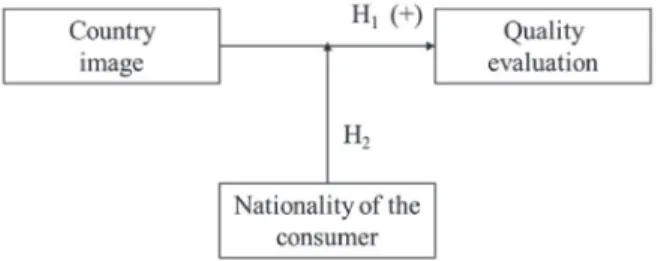
Our main argument concerns the moderating role of the nationality of the consumer. However, in order to properly verify whether a moderating impact is in place, it is desirable to also verify whether there is a direct impact. herefore, based on previous research that has generally suggested a positive impact of CoI on quality evaluation (cf. Peterson, & Jolibert, 1995; Verlegh, & Steenkamp, 1999), we present our irst hypothesis:
H1: here is a positive association between country image and quality evaluation of foreign products.
Regarding the moderating impact of nationality over the efect of CoI on product quality assessment, two apparently contradictory arguments can be posed.
First, there is the argument related to less familiarity on the part of consumers from developing markets with imported products (Johansson et al. 1985) and the expected higher relevance that extrinsic cues – including CoI – would gain when consumers are less familiar with products and ind it hard to “objectively” assess them (Cattin, Jolibert, & Lohnes, 1982; Dawar, & Parker, 1994; Han, 1989; Manrai et al., 1998; Rao & Monroe, 1989; Steenkamp, 1990). his argument suggests that, when comparing two otherwise similar foreign products, albeit originated from two diferent countries, a given level of diference in the perceptions of country images of those two countries would tend to lead to a higher diference in product quality evaluation in the case of consumers from developing markets
than in the case of consumers from developed markets.
Second, there is the argument that prejudice against products from developing countries (vs. those from developed countries) would be higher in the case of consumers from developed markets. his argument suggests that, when comparing two otherwise similar products, albeit originated from diferent foreign countries – one developed and the other developing – diferences in perceptions of country images would tend to lead to higher diferences in quality evaluation in the case of consumers from developed markets than in the case of consumers from developing markets. An alternative interpretation, however, would be that consumers from developed countries might evaluate less favorably the images of developing countries (than would consumers from other developing countries); and it would be this lower absolute perception of CoI (and, consequently, higher diference in the comparison of CoI of the two foreign countries) that would lead a consumer from a developed country to indicate lower product quality assessments for products from less developed markets. Note that this argument in fact means that CoI would mediate the impact of nationality of the consumer on product quality evaluation; it does not, however, relate to our main argument that nationality would moderate the impact of CoI on quality evaluation.
Thus, considering basically the first argument, and drawing from Hsieh’s (2004) empirical results, we present our second hypothesis:
H2: he efect of country image on quality evaluation of foreign products is stronger for consumers from developing markets than for consumers from developed markets
Figure 2. celure 1 - conceptula Conceptual Model
Source: Based on “An Investigation of Country-of-Origen Efect Using Correspondence Analysis: A cross-national context”, M.-H. Hsieh, 2004, International Journal of Market Research, 46, 267-295.
It is interesting to compare our hypotheses with those advanced by Sharma (2011). We argue that the magnitude of the efect of CoI is higher for consumers from developing markets vs. for consumers from developed markets. On the other hand, Sharma (2011) posited, and found empirical support for the argument, that (a) consumers in developing markets – compared with consumers from developed markets – would express more favorable product evaluations (in terms of quality, performance and value for money) for products originated from developed markets; and (b) consumers in developed markets – compared with consumers from developing markets – would express less favorable product evaluations for products originated from developing markets. However, these arguments rest on the assumption that there is variation, across nationalities of the consumers, in the perception of country images and, as a consequence, on absolute value of consumers’ preferences.
Our argument, on the other hand, is not about an absolute comparison of quality evaluation for products originated from developed vs. developing markets by consumers from developed vs. developing markets. We argue that there is an association between diferences in CoI perceptions (comparing two foreign countries of origin) and diferences in quality evaluation of respective foreign products; we also argue that diferences in the images between two countries-of-origin would afect more intensely the comparative quality evaluations given by consumers from a developing market than those
expressed by consumers from a developed market. It is also interesting to compare our arguments with those of Amine and Shin (2002), who argue that the “CoO efects are not absolute for a given country” (p.45). heir reasoning to explain variations in the efect of CoO, however, is not based on the argumentation about level of development of the consumer’s country, but rather based on proximity/distance (geographical or cultural) between the country of the product and the country of the consumer. hey argue that consumers from a certain nationality may have a given image about a given foreign country and that there would be variations in the (absolute) image of a country across consumers of diferent nationalities (“perceptions of country-of-origin will vary by nationality of respondent [consumer]”, p. 47) and that, as a consequence, consumers’ responses would vary across nationalities (“[w]illingness to buy products bearing a given CoO label will vary by nationality of respondent [consumer]”, p. 47). While Amine and Shin (2002) only argue that there would be diferences across nationalities of consumers in their assessment of (foreign) country images, they do not, however, estimate the size of the association between diferences in perceptions of CoI and diferences in quality assessments of foreign products; nor do they test whether this association would vary across nationalities of consumers, as we do in this study.
4
Methods
here are three main constructs in this study: country image (of the country-of-origin of the products), quality evaluation (of foreign product) and nationality (of the consumer), and three contextual critical choices: type of product and country-of-origin of the product and nationality of the consumers.
4.1
Type of product
& Machleit, 1989; Han, & Terpstra, 1998; Johansson, 1989; Kaynak, & Cavusgil, 1983; Maheswaran, 1994; Manrai et al., 1998; Witt, & Rao, 1992). To keep our argument simple and in order to not introduce an additional source of variation in the data, we decided to focus on a single product type (electrical home appliances) as an example of a broader class of industrialized utilitarian products.
4.2 1
Country image
Roth and Diamantopoulos (2009) contended that country-of-origin (CoO) and, in particular, country image (CoI) are rather complex constructs – composed of several diferent types of information and perceptions – and that CoI would be better understood if one unpacked its constituent parts. heir suggestion is to consider two main “dimensions” of the construct: cognitions (informational beliefs about the characteristics of the country and its people, society, environment etc.) and afections (feelings and emotions about a country).
Previous research (Ittersum, Candel, & Meulenberg, 2003; Javalgi, Thomas, & Rao, 1992; Kempf, 1999; Roth, & Diamantopoulos, 2009; Verlegh, 2001; Wang, Barnes, & Ahn, 2012) suggests that diferent aspects of CoI (e.g. cognitions vs. afections) might bear diferent inluences on consumers’ attitudes and responses to foreign products. We contend that diferences in the magnitude of the efect of CoO would be better understood if one disentangles the distinct dimensions of CoI.
Given our choice of a single class of product and the particular illustrative product – electrical home appliances – which is acquired for utilitarian (not hedonic) reasons, we believe that the afective component of CoI will bear little inluence on the consumers’ evaluation of that type of product. herefore, we operationalized country image only in terms of the cognitive component, a decision that has the advantage of a simpler explanatory model.
here are, nonetheless, several aspects of cognitions about a country, such as degree of economic development, degree of technological advancement, political regime and level of political maturity, legal systems, historical events, demographic and social traits, culture and traditions, geography, climate, and also characteristics of its people (e.g., competence, creativity, living standards and technical qualiications), among others. he aspects that we believe could afect more the quality assessment of electrical home appliances are those related to technological advancement and the skills of the workers of the producing country. In this study, we chose to focus specifically on the human aspects of cognitions.
Several indicators can be found for human aspects, for example, educational level, whether people are hardworking, creative, friendly or pleasant, technical skill level of the workforce (Parameswaran, & Yaprak, 1987), characteristics related to kindness and reliability (Papadopoulos, Heslop, & Bamossy, 1994), competence and creativity (Verlegh, 2001), hardworking spirit and ethics (Heslop, Papadopoulos, Dowdles, Wall, & Compeau, 2004).
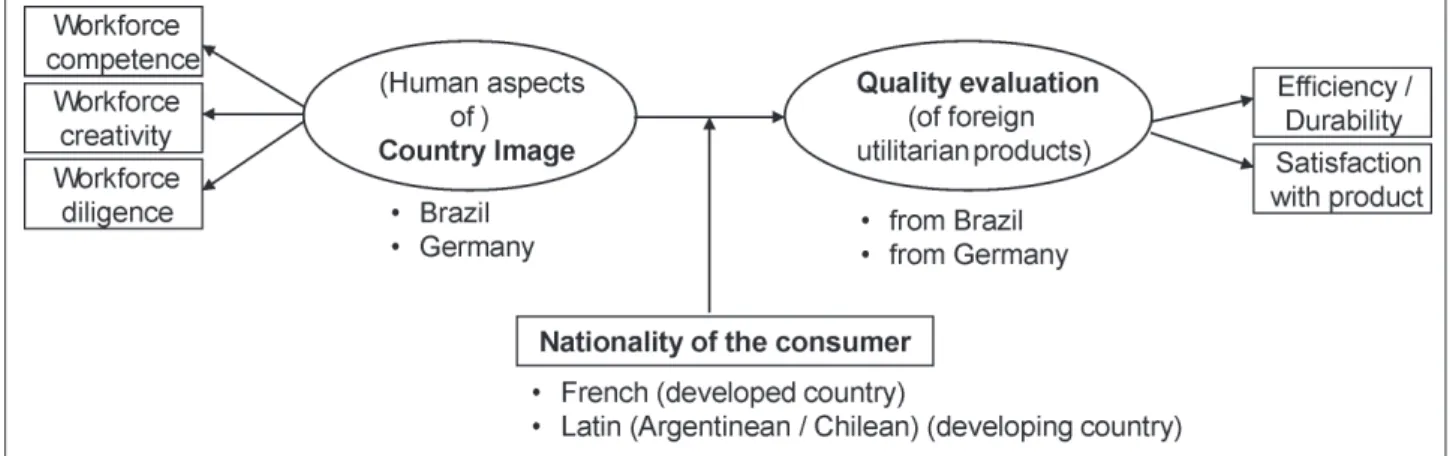
We specifically chose three indicators that would be expected to inluence the quality of utilitarian products: workforce competence, workforce creativity, and workforce diligence.
4.3
Products’ countries-of-origin
We decided to choose two countries-of-origin (of products) which would (expectedly) be rather diferent in terms of cognitions (human aspects). he two focal countries-of-origin chosen were Brazil and Germany. Thus, our study compares products – one from a developed and another from a developing country.
4.4
Quality evaluation as the dependent
variable
he diferent reactions of consumers to foreign products might include quality evaluation, willingness to buy, purchase intention, attitude towards the product, etc.
It is important to distinguish the impact of CoI or of CoO on quality assessment vs. the impact on willingness to buy / purchase intention. While the latter may be subject to inluence from several potential determinants (e.g., price, ethnocentric concerns and related perceived consequences of buying foreign products), quality assessment, on the other hand, would seem to be less subject to such external inluences. herefore, we chose quality evaluation as the dependent variable for this study; the variable was operationalized by means of two items: eiciency / durability, and expected satisfaction with the product (if subsequently bought).
4.5
Consumers’ nationality
As for the nationality of consumers, it was important that they not show strong favorable or antagonistic predispositions towards those two countries of origin or to their products. In addition, it would be advisable to choose nations whose consumers are not too ethnocentric (if at all), at least regarding the particular class of product to be assessed or the particular countries-of-origin chosen. For reasons of personal
relationships of the researchers, we chose France (a developed country) and Argentina/Chile (pooled together to represent a developing country) to collect data. French consumers were acceptable since they would be expected not to show clear rejection or preference based on normative aspects of what is right or wrong, moral or immoral regarding the particular focal countries-of-origin of the products. Besides, French consumers are expected to have suicient experience with the particular types of product (although not necessarily from the particular countries-of-origin chosen for this study) and also are expected to have some preliminary (at least) idea about the cognitive aspects related to those countries, so that they will be able to provide answers about their perceptions of those countriesoforigin. he same arguments apply to the selection of consumers from Argentina/Chile. Since the samples obtained from Argentina / Chile were small, we decided to pool them together. his aggregation of samples is justiied from a cultural cluster perspective: Argentina and Chile were assigned to the same cultural cluster in three studies reviewed by Ronen and Shenkar (1985). Moreover, the two countries-of-origin (Brazil and Germany) and the two countries of nationality of consumers (France and pooled Argentina/Chile) were classiied in four diferent cultural clusters (Ronen & Shenkar, 1985).
he operational model of this study is illustrated in Figure 3.
4.6
Control variables
Since several variables have been argued to afect the impact of CoO, we employed the following controls in our study: age (Good, & Huddleston, 1995; Hsieh, Pan, & Setiono, 2004), gender (Bilkey, & Nes, 1982; Good, & Huddleston, 1995; Lawrence, Marr, & Prendergast, 1992), and level of formal education (Chao, & Rajendran, 1993).
4.7
Within-subjects vs. between-subjects
design
Following Verlegh and Steenkamp’s (1999) advice, we employed a within-subjects (vs. between-subjects) design. In this within-subjects design, we had each respondent provide information about CoI for the two countries of origin of the products (Brazil and Germany) and about their quality assessment of products respectively originated from those countries. Then we compared, across respondents, the association of diferences in CoI (as reported by each respondent) and diferences in quality assessment (as reported, respectively, by the same respondents). In the alternative between-subjects design, one would compare (absolute) answers of each respondent with answers of the other respondents on each of the two focal constructs (CoI and quality evaluation). When compared to a between-subjects design, the withinsubjects design has the advantage of reducing error variance associated with individual respondents’ diferences.
4.8
Mention of type of product vs.
physical products or verbal descriptions
We believe that if consumers are shown a real physical product or given a verbal description of it, they may employ other cues, besides CoI, when reporting attitudes towards the product. herefore, we chose to provide a mere mention of the category of product. Although this design decision may inadvertently inflate the effect of CoI, we were in fact interested not in the particular magnitude of the efect but rather
on whether such magnitude would vary across consumers from developed vs. developing countries. Indeed, it is better to avoid intrinsic cues, which might not be the same across the product, thereby, modifying the efect.
4.9
Data collection instrument
An online survey was used to collect data from consumers. he questionnaire was irst drafted in Portuguese (the native language of the researchers), tested in a pilot study with 10 Brazilian students and, after adjustments, translated into, and back translated from, French and Spanish by native speakers. Similar pre-tests were run with two French and two Spanish-speaking students. Seven-point semantic-diferential response scales operationalized the indicators of the country image and the quality evaluation constructs.
4.10
Sample
For reasons of convenience, respondents were recruited in a snowball fashion, starting from 35 French students and 10 Argentinean/Chilean (hereinafter, Latin American) students - who were taking courses in a Brazilian university - as well as the authors’ personal networks.
Table 1
Respondents’ proile
Gender Age Education
French Latin
American French
Latin
American French
Latin American Female 59.9% 67.7% 18 to 29 80.8% 67.7% High school or less 4.0% 0.0%
Male 40.1% 33.3% 30 to 39 7.9% 16.1% University degree (incomplete) 34.5% 16.1%
40 to 49 4.0% 8.1% University degree (complete) 23.2% 40.3%
50 to 59 5.7% 4.8% Post-graduation 38.4% 43.5% over 60 1.7% 3.2%
A l t h o u g h o u r s a m p l e m i g h t b e overpopulated with students, instead of general consumers, this fact does not seem to pose a threat to the validity of the study. Verlegh and Steenkamp (1999) argued that two counter-balancing efects would be in place. First, CoO efects are generally smaller for younger consumers and for consumers with a higher level of education (cf. Usunier, 2006); second, student samples comprise a more homogeneous set, thereby yielding larger efects because they have lower response variance due to individual diferences (cf. Sternthal, Tybout, and Calder, 1994). Verlegh and Steenkamp’s (1999) empirical indings corroborate these arguments. Furthermore, we were not interested in the absolute value of the CoI efect, per se, but rather in determining whether the magnitude of the efect of (diferences in) CoI would vary across consumers of diferent nationalities – so any potential upward bias of the CoO efect would be ofset by this “diferences” perspective.
4,11
Missing data treatment
Data was MCAR (missing completely at random, cf. Little, & Rubin, 1987), and we imputed missing data by the average of mean substitution, regression imputation and EM approach.
4.12
Assessment of common method bias
To safeguard against common method bias, we followed Podsakof, MacKenzie and Lee’s (2003) suggestions, such as assuring anonymity of the respondents and clear phrasing of the items.
We used the Harman’s single-factor test for the extent of common method bias. he questionnaire included several other items besides those used in this study (25 items overall). As common method bias does not relate to speciic questions but, rather, to the data collection instrument, all variables were used in Harman’s test. Four factors emerged with eigenvalues greater than 1, with the irst factor accounting for only 28% of total variance, which suggests that common method bias is unlikely to have been a major problem in this study. Furthermore, our main hypothesis is about moderation efects, which are not likely to be conirmed due to common method variance (Siemsen, Roth, & Oliveira, 2010).
4.13
Model estimation
We employed Partial Least Squares Structural Equation Modeling (PLS-SEM) to estimate the measurement models and test the hypotheses, following recent papers in some of the most important Marketing journals (for a review, see Hair, Sarstedt, Ringle & Mena, 2012). PLS-SEM has more lexible assumptions than the traditional covariance-based SEM, and, in cases involving small samples and nonnormal indicators, may be more suitable (Cassel, Hackl, & Westlund, 1999).
5
Findings
Table 2
Observed correlations between operational indicators
Latin American sub-sample French sub-sample Full sample
2 3 4 5 2 3 4 5 2 3 4 5
1. Competence .548 .689 .384 .465 .427 .424 .566 .502 .455 .506 .513 .481 2. Creativity .421 .195 .177 .345 .394 .402 .355 .335 .317
3. Diligence .425 .486 .405 .324 .409 .378
4. Quality .849 .646 .713
5. Satisfaction 1.00 1.00 1.00
Tests of internal consistency, construct dimensionality and reliability were conducted. All loadings were statistically signiicant, but two were below the desirable .707 threshold, although still higher than the minimally acceptable .50
threshold (Table 3). Composite reliability was .79 and .91 (respectively) and AVE was .87 and .96 (respectively), which indicates adequate psychometric properties of the measurement models.
Table 3
Estimation of Measurement (outer) Model Parameters
French Latin
American
p-value for diference
Construct AVE Composite
reliability Indicators Loadings
CountryImage .87 .79
Competence .85*** .91*** .31 Creativity .72*** .66*** .41 Dedication .64*** .90*** .17 Quality
Assessment .96 .91
Eiciency / Durability .90*** .96*** .25 Satisfaction with Product .92*** .96*** .24
Measurement invariance across the two national samples was supported because it was not possible to reject the hypothesis of equality of weights across groups, using the combined probability test (Shipley, 2000; Nassif et al., 2009). his result implies that a single measurement model may be used for French and Latin American respondents.
he Hypotheses were tested in two steps. In the irst step, a model was estimated with data from the full sample (French and Latin American respondents), having Country Image and a set of control variables (gender, level of formal education, and age) as exogenous predictors.
Table 4
Estimation of Structural (inner) Model Parameters
Exogenous
variables Path coeicients
Coeicients diference (French – Latin Am.)
p-value of coeicients diference Full Sample French Latin American
Age .09 .01 .13 -.12 .27
Education -.02 -.01 -.06 .05 .41
CoI .48*** .56*** .43*** .13 .25
Gender .13 .04 .20 -.16 .24
6
Discussion
While several studies have investigated factors that would afect consumers’ preference for domestic vs. foreign products, we took the relatively under-researched topic of whether there would be diferences across consumers from developed vs. developing markets in the impact of country image on the evaluation of foreign products.
he objective of this study was to bring an incremental contribution to our understanding of the mechanisms by which the country-of-origin might inluence consumers’ evaluations of products, speciically, veriication of whether the nationality of the consumer moderates the relationship between country image and quality evaluation of foreign products.
In our literature review, we found only one study – Hsieh (2004) – that tested the moderating impact of nationality in a manner similar to that of the present study. Given Sharma’s (2011) plea for more research on diferences across consumers from developed vs. developing markets, our study is an attempt to incrementally ill this gap.
If such moderating impact does in fact exist, then, drawing on recommendations advanced by Amine and Shin (2002), managers should not only consider “where to produce, but also where to target goods manufactured at that location, in order to elicit the most favorable CoO efect in the mind of the target consumer” (p. 46).
Since very few studies have used Brazil as country-of-origin (only 12 in Unisier’s (2006) review of 583 studies and none in Roth & Diamantopoulos’ (2009) review), this study contributes by bringing this additional context.
Our signiicant indings about the positive effect of CoI on quality evaluations are in agreement with previous studies in general.
Häubl (1996) also found virtually no statistically signiicant diferences in CoO efects across consumers from two developed countries (Germany and France), but they did not investigate the impact of CoO across consumers of developed vs. developing markets.
We now discuss some possible reasons for the non-signiicant moderator efect. First, the sample (in particular, the Latin American) was reasonably small, so the statistical power of the test to detect a relationship (if it truly exists in the population) was small (the probability to detect a diference of medium efect size is approximately 56%).
Additionally, it may be possible that Argentineans and Chileans have gained suicient experience with foreign products over the years after trade liberalization – so their diferences relative to consumers from more developed countries may have diminished. his argument may be especially valid for Chilean consumers, whose country opened its economy earlier. Also, Argentinean consumers may have enough experience with Brazilian products – Argentina has long been among the three largest commercial partners of Brazil –, so that they do not need to resort to CoI in order to judge the quality of Brazilian appliances.
7
Conclusions
This study investigated whether the strength of the effect of CoI on consumers’ quality assessment of foreign products varies across consumers from more developed vs. less developed countries. Given the scarcity of studies on CoI efects that have used a developing country context (both as the source of products and speciically as the birthplace of consumers), this study helps to address this gap.
Future studies may move a step beyond and untangle what would account for the moderating effect of the nationality of the consumer (as has done, for example, Sharma (2011), who considered the influence of consumer’s materialism, ethnocentrism and value consciousness on the relationship of CoO with
product evaluation and behavioral intentions). he non-signiicance of the moderator efect found in this study should not be taken to mean that the nationality of the consumer does not modify the impact of CoI or does not have a direct impact on quality evaluation. In terms of “variety” of nationalities tested, this was a two-case (French and Argentinean/Chilean nationalities) study. hus, it should be clear that these results may be speciic to this particular two-case convenience sample. It is possible that Argentinean/Chilean consumers are sufficiently similar to French consumers in terms of the information they use to assess foreign products, since these countries have well-educated, Westernized, cosmopolitan elite classes who may be quite familiar with foreign products and brands. he argument that developing country consumers would tend to have less familiarity with foreign products may have become outdated (especially in the Chilean case), given globalization and trade openness trends. Therefore, although easier to operationalize, nationality (as a representation of level of country development) may not be well associated with familiarity with foreign products.
Several other differences between consumers from developed vs. developing markets – in terms of demographic, socio-economic, psychographic aspects – may also be associated with diferences in their attitudes and behaviors towards foreign products (Batra, 1997; Cui & Liu, 2001; Han and Terpstra, 1988; Sharma, 2011). Since the present study controlled for some, but not all, of these diferences, the impact of (diferences in) CoI may have been inadvertently inlated or delated (cf. Bilkey and Nes’ (1982) argumentation).
(and the reverse might be true for Argentineans/ Chileans), which may have somehow modiied their opinions beyond the mere impact of CoI. Besides, at the country level, this is a two-case study (France and pooled Argentina/Chile). At the product level, this is a single-case study (electrical home appliances); although the use of a single product minimized confounding efects, it cautions against immediate generalization of indings – so results should be regarded as merely indicative.
Some recommendations and suggestions for future studies can be advanced. For example, investigating cross-country differences in the magnitude of the efect of CoI on consumers’ assessment, attitude and behavior towards foreign products may shed light on the CoO phenomenon; moreover, researchers may also consider the existence of possible differences across sub-national cultures. As suggested by Laroche et al. (2003, p.244), “Although nations have been used as a proxy for culture (probably because it is more convenient), cultures and subcultures are not bound by national or other borders.”
Future studies can take up the investigation of whether the efects of CoI dimensions (e.g., cognitions and afections) would be statistically diferent across consumers of diferent countries. Employment of diferent combinations of level of country development (speciically, developed (origin) vs. developed (destination), developed vs. developing, developing vs. developed, and developing vs. developing), as argued by Bilkey and Nes (1982) and by Verlegh and Steenkamp (1999), would be interesting. Future studies may continue the investigation about whether the size of the efect of CoO (or the speciic efects of CoI dimensions) may vary across consumers from developed vs. developing countries, and whether the magnitude of the efect may vary for products from developed vs. developing markets. In order to better isolate the impact of particular CoI aspects on quality (or purchase intention) of particular types of products, it is recommended to choose countries (seller and buyer) that do not
present signs of high mutual rivalry or are seen as a threat to one another: such feelings may relect impacts that go beyond the “neutral” judgment of CoI aspects.
References
Amine, L. & Shin, S.-H. (2002). A comparison of consumer nationality as a determinant of COO preferences. Multinational Business Review, 10(1), 45-53.
Batra, R. (1997). Marketing issues and challenges in transitional economies. Journal of International Marketing, 5(4), 95-114.
Batra, R., Ramaswamy, V., Alden, D. L., Steenkamp, J.-E., & Ramachander, S. (2000). Efects of brand local and nonlocal origin on consumer attitudes in developing countries. Journal of Consumer Psychology, 9(2), 83-5.
Bilkey, W., & Nes, E. (1982). Country-of-origin efects on product evaluations. Journal International Business Studies, 8(1), 89-91.
Cassel, C., Hackl, P., & Westlund, A. (1999). Robustness of partial least-squares method for estimating latent variable quality structures. Journal of Applied Statistics, 26(4), 435-446.
Cattin, P., Jolibert, A., & Lohnes, C. (1982). A cross-cultural study of «made in» concepts. Journal of International Business Studies, 13(3), 131-141.
Chao P., & Rajendran, K. N. (1993). Consumer profiles and perceptions: Country-of-origin efects. International Marketing Review, 10(2), 22-39.
Cui, G., & Liu, Q. (2001). Emerging market segments in a transitional economy: A study of urban consumers in China. Journal of International Marketing, 9(1), 84-106.
reputation as signals of product quality. Journal of Marketing, 58, 81-95.
Eroglu, S., & Machleit, K. (1989). Efects of individual and product-specific variables on utilising country of origin as a product quality cue. International Marketing Review, 6(6), 27-41.
Ettenson, R. (1993). Brand name and country of origin efects in the emerging market economies of Russia, Poland and Hungary. International Marketing Review, 10(5), 14-36.
Good, L. & Huddleston, P. (1995). Ethnocentrism of polish and Russian consumers: are feelings and intentions related? International Marketing Review, 12(5), 35-48.
Gurhan-Canli, Z., & Maheswaran, D. (2000). Cultural variations in country of origin efects. Journal of Marketing Research, 37(3), 309-317.
Hair, J., Jr, Black, W., Babin, B., & Anderson, R. (2005). Multivariate data analysis (6th ed.). Upper Saddle River, NJ: Prentice Hall.
Hair, J., Sarstedt, M., Ringle, C. & Mena, J. (2012). An assessment of the use of partial least squares structural equation modeling in marketing research. Journal of the Academy of Marketing Science, 40(3), 414-433.
Han, C. (1989). Country image: halo or summary construct? Journal Marketing Research, 26(2), 222-229.
Han, C., & Terpstra, V. (1988). Country of origin efects for uni-national and bi-national products. Journal of International Business Studies, 19(2), 235-255.
Häubl, G. (1996). A cross-national investigation of the efects of country of origin and brand name on the evaluation of a new car. International Marketing Review, 13(5), 76-97.
Heslop L., Papadopoulos, N., Dowdles, M., Wall, M., & Compeau, D. (2004). Who controls the purse strings: a study of consumers’ and
retail buyers’ reactions in an America’s FTA environment. Journal Business Research, 57(10), 1177-1188.
Hsieh, M.-H. (2004). An investigation of country-of-origin efect using correspondence analysis: A cross-national context. International Journal of Market Research, 46(3), 267-295.
Hsieh, M.-H., Pan, S.-L., & Setiono, R. (2004). Product-, corporate-, and country image dimensions and purchase behavior: A multicountry analysis. Journal of the Academy of Marketing Science. 32(3), 251-270.
Ittersum, K., Candel, M., & Meulenberg, M. (2003). he inluence of the image of a product‘s region of origin on product evaluation. Journal of Business Research, 56(3), 215-226.
Javalgi, R., Cutler, B., & Winans, W. (2001). At your swervice! Does country of origin research apply to services? Journal of Services Marketing, 15(7), 565582.
Javalgi R., homas E., & Rao S. (1992). US pleasure travellers’ perceptions of selected European destinations. European Journal of Marketing, 26(7), 45-64.
Johansson, J. (1989). Determinants and efects of the use of “made-in” labels. International Marketing Review, 6(1), 47-58.
Johansson, J., Douglas, S., & Nonaka, I. (1985). Assessing the impact of country of origin on product evaluations: a new methodological perspective. Journal of Marketing Research, 22(4), 388-96.
Joiassen, A., & Harzing, A.-W. (2008). Descending from the Ivory tower: relections on the relevance and future of country-of-origin research. European Management Review, 5(4), 264-270.
involvement. International Marketing Review, 25(4), 423-440.
Kaynak, E., & Cavusgil, S. (1983). Consumer Attitudes towards products of foreign origin: Do they vary across product classes? International Journal of Advertising, 2(2), 147-157.
Kempf, D. (1999). Attitude formation from product trial: Distinct roles of cognition and afect for hedonic and functional products. Psychology Marketing, 16(1), 35–50.
Laroche, M., Papadopoulos, N., Heslop, L., & Bergeron, J. (2003). Efects of subcultural diferences on country and product evaluations. Journal of Consumer Behaviour, 2(3), 232-247.
Lawrence, C., Marr, N., & Prendergast, G. (1992). A country-of-origin stereotyping: a case study in the New Zealand motor vehicle industry. European Journal of Marketing, 26(3), 37-51.
Little, R., & Rubin, D. (1987). Statistical analysis with missing data. New York: John Wiley & Sons.
Maheswaran, D. (1994). Country of origin as a stereotype: Efects of consumer expertise and attribute strength on prodcut evaluations. Journal of Consumer Reserch, 21(2), 354-365.
Manrai, L., Lascu, D.-N., & Manrai, A. (1998). Interactive efects of country of origin and product category on product evaluations. International Business Review, 7(6), 591-615.
Nassif, H., Woods, R., Burnside, E., Ayvaci, M., Shavlik, J., & Page, D. (2009). Information extraction for clinical data mining: A mammography case study. Proceedings of the IEEE International Conference on Data Mining Workshops (pp. 37-42). IEEE Computer Society, Washington.
Okechuku, C., & Onyemah, V. (1999). Nigerian consumer attitudes toward foreign and domestic products. Journal of International Business Studies, 30(3), 611-622.
Papadopoulos, N., Heslop, L., & Bamossy, G. (1994). An international comparative analysis of consumer attitudes of consumer attitudes toward Canada and Canadian products, Canadian Journal of Administrative Sciences, 11(3), 224-239.
Parameswaran R., & Yaprak A. (1987). A cross-national comparison of consumer research measures. Journal of International Business Studies, 18(1), 35-49.
Peterson, R., & Jolibert, J. (1995). Meta-analysis of country-of-origin efects. Journal of International Business Studies, 26(4), 883-900.
Podsakof, P., MacKenzie, S., Lee, J., & Podsakof, N. (2003). Common method biases in behavioural research: A critical review of the literature and recommended remedies. Journal of Applied Psychology, 88(5), 879-903.
Rao, A., & Monroe, K. (1989). he efect of price, brand name, and store name on buyers on perceptions of product quality: An integrative review. Journal of Marketing Research, 26(3), 351-357.
Reardon, J., Miller, C., Vida, I., & Kim, I. (2005). The effects of ethnocentrism and economic development on the formation of brand and ad attitudes in transitional economies. European Journal of Marketing, 39(7), 737-754.
Ronen, S., & Shenkar, O. (1985). Clustering countries on attitudinal dimensions: A review and synthesis. Academy of Management Review, 10(3), 435-454.
Roth, K., & Diamantopoulos, A. (2009). Advancing the country image construct. Journal of Business Research, 62(7), 726-740.
Sharma, S., Shimp, T., & Shin, J. (1995). Consumer ethnocentrism: A test of antecedents and moderators. Journal of the Academy of Marketing Science, 23(1), 26-37.
Shipley, B. (2000). Cause and correlation in biology: A user’s guide to path analysis, structural equations and causal inference. New York: Cambridge University Press.
Siemsen, E., Roth, A., & Oliveira, Pedro. (2010). Common method bias in regression models with linear, quadratic, and interaction efects. Organizational research methods 13(3), 456-476.
Steenkamp, J.-E. (1990). Conceptual model of the quality perception process. Journal of Business Research, 21(4), 309-333.
Sternthal, B., Tybout, A., & Calder, B. (1994). Experimental design: Generalisation and theoretical explanation. In R. Bagozzi (Ed.), Principles of marketing research (Chap. 6, pp. 195-223). Oxford: Basil Blackwell.
Usunier, J. (2006). Relevance in business research: he case of country-of-origin research in marketing. European Management Review, 3(1), 60-73.
Verlegh P. (2001). Country-of-origin efects on consumer product evaluations (Phd Dissertation). Wageningen University, Wageningen, The Netherlands.
Verlegh, P., & Steenkamp J. (1999). A review and meta-analysis of country-of-origin research. Journal of Economic Psychology, 20(5), 521-546.
Wang, C., & Chen, Z. (2004). Consumer ethnocentrism and willingness to buy domestic products in a developing country setting: Testing moderating efect. Journal of Consumer Marketing, 21(6), 391-400.
Wang, C. L., Li, D., Barnes, B. R., & Ahn, J. (2012). Country image, product image and consumer purchase intention: Evidence from an emerging economy. International Business Review, 21(6), 1041-1051.
Wang, X., & Yang, Z. (2008). Does Country-of-origin matter in the relationship between brand personality and purchase intention in emerging economies? Evidence from China’s auto industry. International Marketing Review, 24(4), 458-474.
Watson, J., & Wright, K. (2000). Consumer ethnocentrism and attitudes towards domestic and foreign products. European Journal of Marketing, 34(9/10), 1149-1166
Witt, J., & Rao, C. (1992) he impact of global sourcing on consumers: Country-of-origin efects on perceived risk. Journal of Global Marketing, 6(3), 105-128.
Supporting Agencies:
he second author acknowledges the support received from FAPERJ (Fundação de Amparo à Pesquisa do Estado do Rio de Janeiro, “Jovem Cientista do Nosso Estado – 2012” Project, grant nr. E-26/103.004/2012)
About the Authors:
1. Camila Carvalho Costa, MSc in Business Administration from Pontiical Catholic University of Rio de Janeiro. E-mail: [email protected]
2. Jorge Maneol Teixeira Carneiro, PhD in Business Administration from the Federal University of Rio de Janeiro. E-mail: [email protected]
Contribution of each Authors:
Contribution Camila Costa Jorge Carneiro Rafael Goldszmidt
1. Deinition of research problem √ √
2. Development of hypotheses or research questions ( empirical studies ) √ √ 3. Development of theoretical propositions ( theoretical Work )
4. heoretical foundation/Literature review √ √ √
5. Deinition of methodological procedures √ √ √
6. Data collection √ √
7. Statistical analysis √ √ √
8. Analysis and interpretation of data √ √ √
9. Critical revision of the manuscript √ √ √
10. Manuscript Writing √ √