Printed in Brazil - ©2005 Sociedade Brasileira de Química 0103 - 5053 $6.00+0.00
Article
* e-mail: [email protected]
The Role of Nonelectrostatic Solvation to Chemical Reactions in Liquid Phase
Josefredo R. Pliego Jr.
Departamento de Química, Universidade Federal de Santa Catarina, 88040-900 Florianópolis - SC, Brazil
A importância de cada termo de solvatação não eletrostática, mais especificamente, formação de cavidade e dispersão-repulsão, para reações químicas em fase líquida foi analisada tomando como exemplo a reação de uma e duas moléculas de H2O com CCl2. O cálculo do efeito do solvente para estas reações em solução aquosa, via perturbação de energia livre, está disponível na literatura e foi usado para comparação. Neste trabalho, utilizamos a fórmula de Pierotti e o método de Claverie-Pierotti para computar o valor da contribuição de formação de cavidade, enquanto que o termo de dispersão-repulsão foi calculado pelo método de Floris e Tomasi. Nossos resultados mostram que o termo de cavidade é o mais importante, sendo que o termo de dispersão-repulsão corresponde de 25% a 35% do termo de cavidade. Além disso, observamos que a aplicação direta da fórmula de Pierotti para a energia livre de cavidade é mais acurada do que o método de Claverie-Pierotti para este sistema.
The relative importance of cavity formation and dispersion-repulsion contributions to the activation free energy of chemical reactions in liquid phase is discussed, taken as example the reaction of one and two H2O molecules with CCl2 in aqueous solution. The solvent effect on these systems was investigated by free energy perturbation in previous publications. In the present report, were used the Pierotti scaled particle theory and the Claverie-Pierotti method to compute the free energy of cavity formation, while the dispersion-repulsion contribution was determined by the Floris and Tomasi method. We have found that the cavity term is the most important nonelectrostatic contribution of the solvent to the activation free energy, while the dispersion-repulsion contribution accounts for 25% to 35% of that term. In addition, we have observed that the direct Pierotti formula is more accurate than the Claverie-Pierotti method for the present system.
Keywords:solvent effect, continuum model, reaction kinetics
Introduction
The important role of the solvent on the outcome and kinetics of chemical reactions is well established.1-14 Usually,
the electrostatic solute-solvent interaction is the most important contribution of the solvent to the free energy of solvation ('Gel), mainly in polar media and in situations where ionic species are involved. The nonelectrostatic contribution ('Gnel) is regarded as playing a minor role, but it is important for a fine turning of the solvation process modeling. This contribution can be separated in two terms: free energy of cavity formation ('Gcav) and dispersion-repulsion contribution ('Gdr). Thus, the full solvation free energy of a molecule can be written as:
'G*
solv = 'Gel + 'Gnel (1)
'Gnel = 'Gcav + 'Gdr (2)
An important question to be analyzed is the level of importance of each nonelectrostatic term. It is known that both nonelectrostatic contributions can be relatively large and have opposite signals, leading to a small 'Gnel. However, for a chemical process in solution, the variation of the solvation free energy (''G*
solv, from the reactants to
transition state is formed, a few solvent molecules are withdrawn from close contact with the reactants and, as a consequence, we should expect a small positive contribution of the dispersion-repulsion term to the activation free energy. If we imagine a limit situation, where the reactants are similar molecules and the transition state corresponds to the full overlap between the reactants, the
''Gdr term is zero while the ''Gcav term drops to 1/2 of the initial value. Thus, in this special case the cavity term is by far the most important. In general situations, involving reactions of small molecules, we are lead to think that the cavity term should play the major role.
The importance of the free energy of cavity formation for chemical reactions in liquid phase was recognized almost thirty years ago by Chandler.15 This author has used
scaled particle theory16 to explain the increase by a factor
of 103in the dimerization equilibrium constant of NO 2 in
liquid phase in relation to gas-phase. He has found that the cavity contribution was able to explain the experimental observations, not well understood at that time. Some years later, Ladanyi and Hynes have investigated the cavity (caging) effect on the reaction kinetics of hydrogen transfer reaction between CH4 and CH3 in a inert solvent.17 They have concluded that this
effect could increase the reaction rate by a factor of 102.
The concept of free energy of cavity formation is nowadays widely accepted, and there are many recent works dealing with the development of efficient procedures to accurately compute this contribution.18-23
In this report, we will present a study of the relative importance of 'Gcav and 'Gdr for two reaction systems where results of free energy perturbation calculation are available.24,25 Our calculations were done using both the
Claverie-Pierotti method16,21 and the Pierotti formula16 to
evaluate the cavity formation contribution and the Floris and Tomasi approximation26-28 for the dispersion-repulsion
terms. A comparison with free energy perturbation calculations allows us to verify the accuracy of the cavity term alone for the nonelectrostatic contribution to the activation free energy.
Theoretical Calculations
We have investigated the solvent contribution to the activation free energy of the reaction of CCl2 with one (TS1) and two (TS2) water molecules in aqueous solution. A study of the solvent effect on these systems by free energy perturbation is available from the literature24,25 and we have
adopted the structures optimized at MP2/DZP level of ab initio theory of those reports. Figure 1 shows the transition states TS1 and TS2.
The cavity term was calculated using the Claverie-Pierotti formula:
'Gcav = 6fi'Gcav(Ri) (3)
In this model, the solute is considered as composed of spherical atoms of radii Ri and fi is the fraction of the surface area of the atom i that is exposed to the solvent. Each
'Gcav(Ri) term is calculated by the Pierotti formula based on the scaled particle theory and is related to the radii of the atom i, the density number of the solvent (0.0335 molecules/Å3 for water), the radius of the solvent (1.385 Å
for water), temperature and pressure. The explicit form of these terms is available in the literature.16 Although Floris
et al.29 have shown that this method is less accurate than
the direct Pierotti approach, it has the advantage of size consistency.20 The radii of the atoms used to determined
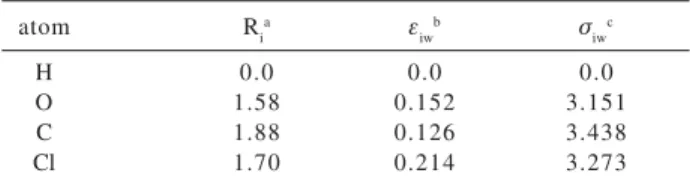
the surface area were obtained from the equation Ri = Vii/2, whereVii is the OPLS parameter30-32 of atom i used in the
Monte Carlo simulations (see Table 1).
We have also calculated the 'Gcav term through the direct Pierotti scaled particle theory.16 In this procedure,
we compute the total surface area of the molecule, considered as interlocking spheres of radii Ri (Table 1)
Figure 1. Transition states for n H2O + CCl2 reaction.
Table 1. Atomic parameters used for the calculations
atom Ria H
iwb Viwc
H 0.0 0.0 0.0
O 1.58 0.152 3.151
C 1.88 0.126 3.438
Cl 1.70 0.214 3.273
and determine the sphere that has the same surface area. In the next step, the radii of this effective sphere is used in the calculation of the 'Gcav using the Pierotti formula.16
The dispersion-repulsion term was calculated by the Floris and Tomasi method (uniform approximation)26-28
using the Lennard-Jones parameters Hiw and Viw for the
atoms C, O and Cl, the same parameters used in the free energy perturbation. For hydrogen, no Lennard-Jones parameters were assigned in agreement with the liquid simulation study. All used parameters used are in Table 1 and the calculations were done with the available routines of the polarizable continuum model (PCM)33 implemented
in the Gamess program.34
We will refer the approximated calculation of the solvation free energy as PCM-CP when using a combination of cavity formation from the Claverie-Pierotti method plus dispersion-repulsion and PCM-P for the case of using the Pierotti formula instead of the Claverie-Pierotti. The Monte Carlo Free Energy Perturbation24,25 calculations
will be named as FEP. For comparison, we have also computed the electrostatic contribution to the activation barrier by the PCM model using the default atomic radii in Gamess program and a scale factor of 1.10 instead of the usual 1.20 for water. Our choice is based on the study of Luque et al.35 who have shown that this scale factor is more adequate for solvation of ions. Although we are treating neutral molecules, we think that radii optimized for ions are more realistic because the sensitivity of the solvation free energy in relation to the cavity size is considerable in the case of ionic species.
Results and Discussion
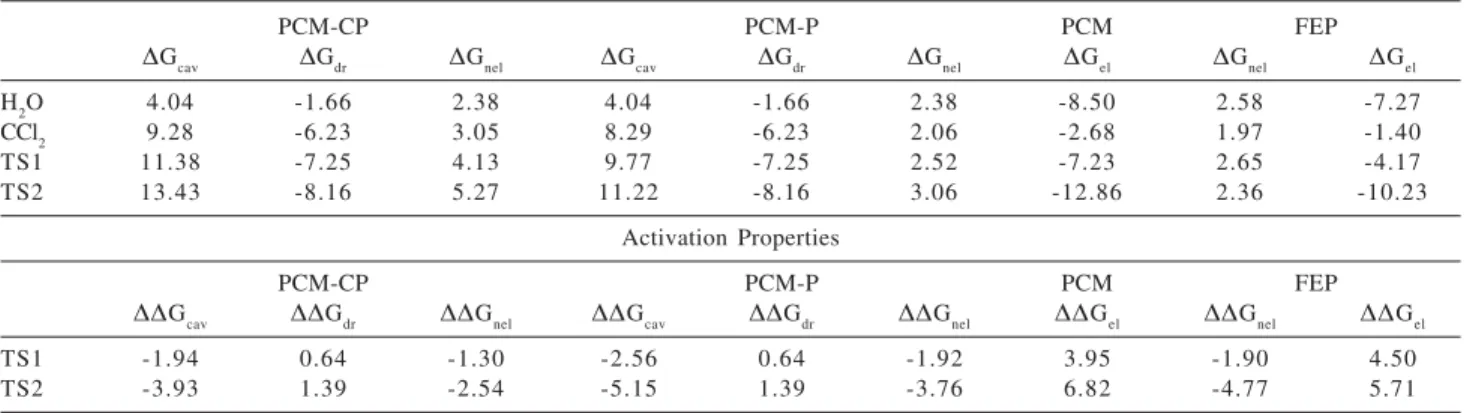
The calculated solvation free energy, separated to each contribution, is presented in Table 2. The good agreement between the 'Gnel obtained through PCM-CP and FEP calculations for H2O is observed, but the deviation increases for CCl2 ,TS1 and TS2. This overestimation increases with the number of atoms and it is probably due to the 'Gcav calculated by the Claverie-Pierotti method. When we compare the 'Gnel calculated by the PCM-P method for H2O, CCl2, TS1 and TS2, we notice a much better agreement between FEP and PCM-P. This finding supports the observation made by Floris et al.29 on a better
performance of the Pierotti method against the Claverie-Pierotti approach.
Nevertheless, the most important test is the prediction of''Gnel. In this case, the agreement is more reasonable. The PCM-CP method has a deviation of 0.6 kcal mol-1 in
the case of TS1 and 2.2 kcal mol-1 in the case of TS2. When
only the ''Gcav term is compared with the ''Gnel
calculated by FEP, the agreement is considerably improved. The deviations are –0.04 and 0.84 kcal mol-1, respectively.
These results suggest the tendency of the PCM-CP method to underestimate the absolute value of the ''Gnel contribution, probably due the flaw of the Claverie-Pierotti
''Gcav term. As a consequence, including only the ''Gcav contribution leads to more accurate results.
In the case of the PCM-P method, we can notice an excellent agreement with the FEP values for the reaction through TS1, whereas for TS2 the error of the PCM-P method reaches 1.0 kcal mol-1. Considering only the cavity
contribution, the deviation is –0.66 kcal mol-1 for TS1 and
–0.38 kcal mol-1 for TS2. Again, using only the ''G cav
term leads to good results. This observation corroborates our argument that the cavity formation term would be able to provide a reliable description of the ''Gnel contribution for reactions involving small molecules.
Testing the accuracy of the PCM method for nonelectrostatic solvation is an important issue. However, our main objective is to verify the relative importance of cavity formation and dispersion-repulsion contributions to activation properties. In other words, how much each term contributes to ''Gnel. For the reaction through TS1, the''Gcav term is negative, indicating a decrease of the surface area of the transition state with respect to the reactants. As expected, the ''Gdr term has opposite signal. The same observation can be made for the reaction through TS2. The most interesting point to note is the absolute value of each term for both PCM-CP and PCM-P methods. The ''Gcav dominates the ''Gnel contribution and we can observe that the ''Gdr corresponds to ~35% (PCM-CP) and ~25% (PCM-P) of the ''Gcav. Another example was reported by Truong and Stefanovich.8 These authors
have theoretically studied the SN2 reaction Cl- + CH 3Cl in
aqueous solution and calculated the dispersion-repulsion and cavity formation terms contribution. Their results point out that the cavitation free energy is considerably more important than the dispersion-repulsion term. These results support the idea that the cavity formation is the most important nonelectrostatic term for chemical reactions involving small molecules in aqueous solution.
We have also computed the electrostatic contribution to the solvation free energy using the continuum model in order to make a comparison with the FEP results. The values of 'Gel obtained through PCM for the all species are somewhat more negative, but the ''Gel values are in much better agreement with the FEP results, with deviations of – 0.55 and 1.11 kcal mol-1 for TS1 and TS2, respectively.
Thus, the dielectric continuum solvation model provides a reliable prediction of the electrostatic solvation.
nonelectrostatic contributions, it is evident that for reactions involving neutral molecules, the nonelectrostatic solvation can be as important as the electrostatic one, and must be included for a quantitative prediction. In addition, for the case of ionic reactions, the electrostatic contribution is by far the most important term. But even in this situation, the nonelectrostatic solvation could be relevant in order to predict accurate activation barriers. Thus, the inclusion of this term is recommended.
Conclusions
The present study indicates that including both electrostatic and nonelectrostatic solvation terms for modeling chemical reactions in aqueous solution is very important in order to obtain accurate free energy barriers. In addition, our data suggest that for reactions of small molecules in aqueous solution, the following relevance order should be observed:
''Gel > ''Gcav > ''Gdr
Acknowledgments
The author thanks CNPq for support through the Profix program.
References
1. Reichardt, C.; Solvents and Solvent Effects in Organic Chemistry, VHC: Weinheim, Germany, 1988.
2. Pliego Jr., J. R.; Riveros, J. M.; J. Phys. Chem. A2004,108,
2520.
3. Pliego Jr., J. R.; Riveros, J. M.; Chem. Eur. J.2002,8, 1945.
4. Pliego Jr., J. R.; Riveros, J. M.; Chem. Eur. J.2001,7, 169. 5. Raugei, S.; Cardini, G.; Schettino, V.; J. Chem. Phys.2001,
114, 4089.
6. Re, S.; Morokuma, K.; J. Phys. Chem. A2001,105, 7185.
7. Yamataka, H.; Aida, M.; Chem. Phys. Lett.1998,289, 105. 8. Truong, T. N.; Stefanovich, E. V.; J. Phys. Chem.1995,99,
14700.
9. Evanseck, J. D.; Blake, J. F.; Jorgensen, W. L.; J. Am. Chem. Soc.1987,109, 2349.
10. Luque, F. J.; Curutchet, C.; Munoz-Muriedas, J.; Bidon-Chanal, A.; Soteras, I.; Morreale, A.; Gelpi, J. L.; Orozco, M.; Phys. Chem. Chem. Phys.2003,5, 3827.
11. Cramer, C. J.; Truhlar, D. G.; Chem. Rev.1999,99, 2161.
12. Tomasi, J.; Persico, M.; Chem. Rev.1994,94, 2027. 13. Kollman, P. A.; Chem. Rev.1993,93, 2395.
14. Longo, R. L.; Nunes, R. L.; Bieber, L. W.; J. Braz. Chem. Soc.
2001,12, 52.
15. Chandler, D.; Faraday Discuss.1978,66, 184. 16. Pierotti, R. A.; Chem. Rev.1976,76, 717.
17. Ladanyi, B. M.; Hynes, J. T.; J. Am. Chem. Soc.1986,108, 585.
18. Zacharias, M.; J. Phys. Chem. A2003,107, 3000.
19. Huang, D. M.; Geissler, P. L.; Chandler, D.; J. Phys. Chem. B
2001,105, 6704.
20. Colominas, C.; Luque, F. J.; Teixido, J.; Orozco, M.; Chem. Phys.1999,240, 253.
21. Langlet, J.; Claverie, P.; Caillet, J.; Pullman, A.; J. Phys. Chem.
1988,92, 1617.
22. Levy, R. M.; Zhang, L. Y.; Gallicchio, E.; Felts, A. K.; J. Am. Chem. Soc.2003,125, 9523.
23. Hofinger, S.; Zerbetto, F.; Chem. Eur. J.2003,9, 566.
24. Pliego Jr., J. R.; de Almeida, W. B.; J. Phys. Chem. A1999,
103, 3904.
25. Pliego Jr., J. R.; França, M. A.; de Almeida, W. B.; Chem. Phys. Lett.1998,285, 121.
26. Floris, F. M.; Tani, A.; Tomasi, J.; Chem. Phys.1993,169, 11.
27. Floris, F. M.; Tomasi, J.; Ahuir, J. L. P.; J. Comp. Chem.1991,
12, 784.
28. Floris, F.; Tomasi, J.; J. Comp. Chem.1989,10, 616. 29. Floris, F. M.; Selmi, M.; Tani, A.; Tomasi, J.; J. Chem. Phys.
1997,107, 6353.
Table 2. Solvation free energy of reactants and transition states and solvent contribution to the activation free energya
PCM-CP PCM-P PCM FEP
'Gcav 'Gdr 'Gnel 'Gcav 'Gdr 'Gnel 'Gel 'Gnel 'Gel
H2O 4.04 -1.66 2.38 4.04 -1.66 2.38 -8.50 2.58 -7.27
CCl2 9.28 -6.23 3.05 8.29 -6.23 2.06 -2.68 1.97 -1.40
TS1 11.38 -7.25 4.13 9.77 -7.25 2.52 -7.23 2.65 -4.17
TS2 13.43 -8.16 5.27 11.22 -8.16 3.06 -12.86 2.36 -10.23
Activation Properties
PCM-CP PCM-P PCM FEP
''Gcav ''Gdr ''Gnel ''Gcav ''Gdr ''Gnel ''Gel ''Gnel ''Gel
TS1 -1.94 0.64 -1.30 -2.56 0.64 -1.92 3.95 -1.90 4.50
TS2 -3.93 1.39 -2.54 -5.15 1.39 -3.76 6.82 -4.77 5.71
30. Jorgensen, W. L.; Laird, E. R.; Nguyen, T. B.; Tirado-Rives, J.;J. Comp. Chem.1992,14, 206.
31. Jorgensen, W. L.; Briggs, J. M.; Contreras, M. L.; J. Phys. Chem.1990,94, 1683.
32. Jorgensen, W. L.; Tirado-Rives, J.; J. Am. Chem. Soc.1988,
110, 1657.
33. Cossi, M.; Barone, V.; Cammi, R.; Tomasi, J.; Chem. Phys. Lett.1996,255, 327.
34. Schmidt, M. W.; Baldridge, K. K.; Boatz, J. A.; Elbert, S. T.; Gordon, M. S.; Jensen, J. H.; Koseki, S.; Matsunaga, N.; Nguyen, K. A.; Su, S.; Windus, T. L.; Dupuis, M.; Montgomery Jr., J. A.; J. Comput. Chem.1993,14, 1347.
35. Orozco, M.; Luque, F. J.; Chem. Phys.1994,182, 237.
Received: July 21, 2004