Article
J. Braz. Chem. Soc., Vol. 22, No. 10, 1866-1871, 2011. Printed in Brazil - ©2011 Sociedade Brasileira de Química 0103 - 5053 $6.00+0.00
A
*e-mail: [email protected], [email protected]
Extraction of Lignin from Sugar Cane Bagasse and its Modiication into a High
Performance Dispersant for Pesticide Formulations
Zhili Li and Yuanyuan Ge*
School of Chemistry and Chemical Engineering and Guangxi Key Laboratory of Petrochemical Resource Processing and Process Intensiication Technology, Guangxi University,
530004 Nanning, P. R. China
Com o objetivo de utilizar efetivamente um sub-produto de material não madeireiro, foi extraída lignina do bagaço de cana-de-açúcar via acidiicação do licor negro. A lignina extraída do bagaço da cana-de-açúcar (EBL) foi modiicada por oxidação, hidroximetilação e sulfonação em um lignossulfonato solúvel em água (EBL-M). O composto foi caracterizado por IR, UV, GPC e análise elementar. Os resultados mostraram que as unidades aromáticas do EBL-M foram mantidas e efetivamente sulfonadas e que a porcentagem de S foi alta (7,82%). A eiciência de dispersão de EBL-M para formulações pesticidas foi comparada com dispersantes comerciais via medição da frequência de suspensão. Como esperado, EBL-M mostrou a mesma eiciência de outros lignossulfonatos comerciais para dispersar kinsperse, quando usados para grânulos de dimetomorfe dispersíveis em água. A caracterização através do peso molecular e do teor de lignossulfonatos no grupo sulfônico, sugeriu que a eiciência dispersante aumentou com o maior teor de grupo sulfônico e maior peso molecular. Quando usado para grânulos de tribenuron dispersíveis em água, a eiciência dispersante de EBL-M foi muito próxima dos dispersantes comerciais.
In order to effectively utilize a by-product of non-wood material, lignin was extracted from sugar cane bagasse via acidiication of black liquor. The extracted sugar cane bagasse lignin (EBL) was modiied by oxidation, hydroxymethylation, and sulfonation into a water-soluble lignosulfonate (EBL-M). It was characterized by IR, UV, GPC and elemental analysis. The results showed that the aromatic units of EBL-M were kept well and it was effectively sulfonated, that the percentage of S was high as 7.82%. The dispersing eficiency of EBL-M for pesticide formulations was compared with commercial dispersants via suspending rate measurement. As expected, EBL-M had the equal optimal dispersing eficiency to kinsperse than other commercial lignosulfonates when being used for dimethomorph water dispersible granules. The characterization of molecular weight and sulfonic group’s content of lignosulfonates suggested that the dispersing eficiency increased with higher sulfonic group’s content and higher molecular weight. As to being used for tribenuron water dispersible granules, the dispersing eficiency of EBL-M was much close to the commercial dispersants.
Keywords: lignin, sugar cane bagasse, dispersant, pesticide formulation
Introduction
Biomass, which has the virtues of being abundant and being renewable, is the optimal sustainable resource for our industrial society.1 Especially, lignocellulosic
biomass, as a nonedible biomass without affecting food supplies, has attracted scientiic researchers around the world to develop technologies to convert it into fuels
and chemicals. The lower cost and faster growth of lignocellulosic biomass compared with food crops and its high availability make this resource an attractive raw material for substitution of fossil resources.2-4 Many of
the procedures of papermaking,5 ethanol production and
bio-oil synthesis6-8 consist of an acid hydrolysis process
has good water solubility and amphiphilicity, is widely used in many industrial applications, such as concrete, coal-water slurry, textile dyeing, agrochemicals and oil recovery processes, etc.9-11
However, in Asia and some places of the world where wood resources are less abundant, the utilization of non-wood plant materials such as straw, sugar cane bagasse and bamboo have been becoming increasing important. In South China, especially in Guangxi Province, sugar cane bagasse is an abundant natural solid lignocellulosic residue after extraction of juice from sugar cane stalk. A large amount of bagasse is currently burnt as a low-grade fuel for energy recovery; only a limited quantity has been used to make pulps, broad materials and composites.12-14
The expansive utilization of bagasse lignin is possible if its added value is enhanced, which is possible if industrial and scientiic researchers can ind better applications.
In this paper, we report some results on the utilization of sugar cane bagasse lignin based product for pesticide formulations. Lignin was irst extracted from the black liquor of alkaline pulping of sugar cane bagasse, and then it was modified by oxidation, sulfonation and copolymerization, after which a water-soluble product was obtained. The dispersing eficiency of the product being used as a dispersant for pesticide formulations was estimated via suspending rate measurement and was compared with some commercial dispersants.
Experimental
Extraction of lignin from sugar cane bagasse
Lignin was extracted from sugar cane bagasse with an alkaline pulping process by a pulp and paper industry (Nanning Sugar Industry Co. Ltd., China). Lignin was precipitated from black liquor by acidification with sulphuric acid, until the pH of the solution was close to 2.0. Then followed by iltered and washed with distilled water until the pH of the rinse was close to 6.8. Finally, the extracted bagasse lignin was dried at 60 oC overnight, after
which a ine powder was obtained (EBL).
The relative contents of moisture, ashes, and pure lignin content of EBL were measured as following. A certain amount of raw EBL was weighted and placed in an oven heated to 105 oC in air. The corresponding mass
loss was assigned as moisture. Another sample was placed in a mufle furnace heated to 800 oC in air. The remaining
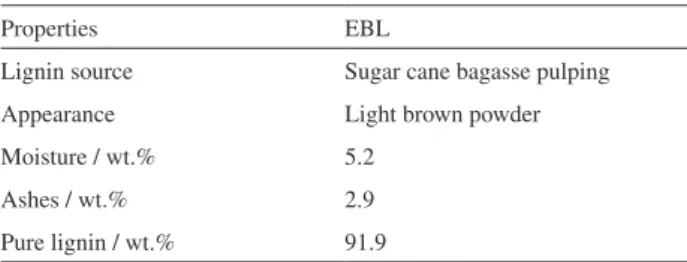
amount was accounted as ashes. The pure lignin amount was subtracted the moisture and ashes from the total amount of sample. The properties of EBL are shown in Table 1.
Commercial lignosulfonates and other chemicals
Commercial lignosulfonates (Borresperse, Ultrazine and Kinsperse) were purchased from Borregaard Lignotech., Norway. The active ingredients of pesticides (including dimethomorph and tribenuron) were obtained from Jiangsu Frey Agrochemicals Co. Ltd., China with a minimum purity of 95.0%.
The other adjuvants for pesticide formulations are sodium dodecyl sulfonates (SDS), ethyl-naphthalene sulfonates, LH-14, LH-11, LH-AS and bentonite which were all purchased from Nanning Lantian Chemicals, China. Hydrogen peroxide solution (30%) was also gained from Nanning Lantian Chemicals, China.
Modiication of the extracted sugar cane bagasse lignin
A mixture of 10 g extracted sugar cane bagasse lignin (EBL) and 100 mL water was poured into a lask bottle equipped with an electric heating device, a motor stirrer, a thermometer, a dropping funnel, and a relux condenser. The mixture was heated to 50 oC for 30 min and the NaOH
solution was added to adjust the pH of the solution to 10.0. Subsequently, hydrogen peroxide was added dropwise to pre-oxidize EBL. The reaction was maintained 30 min and then formaldehyde was added dropwise for hydroxymethylation for 1 h. After that the solution was heated to 85 oC and Na
2SO3
was added to cause sulfonation for 2 h. Finally another part formaldehyde was added dropwise to copolymerize with the sulfonated EBL for 2 h. The reaction mixture was cooled to ambient temperature and then was ultrailtrated with a hollow ibre membrane, which had a 2500 molecular weight cut off to remove the inorganic reagents residues. The cutted fraction products were vacuum dried at 60 oC overnight to
yield a brown powder (EBL-M).
FT-IR spectroscopy
FT-IR spectroscopy was very often used to characterize lignin and lignin derivatives.15 The investigation of EBL-M
by FT-IR spectroscopy was carried out on a Nexus470
Table 1. Properties of lignin extracted from sugar cane bagasse (EBL)
Properties EBL
Lignin source Sugar cane bagasse pulping
Appearance Light brown powder
Moisture / wt.% 5.2
Ashes / wt.% 2.9
FT-IR Spectrophotometer (Hewlett-Packard Development Company, L.P.). About 2 mg of dried EBL-M was carefully mixed with 100 mg of KBr and then was pressed into a lakelet. The spectrum was conducted between 4000 cm-1
and 400 cm-1 wavenumbers.
Ultraviolet spectroscopy
The ultraviolet spectroscopy of EBL-M was investigated by a UV-2501PC spectrophotometer (Shimadzu Corporation, Japan). The scan was conducted between 200 nm and 400 nm wavelength.
Elemental analysis
The elemental analysis was performed in Perkin Elmer PE 2400II apparatus, and the following elements were especially looked for: C, H, O, N, and S.
Molecular weight distribution of EBL-M
Molecular weight distribution of EBL-M was carried out with a Waters gel permeation chromatography (GPC) equipped with a 1515 HPLC pump, a 2478 dual absorbance detector with 0.1 mol L-1 NaOH as eluent. Sodium
polystyrene sulfonate was used as a standard sample (Sigma Aldrich). The injection volume of the sample was 20 μL.
Determination of sulfonic group’s content
The sulfonic group’s contents of lignosulfonates (EBL-M and commercial lignosulfonates) were measured by an automatic potentiometric titrator (809 Titrando, Metrohm AG., Switzerland). Lignosulfonate was irstly transformed into lignosulfonic acid by passing through anion exchange resin and cation exchange resin in turn. A certain volume of lignosulfonic acid (V1) solution was
titrated with 0.01 mol L-1 NaOH. The pH of the solution
increased with increasing consumption of NaOH (V2) until
the differential curve showed a distinctive mutation. The concentration of lignosulfonic acid (C1, g L-1) solution was
determined by ultraviolet spectrophotometer. The sulfonic group’s content was calculated by equation 1:
(1)
Preparation of water dispersible granules (WG)
The 80% dimethomorph water dispersible granules (DWG) were prepared by a high-speed mixed granulation
method. A mixture of 8.4 g dimethomorph (80 wt.% active ingredient) and 0.8 g dispersant (8 wt.%, EBL-M or the commercial lignosulfonates) and 0.8 g sodium dodecyl sulfonates and ethyl-naphthalene sulfonates were ground in a high speed mixer (Philip HR1727, Philips, Netherlands) for 5 min. Then a total amount of 1.8-2.0 g of water was added in batches as a binder for granulation. After a continuous stirring, the formed granules between 20-40 standard meshes (0.45-0.9 mm) were dried as products. The detailed procedures were described in our previous work.16
The 75% tribenuron water dispersible granules (TWG) were also prepared by the procedures mentioned above. The compositions were as follow: 7.9 g of tribenuron (75 wt.% active ingredient), 0.4 g LH-14, 0.3 g LH-11, 0.5 g dispersant (5 wt.%, EBL-M or LH-AS), 0.9 g bentonite as carrier.
Evaluation of dispersing eficiency
Evaluation of the dispersing eficiency of lignosulfonates was indicated by the suspending rate of water dispersible granules that was conducted as follows.17 A required
amount of water dispersible granules (active ingredient content: m mg) was disintegrated in distilled water with shaking 2 min and then was put stationary for a certain time in a 250 mL graduated lask with a stopper. After that the upper 90% suspension was drew out and 10% suspension (active ingredient content: q mg) was left. The contents of active ingredients of the WG and the left 10% suspension were determined by Agilent HPLC 1100 with a stainless column (250 mm × 4.6 mm) packed by C18, with
a mixture of methanol and water (v:v, 65:35) as mobile phase, injection volume of 20 μL, wavelength of 243nm.18
Thus the suspending rate of WG could be calculated by equation 2:
(2)
Results and Discussion
FT-IR analysis of lignosulfonates
The FT-IR spectrum of EBL-M was given in Figure 1. The ingerprint region lied between wavenumbers ranging from 700 cm-1 to 1600 cm-1 and typical stretching of
chemical groups was observed at 2800 cm-1 to 3500 cm-1.
characteristic of phenyl ring skeletal vibrations of lignin macromolecules.15,19This observation conirmed that the
core of lignin polymer did not change signiicantly during the extraction and modiication procedures. The broad band at 3413 cm-1 was due to the presence of hydroxyls.
The band at 2940 cm-1 was contributed to methylene and
methyl groups. The adsorption of aromatic methoxy group was located at 2850 cm-1. The absorption at 1711 cm-1 was
characteristic for the presence of an aldehyde or ketone carbonyl group. As to the ingerprint region: the vibration of methylene and methyl groups were at 1461 cm-1 and
1420 cm-1, and methyl groups also at 1375 cm-1, methylenes
and hydroxyls at 1330 cm-1 and aromatic rings near 850 cm-1.
The C–O bonds were considered at 1260 cm-1, 1219 cm-1.
The band at 1040 cm-1 was duo to the
−SO3 adsorption.
Ultraviolet spectrum of EBL-M
Figure 2 showed the ultraviolet spectrum of EBL-M. It presented a typical adsorption peak near 280 nm (due to phenolic groups), a shoulder at 230 nm and a maximum adsorption at 200-208 nm (assigned to conjugated C=C). The typical adsorption peak at ca. 280 nm shifted to a
shorter wavelength at 276 nm, which indicated the sugar cane bagasse lignin contained much more symmetrical syringyl units than guaiacyl units and p-hydroxyphenyl units.19
Elemental analysis of EBL and EBL-M
As represented in Table 2, the contents of C and N of EBL were decreased by comparing with EBL-M. This could be due to the elimination of organic impurities (such as protein) by the oxidation process.20 The percentages of
H and O were in close agreement for EBL and EBL-M. The content the content of S was clearly increased, which was caused by the sulfonation process.
Molecular weight distribution and sulfonic group’s content of EBL-M
The molecular weight distribution of EBL-M was measured by GPC. As shown in Figure 3, it had a standard normal distribution. Weight- and number-average molecular weights (Mw and Mn, respectively) as well as polydispersity
(Mw/Mn) of EBL-M were presented in Table 3. The sulfonic
group’s content of EBL-M measured by titration are also in Table 3. For comparison, the values of the commercial lignosulfonates reported by our previous work21 were also
listed in Table 3.
Table 3 showed that EBL-M had the largest weight-average molecular weight (8600). Kinsperse had the highest sulfonic group’s content (2.05 mmol g-1) and
Figure 1. FT-IR spectrum of EBL-M.
Figure 2. Ultraviolet spectrum of EBL-M.
Table 2. Elemental analysis
C % H % O % N % S %
EBL 58.75 5.89 31.92 2.65 0.78
EBL-M 52.86 5.75 32.39 1.17 7.82
EBL-M had the second highest sulfonic group’s content (1.86 mmol g-1).
Dispersing eficiency of EBL-M for pesticide formulations
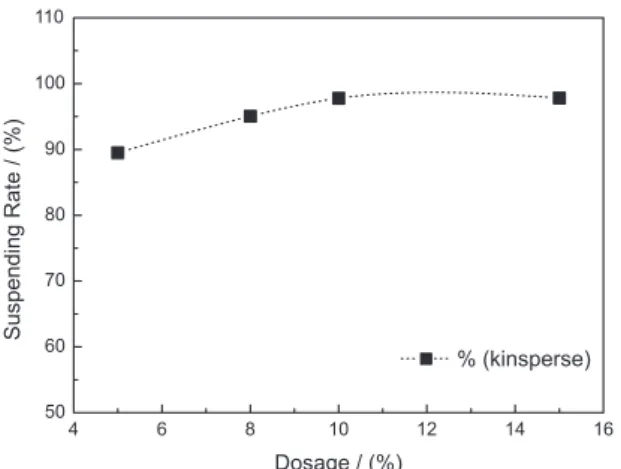
In this experiment, dispersing efficiency of lignosulfonates was determined by the suspending rate measurement of dimethomorph water dispersible granules (DWG) in the presence of different lignosulfonates additives. It was well-known that the suspending rate of water dispersible granules was related to the content of dispersant.22 The relationship between the suspending rate
and dosage of lignosulfonate (Kinsperse) was presented in Figure 4. As shown, the suspending rate of DWG with kinsperse increased with an increase of the dosage of kinsperse. The suspending rate of DWG reached a plateau at 8.0% dosage. Thus, we evaluated the dispersing eficiency of lignosulfonates by measuring the suspending rate at 8.0% added to the pesticide formulation.
The suspending rates of DWG using EBL-M and commercial lignosulfonates as dispersants were shown in Figure 5. It was found that kinsperse and EBL-M had the higher dispersing eficiency than other commercial lignosulfonates. The eficiency could be explained in two aspects: (i) higher molecular weight of lignosulfonate had a larger steric repulsive force, and (ii) higher sulfonic group’s content of lignosulfonate had a stronger electrostatic repulsive force.23 In addition, the dispersing eficiency
of EBL-M was less than kinsperse, which indicated the electrostatic repulsive force was premier to steric repulsive force in this aqueous dispersing system. The similar conclusion could be drawn by the comparison of ultrazine with borresperse.
EBL-M was also used as a dispersant for producing 75% tribenuron water dispersible granules (TWG). The suspending rates of TWG were also measured for investigating its dispersing eficiency comparing with a sodium polyacrylate dispersing agent24 and a commercial
dispersant (LH-AS).25 The suspending rates of TWG were
shown in Figure 6. It presented that the suspending rate of TWG with different dispersants were closed with each other and were all above 90%, indicating that EBL-M
Table 3. Properties of EBL-M and commercial lignosulfonates
lignosulfonates Mw Mn Mw/Mn sulfonic group’s content / (mmol g-1)
EBL-M 8600 2900 2.97 1.86
Kinsperse 5200 1200 4.33 2.05
Borresperse 7100 2700 2.63 1.20
Ultrazine 5500 2000 2.75 1.36
Figure 4. Suspending rate of DWG using kinsperse as dispersant.
Figure 5. Suspending rate of DWG with different lignosulfonates at 8.0% dosage.
had high dispersing eficiency for 75% tribenuron water dispersible granules.
Conclusions
Lignin was extracted from sugar cane bagasse via acidiication of black liquor. The extracted lignin (EBL) was modiied by oxidation, sulfonation and copolymerization into a lignosulfonate (EBL-M), which was characterized by FT-IR, UV, elemental analysis, GPC, and titration to determine the molecular structure and sulfonic group’s content. UV spectrum indicated the molecules of EBL-M contained more symmetrical syringyl units than guaiacyl units and p-hydroxyphenyl units. FT-IR spectroscopy revealed that the aromatic units were kept during the extraction and modiication procedures. Elemental analysis represented that the content of S of EBL-M was much higher than EBL. Titration results showed the sulfonic group’s content of EBL-M was 1.86 mmol g-1 being close
to kinsperse and the Mw were 8600 being higher than all
commercial lignosulfonates.
To estimate the dispersing eficiency of lignosulfonates for pesticide formulations, suspending rate measurement was conducted. It was found that EBL-M had the equal optimal dispersing efficiency to kinsperse than other commercial lignosulfonates when being used for dimethomorph water dispersible granules. By the combination of molecular weight and sulfonic group’s content measurements, there was a conclusion that the dispersing eficiency increased with higher sulfonic group’s content and molecular weight. Especially higher sulfonic group’s content played a more important role on it. As to tribenuron water dispersible granules, the dispersing efficiency of EBL-M was much close to the sodium polyacrylate dispersing agent and LH-AS.
Acknowledgments
The authors wish to thank the supports of Guangxi University Natural Science Foundation (XB2090782).
References
1. Chheda, J.; Huber, G. W.; Dumesic, J. A.; Angew. Chem., Int. Ed.2007, 46, 7164.
2. Klass, D. L.; Biomass for Renewable Energy and Fuels; Elsevier: London, 2004.
3. Huber, G. W.; Iborra, S.; Corma, A.; Chem. Rev.2006, 106, 4044.
4. Lange, J. P.; Biofuels, Bioprod. Biorein. 2007, 1, 39. 5. Coelho, D.; Marques, G.; Gutiérrez, A.; Silvestre, A. J. D.; Río,
J. C. d.; Ind. Crop. Prod.2007, 26, 229.
6. Aden, A.; Ruth, M.; Ibsen, K.; Jechura, J.; Neeves, K.; NREL Rep. TP-510-32438. U.S. Natl. Renew. Energy Lab.2002; http:// www.osti.gov/energycitations/servlets/purl/15001119-zb17aV/ native/ .
7. Kumar, P.; Barrett, D. M.; Delwiche, M. J.; Stroeve, P.; Ind. Eng. Chem. Res. 2009, 48, 3713.
8. Sun, Y.; Cheng, J.; Bioresour. Technol.2002, 83, 1.
9. Martins, G.; Vara, E.; Duarte, C.; Ind. Crop. Prod. 2008, 27, 189.
10. Stewart, D.; Ind. Crop. Prod. 2008, 27, 202.
11. Lora, J. H.; Glasser, W. G.; J. Polym. Environ. 2002, 10, 39. 12. Paiva, J. M. F.; Frollini, E.; J. Appl. Polym. Sci. 2002, 83, 880. 13. Stael, G. C.; Tavares, M. I. B.; Almeida, J. R.; Polym. Test. 2001,
20, 869.
14. Zarate, C. N.; Aranguren, M. I.; Reboredo, M. M.; J. Appl. Polym. Sci. 2000, 77, 1832.
15. Fengel, D.; Wegener, G.; Wood-Chemistry, Ultrastructure, Reactions;Walter de Gruyter: Berlin, 1989.
16. Li, Z.; Qiu, X.; Pang, Y.; Ouyang, X.; Lou, H.; Journal of Chemical Engineering of Chinese Universities2009, 23, 466. 17. Ling, S. H.; Solid Formulation, 3rd ed.; Chemical Industry Press:
Beijing, China, 2003.
18. Yang, J.; Huang, C.; Xiong, L.; Fine Chemical Intermediates
2003, 33, 50.
19. Hergert, H. L.; Lignins, Occussence, Formation, Structure, and Reactions; Wiley Interscience: New York, 1971.
20. Gosselink, R. J. A.; Abächerli, A.; Semke, H.; Malherbe, R.; Käuper, P.; Nadif, A.; Dam, J. E. G.; Ind. Crop.Prod.2004, 19, 271.
21. Li, Z.; Pang, Y.; Li, X.; Qiu, X.; J. Chem. Ind. Eng.2008, 59, 2127.
22. Bell, G. A.; Water-Dispersible Granules, 4th ed.; Kluwer Academic Publishers: London, 1998.
23. Myers, D.; Surfactant Science and Technology, 3rd ed.; John Wiley & Sons, Inc.: Hoboken, New Jersey, 2006.
24. Li, H.; Zhang, Q.; Xu, Y.; Jiao, Q.; Agrochemicals2006, 45, 253.
25. Li, W.; Lai, H.; Ge, Z.; Ding, C.; Zhou, Y.; Journal of Zhejiang University fo Technology2006, 34, 154.
Submitted: March 3, 2011