
Oxygen self-diusion in a cordierite glass
A.C.S. Sabioni
a,*, E.D. Zanotto
b, F. Millot
c, H.L. Tuller
d aFederal University of Ouro Preto, Department of Physics/ICEB, 35400-000 Ouro Preto, MG, Brazil bFederal University of S~
ao Carlos, Department of Materials Engineering, Via Washington Luiz, km 235, 13565-905 S~ao Carlos, SP, Brazil
c
Centre de Recherche sur la Physique des Hautes Temperatures/CNRS, Orleans, France d
Crystal Physics and Electroceramics Laboratory, Department of Materials Science and Engineering, Massachusetts Institute of Technology, Cambridge, MA 02139, USA
Received 24 February 1998; received in revised form 12 August 1998
Abstract
Oxygen self-diusion measurements determined below and above the glass transition temperature in a cordierite glass are reported. The diusion experiments were performed by the solid±gas isotope exchange method using18O as a
tracer in H2±H218O and Ar/18O2 atmospheres. The 18O diusion pro®les were established by secondary ion mass
spectrometry (SIMS) after appropriate diusion annealing. The oxygen diusion coecients changed at the glass transition temperature as expected. The atmosphere aected the oxygen diusivity in agreement with other studies. The diusion data were useful for comparisons with diusion controlled process in the same glass. There is a dierence between the activation enthalpies for crystal growth, viscous ¯ow, and oxygen self-diusion. Hence, bond-breaking and molecular reorientation required for crystallization and the atomic transport mechanism involved in viscous ¯ow are not correlated in any obvious way to oxygen diusion in cordierite glass. Ó1998 Elsevier Science B.V. All rights
reserved.
1. Introduction
The study of physical and chemical properties of cordierite glasses (2MgOá2Al2O3á5SiO2) has gained interest in the last few years. Most research has been motivated by the use of cordierite based compositions in the production of glass±ceramics because of the chemical and physical properties, when used as dielectric substrates in a number of electronic applications. Due to these uses, a cor-dierite glass was chosen by the Nucleation, Crys-tallization & Glass±Ceramics Committee of the
International Commission on Glass (TC-7 Com-mittee of the ICG) for a world-wide round-robin study of crystallization.
The TC-7 members have determined several issues regarding the crystallization properties of cordierite glasses and were looking for auxiliary data (e.g., diusion data) to aid in the interpr-etation of crystallization kinetics. In oxide glasses, the O2ÿ ion is one of the network-forming ions;
therefore, data about oxygen diusion are essential for understanding diusion controlled processes, such as viscous ¯ow and crystallization. In addi-tion, as far as we know, there are no data about oxygen diusion available in the literature for cordierite glass. This communication deals with the experimental determination of oxygen
*
Corresponding author. Fax: +55-31 551 1689; e-mail: [email protected].
self-diusion in an almost stoichiometric cordierite glass. We also test if there is any obvious correla-tion between oxygen diusion, viscous ¯ow and crystal growth kinetics in the same glass.
2. Experimental
The composition of the cordierite glass samples was 52.3 wt% SiO2, 33.2 wt% Al2O3and 14.6 wt% MgO (the stoichiometric composition is 51.3 wt% SiO2, 34.9 wt% Al2O3, 13.8 wt% MgO). This commercial glass (GM-30870) was obtained from Schott Glaswerke, Germany. For the diusion experiments, l´5 ´5 mm samples were cut and
polished to an optical ®nish with diamond paste. The oxygen diusion coecients were deter-mined by using the gas±solid isotope exchange method. Two dierent series of experiments were performed.
2.1. Determination of the oxygen diusion coe-cient above and below the transition temperature in H2/H2O atmosphere
The diusion experiments were performed in a range of temperatures, between 650°C and 800°C; that is, below the glass transition temperature (Tg820°C), by using the gas±solid isotope ex-change method. Some experiments were also per-formed at temperatures aboveTg, between 832°C and 930°C. The atmosphere used in these
experi-ments was a gaseous mixture of 98.4% N2:1% H2:0.6% H2O. The oxygen partial pressure in these experiments was ca 3.0´ 10ÿ13 Pa at 860°C. For annealing, the water vapor in the atmosphere was supplied by natural water H216O, while in the diusion treatments the source of vapor was water enriched with the 18O isotope
H218O. The
H218Orich oxygen had about 40%l8O.
In the exchange isotope method, the introduc-tion of the tracer and the diusion treatment is simultaneous. The incorporation of l8O in the surface of the sample may be schematically de-scribed by
H218O g 16O cordierite surface
H216O g 18O cordierite surface:
After being incorporated into the sample sur-face, 18O diuses into the material. Details of the experimental arrangement used in the diusion experiments are described in Ref. [1].
The diusion pro®les of the oxygen were de-termined by secondary ion mass spectrometry (SIMS-Cameca 4F-CNRS/Meudon/France). The analyses were made using l0 keV Csprimary ions.
Since cordierite is an insulator, it charges during SIMS analysis. This problem was eliminated by depositing by evaporation a gold ®lm on the specimen surface.
The oxygen diusion pro®les were established from the 16Oÿ and 18Oÿ signals through the
fol-lowing expression:
C 18O I 18
Oÿ
I 18Oÿ I 16Oÿ: 1
2.2. Determination of the oxygen diusion above the glass transition temperature in O2/Ar atmosphere
We have repeated the diusion experiments at temperatures above the transition temperature. This second series of experiments was also per-formed by the gas±solid isotope exchange method, but using an Ar + O2 (98%18O) atmosphere. The heat-treatment arrangement used in these experi-ments are described elsewhere [2]. The diusion annealings were performed from 826°C to 880°C,
and the oxygen pressure was equal to 2.1 ´104Pa. To avoid crystallization or thermal etching, the annealings were performed for short times. The correction for heat up and cool down of the tem-peratures was performed using a method described by Rothman [3].
Concentration pro®les were established by sec-ondary ion mass spectrometry (SIMS) (Vacuum Generators time-of-¯ight instrument), using a 10 keV Ga ion source. 1
During these analyses, charge neutralization was obtained by means of an electron ¯ood gun. The oxygen concentration was determined from the 16Oÿ and18Oÿ signals using
Eq. (1).
1
The penetration depths were obtained assuming a constant sputtering rate and measuring the depth of the crater by means of a pro®lometer (Dektak).
3. Results
The 18O concentration at the sample surface was less than that in the atmosphere in all exper-iments. Consequently, the oxygen diusion coe-cients were determined by using a solution of the diusion equation for the case of diusion con-trolled by a surface exchange reaction. That solu-tion is given by the following expression [4]:
CÿC1
CgÿC
1
erfc x 2
Dt
p
ÿexp hxh2Dt:
erfc x2hDt 2
Dt
p
; 2
whereC1is the natural concentration of18O in the
sample, Cg is the concentration of 18O in the at-mosphere, erfc is the inverse error function, D is the diusion coecient, tis the time of the diu-sion treatment, x is the penetration depth and
ha/D. The parameter a is the exchange
coe-cient given by the boundary condition [4]:
ÿDoC 0;t
ox aCgÿC 0;t: 3
Eq. (2) has two ®tting parameters,Dandh. These parameters were determined by ®tting Eq. (2) to the depth pro®les obtained for 18O diusion in cordierite glass. It was performed by nonlinear ®tting using the software Origin [5]. In this soft-ware, the ®tting is achieved by minimizing the Chi-squares using the Levenberg±Marquardt al-gorithm [5].
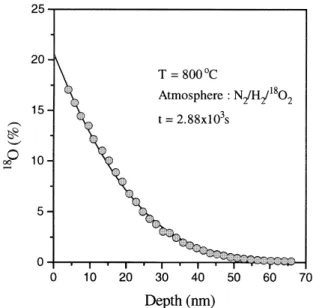
Fig. 1 shows a ®t of Eq. (2) to an experimental diusion pro®le after a diusion treatment at 800°C. The nonlinear ®tting analysis, indicated by the solid line in Fig. 1, yields D(1.18 0.03)
´ 10ÿ16 cm2/s, andh(4.24 0.10)´105 cmÿ1. The diusion coecients (D) and the exchange coecients (a) obtained for oxygen diusion in
cordierite glass at temperatures below and above
Tg, in N2/H2/H2O atmosphere, are listed in Table 1.
Below the transition temperature (Tg820°C), in N2/H2/H2O atmosphere, the diusion coe-cients of oxygen in cordierite glass can be repre-sented by the following Arrhenius relation:
Fig. 1. () Penetration plot for18O diusion in cordierite glass
at 800°C, in N2/H2/H2O atmosphere, and (±±±) non-linear
®t-ting giving D(1.18 0.03)´10ÿ15cm2/s, h
(4.24 0.10)
´105cmÿ1, and correlation coecient0.998.
Table 1
Results for oxygen diusion in cordierite glass in N2/H2/H218O
Sample T(°C) t(s) D(cm2/s)
a(cm/s)
1 650 9.90´103 (1.42 0.13)´10ÿ16 (5.50 0.92)´10ÿ11
2 700 7.92´103 (2.25 0.04)´10ÿ16 (7.00 0.28)´10ÿ11
3 750 3.60´103 (4.00 0.22)´10ÿ16 (1.70 0.19)´10ÿ10
4 800 2.88´103 (1.18 0.03)´10ÿ15 (5.00 0.25)´10ÿ10
5 832 3.60´103 (7.52 0.26)´10ÿ15 (3.30 0.28)´10ÿ9
D cm2=s 2:9710ÿ10
exp ÿ 11321kJ=mol RT
4
obtained by linear regression of the diusion co-ecients measured from 650°C to 800°C, with a
correlation coecient0.969.
An Arrhenius relation for the oxygen diusion coecients obtained above Tg, in N2/H2/H2O, is not proposed because there are only two data points at 832 and 860°C. In fact, we have also
performed diusion experiments at 905 and 930°C,
however these were discarded due to surface crystallization, as shown by X-ray diraction.
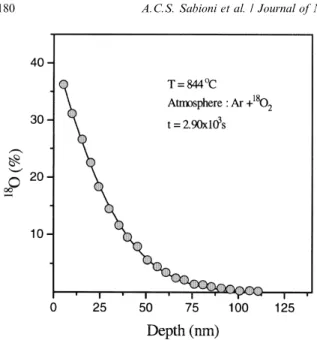
Fig. 2 shows a depth pro®le for oxygen diu-sion at 844°C, in Ar/O2 atmosphere. Again, the 18O concentration at the sample surface was much
less than that in atmosphere (98%). Thus, the diusion coecients were also determined by using Eq. (2). The non-linear ®tting analysis, shown as the solid line in Fig. 2, yields D(2.70 0.04)
´ 10ÿ15 cm2/s, andh
(2.15 0.04)´105 cmÿ1. The oxygen diusion coecients and the ex-change coecients obtained for oxygen diusion in cordierite glass, above Tg, in Ar + O2 atmo-sphere, are shown in Table 2.
From 826°C to 880°C, the diusion coecients
can be described by the following Arrhenius rela-tion:
D cm2=s 7:9107 exp
ÿ 48136RTkJ=mol
:
5 Relation (5) was obtained by linear regression of the data given in Table 2, with a correlation co-ecient 0.988.
4. Discussion
Fig. 3 shows an Arrhenius plot of the oxygen diusion coecients (D) measured above and be-low the transition temperature, in N2/H2/H2O at-mosphere.
The diusion coecients measured below the transition temperature, extrapolated to tempera-tures above Tg by Eq. (4) are less than those ob-tained experimentally above Tg. This dierence indicates a change of the diusion coecients through the transition temperature, which has been observed by other authors in other silicate glasses [6,7], and also in metallic glasses [8].
Fig. 2. () Penetration plot for18O diusion in cordierite glass
at 844°C, in Ar + O2 atmosphere, and (±±±) non-linear
®tting givingD(2.70 0.04)´10ÿ15cm2/s,h
(2.15 0.04)
´105cmÿ1, and correlation coecient 0.998.
Table 2
Results for oxygen diusion in cordierite glass in Ar +18O 2
Sample T(°C) t(s) D(cm2/s)
a(cm/s)
1 826 7.28´103 (1.30 0.03)´10ÿ15 (3.30 0.22)´10ÿ10
2 830 6.97´103 (1.10 0.06)´10ÿ15 (1.60 0.23)´10ÿ10
3 844 2.90´103 (2.70 0.04)´10ÿ15 (5.80 0.19)´10ÿ10
4 862 3.34´103 (7.35 0.18)´10ÿ15 (8.00 0.42)´10ÿ10
5 869 1.41´103 (7.92 0.28)´10ÿ15 (1.60 0.12)´10ÿ9
Fig. 4 compares the oxygen diusion coe-cients obtained in Ar + O2 and N2/H2/H2O at-mospheres, above Tg. The larger diusion coecients in a water rich atmosphere were also expected and have been observed in previous studies of oxygen diusion in other silicates [9,10].
As far as we know, there are no previous data available on oxygen diusion in cordierite glass for comparison.
In oxide glasses such as cordierite, the ion O2ÿis
one of the network-forming ions and its diusion may play an important role in diusion-controlled processes, such as viscous ¯ow and crystallization. Using the data determined in this work, a corre-lation of oxygen self-diusion with viscous ¯ow and crystallization kinetics determined in the same glass [11] will be discussed.
In a previous publication, Diaz-Mora et al. [12] investigated the activation enthalpies and energies for crystal growth (DHu, DGu) and viscous ¯ow (DHg, DGg) in the same cordierite glass, by using
experimental growth rates and viscosity data. They found that DGu is similar to DGg in magnitude,
however, their temperature dependencies are not equal, leading to dierent activation enthalpies, thus DHu ¹DHg. This conclusion was con®rmed
by an analysis of literature data for six other glasses.
Fig. 5 showsDHu andDHg(from [12]) and the
activation enthalpy for oxygen diusion, DHD, obtained in this work above Tg, in Ar + O2 at-mosphere. There is a dierence between these quantities indicating that there is no obvious re-lationship among them. Hence, bond-breaking and atomic reorientation required for
crystalliza-Fig. 4. Comparison between the oxygen diusion coecients measured in Ar +18O
2and N2/H2/H218O atmospheres, above
Tg.
Fig. 5. Activation enthalpies for crystal growth,DHu [12],
vis-cous ¯ow,DHg[12], and oxygen diusion,DHD, in a cordierite
glass. Fig. 3. Arrhenius plot for oxygen diusion in cordierite glass
above and below the transition temperature, in N2/H2/H218O
tion and the atomic transport mechanism involved in viscous ¯ow are not correlated directly to oxy-gen diusion in cordierite glass.
5. Conclusion
Oxygen diusion in cordierite glass changes at the glass transition temperature and is dependent on atmosphere. These results con®rm previous studies with other glass systems and have been used for comparison with viscous ¯ow and crystal growth kinetics. There is a dierence among the activation enthalpies for crystal growth, viscous ¯ow and oxygen self-diusion. Hence, bond-breaking and atomic reorientation required for crystallization and the atomic transport mechanism involved in viscous ¯ow are not correlated in any obvious way to oxygen diusion in cordierite glass.
Acknowledgements
A.C.S.S. and E.D.Z. are grateful to CNPq/ Brazil and to PRONEX (`Glass Crystallization:
Mechanisms, Kinetics and Applications' Research grant) for ®nancial help.
References
[1] A.C.S. Sabioni, A.M. Huntz, F. Millot, C. Monty, Philos. Mag. A 66 (3) (1992) 351.
[2] A.C.S. Sabioni, H.L. Tuller, B.J. Wuensch, Oxygen self-diusion in ZnO single crystals (accepted for publication). [3] S.J. Rothman, in: G.E. Murch, A.S. Nowick (Eds.), Diusion in Crystalline Solids, Academic Press, Orlando, FL, 1984.
[4] J. Crank, Mathematics of Diusion, Clarendon, Oxford, UK, 1957.
[5] Microcal Software - Origin, Technical Graphics and Data Analysis in Windows, Reference manual, Version 3.5. [6] S. Brawer, Relaxation in Viscous Liquids and Glasses,
American Ceramic Society, Columbus, Ohio, 1985. [7] B.S. Rawal, A.R. Cooper, J. Mater. Sci. 14 (1979) 1425. [8] H. Nakajima, W. Sprengel, K. Nonaka, Defect Dius.
Forum 143±147 (1997) 803.
[9] R. Freer, Defect Dius. Forum 1101&1102 (1993) 1. [10] K.C. Berg, I. Lauder, Phys. Chem. Glasses 19 (1978) 83. [11] N.D. Mora, PhD thesis, Federal University of S~ao Carlos,
1994.
![Fig. 5 shows D H u and D H g (from [12]) and the activation enthalpy for oxygen diusion, D H D , obtained in this work above T g , in Ar + O 2 at-mosphere](https://thumb-eu.123doks.com/thumbv2/123dok_br/15712681.631020/5.816.69.382.646.936/fig-shows-activation-enthalpy-oxygen-usion-obtained-mosphere.webp)
