O
O
ABSTRACT
RESUMO
FLUORIDE CONTENT OF UHT MILKS
COMMERCIALLY AVAILABLE IN BAURU, BRAZIL
CONTEÚDO DE FLÚOR EM LEITES UHT DISPONÍVEIS COMERCIALMENTE EM BAURU,
BRASIL
Marília Afonso Rabelo BUZALAF1, Juliano Pelim PESSAN2, Rejane FUKUSHIMA3, Andréia DIAS4, Helena Maria ROSA4
1- DDS, MSc, PhD, Associate Professor, Department of Biological Sciences, Bauru Dental School, University of São Paulo, Brazil. 2- DDS, MSc Student, Department of Pediatric Dentistry, Orthodontics and Public Health, Bauru Dental School, University of São Paulo, Brazil.
3- DDS, PhD Student, Department of Biological Sciences, Bauru Dental School, University of São Paulo, Brazil. 4- DDS, Graduate Students, Bauru Dental School, University of São Paulo, Brazil.
Corresponding address: Marília Afonso Rabelo Buzalaf - Al. Octávio Pinheiro Brisolla, 9-75 - Bauru-SP - Cep.: 17012-901 (Brazil) Tel. + 55 14 32358246 - Fax + 55 14 32262076 - e-mail: [email protected]
Received: May 31, 2005 - Modification: September 16, 2005 - Accepted: September 27, 2005
bjectives: The aims of the present study were to evaluate the fluoride (F) concentrations in whole, defatted and chocolate milks commercially available in Brazil and to estimate the daily F intake from these sources. Material and Methods: F concentrations were determined for 23 brands of milks, after HMDS-facilitated diffusion, using a F ion-specific electrode. Possible F ingestion per kg body weight was estimated, based on suggested volumes of formula consumption, for infants aging 1 to 12 months. Results: F concentrations ranged from 0.02 to 1.6 µg/mL F for all brands analyzed. Whole and defatted milks had the lowest F concentrations, ranging from 0.02 to 0.07 µg/mL. With respect to chocolate milks, three brands had F concentrations above 0.5 µg/mL. Some brands of chocolate milks exceeded the dose regarded as the threshold level for the development of dental fluorosis, without taking into account other sources of fluoride intake. Conclusion: The high fluoride concentrations found in some brands of chocolate milks in the present study indicate that many products may be important contributors to the total fluoride intake, reinforcing the need of assaying fluoride content of foods and beverages consumed by small children.
Uniterms: Fluoride; Milk; Dental fluorosis
bjetivos: Os objetivos do presente estudo foram avaliar as concentrações de flúor (F) em leites integrais, desnatados e achocolatados disponíveis comercialmente no Brasil e estimar a ingestão diária de F a partir destas fontes. Material e Métodos: as concentrações de F foram determinadas em 23 marcas de leite, após difusão facilitada por HMDS, usando um eletrodo íon-específico para F. A ingestão provável de F por Kg de peso corporal foi estimada, baseando-se em volumes sugeridos de consumo de fórmulas infantis, para crianças entre 1 e 12 meses de idade. Resultados: As concentrações de F variaram entre 0,02 e 1,6 µg/mL para todas as marcas analisadas. Os leites integrais e desnatados apresentaram as menores concentrações de F, variando entre 0,02 e 0,07 µg/mL. Com relação aos leites achocolatados, três marcas apresentaram concentrações de F acima de 0,5 µg/mL. Algumas marcas de leites achocolatados excederam a dose de flúor reconhecida como o limite máximo de exposição a fim de se evitar o desenvolvimento da fluorose dentária, sem se considerar outras fontes de ingestão de F. Conclusão: As altas concentrações de F encontradas em algumas marcas de leites achocolatados no presente estudo indicam que muitos produtos podem contribuir significativamente para a ingestão total de F, reforçando a necessidade de se avaliar o conteúdo de F em alimentos e bebidas consumidos por crianças pequenas.
INTRODUCTION
Fluoride is the most clinically used mean of reducing dental caries. Besides the decline in tooth decay, the widespread use of fluoride has contributed to an increase in the prevalence of dental fluorosis3. Since dental fluorosis
results of excessive ingestion of fluoride during enamel formation, all sources that contribute to the total intake of this ion should be considered to evaluate the risk of development of dental fluorosis. Regarding infants, the major dietary intake constitutes the breast milk, cow’s milk and infant milk formulations, in which the fluoride content varies widely4,12,15,21.
Milk is a universal food for newborns and growing mammals and contains all of the essential nutrients for their development and growth12. Changes in infant feeding
practices have occurred over the past 30 years3,8,9. A decline
in breast feeding has been noted, whereby a considerable number of infants are weaned early and artificially fed before they are a month old15. Thus, the concentration of fluoride
in cow’s milk and infant formula plays an important role in the supply of fluoride to infants.
Although cow’s milk is reported to have low fluoride concentrations9,15,18, some studies related wide variations
in fluoride concentrations in dairy milks9,12,14,15. In addition,
previous studies found high fluoride concentrations in ready-to-drink chocolate milks6,14. Thus, the aim of the
present study was to evaluate the fluoride concentrations in whole, defatted and chocolate milks commercially available in Brazil and to estimate the daily fluoride intake from these sources.
MATERIAL AND METHODS
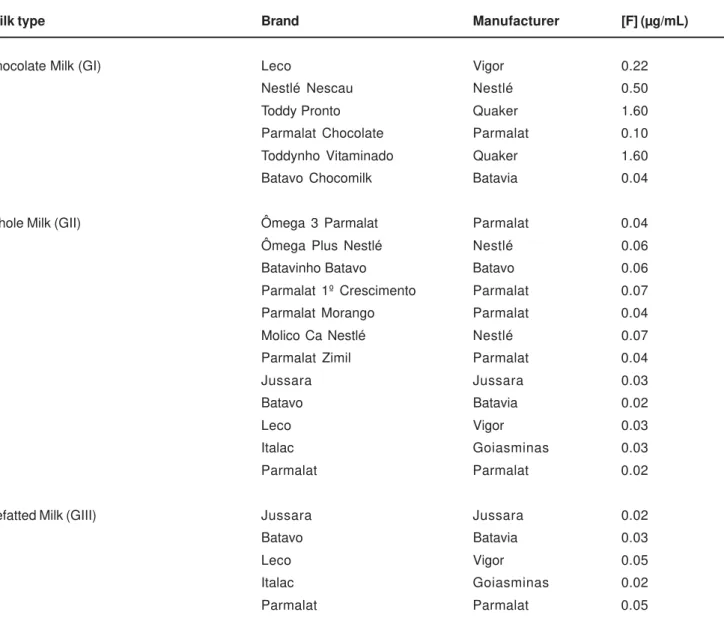
Twenty-three brands of UHT (ultra high temperature) milks were purchased in supermarkets of Bauru, São Paulo State, Brazil, in October 2004. They were divided into three groups, as follows: GI – chocolate milks, GII – whole milks and GIII – defatted milks. The division of the brands into the groups, as well as the manufacturers, is presented in Table 1.
The boxes of milks were opened on the day of the analysis and 1 mL of milk was used for fluoride analysis. Fluoride determinations were carried out after overnight HMDS-facilitated diffusion, as described by Taves19, using the
ion-specific electrode (Orion Research, Cambridge, MA, USA, model 9609). A set of standards (ranging between 0.025-3.200 ppm F) was prepared, using serial dilution from a 100 ppm NaF stock solution (Orion #940907) and diffused in triplicate in the same way as the samples. The millivoltage potentials were converted to µg F using a standard curve with a coefficient correlation of r>0.999. All samples were analyzed in triplicate.
RESULTS
Table 1 presents all brands of cow’s milk analyzed, divided into the three groups (chocolate, whole and defatted milks), the manufacturers, as well as the fluoride concentrations determined for all brands of milk (expressed in µg/mL). All whole and defatted milks had low fluoride concentrations, ranging from 0.02 to 0.07 µg/mL F. Among chocolate milks, we found higher fluoride concentrations, ranging from 0.04 to 1.6 µg/mL. Three brands of chocolate milks had fluoride concentrations above 0.5 µg/mL (Nestlé Nescau, Toddy pronto and Toddynho vitaminado).
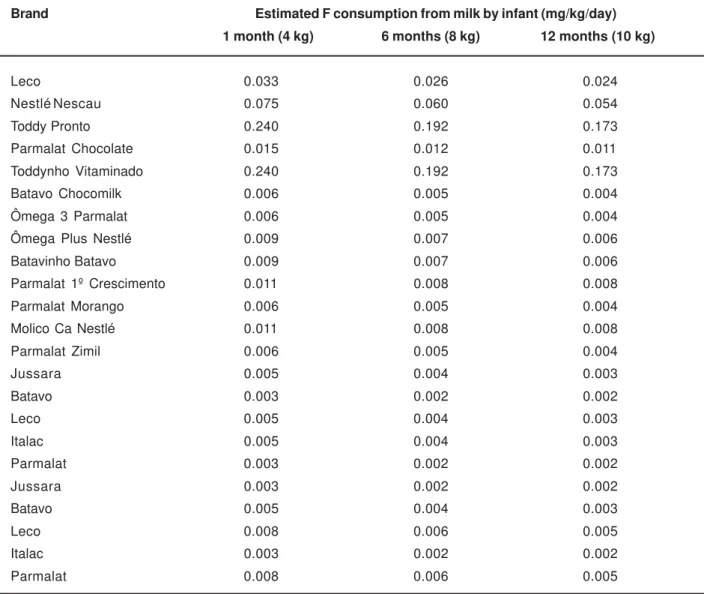
Average infant body masses and suggested volumes of formula consumption for infants from one to twelve months of age are shown in Table 2. Using these data, the possible daily fluoride ingestion per kg body mass, presented in Table 3, can be estimated. Daily fluoride intake (mg/ kg body weight) from whole and defatted milks ranged from 0.003– 0.0110, 0.002–0.008 and 0.002–0.008, while daily fluoride intake from chocolate milks ranged from 0.006–0.240, 0.005– 0.192 and 0.004–0.173, respectively for infants aging 1, 6 and 12 months.
DISCUSSION
In the present study, whole and defatted milks had low fluoride concentrations. The values found (0.02-0.07 µg/ mL) are in accordance with other previous reports8,12,21.
These low fluoride levels were expected because fluoride is poorly transported from plasma to milk, and concentrations of fluoride in milk remain low even when the intake of fluoride by the mammal is high18. Analyzing fluoride concentrations
in whole and defatted milks in relation to daily fluoride intake per kilogram of body mass (Table 3), it can be concluded that the use of such products is safe, concerning the dosages believed to increase the risk of development of dental fluorosis2. Among the different types of milk analyzed
in this study, these products may be the most consumed. Regarding chocolate milks, fluoride concentrations varied widely among the brands analyzed. Three brands of chocolate milks had fluoride concentrations above 0.5 µg/ mL: Nescau (Nestlé®) had 0.5 µg/mL F, while Toddy Pronto
and Toddynho Vitaminado (both from Quaker®), had 1.6 µg/
mL F. We had already found high fluoride levels in chocolate milks6,14, but we were not able to identify the possible source
on the consumption of chocolate milks by infants. This does not allow the precise estimation of their contribution to the total daily fluoride intake.
It is considered that the optimal range of fluoride intake is 0.05-0.07 mg F/kg body weight/day2,9. Taking into account
average body masses and suggested volumes of formula consumption for infants of one, six and twelve months of
age (Table 3), it is observed that some brands of chocolate milks exceeded the upper limit of daily fluoride intake (Nestlé®
Nescau), or even exceeded the threshold level for development of dental fluorosis (Toddy Pronto and Toddynho Vitaminado). The bioavailability of milk is another point to be considered. Due to the high calcium concentrations in milk, there is a possibility of diminution of
Milk type Brand Manufacturer [F] (µg/mL)
Chocolate Milk (GI) Leco Vigor 0.22 Nestlé Nescau Nestlé 0.50 Toddy Pronto Quaker 1.60 Parmalat Chocolate Parmalat 0.10 Toddynho Vitaminado Quaker 1.60 Batavo Chocomilk Batavia 0.04
Whole Milk (GII) Ômega 3 Parmalat Parmalat 0.04 Ômega Plus Nestlé Nestlé 0.06 Batavinho Batavo Batavo 0.06 Parmalat 1º Crescimento Parmalat 0.07 Parmalat Morango Parmalat 0.04 Molico Ca Nestlé Nestlé 0.07 Parmalat Zimil Parmalat 0.04 Jussara Jussara 0.03 Batavo Batavia 0.02 Leco Vigor 0.03 Italac Goiasminas 0.03 Parmalat Parmalat 0.02
Defatted Milk (GIII) Jussara Jussara 0.02 Batavo Batavia 0.03 Leco Vigor 0.05 Italac Goiasminas 0.02 Parmalat Parmalat 0.05
TABLE 1- Fluoride content of the different types of milk analyzed
Age (months) Body mass (kg) Suggested feedings Total volume (mL)
0-1 0-4 5 bottles of 120 mL 600 1-2 4-5 5 bottles of 150 mL 750 2-3 5-6 5 bottles of 180 mL 900 3-6 6-8 4 bottles of 240 mL 960 6-12 8-10 4 bottles of 270 mL 1080
TABLE 2- Formula administration guide*
fluoride absorption from gastro-intestinal tract18,20,22. Thus,
the calculations made for these products could be overestimated. On the other hand, milk is also rich in fats, what are known to increase the lag time of the food or beverage in the stomach20,22. Although milk is known to
interfere with the rate of fluoride absorption, it is demonstrated that 67 to 82% of total fluoride in milk is absorbed17.
Our special attention concerns children older than 11 months, since this period coincides with the beginning of the development of the permanent teeth crowns. Even for brands that did not exceed the upper optimal limit of fluoride intake, the risk of development of dental fluorosis exists, because children at this age are fed with other foods than milk, ingesting fluoride from water, beikost and formulas, etc. The ingestion of these sources with other fluoride-rich products is a possibility that must be considered. It seems likely that fluoride intake from beikost rarely averages more than 0.02 mg/kg body weight/day9. Mean daily fluoride
intake from water by itself up to 9 months of age is usually < 0.05 mg11. Powdered or liquid concentrated infant formulas,
as well as soymilk, appear to have high fluoride
concentrations3,4,5. It is estimated that the fluoride intake of
children aging 6 and 12 months from powdered milk-based formulas reconstituted with optimally fluoridated water is 0.145 and 0.116 mg/kg body weight/day, respectively9, thus
exceeding the optimal range of fluoride intake2. It must be
also considered that some parents start to use fluoride dentifrice when the first teeth erupt and it is known that fluoride ingestion from dentifrice is inversely related to the age of the child4,16. However, a recent study by Brofitt, et al.1
has shown that the mean fluoride ingestion from dentifrice is negligible during the first twelve months.
Taking these situations together, total fluoride intake will be higher and probably will exceed the upper limit recommended for fluoride intake. Taking into account that enamel fluorosis can occur following either an acute or chronic exposure to fluoride during tooth formation7 this
assumes a greater relevance, showing the importance of monitoring fluoride intake by small children. In this sense, dairy companies should consider providing information to the public on fluoride content of all dairy products. In addition, public health measures should be taken, informing the consumer with respect to fluoride ingestion and its
Brand Estimated F consumption from milk by infant (mg/kg/day)
1 month (4 kg) 6 months (8 kg) 12 months (10 kg)
Leco 0.033 0.026 0.024 Nestlé Nescau 0.075 0.060 0.054 Toddy Pronto 0.240 0.192 0.173 Parmalat Chocolate 0.015 0.012 0.011 Toddynho Vitaminado 0.240 0.192 0.173 Batavo Chocomilk 0.006 0.005 0.004 Ômega 3 Parmalat 0.006 0.005 0.004 Ômega Plus Nestlé 0.009 0.007 0.006 Batavinho Batavo 0.009 0.007 0.006 Parmalat 1º Crescimento 0.011 0.008 0.008 Parmalat Morango 0.006 0.005 0.004 Molico Ca Nestlé 0.011 0.008 0.008 Parmalat Zimil 0.006 0.005 0.004 Jussara 0.005 0.004 0.003 Batavo 0.003 0.002 0.002 Leco 0.005 0.004 0.003 Italac 0.005 0.004 0.003 Parmalat 0.003 0.002 0.002 Jussara 0.003 0.002 0.002 Batavo 0.005 0.004 0.003 Leco 0.008 0.006 0.005 Italac 0.003 0.002 0.002 Parmalat 0.008 0.006 0.005
adverse effects.
CONCLUSION
The high fluoride concentrations found in some brands of chocolate milks in the present study, together with many others around the world, indicate that many products may be important contributors to the total fluoride intake, reinforcing the need of assaying fluoride content of foods and beverages consumed by small children.
REFERENCES
1- Broffit B, Levy SM, Warren JJ, Heller KE. Seasonal variation in fluoride intake: the Iowa fluoride study. J Publ Health Dent. 2004;64(4):198-204.
2- Burt BA. The changing patterns of systemic fluoride intake. J Dent Res. 1992;71:1228-37.
3- Buzalaf MAR, Cury JA, Whitford GM. Fluoride exposures and dental fluorosis: a literature review. J Appl Oral Sci. 2001;9(1/2):1-10.
4- Buzalaf MAR, Damante CA, Trevizani LM, Granjeiro JM. Risk of fluorosis associated with infant formulas prepared with bottled water. J Dent Child. 2004;71(2):110-3.
5- Buzalaf MAR, Granjeiro JM, Cardoso VES, Silva TL, Olympio KPK. Fluorine content of several brands of chocolate bars and chocolate cookies found in Brazil. Pesqui Odontol Bras. 2003;17(2):223-7.
6- Buzalaf MAR, Granjeiro JM, Duarte JL, Taga MLL. Fluoride content in infant foods and risk of dental fluorosis. J Dent Child. 2002;69(2):196-200.
7- DenBesten PK, Thariani H. Biological mechanisms of fluorosis and level and timing of systemic exposure to fluoride with respect to fluorosis. J Dent Res. 1992;71:1238-43.
8- Fomon SJ, Ekstrand J. Fluoride intake by infants. J Publ Health Dent. 1999;59(4):229-34.
9- Fomon SJ, Ekstrand J, Ziegler EE. Fluoride intake and prevalence of dental fluorosis: trends in fluoride intake with special attention to infants. J Public Health Dent. 2000;60(3):131-9.
10- Leveret DH. Fluorides and the changing prevalence of dental caries. Science. 1982;217:26-30.
11- Levy SM, Kohout FJ, Guha-Chowdhury N, Kiristy MC, Heilman JR, Wefel JS. Infants’ fluoride intake from drinking water alone, and from water added to formula, beverages and food. J Dent Res. 1995;74(7):1399-407.
12- Liu C, Wyborny LE, Chan JT. Fluoride content of dairy milk from supermarket: A possible contributing factor to dental fluorosis. Fluoride. 1995;28(1):10-6.
13- Pessan JP, Silva SMB, Buzalaf MAR. Evaluation of the total fluoride intake of 4-7-year-old children from diet and dentifrice. J Appl Oral Sci. 2003;11(2):150-6.
14- Pin MLG, Oliveira FS, Silva SMB, Buzalaf MAR, Machado MAAM, Granjeiro JM. Concentração de flúor no leite, sucos, refrigerantes e alimentos infantis [abstract B231]. Pesqui Odontol Bras. 2000;14(Suppl):136.
15- Rahul P, Amitha MH, Munshi AK. Estimation of the fluoride concentrations in human breast milk, cow’s milk and infant formulae. J Clin Pediat Dent. 2003;27(3):257-60.
16- Richards A, Banting DW. Fluoride toothpastes. In: Fejerskov O, Burt BA, editors. Fluoride in dentistry. Copenhagen, Munksgaard; 1996. p.328-46.
17- Spak CJ, Ekstrand J, Zylberstein D. Bioavailability of fluoride added to baby formula and milk. Caries Res. 1982;16(3):249-56.
18- Spak CJ, Hardell LI, De Chateau P. Fluoride in human milk. Acta Paediatr Scand.1983;72:699-701.
19- Taves DR. Separation of fluoride by rapid diffusion using hexamethildisiloxane. Talanta. 1968;15:969-74.
20- Trautner K, Sibert G. An experimental study of bioavailability of fluoride from dietary sources in man. Arch Oral Biol. 1986;31:223-8.
21- Vlachou A, Drummond BK, Curzon MEJ. Fluoride concentrations of infant foods and drinks in the United Kingdom. Caries Res. 1992;26(1):29-32.