Globally chaotic analysis of Heart Rate Variability during
acute auditory stimulus by heavy metal music
Marcela Leme NogueiraI, David M. GarnerII, Elaine OsórioIII, Luiz Carlos de AbreuIV, Vitor Engrácia ValentiI,III
DOI: 10.5935/MedicalExpress.2015.05.04
I UNESP. Universidade Estadual Paulista, Faculdade de Filosoia e Ciências, Departamento de Fonoaudiologia, Centro de Estudos do Sistema Nervoso Autônomo (CESNA), Marília, SP, Brazil
II Oxford Brookes University, Cardiorespiratory Research Group, Department of Biological and Medical Sciences, Faculty of Health and Life Sciences, Gipsy Lane, Oxford OX3 0BP, United Kingdom
III FAculdade de Medicina do ABC, Departamento de Morfologia e Fisiologia, Santo André, SP, Brazil
IV UNESP. Universidade Estadual Paulista, Faculdade de Filosoia e Ciências, Departamento de Fonoaudiologia, Centro de Estudos do Sistema Nervoso Autônomo (CESNA), Programa de Pós Graduação em Fonoaudiologia, Marília, SP, Brazil
OBJECTIVE: Auditory stimulation with relaxing style music can improve cardiac autonomic regulation in subjects treated with a cardio-toxic medication. We assess the acute efect of heavy metal music on cardiac autonomic regulation, through novel high spectral chaotic global analysis techniques: (a) high spectral detrended luctuation, (b) high spectral entropy (c) spectral multi-taper method.
METHOD: We investigated young adult women between 18 and 30 years old exposed to heavy metal (75-84 dB) music for 20 min. Normality tests were applied: (i) Anderson-Darling, (ii) Ryan-Joiner (similar to Shapiro-Wilk); (iii) Lilliefors for low number of subjects. They all indicated a non-normal data distribution. Consequently we applied the Kruskal-Wallis non-parametric test. Also because of the small population, we used a broader than usual level of signiicance (critical p = 0.1).
RESULTS: The application of the three tests for normality and the non-parametric test of signiicance by the Kruskal-Wallis technique showed that acute musical auditory stimulation with heavy metal music lead to a signiicant increase (p < 0.07) in one of the seven combinations of chaotic globals. The most signiicant combination of chaotic globals is the Chaos Forward Parameter One (CFP1), which includes all three studied chaotic globals (high spectral detrended luctuation, high spectral entropy, spectral multi-taper method). We found signiicantly increased values during musical auditory stimulation for this speciic CFP1.
CONLCUSION: It is suggested that acute musical stimulation with heavy metal inluences cardiac autonomic regulation at a more complex level than previously reported and that this may be beneicial to heart function.
KEYWORDS: Cardiovascular system; Autonomic nervous system; Auditory; Acoustic stimulation; High spectral chaotic globals.
Nogueira ML, Garner DM, Osório E, Abreu LC, Valenti VE. Globally chaotic measurements of Heart Rate Variability during acute auditory stimulus by heavy metal music. MedicalExpress (São Paulo, online). 2015;2(5):M150504
Received for Publication on June 06, 2015; First review on June 25, 2015; Accepted for publication on July 29, 2015 E-mail: [email protected]
■
INTRODUCTIONEarlier studies have demonstrated that music induces physiological responses.1 Some studies have been described which assess the long-term effect of musical stimulation. Exposition to relaxing music for two hours per
day, two days per week over eight weeks was beneficial
in subjects treated with cardio-toxic drugs.2 However,
the short term effects remain controversial.1 Heavy metal music has been shown to lead to negative effects associated with stress such as; sleep disorders, fatigue, exhaustion and immunological impairment.3 Relaxing music reduces arterial blood pressure and sympathetic nervous activity.4
with an acoustic CR:514 model calibrator (Cirrus Research
plc). For the analysis, we used Leq (A), which is defined as the
equivalent sound pressure level and which corresponds to the constant sound level in the same time interval. It contains the same total energy as the sound.
Non-inclusion criteria. Women who presented with the following conditions: body mass index > 35 kg/m2; blood pressure (at rest) systolic > 140 mmHg or diastolic > 90 mmHg, endocrine, cardiovascular, respiratory and neurological related disorders or any condition that would have prevented the subject to perform the study.
HRV Analysis
The ECG interpeak temporal separations (RR-intervals) recorded by a portable heart rate monitor (with a sampling rate of 1000 Hz) were downloaded to the Polar Precision Performance program (v.3.0, Polar Electro, Finland). The software enabled the visualization of heart rate and the
extraction of a cardiac period (RR-interval) file in “txt” format. Following digital filtering complemented with manual filtering
for the elimination of premature ectopic beats and artefacts, 1000 RR-intervals were used for the data analysis. Only series with sinus rhythm > 95% were included in the study. HRV was analysed during two time periods: a 20-minute period without exposure to music (control) and a 20-minute during exposure to heavy metal music (experimental)
Protocol
Data collection was undertaken in the same room for all subjects. The temperature was between 21°C and 25°C and the relative humidity between 50% and 60%. Subjects were instruc-ted not to drink alcohol, caffeine or other autonomic nervous system stimulants for 24 hours prior to the evaluation. Data were collected on an individual basis, always between 18H00 and 21H00 to standardize the protocol and avoid circadian
in-fluences. All procedures necessary for the data collection were
explained to each subject separately. The subjects were instruc-ted to remain at rest and avoid talking during the collection. The sequence of songs was randomized for each individual.
Chaotic Global Parameters
A potential criticism in previous studies on diabe-tes18 and childhood obesity19 with respect to chaotic glo-bal parameters is that the spectral entropy20 and spectral Detrended Fluctuation Analysis (sDFA)16 analysis may be more sensitive if we applied the Shannon entropy21,22 and DFA23 algorithms to the multi-taper spectrum24 rather than the Welch power spectrum.25 Thus the spectra applied in all three chaotic global parameters would be the same.
Multi-Taper Method
Multi-Taper Method (MTM) is useful for spectral estimation and signal reconstruction of the time series of a spectrum that may contain broadband and line components. arrhythmias. HRV analysis is a popular method for investigating
cardiac autonomic regulation. It detects poor prognostic situa-tions in patients with cardiac abnormalities.6 Such conditions which originate from varying levels of ‘physiological chaos’ are often termed dynamic diseases.7 Such conditions include diabetes,8,9 dyspnea,10,11 sleep apnea12 and epilepsy,13,14 amongst others. No previous study has assessed the acute effects of heavy metal music on HRV using the new chaotic global techniques.
The heavy metal music applied here was entitled -“Gam
-ma-ray: Heavy metal universe”. The new techniques applied
were high spectral Detrended fluctuation analysis (hsDFA), high
spectral Entropy (hsEntropy) and spectral multi-taper method
(sMTM). The parameters can be applied as seven different com-binations which we term the chaos forward parameters (CFP). The high spectral techniques described in a study of the HRV in obese youths15 are more responsive than the standard chaotic global techniques of Garner and Ling.16 It is proposed that the systematic characterization of cardiac responses to types of musical stimulation could lead to future therapeutic techniques for the prevention of cardiovascular disorders.
The key points uniquely described this study are: the length of the datasets is increased to 20 minutes or 1000 RR intervals, the novel high spectral chaotic global techniques are used and the acute effects of the heavy metal music are assessed.
■
METHODWe analysed 20 apparently healthy female students aged between 18 and 30 years old. All subjects were informed about the procedures and objectives of the study and signed an informed consent form. In order to avoid effects related to sexual hormones participants we performed no tests on the 11th - 15th and 21th - 25th days after the first day of the menstrual cycle.17 All study procedures were approved by the Research Ethics Com-mittee of the institution (case number 2011/382) and adhered to Resolution 196/96 of the Brazilian National Health Council.
Measurements
Baseline information collected included: age, gender, weight, height and body mass index (BMI). Weight was determined using a digital scale (W 200/5, Welmy, Brazil) with a precision of 0.1 kg. Height was determined using a stadiometer (ES 2020, Sanny, Brazil) with a precision of 0.1 cm and 2.20 m of extension. BMI was calculated as weight (kg)/height2 (m).
Measurements of the equivalent sound levels were conducted in a soundproof room using a SV 102 audiodosimeter (Svantek, Poland). The device was programmed to take
measurements in the “A” weighting circuit with a slow response.
MTM is non-parametric since it does not apply an a priori
parameter dependent model of the process that generated the time series under analysis. The Multi-Taper Method reduces the variances of spectral estimates by using a small set of tapers. Data is pre-multiplied by orthogonal tapers
created to minimize the spectral leakage owing to the finite
length of the time series. A set of independent approxima-tions of the power spectrum is calculated. Funcapproxima-tions
identi-fied as discrete prolate spheroidal sequences (DPSS)26 are a
set of functions which optimize the tapers. They are defined
as eigenvectors of a Rayleigh-Ritz minimization problem.27
Chaotic Globals
High spectral entropy (hsEntropy) is a function of
the irregularity of amplitude and frequency of the power spectrums peaks. It is derived by applying Shannon entropy to the Multi-Taper Method power spectrum. This output is then normalized so that the sum of the magnitude is equal to unity; this yealds a normalized power spectrum. We then calculate an intermediate parameter which is the median Shannon entropy of the value obtained from three different power spectra using the Multi-Taper Method power spectra under three test conditions: a perfect sine wave, uniformly distributed random
variables, and finally the experimental oscillating signal. These
values are then again normalized mathematically so that the
sine wave gives a value of zero, uniformly random variables give unity, and the experimental signal ranges between zero
and unity. It is this final value that corresponds to hsEntropy. To obtain high spectral Detrended Fluctuation Analysis (hsDFA) we calculate the spectral adaptation in exactly the same way as for hsEntropy using a Multi-Taper Method power spectrum with the same settings; but here a Detrended Fluctuation Analysis rather than the Shannon entropy is the algorithm applied.
The Spectral Multi-Taper Method (sMTM)16 is founded on the increased intensity of broadband noise in power spectra generated by irregular and chaotic signals. sMTM is the area between the MTM power spectrum and the baseline. For all chaotic global techniques the parameters for MTM are: (i) sampling frequency of 1Hz; (ii) time bandwidth for the DPSS is 3; (iii) FFT length of 256; (iv) Thomson’s adaptive nonlinear combination method to combine individual spectral estimates.
The [CFPx 1-7] parameters are referred to as Chaotic Forward Parameters for the functions 1 to 7 below where they are applied to control and musical auditory stimulation by heavy metal music datasets. Since spectral Detrended Fluctiation analysis responds to chaos in the opposite way to those observed for other procedures, we subtract its value from unity when applying it here. All three chaotic global values have an equal weighting of unity.
Statistical Analysis
Parametric statistics generally assume or actually prove that the data are normally distributed. To test our assumptions of normality we applied the Anderson-Darling,28 the Ryan-Joiner29 and the Lilliefors30 tests. The Anderson-Darling test for normality applies an empirical cumulative distribution function, whereas the Ryan-Joiner test is a correlation based test; the Lilliefors test is useful where the number of subjects is low.
The Anderson-Darling test compares the empirical cumulative distribution function of your sample data with the distribution expected if the data were normal. If this
observed difference is sufficiently large, the test will reject
the null hypothesis of population normality.
The Ryan-Joiner normality test assesses normality by calculating the correlation between your data and the
normal scores of your data. If the correlation coefficient is
near 1, the population is likely to be normal. The Ryan-Joiner statistic assesses the strength of this correlation; if it falls below the appropriate critical value, you will reject the null hypothesis of population normality. This test is similar to the Shapiro-Wilk normality test.
The Lilliefors Test is similar to the other two in the sense that it tests the normality of the data distribution. However, this test in particular has the merit that it is very good at deducing the normality with small sample sizes.
■
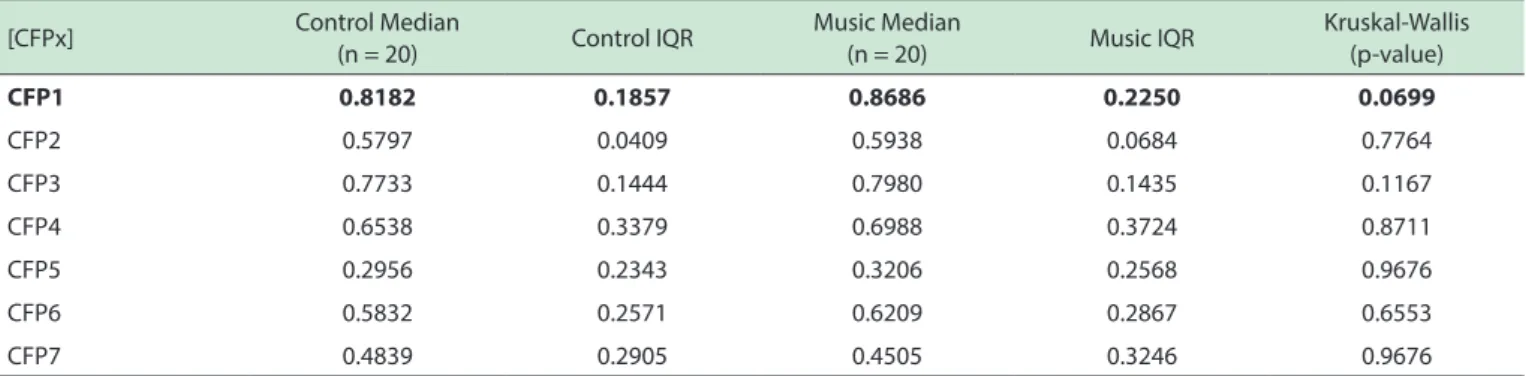
RESULTSTable 1 exhibits the statistical results for 20 control and 20 test measurements coming from a single population of 20 subjects. The results from all tests show an extremely non-normal distribution. Therefore, we must apply the Kruskal-Wallis31 (non-parametric) test of significance.
The only significant combination of new chaotic
globals is CFP 1 (p < 0.07). CFP1 is expected to be the
most significant CFP, because it contains to most of the
information of the system from the three chaotic globals rather than two or one. It has also been shown in Garner
& Ling (2014) in the optimization study that the chaotic globals are most robust when applied three ways and
also in youth obesity. Since there is only one significant
combination of chaotic global we did not neeed to perform multi-variate analysis.32
■
DISCUSSIONWe investigated the acute effects of auditory stimulation with heavy metal music on cardiac autonomic regulation through analysis of HRV with novel high spectral chaotic globals. Preceeding studies have shown
the long-term beneficial effects of relaxing classical music.2 Contrastingly, heavy metal music has been associated with physiological and psychological arousal. It was suggested that heavy metal music is ineffective as a therapeutic remedy because it induces stress and possibly life threatening arrythmias,33 including an elevated heart rate.34,35 This is
understood to be due to its influence on the neuroendocrine system with significant increases in the secretion of
noradrenalin, cortisol and adrenocorticotrophic hormones. In this study, all median values for the control are less than those for heavy metal music, with the exception of
CFP7. Because only CFP1 is significant we can assume that
heavy metal music is leading to an increase in the median and also in the interquartile range. With the exception of pathological arrythmias we would have expected the measurements of chaos to decrease in response to heavy metal music, because we expected it to have a negative effect. However, our results suggest that it may be the case that short-term and acute exposure to heavy metal music
is beneficial, whereas longer term exposure is detrimental. We detected significance only in the first Chaos
Forward Parameter, CFP1; this parameter applies all three chaotic global techniques and therefore contains most of the statistically relevant information relating to the measured data. In CFP1 the data has been applied in three ways. rather than in two ways, as occurrs for CFP 2, 3, 4 or in one way, as in CFP 5, 6, 7.16
Table 1 - Non-parametric statistics (median and interquartile range, and Kruskal-Wallis test of signiicance) for the CFP parameters (1-7) for the control mode and the exposed to heavy-metal music mode. The number of RR intervals is 1000 and recordings lasted approximately 20 minutes
[CFPx] Control Median
(n = 20) Control IQR
Music Median
(n = 20) Music IQR
Kruskal-Wallis (p-value)
CFP1 0.8182 0.1857 0.8686 0.2250 0.0699
CFP2 0.5797 0.0409 0.5938 0.0684 0.7764
CFP3 0.7733 0.1444 0.7980 0.1435 0.1167
CFP4 0.6538 0.3379 0.6988 0.3724 0.8711
CFP5 0.2956 0.2343 0.3206 0.2568 0.9676
CFP6 0.5832 0.2571 0.6209 0.2867 0.6553
consequently, there is an increase in heart rate and blood pressure.
This study is a pioneer in the chaotic analysis of the behavior of HRV in women undergoing auditory stimulation with heavy metal music style. In this sense, we suggest that this information can be useful and induce additional studies to bring innovations into clinical practice and to advance alternative therapies. In future, we intend to examine other musical styles and
different musical exposure times to verify if they influence
nonlinear dynamics of HRV.
This study has limitations. The included population is not large, and this is why we applied the Lilliefors test of normality and then the non-parametric tests of
significance (Kruskal-Wallis) rather than ANOVA1. This
is also the reason why we have used a broader than usual
level of significance. However, we would like to note that the significant chaos forward parameter (CPF1) attained
a level of < 7% probability. One other parameter, CPF3 attained a level of <11%, while all the others are entirely
non-significant. It is clear that more research is required
before these claims can be established, but we believe this
to a be a valid first approach.
■
CONCLUSIONSAcute musical auditory stimulation by heavy
metal music did significantly influence the global chaotic
parameters of HRV in a small sample of healthy female subjects. It appears that the acute exposure to heavy metal
music may be beneficial, in contrast to what is known about
the chronic exposure to it.
■
ACKNOWLEDGEMENTSThe study received financial support from Pró
Reitoria de Pesquisa - PROPe - UNESP
■
CONFLICT OF INTERESTThe authors declare that there is no conflict of
interests regarding the publication of this article..
■
AUTHOR CONTRIBUTIONSAll authors participated in the acquisition of data
and revision of the manuscript, Nogueira ML, Osório E
and Valenti VE performed statistical analysis and drafted the manuscript. Valenti VE, Abreu LC, and Garner DM determined the design, interpreted the data and drafted
the manuscript. All authors read and gave final approval
for the version submitted for publication. Previous studies using HRV indices in the time
and frequency domains to assess the effects of classical baroque and heavy metal music found no difference in cardiac autonomic regulation in men. Additionally, in the same study, increasing the sound levels in three groups still led to no significant change.36 In order to avoid gender differences regarding the cardiac autonomic responses; this study compared only females. One study suggests females are more reactive to musical stimulation than men.37 The physiological and psychological influence has been suggested as owing to the influences of hormones.38,39
Therefore, this study is unique in that it has proved
a mildly significant statistical difference between the control subjects and those under influence of heavy metal music. However, the differences which are significant
where all three chaotic globals are applied, lead to an increase in the measurements of chaos. Increasing Chaotic Forward Parameter is usually associated with improved physiological status and lower levels of dynamic diseases. Because these results were not expected, it is suggested that the study be repeated over the long-term by applying heavy metal music in the same manner as was employed in the study which applied relaxant music; two hours per day, two days per week over eight weeks. It may be that
acute effects of heavy metal music are beneficial, when
the longer-term effects are the opposite. An investigation should also endeavor to determine what may be the
influence of elevating or decreasing the sound levels of
the heavy metal music, systematically as was undertaken a previously mentioned study.36
The interaction between activities of the autonomic
nervous system and emotions have been properly defined,
this interaction was also synthesized with music.40 Listening to music provides moments of pleasure and excitement, it triggers individual activities followed by physiological changes in the body which leads to an increase in the activities of the autonomic nervous system,41,42 specifically the sympathetic component.40
It is not necessary familiarity with a particular musical style to induce physiological responses,43 the dynamics of changes in sounds, such as unexpected bills that occur early or late, raise a variety of emotions.44,45 The musical heterogeneity may be the key to such events because there is a permanent alternation of harmonic characteristics, rhythmic and spectral during the execution of music.43
A significant finding in our study is the increase in
HRV during the musical auditory stimulus heavy metal
style. The specific music we use is characterized by a fast
pace and in individuals exposed to the same music once had opposite responses, ie reduced HRV.44
MEDIDAS GLOBALMENTE CAÓTICAS DE VARIA-BILIDADE DE FREQUÊNCIA CARDÍACA DURANTE ESTÍMULO AUDITIVO AGUDO POR MÚSICA HEA-VY METAL
OBJETIVO: A estimulação auditiva com música
relaxante pode melhorar a regulação autonômica cardíaca
em indivíduos tratados com um medicamento cardiotóxica.
Avaliamos o efeito agudo de música heavy metal sobre a regulação autonômica cardíaca, por meio de novas técnicas
de análise, ditas globalmente caóticas de espectrais altos: (a) high spectral detrended fluctuation, (b) high spectral
entropy (c) spectral multi-taper method.
MÉTODO: Estudamos mulheres jovens entre 18 e
30 anos de idade expostas a música heavy metal (75-84 dB) durante 20 min. Foram aplicados os seguintes testes de normalidade: (i) Anderson-Darling, (ii) Ryan-Joiner (similhante ao de Shapiro-Wilk); (iii) Lilliefors para baixo número de indivíduos. Todos indicaram que os dados obtidos apresentavam distribuição não-normal. Consequentemente foi aplicado o teste não-paramétrico de Kruskal-Wallis. Por causa da pequena população,
utilizou-se um nível de significância mais amplo do que o habitual
(p crítico = 0,1).
RESULTADOS: A aplicação dos três testes para
normalidade e o teste não-paramétrico de significância
pela técnica de Kruskal-Wallis mostrou que a estimulação auditiva musical aguda com metais pesados produziu
um aumento significativo (p < 0,07) em uma das sete combinações de globais caóticos. A combinação de globais caóticos que é mais importante é a “Chaos Forward Paremeter one” (VFP1) na qual se manifestam todos os três globais caóticos aplicados (high spectral detrended fluctuation, high spectral entropy, spectral multi-taper method). Encontramos um aumento significativo durante a estimulação auditiva musical para este parâmetro específico.
CONCLUSÃO: Sugere-se que a estimulação musical
aguda com heavy metal influencia a regulação autonômica cardíaca em um nível mais complexo e pode ser benéfica
para a função cardíaca.
PALAVRAS-CHAVE: sistema cardiovascular; sistema
nervoso autônomo; estimulação auditiva; medida global
caótica espectral elevada
■
REFERENCES1. Valenti VE, Guida HL, Frizzo AC, Cardoso AC, Vanderlei LC, Abreu LC. Auditory stimulation and cardiac autonomic regulation. Clinics. 2012;67(8):955-8.
2. Chuang CY, Han WR, Li PC, Song MY, Young ST. Effect of long-term music therapy intervention on autonomic function in anthracycline-treated breast cancer patients. Integr Cancer Ther. 2011;10(4):312-6. 3. Yamasaki A, Booker A, Kapur V, Tilt A, Niess H, Lillemoe KD, et al. The
impact of music on metabolism. Nutrition. 2012;28(11-12):1075-80.
4. Nakamura T, Tanida M, Niijima A, Hibino H, Shen J, Nagai K. Auditory stimulation affects renal sympathetic nerve activity and blood pressure in rats. Neurosci Lett. 2007;416(2):107-12.
5. Bernardi L, Porta C, Casucci G, Balsamo R, Bernardi NF, Fogari R, et al. Dynamic interactions between musical, cardiovascular, and cerebral rhythms in humans. Circulation. 2009;119(25):3171-80.
6. Vanderlei LC, Pastre CM, Hoshi RA, Carvalho TD, Godoy MF. Basic no-tions of heart rate variability and its clinical applicability. Rev Bras Cir Cardiovasc. 2009;24(2):205-17.
7. Mackey MC, Milton JG. Dynamical diseases. Ann N Y Acad Sci. 1987;504:16-32.
8. Costa MD, Henriques T, Munshi MN, Segal AR, Goldberger AL.Dynamical glucometry: Use of multiscale entropy analysis in diabetes. Chaos. 2014;24(3):033139.
9. Liu AB, Wu HT, Liu CW, Liu CC, Tang CJ, Tsai IT, et al. Application of multiscale entropy in arterial waveform contour analysis in healthy and diabetic subjects. Med Biol Eng Comput. 2015;53(1):89-98. 10. Banzett RB, Pedersen SH, Schwartzstein RM, Lansing RW. The affective
dimension of laboratory dyspnea: air hunger is more unpleasant than work/effort. Am J Respir Crit Care Med. 2008;177(12):1384-90. 11. Laveneziana P, Garcia G, Joureau B, Nicolas-Jilwan F, Brahimi T,
Lavio-lette L, et al. Dynamic respiratory mechanics and exertional dyspnoea in pulmonary arterial hypertension. Eur Respir J. 2013;41(3):578-87. 12. Alvarez D, Hornero R, Marcos J, Del Campo F, Lopez M. Spectral analysis of electroencephalogram and oximetric signals in obstructive sleep apnea diagnosis. Conf Proc IEEE Eng Med Biol Soc. 2009;2009:400-3. 13. Ponnusamy A, Marques JL, Reuber M. Comparison of heart rate vari-ability parameters during complex partial seizures and psychogenic nonepileptic seizures. Epilepsia. 2012;53(8):1314-21.
14. Ponnusamy A, Marques JL, Reuber M. Heart rate variability measures as biomarkers in patients with psychogenic nonepileptic seizures: potential and limitations. Epilepsy Behav. 2011;22(4):685-91. 15. Vanderlei FM, Vanderlei LCM, Garner DM. Heart rate dynamics by
novel chaotic globals to HRV in obese youths. Rev bras crescimento desenvolv hum. 2015;25(1):82-8.
16. Garner DM, Ling BWK. Measuring and locating zones of chaos and irregularity. J Syst Sci Complex. 2014;27:494-506.
17. Bai X, Li J, Zhou L, Li X. Influence of the menstrual cycle on nonlinear properties of heart rate variability in young women. Am J Physiol Heart Circ Physiol. 2009;297(2):H765-74.
18. Souza NM, Vanderlei LC, Garner DM. Risk evaluation of diabetes melli-tus by relation of chaotic globals to HRV. Complexity. 2015;20(3):84-92. 19. Vanderlei FM, Vanderlei LC, Garner DM. Chaotic global parameters
correlation with heart rate variability in obese children. Rev bras crescimento desenvolv hum. 2014; 24(1):24-30.
20. Johnson R, Shore J. Which is the better entropy expression for speech processing:-S log S or log S? Acoustics, Speech and Signal Processing, IEEE Transactions. 1984:32(1):129-37.
21. Shannon CE. A mathematical theory of communication. ACM SIGMO-BILE Mobile Comput Communic Rev. 2001;5(1):3-55.
22. Zyczkowski K. Rényi extrapolation of Shannon entropy. Open Syst Inf Dynamics 2003;10(3):297-310.
23. Peng CK, Havlin S, Stanley HE, Goldberger AL. Quantification of scaling exponents and crossover phenomena in nonstationary heartbeat time series. Chaos. 1995;5(1):82-7.
24. Percival DB, Walden AT. Spectral Analysis for Physical Applications: Multitaper and Conventional Univariate Techniques. Cambridge Uni-versity Press, 1993.
25. Alkan A, Kiymik MK. Comparison of AR and Welch methods in epileptic seizure detection. J Med Sys. 2006;30(6):413-9.
26. Slepian S. Prolate spheroidal wave functions, Fourier analysis and uncertainty - V: The discrete case. Bell Syst Tech J. 1978;57(5):1371-430.
27. Gould SH. Variational methods for eigenvalue problems: an introduc-tion to the methods of Rayleigh, Ritz, Weinstein, and Aronszajn. Courier Dover Publications, 1995.
29. Ryan TA, Joiner BL. Normal probability plots and tests for normality. Minitab Statistical Software: Technical Reports. The Pennsylvania State University, State College, PA. Available from MINITAB. Inc, 1976. 30. Razali NM, Wah YB. Power comparisons of shapiro-wilk,
kolmogorov-smirnov, lilliefors and anderson-darling tests. J Statistical Modeling Analytics. 2011;2(1):21-33.
31. Kruskal WH, Wallis WA. Use of ranks in one-criterion variance analysis. J Am Statistical Ass 1952;47(260):583-621.
32. Jolliffe I. Principal component analysis. Wiley Online Library, 2005. 33. Trappe HJ. The effects of music on the cardiovascular system and
cardiovascular health. Heart. 2010;96(23):1868-71.
34. Blood AJ, Zatorre RJ. Intensely pleasurable responses to music correlate with activity in brain regions implicated in reward and emotion. Proc Natl Acad Sci U S A. 2001;98(20):11818-23.
35. Burns JL, Labbé E, Arke B, Capeless K, Cooksey B, Steadman A, et al. The effects of different types of music on perceived and physiological measures of stress. J Music Ther. 2002;39(2):101-16.
36. Amaral JA, Nogueira ML, Roque AL, Guida HL, De Abreu LC, Raimundo RD, et al. Cardiac autonomic regulation during exposure to auditory stimulation with classical baroque or heavy metal music of different intensities. Turk Kardiyol Dern Ars. 2014;42(2):139-46.
37. Nater UM, Abbruzzese E, Krebs M, Ehlert U. Sex differences in emo-tional and psychophysiological responses to musical stimuli. Int J Psychophysiol. 2006;62(2):300-8.
38. Chikahisa S, Sano A, Kitaoka K, Miyamoto K, Sei H. Anxiolytic effect of music depends on ovarian steroid in female mice. Behav Brain Res. 2007;179(1):50-9.
39. Plassa BO, Milan RC, Guida HL, de Abreu LC, Raimundo RD, Gon-zaga LA, et al. Cardiac autonomic responses induced by auditory stimulation with music is influenced by affinity. MedicalExpress. 2014;1(4):206-10.
40. Salimpoor VN, Benovoy M, Longo G, Cooperstock JR, Zatorre RJ. The Rewarding Aspects of Music Listening Are Related to Degree of Emo-tional Arousal. PLoS ONE. 2009;4(10):e7487.
41. Sequeira H, Hot P, Silvert L, Delplanque S. Electrical autonomic cor-relates of emotion. Int J Psychophysiol. 2009;71(1):50-6.
42. van den Bosch I, Salimpoor VN, Zatorre RJ. Familiarity mediates the relationship between emotional arousal and pleasure during music listening. Front Hum Neurosci. 2013;7:534.
43. Salimpoor VN, Zald DH, Zatorre RJ, Dagher A, McIntosh AR. Predictions and the brain: how musical sounds become rewarding. Trends Cogn Sci. 2015;19(2):86-91.
44. McLachlan N, Marco D, Light M, Wilson S. Consonance and Pitch. J Exp Psychol Gen. 2013;142(4):1142-58.