Bolm Inst. oceanogr., S Paulo, 31(1):93-112,1982
DISTRIBUTION OF WARM WATER ALPHEOID SHRIMP (CRUSTACEA
JCARIDEA) ON
THE CONTINENTAL SHELF OF EASTERN SOUTH AMERICA BETWEEN
23AND
35°LAT, S,
Martin L. CHRISTOFFERSEN*
Universidade Federal da Paraíba
Synopsis
The southern boundaries of
Toze.uma. .6eJVta.tum
A. MiLne Edl.JJards.,Salmone.U6 ofLtma.n.ni
(Rankin) and P~oee..6.6a. p~OóUYl.da. Manning
&
Chace., previousLy known onLy from thenorthwestern AtLantic., have been extended to são PauLo., Paraná and Uruguay.,
re-spectiveLy. ~e.ute..6 ~VulU6 (Stimpson)., previousLy not known beyond são Paulo.,
has been found to as far south as the Province of Buenos Aires. A systematic account of these four species is furnished., based mainLy on materiaL coUected by
the R/V "Prof. W. Besnard". The 16 species of ALpheoideawhose southern boundaries
occur in warm-temperate sheLf waters of eastern South America belong to two distinct
fauna L asserrb Lages: (1) TropicaL species -
Atphe.U6 óloJÚda.n.U6
Kings Ley., A.h1bún6e.C.U6 Bate., A.
nOJuna.nni
KingsLey.,Salmone.U6 oJr;tma.n.ni
(Rankin).,Syna..tphe.U6
longi~pU6 (Herrick).,OgyJÚde..6
a.fpha.e.~o.6tni.6 (KingsLey) (= O.oc.c.ide.Yl.ta.fi.6
(O~ma.n.nJJ,
ExhippolY.6maia.
oplopho~oide..6 (HoLthuis)., L~e.ute..6 pa.~VulU6 (Stimpson).,P~c.e..6.6a. b~ude.Yl..6i.6 (Rankin) and
P.
he.mphiffi
Manning&
Chace - which are Largetyrestricted to coastaL and inshore sheLf waters Less than 50 m deep; and (2)
Sub-tropicaL species -
Mphe.U6 poua.n.g
Christoffersen.,A.
pua.pe.ba.
Christoffersen.,Me.ilippolyte. a.me.JÚc.a.n.a.
HoUhuis.,Toze.uma. .6e.JUta.tum
A. MiLne Edl.JJards., P~oc.e.6.6a.guya.n.a.e.
HoUhuis and
P.
p~oÓUYl.da. Manning & Chace - which a:r>e ZargeLy restricted to theouter portion of the continentaL sheLf within the studied area. Considering the terrrperature and distributionaL data avaiZabLe for each species., it is suggested
that the poLewar'd boundaries of
O.
a.fpha.e.~.6tni.6 are set by mGZÍrrrum SUJ71J7/ertempero-atures of about 20°C required for the reproduction of the species., whiLe the poZeward boundaries of most of the tropicaL and subtropicaL species are set by
minimum winter terrrperatures criticaL for their survivaL: about 15°C for
A.
ólollida.nU6,
aboutnOc
forE.
opfopho~oide..6, about 9°C forA.
poua.n.g,
L. pa.~VulU6,P.
guya.n.a.e.,
P.
he.mphiffi
andP.
p~oóUYl.da..,
and about8
°
C forA.
pua.pe.ba.
andM.
a.me.Ilic.a.n.a..
It is further suggested that the shoreward boundaries of some of the subtropicaL species are set by maximum SUJ71J7/er temperatures criticaL for their survivaL: about
20-22°C for
A.
pua.pe.ba.
and about17-1S0c
forA.
poua.n.g
andM.
a.me.JÚc.a.n.a..
Introduction
The shelf carideans of the superfamily Alpheoidea from southern Brazil and Uruguay have been sampled in 1961 by the French oceanographic ship "Calypso" and in -the last 14 years mainly by the Brazi lian oceanographic ship "Prof. W. Besnard". The most important material was ob tained by the "Prof. W. Besnard"
in the region between Torres, Brazil (29°S), and Maldonado, Uruguay (35°S), consisting of samples from 12 lines
*
Núcleo de Estudos e Pesquisas dos Re-cursos do Mar and Departamento de Bio-logia. Universidade Federal da Paraí-ba. - 58.000 - João Pessoa - PB.Publ. n.9
533do IYl..6t.
oc.e.a.n.og~.da. U.6p.
perpendicular to the Brazilian coastline dredged in January, April, August and October of 1972, and from 3 lines perpen-dicular to the Uruguayan coastline, dredged in August and November of 1972
(Vazzoler, 1973).
94
Mate ri a 1
Specimens from the following insti-tutions have been included in this report: Institute of Marine Sciences, North Carolina (IMS); Instituto
Oceano-gráfico da Universidade de são Paulo (IOUSP); Museu Nacional do Rio de Janei-ro (MNRJ); Museu de Zoologia da Univer-sidade de são Paulo (MZUSP); and United ' States National Museum, Washington, D.C.
(USNM). Other specimens mentioned in the systematic section are under the author's care or in the collections of the Departamento de Biologia da Univer-sidade Federal da Paraíba.
Systematic section
Sa1.moneU6 OMmamú
(Rankin, 1898)(Figs 1-3)
A:tha.naó
oJr;tmanni.
Rankin, 1898: 251, p1. 30 figo 7 TI:ype locality: NearNassau, New Providence Island, Bahama~. -Ve rri 1l, 1900: 579 me rmuda~ •Jo~~eaurnea
ontmanni.
-
Coutiere, 1900: 356 [discussion]. - Verrill, 1922: 122 [condensed original description]. - Schnútt, 1936: 367, p1. 12 figo2 h,i ~iscussion; Bermuda specimen figured in dorsal and lateral view~.
Sa1.moneU6 oMmanni.
-
Chace Jr., 1972: 79frucatan Peninsula; keil. - Carvacho, 1979: 453 ~uadeloupe;
synonymy] •
Examined material
BRAZIL, SÃO PAULO: Cananéia: February 1, 1967, lovig. spec. (MZUSP 29); Mar de Cananéia and Baía do Trapandé, 0.3 to 0.8-1.17 m, 18.72 to 34.4loC, 3.07 to
26.84 % 0 . C. Jesus, M. Iwai
&
Lincoll. February 21, 1973 to March 13, 1975 (not collected in July and August), 35 samples (IOUSP).
-PARANÁ: 25°30'S - 48°29'W, 22 m, mud, December 11, 1971, "Prof. W. Besnard" Sta. 1587, 1 ovig. spec.
(IOUSP) .
Measuremen ts
The largest ovigerous specimen measures 6 mm (carapace and rostrum) plus 11 mm
(abdomen and telson) along the dorsal midline of the body, its major CheIa measures 5.5 mm (length of propodus) by 2 mIl (width of propodus) by 1.5 mm
Bolm Inst. oceanogr., S Paulo, 31 (1), 1982
(height of propodus) , whi1e its minor first cheIa is absent. The largest non-ovigerous specimen measures 5 plus 9 mm, its major cheIa measures 5 by 2 by 1.5 mm, while its minor first cheIa is
absent. The sma1lest ovigerous specimen measures 5 plus 9 mm, both chelae being absent.
Remarks
Of the 16 known species of
Sa1.moneU6, 13
inhabit the Indo-Pacific region and have a characteristic "trapeziform" notch in the posterior margin of the telson:
S.
babai
Miyake & Miya,1966"S. bnevinMtw
(Edmondson, 1930),
S. bnun..t
Banner&
Banner, 1966,
S.
~tatU6 (Coutiere,1897), S. gJz.aeLtip~ Miya, 1972, S.
h-U.a.Jwi..a.
(De Man, 1910), S. .e.a.t.iJto~:.tJcM(Coutiere, 1896),
S.
mau.te~~ (Edmondson,1930), S. Jz.O~thatU6 Barnard, 1962, S.
~enJz.ati~gi~ (Coutiere, 1896),
S.
~ibogae (D~ Man, 1910),
S. ta6aongae
Banner & Banner, 1966 and S. :tJú~~
Banner, 1959.
S. oMmanni.
(Rankin, 1898) approaches Western Atlantic S.aJLUbae
(S chmi tt '.. 1936) and E as te rnAtlantic
S.
jant.<.
(Holthuis, 1951) for having the posterior margin of the te1sonat most very slightly emarginate and somewhat depressed dorsoventrally among the two posterior pairs of spines, five to seven hairs being placed between these spines.
S.
jaJz.li
can be dis-tinguished mainly by the general shape of the first pair of chelipeds (Holthuis, 1951: 95, figo 20), whileS.
ahU6ae
can be distinguished mainly by the broadlytriangular rostrum and by the relative1y short dacty1us of the third pereiopod, which is contained in the propodus two and one-third times (Schmitt, 1936: 366) •
The new material differs slightly from the original description in having the major cheIa 2.5 to 3 times longer than wide, instead of on1y twice as long as wide (Rankin, 1898: 251). In his key to the Western Atlantic species of
Sa1.moneU6,
Chace Jr. (1972: 78)vari-CH RI STOFFERSEN: South America: alpheoid shrimp 95
ation of these characters in
S. oldmannL
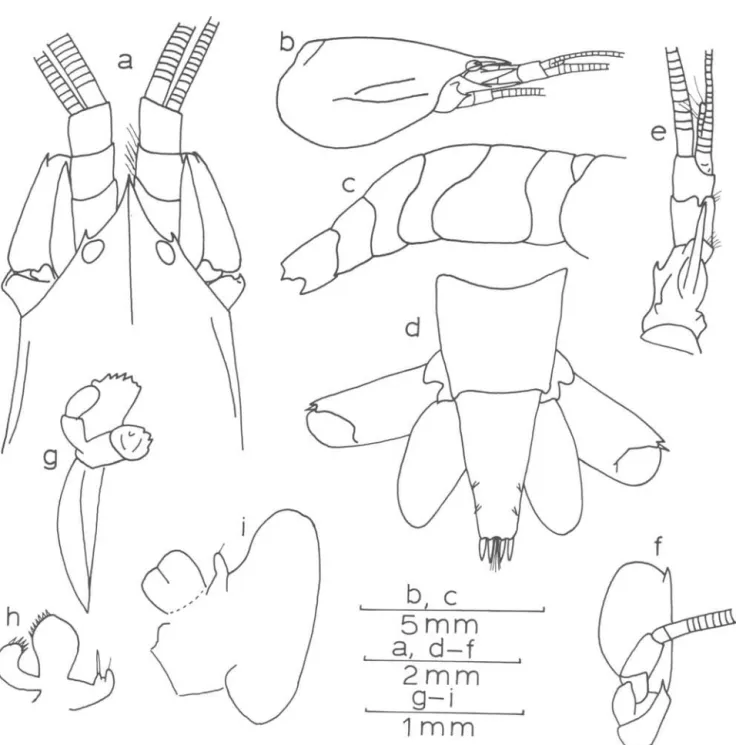
As on1y the very short original de-scription based on a sing1e specimen is avai1ab1e for this species , I h ave furnished complete illustrations fo r the new material (Figs 1- 3). Othervari-at ions encountered are the fo110wing: rostrum re aching between end of first and end of second segment of antennu1ar pedunc1e; antenna1 sca1e reaching
between end of second and ha1f of third segment of antennu1ar pedunc1e. A re-markab1e morpho10gica1 aspect is the presence of an appendix masculina on the
second p1eopod of alI specimens ex-amined, inc1uding those bearing eggs.
BioLogy
Ovigerous specimens have been collected at the Yucatan Peninsula in Apri1
(Chace Jr., 1972), at Cananéia, são Pau-lo, in February, and at Paraná in
December. I have been unab1e to dis-tinguish the sex of the Brazi1ian ma-terial due to the preseuce of an appendix masculina in alI specimens examined.
The bio10gica1 imp1ications of this peculiar trait are not c1ear to me, especia11y as Chace Jr.
(op. cit.)
has apparent1y been ab1e to distinguish between males and non-ovigerous fema1es. The species appears to be abundant in sha110w estuarine environments just be10w the low-water 1ine, where rneasured water temperatures in which specimens were co11ected varied from 18.72 to 30.41°C, and measured sa1inities varied from 3.07 to 26.84 % 0 .Habitat
Within the bay waters at Yucatan Pen-insula, specimens are most common on shallow turt1e grass f1ats, but thrée specimens carne from tide poo1s and rocks near 10w-tide leveI and one specimen was apparent1y taken from much eroded coral standing in 3 m of water (Chace Jr., 1972: 79). The species was found in
~stuaries in Guade10upe (Carvacho,
1979: 453) and Cananéía, SP, where
specimens are common on sha110w mud f1ats. The "Prof. W. Besnard" speci men comes from muddy she1f sediments (22 m deep) facing the 1arge estuarine comp1ex of Cananéia-paranaguá.
Distribution
Bermudas, Bahamas', Yucatan Península, Guade1oupe, são Paulo and Paraná; intertida1 region to a depth of 22 m.
Labteu.tu paJ!..vutu.6 (Stimpson, 1866)
RhynQhoQyctu.6 panvutu.6
Stimpson, 1866:48[type 10ca1 ity: Saint Joseph Is1and, Texas] .
Labteu.tu
panvutu.6
-
Ho1thuis, 1951:131,figs 28-29 [descriptíon; _synonymy; distribution]; 1952a:541Rio de Oro, 16-20 m; Annobon, 15-31
m] . -
Pearse& Wi11iams, 1951:143 [South Carolina,
12-16.8 m] . - Wass, 1955: 145fA11i-gator Harbor region~ Florida . - Tabb
&
Manning, 1961:596LEast Cape Sab1e,Florida] ; 1962: 62 i}'l_orida BayJ.
- HUlin~s, 1961:2171}>anama City,
Florida . - Roussigno1, 1962: 131 [Congo • -Wi11iams, 1965:79, figo
64 [Carolinas; Rio d= Janeiro-.J . - Ejche1, 1965:326_[Sao Paulo
J.
- Rouse, 1970: 139 [Everg1ades, Florida, 1.4-2.1 m]. - Fausto Filho, 1970:56[Ceará]; 1978: 66 [Piaui; Rio Grande
do Norte~ 1980:113. - Uschakov,
1970:455 Guinea]. - Crosnier, 1971:575 Congo 3 to 15 m]. - Chace Jr., 1972:124LYucatan Peninsu1a; key]. -Coelho & Ramos, 1972:153
Q?araiba; Pernambuco; Alagoas; O to 44 ~]. -_Wood, 1974:38, p1.5 figs 2-4 [key
J. -
Camp, Whiting & Marti;t,197 7 : 27 [Hutchinson Is 1and, F10rI.da, 7.1 to 11.2 m]. - Carvacho, 1979:465 [Guade10upe, 0.5 m; synonymy
J.-
Bowenet
al.,
1979:252 [between New Jerseyand Virginia] . - Fe1der & Chaney, 1979: 25 [Texas, 14 m; seasona1 a-bundance ] . - Ramos-Porto, 1980: 303
[pernambti""co, 0.3 to 14-15 m] .
Synonym - ConQo~dia g~bb~o~U6 Kingsley, 1880.
Examined materia L
. USA, NORTH CAROLINA: Carteret County: Beaufort, 0-0.3 m, from Zo~t~ f1at, M. L. Christoffersen co11. June 15, 1978,
2 ovi g.
«;
Morehead Ci ty , pie r at "Ins ti-tute of Fisheries Research", day and night p1ankton tows, A.B. wi11iams and E.E. Deub1er, Jr. co11. from April 10 to October 9, 1957, and on March 13, 1959,Guarapa-96
ri, Praia de Peracanga, 0-0.3 m, among a1gae and gorgonians, M. L. Christoffersen co11. January 10, 1978, at night, 1 spec. - RIO DE JANEIRO: Baía de Mangara-tiba, Praia da Ribeira, mud, A. Lemos de Castro and Arnaldo co11. February 6, 1959, severa1 spec. (MNRJ), 2 spec. (MNRJ26-61), 3 ~, 2 ovig. 9,1 young spec. (USNM 103769). 23° 13' S -44°15'W, 42 m, December 17, 1971, "Prof. W. Besnard" Sta 1631, 1 ovig. 9 (IOUSP - C0397). SÃO .PAULO: Ubatuba: J. Loyo1a e
Silva co11. January 16, 1963, 1 Ó , 5
9
(2 ovig.), 1 young spec. (USNM); Enseada do Flamengo, Praia da Andorinha, January 22,1963, severa1 spec.;
J..bJ..d.,
Praia do Lamberto, 1 to 6 m, sand, mud and she11fragments, L.F. Duarte co11. from Ju1y 20, 1961 to January 22, 1963, 6 samp1es
(2 cf , 1 ovig.
9,
7 spec.) (MZUSP 15 to20);
J..bJ..d.,
inSaJtgM.6um, Ju1y 13,1967,1 spec. (with spec. of Bopy~»a
abb~evJ..ata Rich. in branchia1 chamber)
(MNRJ);
J..bJ..d.,
intertida1 zone, inSaJtgM.6um, 1972, at night, 1 spec. (with
spec. of
B.
abb~vJ..ata in branchia1 chamber) (MNRJ); .J..bJ..d.,
0-1 m, in the red a1gae B~octadJ..a and AQanthopho~, M.L. Christoffersen co11. Ju1y 8, 1976, 1 Ô , 1 ovig. 9' 23°50'S-45°S2'W, 22 m, December 15, 1971, "Prof. W. Besnard" Sta 1615, 1 Ó , 1 ovig. 9 (IOUSP-C0391).23°51'S-45°41'W, 25-26 m~ mud, 21.12°C, Augus t 11, 1970, "Prof. W. Besnard" S ta 1163, 2 samp1es (1 ovig. 9. 1 spec.) (IOUSP-C0249). 24°21'S-46°38'W, 25 m, sand, 20.63° C, Augus t 13, 1970, "Prof. W. Besnar~' Sta 1170, 1 ovig. 9 (IOUSB-C0254). 24°40'S-47°16'W, 19 m, December 13, 1971, "ProL W. Besnard" Sta 1599, severa1 spec. (IOUSP-C0384). 24°51'S-47°29'W, 21 m, sand, research vesse1 "Emília", 3 ovig. <j? (roUSP-C1082).
24°S3'S-47°37'W, 19 m, sand, "Emília", 1 spec. (IOUSP-C1081). Cananéia: Mar de Cananéia, 0.6 m, 19.85°C, 26.30 %0, Augus t 9, 1974, 1 ovig 9' (IOUSP); Baía do Trapandé, 5 m, January 11, 1973, 7 spec. (6 ovig.
9)
(IOUSP);J..bJ..d.,
0.5 m, 22.59°C, October 30, 1973, 1 spec.(IOUSP). 25°00.5'S-47°44'W, 17 m, sand, "E ' 1 . "2 nu ~a, samp es 1 ( 5 ' ov~g. 9, spec. • 1 ) 25°03.5'S-47°51'W, 12m, sand, "Emília", 1 ovig. 9 (IOUSP-C1076). - PARANÁ: 25°30's-4S029'w, 22 m, December 11, 1971, "ProL W. Besnard" Sta 1587, 3 samp1es (6 ovig
9'
2 9) (IOUSP-C0379). 25°30'S-4S029'W, 23 m, she11 fragmentsBolm Inst. oceanogr., S Paulo, 31 (1), 1982
and sand, December 11, 1971, "ProL W. Besnard" Sta 1587, 9 spec. (8 ovig 9)
(IOUSP-C0379) . 25 °51 'S-48°19
'w,
21-22 m, sand with a1gae, 18.77°C, Augus t 19, 1970, "ProL W. Besnard" S ta1180, 1 spec. (IOUSP-C0262). - SANTA CATARINA: 28°10'S-48°35'W, 32 m, c1ay, 20.26°C, December 9,1970, "ProL W. Besnard" Sta 1295, 1 ovig. 9 (IOUSP-C03l8). 2S018'S-48°34'W, 50 m, c1ay and empty she11s, 24.75°C, March 1, 1971, "ProL W. Besnard" S ta 1441, 1 spec. (IOUSP-C0338). 29°13'S-49°35'W, 21-22 m, fine sand, 24.01°C, 35.72 %0, "Prof. W. Besnard" Sta 1699, 1 cf (part of MZUSP 45). - RIO GRANDE DO SUL: 29°24.0'S-49°10.0'W, 55 m, mud and she11s, 18.81°C, 35.39 %0, August 2, 1972, "ProL W. Besnard" Sta 1843, 1 ovig. 9 (IOUSP-C0524). 29°39'S-48°41'W, 122-124 m, mud and clay, 15.66° C,
35.67 %0, January 30,1972, "ProL W. Besnard" S ta 1696, 2 samp1es (1 ovig. 9,
6 spec.). 31°09'S-50043'W, 21 m, dark mud, 22.28°C, 34.83 %0, Apri1 10, 1972, "ProL W. Besnard" Sta 1725,3 samp1es (3 ovig.
9,
10 spec.) (IOUSP-C0485). 31°27'S-51°05'W, 16 m, sand, 22.17°C, 33.78 %0, Apri1 12, 1972, "ProL W. Besnard" Sta 1732,1 ovig.9
(IOUSP-C0494). 31°45'S-51°26'W, 16 m~ fine sand and mud, 21.95°C, 33.43 %0, Apri1 12, 1972, "ProL W. Besnard" Sta 1733, 5 ovig. 9 (IOUSP-C0496). 32°20'S-51°22'W, 52 m, mud and sand, 19.45°C, 35.90 %0, January 21,1972, "ProL W. Besnar~' Sta 1662, 4 ovig.
9
(IOUSP-C0420). 33°14.0'S-51°48.5'W, 45 m, ca1careous sand, 11.94°C, 33.19 %0, August 18, 1972, "ProL W. Besnard" Sta 1893, 1 spec. (IOUSP-C0581). 33°45.5'S-53°16.5'W, 16 m,sandandshellfragments, 11.70 0C, 29.91 %0, August 16, 1972, "Prof. W. Besnard" Sta 1886, 2 samp1es (2 spec.) (IOUSP-C0573). - URUGUAY: 33°50.0'S-51°50.0'W, 75 m, fine sand, mud and she11s, 12.17°C, 34.08 %0, August 17, 1972, "Prof. W. Besnard" S ta 1889, 2 samp1es (3 spec.) (IOUSP-C0578).34°01.5'S-52°44.0'W, 27 m, ca1careous sand, 10.87°C, 33.08 %0, August 16, 1972., "ProL W. Besnard" Sta 1885, 1 spec. (IOUSP-C0570). 34°35.5'S-53°30.0'W, 20 m, mud and fine sand, 11.16°C, 30.55 %0, August 14, 1972, "Prof. W. Besnard" Sta 1877, 1 spec.
(IOUSP-C0560). - BUENOS AIRES: 35°00'S-54°50.2'W, 23 m, fine mud, 10. 83°C,
CHRISTOFFERSEN: South America: alpheoid shrimp
97
Besnard" Sta 1866, 2 spec. (IOUSP-C0548). 35°18.0'S-54°13.0'W, 27 m fine sand 10 6 . 6 C, 33.62
°
°
/00, August 12 1972'
,
11 ' ,
Prof. W. Besnard" S ta 1867, 2 spec. (IOUSP-C0550) . 3S 0~33. 1 'S-53°48. O
'w,
57 m, fine sand, 10.02°C, 33.69 % 0 ,August 13, 1972, "Prof. W. Besnard" Sta 1868, 1 Ó (part of MZUSP 50), 3 samp1es (22 spec.) (IOUSP-C0551).
Measurements
The largest male and the larges t ovigerous female measure 4.5 mm (carapace and rostrum) plus 8 mm (abdomen and telson) along the dorsal midline of the body. The smallest ovigerous female measures 2.5 mm plus 4 mm.
Color
Wass (1955: 145) indicated thàt the specimens are " ... usually associated with S~ga4~um, with which their mottled brown color blends". The two specimens I collected in the red algae
Bnyoctadia
and Acanthopho~ had a body which was transparent spotted by numerous b lue chromatophores, and less distinctly mottled by yellow markings.Remarks
L~~t~ pa~vulU6 is closely related to the Chilean species
L.
antibo~ea~Holthuis. The latter differs " ... in the more elongate rostrum and in having less spines on the third maxilliped"
(Holthuis, 1952b: 65).
Biology
The species appears to be most common in estuarine and marine waters less than 30 m deep, but occurs to a depth of 122-124 m. The northern ran ge limit of the species, between New JerseyandVirginia, is based on samples of pelagic larvae and pelagic adults (Bowen
et
al.,
1979:252) . In North Carolina both day and night plankton tows have provided specimens. In southeastern Brazil I have collected this species in shallow algal beds during low-tide both during the day and during the nigh t. Eggs
measure from 0.4 to 0.5 mm in diameter (Ho1thuis, 1951: 131), and a female measuring 9.4 mm in carapace lenght was found to have 70 eggs (Crosnier, 1971: 575). Although ovigerous females have been taken throughout the year in various parts of the range north of the Equator
(Williams, 1965: 79), towards the
southern boundary ovigerous females have only been taken in water temperatures above l5.66°C: at 2.9°39'S (122-124 m deep, l5.66°C) and 32°20'S (52 m deep
°
'
19.45 C) in summer (January), at 3l045'S
(16 m deep, 2l.95°C) in autumn (April) and at 29°24'S (55 m deep, l8.8l0C) in
winter (August). To the south of são Paulo, measured water temperatures in which specimens were collected varied from 10.02 to 24.0loC, and salinities
from 26.30 to 35.90 % 0 . In eastern
Florida, these values varied from 21.6 to 29.5°C and from 34.8 to 38 % 0
(Camp, Whiting & Martin, 1977: 27), while in southwestern Florida these values varied from 16 to 34°C and from 15 to 50 ° /00 (Rouse, 1970: 139).
Habitat
The species has been found over a wide variety of sub$trates: fine mud; clay; fine sand; calcareous sand; shell fragments; shells and foraminiferans, shells and hydroids (Holthuis, 1951: 131); on a shell of PinVla (Crosnier, 1971: 575); from
Halodu1..e
grass nats (Ramos-Porto, 1980:303); fromZo~te~ grass flats; among algae,
including SMga4~um, B~Cjoctadia and Acanthopho~a; from sponges (Williams, 1965: 79); among algae and gorgonians; fram Ph~agmatopoma sand reefs (Jacques van Montfrans, personal communication); fram calcareous algae (Coelho & Ramos, 1972: 153); from eroded dead coral (Chace Jr., 1972: 124); in a piece of rock (Crosnier, 1971: 575).
Distribution
Western Atlantic from between New Jersey and Virginia (Bowen
et
al.,
1979: 252) to the Province of Buenos Aires, Argentina. Eastern Atlantic from Spanish Sahara toCongo and Annobon Island; larvae possibly belonging to this species are referred
from as far south as Angola (Lebour, 1959: 124).
98
f
\--Bolm Inst. oceanogr., S Paulo, 31 (1), 1982
b ,
C
5mm
ai
d-f
2mm
g-j
1mm
Fig. 1. Salmone.u..6 oJttmann"t (Rankin), ovigerous specimen from Cananéia (MZUSP 29):
a,
anterior region, dorsal view;b,
same, lateral view; ~, abdomen,later-al view;
d,
telson and uropods, dorsal view;e.,
antennule, lateral view;CHRISTOFFERSEN: South America: alpheoid shrimp 99
d
c-h
2mm
ai b
1mm
Fig. 2.
Saimo~e~
ontma~ni
(Rankin), ovigerous specimen from Cananéia (MZUSP 29):100 Bolm Inst. oceanogr., S Paulo, 31(1), 1982
e
e
5mm
2mm
a-c
1mm
Fig.
3.
SalmoneUó o~an~ (Rankin), ovigerous specimen from Cananéia (MZUSP 29):a, first pleopod;
b,
second pleopod; ~, fifth pleopod. Ovigerous specimenfrom R/V "Prof. W. Besnard" Sta 1587: d, antenna, dorsal view; e, major
CHRISTOFFERSEN: South America: alpheoid shrimp
101Toze.uma .6e.JUta.:tum
A. Milne Edwards, 1881 (Figs 4-5).Toze.uma .6e.JUta.:tum
A. Mi1ne Edwards, 1881:16 IJ:ype loca1i ty: oH Barbados,
102.4~; 1883: .pl. 29. -Schmitt,
1924: 83 ~arbado~.-Ho1thuis, 1947:
23 [lis ted as
.6pe.ue..ó
-Ú1c.e.JU:a~.-Ewa1d, 1969: 511 [deep water east
of Florida key~. - Chace Jr., 1972:
141 ~orthwestern and south Florida,
44 to 46 m; kei]. - Herbst, Williams &
Boothe Jr., 1978: 991 @orth Carolina,
32 m; Massachuset t~ .
Examined material
BRAZIL, RIO DE JANEIRO: 22°59'S-42°27'W, 41 m, January 17, 1975, "Prof. W.
Besnard" Sta 2152, 1 9 (part of MZUSP
34). - SÃO PAULO: 24°09'S-44°59'W, 79-82 m, sand, 15.9°C, May 28,1970, "Prof. W. Besnard" Sta 1029, 1 J
(IOUSP).
MeasUl'ements
The ma1e measures 11 mm (rostrum) p1us 6 mm (carapace) p1us 15 mm (abdomen and
te1son). The fema1e measures 9 p1us 4.5 p1us l3 mm.
Remarks
A1though Ho1thuis (1947:23) had inc1uded
T •
.óe.~a:tum in his 1ist of.6pe.ue..ó
,{.Vlc.e.Jr;tae.,
commenting that .•. "this species perhaps be10ngs to a new genus as the carpus of the second pereiopod contains 7 segments", it can hard1y be doubted that the present specimens with 3 carpa1 artic1es on the second pereiopod (Figs 4-5) refer to the same distinct species as the previous references for this name.As we11 as the presence of a series of sharp teeth on the dorsal margin of
the rostrum,
T . .óe.JUta.:tum
differs fromT.
C.ahO~Vle.Vl.6e. Kings1ey by the antenna1 sca1e being 10nger than the scaphocerite, by the 10ng and narrow propodus of the first and second pereiopods, and by the te1son being 10nger than the sixthabdominal segment and deep 1y notched ~n
the posterior margin.
Biology
The species may be absent from sha110w tropical waters. A sing1e ovigerous fema1e has been reported from the northern range of the species, from a depth of 32 m and in water measuring 17.3°C in
summer (Herbst, Wi11iams & Boothe Jr.,
1978: 991).
Distribution
The species is known from waters 32 to 102.4 m deep, offMassachusetts, North Carolina, Florida, Barbados, Rio de Janeiro and são Paulo.
Ptwc.e..ó.6a pJto6uVlda
Manning & Chace Jr., 1971PJtoc.e..6.6a c.avtattc.ula:ta
-
Rathbun, 1902 (not Leach, 1815):104 [?orthwest Florida, 202 m; par~.PJtoc.e..6.6a pJto6uVlda
Manning & Chace Jr.,1971: 25, figs 13-15
1-
type10-cality: 28°36 'N - 85°33 '3Õ'
'w,
oHwe s t c o a s t o f F 1 o r i da, 2 O 2 m; other 10ca1ity: 24°20 'N - 83° 20'W, Gulf of Mexico, 346 m]. - Chace
Jr., 1972: 143 [key
-I. -
Bowene.:t
a.t.
,
1 9 7 9: 2 5 9- \- b e -t we e n N e w Jersey and vi rgini~ ] .Exami ned material
BRAZIL, SÃO PAULO: 24°05'S-43°25'W, 205-210 m, sand, mud and ca1careous rock, 13.700C, December 3, 1970, "Prof. W. Besnard" Sta 1263, 2 spe c.
(IOUSP-C0289). - RIO GRANDE DO SUL: ~9~51
'S-4So11'W, 200 m, Apri1 7, 197i., "Prof. W.
Besnard" Sta 1709 extra, 2 spec.
(IOUSP-C0466). 29°51 'S-48°11
'w,
315 m,ca1careous rock, 11. 74°C, 35.09 %0, Apri1 7, 1972, "Prof. W. Besnard" Sta
1709,2 samp1es (l,j , 1 spec.)
(IOUSP-C0465). 29°52'S-48°20'W, 200 m,
102
Apri1 7, 1972 "ProL W. Besnard" Sta 170S, 19 spec. (1 ovig. ~) (IOUSP-C0464). 29°53.0'S-48°19;S'W, 186 m, mud and sand, 14.29°C, 35.82 %0, August 3, 1972, "ProL W. Besn ard" Sta 1846, 2 spe c. (IOUSP-C0526). 30 020'S-48°37' W, 184-190 m, 16.400C, 35.74 %0, January 29, 1972, "ProL W. Besnárd" Sta
1692, 9 spec. (IOUSP-C0449). 30°28' S-4S042 ' W, 150 m, sand, April 7,1972, "ProL W. Besnard" Sta 1711 extra, 2 samp1es (7 spec.) (IOUSP-C0468).
30 031'S-49°52'W, 200 m, ca1careous rock, 17.28°C, 35.87 %0, Apri1 11, 1972, "ProL W. Besnard" Sta 1728, 6 spec. (IOUSP-C0490). 30042.7'S-49°03.4'W, 186 m, mud, sand and sheU.s, 15.80 0C, 35.65 %0, August 5,1972, "ProL W. Besnard" Sta 1856, 19 spec. (IOUSP-C0535). 30046'S-49°07'W, 170-172 m, coarse sand and grave1, 16.37°C, 35.76 %0, January 27,1972, "ProL W. Besnard" Sta 1684, 5 spec.
(IOUSP-C0441). 31°13'S-49°36'W, 232-241 m, ca1careous rock and sand, 17.31°C, 36.02 %0, January 27, 1972, "ProL W. Besnard" Sta 1681, 1 ovig.
9
(IOUSP-C0440). 31°14'S-49°35'W, 180 m, ca1careous rock, 16.58°C, 35.76 %0, Apri1 10, 1972, "ProL W. Besnard" Sta 1721, 2 samp1es (6 spec.) (IOUSP-C0479). 32° 24'S-50014'W, 188-202 m, mudandsand, 17.000C, 35.82 %0, January 22 , 1972, "ProL W. Besnard" Sta 1666, 1 spec.
(IOUSP-C0423). 33°17'S-50034'W, 166 m, fine sand and mud, 15.830C, 33.80 %0, January 19, 1972, "Prof. W. Besnard" Sta 1656, 1 spec. (IOUSP-C0414). - URUGUAY: 34 °06' S-51 ° 33
'w,
139-145 m, grave 1, 14.47°C, 35.58 %0, January 17, 197 2 , "ProL W. Besnard" Sta 1648, 2 samp1es(1 ovig 9 ,6 spec.) (IOUSP-C0407). 34°27.2'S-51°50.0'W, 175 m, ca1careous rock, 13.45°C, 35.33 %0, August 15, 1972, "ProL W. Besnard" Sta 1883, 14 spec. (IOUSP-C0568). 34°28'S-51°50'W, 170 m, coar se sand, 16.82°C, 35.81 %0, April 18, 1972, "Prof. W. Besnard" Sta
1740, 13 spec. (2 ovig. 9)
(IOUSP-C0503) .
MeasUX'ements
The 1argest ma1e measures 10.5 mm (carapace and rostrum) p1us 20 mm (abdomen and te1son) a10ng the dorsal mid1ine of the body. The 1argest ovigerous fema1e measures 13.5 p1us
Bolm Inst. oceanogr., S Paulo, 31 (1), 1982
25 nnn.
Remarks
In the new material the right second pereiopod has 17-22 mera1 and 34-43
carpa1 artic1es, instead of 21-22 and 45-46, respective1y (Manning & Chace Jr., 1971: 26), whi1e the 1eft second pereiopod has 15-17 carpa1 art ic1es, rather than 18-21
(toc.
cit.). Otherwise, on1y the fol1owing slight diffe rences in proportions of appendages were ob served: the thi rd pair of maxi llipeds ove rreaches the antenna1 sca1e by no more t han the dista1 segment, whi1e the first pair of pereiopods is slight1y shorter th an the antenna1 sca1e. The difference smentioned above comp1ement the ranges of variation of these morpho1o gi ca1 characters, and I may add that t he fifth pereiopod - incomp1ete in the t ype
material - has the propodus fou r times longer than the dacty1.
Biology
This species appears to be res tricted to the outer portion of the continental she1f and the upper slope thro ughout its range. Measured water tempera tures and sa1inities in which specimens were
co11ected vary from 11.74 to 17.31°C and from 35.09 to 36.02 %0, respective1y. Ovigerous fema1es have been co11ected in March and Apri1 in the Gu1f of Mexico
(Manning & Chace Jr., 1971: 25 ), and in January and Apri1 in South Ame r i ca. In the 1atter region, the water t emperatures in which ovigerous fema1es were co11ected varied from 14.47 to 17.31°C.
Habitat
The sediment types in which specimens were co11ected were as fo11ow s : mud; mud and fine sand; coarse sand; mud~
sand and she11s; grave1; ca1careous rock.
Di s tribution
CHRISTOFFERSEN: South America: alpheoid shrimp 103
a
c
5mm
ai
b,
d-
g
h-j
2mm
1mm
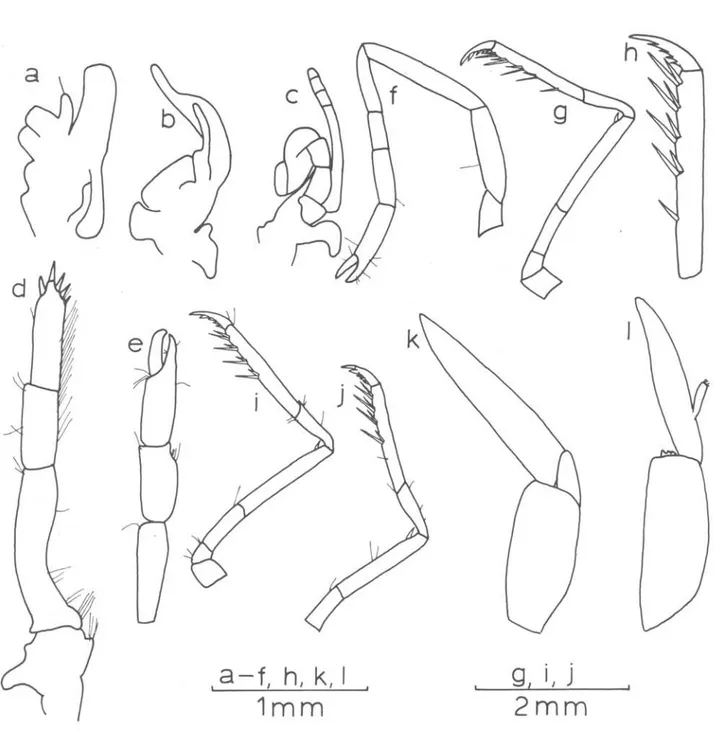
Fig. 4.
Tozeuma
~eJr.Jtcaum A. Mi Ine Edwards, female from R/V "Prof. W. Besnard" Sta2152: a, anterior region, lateral view;
b,
same, dorsal view; ~, abdomen, lateral view;d,
third abdominal somite, dorsal view;e,
sixth abdominal somite, ventral view;6,
telson and uropods, dorsal view; g, antennule,lateral view;
h,
mandible, ventral surface;i,
same, dorsal surface; j,104 Bolm Inst. oceanogr., S Paulo, 31 (1), 1982
Q,
I,
J
2mm
Fig.
5.
Toze.wna .6eJrJta.,tum
A. Milne Edwards, female from R/V "Prof. W. Besnard" Sta2152:
a,
second maxilla;" b, first maxil1iped; c., second maxil1iped; d,third maxilliped;
e.,
anterior portion of first pereiopod;6,
second pereiopod; g, third pereiopod;h,
propodus and dactyl of third pereiopod;CHRISTOFFERSEN: South America: alpheoid shrimp
105Discussion
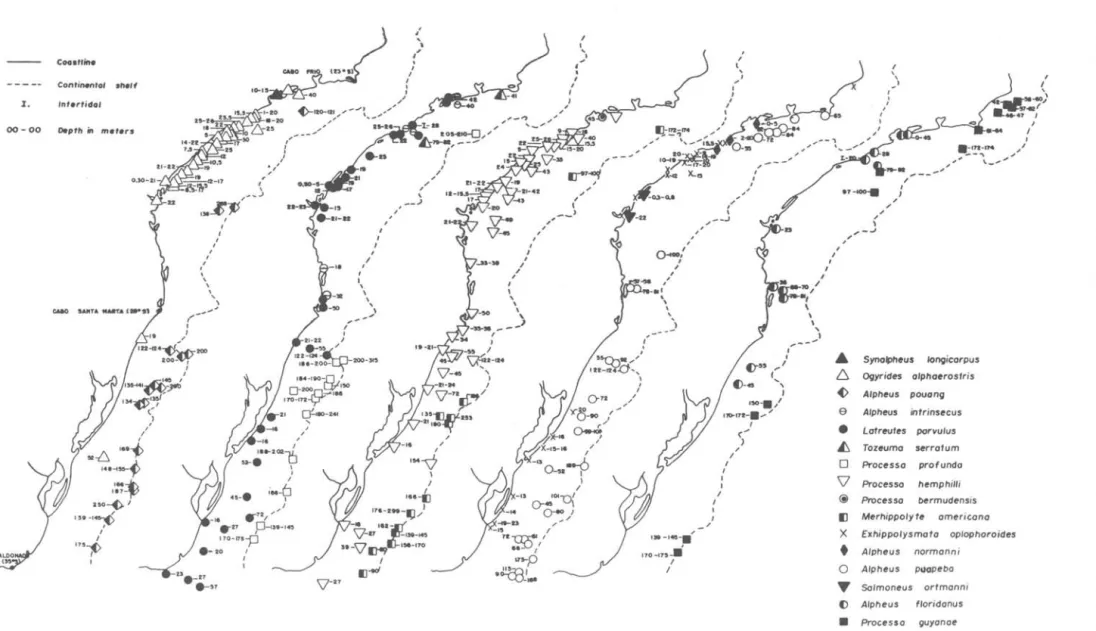
Two distinct faunal assemblages may be recognized on the continental shelf of eastern South America, between 23 and 35°S (Fig. 6):
Tropical species
This is the largest graup: Synaiph~
long~ca4~ (Herrick, 1891), P~oc~~a
beJunu.de~-ià (Rankin, 1900), Atph~
noroman~ Kingsley, 1878,
SalmoneUó
o~an~ (Rankin, 1898) andAlpheUó
~~~ecUó Bate, 1888, are apparently
restricted to seme of the most protected areas within the large bay formed
between Cabo Frio, State of Rio de Janeiro (23°S) and Cabo de Santa Marta, State of Santa Catarina (28°S).
AlpheUó
6(onidanUó
Kingsley, 1878, Ogy~d~~ aiphae~o~~ (Kingsley) (=O.
ocuden~ (Ortmann)),
ExMppoly.6mata
oplopho~o~d~ (Holthuis), P~oc~.6a
hempMili
Manning&
Chace andL~eute.6
pa4vulu.6
(Stimpson) are more widely distri:buted within this large bay, and also occur on the continental shelf facing the State of Rio Grande do Sul and Uruguay.AlI the tropical species are present in shallow coastal waters (intertidal region to 5 m deep) , being largely restricted to the eu1ittoral zone (less than about 50 m deep). The most notab1e exceptions are a sample of
P.
hemp~from 154 m deep and a sample of
L.
paAvui.u6 frem 122-124 m deep.The species of this group have alI beencollected inmeasured water temper-atures above 20.26°C (Christoffersen, 1979: 317), being present in the shallow tropical waters between southern Florida and eastern Brazil in which water tempera-tures are always warmer than 24°C (Hutchins
& Scharff, 1974:pl. 1,2). Salinity ranges
of individual species may vary consider-ab1y -
e.g.,
from 3.07 to 37% 0 forO.
aiphaVto.6bú-6
(Christoffersen, 1979: 299)and from 15 to 50%0 for
L.
pa4vulu.6 -according to the extent of their invasion of estuarine environrnents and hypersaline coas tal "Tate rs .Subtropical species
Alph~
pouang
Christoffersen, 1979,A.
puapeba
Christoffersen, 1979,M~Mppolyte am~cana Holthuis, 1961, P~OC~.6a
guyanae
Ho1thuis, 1959,P.
p~oóu.nda Manning
&
Chace, 1971 andTozeuma
.6~ A. Milne Edwards, 1881are absent from shallow coas tal waters (less than 30 m deep) , being largely restricted to the outer portion of the continental shelf within the studied area.
A.
pouang
andA.
puapeba
may so far be considered endemic to this area.T . .6~ and
P.
guyanae
are possiblyrestricted to cooler subsurface waters within the tropics and range to North Carolina (Herbst, Williams
&
Boothe Jr., 1978: 991; Christoffersen, 1979: 368).M.
am~cana andP.
p~o6unda are onlyknown from deeper waters in the Gulf of Mexico and the eastern United States, ranging, respectively, to North Carolina. (Holthuis, 1961: 1) and to between
Virginia and New Jersey (Bowen
et
ai.,
1979: 252). The species of this group have alI been collected in measured water temperatures below 2l.22°C, while measured salinities varied frem 32.15 to36.04% 0 (Christoffersen, 1979: 300). We can obtain suggestions about the factors that set the poleward boundaries of the tropical and subtropical sp~cies
known beyond 29°S from the temperature and distributional data available for each species (Tab. I). This is possible mainly because 'there are marked differ-ences in the fluctuations of the maximum and minimum monthly mean s~a tempera-tures in the northwestern Atlantic (up to about 22°C in surface waters around Cape Hatteras) and in the southwestern Atlantic (up to about 11°C in surface waters around the Rio de la P1ata)
(based on Hutchins
&
Scharff, 1947: p1.1.2) •
The po1eward boundaries of
A.
6lo~danUó (Tab. I) may be set by their inability to survive temperatures below about 15°C, because if these boundaries were set by the requirement of tempera -tures above about 21°C for the completion of some fase of the process of rePOPU-1ation of the species, their northern limit of distribution in sha110w waters wou1d be expected to reach Long Is1and, New York. A criticaI winter temperature
of 15°C wou1d also exp1ain the absence of this species from sha110w coas tal waters in the Caro1inian province, becaUSE' south of Cape Hatteras the bottom winter temperatures in the inshore she1f
1:.
00-00
Coa.tline
Continental .".,#
'nt.rt;dol
Oepth in m.t.rs
O,.-E~
,
"
~_ .. J
~/ ,
-.
"
,
" ~'.
I I I , ,C>-IZO-IZI , _ ... , " , /
~,' \ .. _,"
-'
,~-~-."
,
,1 '
....
" I
.
I I II-" ,'-'" , /
~.:
05-«100{] / ' , -~
,--;,--,'
, , /// -40_
....
"-lO n ..,v ,
rrr~
./ ,
t
~ lL ..
, I
"
~',
I I I , / \ ,. I , I _/"
I I,
, I I I \,," __ ..J
I ,
I
,,--)
,
..
~~
, ' / , __ JCAOO SANTA ...,. .. ''''1
o.
-', ,
"
I I , \,
1'----,
I I ,
11-21 / '
I / I
,
,,
, , \ ,--;' I I,
,
,,
,
, ,-50 \
~
...
___
,
I
..
,
"
,
0-:
,
Itl2-ct4-4'h~200
I~.w I
I
'11~~-%OO-:5I' , •• -zoo-~
'-$O ,
'"~ ~1.-1Z4
\7-" ",
I
'~.,~
t 1.1.-124t:1 .. ,
1)5-Mf~'" I
~:J""
'34~~~(
(
/
.. .,0.0"1>
''''~""""f;> o . . . . . ,
187-~
UO-{). I
'l.-I~ I I o,.~ ,l 1'4.'s.o-&:~ Q-lOOn':"""H '70-'72~·
[J!.,.,-2.4I ,
, I
I
,
'·"2.CIr:llJ.:>-. ,
o
1
I'J •
.. ,- i .. -Ó I"
.-72./'
· ~II·M ,
\7-71"r'"' /
1l5~.IJlI.5)
Itleo~
I
'''\1
,
I I
,.e-I]
\}-u -"'-MO
,
/
'-27 ,O-IU-'.'
'70-In-p
e-lO I
''''_1"_1)/'
-. '.I~
,. -\] ()411 '''-'70
I
,
".-."
\7-27I
1)-'
~
071 / ))("õ-
eo,..-, j
~'iE-"~
X-I!5-'1 , / " ' - I > --6
0-.. ,
0";"-0{
0-«> I
-I' "'-rTX"' I I
I~II
I1>-P
.~I - LO-...
-'
,.
\
/
,. -14&-,.'
'70-175 __
,
I
I I I /
()"" I "
()-.. "
I 150-./ 1"Jt>17t-., , I (~ / / ) I I
,
I,
I , ·10 , /.,
\ I \ \ ,,
,..--' I , I , ,\n
...
,---'~--,
, I .,-~ I I , /' ~ 6 (> e•
~ O \7 @ I) X•
O•
()•
,
, , \ ,_..J ,Syoo.",eus klllgicorpus
Ogyrides olphoerosfris
Alpheus pouong
Alpheus ;ntrinsecus
Lotreufes porvulus
Tozeumo serrofum
Processo profundo
Processo hemphilli
Processo bermudensis
Merhippolyte americano
Exhippolysmoto oplophoroides Alpheus normonn;
Alpheus Pllopeba
Solmoneus ortmonni
Alpheus floridonus
Processo guyonoe
Fig.
6.
Distribution of tropical and subtropical species of Alpheoidea in thewarm-temperate shelf waters of eastern South America.
I I o O' 07 o 3 :::l UI r-t o n (1) DI :::l o
\O
.,
Table
Faunal assc.b 1 ages
::: ~ ~ '" L o "' o--::: L ~ ~ '" u L o
o
-~ ~ Expected of 29°S,to their
winter and summer northern boundaries of western Atlantic warm-water Alpheoidea knownto the south based on the maximum and minimum temperature conditions at their southern boundaries and compared
known distributions and the measured temperature ranges In which specimens were collected
War,,-water species collected to the south af 29°5 by the R/V "Prof.
W. 8esnard"
Alplte.Uj ,loJt.id4nu.~
Ki "95 ley
OglJ'údf.6 alpltaeltO~.t1t-i6
(Kingsley)
f .. h.i.ppol~6.ata oplopholtoide.6
(Holthuis)
PJtOct664 'uJftphilti
Hanni n9 .. Chace
lat-tl.ute.6 palt\1UlU6 (5 t i mpson)
P-tOC1.664 guq4n41.
Holthuis
PItOCI.6611 p'lo~unda
Mann i n9 .. Chace
Alphe.U6 pOU4n9
Christoffersen
Alph e.U4 puape.ba
Christoffersen
Ue.lthippolqte. 4JIIe-ticaP1a
Holthui 5
Known dist!'"ibution
North Carol ina to Rio Grande do Sul; intertidal to 78-81 m
Virginia to Rio Grande doSul; 0-0.)0 to 52 m deep
North Carolina to Rio Grande do Sul - Uruguay border; 5 to 45 m deep
North Carolina to Buenos Aires; 1.8-5 to 154 m deep
Virgínia to Buenos Aires; intertidal to 122-124 m deep
North Carol ina to Uruguay;
30 to 331 m deep
Virginia to Uruguay; 150 to 346 m deep
são Paulo to Uruguay; 120-121 to 268 m deep
Espírito Santo to Buenos A ires; 45 to 175 m deep North Carolina to Buenos Aires; 80 to 274.2 m deep
Heasured water temperatures in
which specimens
were collected
15.2-27·C 11.0-31·C 16.7-27·C 10.66-]2.0·C 10.02-34·C 13.45-19.48·C 11.74-17.31°C
10.49*-16 . 99°C
8.14-21.22·C
8.14-17.94°C
Hinimum winter
temperature at
southern boundary (based on Hi randa,
luedemann &-Mi yao, 1973 ) 15°C 15· C II0C 9 ·c 9' C 9' C 9'C 9'C 8'C 8'C
Expected northern
boundary inshallow
water i f minimum
wi n ter tempe
ra-ture is criticaI for suryiyal (based
Hutchins Scharff. 194]}
North Carol i na
Nort h Ca ro I i na
North Caro I i na
tlorth Carolina
Heasured water
temperatures in
which ovigerous
females
collected
25 . 3·C
20.41-2].21·C
16.7-H.72·C
15.10-25.36·C
15.66-22 . 28·c
14.47-19.48·C
14.47-17.31·C
16.80·C
11.94-20.12·C
14.49-16.82·C
Max i mum summe r
temperature at
southern boundary
(based on "i randa.
luedemann & Hi y.o. 1973)
2'· C
20· C
22·C
170 C
17'C
Expected northern
boundary in shal10101
water if maximufII
temperature
i5 criticai for repopu 1 at i on (based
Hutchins
Scharff. 1~3't])
Long Island.
New York
Long Island.
New Y'ork
.. lhe lower temperature Iimit indicated in Christoffersen (19791 was a mistake, for the bottom temperature at the
RN "Prof. W. Besnard" Sta 1856 is 15.80·C, instead of 03.89·C
n :c
;x1 Vl -I O TI TI 1T1 ;;r; Vl 1T1 Z Vl O C N ::r
§>
(I).,
() !li !li-O ::r
108 Bolm Inst. oceanogr., S Paulo, 31 (1) , 1982
(Cerame-Vivas
&
Gray, 1966: 265). Thus the male and ovigerous female collected to the southeast of Cape Hatteras, in water 38 m deep and measuring 25.3°C insummer (Herbst, williams
&
Boothe Jr., 1978:991), could represent either a permanent or a temporal range boundary for this species. In the first case, the collection site would be permanently under the influence of the warm Florida Current, which flows over the outer shelf and has a relatively mild climate even in winter: a minimum temperature of 19.5°C was registered in this region, at a depth of 146 m (Cerame-Vivas & Gray, 1966: 265). In the second case, this point may represent a seasonal range extension beyond the survival boundary of the species, that is, towardsshallower waters in summer.
Bottom samples of O.
ai..pha.eJz.O.6.tJrÁ1>
have been taken in waters as cold as l3-l3.5°C in Mississippi (Christoffersen, 1979: 356), and larvae in waters as cold as 11.OoC in the Chesapeake Bay, even though less than 1% of these larvae were taken in water temperatures below 19°C (Sandifer, 1973: 241). If the poleward boundaries of
O.
ai..phae~.6.tJrÁ1> were set by winter temperatures of about 11°C criticaI for the survival of the most resistent stage (Tab. I), the species would not be expected to occur along theinner shelf waters beyond Cape Hatteras, because north of this point bottom
temperatures as low as 4.5°C have been measured at a depth of 18.3 m in North Carolina (Cerame-Vivas & Gray, 1966:
265), and as low as 3°C in waters less than 20 m deep between Virginia and New Jersey (Bowen
et
ai...,
1979: 218).Furthermore, towards the south the species would be expected to reach the northern shelf of Uruguay, in waters sha110wer than 40 m (based on Miranda, Luedemann
&
Miyao, 1973: 46, figs 30a,44a;
Furtado, 1973: 113, figo 9). The occurrence ofO.
ai..phae~.6~ inshallow waters of the Virginian Province, on the other hand, fits the expected distribution for this species if temper-atures above about 20°C are required for some fase of the repopulation of the species. This is because between New Jersey and Virginia maximum bottom
temperatures of 20°C are expected in waters sha110wer than 20 m (Bowen
et
ai...,
1979: 218), while a little to the North of Cape Hatteras a maximumtemperature of 23.9°C was recorded at 18.3 m deep (Cerame-Vivas
&
Gray, 1966: 265). I t seems probable that maximum summer temperatures of about 20°C are required for the repróduction of the species, as ovigerous females have apparently only been collected in the warmer months of the year towards boththeir poleward boundaries (Christoffersen, 1979: 356).
Specimens of
E.
oplopho~oide.6 may not survive temperatures below 11°C, while temperatures below 9°C may be criticaI to the surviral of specimens of specimens ofP.
hemp~ andL.
p~vuXUó (Tab. I). I f maximum summer
temperatures between 15.10 and l6.7°C were required for the reproduction of
these species, their poleward
boundaries in shallow waters wOllld be expected to reach Nova Scotia in the north a~d the Patagonian coast of
Argentina in the south (Hutchins
&
Scharff, 1947: pl.l). Even with criticaI winter temperatures as low as 9°C, these tropical species are not expected to oc<ezur in shelf waters beyond North Carolina, because between New Jersey and Virginia bottom
temper-atures as low as 3-4°C are expected over the continental shelf (Bowen
et
ai...,
1979: 218). Thus the recent range extension of P. hemp~ from Florida to North Carolina (Herbst, Williams
&
Boothe Jr., 1978: 992) confirms the expected boundary for this species, assuming the minimum winter temperature of 9°C limits the poleward distribution of this species. The pelagic larvae and pelagic adults of L. p~vulu.6 collected between New Jersey and Virginia (Bowen
et
ai...,
1979:252), on the other hand,may belong to a temporary population which has spread beyond the survival boundary of 9°C. That this is a high1y mobile or migratory species appears to be indicated by the fact that L. p~vu1..u6
is not restricted to specific substrate types and has been frequently collected in plankton tows in North Carolina.
A1though less information is
avai1able on the extreme bottom temper-atures in the neeper sublittora1 waters in which the group of subtropical
CHRISTOFFERSEN: South America: alpheoid shrimp 109
species (Tab. I). At least for
P.
guyanae
andP.
p~o6unda, ovigerousfemales were encountered in water temperatures somewhat lower (14.47°C) than the maximum summer conditions at the southern range limit of these species (17°C). Furthermore, if
P.
guyanae,
P.
p~o6unda andM.
arnenicana
required temperatures above 14.47-l4.49°C for their reproduction or
completion of life cycles, the poleward distributions of these species would be expected to range much further north along the eastern United States, because in waters less than 20 m deep between New Jersey and Virginia, bottom water temperatures are still expected to reach 20°C (Bowen
et
al.,
1979: 218). Thus the poleward boundaries ofP.
guyanae,
P.
p~o6unda andA.
pouang
maybe set by their inability to survive winter temperatures below 9°C, while
these boundaries for
A.
puapeba
andM.
ame~cana may be set by criticaI winter temperatures of about 8°C. With these criticaI temperatures the three species known frem the northwestern Atlantic would only be expected to occur beyond Cape Hatteras at the shelf break (80-100 m) and at the uppermost continental s lope, where the warmer and more constan t temperatures of lO-12°C are expected to occur between New Jersey and Virginia(Bowen
et
al.,
1979: 218).It has further been noticed that the limit of distribution of
A.
pouang
andM.
ameJU.cana
towards the shallower coas talwaters perpendicular to the State of Rio Grande do Sul coincides very nearly with the maximum summer temperatures of about l7-l8°C, while the shoreward boundary
of
A.
puapeba
in this region appearsto coincide with the maximum summer temperatures of about 20-22°C (based on Miranda, Luedemann
&
Miyao, 1973: 10, figs4a,
l8a). Thus the shoreward boundaries of these subtropical species appear to be set by criticaI summer temperatures in the shallower coastal waters, which are too high for thesurviva1 of the species. The absence
of M.
ameM.cana
from the continental shelfof the eastern United States - the species has been recorded from off Cape Lookout, at a depth of 195.6 m (Holthuis, 1961: 1), and the continental slope of North Carolina begins at about 128-183 m
(Cerame-Vivas
&
Gray, 1966: 265) - may a1so be due to this upper surviva1boundary 0f l7-l8°C, for the shelf waters south of Cape Hatteras are
expected to reach much higher values in summer: 26-29°C in surface waters and only a few degrees 10wer in offshore bottom waters (Cerame-Vivas & Gray, 1966: 265).
Acknowledgements
I would like to thank Drs Plínio Soares Moreira, Motonaga Iwai (IOUSP), Paulo E. Vanz.olini, Gustavo A. S. de Mello (MZUSP), Alceu Lemos de Castro (MNRJ) , Raymond B. Manning, Fenner A. Chace Jr., Austin B. Williams (USNM) and Charles Petersen (IMS) for making crustacean collections availab1e and providing working space during my visits to their institutions.
The financiaI support in North America was obtained from Rockfeller Foundation and UNESCO, and in Brazil from "Funda~ão de Amparo ã Pesquisa do Estado de Sao Paulo (FAPESP)" and
"Con-selho Nacional de Desenvolvimento Cien-tífico e Tecnologico (CNPq)".
Refe rences
BOWEN, M. A.; SMYTH, P. O.; BOESCH, D. F.
&
MONTFRANS, J. van 1979.Compara-tive biogeography of benthic macro-crustaceans of the middle Atlantic
(U.S.A) continental shelf. BulI. biol. Soc. Wash., (3):214-255.
CAMP, D. K.; WHITING, N. H. & MARTIN,
R. E. 1977. Nearshore marine ecology at Hutchinson Is1and, Florida: 1971-1974. V. Arthropods. FIa mar. Res. Pub1., (25):1-63.
CARVACHO, A. 1979. Les crevettes
carides de la mangrove guade1oupéene. BulI. Mus. natn Hist. nat., Paris, 4th ser., 1~ seCo A, (2):445-470.
CERAME-VIVAS, M. J. & GRAY, I. E. 1966.
The distributiona1 pattern of the benthic invertebrates of the
continental she1f off North Carolina. Ecology, 47:260-270.
CHACE Jr., F. A. 1972. The shrimps of the Smithsonian-Bredin Caribbean Expedi tions wi th a summary of the West Indian sha11ow-water species
110
CHRISTOFFERSEN, M. L. 1979. Campagne de
la Ca1ypso au 13rge des côtes At1an-tiques de l'Amerique du Sud (1961-1962). I. 36. Decapod Crustacea: A1pheioda. In: Resu1tats Scientifi-ques des Campagnes de la Ca1ypso. Ann1s Inst. oceanogr., Monaco, 55(supp1.):297-377.
COELHO, P. A. & RAMOS, M. A. 1972. A constituição e a distribuição da fauna de decápodos do litoral leste da America do Sul entre as latitudes de 5°N e 300S. Trabhs Inst. Bio1.
mar. Oceanogr. Univ. Recife, 13:133-236.
COUTIERE, H. 1900. Sur que1ques A1pheidae des côtes americaines
(Co11ection de l'U.S. National Museum, Washington). C. r. hebd. Seanc. Acad. Sei., Paris, 131:356-358.
CROSNIER, A. 1971. Sur que1ques crustaces decapodes ouest-africains nouveaux ou rarement signa1es. Bu11. Mus. Hist. nat., Paris, ser. 3., Zoo1.,
(9):569-595.
EJCHEL, F. Z. 1965. Notes on crusta-cean decapods. Anais Acad. bras. Ciênc., 37(sup1.):325-326.
EWALD, J. J. 1969. Observations on the bio10gy of
Tozeuma
~ano~nen~e(Decapoda, Hippo1ytidae) from Florida, with specia1 reference to 1arva1
deve10pment. Bu11. mar. Sei., 19: 510-549.
FAUSTO FILHO, J. 1970. Quarta con-tribuição ao inventário dos crustá-ceos decápodos do nordeste
brasilei-ro. Arq. Ciênc. Mar., 10:55-60.
1978. Crustáceos es-tomatopodos e decápodos dos substra-tos de lama do nordeste brasileiro. Arq. Ciênc. Mar., 78(1/2) :63-71.
1980. Crustáceos es-tomatopodos e decápodos dos substra-tos de cascalho do nordeste brasilei-ro. Ciênc. Agron., 7 O (1) : 109-124.
FELDER, D. L. & CHANEY, A. H. 1979. Decapod crustacean fauna od Seven and One-ha1f Fat?om reef, Texas: species
Bolm Inst. oceanogr., S Paulo, 31 (1), 1982
composition, abundance. and species diversity. Contr. mar. Sei., 22:1-29.
FURTADO, V. V. 1973. Sedimentos de su-perfície e de fundo. Pub1. esp. Inst. oceanogr. Univ. S Paulo, (3, pte 2): 83-115.
HERBST, G. N.; WILLIAMS, A. B. & BOOTHE Jr., B. B. 1978. Reassessment óf
northern geographic 1imits for decapod crustacean species in the Caro1inian Province, U.S.A.; some major range extensions itemized. Proc. bio1. Soe. Wash., 97(4):989-998.
HOLTHUIS, L. B. 1947. The Hippo1ytidae and Rhynchocinetidae co11ected by the Siboga and Sne11ius Expeditions with remarks on other species. The
Decapoda of the Siboga Expedition. Parto IX. Siboga Exped.,Mon. 39a(8): 1-100.
1951. The Caridean Crustacea of Tropical West Africa. At1antide Rep., (2):7-187.
1952a. Crustaces Decapodes Macrures. Resu1t. scient. Expéd. oceanogr. Eaux côtieres afric. At1ant. Sud (1948-1949), 3(2):1-88.
1952b. The Crustacea Decapoda Macrura of Chile. Reports of the Lund University Chile
Expedition 1948-49, 5. Acta Univ. Lund., N. F. Avd. 2, 47:1-110.
1961. A new species of Me~hippofy~e (Decapoda Natantia) from Eas t American waters.
Crustaceana, 2:1-5.
HULINGS, N. C. 1961. The barnac1e and decapod fauna from the nearshore area of Panama City, Florida. Q. J1 F1a Acad. Sei., 24:215-222.
HUTCHINS, L. W.
&
SCHARFF, M. 1947. Maximum and minimum month1y mean sea-surface temperatures charted from the "Wor1d Atlas of Sea Surface Temperatures". J. mar. Res.,6:264-268.
CHRISTOFFERSEN: South America: alpheoid shrimp
111MANNING, R. B. & CHACE Jr., F. A. 1971. Shrimps of the fami1y Proeessidae (Crustacea, Decapoda, Caridea) from the northwestern At1antic. Smiths on. Cont r. Zool.,
(89) : 1-41.
MILNE EDWARDS, A. 1881. Description de que1ques crustacés macroures provenant des grandes profondeurs de la Mer des Anti11es. Ann1s Sei. nat., Zoo1., 11(4):1-16.
1883. Recuei1 de figures de crustacês nouveaux ou peu connus, p. 1-3, p1. 1-44. Paris.
MIRANDA, L. B. de; LUEDEMANN, F.. F. & MIYAO, S. Y. 1973. Distribuição da
temperatura, sa1inidade e circulação geral em superfície. Relatório so-bre a segunda pesquisa oceanográfica e pesqueira do Atlântico Sul entre Torres e Ma1donado (lat. 29°S - 35°S). Programa Rio Grande do Sul - lI.
Pub1. esp. Inst. oceanogr. Univ. S Paulo, (3, pte 2):1-115.
PEARSE, A. S.
&
WILLIAMS, L. G. 1951. The biota of the reefs off theCaro1inas. J. E1isha Mitche11 scient. Soc., 67:133-161.
RAMOS-PORTO, M. A. 1980. Estudo
ecoló-gico da região de Itamaracá, Pernam-buco, Brasil, VII. Crustáceos decá-podos natantes. Trabhs oceanogr., Univ. fedo PE, Recife, 15:277-310.
RANKIN, W. M. 1898. The Northrop co11ection of Crustacea from the Bahamas. Ann1s N. Y. Acad. Sci., 11 :
255-258, p1. 29,30.
RATHBUN, M. J. 1902. The Brachyura and Macrura of Porto Rico. BulI. U.S. Fish. Commn., 20:1-127, 129-137, p1. 1,2.
ROSSIGNOL, M. 1962. Catalogue des crustacês dêcapodes brachyoures, anomoures et macroures 1ittoraux en co11ection au Centre d'Oceanographie de Pointe-Noire. Cah. ORSTOM ser. Ocêanogr., 2:111-138.
ROUSE, W. Z. 1970. Littora1 Crustacea from Southwest Florida.
Q.
J1 F1a Acad. Sci., 32:127-152.SANDIFER, P. A. 1973. Distribution and abundance of decapod crustacean 1arvae in the York River Estuary and adjacent 10wer Chesapeake Bay, Virginia, 1968-1969. Ches apeake Sci., 14:235-257.
SCHMITT, W. L. 1924. Report on the Macrura and Stomatopoda co11ected by
the Barbados-Antigua Expedition from the University of Iowa in 1918. Stud. nato Hist. Iowa Univ., 10(4):65-99,
p1. 1-5.
1936. Macruran and anomuran Crustacea from Bonaire, Curaçao and Aruba. Zoologische ergebnisse Einer Reise nach Bonaire, Curaçao und Aruba im Jahre 1930. Number 16. Zool. Jb., Syst.,
67:363-378, p1. ll-l3.
STIMPSON, W. 1866. Descriptions of new genera and species of macrurous Crustacea from the coasts of North America. Proc. Chicago Acad. Sci.,
1 :46-48.
TABB, D. C. & MANNING, R. B. 1961. A check 1ist of the flora and fauna of northern Florida Bay and adjacent brackish waters of the Florida
main1and co11ected during the period Ju1y, 1957 through September, 1960. BulI. mar. Sci. Gu1f Caribb., 11: 552-649.
1962. Aspects of the bio10gy of northern Florida Bay and adjacent estuaries. Parto 11. In: Tabb, D. C.; Dubrow, D. L. & Manning, R. B. The ecology of northern Florida Bay and adjacent estuaries. Tech. Ser. FIa St. Bd Conserv., (39):39-81.
USCHAKOV, P. V. 1970. la rêpartition de la du 1ittora1 Guineen.
11 : 435-457.
Observations sur faune benthique
Cah. Biol. mar.,
VAZZOLER, G. 1973. Introdução. Rela-tório sobre a segunda pesquisa ocea-nográfica e pesqueira do Atlântico Sul entre Torres e Ma1donado. (Lat. 29°S - 35°S). Programa Rio Grande do Sul - 11. Publ. esp. Inst. oceanogr. Uni V. S Paulo, (3, pte 1) :
112
VERRILL, A. E. 1900. Additions to the Crustaeea and pycnogonida of the Bermudas. Trans. Conn. Aead. Arts Sei., 10:573-582.
1922. Deeapod Crustaeea of Bermuda. 11. Maerura. Trans. Conn. Aead. Arts Sei., 26:1-179, p1. 1-48.
WASS, M. L. 1955. The deeapod
erustaeeans of A11igator Harbor and adj aeent inshore areas of northwestem Florida.
Q.
J1 F1a Aead. Sei., 18: 129-176.Bolm Inst. oceanogr. , S Paulo, 31 (1), 1982
WILLIAMS, A. B. 1965. Marine deeapod erustaeeanos of the Caro1inas. Fish. Bu11. V.S. Fish Wi1dl. Serv., 65:1-298.
WOOD, C. E. 1974. Key to the Natantia (Crustaeea, Deeapoda) of the coasta1 waters of the Texas coast. Contr. mar. Sei., 18:35-56.