Live Fast, Die Young: Experimental Evidence
of Population Extinction Risk due to Climate
Change
Elvire Bestion1,2,3*, Aimeric Teyssier2,4, Murielle Richard1, Jean Clobert1, Julien Cote2*
1CNRS USR 2936, Station d'Ecologie Expérimentale de Moulis, Moulis, France,2CNRS, Université Toulouse III Paul Sabatier, ENFA; UMR5174 EDB (Laboratoire Évolution & Diversité Biologique), Toulouse, France,3Environmental and Sustainability Institute, College of Life and Environmental Sciences, University of Exeter, Penryn, United Kingdom,4Terrestrial Ecology Unit, Ghent University, Ghent, Belgium
*[email protected](EB);[email protected](JC)
Abstract
Evidence has accumulated in recent decades on the drastic impact of climate change on bio-diversity. Warming temperatures have induced changes in species physiology, phenology, and have decreased body size. Such modifications can impact population dynamics and could lead to changes in life cycle and demography. More specifically, conceptual frame-works predict that global warming will severely threaten tropical ectotherms while temperate ectotherms should resist or even benefit from higher temperatures. However, experimental studies measuring the impacts of future warming trends on temperate ectotherms' life cycle and population persistence are lacking. Here we investigate the impacts of future climates on a model vertebrate ectotherm species using a large-scale warming experiment. We manipulated climatic conditions in 18 seminatural populations over two years to obtain a present climate treatment and a warm climate treatment matching IPCC predictions for future climate. Warmer temperatures caused a faster body growth, an earlier reproductive onset, and an increased voltinism, leading to a highly accelerated life cycle but also to a decrease in adult survival. A matrix population model predicts that warm climate populations in our experiment should go extinct in around 20 y. Comparing our experimental climatic conditions to conditions encountered by populations across Europe, we suggest that warming climates should threaten a significant number of populations at the southern range of the distribution. Our findings stress the importance of experimental approaches on the entire life cycle to more accurately predict population and species persistence in future climates.
Author Summary
Ongoing climate change has potentially drastic impacts on biodiversity. Because their body temperature depends on their external environment, ectotherm (“cold-blooded”) species are thought to be more at risk from warming climates than endotherm (“ warm-blooded”) species that regulate their temperature internally. Tropical ectotherms should
OPEN ACCESS
Citation:Bestion E, Teyssier A, Richard M, Clobert J, Cote J (2015) Live Fast, Die Young: Experimental Evidence of Population Extinction Risk due to Climate Change. PLoS Biol 13(10): e1002281. doi:10.1371/ journal.pbio.1002281
Academic Editor:Georgina M Mace, University College London, UNITED KINGDOM
Received:July 13, 2015
Accepted:September 17, 2015
Published:October 26, 2015
Copyright:© 2015 Bestion et al. This is an open access article distributed under the terms of the
Creative Commons Attribution License, which permits unrestricted use, distribution, and reproduction in any medium, provided the original author and source are credited.
Data Availability Statement:All relevant data are within the paper and its Supporting Information files. Raw data are available as supportingS1 dataandS2 data.
Funding:This work was supported by the French Laboratory of Excellence project "TULIP" (10-LABX-41; 11-IDEX-0002-02) and by an ANR-12-JSV7-0004-01 to JCo. The funders had no role in study design, data collection and analysis, decision to publish, or preparation of the manuscript.
be particularly threatened by climate change, while temperate ectotherms should resist or even benefit from higher temperatures. While most of the evidence on the impacts of cli-mate change comes from long-term field studies, experimental evidence of the impact of future climatic conditions is still lacking. Here we investigate the impacts of future climates on a temperate lizard using a seminatural warming experiment. We find that warmer tem-peratures led to a highly accelerated life cycle and a decrease in adult survival. As a result, we postulate that populations in such warm climates would be expected to go extinct in around 20 y. Comparing our experimental conditions to climatic conditions in European populations of common lizards, we show that many populations should be threatened in the next century, particularly in Southern Europe. Our findings challenge the optimistic view that climate change is only a threat for tropical ectotherms and stress the importance of experimental approaches to predicting the consequences of future warming trends.
Introduction
Over the last decades, consequences of global warming on biodiversity have become obvious
[1–3], with many species likely to be committed to extinction by 2050 [4]. Climate warming
has already led to changes in species phenology [1], physiology (increased metabolic rates [5]), morphology (shrinking body size [6]), life cycle demography [7], and distribution [1], and, as a consequence, in community structure [8]. Because their body temperature, and hence their basic physiological functions, directly depend on environmental conditions, ectotherms are particularly at risk with climate change [5], while the number of studies assessing their response to changing climate is far lower than for endotherms [9]. The evaluation of their vul-nerability is therefore urgent. For instance, a recent study predicted local extinctions of popula-tions from various lizard families worldwide to reach 39% by 2080 due to climate change [10]. Theoretical studies predict that climate change will principally threaten tropical ectotherms
[11–14], while temperate ectotherms should resist or even benefit from the warmer
tempera-tures [13,15–17]. However, most evidence on the impacts of climate change on species comes from long-term field survey data [1,8], or on the contrary, on short term laboratory experi-ments lacking ecological realism and complexity [18–20]. Despite the growing evidence on the strong impact of ecological context on species adaptation to temperature [21], there is little large scale realistic experimental evidence on animals, especially on vertebrates [20,22–25]. More importantly, to our knowledge, the impact of climate change on a species’entire life cycle and population persistence has never been experimentally tested on a vertebrate [26]. This information gap hinders the prediction of future impacts, because unraveling the impact of predicted climate on different demographic parameters is essential for the precise estimation of extinction probability [27,28]. The Intergovernmental Panel on Climate Change (IPCC) pre-dicts a global temperature increase between +0.3 and +4.8°C over the next century, depending on the CO2emission scenarios [29]. Experimental studies should thus implement realistic
IPCC climate change projections relying on several greenhouse gas emission scenarios and describe population responses to said scenarios in large field experiments [24,25].
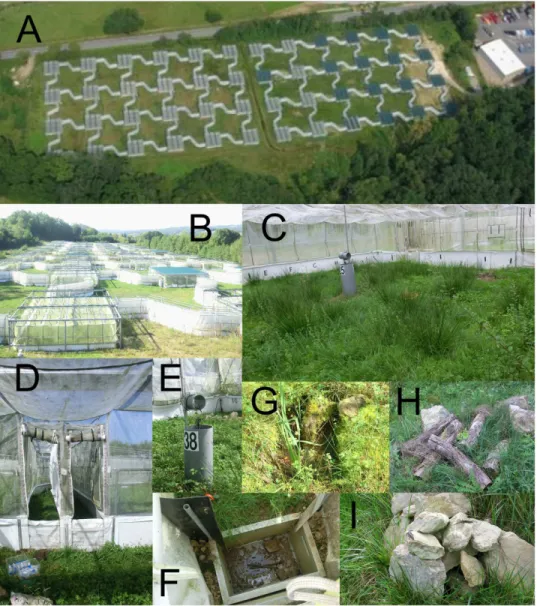
Here, we studied the effect of a warmer climate on the life cycle and demography of a lizard species with large-scale experimental mesocosms (Fig 1). Using common lizards (Zootoca vivi-para) as model species, we aimed to determine whether predicted temperature increases will be detrimental or beneficial to temperate lizards and to identify the key parameters involved in potential declines of populations, especially in populations at the southern margin of the distri-bution area. To that end, we took advantage of an innovative experimental facility, the
Metatron, a system with large seminatural enclosures in which climatic conditions can be manipulated (Fig 1) [30].
We created 18 lizard populations in the Metatron over two years of experiment (2012: 8 populations, 2013: 10 populations) and allocated them to one of two climatic treatments throughout the summer:“present climate”(existing local area climate) and“warm climate”
(~2°C warmer than ambient temperatures), coherent with IPCC climate change projections for the end of the century (global temperature increase projections for a midrange emission sce-nario, Representative Concentration Pathway (RCP) 4.5: +1.8 ± 0.5°C [29]). We investigated adult and juvenile survival, body growth, and female reproduction to estimate the effect of warmer climatic conditions on lizard life history and population growth rate. We further
Fig 1. The Metatron. A: Aerial view of the structure. On the right, top shutters are closed on 17 enclosures. Credits: Quentin Bénard.B: Close view of the structure. On the bottom left, an enclosure with open shutters. On the top right, an enclosure with closed shutters.C: Inside view of one enclosure.D: Entrance of the two
half-corridors of one enclosure.E: Pole containing the sensors recording temperature, humidity, and illuminance inside of the enclosure as well as the sprinkler system, protected with plastic and labeled with the patch identification number.F: Pitfall trap at the end of one corridor.G: One of the two ponds set in each enclosure.HandI: Rock and logs allowing for lizard thermoregulation, set in each corner of the enclosures.
compared our results to climatic conditions across Europe to inform predictions about more general fate of European lizard populations.
Results
Impact of Climate Change on Juveniles
Warm climatic conditions had a strong positive impact on juvenile body growth (Table 1,Fig 2a) but had no effect on body condition (Table 1). Warm climates also led to an earlier reproductive onset in these juveniles. Indeed, female juveniles from the“warm summer climate”populations were more likely to reproduce the following spring (Table 1,Fig 2b). This accelerated reproduc-tive onset was likely due to the higher individual body growth rate, as female body size in May had a significant impact on probability of gravidity (Likelihood ratio test,χ² = 24.9,p<0.001). There was no overall effect of climate treatment on annual survival (Table 1), although juveniles from the“warm climate”treatment tended to survive less during the summer (S3 Table).
Impact of Climate Change on Adults and Yearlings
Warmer climate was detrimental for the survival of older individuals. The annual survival of adults and yearlings was lower in“warm climate”environments (Table 2,Fig 2c), and this effect was mainly due to a difference of survival during the summer (S3 Table). Warmer cli-matic conditions had, however, a positive impact on the body condition of adults that survived (Table 2), while there was no impact of climatic conditions on individual growth rate. We fur-ther found a tendency for an earlier laying date in adult females from the“warm climate”
Table 1. Effect of temperature treatment on survival, body growth, body condition, and female reproduction the following year in juveniles.
Best Model Likelihood ratio test (df = 1)
Effect of the temperature treatment
Effect of the date of birth
Effect of sex R² Proportion change in variance (PCV)
χ² p Estimate SE Estimate SE Estimate SE R²m R²c enclosure family year residuals
Annual
survival (1|Enclosure) +BirthDate + (1|Family)
2.69 0.101 0.019 0.013 0.008 0.206 −0.006 −0.01
Annual body growth
Temp
+ BirthDate + (1|Enclosure)
12.16 <0.001*** 2.84 0.79
−0.14 0.03 0.186 0.434 0.193 0.193
Spring body
condition BirthDate +(1|Family) 0.96 0.326 −0.003 0.003 0.015 0.214 0.06 0.003
Probability of gravidity (t + 1)
Temp
+ BirthDate + (1|Enclosure)
4.53 0.033* 1.33 0.62 −0.05 0.03 0.114 0.114 1
Clutch size
(t + 1) BirthDate +(1|Year) 1.85 0.174 0.001 0.01 0.0002 0.009 0
Laying date
(t + 1) BirthDate +(1|Family) 0.1 0.757 0.34 0.18 0.127 0.869 0.12 0.075
NOTE: Statistics of Likelihood Ratio test compare two models, one with temperature treatment and one simpler model without temperature treatment. Generalized linear mixed models with logit links are used for binomial factors such as survival and gravidity, other variables are modeled with linear mixed models except for clutch size, which is modeled with a Poisson distribution. We provide estimate and standard error of thefixed effects included in the model (temperature treatment and date of birth). Following Nakagawa and Schielzeth (2013), we also provide marginal (R²m, effect of thefixed effects) and conditional (R²c, effect of thefixed and random effects) R² for our best models, as well as the proportion change in variance (PCV) for the random effects.
enclosures (Table 2). Moreover, we found out that some females had produced a second clutch during the summer 2012. Twelve neonates, from five females, hatched in the“warm climate”
enclosures during the summer (Fig 2d), while we did not find such neonates in“present cli-mate.”These neonates were born from a second clutch of these females.
Fig 2. (a)Juvenile annual body growth (mean±SE) depending on the temperature treatment. Body growth is calculated as the difference between snout–
vent length at birth and snout–vent length at recapture after one year, measured in mm.(b)Female juvenile probability of gravidity at one year old (mean±
SE) depending on the temperature treatment.(c)Adult and yearling annual survival probability (mean±Standard Error [SE]) depending on the temperature
treatment.(d)Clutch size of females that laid a second clutch during the 2012 summer (mean±SE) depending on the temperature treatment. Underlying
data can be found inS7 Table.
Population Growth Rate
We modeled the impact of our climatic treatment on lizard population dynamics with an age-structured Leslie matrix fitted with the survival and reproduction parameters obtained from our field experiment (S3 Text,S3 Fig,S4 Table). Population growth rate in“warm climate”
environments was very low (λ= 0.75 [0.72, 0.77], mean [95% CI], results for a deterministic model), while populations in“present climate”environments were maintaining themselves (λ
= 0.98 [0.95, 1.01], confidence interval crossing 1). As a consequence, populations in warm cli-mates should go extinct rapidly (years to extinction, mean [95% CI], warm climate = 22 y [20, 24], present climate = 298 y [118, no extinction]). Using a stochastic model yielded very similar results (S3 Text).
Consequences for European Populations
We compared maximum daily temperatures in common lizard populations across Europe to maximum daily temperatures experienced by lizards in our experimental setup to categorize populations into“risk profiles”(S4 Text,S6 Table). We showed that under a 2°C temperature increase scenario, a significant number of European populations, mostly at the southern mar-gin of the distribution, may be at risk from warming climates. Fourteen percent of European populations may be threatened in the future if temperature increases by 2°C (Fig 3,S4 Text, risk levels A to C). Moreover, if temperature rises by 3°C, 21% of the populations might be at risk in the future (Fig 3,S4 Text, risk levels A to D). Additionally, comparing with a survey done by Sinervo et al. [10] on European populations of common lizards, we found that popula-tions classified by the authors as nearly extinct or extinct fell significantly more within our“at
Table 2. Effect of temperature treatment on survival, body growth, body condition, and female reproduction the following year in yearling and adults.
Best Model Likelihood ratio test
(df = 1)
Effect of the temperature treatment
Effect of age Effect of sex R² Proportion change in variance (PCV)
χ² p Estimate SE Estimate SE Estimate SE R²m R²c enclosure family year residuals
Annual
survival Temp+ sex ++ age (1|Enclosure)
3.92 0.048* −0.55 0.28 −0.58 0.22 0.65 0.21 0.058 0.147 0.134
Annual body growth
Age + sex + (1|Year)
0.25 0.617 6.75 0.44 0.07 0.4 0.389 0.686 0.1 0.553
Spring body condition
Temp+ age
+ sex + (1|Year) 5.86 0.015* 0.23 0.09 −0.12 0.11 0.16 0.1 0.045 0.089 −0.33 0.074 Probability of
gravidity (t + 1)
Age +
(1|Enclosure) 0.35 0.553 0.05 0.24 0.0001 0.0001
Clutch size
(t + 1) Age + (1|Year) 0.26 0.613 −0.09 0.1 0.009 0.02 0.186 0
Laying date (t + 1)
Temp+ age + (1|Enclosure) +
(1|Year)
3.1 0.078 −4.11 2.2 2.12 2.03 0.031 0.565 0.333 −0.03 0.015
NOTE: Statistics of Likelihood Ratio test compare two models, one with temperature treatment and one simpler model without temperature treatment. Generalized linear mixed models with logit links are used for binomial factors such as survival and gravidity, other variables are modeled with linear mixed models except for clutch size, which is modeled with a Poisson distribution. We provide estimate and standard error of thefixed effects included in the model (temperature treatment, age, and sex). Following Nakagawa and Schielzeth (2013), we also provide marginal (R²m, effect of thefixed effects) and conditional (R²c, effect of thefixed and random effects) R² for our best models, as well as the proportion change in variance (PCV) for the random effects.
risk”profiles than populations classified as maintaining themselves (χ² = 7.8,p= 0.005,S4 Text). Risk profile projections depend on the demographic parameters obtained from our experiment, and as such should be sensitive to differences in demographic parameter estimates in the natural populations, particularly on changes in adult and juvenile survival rates (S3 Text, S5 Table), as well as on uncertainty in climatic data observations.
Discussion
We found that warmer climatic conditions strongly modified lizard's life history. On one hand, warm climatic conditions had a strong positive impact on juvenile body growth. In ectotherms, a difference of 2°C, as generated in our experiment, can largely increase metabolic rate [5] and hence energetic needs. When juveniles can compensate for this increased metabolism by forag-ing more, it should lead to a faster body growth rate. Invertebrate diversity and abundance were high in enclosures, and there was no difference between climatic conditions (p>0.55,S1
Text,Material and Methods). Juveniles could thus compensate by foraging more, resulting into
a faster growth rate with subsequent consequences on their entire life history. For instance, reproduction is size-dependent in reptiles [31] and should be favored by an accelerated individ-ual growth. Indeed, female juveniles from the“warm climate”populations were more likely to reproduce the following spring because of the fast summer individual growth rate. Such results are consistent with patterns observed in natural populations, as body size and individual growth rate were shown to increase with temperature in common lizard populations [32–35], while age at first reproduction depended on body size [36]. Warm climatic conditions were therefore mostly beneficial at juvenile stages as juvenile survival during the summer was only slightly decreased in our experimentally warmer climates, with overall 30% of juveniles from all populations surviving their first year, as in natural populations [33,37].
On the other hand, a warmer climate was mostly detrimental for older individuals. Only 42% of adults and yearlings from the“warm climate”treatment survived after one year, while 52% survived in present climates, comparable to survival rates found in natural populations from France, Belgium, and the Netherlands [33,37–39]. One explanation for this difference could be a summer heat stress, daily temperatures surpassing lizard critical thermal maximum. However,
Fig 3. Potential risk from climate change for common lizard populations across Europe inferred from current maximum temperatures experienced by these populations.Colors represent“risk profiles”of the populations, from A: imminent risk (purple) to F: low risk (green), seeS4 Text,S6 Table. Populations in risk levels from A to C (purple, red and dark orange) will be threatened by a 2°C increase in temperatures. Populations in risk level D (light orange) will be threatened by a 3°C temperature increase, and risk level E (yellow) will be threatened by a 4°C temperature increase.
this view was not supported, as temperature only rarely surpassed critical thermal maximum (CTmax = 40°C [40]), and as a large temporal and spatial thermal heterogeneity within enclo-sures allowed lizards to find cool conditions during warm hours in both climates (S2 Text,S1 Table). In addition, climatic conditions had no effect on juvenile survival, while juvenile individ-uals likely have lower CTmax, as in other lizard species [41,42]. A second, more likely hypothe-sis could be linked to metabolic costs [43]. In ectotherms, metabolic rate scales positively with body size and temperature [44]. Warmer temperatures should increase energetic needs that can-not be fully compensated by an increase in foraging, in particular when warming induces restriction of lizard activity period, as suggested by a recent study [10] (but see [45]). This expla-nation may also explain the discrepancy of effects between ages as the rise in energetic needs in smaller individuals (i.e., juveniles) may be more easily compensated by foraging. However, adult body condition did not decrease in warmer conditions over the summer (S3 Table) and even increased after the winter in surviving individuals from the warm climate (Table 2). As the bet-ter spring body condition can be explained by a lower lizard density and thus competition for food during the spring (impact of lizard density on adult body condition, Likelihood ratio test,
χ² = 5.91,p= 0.02), our energetic needs hypothesis may still explain our results and would con-cur with previous results on fish [46,47] and marine invertebrates [48]. In these studies, juve-niles and smaller individuals survived better in higher temperatures than larger ones, which were failing to meet overall energy demands [46]. On top of energy demands, a warming-accel-erated metabolism and foraging could change various physiological parameters (e.g., increased oxidative stress [49,50]) leading to physiological exhaustion and mortality in adults only [50,51]. A last possibility is that our climatic treatments, mainly set in the summer, generated a mismatch between summer and winter temperatures, hence increasing mortality during the winter. Because adult mortality during the summer was already affected by climatic treatment (S3 Table), it seems however unlikely that a temperature mismatch between summer and winter temperature could be the sole cause of the observed mortality increase.
maintained themselves (λ= 0.98, 95% CI forλcrossing 1, [0.95,1.01]). These predictions are made even worse by the absence of warming enhanced dispersal movements (S3 Table), which could allow individuals to track their climatic niche [55], but see [56].
When we compared climatic conditions in our experiment to conditions encountered by common lizard populations across Europe, we found that several populations at the southern margin of the distribution should be at risk from climate warming in the near future, while populations at the northern margin should not be threatened (Fig 3,S4 Text). Considering a scenario of around +2°C temperature increase by the end of the century (consistent with RCP 4.5 greenhouse gas emission scenario [29]), we showed that 14% of populations surveyed should be threatened by the climate change in the next century, 11% in the very near future (around 2050,S4 Text). If we consider a higher temperature increase of 3°C, which could be attained with RCP 6.0 high emission scenario, the percentage of threatened populations went up to 21%, and with a very high temperature increase scenario of 4°C, possible under RCP 8.5 emission scenario, it attained 30% of the populations (S4 Text). Moreover, we showed that two European populations, located at the extreme southern margin of the distribution, might already be threatened under the current levels of temperature (S4 Text,“imminent risk” pro-files). Finally, we found that nearly extinct or extinct populations from Sinervo et al. survey [10] were more likely to fall within our“at risk with 2°C increase”profiles than populations found to maintain themselves, confirming that temperature was probably one of the main driv-ers of the observed extinctions. Further modeling on range dynamics and extinction risks ofZ.
viviparaand other lizard species should use spatially explicit demographic models (e.g., [28,57,58], but see [59] for a review of available methods) informed by our experimental results as well as by data from field surveys (e.g., density and demographic parameters), to draw a bet-ter picture of the impacts of climate change on lizard population and range dynamics under several greenhouse gas emission scenarios. Overall, we showed that lizard populations at the southern margin of their distribution should be particularly sensitive to a warming climate, leading to potential population extirpations and a shrinking of lizard’s range, while populations at higher latitudes should not be threatened. The limitation of a species range has been attrib-uted to two interacting factors, abiotic conditions such as temperature and hygrometry and biotic conditions such as competitive interactions [60,61]. Our results support the idea that common lizards range is limited in the south by abiotic conditions due to the climate-depen-dent species demography.
change is not only a problem for tropical ectotherms [11–14] but, contrary to more optimistic predictions [13,15–17], it could endanger temperate ectotherms with population extirpations and a shrinking of their range of distribution by the disappearance of southern populations. In species with a restricted range distribution, such population extirpations could ultimately lead to species extinctions if these species are unable to adapt to warmer climates. Now, we should therefore study how species can adapt to future climatic conditions through phenotypic and phenological modifications. For instance, a selection for an earlier onset of reproduction and an increased voltinism might allow species to shift towards a faster life history strategy and populations to be rescued by compensating lower adult survival rates [64–66]. However, such acceleration of population turnover might, on the contrary, be detrimental. For instance, in a European butterfly (Lasiommata megera), an increased voltinism led populations into a devel-opmental trap where individuals attempted third generations, resulting in higher mortality and the loss of the third generation [67]. Future experiments should therefore simulate future warmer climates on several generations to study species adaptiveness and persistence.
Materials and Methods
The use of animals in this study was approved by the French Government, License no.2010-189-16 DREAL.
Species and Experimental System
experiment in“present climate”conditions (see next section) using similar population densi-ties and structures than in this study.
Between May 2012 and May 2014, we performed two studies manipulating summer climatic conditions and monitoring consequences on lizard populations. We used data from these two years of experiment altogether. The same experimental procedure was used for the two years. From mid-May, at the end of female gestation period, we captured all surviving lizards main-tained in the Metatron during multiple successive capture sessions. Each lizard was measured for snout–vent length and total length and weighted. A tail tip was taken for routine genetic sampling. Yearlings (1-year-old lizards) and adult males were kept only for the amount of time necessary to ensure that we had captured all surviving individuals from the enclosures and were released into the Metatron on average one month after capture, whereas females were maintained in the laboratory until parturition. In the laboratory, lizards were kept in 25 x 15.5 x 15 cm individual glass terraria with a 3 cm litter layer, a piece of cardboard and a plastic tube for shelter and a piece of absorbent paper. A light bulb (25 W) and an ultraviolet lamp (Zoomed Reptisun 5.0 UVB 36 W) provided heat for thermoregulation and light 6 h per d (from 9:00 to 12:00 and from 14:00 to 17:00). Lizards were lightly sprayed with water three times a day (in the morning, at mid-day, and in the evening) and offered one cricket (Acheta domestica) daily. Between early June and mid-July, females laid eggs in the terraria. Offspring were marked and measured for body length (snout–vent length and total length to the nearest mm) and mass (to the nearest 0.001 g) immediately after birth; their sex was determined by counting ventral scales [78], and a tail tip was taken for genetic sampling. Families were then released into the Metatron.
Release of the Lizards into the Metatron
Lizards were released into the Metatron controlling for body size and source population. From June to the end of September (2012 and 2013), we applied several climatic treatments to the enclosures. In 2012, we created nine populations from three climatic treatments (three popula-tions in each treatment), while in 2013 we created ten populapopula-tions from the two extreme cli-matic treatments (five populations in each treatment). Enclosures were chosen to be the most homogeneous respective to the vegetal cover (F2,6= 0.80,p= 0.49 and F1,8= 0.54,p= 0.48,
respectively for 2012 and 2013), vegetal height (F2,6= 2.26, p = 0.18 and F1,8= 0.04, p = 0.85,
respectively for 2012 and 2013), vegetal composition (F2,6= 0.01,p= 0.99 and F1,8= 3.16, p= 0.11, respectively for 2012 and 2013), and invertebrate prey diversity (F2,6= 0.91,p= 0.45
and F1,8= 2.60,p= 0.15, respectively for 2012 and 2013, seeS1 Text). In 2012, we had a“
pres-ent climate”(PC) in which automatic shutters were allowed to close when temperature
exceeded 28°C, an“intermediate climate”level, in which shutters closed when temperature sur-passed 34°C and a“warm climate”(WC) in which shutters were only allowed to close when temperature rose above 38°C. In 2013, we only kept the present and warm climate treatments because the intermediate treatment had similar temperatures and gave similar results to the warm climate treatment. Enclosed habitats are warmer than outside habitats. Closing the shut-ters both stopped temperature from rising and caused temperatures to drop, evening out tem-perature peaks. As a result,“present climate”enclosures showed similar summer temperatures to ambient temperatures outside of the Metatron (temperatures in the nearby meteorological station of Saint-Girons Antichan,S2 Text), while“warm climate”enclosures were on average 2°C warmer (e.g., mean daily temperatures between mid-June and mid-September 2012 and 2013, PC: 26.4 ± 0.3°C, WC: 28.3 ± 0.3°C, mean ± SE, F1,282= 23.1,p-value<0.001; maximum
daily temperatures: PC: 29.2 ± 0.3°C, WC: 32.1 ± 0.3°C mean ± SE, F1,282= 50.6,p
over the summer in temperature and illuminance, but not in hygrometry (S2 Text,S1 Table), while the treatment effects were negligible during the winter and the spring (S2 Table). Such temperature differences are coherent with IPCC climate change projections for southern Europe [29], which predicts a 3°C temperature increase by 2080, with the largest warming dur-ing the summer. Indeed, projections from RCP 4.5 scenario (an emission stabilization scenario) in southern Europe predict a temperature increase of between 1.2 and 5.5°C between June and August against−0.2 and 3.0°C between December and February [29]. Thanks to a dense and
diverse vegetation, there was a large temporal and spatial variation within enclosures of warm and present climate allowing cooler refuges despite an overall warmer environment (S2 Text). In 2012, we only had three enclosures in the intermediate climate level, and in one of them, a technical problem (important disturbance in the enclosure related to maintenance issues of the Metatron) caused a quasiextinction of a population. Moreover, when we compared summer temperatures between“intermediate”and“warm”climate treatments, we did not find signifi-cant differences in mean, maximum, or minimum temperatures (S2 Text). Hence, we decided to exclude the data from the quasiextinct enclosure and merge the data from the two remaining intermediate climate enclosures to the warm climate enclosures for the analyses.
Each year, populations were composed of 11 ± 1 adult females, 6 ± 1 adult males, 9 ± 2 year-lings and 38 ± 4 juveniles. These population densities conform with local densities observed in natural populations [37,79] and in other seminatural experiments on common lizards
[68,71,77,80–82]. There was no difference between treatments in juvenile birthdate, in individ-ual snout–vent length, or mass at release (p>0.36 for all).
Population Monitoring
In mid-July, one-way corridors between enclosures were opened to allow lizard dispersal from enclosures. A pitfall trap at the end of each corridor allowed the capture of dispersing individu-als. Dispersing individuals were measured, weighed, and released into another enclosure at random.
In mid-September, we performed three capture–recapture sessions to measure lizard body growth and survival in each enclosure. In these three sessions, we were able to capture 93% of survivors (capture probability estimated by MARK version 6.1 [83]). All surviving lizards were measured for snout–vent length and total length, weighed, and released into their enclosure to hibernate in the Metatron. During these capture sessions in 2012, we caught 12 neonate juve-niles born in the enclosures during the summer. A tail tip was taken from these individuals to assess maternity and paternity.
Finally, the following spring, we recaptured all surviving lizards from each enclosure during multiple capture sessions (>10) without release and brought them into the laboratory. All sur-viving lizards were measured and weighed again and kept in similar conditions as described above until female parturition, allowing assessment of female reproductive success.
Genetic Data and Maternities
stay in the laboratory in June, and neonates found were born from a second clutch during the summer.
Statistical Analyses
We modeled the effect of climatic treatment on individual dispersal probability, survival proba-bility, body growth (difference between snout–vent length at release at the beginning of the experiment and snout–vent length at capture), body condition (residuals from a linear model of body mass by body length), and finally on female probability of gravidity (probability that a female will lay eggs), clutch size (number of viable offspring laid by a gravid female), and laying date (treated as a continuous variable). We analyzed juvenile data separately from adult and yearling data, since this allowed us to include a family effect in the analysis concerning juve-niles, as siblings cannot be considered as independent. We first analyzed dispersal propensity, then we excluded dispersing individuals from the latter analyses, as dispersing individuals could not be assigned to a unique temperature treatment for the whole summer period. For survival probability, body growth rate, and body condition, we analyzed effects of climatic treatments over a year. However, we also provide inS3 Tablethe effects of treatment by the end of summer in order to better understand paths of effects.
To estimate the effect of temperature treatment on juvenile, yearling, and adult demogra-phy, we performed generalized mixed models and linear mixed models with lmer procedure [84] in R, version 3.1.1 [85]. Dispersal, survival, and probability of gravidity were modeled using a generalized mixed model with a binomial distribution and a logit link. Body growth, body condition, and laying date were modeled as linear variables. Finally, clutch size was mod-eled using a Poisson distribution, except for clutch size in September 2012 where we used a zero-inflated Poisson GLM because of the low number of neonate juveniles recovered in Sep-tember 2012. Models included temperature treatment as a categorical variable and several covariates plus random intercepts. For juveniles, we included birthdate modeled as a continu-ous covariate, and for adult and yearlings, we included age modeled as a two-level factorial var-iable (yearling or adult) and sex. Finally, mixed modeling allowed adding random intercepts to the models: 1) a family effect in juvenile analyses, as juveniles from a family are not indepen-dent, 2) enclosure identity to account for variation due to potential differences among enclo-sures, and 3) the year of experiment to account for the block design. Following Zuur et al. [86], we fitted full models with all fixed variables and every combination of random intercepts with a restricted maximum likelihood approach. We compared models using the respective AIC and chose the best structure of the random component for each dependent variable. We com-pared a full model with temperature treatment, necessary covariates, and random intercepts to a model including only the covariates and random intercepts through theirΔAIC. We then performed likelihood ratio tests to evaluate the impact of the temperature treatment. We pro-vided estimates and standard errors of the effect of each fixed variable. We further calculated both the marginal (effect of the fixed variables) and the conditional (effect of the fixed and ran-dom variables) R², as well as the PCV for each ranran-dom variable following Nakagawa and Schielzeth [87].
after one year; therefore, it was unlikely that differences in prey availability could lead to differ-ences in survival. Nevertheless, we tested the impact of insect density the following year on adult survival and on juvenile survival and body growth.
Supporting Information
S1 Data. Raw data spreadsheet for juveniles. (XLSX)
S2 Data. Raw data spreadsheet for adults and yearlings. (XLSX)
S1 Fig. Maximum daily temperatures (°C ± SE) between June and September in the two temperature treatments.
(PNG)
S2 Fig. Mean daily temperatures during lizard activity period (°C ± SE) between June and September in the two temperature treatments.
(PNG)
S3 Fig. Three age class life cycle graphs representing lizard population dynamics in our sys-tem.sj: juvenile survival, sy: yearling survival, sa: adult survival, py: yearling probability of
gra-vidity, pa: adult probability of gravidity, fy: yearling fecundity, fa: adult fecundity,σ: primary sex ratio.
(PDF)
S1 Table. Impact of climatic treatment on our principal climatic variables during the sum-mer (June–September).ANOVAs compare values between present climate and warm climate (mix of warm and intermediate climate treatments). Summaries of the mean values ± SE of the parameters are given for each treatment.
(DOCX)
S2 Table. Impact of climatic treatment on our principal climatic variables during the win-ter and spring (January–May).ANOVAs compare values between present climate and warm climate (mix of warm and intermediate climate treatments). Summaries of the mean
values ± SE of the parameters are given for each treatment. (DOCX)
S3 Table. Effect of temperature treatment on juvenile, yearling, and adult dispersal and on summer survival, body growth, and body condition.
(DOCX)
S4 Table. Values for each demographic parameter estimated from the outputs of the mixed models investigating the impact of climatic treatment.
(DOCX)
S5 Table. Sensitivity and elasticity ofλto the values of each demographic parameter. (DOCX)
S6 Table. Position and averaged maximum daily temperatures observed for each common lizard populations, associated“risk levels”(from A: imminent risk to F: low risk), and ref-erences for the global positioning system coordinates, plus extinction status from Sinervo et al. 2010 survey populations (0 = recently extinct and committed to extinction popula-tions; 1 = populations maintaining themselves).
S7 Table. Data underlyingFig 2. (DOCX)
S1 Text. Invertebrate community sampling. (DOCX)
S2 Text. Temperature treatments. (DOCX)
S3 Text. Population dynamics modeling. (DOCX)
S4 Text. Projections for European populations of common lizards. (DOCX)
Acknowledgments
We thank Olivier Calvez, Olivier Guillaume, Romain Chazal, Rémi Patin, Marion Segall, Julie Siracusa, Julie Raphalen, Antoine Cave, Bastien Rémurier, Laure Geidel, Alice Fournier, Erika Beaugeard, Aude Benhemma-Le Gall, Rogini Runghen, Marion Garacci, Lorelei Boyer, and Marlene Kleffert for fieldwork assistance, Jean-François Le Galliard and Xavier Lambin for constructive comments about the experimental design, Michel Baguette, Alexis Chaine, Jose Montoya, and three anonymous referees for helpful comments on the manuscript, Michel Lor-eau for supporting the manuscript, and Radica Michniewicz for editing.
Author Contributions
Conceived and designed the experiments: JCo EB JCl. Performed the experiments: EB AT JCo MR EB. Analyzed the data: EB JCo. Wrote the paper: EB AT JCo MR EB JCl.
References
1. Parmesan C, Yohe G. A globally coherent fingerprint of climate change impacts across natural sys-tems. Nature. 2003; 421: 37–42. PMID:12511946
2. Bellard C, Bertelsmeier C, Leadley P, Thuiller W, Courchamp F. Impacts of climate change on the future of biodiversity. Ecology Letters. 2012; 15: 365–377. doi:10.1111/j.1461-0248.2011.01736.x PMID:22257223
3. O’Connor MI, Selig ER, Pinsky ML, Altermatt F. Toward a conceptual synthesis for climate change responses. Global Ecology and Biogeography. 2012; 21: 693–703.
4. Thomas CD, Cameron A, Green RE, Bakkenes M, Beaumont LJ, Collingham YC, et al. Extinction risk from climate change. Nature. 2004; 427: 145–148. PMID:14712274
5. Dillon ME, Wang G, Huey RB. Global metabolic impacts of recent climate warming. Nature. 2010; 467:
704–706. doi:10.1038/nature09407PMID:20930843
6. Sheridan JA, Bickford D. Shrinking body size as an ecological response to climate change. Nature Clim Change. 2011; 1: 401–406.
7. Daufresne M, Lengfellner K, Sommer U. Global warming benefits the small in aquatic ecosystems. PNAS. 2009; 106: 12788–12793. doi:10.1073/pnas.0902080106PMID:19620720
8. Walther G-R. Community and ecosystem responses to recent climate change. Phil Trans R Soc B. 2010; 365: 2019–2024. doi:10.1098/rstb.2010.0021PMID:20513710
9. Pacifici M, Foden WB, Visconti P, Watson JEM, Butchart SHM, Kovacs KM, et al. Assessing species
vulnerability to climate change. Nature Clim Change. 2015; 5: 215–224.
10. Sinervo B, Méndez-de-la-Cruz F, Miles DB, Heulin B, Bastiaans E, Villagrán-Santa Cruz M, et al. Ero-sion of lizard diversity by climate change and altered thermal niches. Science. 2010; 328: 1354–1354. doi:10.1126/science.1184695PMID:20466932
12. Huey RB, Deutsch CA, Tewksbury JJ, Vitt LJ, Hertz PE, Pérez HJÁ, et al. Why tropical forest lizards are vulnerable to climate warming. Proc R Soc B. 2009; 276: 1939–1948. doi:10.1098/rspb.2008.1957 PMID:19324762
13. Deutsch CA, Tewksbury JJ, Huey RB, Sheldon KS, Ghalambor CK, Haak DC, et al. Impacts of climate warming on terrestrial ectotherms across latitude. PNAS. 2008; 105: 6668–6672. doi:10.1073/pnas. 0709472105PMID:18458348
14. Duarte H, Tejedo M, Katzenberger M, Marangoni F, Baldo D, Beltrán JF, et al. Can amphibians take the heat? Vulnerability to climate warming in subtropical and temperate larval amphibian communities. Glob Change Biol. 2012; 18: 412–421.
15. Kearney M, Shine R, Porter WP. The potential for behavioral thermoregulation to buffer“cold-blooded” animals against climate warming. PNAS. 2009; 106: 3835–3840. doi:10.1073/pnas.0808913106 PMID:19234117
16. Tewksbury JJ, Huey RB, Deutsch CA. Putting the heat on tropical animals. Science. 2008; 320: 1296. doi:10.1126/science.1159328PMID:18535231
17. Kearney M, Porter WP. Mapping the fundamental niche: physiology, climate, and the distribution of a nocturnal lizard. Ecology. 2004; 85: 3119–3131.
18. Elphick MJ, Shine R. Longterm effects of incubation temperatures on the morphology and locomotor
performance of hatchling lizards (Bassiana duperreyi, Scincidae). Biological Journal of the Linnean Society. 1998; 63: 429–447.
19. Lu H, Wang Y, Tang W, Du W. Experimental evaluation of reproductive response to climate warming in
an oviparous skink. Integrative Zoology. 2013; 8: 175–183. doi:10.1111/1749-4877.12025PMID: 23731813
20. Radchuk V, Turlure C, Schtickzelle N. Each life stage matters: the importance of assessing the
response to climate change over the complete life cycle in butterflies. Newman J, editor. Journal of Ani-mal Ecology. 2013; 82: 275–285. doi:10.1111/j.1365-2656.2012.02029.xPMID:22924795
21. Van Doorslaer W, Stoks R, Swillen I, Feuchtmayr H, Atkinson D, Moss B, et al. Experimental thermal
microevolution in community-embedded Daphnia populations. Climate Research. 2010; 43: 81–89.
22. Biro PA, Post JR, Booth DJ. Mechanisms for climate-induced mortality of fish populations in whole-lake experiments. PNAS. 2007; 104: 9715–9719. PMID:17535908
23. Pelini SL, Bowles FP, Ellison AM, Gotelli NJ, Sanders NJ, Dunn RR. Heating up the forest: open-top chamber warming manipulation of arthropod communities at Harvard and Duke Forests. Methods in Ecology and Evolution. 2011; 2: 534–540.
24. Thompson RM, Beardall J, Beringer J, Grace M, Sardina P. Means and extremes: building variability into community-level climate change experiments. Ecology Letters. 2013; 16: 799–806. doi:10.1111/ ele.12095PMID:23438320
25. Stewart RIA, Dossena M, Bohan DA, Jeppesen E, Kordas RL, Ledger ME, et al. Chapter Two—Meso-cosm Experiments as a Tool for Ecological Climate-Change Research. In: Woodward Guy and O’Gor-man Eoin J., editor. Advances in Ecological Research. Academic Press; 2013. pp. 71–181.http://www. sciencedirect.com/science/article/pii/B9780124171992000021
26. Richter-Boix A, Orizaola G, Laurila A. Transgenerational phenotypic plasticity links breeding phenology with offspring life-history. Ecology. 2014; 95: 2715–2722.
27. Fordham DA, Resit Akçakaya H, Araújo MB, Elith J, Keith DA, Pearson R, et al. Plant extinction risk under climate change: are forecast range shifts alone a good indicator of species vulnerability to global warming? Glob Change Biol. 2012; 18: 1357–1371.
28. Fordham DA, Akçakaya HR, Araújo MB, Keith DA, Brook BW. Tools for integrating range change, extinction risk and climate change information into conservation management. Ecography. 2013; 36: 956–964.
29. IPCC. Climate change 2013: the physical science basis: Working Group I contribution to the fifth assessment report of the Intergovernmental Panel on Climate Change. Stocker TF, Qin D, Plattner G-K, Tignor MMB, Allen SG-K, Boschung J, et al., editors. Cambridge, United Kingdom and New York, NY, USA: Cambridge University Press; 2013.
30. Legrand D, Guillaume O, Baguette M, Cote J, Trochet A, Calvez O, et al. The Metatron: an experimen-tal system to study dispersal and metaecosystems for terrestrial organisms. Nature Methods. 2012; 9: 828–833. doi:10.1038/nmeth.2104PMID:22796664
31. Cote J, Clobert J, Fitze PS. Mother–offspring competition promotes colonization success. Proceedings of the National Academy of Sciences. 2007; 104: 9703.
33. Sorci G, Clobert J, Belichon S. Phenotypic Plasticity of Growth and Survival in the Common Lizard Lacerta vivipara. Journal of Animal Ecology. 1996; 65: 781–790.
34. Uller T, Olsson M. Life in the land of the midnight sun: are northern lizards adapted to longer days? Oikos. 2003; 101: 317–322.
35. Le Galliard J-F, Marquis O, Massot M. Cohort variation, climate effects and population dynamics in a
short-lived lizard. Journal of Animal Ecology. 2010; 79: 1296–1307. doi:10.1111/j.1365-2656.2010. 01732.xPMID:20649911
36. Horváthová T, Cooney CR, Fitze PS, Oksanen TA, JelićD, Ghira I, et al. Length of activity season
drives geographic variation in body size of a widely distributed lizard. Ecology and Evolution. 2013; 3: 2424–2442.
37. Massot M, Clobert J, Pilorge T, Lecomte J, Barbault R. Density Dependence in the Common Lizard:
Demographic Consequences of a Density Manipulation. Ecology. 1992; 73: 1742–1756.
38. Heulin B, Surget-Groba Y, Sinervo B, Miles D, Guiller A. Dynamics of haplogroup frequencies and sur-vival rates in a contact zone of two mtDNA lineages of the lizard Lacerta vivipara. Ecography. 2011; 34: 436–447.
39. Heulin B, Osenegg-Leconte K, Michel D. Demography of a Bimodal Reproductive Species of Lizard (Lacerta vivipara): Survival and Density Characteristics of Oviparous Populations. Herpetologica. 1997; 53: 432–444.
40. Van Damme R, Bauwens D, Verheyen RF. The Thermal Dependence of Feeding Behaviour, Food Consumption and Gut-Passage Time in the Lizard Lacerta vivipara Jacquin. Functional Ecology. 1991; 5: 507.
41. Tang X, Yue F, He J, Wang N, Ma M, Mo J, et al. Ontogenetic and sexual differences of thermal biology and locomotor performance in a lacertid lizard, Eremias multiocellata. Zoology. 2013; 116: 331–335. doi:10.1016/j.zool.2013.08.006PMID:24156978
42. Xu X-F, Ji X. Ontogenetic shifts in thermal tolerance, selected body temperature and thermal depen-dence of food assimilation and locomotor performance in a lacertid lizard, Eremias brenchleyi. Compar-ative Biochemistry and Physiology Part A: Molecular & IntegrCompar-ative Physiology. 2006; 143: 118–124. PMID:16380280
43. Parsons PA. The metabolic cost of multiple environmental stresses: Implications for climatic change
and conservation. Trends in Ecology & Evolution. 1990; 5: 315–317. doi:10.1016/0169-5347(90) 90089-VPMID:21232382
44. Gillooly JF, Brown JH, West GB, Savage VM, Charnov EL. Effects of Size and Temperature on
Meta-bolic Rate. Science. 2001; 293: 2248–2251. PMID:11567137
45. Kearney MR. Activity restriction and the mechanistic basis for extinctions under climate warming. Ecol-ogy Letters. 2013; 16: 1470–1479. doi:10.1111/ele.12192PMID:24118740
46. Pörtner HO, Knust R. Climate Change Affects Marine Fishes Through the Oxygen Limitation of Thermal Tolerance. Science. 2007; 315: 95–97. PMID:17204649
47. Vindenes Y, Edeline E, Ohlberger J, LangangenØ, Winfield IJ, Stenseth Nils C., et al. Effects of
Cli-mate Change on Trait-Based Dynamics of a Top Predator in Freshwater Ecosystems. The American Naturalist. 2014; 183: 243–256. doi:10.1086/674610PMID:24464198
48. Peck LS, Clark MS, Morley SA, Massey A, Rossetti H. Animal temperature limits and ecological rele-vance: effects of size, activity and rates of change. Functional Ecology. 2009; 23: 248–256.
49. Cote J, Arnoux E, Sorci G, Gaillard M, Faivre B. Age-dependent allocation of carotenoids to coloration
versus antioxidant defences. J Exp Biol. 2010; 213: 271–277. doi:10.1242/jeb.035188PMID: 20038661
50. Selman C, Blount JD, Nussey DH, Speakman JR. Oxidative damage, ageing, and life-history evolution:
where now? Trends in Ecology & Evolution. 2012; 27: 570–577. doi:10.1016/j.tree.2012.06.006PMID: 22789512
51. Monaghan P, Charmantier A, Nussey DH, Ricklefs RE. The evolutionary ecology of senescence.
Func-tional Ecology. 2008; 22: 371–378.
52. Altermatt F. Climatic warming increases voltinism in European butterflies and moths. Proc R Soc B. 2010; 277: 1281–1287. doi:10.1098/rspb.2009.1910PMID:20031988
53. Clarke DN, Zani PA. Effects of night-time warming on temperate ectotherm reproduction: potential fit-ness benefits of climate change for side-blotched lizards. J Exp Biol. 2012; 215: 1117–1127. doi:10. 1242/jeb065359PMID:22399656
55. Loarie SR, Duffy PB, Hamilton H, Asner GP, Field CB, Ackerly DD. The velocity of climate change. Nature. 2009; 462: 1052–1055. doi:10.1038/nature08649PMID:20033047
56. Bestion E, Clobert J, Cote J. Dispersal response to climate change: scaling down to intraspecific varia-tion. Ecology Letters. 2015; doi:10.1111/ele.12502
57. Bocedi G, Palmer SCF, Pe’er G, Heikkinen RK, Matsinos YG, Watts K, et al. RangeShifter: a platform for modelling spatial eco-evolutionary dynamics and species’responses to environmental changes. Methods Ecol Evol. 2014; 5: 388–396.
58. Buckley LB, Waaser SA, MacLean HJ, Fox R. Does including physiology improve species distribution
model predictions of responses to recent climate change? Ecology. 2011; 92: 2214–2221. PMID: 22352161
59. Lurgi M, Brook BW, Saltré F, Fordham DA. Modelling range dynamics under global change: which
framework and why? Travis J, editor. Methods in Ecology and Evolution. 2015; 6: 247–256.
60. Gaston KJ. Geographic range limits: achieving synthesis. Proc R Soc B. 2009; 276: 1395–1406. doi: 10.1098/rspb.2008.1480PMID:19324809
61. Bocedi G, Atkins KE, Liao J, Henry RC, Travis JMJ, Hellmann JJ. Effects of local adaptation and inter-specific competition on species’responses to climate change. Ann NY Acad Sci. 2013; 1297: 83–97. doi:10.1111/nyas.12211PMID:23905876
62. Huey RB, Kearney MR, Krockenberger A, Holtum JAM, Jess M, Williams SE. Predicting organismal vulnerability to climate warming: roles of behaviour, physiology and adaptation. Phil Trans R Soc B. 2012; 367: 1665–1679. doi:10.1098/rstb.2012.0005PMID:22566674
63. Gilman SE, Urban MC, Tewksbury J, Gilchrist GW, Holt RD. A framework for community interactions under climate change. Trends in Ecology & Evolution. 2010; 25: 325–331.
64. Gaillard J-M, Pontier D, Allainé D, Lebreton JD, Trouvilliez J, Clobert J. An Analysis of Demographic Tactics in Birds and Mammals. Oikos. 1989; 56: 59–76.
65. Clobert J, Garland T, Barbault R. The evolution of demographic tactics in lizards: a test of some
hypoth-eses concerning life history evolution. J Evol Biol. 1998; 11: 329–364.
66. Promislow DEL, Harvey PH. Living fast and dying young: A comparative analysis of life-history variation among mammals. Journal of Zoology. 1990; 220: 417–437.
67. Van Dyck H, Bonte D, Puls R, Gotthard K, Maes D. The lost generation hypothesis: could climate change drive ectotherms into a developmental trap? Oikos. 2015; 124: 54–61.
68. Le Galliard J-F, Fitze PS, Ferrière R, Clobert J. Sex ratio bias, male aggression, and population
col-lapse in lizards. Proc Natl Acad Sci U S A. 2005; 102: 18231–18236. PMID:16322105
69. Le Galliard J-F, Cote J, Fitze PS. Lifetime and intergenerational fitness consequences of harmful male
interactions for female lizards. Ecology. 2008; 89: 56–64. PMID:18376547
70. Dreiss AN, Cote J, Richard M, Federici P, Clobert J. Age- and sex-specific response to population den-sity and sex ratio. Behavioral Ecology. 2010; 21: 356–364.
71. Bestion E, Teyssier A, Aubret F, Clobert J, Cote J. Maternal exposure to predator scents: offspring phe-notypic adjustment and dispersal. Proc R Soc B. 2014; 281: 20140701. doi:10.1098/rspb.2014.0701 PMID:25122225
72. Trochet A, Legrand D, Larranaga N, Ducatez S, Calvez O, Cote J, et al. Population sex ratio and dis-persal in experimental, two-patch metapopulations of butterflies. Journal of Animal Ecology. 2013; 82: 946–955. doi:10.1111/1365-2656.12082PMID:23600890
73. Legrand D, Trochet A, Moulherat S, Calvez O, Stevens VM, Ducatez S, et al. Ranking the ecological causes of dispersal in a butterfly. Ecography. 2014; 38: 822–831.
74. Ducatez S, Baguette M, Trochet A, Chaput-Bardy A, Legrand D, Stevens V, et al. Flight endurance and heating rate vary with both latitude and habitat connectivity in a butterfly species. Oikos. 2013; 122: 601–611.
75. Stokstad E. The Metatron: Experimental Ecology Gets Connected. Science. 2012; 337: 279–279. doi: 10.1126/science.337.6092.279PMID:22822120
76. Haddad NM. Connecting ecology and conservation through experiment. Nat Meth. 2012; 9: 794–795.
77. Boudjemadi K, Lecomte J, Clobert J. Influence of connectivity on demography and dispersal in two con-trasting habitats: an experimental approach. Journal of Animal Ecology. 1999; 68: 1207–1224.
78. Richard M, Massot M, Clobert J, Meylan S. Litter quality and inflammatory response are dependent on mating strategy in a reptile. Oecologia. 2012; 170: 39–46. doi:10.1007/s00442-012-2282-3PMID: 22358996
80. Cote J, Clobert J, Brodin T, Fogarty S, Sih A. Personality-dependent dispersal: characterization, ontog-eny and consequences for spatially structured populations. Philosophical Transactions of the Royal Society B: Biological Sciences. 2010; 365: 4065–4076.
81. Cote J, Clobert J. Social personalities influence natal dispersal in a lizard. Proceedings of the Royal Society B: Biological Sciences. 2007; 274: 383–390. PMID:17164202
82. Clobert J, Massot M, Le Galliard J-F. Multi-determinism in natal dispersal: the common lizard as a
model system. In: Clobert J, Baguette M, Benton TG, Bullock JM, editors. Dispersal Ecology and Evolu-tion. Oxford University Press; 2012. pp. 29–40.
83. White GC, Burnham KP. Program MARK: survival estimation from populations of marked animals. Bird Study. 1999; 46: S120–S139.
84. Bates D, Maechel M, Bolker B. lme4: Linear mixed-effects models using S4 classes [Internet]. 2014.
http://CRAN.R-project.org/package = lme4
85. R Core Team. R: A Language and Environment for Statistical Computing [Internet]. Vienna, Austria: R Foundation for Statistical Computing; 2014.http://www.R-project.org/
86. Zuur AF, Ieno EN, Walker NJ, Saveliev AA, Smith GM. Mixed Effects Models and Extensions in Ecol-ogy with R. Springer. New York; 2009.