BGD
6, 8393–8409, 2009Ecosystem respiration on Surtsey, Iceland
B. D. Sigurdsson and B. Magnusson
Title Page
Abstract Introduction
Conclusions References
Tables Figures
◭ ◮
◭ ◮
Back Close
Full Screen / Esc
Printer-friendly Version
Interactive Discussion Biogeosciences Discuss., 6, 8393–8409, 2009
www.biogeosciences-discuss.net/6/8393/2009/ © Author(s) 2009. This work is distributed under the Creative Commons Attribution 3.0 License.
Biogeosciences Discussions
Biogeosciences Discussionsis the access reviewed discussion forum ofBiogeosciences
Ecosystem respiration, vegetation
development and soil nitrogen in relation
to breeding density of seagulls on a
pristine volcanic island, Surtsey, Iceland
B. D. Sigurdsson1and B. Magnusson2
1
Agricultural University of Iceland, 112 Keldnaholt, 125 Reykjavik, Iceland
2
Icelandic Institute of Natural History, P.O. Box 5320, 125 Reykjavik, Iceland
Received: 26 June 2009 – Accepted: 9 August 2009 – Published: 26 August 2009
Correspondence to: B. D. Sigurdsson ([email protected])
BGD
6, 8393–8409, 2009Ecosystem respiration on Surtsey, Iceland
B. D. Sigurdsson and B. Magnusson
Title Page
Abstract Introduction
Conclusions References
Tables Figures
◭ ◮
◭ ◮
Back Close
Full Screen / Esc
Printer-friendly Version
Interactive Discussion
Abstract
Since its birth in 1963 by volcanic eruption in the North Atlantic Ocean off Iceland, Surtsey has been a unique natural laboratory on how organisms colonize volcanic islands and form ecosystems with contrasting structure and function. In July, 2004, ecosystem respiration rate, soil properties and surface cover of vascular plants were 5
measured on 21 plots distributed among the main plant communities found 40 years after the primary succession started. The plots could be divided into two groups, inside and outside seagull (Larus sp.) colonies found on the island. Vegetation cover of the plots was strongly related to the density of seagull nests within and around them. The occurrence of seagull nests and increased vegetation also coincided with significant 10
increase in ecosystem respiration, soil carbon and nitrogen, and with significantly lower soil pH and soil temperatures. The ecosystem respiration was high inside the gull colonies, similar to the highest fluxes measured in drained wetlands or agricultural fields in Iceland. The most important factor for vegetation succession and ecosystem function on Surtsey seems to be the amount of nitrogen, which was mainly brought in 15
by the seagulls.
1 Introduction
Surtsey is a volcanic island that emerged from the North Atlantic Ocean in 1963 in an eruption that lasted for three years. The island was protected in 1965, which limited the human impact to only few visits annually by scientists. Since then, Surtsey has been an 20
unique laboratory to study how life colonizes isolated volcanic islands and how primary succession starts. The island became UNESCO World Heritage Site in July 2008 due to its unique geology and research activity during the past 45 years (Hermannsson, 2009).
Bacteria and fungi were probably the first organisms to become established on the 25
volcanic substrate (e.g. Schwabe, 1970), but the first vascular plant was found on the
BGD
6, 8393–8409, 2009Ecosystem respiration on Surtsey, Iceland
B. D. Sigurdsson and B. Magnusson
Title Page
Abstract Introduction
Conclusions References
Tables Figures
◭ ◮
◭ ◮
Back Close
Full Screen / Esc
Printer-friendly Version
Interactive Discussion beach in 1965 while the island was still erupting (Fridriksson, 1966). Mosses were
first detected in 1968, lichens in 1970 and mushrooms in 1971 (Jóhannsson, 1968; Kristinsson, 1972; Eyjólfsdóttir, 2009).
Vascular plants have dominated the primary succession on Surtsey, and their col-onization and succession has been studied intensively (e.g. Fridriksson, 1966; Mag-5
nússon et al., 1992, 2009; Magnússon and Magnússon, 2000). The first twenty years were characterised by colonization and succession of coastal plant communities, with Honckenya peploides and Leymus arenarius being the key species, forming sparse vegetation cover on sandy areas of the island (Fridriksson, 1992; Magnússon et al., 2009). In 1986 a few pairs of lesser black-backed gull (Larus fuscus) formed a small 10
breeding colony on a lava plain on the southern part of the island (Magnússon and Magnússon, 2000; Petersen, 2009). This colony remained spatially well defined and grew in size over the next several years, with herring gulls (Larus argentatus) and great black-backed gulls (Larus marinus) moving in. In 2003, ca. 300 pairs of gulls bred on the island (Petersen, 2009), most of them within the colony. The establishment of the 15
gull colony had a large effect on the rate of colonization by vascular plants. In total, 69 vascular plant species have been found on the island, whereof 63 species were surviving in 2008 (Magnússon et al., 2009), which is 16% of Iceland’s native vascular plant flora.
Ecosystem function has not been studied as much on Surtsey as the ecosystem 20
structure. In the early years Henriksson and Rodgers (1978) and Henriksson and Henriksson (1982) studied terrestrial nitrogen cycle. Magnússon (1992) studied how ecosystem respiration changed with increasing cover ofL. arenariusandH. peploides on the island. He found that respiration rates were related to differences in vegetation cover and root biomass. Frederiksen et al. (2000) studied soil development on Surtsey 25
BGD
6, 8393–8409, 2009Ecosystem respiration on Surtsey, Iceland
B. D. Sigurdsson and B. Magnusson
Title Page
Abstract Introduction
Conclusions References
Tables Figures
◭ ◮
◭ ◮
Back Close
Full Screen / Esc
Printer-friendly Version
Interactive Discussion amount of microbial biomass in unvegetated and vegetated soil. Sigurdsson (2009)
measured ecosystem carbon fluxes in swards of Leymus arenarius and Honckenya peploidesgrowing within moist and dry microsites on the island. This study indicated that soil humidity could also be an important factor for ecosystem function.
How fast the nutrients are released from the dead organic matter depends on the 5
activity of decomposition in the soil layer. As the organic matter is decomposed, CO2 is released and leaves the surface as soil respiration. The second major contributor of CO2to the soil respiration is the metabolism of living plant roots in the soil volume. When aboveground parts of living plants are included in respiration measurements, as in the present study, CO2 from shoot metabolism is also included. Then, the pro-10
cess is termed ecosystem respiration (Re). The rate ofRe depends therefore both on plant biological activity and decomposition activity of soil organisms. TheRe gives a measure of the ecosysterm function and together with gross primary production (GPP) determines the annual carbon balance and the accumulation of organic matter in the ecosystem (Grace, 2001).
15
The objective of the present study was to investigate biological activity in different vegetation types and development stages on Surtsey which have been followed in a study with permanent plots initiated in 1990 (Magnússon and Magnússon, 2000; Magnússon et. al., 2009).
2 Material and methods
20
2.1 Site desription
Surtsey is the southernmost of the Vestmannaeyjar islands, offthe south coast of Ice-land (63.3◦N, 20.6◦W). The climate is relatively mild for the 63rd latitude and oceanic, with annual mean temperature of 5.0◦C and mean annual precipitation of 1576 mm dur-ing 1965–2005, as recorded on the Heimaey weather station 15 km to the northeast of 25
Surtsey (Icelandic Meterological Office).
BGD
6, 8393–8409, 2009Ecosystem respiration on Surtsey, Iceland
B. D. Sigurdsson and B. Magnusson
Title Page
Abstract Introduction
Conclusions References
Tables Figures
◭ ◮
◭ ◮
Back Close
Full Screen / Esc
Printer-friendly Version
Interactive Discussion Surtsey emerged in an eruption that lasted from November 1963 to June 1965.
When the eruption ceased the island was 2.65 km2 and ca. 30% were made out of rough lava surfaces and 70% was covered by loose tephra, but its size has decreased to 1.41 km2due to sea erosion (Jakobsson et al., 2007). Weathering and erosion have also greatly changed the surface of the island. The tephra cones around the two craters 5
(Fig. 1) have gradually transformed into dense palagonite tuffand the rough lava has been covered to large extent by a layer of drifting tephra and sand, which is this study is termed “soil”.
2.2 Measurements
Measurements of ecosystem respiration were conducted on 19–20 July 2004 in 21 10
permanent vegetation survey plots (Fig. 1). The plots, which are 10×10 m in area, were set up on the island in 1990–1995 to follow the impact of the developing seagull colony on the vegetation succession (Magnússon and Magnússon, 2000). Plots 1– 10 were placed inside the colony while plots 11–23 were placed on different surfaces outside the colony (Fig. 1). It was evident in 2004 that plot 23 had become influenced 15
by the seagulls and was therefore reclassified with the plots inside the gull colony. CIRAS II infrared gas analyser and a SP1 respiration chamber (PP Systems, UK) were used to measure ecosystem respiration (Re) in the plots. A 14 m long tape was fitted diagonally between the SW and NE corners of the plots and four respiration mea-surements were made per plot, generally at 1 m, 4 m, 8 m and 11 m from the SW corner. 20
In few plots, where the respiration chamber could not be sealed due to uneven volcanic rocks, the measurements were made at next suitable surface along the tape. Soil tem-perature was recorded at 5 and 10 cm depth with a temtem-perature probe placed adjacent to the respiration chamber. All measurements took place during daytime hours.
Vegetation surface cover was measured in each permanent plot during routine sam-25
BGD
6, 8393–8409, 2009Ecosystem respiration on Surtsey, Iceland
B. D. Sigurdsson and B. Magnusson
Title Page
Abstract Introduction
Conclusions References
Tables Figures
◭ ◮
◭ ◮
Back Close
Full Screen / Esc
Printer-friendly Version
Interactive Discussion inspecting a 1000 m2circular plot around each permanent vegetation plot (Magnússon
et al., 2009).
The soil was sampled in the permanent plots in 2004. Four 10 cm deep soil cores were taken at random location within each plot and mixed to form a composite sample. The samples were sieved through 2 mm mesh and dried at 80◦C for 48 h and analysed 5
at the Centre of Chemical Analyses (Efnagreiningar Keldnaholti), ICETEC, Reykjavik, Iceland. Total N was analysed by Kjeldahl wet combustion on Tecator Kjeltec Auto 1030 Analyzer. Total C was analysed by dry combustion on Leco CR-12 Carbon Analyzer and the soil pH was measured by an electrode (Orion model 920 A) in a soil/water mixture of 1:1.
10
3 Results
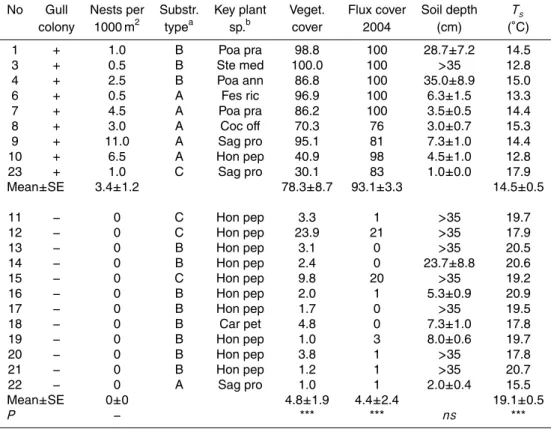
The plots inside the gull colony had on average 3.4 nests within a 1000 m2area, while no nests were found by the plots outside the colony (Table 1). Vegetation cover in the plots within the gull colony was significantly greater than in the plots outside, or on the average 78% and 5%, respectively. The increased vegetation cover in the gull colony 15
was reflected in significantly lower soil temperatures compared to barren sand plots outside the colony. The difference was on average 4.6◦C (Table 1). The average vege-tation cover measured in each plot in 2004 was similar to the average cover in the four fixed measurement points for ecosystem respiration (Re) within each plot (Table 1), in-dicating that four points were enough to cover the variation within each plot. There was 20
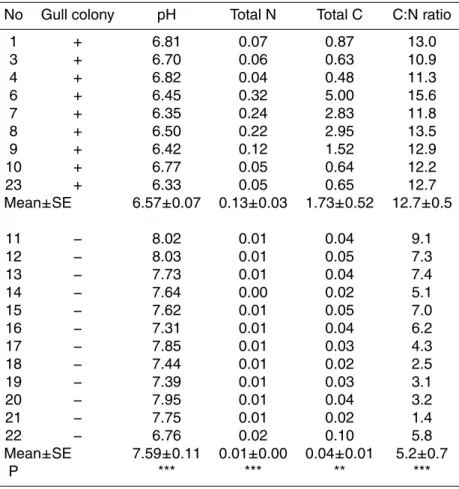
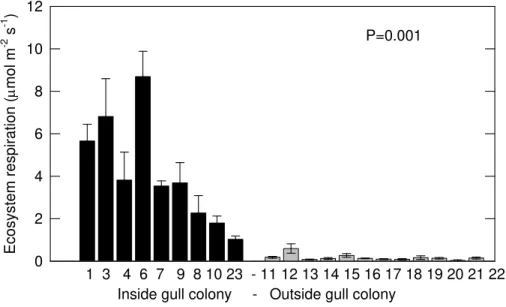
also a significant increase in both total carbon and nitrogen in the soil in the gull colony and soil pH was significantly lower in the more vegetated soil (Table 2). Ecosystem respiration varied in a similar way as the vegetation cover, with a highly significant dif-ference between the gull colony and the area outside it (Fig. 2). On average theRewas 4.14 and 0.17µmol CO2m−2s−1within and outside the gull colony, respectively. Plot 25
23, which was in an area recently colonized by the gulls, showed intermediate rates of
Re(Fig. 2).
BGD
6, 8393–8409, 2009Ecosystem respiration on Surtsey, Iceland
B. D. Sigurdsson and B. Magnusson
Title Page
Abstract Introduction
Conclusions References
Tables Figures
◭ ◮
◭ ◮
Back Close
Full Screen / Esc
Printer-friendly Version
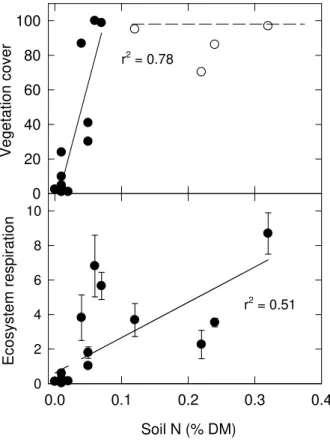
Interactive Discussion The most important driving factor for vegetation cover and ecosystem function
ap-peared to be the amount of nitrogen (N) found in the soil (Fig. 3). The vegetation cover in the permanent plots had reached 100% when nitrogen content was at about 0.1% of soil DM. At soil N concentration lower than 0.1% there was a strong positive linear relationship with surface cover (ANOVA,P <0.001,r2=0.78):
5
Cover=1455.4×N−9.0 (1)
Ecosystem respiration also showed a strong linear relationship with soil N (ANOVA,
P <0.001), but contrary to surface cover, there was no saturation observed with higher nitrogen concentrations (Fig. 3). Soil N explained 51% of the variability observed inRe
(ANOVA, v0.001,r2=0.51): 10
Re=20.45×N+0.62 (2)
4 Discussion
The formation of the gull colony was a turning point in the succession of plant and animal life on Surtsey (Magnússon and Magnússon, 2000). The gulls facilitated col-onization of new plant species, probably by carrying seeds to the island. Also they 15
fertilized the sterile soil with their droppings and food brought to the nest sites from the sea. This led to an explosive development of plant and animal communities, including an ever increasing number of invertebrate (Ólafsson and Ingimarsdóttir, 2009), lichen (Kristinsson and Heidmarsson, 2009) and fungal species (Eyjólfsdóttir, 2009). In the past 15 years extensive swards of grasses and forbs have been formed within the area 20
affected by the gulls (Magnússon and Magnússon, 2000; Magnússon et al., 2009). Vegetation development on other parts of the island have on the other hand remained slow by comparison (Magnússon et. al., 2009).
BGD
6, 8393–8409, 2009Ecosystem respiration on Surtsey, Iceland
B. D. Sigurdsson and B. Magnusson
Title Page
Abstract Introduction
Conclusions References
Tables Figures
◭ ◮
◭ ◮
Back Close
Full Screen / Esc
Printer-friendly Version
Interactive Discussion the sea and brought upon the island by the birds (Magnússon et al., 1996; Magnússon
and Magnússon, 2000; Frederiksen et al., 2000). Low water retention of the volcanic substrate which can lead to water stress episodes at dry spells during summer, may however also pose a barrier for plant growth on Surtsey (Sigurdsson, 2009).
The present results highlight how important the nutrient inputs from the seagulls have 5
been for the biological activity on Surtsey, indicated by the rate ofRe. TheRe was 24 times higher within the seagull colony than outside. The large difference existed even if temperature sensitivity of Re must partly have counteracted it, since the insulation from the increased vegetation cover kept the soil from warming as much within the seagull colony as the sparsely vegetated areas outside. Both soil and plant respiration 10
increase in an exponential way as temperature rises (e.g. Grace, 2001).
TheRe values measured in the gull colony were among the highest encountered in terrestrial ecosystems in Iceland (e.g. Óskarsson, 1998; Sigurdsson, 2001; Beckmann et al., 2004; Bjarnadottir et al., 2009) and compare to maximum values encountered in agricultural croplands and temperate grasslands (Falge et al., 2002) or in fertile 15
Icelandic wetlands (Óskarsson, 1998).
The present results showed a clear linear relationship between vegetation cover and the soil N in the range of 0.0–0.10% of DM and over the whole range encountered in soil N for Re (0.0–0.35% N). Such a postive relationship between soil N and soil respiration was also found by Halvorson et al. (1991), who studied how primary suc-20
cession and ecosystem processes were affected by colonization of a nitrogen-fixing Lupinusspecies on pyroclastic deposits created in the 1980 eruption in Mount St. He-lens, Washington state, USA.
The importance of seabirds on ecosystem functions has been increasingly acknowl-edged in recent years. Where they build their colonies they can be viewed as chemi-25
cal and physical engeneers that affect both ecosystem structure and function through disturbance, seed dispersal and nutrient transport from sea to land (Ellis, 2005; Seker-cioglu, 2006).
BGD
6, 8393–8409, 2009Ecosystem respiration on Surtsey, Iceland
B. D. Sigurdsson and B. Magnusson
Title Page
Abstract Introduction
Conclusions References
Tables Figures
◭ ◮
◭ ◮
Back Close
Full Screen / Esc
Printer-friendly Version
Interactive Discussion It is useful to study how biological activity changes in the early stages of primary
succession of a pristine volcanic island like Surtsey. First primary producers have to become established on the sterile surface. They accumulate atmospheric carbon (organic matter) with photosynthesis and absorb soil nutrients into their living tissues. Their dead tissues create the soil organic matter and improve soil fertility, which allows 5
more nutrient and moisture demanding species to colonize. Such a development has generally been believed to take a long time (del Moral and Wood, 1993), especially at higher latitudes where each growing season is short. The present study showed, however, how the initial steps of such a development can be much faster than previosly expected, with the seabirds playing the key role.
10
5 Conclusions
The most important factor for the rapid vegetation succession and a build-up of high ecosystem fluxes on Surtsey appears to be the amount of nitrogen, which was mainly brought in by the seagulls. The present study shows how ecosystem activity can be enhanced by colonization of animals who are not dependent on the resources of the 15
given ecosystem.
Acknowledgements. The Surtsey Research Society, Institute of Natural History, Mogilsa - Ice-landic Forest Research and the IceIce-landic Coastguard provided logistic support for the present study. S. H. Magnússon and E. Ólafsson took part in the field measurements and Anette Th. Meier made the 2007 elevation map of the island.
BGD
6, 8393–8409, 2009Ecosystem respiration on Surtsey, Iceland
B. D. Sigurdsson and B. Magnusson
Title Page
Abstract Introduction
Conclusions References
Tables Figures
◭ ◮
◭ ◮
Back Close
Full Screen / Esc
Printer-friendly Version
Interactive Discussion
References
Beckmann, M., Sheppard, S. K., and Lloyd, D.: Mass spectrometric monitoring of gas dynamics in peat monoliths: effects of temperature and diurnal cycles on emissions, Atmos. Environ., 38, 6907–6913, 2004.
Bjarnadottir, B., Sigurdsson, B. D., and Lindroth, A.: Seasonal and annual variation of carbon 5
fluxes in a young Siberian larch (Larix sibirica) plantation in Iceland, Biogeosciences Dis-cuss., 6, 6601–6634, 2009,
http://www.biogeosciences-discuss.net/6/6601/2009/.
del Moral, R. and Wood, D. M.: Early primary succession on the volcano Mount St. Helens, J. Veg. Sci., 4, 223–234, 1993.
10
Ellis, J. C.: Marine birds on land: a review of plant biomass, species richness, and community composition in seabird colonies, Plant Ecol., 181, 227–241, 2005.
Eyjólfsdóttir, G. G.: Investigation of the funga of Surtsey 2008, Surtsey Res., 12, 105–111, 2009.
Falge, E., Baldocchi, D., Tenhunen, J., Aubinet, M., Bakwind, P., Berbigier, P., Bernhofer, C., 15
Burba, G., Clement, R., Davis, K. J., Elbers, J. A., Goldstein, A. H., Grelle, A., Granier, A., Gudmundsson, J., Hollinger, D., Kowalski, A. S., Katul, G., Law, B. E., Malhi, Y., Meyers, T., Monsons, R. K., Mungert, J. W., Oechel, W., Paw, K. T., Pilegaard, K., Rannik, U., Reb-manny, C., Suyker, A., Valentini, R., Wilson, K., and Wofsy, S.: Seasonality of ecosystem respiration and gross primary production as derived from FLUXNET measurements, Agric. 20
For. Meteorol., 113, 53–74, 2002.
Frederiksen, H. B., Pedersen A. L., and Christensen, S.: Substrate induced respiration and microbial growth in soil during primary succession on Surtsey, Iceland, Surtsey Res., 11, 29–35, 2000.
Fridriksson, S.: The pioneer species of vascular plants in Surtsey,Cakile edentula, Surtsey 25
Res. Progr. Rep., 2, 63–65, 1966.
Fridriksson, S.: Vascular plants on Surtsey 1981–1990, Surtsey Res. Progr. Rep., 10, 17–30, 1992.
Grace, J.: Carbon cycle, Encyclopedia of Biodiversity, 1, 609–628, 2001.
Halvorson, J. J., Smith, J. L., and Franz, E. H.: Lupine influence on soil carbon, nitrogen and 30
microbial activity in developing ecosystems at Mount St. Helens, Oecologia, 87, 162–170, 1991.
BGD
6, 8393–8409, 2009Ecosystem respiration on Surtsey, Iceland
B. D. Sigurdsson and B. Magnusson
Title Page
Abstract Introduction
Conclusions References
Tables Figures
◭ ◮
◭ ◮
Back Close
Full Screen / Esc
Printer-friendly Version
Interactive Discussion Henriksson, L. E. and Rodgers G. A.: Further studies in the nitrogen cycle of Surtsey, 1974–
1976, Surtsey Res. Prog. Rep., 8, 30–40, 1978.
Henriksson L. E. and Henriksson E.: Concerning the biological nitrogen fixation on Surtsey, Surtsey Res. Prog. Rep., 9, 9–12, 1982.
Hermannsson, S.: Introduction, Surtsey Res., 12, 5–6, 2009. 5
Jakobsson, S. P., Magnússon, B., Ólafsson, E., Thorvardardóttir, G., Gunnarsson, K., Baldurs-son, S., and Petersen, A. E.: Nomination of Surtsey for the UNESCO World Heritage List, edited by: Baldursson, S. and Ingadóttir, A., Icelandic Institute of Natural History, Reykjavik, 124 pp., 2007.
Jóhannsson, B.: Bryological observation on Surtsey, Surtsey Res. Progr. Rep., 4, 61, 1968. 10
Klamer, M., Sponring, A., and Bååth, E.: Microbial biomass and community composition in soils from Surtsey, Iceland, studied using phospholipids fatty acid analysis, Surtsey Res., 11, 37–42, 2000.
Kristinsson, H.: Studies on lichen colonization in Surtsey 1970, Surtsey Res. Progr. Rep., 6, 77–78, 1972.
15
Kristinsson, H. and Heidmarsson, S.: Colonization of lichens on Surtsey 1970–2006, Surtsey Res., 12, 81–104, 2009.
Magnússon, B.: Soil Respiration on the volcanic island Surtsey, Iceland, in 1987 in relation to vegetation, Surtsey Res. Prog. Rep., 10, 9–16, 1992.
Magnússon, B. and Magnússon, S. H.: Vegetation succession on Surtsey, Iceland, during 20
1990–1998 under the influence of breeding gulls, Surtsey Res., 11, 9–20, 2000.
Magnússon, B., Magnússon, S. M., and Guðmundsson, J.: Vegetation succession on the vol-canic island Surtsey, Icel. Agric. Sci., 10, 253–272, 1996 (in Icelandic with English sum-mary).
Magnússon, B., Magnússon, S. H., and Fridriksson, S.: Development in plant colonization and 25
succession on Surtsey during 1999–2008, Surtsey Res., 12, 57–76, 2009.
Ólafsson, E., and Ingimarsdóttir, M.: The land-invertebrate fauna on Surtsey during 2002–2006, Surtsey Res., 12, 57–76, 2009.
Óskarsson, H.: Icelandic peatlands: effects of draining on trace gas release, Ph.D thesis, Univ. of Georgia, USA, 138 pp., 1998.
30
Petersen, A.: Formation of a bird community on a new island, Surtsey, Iceland, Surtsey Res., 12, 133–148, 2009.
BGD
6, 8393–8409, 2009Ecosystem respiration on Surtsey, Iceland
B. D. Sigurdsson and B. Magnusson
Title Page
Abstract Introduction
Conclusions References
Tables Figures
◭ ◮
◭ ◮
Back Close
Full Screen / Esc
Printer-friendly Version
Interactive Discussion 464–471, 2006.
Schwabe, G. H.: On the algal settlement in craters on Surtsey during summer 1968, Surtsey Res. Prog. Rep., 5, 51–55, 1970.
Sigurdsson, B. D.: Environmental control of carbon uptake and growth in aPopulus trichocarpa plantation in Iceland, Acta Universitatis Agriculturae Sueciae, Silvestria 174, 64 pp., 2001. 5
Sigurdsson, B. D.: Ecosystem carbon fluxes ofLeymus arenariusandHonckenya pebloideson Surtsey in relation to water availability: a pilot study, Surtsey Res., 12, 77–80, 2009.
BGD
6, 8393–8409, 2009Ecosystem respiration on Surtsey, Iceland
B. D. Sigurdsson and B. Magnusson
Title Page
Abstract Introduction
Conclusions References
Tables Figures
◭ ◮
◭ ◮
Back Close
Full Screen / Esc
Printer-friendly Version
Interactive Discussion Table 1.Site properties of permanent survey plots inside and outside a gull colony in July 2004.
Cover was measured in % of surface area. Ts stands for soil temperature at ca. 10 cm depth (◦C). Di
fference within and outside gull colony was tested with One-Way ANOVA:ns=P >0.05, *P=0.05–0.01, **P=0.01–0.001, ***P <0.001.
No Gull Nests per Substr. Key plant Veget. Flux cover Soil depth Ts colony 1000 m2 typea sp.b cover 2004 (cm) (◦C)
1 + 1.0 B Poa pra 98.8 100 28.7±7.2 14.5
3 + 0.5 B Ste med 100.0 100 >35 12.8 4 + 2.5 B Poa ann 86.8 100 35.0±8.9 15.0 6 + 0.5 A Fes ric 96.9 100 6.3±1.5 13.3 7 + 4.5 A Poa pra 86.2 100 3.5±0.5 14.4
8 + 3.0 A Coc off 70.3 76 3.0±0.7 15.3
9 + 11.0 A Sag pro 95.1 81 7.3±1.0 14.4 10 + 6.5 A Hon pep 40.9 98 4.5±1.0 12.8 23 + 1.0 C Sag pro 30.1 83 1.0±0.0 17.9
Mean±SE 3.4±1.2 78.3±8.7 93.1±3.3 14.5±0.5
11 − 0 C Hon pep 3.3 1 >35 19.7 12 − 0 C Hon pep 23.9 21 >35 17.9 13 − 0 B Hon pep 3.1 0 >35 20.5 14 − 0 B Hon pep 2.4 0 23.7±8.8 20.6 15 − 0 C Hon pep 9.8 20 >35 19.2 16 − 0 B Hon pep 2.0 1 5.3±0.9 20.9
17 − 0 B Hon pep 1.7 0 >35 19.5 18 − 0 B Car pet 4.8 0 7.3±1.0 17.8 19 − 0 B Hon pep 1.0 3 8.0±0.6 19.7 20 − 0 B Hon pep 3.8 1 >35 17.8 21 − 0 B Hon pep 1.2 1 >35 20.7 22 − 0 A Sag pro 1.0 1 2.0±0.4 15.5 Mean±SE 0±0 4.8±1.9 4.4±2.4 19.1±0.5
P − *** *** ns ***
a
Substrate type A=Lava (hard surface), B=partly sand-filled lava, C=sand;
b
Car pet=Cardaminopsis petraea(L.) Hiit., Coc off =Cochlearia officinalisL., Fes ric=Festuca richardsoniiHooker, Hon peb=Honckenya peploides(L.) Ehrh., Poa ann=Poa annuaL., Poa pra=Poa pratensisL., Sag pro=Sagina
BGD
6, 8393–8409, 2009Ecosystem respiration on Surtsey, Iceland
B. D. Sigurdsson and B. Magnusson
Title Page
Abstract Introduction
Conclusions References
Tables Figures
◭ ◮
◭ ◮
Back Close
Full Screen / Esc
Printer-friendly Version
Interactive Discussion Table 2. Total carbon (C), pH and nitrogen (N), expressed in % of dry soil, sampled in
per-manent plots on Surtsey in 2004.. Difference within and outside gull colony was tested with One-Way ANOVA:ns=P >0.05, *P=0.05–0.01, **P=0.01–0.001, ***P <0.001.
No Gull colony pH Total N Total C C:N ratio
1 + 6.81 0.07 0.87 13.0
3 + 6.70 0.06 0.63 10.9
4 + 6.82 0.04 0.48 11.3
6 + 6.45 0.32 5.00 15.6
7 + 6.35 0.24 2.83 11.8
8 + 6.50 0.22 2.95 13.5
9 + 6.42 0.12 1.52 12.9
10 + 6.77 0.05 0.64 12.2
23 + 6.33 0.05 0.65 12.7
Mean±SE 6.57±0.07 0.13±0.03 1.73±0.52 12.7±0.5
11 − 8.02 0.01 0.04 9.1
12 − 8.03 0.01 0.05 7.3
13 − 7.73 0.01 0.04 7.4
14 − 7.64 0.00 0.02 5.1
15 − 7.62 0.01 0.05 7.0
16 − 7.31 0.01 0.04 6.2
17 − 7.85 0.01 0.03 4.3
18 − 7.44 0.01 0.02 2.5
19 − 7.39 0.01 0.03 3.1
20 − 7.95 0.01 0.04 3.2
21 − 7.75 0.01 0.02 1.4
22 − 6.76 0.02 0.10 5.8
Mean±SE 7.59±0.11 0.01±0.00 0.04±0.01 5.2±0.7
P *** *** ** ***
BGD
6, 8393–8409, 2009Ecosystem respiration on Surtsey, Iceland
B. D. Sigurdsson and B. Magnusson
Title Page
Abstract Introduction
Conclusions References
Tables Figures
◭ ◮
◭ ◮
Back Close
Full Screen / Esc
Printer-friendly Version
Interactive Discussion Fig. 1. Location of the 21 permanent vegetation plots on Surtsey where flux measurements
BGD
6, 8393–8409, 2009Ecosystem respiration on Surtsey, Iceland
B. D. Sigurdsson and B. Magnusson
Title Page
Abstract Introduction
Conclusions References
Tables Figures
◭ ◮
◭ ◮
Back Close
Full Screen / Esc
Printer-friendly Version
Interactive Discussion
P=0.001
Inside gull colony - Outside gull colony
Ecosyst
e
m respirat
ion (
μ
mol m
-2 s -1 )
0 2 4 6 8 10 12
1 3 4 6 7 9 8 10 23 - 11 12 13 14 15 16 17 18 19 20 21 22
Fig. 2. Ecosystem respiration (average of n=4±SE) in the permanent vegetation plots on
Surtsey. Black and light grey bars indicate plots located within and outside the seagull colony, respectively. Numbers on x-axis are plot numbers. The P-value indicates the significance of One-Way ANOVA test on the difference between the two groups.
BGD
6, 8393–8409, 2009Ecosystem respiration on Surtsey, Iceland
B. D. Sigurdsson and B. Magnusson
Title Page
Abstract Introduction
Conclusions References
Tables Figures
◭ ◮
◭ ◮
Back Close
Full Screen / Esc
Printer-friendly Version
Interactive Discussion
r2 = 0.51
Soil N (% DM)
0.0 0.1 0.2 0.3 0.4
Ecosy
s
te
m
re
sp
ir
a
tio
n
0 2 4 6 8 10
r2 = 0.78
Ve
ge
ta
tion
c
o
v
e
r
0 20 40 60 80 100
μ
Fig. 3.Vegetation surface cover (top panel; in %) and ecosystem respiration (bottom panel; in µmol CO2m−
2
s−1