© Ecologia Balkanica
http://eb.bio.uni-plovdiv.bg
Union of Scientists in Bulgaria – Plovdiv University of Plovdiv Publishing House
ECOLOGIA BALKANICA
2014, Vol. 6, Issue 1 June 2014 pp. 31-35
A Study on the Effects of Pulp and Paper Industry Sludge on Sweet
Corn Crops Grown in Containers
Daniela Krasteva
–
Malinova*
1,
Ventsislava Vancheva
2, Ekaterina Valcheva
31 - University of Plovdiv “Paisii Hilendarski”, Faculty of Biology, Department of Ecology and Environmental Conservation, 24 Tsar Assen Str., BG-4000 Plovdiv, BULGARIA
2 – Agricultural University, Faculty of Plant Protection and Agroecology, 12 Mendeleev Blvd., BG-4000 Plovdiv, BULGARIA
3 - Agricultural University, Faculty of Plant Protection and Agroecology, 12 Mendeleev Blvd., BG-4000 Plovdiv, BULGARIA
* Corresponding author: [email protected]
Abstract. Sludge which are produced from waste-water treatment facilities represent a serious environmental problem in terms of their storage. However, they also represent an organic reserve, biomass rich in macro and micronutrients for soils. Thus, sludge could be used to recover the balance of organic matter in soils. We aimed in the present study to determine the influence of sludge produced from a pulp factory on the development of mays (Zea mays) in laboratory conditions.
Keywords: sludge, corn, farming, soil
Introduction
Sludge coming from wastewater treatment facilities is an environmental issue in regard with its production, disposal and reuse. On the other hand, it is an organic soil conditioner, containing high concentration of macro- and microelements (ELMEDIA, 2011).
Therefore, sludge could
successfully be used for obtaining organic balance in soils (EEA, 2011).The objective of this research is to estimate the effects of the active sludge produced by pulp and paper industry, wastewater plant on the sweet corn farming in containers.
Materials and
M
ethodsTo carry out the experiments an activated sludge material taken from a
wastewater treatment plant of a pulp and paper mill was provided. It was previously dewatered on the sludge drying bed next to the plant.
Out coming chemical analyses on the results of the samples was carried out according to the requirements of the Bulgarian Regulation for Sludge treatment, management and utilization in farming, approved with Ministerial Order and issued in State Gazette with Regulation number 339/14.12.2004
-
Ordinance Sludge treatment, management and utilization in farming (Ministryof Agriculture and
Food, 2004).
32 Each container had capacity of 1 kg.
Variant І – 100% soil /reference/
Variant ІІ – 75% soil / 25% sludge
Variant ІІІ – 50% soil / 50% sludge
Variant ІV – 25% soil / 75% sludge The bottoms of the containers covered with a layer of 100 g felt and after that the mixtures were laid over the felt.
Three grains of sweet corn were planted in every container. They were sowed at depth from 4 to 6 cm. To determine sludge permeability and water retention capacity, the containers were kept moist to 50% and measured every 15 minutes after they had been watered. The weigh measurement showed the following results:
- Variant І – 1.5 kg - Variant ІІ – 1.4 kg - Variant ІІІ – 1.35 kg - Variant ІV – 1.25 kg - Variant V – 1.15 kg
The corn samples were planted in a greenhouse on 1st May, 2013. They grew
under well-controlled environmental conditions: optimal humidity and ambient temperature between 27-28º . The moisture
was kept at a constant level by regular watering up to the original weight.
The following processes were monitored: germination, first and second leaf growth, third and fourth leaf growth and the stage of fifth and sixth leaf growth.
The experimental soil was put to analysis in Agricultural Chemistry and Soil Science Department at Agricultural University of Plovdiv. The following analysis methods were applied to it:
Mechanical composition analysis by means of FRITISH vibratory sieve shaker
р in 2 – potentiometric pHmeasurement
Humus content determination by the method of Turin
К content was determined in salt- acid based extraction of 2n HCl
Movable phosphates were determined by Egner-Riem method (DL-method)
Ammonium and nitrate N in an extract of 1% KCl
Determining carbonate concentration level by Schibler methodResults and
D
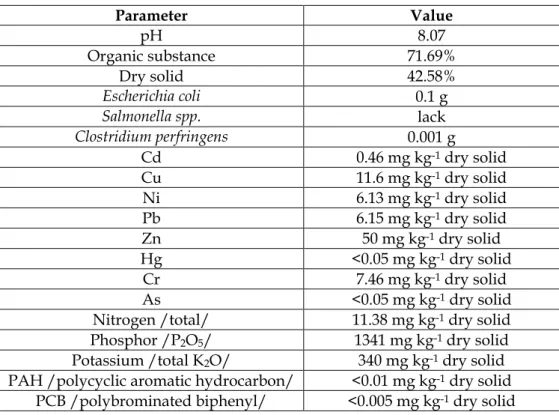
iscussionParameters of activated sludge are presented in Table 1.
Table 1. Chemical analysis of activated sludge
Parameter Value
р 8.07
Organic substance 71.69%
Dry solid 42.58%
Еscherichia coli 0.1 g
Salmonella spp. lack
Clostridium perfringens 0.001 g
Cd 0.46 mg kg-1 dry solid
Cu 11.6 mg kg-1 dry solid
Ni 6.13 mg kg-1 dry solid
Pb 6.15 mg kg-1 dry solid
Zn 50 mg kg-1 dry solid
g <0.05 mg kg-1 dry solid
Cr 7.46 mg kg-1 dry solid
As <0.05 mg kg-1 dry solid
Nitrogen /total/ 11.38 mg kg-1 dry solid
Phosphor / 2 5/ 1341 mg kg-1 dry solid
Potassium /total К2 / 340 mg kg-1 dry solid
PАH /polycyclic aromatic hydrocarbon/ <0.01 mg kg-1 dry solid
33 During the preparation of the experimental variants, and namely soil, sludge and soil/ sludge ratio, it was observed that the sludge featured bigger volume and took bigger space in the
containers. It also had less density and featured better permeability than the soil and better aeration. Although the sludge was more permeable, it retained the moist longer.
Table 2. Physical and chemical properties
Moisture, % Humus, % Total Nitrogen, % CaCO3, % pH in 2
4.48 1.7 0.25 7.48 7.8
Table 3. Agrochemical parameters
Soil Type Depth, cm
in. Nitrogen
NH4 + NO3
mg kg-1
P2O3
mg per100g
K2O
mg per100g
Alluvial meadow soil АI 0 – 10 13.4 12.4 26
According to the World Soil Classification developed by FAO alluvial meadow soils relate to molikovite fluvisoles class.
Alluvial soils are soils deposited by running water. They feature well-formed humus accumulative horizon, which gradually transforms to C – type horizon.
These types of soil are widely spread in Bulgaria. They are located in the central part of river valleys right after the alluvial meadow soils towards the first land off shore terrace. Such soils exist also at the first low off shore terrace. They are divided in two types: calcic and non – calcic ones. Further they are classified according to the depth of soil graying (swallow – 100-150 cm, average deep – 150-200 cm, deep – bellow 200 cm.)
Humus horizon as well as the fixed soil layers is colored in brown with different intensity of the color shades. The humus horizon is about 30-40 cm high.
The examined soils had an average sandy – clay composition. They featured high permeability, average water retaining capacity and relatively good aeration capacity.
Humus content in the upper horizon was 1.7 %. Carbonates have been detected at the surface. Their availability explained the slight alkaline reaction (see Table 1) – р =7.8.
Regarding the microelements, their content in the examined soil samples was evaluated as poor – regarding the nitrogen, as average – regarding the phosphor, and good – regarding the potassium. (see Table 2)
They are considered being beneficial in regard with their physical and chemical qualities and are the most fertile soils in the municipality land. Being friable and not very flexible or clayey, these soils show slight resistance when processing. They are suitable for farming serials.
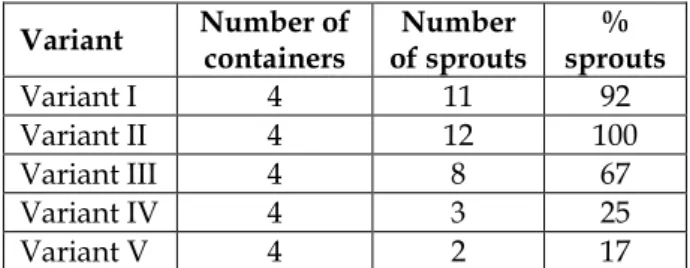
The seeds sprouted on the sixth day after their sowing (Table 4)
Table 4. Seed germination
Variant Number of containers
Number of sprouts
% sprouts
Variant І 4 11 92
Variant ІІ 4 12 100
Variant ІІІ 4 8 67
Variant ІV 4 3 25
Variant V 4 2 17
34 concluded that the increasing the sludge content in soil delays the germination/sprouting.
Next table shows the records made on 9th May, 2013 when the appearance of 1st
and 2nd leaves was observed (Table 5).
Table 5. Number of sprouts at the 9th day of
the experiment
Variant Number of
containers
Number of sprouts
Variant І 4 12
Variant ІІ 4 12
Variant ІІІ 4 12
Variant ІV 1 1
2
2 1 0
Variant V
2 1 1
4 1 0
As the table shows, the results in Variant ІV remained (See Tables 4 and 5).
Observation on the 3rd and 4th sprout
stage was recorded on 26th May, 2013 and
the results are shown on Table 6.
The report shows that all the sprouts in the soil, which was used as a reference, were in a stage of the 4th leaf. In Variant II, there
were plants in 5th leaf stage. In Variant III
we observed massive germination of 5th leaf.
There were least number of sprouts in
Variant V, however the sixth leaf of the plants was best formed.
Table 6. Number of sprouts at the 25th day
of the experiment
Variant Number of
plants
Stage of growth
Variant І All the plants are in stage of 4th leaf
Variant ІІ 10
2
4th leaf stage
5th leaf stage
Variant ІІІ All the plants are in stage of 5th leaf
Variant ІV 1
2
4th leaf stage
5th leaf
Variant V
1 1 1
4th leaf stage
5th leaf stage
6th leaf stage
The last record on the growth stages was done on 30th May, 2013. The records
showed that most of the plants were in their stage of development 5th-6th leaf. More
precisely: Variants I and II had plants in 5th
leaf stage; Variants IV and V – plants in 6th
leaf stage, respectively.
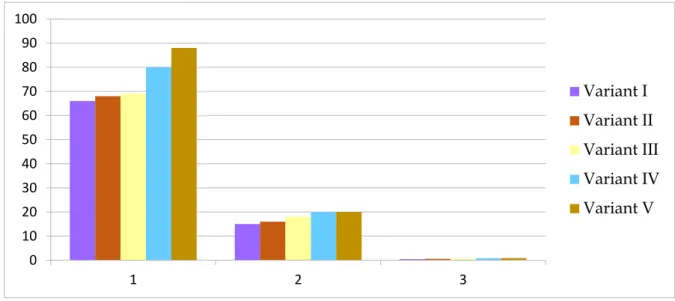
At true leaf stage we carried out measurements of the plants height, stems length and thickness (Fig. 1).
0 10 20 30 40 50 60 70 80 90 100
1 2 3
Variant I
Variant II
Variant III
Variant IV
Variant V
© Ecologia Balkanica
http://eb.bio.uni-plovdiv.bg
Union of Scientists in Bulgaria – Plovdiv University of Plovdiv Publishing House The records show that the plants in
Variants IV and V obtained the most favorable characteristics. They stood out from the rest of the variants for having the highest plants with the longest and thickest stems.
From the obtained results, it was concluded that the plants, which grew in soils with greater sludge content, grew faster, had greater biomass and much better developed root system. The root system development was proportional to the sludge proportion in the soil.
Conclusions
As a results of the experiment carried out with corn seeds of sort “Kneja 613”, grown in a soil and active sludge with content ratio: 3:1; 1:1; 1:3 and 100% sludge, it was concluded that:
1. Plants in Variant II and III grow earlier in comparison with the rest of variants, however Variants IV and V has faster growth.
2. At the time of growth assessment of 3rd – 4th leaf stages, Variant III showed
massive appearance of fifth leaf. Variant V showed least number of sprouts; however, the same plants had the best-formed sixth leaf.
3. With best plant development/ growth are Variants IV and IV. They stand out from the rest of the Variants for having the highest plants with the longest and thickest stems.
4. Plants, which grow in soils with greater sludge content, grow faster, have greater biomass and much better developed root system. Root system development is proportional to the sludge proportion in the soil.
References
ELMEDIA, 2011. Wastewater sewage plants and technologies for obtaining better environment, - Stroiteli, V(8), Available at:
[http://stroiteli.elmedia.net/sti/bg/2 011]
EXECUTIVE ENVIRONMENT AGENCY (EEA).
2011.Report on Article 16, Paragraph 2 of Ordinance Sludge treatment, management and utilization in farming, pp. 1-2.
Ministry of Agriculture and Food. 2004. Ordinance of sludge treatment, management and utilization in farming, DV 112, 23.12.2004. Available at:
[http://www.mzh.government.bg/M ZH/Libraries/%D0%9D%D0%BE%D1 %80%D0%BC_%D0%90%D0%BA%D1 %82%D0%BE%D0%B2%D0%B5-%D0%9D%D0%B0%D1%80%D0%B5% D0%B4%D0%B1%D0%B8/Naredba_U taiki.sflb.ashx].