http://dx.doi.org/10.1590/0104-530X1009-13
Resumo: A concorrência gerada pela globalização e a busca por produtos que satisfaçam os consumidores faz parte da indústria de alimentos. Para tanto, os projetos de desenvolvimento de produtos são fundamentais para as empresas, uma vez que, em 2012, as indústrias de alimentos geraram produtos ao equivalente a 9,5% do PIB brasileiro e faturaram R$ 431,9 bilhões. O setor alimentício se tornou líder, em valor bruto, entre as indústrias de transformação do Brasil. Contudo, identiica-se signiicativa quantidade de projetos de desenvolvimento de produtos que falham por razões diversas: a) escopo mal deinido; b) mudanças do escopo durante o projeto; c) aumento de custo do projeto; d) elevado tempo de projeto. A literatura pertinente a essa temática apresenta alguns modelos de desenvolvimento de produtos alimentícios. No entanto, não foca a deinição de escopo, reletindo a informalidade dessa etapa em todo o processo. O objeto de pesquisa desta investigação é o escopo dos projetos de desenvolvimento de produtos para empresas da indústria alimentícia. Complementarmente à ciência tradicional, esta pesquisa não se limita à descrição, à explicação e à predição do fenômeno. A pesquisa avança para a proposição de um artefato que melhor trate do objeto de pesquisa. Por esta razão, para a realização deste trabalho, foi utilizada a Design Science Research como método de pesquisa. Como resultado, se propôs um artefato, especiicamente um método para a deinição do escopo de projetos de desenvolvimento de produtos alimentícios. O método proposto Abstract: The competition triggered by globalization and the pursuit of products that satisfy customers are intrinsic to the food industry. In this context, projects for product development are vital for companies in this segment, which presented gross revenue of R$ 431.9 billion in 2012, 9.5% of the Brazilian gross domestic product (GDP). The food segment has become the leader among transformation companies in terms of gross value. However, one can identify a signiicant number of product development projects that fail for several reasons: a) badly outlined scope, b) scope changes along the project, c) project cost increase, and d) long project time. The literature concerning this theme presents some models for the development of food products, but it does not focus on the deinition of scope, thus relecting the informality of this stage in this process. The research object of this investigation is the scope of projects in the development of products for the food industry. Unlike traditional science, this research is not restricted to describing, explaining, and predicting the phenomenon on screen; it advances towards proposing an artifact that best deals with the research object. To this end, a Design Science Research was used as the methodological guideline of this study. As a result, an artifact was proposed for this particular case: a method to deine the scope of projects for product development in the food industry. The method proposed was designed from the combination and reinement of some steps: a) bibliographical research, b) practical experience, and c) research performed with Research and Development (R&D) experts from companies of the food industry. The method and its relevance for the food sector were assessed by specialists, thus conirming that, for a proper deinition of scope in food product development projects, one needs a systematic, lexible, systemic-oriented process which increases the chances of success and reduces cost and project length. This study is intended to present a systematic method to deine scope in the development of products for the food industry.
Keywords: Product development; Project scope; Product scope; Food industry; Project management; Method for product development.
Definition of scope in new product development
projects for the food industry: a proposed method
Definição do escopo em projetos de desenvolvimento de produtos alimentícios: uma proposta de método
Noelise Martins Manfio1 Daniel Pacheco Lacerda2
1 Programa de Pós-Graduação em Engenharia de Produção e Sistemas, Universidade do Vale do Rio dos Sinos – UNISINOS,
Av. Unisinos, 950, CEP 93022-000, São Leopoldo, RS, Brasil, e-mail: [email protected]
2 Grupo de Pesquisa em Modelagem para Aprendizagem – GMAP, Programa de Pós-Graduação em Engenharia de Produção e
Sistemas, Universidade do Vale do Rio dos Sinos – UNISINOS, Av. Unisinos, 950, CEP 93022-000, São Leopoldo, RS, Brasil, e-mail: [email protected]
Received Sept. 30, 2013 - Accepted Apr. 7, 2015
1 Introduction
According to the Brazilian Association of Food
Industries (ABIA), thirty-two thousand formal food
industries generated the equivalent of 9.5% of the gross domestic product (GDP) in 2012. That same year, the revenues of food and beverage industries totaled
R$ 431.9 billion, the irst highest gross production
value of the manufacturing industry (ABIA, 2013a).
Exports totaled R$ 84.8 billion, equivalent to 20% of
the total industry sales. This result makes the food sector one of the most relevant to the generation of positive balance for Brazil, because in 2012 it
reached US$ 37.8 billion, a igure above the trade
balance of the Brazilian economy as a whole, which was US$ 19.4 billion (ABIA, 2013a).
In 2012, despite the worsening global economic crisis, the food and beverage industries totaled R$ 11.1 billion in investments and, despite the reduced growth of the Brazilian GDP, real sales grew 4.6%.
The growth of real sales was relected in the increasing
number of workers (ABIA, 2013b).
The beginning of the 90s marks the beginning of the restructuring of the food industry in Brazil due to the opening of the market to food imports. Consumers are now opting for the quality and diversity of imported products. The process of productive globalization of processed foods begins. Multinationals install their operational units in the country, taking advantage of the weakness of the positioning of national companies, and begin the process of acquisitions and mergers
(Assunção, 2001).
The cultural, political and economic changes and the globalization impose an acceleration to the
processes of changes, which Vieira (2002) indicates
as being the motivator of organizations in the search
for a better performance of their activities. Example of
these changes is the fact that the Brazilian population migrated strongly from the consumption of in natura products to processed foods. To give an order of
magnitude, 85% of the food consumed in Brazil go
through some kind of industrial processing, number
that in 1990 was of 70% and, in 1980, only 56% of
the food consumed in the country went through some industrial processing (ABIA, 2013a).
For Rozenfeld et al. (2006), the increased competition, the technological changes ever faster, the reduction in the life cycle of products and the greater consumer demand are factors that require from companies greater
lexibility, productivity and high quality. For this, they also depend on the eficiency and effectiveness
in the process of product development. This context is also valid for the food industry.
Clark & Fujimoto (1991) argue that the frequency and strength in developing and launching new products interfere directly in the success and growth of the organization. For Cooper (1999), companies that do not innovate or fail in the development and launch of new products cannot stay on the market.
The development projects of new products play an important role in the strategic management of enterprises, becoming the elements that perform changes allowing the implementation of strategies and innovations and generating competitive advantages. With increasing demand for growth and innovation, routine operations in companies are reducing, while projects are increasing in importance (Shenhar &
Dvir, 2007; Cleland, 1994).
In this context, it is possible to observe the relevance that the projects, in general, and the product development projects, in particular, have for businesses.
The signiicant increase in demand for products that
meet the requirements of consumers, linked to the pressures generated by global competitiveness justify that product development projects need to be better understood. According to PMI (2009), it is estimated that US$ 12 trillion is spent annually on projects worldwide, which is equivalent to 25% of the world GDP. The size of the addressed problem increases, when checking the quantitative of unsuccessful projects.
In a context of reduced budgets, any way to ensure that projects are carried out on time, with guaranteed quality, meeting all the requested scope and within the
estimated cost, is necessary (Knob, 2007). Marques
(2000) comments that despite the relevance of these projects in organizations, most do not meet their goals. The main objective of project management, according to Frame (1995), is to ensure that the job is done on time, within budget and according to
speciications. These three dimensions - time, resource and scope - form the triple constraint of a project
foi desenvolvido a partir da combinação e do reinamento de alguns passos: a) da pesquisa bibliográica; b) da experiência prática; c) da pesquisa realizada com especialistas do setor de Pesquisa e Desenvolvimento de empresas da indústria alimentícia. O método e sua relevância para o setor de alimentos foram avaliados por especialistas, conirmando que, para uma deinição adequada do escopo de projeto de desenvolvimento de produtos alimentícios, é necessário um processo sistemático, lexível e de visão sistêmica. A contribuição central deste trabalho é propor um método sistemático para deinição do escopo de projetos de desenvolvimento de produtos alimentícios, algo aparentemente negligenciado pela literatura pertinente.
and are critical to the success (Xavier et al., 2005;
Rosenau, 1996). According to Valle et al. (2010), it is necessary to balance the conlicting constraints:
time, cost and scope.
However, the project scope is a point overlooked by the project management processes, either by the complexity that it presents or by the diversity of
visions involving a deinition of scope. Kotonya and Sommerville (1998) call for attention to the danger
of belittling the project scope because it seems to be unnecessary expense and not to bring immediate returns. Such savings in time and cost can be the cause of future rework, increasing the time and cost during the project. The lack of quality of a scope could jeopardize the project’s success.
To Camargo (2007), the early stages of the project
are those with a high level of abstraction and require considerable understanding of efforts, because of their complex dynamics. Black (1996) conducted a
research with 70 engineers, who pointed out the lack of deinition at the beginning of the project as the
main cause of delays and costs over budget. Fleming & Koppelman (2005) suggest that there is no factor that contributes more to the success of a project than
starting it with a full and robust deinition of scope.
Therefore, it is possible to verify how much the scope item interferes in development projects, whether in
the speciic sector of food or not.
It is possible to observe the lack of speciic studies
on development projects of food products; hence, there is relevance to the area of foods, a sector with a high rate of product development projects, low rate of successful projects and with incipient and
amateur existing procedures. According to Laidens (2007), what happens in most of the food industries
is that projects are based on empirical procedures and are often based only on knowledge, skills and experiences of individuals. Thus, the aim of this study is to contribute to propose a method that helps the scope construction process in product development projects.
It will be presented next a synthesis of the review of the literature related to the search object. Then, the methodological procedures which bore the conduct of the research are evidenced. Finally, the method (device) developed is exposed and detailed.
2 Literature review
Rozenfeld et al. (2006) state that selling a product with low added value and in high volume is less and less applicable. Companies seek to become global, competitive and launch new products to meet the continuously changing customer needs.
New products that bring technological innovations,
new functionalities, making them more attractive and creating the need for product replacement. This competitive environment makes companies
have better processes for developing their projects (Rozenfeld et al., 2006).
Project management seems to still be a phenomenon to be better understood. An indication of this can be
seen in the CHAOS report (Beware, 2011), where
63% of information technology projects were not
inalized in 2010. For food development projects,
Rudder et al. (2001) state that the success rate is less than 12%. Redmond (1995) mentioned that the failure rate of new food products launched in the
market increased from 42%, in 1965, to 86%, in
1991, mainly due to increased competition, increased product offering and, consequently, consumer market fragmentation. This reality does not seem to have
changed signiicantly, despite the studies.
According to Laidens (2007), the food industry has
the characteristic to release a large number of products
per year. Nonetheless, projects lack deinition and
systematization, contributing to a high failure rate. This can occur because, in most food industries, projects are based on empirical procedures and based only on knowledge, skills and experiences of the individuals
(Laidens, 2007). These failures in the food industry not only affect the inancial or strategic results of the
company, but can also generate consequences in the context of food security, a particularity of the sector
(Laidens, 2007).
Toledo et al. (2008) report that product development
is a complex process and of broad scope, and any research in this area has limitations and a wide range of critical success factors. Fleming & Koppelman (2005) suggest that there is no factor that contributes more to the success of a project than starting it with
the best possible deinition of the scope. Therefore, the
scope interferes with development projects, whether
in the speciic sector of food or not. According to
Salgado et al. (2010), the product development process refers to the steps, activities, tasks, stages and decisions involving the product development project. Clark &
Fujimoto (1991) deine product development as the
process by which the organization transforms data on market opportunities and technical possibilities in goods and information for the manufacture of a commercial product.
According to Rudder et al. (2001), the food product development process is costly, fraught with
dificulties and subjectivity, and therefore, the failure
rate is high. According to Prieto et al. (2005), the product development problem in the food industry is the resistance to innovation, due to the high cost of research, the communication disability between
sectors involved and the dificulty of companies
regarding market research. Thus, the process of product development that occurs in most food companies is
characterized by informality - because it is based,
largely, on adaptations of products that are similar
products on trial and error until the objectives are achieved.
For Toledo et al. (2004), in the last three years companies are featuring their development projects
according to the classiication described by Fuller (1994): line extensions; new forms of existing
products; reformulation of existing products; new packaging for existing products; new product for the company (already on the market); and innovative products (new to the market). Toledo et al. (2004) found that the majority of products developed by the companies (regardless of their size and whether they export their products or not) are of the type line extensions, on average, 42% of the developed designs. The relative share of companies doing innovative product designs is 14%.
Santos (2004) found that most types of products in the food industry is characterized by few transformations, little changes. Companies prefer to invest in the line extension development, which apparently presents no need to use development method of products or project management. Given this reality, the food product development methods are little widespread or not used.
According to Révillion et al. (2004), the food industry
is paradoxical. On the one hand, overt investment
in advertising, but with low investment in research
and development. On the other hand, the launch of high value-added products for speciic niches and demanding markets. Abreu (2007) states that the
consumer is a challenging factor in the development of products in the food industries because of conservative consumption habits. The consumer buying behavior
changes demanding higher value-added products
has caused an increase in food product development projects (Beccatini, 1994).
Penso (2003) mentions that the food industry rarely used the expression “product design”, but rather “product development”, which was seen as a sophisticated cuisine, with laboratory sensory testing. This image has changed over time, although it is still
common. The inal characteristics of a food product depends on the qualiication and quantiication of
all sensory and physicochemical properties, of the process parameters, the conservation methods used, the packaging used and the food safety.
Fuller (1994) states that researchers have stepped up efforts to implement tools and methods for product development. So therefore they can identify the needs and desires of consumers and translate them into product features, thus reducing design time increasing its chances of success. For Rozenfeld et al. (2006), the way of conduction of the development can occur under different approaches. The evolution of the vision of how to manage product development is linked to the evolution of the general administrative procedure adopted by the company. The analysis
of how the product development management of a company is and how it should be must consider a broad context. Including the competitive environment in which the company operates and its demands, the training and internal organization of the company and process performance. Hence, there is neither best approach nor the most appropriate (Rozenfeld et al.,
2006). Speciically in the development projects of
food products, Rozenfeld et al. (2006) argue that a study of role models is leveraged by the capacity of design time reduction and better understanding of the demand, increasing the success rate.
Earle (1997) states that in the 50s there were two product development lines in a food company:
one dominated by the marketing sector and another by the research and development (R&D) sector. At that time a high rate of failure was viewed in the projects, since both sectors used to neglect the consumer
opinion. One of the characteristic obstacles in food
industry enterprises, which remains until today, is the distance between marketing and R&D sectors, continuing to generate failures in the projects.
To Laidens (2007), the reference methods for the
food industry are little widespread in business circles,
but have been the subject of studies. Abreu (2007)
states that one of the success factors of a food product development project is the use of a formal process, of a methodology. Santos (2004) presents
the most well-known methods in the literature for the
development of food products, according to Chart 1. It can be seen in the methods shown in Chart 1 that the steps have reduced approach regarding the description of the scope. This suggests that the stages
of scope deinition, as well as its management, are not speciic and, therefore, do not get enough attention,
or, perhaps, are being dealt internally at some stage. Understanding the importance that the scope has
to projects, PMI has deined two speciic problems
of the scope area that were questioned in the research Study of Benchmarking in the Management of Projects Brazil. Chart 2 shows the occurrence of the problems with scope.
One can observe the high rate of quotes, by enterprises
for these problems, which involve directly the result of the project. In all versions of the study, from 2003 to 2012, there was the constancy of the high rates for these two problems related to the scope. It can be seen the negative implications with which the product development projects are impacted due to the scope
that is ill-deined and/or with recurring changes.
These changes can interfere with the delivery of the
project and/or its budget, jeopardizing companies with
regard to product launches and costs, for example.
Guerra (2006) found that 86% of surveyed projects
were not delivered on time, 65% had changes in
interference of some situations in a project. It were only brought situations regarding this project, the scope. Survey responses with respect to the scope are shown in Chart 3.
The research of Yugue (2011) helps to verify how
much the scope interferes in the projects to the point of increasing its complexity. This makes it possible to understand the importance that the scope represents for the projects and the need to balance this restriction
with the others. In Yugue research (2011), it is also
possible to verify a correlation between the changes in scope during the implementation of projects and cost. The increased complexity related to the scope changes during the projects decreases the likelihood of a project to be delivered on budget.
From 2010, the PMI began to consider sectors of the economy in the Study of Benchmarking in the Management of Projects Brazil. Chart 4 presents the results of the food sector and consumer goods.
This context requires research to develop devices to help reducing the problems observed. However, is necessary to build and classify the intended device in a certain Class of Problems to develop artifacts whether minimally generalizable and comparable. The Problem Classes allow the artifacts and their
solutions not to be just a one-off response to a particular problem in a speciic environment. That is,
the artifact and its solutions can generally be used for similar problems (Dresch, 2013). The proposed method, artifact of this research, was inserted into
the Class of Problems: deinition of food product
development project scope. This class of problems includes the following artifacts, as shown in Chart 5.
Once characterized the problem class in which is
inscribed the proposed device, it should be exposed the method of research and work that this investigation. The following section details the logic of realization and the criteria used in the survey.
Chart 1. Food product development methods.
Fuller (1994) Rudolph (1995) Earle (1997) Polignano & Drumond (2001)
Penso (2003)
Product design - deinition of the product
- prototype development - benchtop testing - objective tests - subjective tests
Product design - prototype development
Design the product - product concept - product design speciication - product prototype
Product design - detail the product design
- build/develop and test prototypes
Product design Informational Design Phase
- product concept - product attributes - product speciications Conceptual Design Phase - basic structure of the product
- product conceptions -tests of the product prototype
Detailed Design Phase - formulation and pilot test Process design
- tests in pilot plants - tests in industrial plant
Process design
- pilot test Process design- process plan Process design- detail the process - test in pilot scale - prepare industrial plant
Process design Detailed Design Phase - process design speciications - layout of premises - test and manufacturing preparation for the batch test
Source: Santos (2004).
Chart 2. Problems that occur more often in projects in general of the organizations related to the scope.
Problems 2003 2004 2005 2006 2007 2008 2009 2010 2011 2012
Constant changes of scope 69% 64% 69% 29% 62% 59% 70% 43% 62% 59%
Scope was not
adequately deined -- 54% -- -- 60% 53% 61% 39.5% 62% 62%
Number of participating
organizations 60 73 80 183 184 373 300 460 754 730
3 Research method
The purpose of the Design Science Research (DSR) is to develop knowledge to be used to design solutions
to real problems (Van Aken, 2004). Therefore, the
DSR is not concerned only with the research itself, but with the generation of knowledge that can be used to solve real problems, in improvement possibilities or in the creation of new artifacts. Simon (1996) explains that artifact is something that is built by man.
The DSR is a new look or a set of analytical techniques that allow the development of research
in different ields, including engineering (Vaishnavi
& Kuechler, 2011). The DSR aims to study, research and investigate things created by man and how these creations behave both from an academic point of view and from the point of view of the company, of the organization, of the industry (Bayazit, 2004). The result of this type of research is an artifact.
The artifact generated in this study is a method that, according to March & Smith (1995), can be understood as a set of steps required to perform a certain task. According to Chakrabarti (2010), what differentiates the traditional research from the DSR method is that traditional research is primarily concerned with understanding the phenomena, whether they are human, natural or systematic. While the DSR approach consists in improving these systems.
The DSR was the research method chosen by the fact that the aim of this study is to build an artifact that may assist in solving a real problem. The DSR is a rigorous process designing artifacts to solve real problems, evaluating the artifact, and the results are
communicated (Lacerda et al., 2013).
The research design requires knowledge on what
is the best way to ind out, by scientiic means, the
answer to the problem set. That best way can come
from several factors: available resources (time, inancial and human), method framing to the objective
of the research, interest and ability of the researcher.
Gil (2007) deines research as being the rational and systematic process that aims to ind answers to the
problems posed. The reasons of motivation for research come from practice or intellect. Saunders et al. (2012) argue that the search process needs to be treated as an “onion”, whose in each layer comes a question to be decided on the methodological approach that the researcher intends to follow.
The working method is a sequence of steps
deined by the researcher. It is characterized by a
set of systematic and rational activities that drive and underpin the generation of valid knowledge, establishing the steps to be followed to achieve the
research objectives (Lakatos & Marconi, 2001).
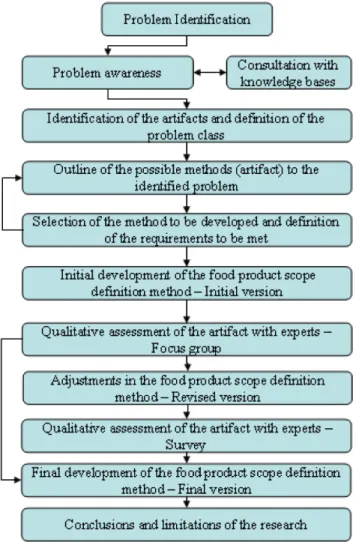
Figure 1 shows the working method that was chosen for the research.
Chart 3. Scope interference to the complexity of the projects.
Project Situations Helped a lot and fully to the complexity of the project
Uncertainty as to the scope of the project 86%
Uncertainty as to the scope of the product 83%
Signiicant changes in the scope during the project 76%
Scope changes during project execution 57%
Deinition of the scope of product 39%
Source: Adapted from Yugue (2011).
Chart 4. Problems that occur more often in projects of the food/consumer goods sector of organizations related to the scope.
Problems 2010 2011 2012
Constant scope changes 53% 50% 50%
Scope was not adequately deined 40% 50% 50%
Number of participating organizations 460 754 730
Source: PMI (2013).
Chart 5. Problem Class and artifacts.
Problem Class Artifacts
Deinition of food product development project scope
Analysis of ideas (Graf & Saguy, 1991) Generation and Selection of ideas (Fuller, 1994) Product deinition (Rudolph, 1995)
Generation of ideas, product design and process design (Earle, 1997) (Polignano & Drumond, 2001)
Informational and conceptual design (Penso, 2003) Informational design (Santos, 2004)
For the survey was conducted a systematic review of the literature in databases of journals, articles, bank of theses and dissertations, as shown in Chart 6, using
the method structured by Lacerda (2009).
Subsequently, the keywords and connectors were
deined, aligned to the research topic in question.
The search cutting by publication date was from 2000, for considering this period as being current for the material to be searched and for the subject
matter of the research. Notwithstanding, some authors
with publication dates previous to 2000 have been included for their relevance to the subject.
For the evaluation and validation of the proposed
method were planned two moments: a) focus group for reinement; b) questionnaire for inal validation.
To structure the focus group, the recommendations
used were from Tremblay et al. (2010) and Oliveira & Freitas (1998). For the participation of the focus group were selected ive experts of food products
development, with operations in the academic and business scope, as shown in Chart 7. Furthermore,
they were selected based on two aspects: a) recognized
knowledge and practice in the food product development area; b) availability to participate in the focus group.
The experts selected for the focus group received an invitation letter to participate in the research and to permit possible use of image and identity. A conduction route was built, where the theme and the research objectives, as well as the artifact, were presented to the participants through slide show. The discussion on the topic was given in order to validate the artifact
providing a reinement therein through a previously
formulated questionnaire, with open and closed
questions. Open questions were deined in order to
identify and qualify the experts. The section was
ilmed with the consent of all participants.
From the results obtained in the focus group, improvements were extracted generating a new version of the device, which was presented for a second round of evaluation. This second assessment took place through a questionnaire, sent electronically, also answered by experts in developing food products. The selection took place conveniently, by the own characteristic of the development of food products,
which is restricted. The inclusion criteria for sending the questionnaire to experts was a minimum of 5 years
experience in the ield of projects in the development of
food products. There was no company size restriction or relevance of academic performance, not even of academic background, age, gender or geographic region of operation. The focus was the performance in development projects of food products. The return
rate of questionnaires was above 20%, deined by the literature as a signiicant return (Mattar, 1996). Chart 8 shows the proile of respondents.
The questionnaire was formulated with non-structured and structured questions, with staggered, Likert and
dichotomous questions, in order to capture details
and suggestions from experts. The Likert scale is a
widely used scale. According to Malhotra (2004),
the Likert scale requires that respondents indicate a
degree of agreement or disagreement. This factor is important for the attempt to assess and validate the proposed method. It was not possible to survey the population of specialists in development projects of food products; therefore, the population for this research is considered unknown. The sample was
non-probabilistic by convenience. This classiication
relies on the personal judgment of the investigator and not on the chance to select the sampling units.
Non-probabilistic samples can provide better estimates
of the desired characteristics of the population. Sampling by convenience brings a negative bias, once it does not allow an objective assessment of the sampling results accuracy; however, it has low cost, is simpler and has a positive bias for this research that needs recognized experts. It also allows greater control by the researcher, which may give rise to a
more qualiied answer for the questions posed. It was
in this sense that this technical procedure was adopted.
4 Method proposal – The artifact
The proposed models focused in the food industry do not seem to be aware enough of the importance
of a robust deinition of the scope of project and
product. Models that are not focused on the food industry neglect the particularities of the sector, as well as the importance of setting an appropriate scope.
From the analysis of the models and techniques that the literature presents, one can make two
observations: a) the models of the food product
development process do not focus on the scope
deinition of product and process, clearly the focus is
the development process itself; b) the techniques for
scope deinition are not focused on the food industry, Chart 6. Information sources.
Category Information Source
Scientiic Journals
EBSCOHost – Academic Search Complete, Business Source Complete, Academic Search Premier, Academic Search Elite, Information Science & Technology Abstracts SCIELO
Product Management & Development (publication of the Product Development Management Institute)
Dissertations and Theses
BDTD/IBCT (Digital Library of Theses and Dissertations/Brazilian Institute of Science and Technology)
DART Europe
Source: Elaborated by the author.
Chart 7. Proile of the evaluators participating in the focus group.
Evaluator Training Course Last school
experiene Current position
Experience time in food R&D
Quantity of food R&D projects
1 Food engineering Food engineering Commercial Between 11 and 15 years
Developed projects for
13 years
2 Technical
chemistry
Technical
chemistry course Quality
Between 11 and 15 years
Does not remember
3 Industrial
chemistry
Doctorate in engineering
Research Professor
Between
16 and 20 years 10 to 15
4 Food engineering
Master’s degree in chemical engineering
Research
Professor Less than 5 years 5 to 10
5 Food engineering
Specialization in production engineering
Industrial R&D Between 11 and 15 years
Does not remember
but in project management from the PMI. Chart 9 shows the strengths and weaknesses existing in the evaluated models.
For the proposition of the artifact of this research, the focus of analysis were the models of the development
process of food products. It can be veriied that the models are not clear nor systematic. Each food product
development process model makes its approach and focuses on a process step. However, none of them
describes or discusses the process for proper deinition
of a scope of product and process.
The artifact created for this research aims to meet the food industries, regardless of the size, of the product to be developed or even of the company structure. For use in other sectors, it may need to be
adapted, considering particularities of the sector/case.
To build the artifact, it were considered some features, with emphasis on visual representation
and systemic vision. The proposed scope deinition
method of food product development projects has distinct steps that must be followed. For the conduct of the method, it should be chosen a person who is part of the research and development team of the company. It takes the participation and involvement
of these people in the process:
a) the external or internal customer(s);
b) the team of research and development of the product (which may be the client);
c) representative of the industrial sector (which may be the client);
d) representative of the marketing sector (which may be the client).
The proposed method of the abduction process was given from the theory, the practice, the observation of reality and considerations made during the focus
Chart 8. Proile of the evaluators participanting in the questionnaire.
Evaluator Graduation Course
Last school
experience Current position
Experience time in food R&D
Quantity of food R&D projects
1 Food Engineering Graduation Consultant, R&D Up to 5 years Up to 5
2 Food Engineering Specialization Consultant, R&D,
Industrial Up to 5 years More than 21
3 Food Engineering Specialization R&D, Industrial Between
11 and 15 years More than 21
4 Food Engineering Master’s degree
Professor, R&D Researcher,
Consultant
Between
6 and 10 years Between 6 and 10
5 Food Engineering Specialization R&D Between
11 and 15 years More than 21
6 Food Engineering Specialization R&D Between
1 and 5 years More than 21
7 ChemistryIndustrial Technical course R&D Between
6 and 10 years More than 21
8 Food Engineering Graduation Commercial, R&D Between
11 and 15 years More than 21
9 Food Engineering Graduation Commercial, R&D Between
11 and 15 years More than 21
10 Food Engineering Master’s degree
Professor, R&D, Consultant, Marketing, Commercial
Between
16 and 20 years More than 21
11 Industrial
Chemistry Doctorate Professor, R&D
Between
11 and 15 years Betweeen 6 and 10
12 Food Engineering Specialization
Professor, R&D, Researcher, Consultant, Industrial, Commercial
More than
21 years More than 21
13 Food Engineering Specialization R&D Between
11 and 15 years More than 21
14 Industrial
Chemistry Master’s degree Consultant, R&D
More than
21 years More than 21
Chart 9. Strengths and weaknesses of the existing artifacts.
Model Stage Weaknesses Strengths
Graf & Saguy (1991)
Analysis of ideas
Does not systematize the scope deinition.
Does not consider the process as a deinition of scope.
Does not consider process requirements. Does not consider the business, consumer and Market.
Does not consider cost.
Does not consider legal requirements. Considers that the product requirements is already the scope.
Details of product requirements.
Fuller (1994)
Generation and selection of
ideas
Does not systematize the scope deinition.
Does not consider the process as a deinition of scope.
Does not consider cost.
Does not consider legal requirements.
Raising of ideas.
Selects ideas according to business and consumer objectives.
Analyzes ideas following process, marketing, inancial and technical criteria.
Rudolph (1995) deinitionProduct
Does not systematize the scope deinition.
Does not consider the process as a deinition of scope.
Does not consider process requirements. Does not consider cost.
Integration of consumer issues, business objectives, product requirements and legal requirements.
Earle (1997)
Generation of ideas, product design and process design
Does not systematize the scope deinition.
Does not consider the process as a deinition of scope.
Does not consider process requirements. Does not consider cost.
Does not consider legal requirements.
Considers the business strategies. Search critical analysis of product concepts in the market.
Does market test.
Evaluates the process technically and inancially.
Polignano & Drumond (2001)
Does not systematize the scope deinition.
Does not consider the process as a deinition of scope.
Does not consider process requirements. Does not consider cost.
Does not consider legal requirements.
Considers statistical tools.
Penso (2003)
Informational and conceptual
design
Does not systematize the scope deinition.
Does not consider the process as a deinition of scope.
Does not consider process requirements. Does not consider business, consumer and market.
Does not consider legal requirements.
Considers ife cycle.
Does quality function deployment (QFD).
Develops and tests product design alternatives.
Considers cost analysis.
Selects suppliers for development.
Santos (2004) Informational design
Does not systematize the scope deinition.
Does not consider the process as a deinition of scope.
Does not consider business, consumer and market.
Does not consider cost.
Does not consider legal requirements.
Gathering information for product design.
Considers the product life cycle. Does quality function deployment (QFD).
Details the product speciications. Gathers information and speciications of the process. Identiies availability of ingredients, raw materials, and available equipment.
Records lessons learned.
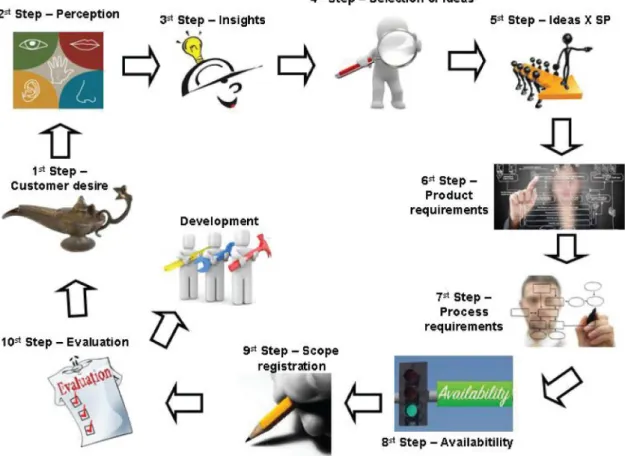
group. The suggestions made by the experts in the focus group were incorporated and represented in Figure 2. This same method was evaluated and
validated in the quali-quantitative survey performed.
Considering that the results obtained in the research have been satisfactory, the suggestions of experts were not followed.
Before describing each step of the proposed method, some applications are required. The method
must start in Step 1, especially when it is the irst
cycle to be conducted, that is, when the project is starting. When there is need to scope change during development, it means that some step of the scope
deinition method has not been adequately developed.
To make the survey of the failure, the lessons learned
logs are gathered and analyzed. From this veriication,
the method needs to be restarted at Step 1 in order to
remedy all the possibilities for new laws. After each
step, it is necessary to register the activities, the decisions made and the lessons learned.
Lessons learned are information recorded during
the process by a member of the development team that is chosen by the team and not necessarily always have to be the same. These records are essential for the whole process to be controlled and for its generated learning to be available, supporting future
scope deinitions or even possible changes that
may occur during the development process. It is also important to use a checklist performed at the end of each stage of the method to ensure that all activities of each step were met. The checklist can be built according to the needs of each project and of each stage, with the choice of activities by the development team.
At the end of each stage, there is a decision making, a gate, a process of systematic review according to Cooper model (Cooper, 2001). At this point, the development responsible checks if the step
is really inished and if there is possibility to move
on to the next. The aim is to ensure that the process will continue to the next stage if the step is really complete. The tools used in the method are options found by the researcher. The developer responsible for conducting the project has the autonomy to decide which tools to use. At every stage it is suggested to use two tools to record the entire event occurred
in the step: a) text editor: software for text editing; b) cheklist: list of activities to be performed during
the step. This decision is the result of the developer experience, of the maturity of the team and of the project. These aspects cannot be overlooked. The following is a description of the proposed method.
1st Step – Customer desire
The method starts with the client’s expression for his desire, what he expects for the product to be developed. The client can be external or internal.
Domestic demand may come from various sectors:
a) marketing; b) industrial; c) research and development;
d) costs; e) commercial; f) management. Each sector may identify an internal demand, being it of the inal
consumer, by reducing cost, of packaging alteration, of equipment exchange, namely, there are many types of
demand. No matter what kind of demand, the method is focused on deining the scope; therefore, the type
of demand does not interfere with the method. It is important to raise awareness of the need for full and
proper deinition of scope for driving the development
project, something neglected in the food sector. Is part of the food sector culture that an existing product will serve as a reference for development projects of other companies. In this case, the product is available to carry out the survey of requirements. The inputs and outputs of this step are shown in Chart 10.
2nd Step – Perception
This step is the one that contains the highest degree of subjectivity of the method, because the
perception is generated from the ive senses, which
are the interface between man and the external world. From the customer’s desire expression, the developer realizes and manages to translate desire into a possible product. The inputs, outputs and suggested tools for this step are shown in Chart 11.
For being a subjective stage and with use of a subjective tool, the result is related to the ability developed that can come with experience or be a natural factor. There are sensory techniques to help
develop this skill connected to the ive senses, which, when united, generate the sixth sense. Ordóñez (2005)
point out the psychic needs of the food, in addition to the organic. It is in this step that the psychic requirements are generated.
3rd Step – Insights
The insights are ideas that arise from the perception of the customer’s desire. It is at this stage that the generation of ideas happens, without bothering to limit or judge. The inputs, outputs and tools suggested for this step are shown in Chart 12.
For the process of generating the ideas, three
cognitive tools are suggested:
a) brainstorming: tool used in groups to develop
and exploit the creative potential (González & Toledo, 2012);
b) rich picture: tool used in Soft System Methodology (SSM), is a way to explore, recognize and deine
a situation and express it through drawings. A rich picture helps to open discussion and reach a broad shared understanding of a situation. For being “playful”, this technique supports and facilitates the visualization of ideas, not compromising the professional reputation and promoting a better understanding (Checkland, 2000);
Chart 10. 1st Step: Customer desire.
Inputs Outputs Tools
1. Customer desire
2. Product visualization (if there is)
1. Product information
2. Product information registration 3. Record of learning
1. Text editor 2. Stage checklist
Source: Elaborated by the author.
Chart 11. 2nd Step: Perception.
Inputs Outputs Tools
1. Product information
2. Product information registration
1. Perceptions on the product
2. Registration of the perceptions on the product 3. Record of learning
1. Five human senses 2. Text editor 3. Stage checklist
Source: Elaborated by the author.
Chart 12. 3rd Step: Insights.
Inputs Outputs Tools
1. Perception on the product 2. Registration of the perception on the product
1. Generated ideas
2. Registration of the generated ideas 3. Record of learning
1. Brainstorming 2. Rich Picture 3. Cognitive mapping 4. Text editor 5. Stage checklist
c) cognitive mapping: tool used in Soft System
Methodology, useful to assist in structuring and solving problematic situations described, mainly, by qualitative notions. They are extremely rich in the sense to represent graphically the perception of an individual about a subjective problem. It is possible to consider that the scope of product and project is a problematic situation and, again, through the viewing occurs the transformation of ideas into written words (Robertson & Williams, 2006).
4th Step – Selection of ideas
In this step occurs the evaluation and selection of the generated ideas which are convergent with the
customer’s wishes. One can not invest in all ideas,
so at this point it is possible that the rejection of a good idea and the acceptance of a bad idea occur. The inputs, outputs and tools suggested for this step are shown in Chart 13.
For the ideas that are most relevant, appropriate
and converging to the project to be identiied and selected, the suggested support tools are:
a) 5W2H (What, Why, Who, When, Where, How,
How Much): “what” to run, “why” it should
be run, “who” must run, “when” it will be run, “where” it should be run, “how” it should be run, and “how much” it will cost to run. This initial quality tool to generate action plans facilitates the tangibilization of the aspects and desired attributes;
b) choice committee: to set up a committee to
make the selection of ideas classifying them
as: a) promising; b) marginal; c) rejected.
This committee, as well as the development team, is free for construction;
c) criteria table: through a criteria framework, where
ideas are assessed according to each criterion.
Example: each idea will be valued from 1 to
5 for each criterion, with 1 signifying least important and 5, more important. The largest sums of values will be for the most important ideas. To build the framework, the team is free
to deine what are the criteria to be evaluated,
as well as the form of valuation.
5th Step – Ideas x Strategic Planning
In this step, one can view the product and arises the need to examine its suitability to the business and the company’s strategies. The inputs and outputs for this step are shown in Chart 14.
Company documents containing relevant information to the business are important to verify the actual suitability of the new product to the company. If the project is not within the scope of the company’s
development, it is necessary a speciic analysis of
the subject in order to verify if there is real interest from the company for the new product to be part of its product portfolio.
6th Step – Product requirements
This is the time of deinitions of the product requirements, preparation of brieing. Fundamental
step in the method, because this is where all the
attributes and requirements - technical, inancial and legal - will be observed. The inputs, outputs and
tools suggested for this step are shown in Chart 15. Unlike the 2nd step, where perception is abstract, this step needs to be objective and focused. For tangibilization of all perceptions, selected
ideas and deined requirements, it is suggested the following tools:
Chart 13. 4th Step: Selection of ideas.
Inputs Outputs Tools
1. Generated ideas
2. Registration of the generated ideas
1. Selected ideas
2. Registration of the selected ideas 3. Record of learning
1. 5W2H
2. Choice committee 3. Criteria Chart 4. Text editor 5. Stage checklist
Source: Elaborated by the author.
Chart 14. 5th Step: Ideias X SP.
Inputs Outputs Tools
1. Selected ideas
2. Registration of the selected ideas
1. Appropriate ideas to the process 2. Registration of the appropriate ideas to the process
3. Record of learning
1. Vision, Mission and Values of the company
2. Strategic plan of the company 3. Text editor
4. Stage checklist
a) reverse engineering (RE): is a product development
tool where the starting point is a product or an existing prototype, where the product development process is applied in reverse. Cunha (1999)
discusses two types of RE. One is applied to
the company’s own products, with the aim of improvement; the other in concurrence products, in order to understand the working principles and technology available. Mury and Fogliatto
(2001) state that the RE is a technique which
is little used by innovative countries, as it may be associated with piracy. But this technique is the most appropriate when the goal is set from quality parameters of existing products, to improve them. Thus, the product developed will be similar to the existing in the market, though different given the eventual changes made by the company;
b) benchmarking: it is a practice that facilitates the continuous low of new information for the
development process, it serves as a source of learning and opportunities (Waqued, 2002);
c) quality function deployment (QFD): is a tool for generating technical speciications of the project
and product. The main objective is to translate the needs of the client(s) on requirements. Santos (2004) states that, due to the characteristics of food products, the deployment of the parts is often not possible;
d) checklist: is a verifying list developed from the
existing need, which may be different for each
project. One can bring issues such as feasibility
of ingredients, production line adjustment, target for cost, etc.;
e) HACCP: set of rules and procedures that ensure
the safety of the product to be consumed, ensuring
consumer health (SENAI, 1999). Factor of great
importance in the food sector, the scope of a project or product that is already in the food safety sphere;
f) ISO 22000: is an international standard that deines the requirements for a food safety
management system covering all links in the
food supply chain (ABNT, 2006). Tool that
converges with the HACCP.
7th Step – Process requirements
Knowing what is needed in the process, equipment and staff for the product to be produced is of fundamental importance for the continuation of the method. It is at this stage that the process requirements are raised. Some requirements can generate changes in the process that do not demand investments or abrupt changes. The inputs and outputs for this step are shown in Chart 16.
For this step is critical the presence of the responsible for the industrial sector, because he will be able to make the most appropriate evaluation and to do the
survey of the needs. Being identiied any need for
changing the process or in the process, an analysis
Chart 15. 6th Step: Product Requirements.
Inputs Outputs Tools
1. Appropriate ideas to the process 2. Registration of the appropriate ideas to the process
1. Technical, inancial and legal requirements of the product 2. Registration of the product requirements
3. Record of learning
1. Reverse Engineering 2. Benchmarking
3. Quality function deployment 4. Checklist
5. HACCP 6. ISO 22000 7. Text editor 8. Stage checklist
Source: Elaborated by the author.
Chart 16. 7th Step: Process requirements.
Inputs Outputs Tools
1. Technical, inancial and legal requirements of the product 2. Registration of the product requirements
3. Evaluation of the product’s adequacy to the process 4. Registration of the product’s adequacy to the process
1. Technical, inancial requirements of the process
2. Registration of the process requirements
3. Record of learning
1. Text editor 2. Stage checklist
needs to be better performed, with participation of managers and decision makers.
8th Step – Availability
The veriication of the availability of ingredients,
supplies, equipment and production team is made
at this stage. Even with a high supply of market
possibilities, one still need to watch out for this step, as they are crucial factors for the development of the product. The search, in the availability market, is given with the research in regional, national and international suppliers. The technology, new researches and possibilities are in favor of the food industry and are already part of the service provided by suppliers to submit such opportunities. The inputs and outputs for this step are shown in Chart 17.
9th Step – Scope egistration
After completing the previous steps, this stage is just the formalization of product and process scopes. The inputs and outputs for this step are shown in
Chart 18.
It is suggested to build the scope with all relevant
information obtained during the process of deinition,
for all will have their importance at some stage of the product development process.
10th Step – Evaluation
Evaluation as the closing of the cycle is important
for the validation of the built scopes. It is at this stage
that one can have the irst viewing of the product and
of the process that will follow in the development process. The inputs, outputs and tools suggested for this step are shown in Chart 19.
This step creates two paths: a) being a positive
assessment, the scopes of the product and process are still in the product development process; b) being a negative assessment, the method starts again at Step 1. It is important to consider some requirements of the proposed method, as shown in Chart 20.
The requirements of the proposed method make the design scope more robust, complete and with fewer failures. The requirements do not present complexity
or dificulty of adaptation, which facilitates and
provides conditions for using the method.
Chart 17. 8th Step: Availability.
Inputs Outputs Tools
1. Technical, inancial and legal requirements of the product
2. Registration of the product requirements 3. Technical, inancial requirements of the process 4. Registration of the process requirements
1. Availability of ingredients, inputs and equipment
2. Registration of availability
3. Datasheets of ingredients, inputs and equipment
4. Record of learning
1. Text editor 2. Stage checklist
Source: Elaborated by the author.
Chart 18. 9th Step: Scope registration.
Inputs Outputs Tools
1. Registration of the product information 2. Perception on the product
3. Technical, inancial and legal requirements of the product 4. Evaluation of the product’s adequacy to the process 5. Technical and inancial requirements of the process 6. Availability of ingredients, inputs and equipment
1. Product and process scope
2. Registration of the scope
3. Record of learning
1. Text editor 2. Stage checklist
Source: Elaborated by the author.
Chart 19. 10th Step: Evaluation.
Inputs Outputs Tools
1. Product and process scope 2. Customer desire
1. Approval of the scope of the product and process OR
2. Non-approval of the scope of the product and process
3. Record of learning
1. Text editor 2. Stage checklist
relevance. The sampling for the survey took place in a convenient way, by the own characteristic of the food product development sector, which is restricted. This convenience can bring a negative bias, but brings
the conirmation and reliability of the theoretical and
practical knowledge of the specialist. Given the fact that it was not possible to conduct the interviews in person, some responses could not be understood.
These were some limitations identiied in the research.
The application of the method proposed in product
development projects, the application in speciic
industry segments and the validation of the proposed method in another sector than the food are some directions for future work.
References
Abreu, A. (2007). Esforço para inovação tecnológica: uma caracterização da indústria de alimentos do município de Marília/SP (Dissertação de mestrado). Universidade Federal de São Carlos, São Carlos.
Associação Brasileira das Indústrias de Alimentos – ABIA. (2013a). A força do setor de alimentos. São Paulo.
Recuperado em 26 de agosto de 2013, de http://abia. org.br/vst/AForcadoSetordeAlimentos.pdf.
Associação Brasileira das Indústrias de Alimentos – ABIA. (2013b). O setor em números. São Paulo. Recuperado
em 26 de agosto de 2013, de http://www.abia.org.br/ vst/o_setor_em_numeros.html.
Associação Brasileira de Normas Técnicas – ABNT. (2006). NBR/ISO 22000: gestão da segurança de alimentos: diretrizes para a qualidade no gerenciamento de projetos. Rio de Janeiro.
Assunção, M. R. P. (2001). A liga açúcar: integração da cadeia produtiva do açúcar à rede de suprimento da indústria alimentícia (Tese de doutorado). Universidade de São Paulo, São Paulo.
5 Conclusions
The survey showed satisfactory results regarding the proposed method. There was agreement among the experts regarding the increase in the chances of
a project to succeed when using a scope deinition
method. Respondents were unanimous in saying that in addition to using the proposed method in their product development routines, they believe that the chances of success in their projects will be higher. They also expressed satisfaction with the artifact developed.
From the veriication of the lack of a structured approach to deine the food product development
project scope, the overall objective was to propose
a scope deinition method. It is understood that the
objectives of this study were achieved satisfactorily, mainly because the method proposed has presented positive assessment among the experts interviewed.
And the conirmation that the scopes of food product development projects will be better deined using a
structured method.
In environment where product development projects can be supported by simply copying or adapting products of competitors (Fuller, 1994), it is important to use the proposed method for the generation of new products, new ideas and successfully completed projects.
The method offers a systematization, establishes
the procedures for deining the scope of food product
development projects, assists in building and ensures
that all steps are analyzed, deined, evaluated and
enforced. The proposed method also contributes to the class of problems, supporting future research in the search for solutions to new problems.
The ignorance of the population of specialists working with product development projects
brought dificulties to perform a sampling of greater Chart 20. Requirements of the proposed method.
Requirements
1. There is no need to use speciic software, the use of computer tool is to support the records and controls (text editor and checklist).
2. It does not require minimum speciic training of the development team, only the knowledge of the tools to be used and the speciic technical knowledge of the food sector is essential.
3. It is necessary that the conduct of the method occurs in traditional format meetings, with the physical presence of all, due to the importance of deining the scope to the process. With the advent of digital communication and globalization, where companies are sectored and geographically far, it is possible to make digital meetings, nonetheless it is believed that there may be losses in communication and important information that could be picked up in person.
4. This method is cyclical and it is important to be completed as many times as necessary until the achievement deemed appropriate for a project scope.
5. Conducting records of lessons learned. 6. Starting the method in Step 1.
7. Using gate between steps, in a go-no go system.
Fuller, G. W. (1994). New food product development: from concept to marketplace. Flórida: CRC Press LLC.
Gil, A. C. (2007). Como elaborar projetos de pesquisa (4. ed.). São Paulo: Atlas.
González, M. O. A., & Toledo, J. C. (2012). A Integração do cliente no processo de desenvolvimento de produto: revisão bibliográfica sistemática e temas para pesquisa.
Produção, 22(1), 14-26.
Graf, E., & Saguy, S. (1991). Food product development: from concept to the marketplace. New York: Van
Nostrand Reinhold.
Guerra, A. C. M. A. (2006). Uma ferramenta para apoio à gestão de escopo de projeto em Tecnologia da Informação. Dissertação de mestrado). Universidade Federal de Uberlândia, Uberlândia.
Knob, F. F. (2007). RiskFree4PPM: uma proposta de processo para o gerenciamento de portfólios de projetos distribuídos (Dissertação de mestrado). Programa
de Pós-Graduação em Ciência da Computação da Pontifícia Universidade Católica do Rio Grande do Sul, Porto Alegre.
Kotonya, G., & Sommerville, I. (1998). Requirements engineering: process and techniques. London: Willey.
Lacerda, D. P. (2009). A Gestão estratégica em uma universidade privada confessional: compreendendo se e como as intenções tornam-se em ações estratégicas (Tese de doutorado). Instituto Alberto Luiz Coimbra de Pós-Graduação e Pesquisa de Engenharia (COPPE) da Universidade Federal do Rio de Janeiro (UFRJ), Rio de Janeiro.
Lacerda, D. P., Dresch, A., Proença, A., & Antunes, J. A. V. Jr (2013). Design Science Research: método de pesquisa para a engenharia de produção. Gestão & Produção, 20(4), 741-761. http://dx.doi.org/10.1590/
S0104-530X2013005000014.
Laidens, G. (2007). Modelo conceitual de integração de ferramentas no processo de desenvolvimento de produtos alimentícios utilizando os princípios da gestão do conhecimento (Dissertação de mestrado). Universidade Federal do Rio Grande do Sul, Porto Alegre.
Lakatos, E. M., & Marconi, M. A. (2001). Metodologia cientíica (4. ed.).São Paulo: Atlas,.
Malhotra, N. K. (2004). Pesquisa de marketing: uma orientação aplicada. Porto Alegre: Bookman. March, S. T., & Smith, (1995). Design and natural science
research on information technology. Decision Support Systems, 15(4), 251-266.
http://dx.doi.org/10.1016/0167-9236(94)00041-2.
Marques, L. J., Jr. (2000). Uma contribuição para melhoria do planejamento de empreendimentos de construção em organizações públicas (Dissertação de mestrado). Escola
Politécnica da Universidade de São Paulo, São Paulo. Bayazit, N. (2004). Investigating design: a review of forty
years of design research, Massachusetts Institute of Technology. Design Issues, 20(1), 16-29. http://dx.doi.
org/10.1162/074793604772933739.
Beccatini, G. O. (1994). O distrito marshalliano. In G. Benko & A. Lipietz (Orgs.), As regiões ganhadoras-distritos e redes: os novos paradigmas da geograia econômica. Oeiras: Celta.
Beware. (2011). Notícias – Setembro/2011 – Beware Consultoria: Projetos em TI ainda são problemáticos. Niterói. Recuperado em 26 de agosto de 2013, de http:// www.beware.com.br/revistas/Newsletter%20da%20 Beware%20-%20setembro%202011.pdf.
Black, K. (1996). Causes of project failure: a survey of professional engineers. PM Network, 10:21-24.
Camargo, F. R. (2007). Modelo para análise e seleção de alternativas na etapa conceitual de projeto (Dissertação de mestrado). Universidade Tecnológica Federal do Paraná, Curitiba.
Chakrabarti, A. (2010). A course for teaching design research methodology. Artiicial Intelligence for Engineering Design, Analysis and Manufacturing, 24(3), 317-334. http://dx.doi.org/10.1017/S0890060410000223. Checkland, P. (2000). Soft System Methodology: a thirty
year retrospective. Systems Research and Behavioral Science, 17(S1), S11-S58.
http://dx.doi.org/10.1002/1099-1743(200011)17:1+<::AID-SRES374>3.0.CO;2-O. Clark, K. B., & Fujimoto, T. (1991). Product development
performance. Boston: Harvard Business School Press. Cleland, D. I. (1994). Project management: strategic design and implementation (2. ed.). São Paulo: McGraw-Hill. Cooper, R. (1999). Product leadership: creating and launching
superior new products. Cambridge: Perseus Books. Cooper, R. (2001). Winning at new products: accelerating to
process from idea to launch (3. ed.). Cambridge: Perseus. Cunha, G. D. (1999). Desenvolvimento do produto. Porto
Alegre: Programa de Pós Graduação em Engenharia de Produção, Escola de Engenharia, UFRGS. Apostila de aula.
Dresch, A. (2013). Design science e design science research como artefatos metodológicos para engenharia de produção (Dissertação de mestrado). Universidade do
Vale do Rio dos Sinos, São Leopoldo.
Earle, M. D. (1997). Changes in the food product development process. Trends in Food Science & Technology, 8(1), 19-24. http://dx.doi.org/10.1016/S0924-2244(96)20009-3.
Fleming, Q. W., & Koppelman, J. M. (2005). Earned value project management (3. ed.). Newtown Square: Project Management Institute.