Crystallization of Zeolite A Coatings from Natural Zeolite
Melkon Tatliera*, Çiğdem Atalay-Orala
Received: July 28, 2016; Revised: September 20, 2016; Accepted: October 20, 2016
An investigation was carried out to determine the possibility of preparing coatings of synthetic zeolites on stainless steel from mixtures containing natural zeolite. Hydrothermal synthesis was applied and the coatings obtained were characterized by various techniques. It was observed that crystalline zeolite A coatings could be prepared from natural clinoptilolite, which provided the silica necessary for zeolite synthesis in the alkaline reaction mixture containing alumina. Zeolite coating formation
was afected by synthesis conditions, such as temperature, time, alkalinity, and alumina content of the
reaction mixture. The involvement of two simultaneous processes, namely, dissolution/transformation of clinoptilolite in the mixture and reaction on the substrate by the help of dissolved reagents, presents a new approach for zeolite coating preparation. This method may especially provide a means for more economical mass-scale production of zeolite coatings since the synthetic reagents may be replaced with much cheaper natural resources.
Keywords: Natural zeolite, Zeolite A, Coating, Hydrothermal crystallization
* e-mail: [email protected]
1. Introduction
Zeolites have many useful existing and potential applications related to adsorption/separation, catalysis and ion-exchange. Utilization of zeolites in the form of coatings,
especially when they are directly crystallized on diferent substrates, may provide signiicant advantages in many of
the applications. Fast heating and cooling of the adsorbent
may be achieved, owing to the irm contact between zeolite
crystals and substrate eliminating heat transfer resistances1,2. A superior control over mass transfer within the adsorbent may also be provided by adjusting the thickness and texture of the coating. Besides this, the preparation of zeolite coatings is important for other reasons, too, such as the reduction of pressure drop in catalysis3, adsorption4 and membrane/ separation5,6 applications.
Zeolite coatings may be prepared by diferent techniques,
the simplest of which involves the immersion of the substrate into the reaction mixture heated by a water bath/oven. This
conventional synthesis method is often insuicient in providing coatings with desired properties for diferent zeolites and
applications. Growing both thick and thin coatings may be
diicult. One of the extreme cases is zeolite A for which
coating thicknesses higher than 5 µm can hardly be achieved in one conventional synthesis step7. The texture and stability
of zeolite coatings are other signiicant issues that should be taken into consideration. Very irm coatings do not promote difusion in the adsorbent layer and stability does not proit
from this type of texture, either.
Diferent techniques may be applied for obtaining relatively
thick or thin coatings. The substrate heating method promotes the growth of relatively thick coatings in one synthesis step7.
In this method, the metal is heated directly while the reaction mixture is kept at a lower temperature in a water/oil bath. Due
to a temperature diference between the reaction mixture and
the substrate, the crystallization in the bulk is suppressed, while that on the metal surface is promoted. Much thicker coatings of zeolite are thus obtained on the substrate, as compared to conventional synthesis. In order to grow ultrathin
coatings, the seed ilm method may be utilized. This is a multi-step method where irstly the substrate is pre-treated
for a surface charge reversal followed by the electrostatical adsorption of colloidal crystals of molecular sieves onto the substrate surface. Finally, crystals are induced to grow into
a dense and continuous ilm of inter-grown crystals under
hydrothermal conditions8. Covering the substrate surface
initially by seed crystals via diferent methods, such as
spin-coating9 or by dip-coating10 prior to the secondary growth of the seeds presents another possibility to control the coating thickness and continuity. In some cases, the support material is used as a source of reactant. The partial transformation of aluminum substrates in the synthesis solution is a typical example while silica based substrates, such as glass may also act as both the support and reactant source in the reaction, leading to zeolite crystallization.
Clinoptilolite is one of the zeolites most commonly
observed in the nature. It is used in diferent applications,
mostly based on its ion-exchange properties. The applications include agriculture, horticulture, nuclear waste management,
puriication of water and the treatment of industrial and
membranes. As one example, disk membranes were generated from natural clinoptilolite-rich rock12. These membranes were reported to show promising water desalination and de-oiling performance. Additionally, clinoptilolite from the British Columbia deposit was also machined into thin membranes and used in the pervaporative desalination of water samples with varying salinity levels, including synthetic seawater13. In
another study, ceramic multilayer micro-iltration membranes
were obtained on a porous support by dip coating of natural zeolite, as the starting material14. The preparation processes including zeolite powder sedimentation, semi-dry pressing, sintering of the support and the membranes, and dip coating of layers were systematically studied. As another example, natural mordenite disks were used in lab-scale ethane dehydrogenation experiments in a membrane reactor to obtain increases in ethane conversion and ethylene yield compared to their equilibrium values15.
Raw materials, such as natural zeolites, coal ly ash and
kaolin have been used to provide more economical production of synthetic zeolites, which generally have higher economic value. The natural zeolite clinoptilolite has been observed to transform into synthetic zeolites through its treatment in alkaline mixtures containing aluminum. Clinoptilolite has been used mainly as the silica source in such synthesis. The hydrothermal transformation of Na and K clinoptilolite was studied by characterizing the solid intermediate phases16. Clinoptilolite partially dissolved and an amorphous gel formed prior to the crystallization of any zeolitic phase, the nature of which depended on the cation present in the original material.
For the Na form, irstly faujasite crystallized which was further
transformed to zeolite P. When Na in clinoptilolite was replaced by K, only zeolite P was obtained. In other studies, it was determined that submicron particles of zeolite A powder formed at certain ratios of Na2O/Al2O3, Na2O/clinoptilolite and suitable synthesis temperatures and times from clinoptilolite under hydrothermal synthesis with one or more steps17,18. Furthermore, ZSM-5 catalysts were prepared through hydrothermal reaction conducted with HCl-treated clinoptilolite19 while mesoporous molecular sieve MCM-41 and zeolite P were synthesized from natural clinoptilolite and cetyltrimethylammonium bromide under hydrothermal conditions in alkaline media20. In the latter study,
XRD and TG results exhibited that at the irst stage where the
mixture of clinoptilolite and cetyltrimethylammonium bromide was treated in alkaline media at ambient temperature, crystal
structure of clinoptilolite did not change signiicantly. At the
second stage where the mixture was subsequently treated under hydrothermal conditions, dissolution of clinoptilolite and formation of zeolite P were observed while at the third stage, mesostructure of MCM-41 with 2d hexagonal symmetry was gradually formed by the adjustment of pH of the reaction mixture. There are no studies in the literature, to our knowledge, dealing with the crystallization of synthetic zeolite coatings that use natural zeolites or other natural materials as a resource. Coating preparation under such conditions is not
straightforward due to the involvement of two simultaneous processes, namely, dissolution/transformation of natural material in the reaction mixture and reaction on the substrate by the help of dissolved reagents.
In this study, the possibility of preparing zeolite A coatings from reaction mixtures containing natural clinoptilolite
was investigated. Diferent synthesis conditions were used
for direct crystallization of zeolite on stainless steel plates immersed into the mixtures containing sodium hydroxide and sodium aluminate besides natural zeolite. The coatings
prepared were characterized by X-ray difraction (XRD), ield emission gun scanning electron microscopy (FEGSEM) and thermogravimetry (TG).
2. Experimental
2.1. Materials
Zeolite coatings were grown on stainless steel plates (AISI 316 grade). The plates had about 1 cm diameter and 0.5 mm
thickness. Coatings were prepared by conventional synthesis and substrate heating methods. When the substrate heating method was used, the device was similar to those described in previous studies7 and was composed of a polypropylene
vessel (0.5 L), a heating resistance (30 W) and a stainless steel rod covered with Telon. The resistance was inserted into the rod. The Telon surrounding the metal rod had an opening (of about 0.8 cm diameter) at the lower side where
the plate was placed vertically on an extension of the rod. The system was immersed into the reaction mixture in the polypropylene vessel. The temperature was measured by a thermocouple placed on the metal rod near the heating resistance. The polypropylene vessel was kept in a water bath. In the experiments utilizing conventional synthesis, the stainless steel plate was simply immersed vertically in
the reaction mixture by the help of a Telon holder.
The chemical composition of the clinoptilolite-rich rock used in the synthesis experiments mainly consisted of
(in wt%) 66.17 SiO2: 9.72 Al2O3: 14.47 H2O: 0.134 Na2O: 1.50 K2O: 2.51 CaO: 0.61 MgO: 3.19 Fe2O3, as reported before21,22. The mineralogical composition of the material, originating from a deposit near Bigadiç, Turkey, mainly
consisted of clinoptilolite (about 85%). Associated minerals
were especially quartz and some feldspar. The ground particles were sieved to have a particle size smaller than
about 25 μm. Diferent reaction mixtures were prepared
for performing the syntheses. Granular sodium aluminate
(Riedel-de Haen), NaOH pellets (Carlo Erba), deionized
water and natural clinoptilolite were utilized as reagents.
2.2. Synthesis
For the preparation of synthesis mixtures, irstly, NaOH
added to this solution. Finally, when the mixture became clear, clinoptilolite was included to the solution which was mixed further for a few minutes. The stainless steel plate was immersed into this mixture in a manner assuring that it was placed at the top and was not in direct contact with the solid phase, which settled at the bottom of the reactor almost in a few minutes after the synthesis started. A relatively clear solution formed over the solid material and the substrate was situated within this relatively clear region. The coatings were prepared in an oven kept at various temperatures for conventional synthesis. For the substrate heating method, a
heating resistance temperature of 140°C and two diferent
water bath temperatures of 30°C and 75°C were used. Under these conditions, the substrate surface temperature was measured to be at about 60°C and 90°C, respectively.
In this study, the reaction mixture with a molar composition of 14 Na2O:1 Al2O3:440 H2O (Cprimary) was taken as a basis, by taking into account literature studies related to the conversion of clinoptilolite to zeolite A powder as well as some preliminary investigations. 2.5 g clinoptilolite
was added to most of the reaction mixtures with diferent
compositions, while in two of the compositions, the amounts
of clinoptilolite used were diferent. The amount of water
was equal to about 43 g in all the conventional synthesis experiments. In the substrate heating system, the amount of reaction mixture and clinoptilolite used was about 3 fold higher. The amounts of clinoptilolite, Al2O3 and Na2O as well as synthesis temperature and time were varied to reveal the
efects of diferent synthesis conditions on the formation
of zeolite coatings. 14 Na2O:1.5 Al2O3:440 H2O (Chigh_Al), 14 Na2O:0.5 Al2O3:440 H2O (Clow_Al), 10 Na2O:1 Al2O3:440 H2O (Clow_Na), 18 Na2O:1 Al2O3:440 H2O (Chigh_Na) were some of the compositions tested. Clow_Cli and Chigh_Cli had similar compositions with Cprimary while only the clinoptilolite mass used in them was equal to 2 g and 3 g, respectively. Prior to the synthesis of the zeolite coatings, the plates were cleaned
irstly by toluene followed by a mixture consisting of 1 part (volumetric) H2O2 (%30), 1 part NH4OH (%25) and 5 parts H2O. Then, the plates were rinsed by deionized water.
2.3. Characterization techniques
The coatings were analyzed by X-ray diffraction
(Bruker-D8-Advance), ield emission gun scanning electron microscopy (FEGSEM) and thermogravimetry (TG). XRD was run for phase identiication and determination of the
purity of the samples with a Cu anode tube at 40 kV/40 mA,
with a Ni ilter and constant sample illumination spot size. CuKα radiation and a step size of 0.02° with 1.0 s per step were used. Electron microscopy (JEOL JSM-7000F) was
used to investigate the morphology of some of the zeolite
coatings. Prior to the FEGSEM examinations, the samples
were coated with Pt by magnetron sputtering using a Hitachi
E-1030. This operation was performed under 0.1 Pa argon atmosphere for 30 min. Thermogravimetric (TG) analysis (Shimadzu TA-503) was performed to determine the water
desorption between ambient temperature and 350°C under
nitrogen low. A heating rate of 20 °C/min was used. The
TG measurements were repeated in order to determine the crystallinities of the samples. After each synthesis, the coating was removed from the system, rinsed with water, dried in the oven and kept in a desiccator under a controlled humidity
atmosphere (saturated NH4Cl solution) prior to and after the TG measurements. The samples were weighed at the end of each procedure and their hydrated masses were reported
in this study. Commercial zeolite NaA (Aldrich) was used
for comparison of TG measurements of the samples. Solid
materials obtained from the reaction mixtures by iltration
were also analyzed by XRD and TG measurements. Chemical analyses were performed to determine the compositions of the clear portions of the reaction mixtures. Accordingly, samples were taken from the top of the mixtures, representing clear solutions. Inductively Coupled Plasma-Mass Spectrometer
(ICP-MS) (Thermo Fisher Scientiic) was used for performing
the chemical analyses. The digestion of the samples was
carried out by utilizing an acid mixture consisting of 4 ml 65% HNO3, 1 ml 37% HCl and 4 ml 40% HF for 15 min at
210°C in a microwave oven (Anton Paar Multiwave 3000).
3. Results and discussion
Zeolite A coatings could be prepared on stainless steel from mixtures containing clinoptilolite both when conventional and substrate heating synthesis methods were used. Table 1 reports the masses and phases of the coatings prepared by conventional synthesis in this study. Investigations were also performed regarding the solid powder materials obtained
by iltration (particles with size>2 µm) from the reaction
mixtures. The properties of these materials, which may provide information about activities in the bulk phase, are also given in the table. When composition Cprimary was used, zeolite A coatings were obtained between 2.5 and 5.5 h of synthesis. The coating mass increased with synthesis time and temperature. Both lowering and increasing the aluminum content of the reaction mixture Cprimary led to reductions in coating mass. Increasing the alkalinity provided some increase in coating mass while decreasing the alkalinity hindered coating formation under the studied conditions. As the mass of clinoptilolite used in the reaction mixture was reduced, the coating mass decreased while increasing
the clinoptilolite content did not result in signiicant change
of the coating amount.
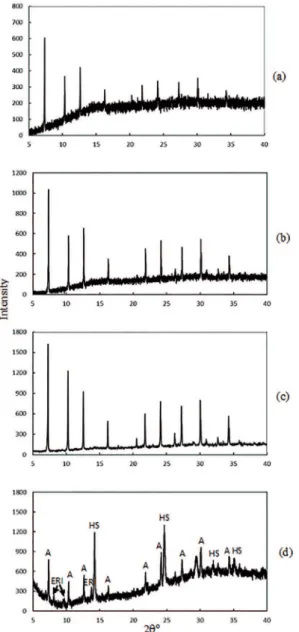
The XRD patterns of the coatings prepared from composition Cprimary after 3.5, 4.5, 5.5 and 18 h of conventional synthesis at 90°C are shown in Figure 1. Zeolite A might
be observed to be the only phase present in the irst three
Table 1: Masses and phases of coatings and bulk phase solid materials obtained by conventional synthesis (A: zeolite A, HS: hydroxysodalite, ERI: erionite, CL: clinoptilolite).
Synthesis composition Synthesis time (h) Synthesis temperature (0C) Mass Phase
Coating (mg) Bulk (g) Coating Bulk
Cprimary
0.5 90 - 2.32 - CL
1.5 90 - 3.31 - A
2.5 90 0.4 3.10 A A
3.5 90 0.9 2.77 A A
4.5 90 1.4 2.68 A A
5.5 90 1.9 2.55 A A+HS
18 90 3.8 3.22 A+HS+ERI A+HS+ERI
4.5 81 0.7 2.52 A A
4.5 99 2.1 2.63 A+HS A+HS
Chigh_Al 4.5 90 0.5 2.90 A+HS+CL A+HS+CL
Clow_Al
4.5 90 0.5 3.05 A A
6 90 0.9 2.95 A A+HS
Clow_Na 4.5 90 - 2.43 - A
Chigh_Na 4.5 90 2.0 2.62 A+HS A+HS
Clow_Cli 4.5 90 0.5 2.32 A A
Chigh_Cli 4.5 90 1.5 3.16 A A
hydroxysodalite seemed to be the most abundant zeolite. Small peaks of erionite were also detected in this sample. According to XRD results, zeolite A was still present in the samples obtained from composition Cprimary at relatively lower and higher temperatures of 81°C and 99°C after 4.5
h of synthesis (see Table 1). The coating prepared at 81°C
was less crystalline. At the higher temperature of 99°C, a small amount of hydroxysodalite also formed besides the dominant zeolite A phase. Increasing the Al content of composition Cprimary (composition Chigh_Al) did not favor zeolite A formation and a mixed phase occurred at 90°C after 4.5 h of synthesis. Besides zeolite A, hydroxysodalite and residual clinoptilolite were also detected in this sample. On the other
hand, decreasing the Al content (composition Clow_Al) still allowed zeolite A formation even though amorphous material also seemed to exist. The crystallinity increased when the synthesis time was extended to 6 h at 90°C. When the amount
of sodium was reduced (composition Clow_Na), no observable coating formed on the stainless steel plate indicating that a decrease in the alkalinity of the reaction mixture did not promote synthesis of zeolite A or other phases after 4.5 h at
90°C. Increasing the alkalinity (composition Chigh_Na) resulted in a small amount of hydroxysodalite besides zeolite A in this sample. When the amount of clinoptilolite used was
reduced to 2 g (composition Clow_Cli) and enhanced to 3 g
(composition Chigh_Cli) for syntheses performed after 4.5 h of synthesis at 90°C, zeolite A still formed.
The TG curves of the coatings prepared from composition Cprimary after diferent synthesis times at 90°C are given in Figure 2. The TG curve of commercial zeolite NaA powder
is also shown in the igure. It may be observed that the water
loss of the samples approached to that of commercial zeolite NaA as the synthesis time was increased from 3.5 h to 5.5 h. Table 2 reports the amount of water loss from the coatings as well as from commercial zeolite NaA powder after the
irst (shown in Figure 2) and second TG measurements
performed for each sample. The second measurements may give indications about the crystallinities of the materials since amorphous materials may generally be expected to
lose their water storage capacity after the irst adsorption/
desorption at a relatively high temperature. The second TG
measurements revealed capacity reductions of about 16%, 12% and 6%, compared to the irst measurements, for the
coatings prepared after 3.5 h, 4.5 h and 5.5 h of synthesis, respectively. From these results, the crystallinities of the samples may be assumed to increase with synthesis time, as also indicated by XRD results. The capacity of the sample prepared after 18 h of synthesis was quite lower. The presence of crystalline phases/amorphous materials less hydrophilic than zeolite A led to a lower water loss for this sample.
FEGSEM micrographs of the coating grown on stainless
steel from composition Cprimary after 5.5 h of synthesis are
given in Figure 3 at diferent magniications. It may be
observed that a closed layer was formed on the substrate after this synthesis time. The mass equivalent thickness of this continuous coating was about 19 µm, which represented the highest zeolite A coating thickness obtained in this study by using conventional synthesis. Mass equivalent thickness
Figure 1. XRD patterns of the coatings prepared from composition Cprimary after (a) 3.5 h, (b) 4.5 h, (c) 5.5 h and (d) 18 h of conventional synthesis at 90 0C.
Figure 2: TG curves of coatings prepared after (□) 3.5 h, (δ) 4.5 h, (x) 5.5 h and (◊) 18 h of conventional synthesis at 90 0C from composition Cprimary and TG curve of (o) commercial zeolite A powder.
Table 2: Desorption capacities of coatings prepared from composition Cprimary at 90 0C by conventional synthesis and the capacity of commercial zeolite A powder. mdes1 and mdes2 denote the irst and second TG measurements performed for each sample.
Synthesis time (h) mdes1 (g/g coating) mdes2 (g/g coating)
3.5 0.170 0.143
4.5 0.179 0.158
5.5 0.183 0.172
18 0.141 0.121
Zeolite A 0.189 0.180
Figure 3: FEGSEM micrographs of the coating grown from
composition Cprimary at 90 0C after 5.5 h of conventional synthesis,
as shown at magniications of (a) x500 and (b) x4500.
of 2 g/cm3 was used in the calculations. Particles of around 5-10 µm were commonly observed in the coating. A quite crystalline zeolite A was also indicated by the XRD and TG results for this sample.
As mentioned before, the solid powder materials
obtained by iltration from the reaction mixtures were also
investigated. The masses and phases of these materials are shown in Table 1 for the conventional synthesis experiments. It should be remembered that the amount of clinoptilolite added initially to the reaction mixture was equal to 2.5 g except for the compositions Clow_Cli and Chigh_Cli where 2 g and 3 g of clinoptilolite were used, respectively. The variations in the masses of the solid materials obtained from the bulk
of the reaction mixtures indicated the presence of diferent stages of synthesis in the system. When there is no signiicant
formation of synthetic zeolite in the reaction mixture, the
dissolution of clinoptilolite (and after its transformation starts, amorphous material) may result in a reduction of
solid material in the mixture. As zeolite synthesis begins, the amount of solid materials may be expected to increase, also depending on the competitive rates of clinoptilolite/ amorphous material dissolution and synthetic zeolite formation in the reaction mixture. Actually, when composition Cprimary was used, the mass of solid material in the reaction mixture,
which was initially equal to 2.5 g (clinoptilolite mass), irstly decreased (after 0.5 h of synthesis) and then increased (after 1.5 h of synthesis). The mass of solid material started to
synthesis in the reaction mixture. During this period, the dissolution of clinoptilolite/amorphous material seemed to
be more signiicant than zeolite formation. When there was
not much of amorphous material left in the reaction mixture for dissolution, e.g., after 18 h of synthesis, the solid mass in the bulk phase increased once again, due to the still ongoing synthesis, especially of zeolite HS.
XRD indicated the presence of mainly zeolites A and HS in the solid material samples collected from the reaction mixtures. However, amorphous materials existed in large quantities in almost all the samples, as also described below by the TG investigations. Only the crystalline phases are mentioned in Table 1. The zeolite phases in the coatings and solid materials were mostly similar for the use of same
synthesis conditions, though there were a few diferences,
which might originate from composition variations in the
diferent parts of the reaction mixture, due to static synthesis
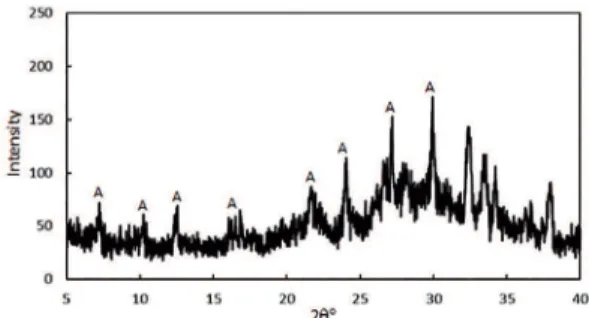
conditions. It may be observed from Table 1 that in the sample obtained at a very early synthesis time of half an hour from composition Cprimary, there was still a lot of clinoptilolite, while amorphous material also started to form. After this time, zeolite A and then zeolite HS started to form in the bulk phase, coexisting with amorphous material. Figure 4 represents the XRD pattern of the solid material obtained from the reaction mixture with composition Cprimary after 4.5 h of synthesis at 90°C. It may be seen that zeolite A and amorphous material existed in this sample. Table 3 reports the desorption capacities of the samples after the
irst and second TG measurements performed for each
sample. The capacities of the clinoptilolite-rich material and commercial zeolite NaA powder are also shown in the table for comparison. As mentioned before, the second measurements may give indications about the crystallinities of the materials. Accordingly, crystallinity seemed to be relatively high immediately after the beginning of synthesis
at 0.5 h. However, it dropped signiicantly after this period
of time. Clinoptilolite was still present at the very early synthesis periods, especially at 0.5 h, which should be the reason for the relatively high crystallinity at this time. The other seemingly high crystallinity was obtained for the synthesis time of 18 h investigated, which seemed to indicate that the amorphous material was then mostly converted to zeolites A and HS and/or a high amount of these zeolites was formed in the reaction mixture. The initial desorption
capacities of the samples tended to increase signiicantly as
the synthesis time was enhanced up to 5.5 h of synthesis. This tendency may be explained by the formation of zeolite A in the samples as well as some changes gradually taking place in the amorphous material.
Zeolite A coatings could also be prepared by using the substrate heating method. Table 4 reports the masses and phases of the coatings prepared by this synthesis method from composition Cprimary. Properties of the solid materials obtained from the bulk phase under the same synthesis conditions
Figure 4: XRD pattern of the powder material formed in the reaction mixture with composition Cprimary after 4.5 h of conventional synthesis at 90°C.
Table 3: Desorption capacities of powder samples obtained from composition Cprimary at 90 0C by conventional synthesis and the capacities of commercial zeolite A and clinoptilolite powder. mdes1 and mdes2 denote the irst and second TG measurements performed for each sample.
Synthesis time (h) mdes1 (g/g sample) mdes2 (g/g sample)
0.5 0.116 0.086
1.5 0.125 0.042
3.5 0.137 0.037
4.5 0.147 0.046
5.5 0.165 0.054
18 0.154 0.134
Zeolite A 0.189 0.180
Clinoptilolite 0.103 0.095
Table 4: Masses and phases of coatings and bulk phase solid
materials obtained by substrate heating method (A: zeolite A, Am: amorphous material).
Synthesis
time (h)
Synthesis temperature
(0C)
Mass Phase
Coating
(mg) Bulk (g) Coating (mg) Bulk (g)
4.5 75-140 2.9 8.06 A A
1.5 30-140 - 6.88 - Am
16 30-140 0.2 6.52 A Am
27 30-140 0.5 6.57 A Am
42 30-140 2.2 6.64 A Am
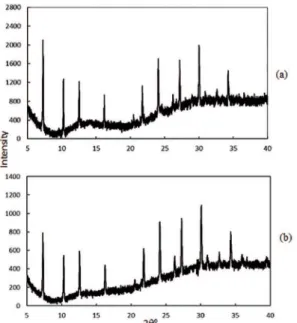
are also given in the table. It may be seen that when water bath and heating resistance temperatures of 30°C and 140°C were used, the coating mass increased with synthesis time. Increasing the temperature of the water bath to 75°C led to a relatively higher coating mass at a quite shorter synthesis time. Figure 5a and Figure 5b represent the XRD patterns of the coatings prepared from composition Cprimary after 4.5 h of synthesis at a 75°C water bath temperature and after 16 h of synthesis at a 30°C water bath temperature, respectively.
Figure 5: XRD patterns of the coatings prepared by substrate heating method from composition Cprimary a) after 4.5 h of synthesis at water bath and heating resistance temperatures of 75 0C and 140
0C, respectively and b) after 16 h of synthesis at water bath and
heating resistance temperatures of 30 0C and 140 0C, respectively.
synthesis duration and about the same substrate temperature. The crystallinity of this sample seemed to be somewhat less than that of the sample prepared after 4.5 h of conventional
synthesis (XRD difractogram in Figure 1b). The reason for the mass increase might be related to the more efective and
rapid heating of the metal plate by conduction in the substrate heating method, when compared to heating by convection in an oven. When the water bath temperature was decreased considerably to 30°C, pure zeolite A still formed, as observed from Figure 5b, but at a longer duration and the amount of zeolite was less. Since clinoptilolite mostly settled at the bottom of the reaction mixture, which was at about 30-35°C according to the synthesis conditions, it may be deduced that the dissolution/transformation of clinoptilolite occurred at this quite low temperature, too. Consequently, zeolite A could crystallize on stainless steel plates kept at a higher temperature, by using silica from dissolved clinoptilolite. The possibility of using substrate heating method in the synthesis provided by the transformation of clinoptilolite in an alkaline
reaction mixture is signiicant since this method may allow
the preparation of relatively thick coatings at prolonged durations, especially for metastable phases, such as zeolite A, which may transform readily into more stable phases.
FEGSEM micrographs of the coating grown by the
substrate heating method on stainless steel from composition Cprimary after 42 h of synthesis at water bath and heating resistance temperatures of 30°C and 140°C, respectively,
are given in Figure 6 at diferent magniications. It may be
observed that this coating was relatively inhomogeneous in
Figure 6: FEGSEM micrographs of the coating grown by using
substrate heating method at water bath and heating resistance temperatures of 30 0C and 140 0C, respectively, after 42 h of
synthesis, as shown at magniications of (a) x1000 and (b) x5000.
nature and the particles were generally of a few microns. Actually, the substrate heating method often leads to open sponge-like zeolite coatings with intracrystalline macrovoids,
which promote difusion in these materials. The mass
equivalent thickness of this coating was about 22 µm. The thickest zeolite A coating of about 29 µm prepared in this study was that obtained by using substrate heating method after 4.5 h of synthesis at water bath and heating resistance temperatures of 75°C and 140°C, respectively.
All the coatings obtained in this study by using the substrate heating method were pure zeolite A. On the other hand, as may be observed from Table 4, solid materials obtained from the bulk phase were generally amorphous materials at the lower water bath temperature of 30°C. Zeolite A was observed in the bulk phase only when the higher water bath temperature of 75°C was utilized. The mass of clinoptilolite added to the reaction mixture was equal to 7.5 g in the substrate heating system, due to the larger amount of reaction mixture used. For the cases utilizing a water bath temperature of 30°C, the mass of solid material obtained from the bulk of the reaction mixture was observed to decrease sharply from the initial amount of 7.5 g after 1.5 h of synthesis, decrease some more after 16 h of synthesis and then remain nearly constant. This indicates that not much synthesis activity took place in the bulk of the reaction mixture, which was kept at a quite low temperature of 30°C. The dissolution of clinoptilolite/amorphous material mainly determined the masses of the solid materials obtained from the reaction mixtures. The substrate heating method aims to promote synthesis on the substrate while suppressing that in the bulk of the reaction mixture. When the higher temperature of 75°C was used for the water bath, the amount of solid materials
in the bulk phase surpassed 7.5 g, indicating signiicant
zeolite A synthesis taking place in the reaction mixture as well as on the substrate.
synthesis methods again revealed the diference in the natures
of these two techniques. A clear solution sample taken after 4.5 h of conventional synthesis from the reaction mixture with composition Cprimary at 90°C indicated a molar composition of 260.3 Na2O:1 Al2O3: 1.2 SiO2: 5878.5 H2O. It seems that at this stage of conventional synthesis, alumina and silica in the reaction mixture, as limiting reactants, were reduced to a great extent, due to the already excessive formation of zeolite A. Another clear solution sample was taken after 27 h of synthesis from the substrate heating synthesis system at water bath and heating resistance temperatures of 30°C and 140°C, respectively. In this case, the molar composition was determined to be 9.7 Na2O:1 Al2O3: 0.1 SiO2: 96.6 H2O. Here, the relative abundance of aluminum seems to be noteworthy, indicating that not much reaction took place in the mixture. The decrease in the sodium oxide/alumina ratio might indicate that some aluminum besides silicon also entered the solution phase from the dissolving clinoptilolite/ amorphous material.
In the syntheses where natural clinoptilolite is used as a natural resource, coating formation takes place on the metal substrate as transformations start to occur in the clinoptilolite in the reaction mixture. Since there is no synthetic silica reagent in the reaction mixture, the silica needed for forming zeolite should be obtained from the dissolution of clinoptilolite. It is possible that aluminum and sodium from the natural zeolite may also contribute to the zeolite A coating formation on the substrate. An
important proit of using natural zeolite for producing
coatings of synthetic zeolites is surely the improved economics, especially when these materials are required to be used in large amounts in various applications. Replacing the synthetic silica source required for zeolite synthesis with a much cheaper natural zeolite should contribute
to a more proitable coating production process. As an
example, considering the use of similar amounts of sodium
aluminate (the limiting reagent) in composition Cprimary of this study and in 50 Na2O:1 Al2O3:5 SiO2:1000 H2O,7 a commonly used clear solution composition for zeolite A coating formation, the cost of reagents may be reduced by
more than 4 fold. Another beneit of the proposed method
in coating preparation may be the provision of synthesis under distinctive conditions, where synthesis involves two simultaneous processes: the dissolution of clinoptilolite to provide necessary reactants and the reaction on the substrate to form zeolite A. In this technique, the coating properties, such as thickness and homogeneity, may be
controlled and manipulated in a manner diferent than
the existing methods.
4. Conclusions
A new concept was presented in this study for preparing synthetic zeolite coatings by using natural
materials. In this context, it was shown that pure and crystalline zeolite A coatings could be prepared from natural clinoptilolite under hydrothermal conditions. A conventional synthesis temperature of 90°C and reaction periods of about 2.5-5.5 h were determined to be suitable conditions for obtaining zeolite A coatings on stainless steel. Utilizing proper alkalinity, alumina and clinoptilolite contents in the reaction mixtures assured relatively high crystallinity and purity of the coatings. Zeolite A tended to transform into hydroxysodalite after certain synthesis periods of time. In the reaction mixture, clinoptilolite mostly settled at the bottom of the reactor and was not in direct contact with the substrate. Clinoptilolite was gradually transformed into amorphous material while zeolite A formation started to take place in the reaction mixture as well as on the substrate. Clinoptilolite provided the silica necessary for zeolite synthesis in the alkaline reaction mixture containing alumina.
The thicknesses of the coatings increased with synthesis time. When conventional synthesis is applied using synthetic reactants, it is known that there is a strict limit to this thickness, especially for the very metastable zeolite A. Only very thin coatings of zeolite A, of about 5 µm7, are known to be obtained by conventional synthesis from clear solution compositions which are suitable for coating preparation. Although the highest mass equivalent thickness of zeolite A coatings obtained in this study was about 29 µm, as obtained by substrate heating method for 4.5 h synthesis at a water bath temperature of 75°C, this may still be not enough for some applications. However, the success in preparation of zeolite A coatings from natural clinoptilolite by using the substrate heating method is very important. Zeolite A coatings could be prepared by using the substrate heating method even at temperatures as low as 30°C for the bulk of the reaction mixture. This may allow the preparation of relatively thick coatings at prolonged durations, since the reaction in the bulk of the reaction mixture may thus be suppressed for a quite long period of time.
The signiicance of using natural zeolite for preparing
coatings of synthetic zeolites mainly lies in its economical
proitability. In this manner, when mass-production of zeolite
coatings becomes necessary for some applications, the costs of the resources used may be reduced. The involvement of two simultaneous processes in coating preparation from clinoptilolite, namely, the dissolution/transformation of clinoptilolite in the reaction mixture and the reaction taking place on the substrate, by the help of dissolved reagents, presents a new approach for zeolite coating preparation. This
may allow obtaining coatings of diferent characteristics, such
as thickness and homogeneity. The possibility of preparing
coatings of diferent synthetic zeolites from various natural resources should also be investigated by using diferent
5. References
1. Tatlier M, Erdem-Şenatalar A. The efects of thermal and mass
difusivities on the performance of adsorption heat pumps
employing zeolite synthesized on metal supports. Microporous and Mesoporous Materials. 1999;28(1):195-203.
2. Rebrov EV, Mies MJM, de Croon MHJM, Schouten JC.
Hydrothermal Synthesis of Zeolitic Coatings for Applications in Microstructured Reactors. In: Valtchev V, Mintova S, Tsapatis M. Ordered Porous Solids. Amsterdam: Elsevier; 2009. p. 311-334.
3. Lefevere J, Gysen M, Mullens S, Meynen V, Van Noyen J. The beneit of design of support architectures for zeolite coated structured catalysts for methanol-to-olein conversion. Catalysis Today. 2013;216:18-23.
4. Mosca A, Hedlund J, Webley PA, Grahn M, Rezaei F. Structured zeolite NaX coatings on ceramic cordierite monolith supports for PSA applications. Microporous and Mesoporous Materials.
2010;130(1-3):38-48.
5. Yu M, Noble RD, Falconer JL. Zeolite membranes: microstructure
characterization and permeation mechanisms. Accounts of Chemistry Research. 2011;44(11):1196-1206.
6. Nikolajsen K, Kiwi-Minsker L, Renken A. Structured Fixed-Bed Adsorber Based On Zeolite/Sintered Metal Fibre For Low
Cocentration VOC Removal. Chemical Engineering Research and Design. 2006;84(7):562-568.
7. Erdem-Senatalar A, Tatlier M, Ürgen M. Preparation of zeolite
coatings by direct heating of the substrates. Microporous and Mesoporous Materials. 1999;32(3):331-343.
8. Valtchev V, Hedlund J, Schoeman BJ, Sterte J, Mintova S.
Deposition of continuous silicalite-1 ilms on inorganic ibers.
Microporous Materials. 1997;8(1-2):93-101.
9. Tosheva L, Ng EP, Mintova S, Hölzl M, Metzger TH, Doyle AM. IPO4-18 seed layers and ilms by secondary growth. Chemistry of Materials. 2008;20(17):5721-5726.
10. Zhang H, Suszynski WJ, Agrawal KV, Tsapatsis M, Al Hashimi S,
Francis LF. Coating of open cell foams. Industrial & Engineering Chemistry Research. 2012;51(27):9250-9259.
11. Misaelides P. Application of natural zeolites in environmental remediation: A short review. Microporous and Mesoporous Materials. 2011;144(1-3):15-18.
12. Adamaref S, An W, Jarligo MO, Kuznicki T, Kuznicki SM.
Natural clinoptilolite composite membranes on tubular stainless steel supports for water softening. Water Science & Technology.
2014;70(8):1412-1418.
13. Swenson P, Tanchuk B, Gupta A, An W, Kuznicki SM. Pervaporative desalination of water using natural zeolite membranes. Desalination. 2012;285:68-72.
14. Hristov P, Yoleva A, Djambazov S, Chukovska I, Dimitrov D. Preparation and characterization of porous ceramic membranes
for micro-iltration from natural zeolite. Journal of the University of Chemical Technology and Metallurgy. 2012;47(4):476-480.
15. Avila AM, Yu Z, Fazli S, Sawada JA, Kuznicki SM. Hydrogen-selective natural mordenite in a membrane reactor for ethane dehydrogenation. Microporous and Mesoporous Materials. 2014;190:301-308.
16. de las Pozas C, Diaz Quintanilla D, Perez-Pariente J, Roque-Malherbe R, Magi M. Hydrothermal transformation of natural clinoptilolite to zeolites Y and P1: inluence of the Na, K content. Zeolites. 1989;9(1):33-39.
17. Kazemian H, Modarress H, Kazemi M, Farhadi F. Synthesis of
submicron zeolite LTA particles from natural clinoptilolite and
industrial grade chemicals using one stage procedure. Powder Technology. 2009;196(1):22-25.
18. Kamali M, Vaezifar S, Kolahduzan H, Malekpour A, Abdi
MR. Synthesis of nanozeolite A from natural clinoptilolite and aluminum sulfate; Optimization of the method. Powder Technology. 2009;189(1):52-56.
19. Kartal OE, Onal I. Synthesis of ZSM-5 from modified clinoptilolite and its catalytic activity in alkylation of benzene to ethylbenzene.
Chemical Engineering Communications. 2008;195(8):1043-1057.
20. Shindo T, Nagai Y, Ikeuchi T, Ozawa S. Synthesis of MCM-41 with Zeolite-P from Natural Clinoptilolite for Silica-alumina Source Under Hydrothermal Conditions in Alkaline Media. International Journal of the Society of Materials Engineering for Resources. 2011;18(1):1-6.
21. Sirkecioğlu A, Erdem-Şenatalar A. Estimation of the zeolite contents of tufaceous samples from the Bigadiç clinoptilolite deposit,
western Turkey. Clays and Clay Minerals. 1996;44(5):686-692.
22. Ceyhan T, Tatlier M, Akçakaya H. In vitro evaluation of the use
of zeolites as biomaterials: efects on simulated body luid and