ISSN 0104-6632 Printed in Brazil
Vol. 19, No. 04, pp. 475 - 482, October - December 2002
Brazilian Journal
of Chemical
Engineering
INCLUDING MODEL UNCERTAINTY IN THE
MODEL PREDICTIVE CONTROL WITH
OUTPUT FEEDBACK
M.A.Rodrigues and D.Odloak
*Department of Chemical Engineering, University of São Paulo C.P. 61548, 05424-970, São Paulo, Brazil.
E-mail: [email protected]
(Received: March 5, 2002 ; Accepted: June 13, 2002)
Abstract - This paper addresses the development of an efficient numerical output feedback robust model predictive controller for open-loop stable systems. Stability of the closed loop is guaranteed by using an infinite horizon predictive controller and a stable state observer. The performance and the computational burden of this approach are compared to a robust predictive controller from the literature. The case used for this study is based on an industrial gasoline debutanizer column.
Keywords: Predictive Control, Robust Stability, Infinite Horizon.
INTRODUCTION
Model predictive control (MPC) is the most popular advanced control technique in the process industry. For more details about the wide acceptance of MPC see the survey paper by Garcia et al. (1989). In industrial applications, production of a stable response is required despite changes in the operating conditions and model uncertainties. This issue is referred to as robust stability and has received considerable attention in academic research, as can be verified in the reviews by Mayne et al. (2000) and Morari and Lee (1999). From the point of view of industrial application, the review papers by Qin and Badgwell (1997, 2000) emphasize the lack of a practical industrial solution to the robust MPC problem.
In the robust MPC literature, the work of Badgwell (1997), which proposed extension of the nominal infinite horizon MPC (IHMPC) of Rawlings and Muske (1993) to the robust case, can be cited. Robustness is achieved by the inclusion of contracting constraints in the objective function
corresponding to each model of the set of possible process models considered by the controller. Another contribution to the robust design of MPCs was made by Lee and Cooley (2000), who proposed a robust infinite horizon MPC for stable and integrating systems with model uncertainties on the input distribution matrix. In this case, the infinite prediction horizon cost becomes equal to the output error at the end of the control horizon. The paper by Kothare et al. (1996), which presented a robust MPC based on the LMI framework, can be also cited. An infinite prediction horizon is used, and the authors propose a method that minimizes an upper bound for the objective function.
it applies to both the regulator and the target tracking problems. The approach is based on a particular realization of the system state space model (Rodrigues, 2001; Tvrzská de Gouvêa and Odloak, 1997). This model realization allows the direct integration of the squared error of the system output so that the cost function of the controller can be defined in a more suitable form. Following this strategy, equality constraints, which ensure that the infinite horizon cost function is bounded, naturally arise. Model uncertainties are approximated by a finite set of disjunct linear models.
This paper is organized as follows: In Section 2 the state space model used in this paper is briefly introduced. In Section 3 the development of a modified nominal IHMPC is presented and in Section 4 these results are extended to the robust case. Simulation results are presented in Section 5, where the proposed controller is compared to a robust MPC presented in a previous paper. In Section 6 some concluding remarks are offered.
MODEL STRUCTURE
In this paper, it is assumed that the system is represented by the following linear discrete-time model:
k 1 k k
[x] + =A [x] + ∆B u (1)
k
y(k+ =t) C(t)[x] (2)
where
x
∈
\
nx is the vector of states,u
∈
nu isthe vector of inputs,
∆ = −
u
ku
ku
k 1− is the processinput increment, k is the present time step and
ny
y
∈
is the vector of outputs. Here the modelrepresentation designated output prediction oriented model (OPOM), which was proposed by Rodrigues (2001), is adopted. Using OPOM, the model matrices involved in eqs. (1) and (2) have the following structure:
s d
x [x]
x
=
,
I 0
A
0 F
= ,
0
d
D B
D FN
=
,
(3)
[
]
C(t)= I Ψ(t) ,
nx
=
ny(1 nu.na)
+
The state vector, x was partitioned into two
auxiliary vectors,
x
s andx
d. For stable systems,component
x
s∈
ny corresponds to the predictedvalue for the system output at steady state. Vector
d nd
x
∈
is related to the dynamic modes of thesystem and na is the order of the respective transfer
function model. Matrix D0 contains the steady state
gains of the process and matrix Ψ(t) is shown below.
More details on the OPOM formulation can be seen in Rodrigues (2001) and Rodrigues and Odloak (2002).
1
2
ny
(t) 0 0
0 (t) 0
(t)
0 0 (t)
Φ
Φ
Ψ =
Φ
(4)
( )
i,1,1 i,1,na
i,nu,1 i,nu,na
r t r t
i
r t r t
e e
t i 1, 2, , ny
e
Φ = =
where
ny nd
(t) ×
Ψ ∈ , nd
i
Φ ∈ , ri 1,= …, nd
are the poles of the system, and
nd
=
ny.nu.na
.INFINITE HORIZON MPC (IHMPC)
An important feature of OPOM is that time appears continuously in the output prediction mapping. This peculiarity was used by Rodrigues (2001) to propose a modified infinite horizon MPC, whose main steps are described in the sequel.
Consider a modified expression for the objective function of MPC as given by (5):
m nT
T
k, (n 1)T k t k k t k n 1
T
k t k k t k
mT
T T
1 k k
J {e } Q{e }dt
{e } Q{e }dt
u R u S
∞ − + +
= ∞
+ +
= + δ + δ +
+ + δ + δ +
+∆ ∆ + δ δ
∑∫
∫
(5)sp k t
e
+=
y(k
+ −
t)
y
,y
sp∈
ny is the vector ofoutput reference values; m is the control horizon; T
nu nu
R
∈
× andS
∈
ny ny× are positive definiteweighting matrices.
δ ∈
k ny is the vector of slackvariables that was introduced into the IHMPC objective function to allow for processes
with
ny
>
nu
. Inside the control horizon, the outputerror can be represented by the following expression:
s d 0
k t k k n n
e + =[e ] + Ψ(t)[x ] + ∆ + ΨD u (t)W Z u∆ (6)
where
(n 1)T
−
≤ <
t
nT
,n
≤
m
s s sp
k k
[e ]
=
[x ]
−
y
n
0 0 0 0
n
D =[D D D 0 0],
0 ny m.nu
n
D
∈
×1 (n 1)
n
W =[I F− F− − 0 0],
nd nd.m n
W
∈
×d
d
m.nd m.nu
d
D N 0 0
0 D N 0
Z , Z
0 0 D N
×
= ∈
,
T
T T T
k k 1 k m 1
u
u
u
+u
+ −
∆ = ∆
∆
∆
Substituting (6) into the first term on the right-hand side of (5), one obtains
m nT
T
k t k k t k
(n 1)T n 1
m
T 0 T 0 0 T T T
n n n 1 1 n n 2 2 n
n 1
m
s T 0
k n 1 1 n
n 1
d T T 0
k 1 1 n 2 2 n
{e } Q{e }dt
u {D QD T 2D Q(G (n) G (n 1))W Z Z W (G (n) G (n 1))W Z} u
2 {[e ] Q(D T (G (n) G (n 1))W Z)} u
{[x ] [(G (n) G (n 1)) D (G (n) G (n 1))W Z]
+ +
− =
=
=
+ δ + δ =
∆ + − − + − − ∆
+ + δ + − − ∆
+ − − + − −
∑∫
∑
∑
m
n 1
} u
= ∆
∑
(7)
where
nT
1 0
G (n)= Ψ
∫
(t)dt andnT T 2
0
G (n)= Ψ
∫
(t) Q (t)dtΨ .When the time t is within the interval mT t≤ <∞,
the error of the process output can be described by
s d 0
k t k k k m m
[e +] =[e ] + Ψ(t)[x ] +D ∆ + Ψu (t)W Z u∆ (8)
Substituting (8) into the infinite integral on the right-hand side of (5), one obtains:
T s 0 T s 0
k t k k t k k k m k k m
m mT
s 0 T d
k k m mT k m
d T T d
k m k m
mT
[e ] Q[e ]dt {[e ] D u} Q{[e ] D u} dt
2{[e ] D u} Q (t){[x ] W Z u}dt
{x ] W Z u} (t) Q (t){[x ] W Z u}dt
∞ ∞
+ +
∞
∞
+ δ + δ = + δ + ∆ + δ + ∆
+ + δ + ∆ Ψ + ∆
+ + ∆ Ψ Ψ + ∆
∫
∫
∫
∫
For stable systems
t
lim
(t)
0
→∞Ψ =
andconsequently the second and third terms on the right-hand side of (9) are bounded. However, the first term on the right-hand side of (9) will be bounded only if the equality below holds:
s 0
k k m
[e ] + δ +D ∆ =u 0 (10)
Introducing (10) into (9), results in
T
k t k k t k
m
d T
k m
d
k m
[e ] Q[e ]dt
{[x ] W Z u}
[G( ) G(m)]{[x ] W Z u}
∞
+ + δ + + δ =
= + ∆
∞ − + ∆
∫
(11)
ROBUST INFINITE HORIZON MPC (RIHMPC)
In this section, the modified infinite horizon MPC presented in the previous section is extended to the case of model uncertainty. When the stabilizing control law takes into account model uncertainties, the resulting controller is designated robust. It is well known that a single linear model can not accurately represent the actual plant under different operating conditions. Recently, the multimodel representation of uncertain processes has been introduced in the robust MPC literature (see Badgwell, 1997 and Rodrigues, 2001). This model mismatch representation considers a finite set of disjunct linear
systems (Ω), which are obtained at different points
of the operating domain, or better:
( )
A, B ∈Ω Ω =| :{
(A ,B )1 1 (A , B )L L}
(12)which means that the matrices of the model described by (1) and (2) are not exactly known, but
belong to Ω.
Considering this kind of uncertainty and the developments presented in Section 3, Rodrigues (2001) proposed a robust infinite horizon MPC for the case where all state variables of the process can be measured (state feedback). However, during actual plant operation only a subset of the model states, the outputs, is measured. One way to extend the referred robust IHMPC to the output feedback case is based on the separation principle (Levine,
1996). Briefly, the separation principle consists in splitting the feedback control design into two steps. In the first step, a full-state feedback controller is designed assuming that all the model states can be measured, and the control sequence is calculated using these model states. In the second step, an observer is introduced to estimate the state of the system based upon the system outputs. This framework was employed here to design the robust output feedback MPC. In the simulations presented here the following sequence is adopted:
a) One model of Ω (the most probable) is assumed
to be the true plant. The output of this model is
designated
[y ]
p k.b) The states of the remaining models are estimated
as follows:
i k 1|k 1 i i k|k i k F p k
i i i k|k i k F i i i k|k
F i i k F p k
[x ] A [x ] B u K {[y ]
C (A [x ] B u )} (I K C )A [x ]
(I K C )B u K [y ] i 1,..., L 1
+ + = + ∆ + −
− + ∆ = − +
+ − ∆ + = −
(13)
c) The observer used here has a static gain given by:
T nd ny
F F
K =[I 0] , K ∈ × (14)
This observer is based on the assumption that the difference between model output and plant measurement is produced by a step disturbance in the system output. This assumption is adopted by most MPC packages but is restricted to stable systems, which is the case considered here.
Therefore, assuming that the uncertain process
belongs to Ω, one estimates the states of all the linear
models lying in Ω using (13) and (14). Substituting
(7) and (11) into (5), one can write the following optimization problem for RIHMPC:
Problem P1)
,
min
i, , L, u∆ δ δ γ
γ
subject to
i i
T T
f ,i i
i i
I H Y
0 2c Y
Y H
>
γ −
k j
u + U
∆ ∈ ,
j
≥
0
(16)s 0
i k i k m,i
[e ] + δ +[ ] D ∆ =u 0, i 1,..., L= (17)
where
T T T
i i k
Y = ∆ u [ ]δ ,
11,m 11, 12
12
i i 1 i
i T
i
H H R H
H
H mQT S
∞
+ +
=
+
m
T T T T
fi fi fi fi
c c c c
∞ δ
= +
11,m
m m
0 T 0 0 T T T
i n,i n,i n,i 1,i 1,i n,i i i n,i 2,i 2,i n,i i
n 1 n 1
H {D QD T 2D Q[G (n) G (n 1)]W Z } {Z W [G (n) G (n 1)]W Z }
= =
=
∑
+ − − +∑
− −11,
T T
i i m,i 2,i 2,i m,i i
H
Z W
[G ( ) G (m)]W
Z
∞
=
∞ −
12
m
0 T T T T
i n,i i n,i 1,i 1,i
n 1
H {D QT Z W [G (n) G (n 1)] Q}
=
=
∑
+ − −m
m m
T s T 0 d T T 0
fi i k n,i 1,i 1,i n,i i i k 1,i 1,i n,i 2,i 2,i n,i i
n 1 n 1
c {[e ] Q[D T (G (n) G (n 1))W Z ]} {[x ] [G (n) G (n 1)] QD [G (n) G (n 1)]W Z }
= =
=
∑
+ − − +∑
− − + − −T d T
fi i k 2,i 2,i m,i i
c ∞ =[x ] [G ( ) G∞ − (m)]W Z ,
m
T s T d T T
fi i k i k 1,i 1,i
n 1
c m[e ] QT [x ] [G (n) G (n 1)] Q
δ
=
= +
∑
− − , R1=diag(R R)U
defines the set of feasible solutions related tothe input constraints. Problem P1 can be solved by the available methods of linear matrix inequalities (LMI). The theorem below summarizes the robust stability of the RIHMPC with output feedback defined by Problem P1).
Theorem:
Consider an open-loop stable process where the
true plant model belongs to Ω and whose states are
estimated by a stable observer. If there is a feasible solution to Problem P1), then the resulting control
law stabilizes all the plants belonging to Ω.
Proof:
The proof for the state feedback case can be found in Rodrigues and Odloak (2002). It remains to be proved that when a stable state observer is used the resulting closed loop remains stable. It is easy to verify that the observer gain defined by
(14) corresponds to λ −(I K C )AF i i <1, i 1,= …, L.
Thus, as a consequence of the separation principle, when one uses IHMPC, which
stabilizes all the models belonging to set Ω when
COMPARING RIHMPC TO A ROBUST MPC FROM THE LITERATURE
Rodrigues and Odloak (2000) proposed a finite horizon robust output feedback MPC, which was named RSMPC. The approach is based on the parameterization of the control moves by an output feedback scheme similar to the conventional linear quadratic regulator. In this way, it was possible to use the quadratic Lyapunov stability condition that was included in MPC as an additional constraint. In their MPC, these authors considered a polytopic representation of the uncertain models. The multimodel version of the Rodrigues and Odloak (2000) robust predictive controller is described below:
Problem P2)
m 1 L
,K ,P , ,P
min
γ …γ
subject to
(
T)
1m k k
T T
k k m k k
T T
k k m
T T T
k k m k k
B QB R K [e ]
0 [e ] A QBK [e ]
[e ] K
[e ] K B QA[e ]
−
+
>
γ + +
+
(18)
i i i i s m
T
i
i i s m i
P P (A B N K C)
0
P
(A B N K C) P
+
>
+
,
(19)
i 1,= …, L
0
γ >
,P
i=
P
iT>
0
,i 1,
=
…
, L
(20)where
p p
e e e
2 1
3 2
1
n n 1
n n 1 n m 1
0 0 0
d d d
S S 0 0
S S
S
S S
B
S S S
D D D
D FN D FN D FN
−
− − +
=
,
[
]
s nu
N = I 0 , Ns∈ℜ[nu] nu.mx[ ]
i
S
is the step response coefficient matrix at samplingstep i
m
K
is the feedback gain of the controllerRodrigues and Odloak (2000) proposed an iterative algorithm based upon LMI tools to solve Problem P2). It is important to observe that matrices
A and B of RSMPC are related to the augmented
system (parameters + outputs at prediction steps).
Consequently, the dimension of the state x of this
controller is different from the dimension of the state considered by RIHMPC.
SIMULATION RESULTS
The process simulated in this work is a debutanizer column of an oil refinery, and it was borrowed from Rodrigues and Odloak (2000). This column produces LPG (liquefied petroleum gas) as the top stream and stabilized gasoline as the bottom stream. The controlled outputs are the concentration
of C5+ in the top stream (y1) and the Reid vapor
pressure of the bottom stream (y2). The manipulated
inputs are the top reflux flow rate (u1) and the
reboiler heat duty (u2). The set of uncertain models,
Ω, was built by linear models identified at three
different operating points of the column. These models can be seen in Table 1. The most probable
model is assumed to be G (s) .1
RIHMPC was simulated using G (s) as the true1
plant, which together with the other two models
constitutes the set Ω. The tuning parameters of
RIHMPC are
T 1= ; m=2; Q=diag(1,1);
2 2
R=diag(10 ,10 )− − ; S=diag(100,100);
j,max
u =15; uj,min = −21 and ∆uj,max =5.
RSMPC was simulated using the same set of models as RIHMPC and the following tuning parameters:
T 1= ; m=2; Q=diag(1,1);
2 2
j,max
u 5
∆ = , np =3; ne = 75; ε = 0.1
where np is the number of equally spaced system
output prediction steps, ne is the extra prediction step
included in the computation of output error and ε is
the convergence parameter of RSMPC.
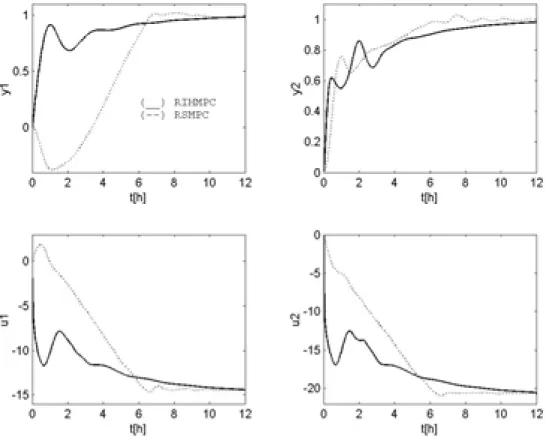
Figure 1 shows the results of RIHMPC and RSMPC for the models and tuning parameters described above. The case of output tracking where
the reference values of the two outputs were simultaneously increased is considered. It can be
observed that for controlled output y1 (C5+ in the
LPG stream), RIHMPC has a better performance
than RSMPC. For y2 the performance of RIHMPC is
quite similar to that of RSMPC. The ratio between the computational time expended to run one sample
step and the sampling time length (CPU Time/T) was
0.0022 for RIHMPC and 10.4208 for RSMPC at a COMPAQ XP1000 workstation (512 MB RAM).
Table 1: Models of the debutanizer column.
1
G (s): G (s)2 : G (s)3
2 2
2 2
0.2623 0.1368
60 59.2 1 1164 99.7 1
0.1242 0.1351
218.7 16.2 1 70 20 1 −
+ + + +
−
+ + + +
s s s s
s s s s
2 2
2 2
0.3544 0.2044
218.6 59.2 1 1150.2 93.86 1
0.0685 0.1256
100.2 11.32 1 20 15 1 −
+ + + +
−
+ + + +
s s s s
s s s s
2 2
2 2
0.2790 0.050
59.77 99.61 1 499.8 73.77 1
0.1950 0.1722
220.1 18.93 1 29.74 20.71 1 −
+ + + +
−
+ + + +
s s s s
s s s s
CONCLUSION
In this paper an extension of a highly numerical efficient robust infinite horizon MPC was developed for the output feedback case. A case study using an industrial process was carried out in order to compare the proposed controller to another robust MPC presented earlier in the MPC literature. The simulation results showed that RIHMPC has a very low computational burden compared to RSMPC. Therefore, it can be concluded that RIHMPC is appealing for industrial applications. Although RIHMPC is a controller where a min-max problem is solved, and consequently the worst case performance is considered, its closed loop performance is better then the performance of RSMPC whose control law is based on the most probable system model. Consequently, inclusion of the Lyapunov stability condition in the MPC problem can make the controller more conservative than the controller based on the min-max approach. The main advantage of RSMPC over RIHMPC is that Problem P2) may be convex in the model matrices if the Lyapunov
matrix Piis the same for all the models lying in Ω.
In this case, stability is guaranteed for any plant whose model is a convex combination of the models
of Ω. This is not true for RIHMPC, since Problem
P1) is not convex and stability is only guaranteed for
the plants lying in Ω.
ACKNOWLEDGEMENTS
Support for this research was provided by FAPESP under grant 01/00181-8 and CNPq under grant 300860/97-9.
REFERENCES
Badgwell, T.A. (1997). Robust Model Predictive Control of Stable Linear Systems. International Journal of Control, 68, 797-818.
Garcia, C.E.; Prett, D.M. and Morari, M. (1989).
Model Predictive Control: Theory and Practice −
A Survey. Automatica, 25, 3, 335-348.
Kothare, M. V.; Balakrishnan, V. and Morari, M. (1996). Robust Constrained Model Predictive Control Using Linear Matrix Inequalities. Automatica, 32, 10, 1361-1379.
Lee, J.H. and Cooley, B.L. (2000). Min-max Predictive Control Techniques for a Linear State Space System with a Bounded Set of Input Matrices. Automatica, 36, 463-473.
Levine, W.S. (1996). The Control Candbook, Chapter 37. CRC Press Inc.
Mayne, D.Q.; Rawlings, J.B.; Rao C.V. and Scokaert, P.O.M. (2000). Constrained Model Predictive Control: Stability and Optimality. Automatica, 36, 789-814.
Morari, M. and Lee, J. H. (1999). Model Predictive Control: Past, Present and Future. Computers & Chemical Engineering, 23, 667-682.
Qin S.J. and Badgwell, T.A. (1997). An Overview of Industrial Model Predictive Control Technology. Fifth International Conference on Chemical Process Control, pp 232-256, AIChE and CACHE, Editors: J.C. Kantor, C. Garcia and B. Carnahan.
Qin S.J. and Badgwell, T.A. (2000). An Overview of Nonlinear Industrial Model Predictive Control Applications. In: Nonlinear Model Predictive Control. Allgöwer, F., A. Zheng (Eds.). Progress in Systems and Control Theory Series, v. 26, Switzerland: Birkhauser Boston.
Rawlings, J.B. and Muske, K.R. (1993). The Stability of Constrained Multivariable Receding Horizon Control. IEEE Trans. Autom. Cont., 38, 1512-1516.
Rodrigues, M.A. (2001). Robust Stability of Model Predictive Controllers. Ph.D. Thesis, University of São Paulo (in Portuguese).
Rodrigues, M.A. and Odloak, D. (2000). Output Feedback MPC with Guaranteed Robust Stability. Journal of Process Control, 10, 557-572.
Rodrigues, M.A. and Odloak, D. (2002). Robust MPC for Stable Linear Systems, Braz. Jour. Chem. Engng., 19: (1) 11-23.