*e-mail: [email protected]
Bioartificial Polymeric Materials Based on Collagen and
Poly(N-isopropylacrylamide)
Valdir Manoa*, Maria Elisa Scarpelli Ribeiro e Silvab
a
Department of Natural Sciences, UFSJ, Praça Dom Helvécio, 74,
36301-160 São João del Rei - MG, Brazil
b
Laboratory of Polymer Science and Technology, DEQ, UFMG,
Rua Espírito Santo, 65, 6° Andar, 30160-030 Belo Horizonte - MG, Brazil
Received: January 9, 2007; Revised: June 13, 2007
Films of collagen (CLG) and poly(N-isopropylacrylamide), PNIPAAm, were prepared by casting from water solutions. These bioartificial polymeric materials were studied to examine the influence of PNIPAAm content and glutaraldehyde vapor cross-linking on the thermal and biological stability of CLG. Mixtures, ranging from 20-80 wt% CLG composition, were cross-linked through exposure to glutaraldehyde vapors. Thermal and morphological properties of the films, cross-linked or not, were investigated by differential scanning calorimetry, thermogravimetry, and scanning electron microscopy, with the aim of evaluating miscibility, thermal stability, and interactions among the constituents. The experimental results indicated that the homopolymers are not thermodynamically compatible. However, there is good evidence that effective interactions, probably due to hydrogen bond formation, takes place between the constituents. These interactions are more evident on the samples that were not cross-linked. DSC studies revealed that PNIPAAm exerts a thermal stabilizing effect on uncross-linked CLG, while the cross-linking with glutaraldehyde affects only the biological polymer, preventing the interactions with PNIPAAm. SEM micrographs of the uncross-linked mixtures showed that the morphology, in all compositions studied, remains similar to the pure collagen. In the corresponding cross-linked samples, a more compact aggregation is observed although no appreciably changes can be seen.
Keywords: collagen, poly(N-isopropylacrylamide), bioartificial polymeric materials
1. Introduction
“Bioartificial polymeric materials” is a term to designate a new class of materials based on blending synthetic and natural polymers for biomedical applications1,2. Originally, these new
ma-terials were conceived to overcome the poor biological performance of synthetic polymers and also to enhance the mechanical charac-teristics of biopolymers, in order to be employed as biomaterials or as low-environmental impact materials1-7. In this context, our group
has investigated several systems involving both biological (prima-rily fibrin, hyaluronic acid, and collagen) and synthetic components (polyurethanes, poly(vinyl alcohol), and poly(acrylic acid))8-13.
Reconstituted collagen (CLG) has been used in a wide variety of biomedical applications14. However, the lack of mechanical properties
of CLG, due to the chemical treatment used to isolate it, as well as the high biodegradation rate after implantation are factors that have limited its application15.
To solve the biodegradation problem, we have aimed to cross-link the collagen in order to reduce its degradation rate and to avoid the rapid dissolution of the material when it comes in contact with biological fluids. Previously, collagen-based materials have been cross-linked by chemical treatment with gaseous glutaraldehyde11,12
and by a dehydro-thermal procedure8,9,13. The thermal cross-linking
method has been a good alternative to the chemical method as there are no release of cytotoxic residuals that could affect the biocompat-ibility9.
Poly(N-isopropylacrylamide), PNIPAAm, is a thermo-responsive polymer, i.e. a polymer that dissolves in water at room temperature, but undergoes a phase separation when heated to approximately 32 °C, exhibiting a lower critical solution temperature (LCST)16.
Many studies have been published utilizing this thermo-sensitive behavior of PNIPAAm in fields such as drug delivery systems17,18
and thermo-sensitive membranes19-21. PNIPAAm has been extensively
studied under the hydrogel state as a polymeric matrix for use in biotechnology and bioengineering22, and has been found to be cell
compatible23. However, PNIPAAm, in a gel or linear form, shows
low mechanical strength, which limits its practical application. To solve this problem, many studies have focused on the preparation of blends and copolymers and on the formation of interpenetrating polymer networks. Following this principle, we have previously reported24,25 the preparation of blends of PNIPAAm with poly(vinyl
alcohol) (PVAl), poly(vinyl pyrrolidone) (PVP), poly(acrylic acid) (PAA), and poly(ethylene-co-vinyl alcohol) (EVAL).
Collagen and PNIPAAm are well known for their interesting biological properties, however the interactions between these poly-mers in blends has not been studied previously. PNIPAAm contains a proton accepting amide group, while collagen contains a carbonyl moiety and an N–H group (amide bonds) and hydroxyl groups as side groups, suggesting some possible interactions between these two macromolecules. Blends can be either miscible or immiscible, in a thermodynamic sense (i.e., miscible polymers blends behave as a single-phase system down to the segmental level of dispersion, and are usually associated with ΔHm < 0). The term “compatible blend” is an utilitarian term indicating a material to be commercially attractive, usually homogeneous to the eye with enhanced physical properties.
between these macromolecules were examined from a physicochemi-cal point of view. Thermal behavior and morphologiphysicochemi-cal aspects of the CLG/PNIPAAm blends were considered in the solid state, in the form of thin films, cross-linked or not with gaseous glutaraldehyde. Differential scanning calorimetry (DSC), thermogravimetry (TG) and scanning electron microscopy (SEM) were used as effective methods of evaluating stability, miscibility, and compatibility among the components, respectively.
2. Experimental Section
2.1. Materials
Soluble collagen, CLG, type III from calf skin, was supplied by Sigma (St. Louis, MO, USA) and used as received.
PNIPAAm was synthesized through a free radical mechanism, under a nitrogenous atmosphere, according to the method described by Freitas26. The monomer (NIPAAm; Aldrich, Milwaukee, WI, USA)
and the initiators (ammonium persulfate and sodium metabisulfite; Reagen, Rio de Janeiro, RJ, Brazil) were used at analytical grade without further purification.
Glutaraldehyde, GTA, 25% aqueous solution (Sigma, St. Louis, MO, USA), was used as received.
2.2. CLG/PNIPAAm films preparation
A 1% (w.v-1) CLG solution was prepared in acetic acid 0.5 M
at 0 °C with mild stirring. A PNIPAAm solution (1% w.v-1) was
prepared in water at room temperature with continuous stirring. Different amounts of the two solutions were mixed together, while stirring for 30 minutes at room temperature, in order to obtain vari-ous CLG/PNIPAAm weight ratios. Films were cast on Petri plates by water evaporation at room temperature and were then stored in a desiccator.
2.3. Films cross-linking
CLG/PNIPAAm films were cross-linked with gaseous glutaral-dehyde. Films of the blends were fixed on the upper side of a desic-cator which contained, in the lower part, 5 mL of an 8% GTA water solution. The container was placed in an oven at 37 °C for 18 hours in the dark.
2.4. Methods
The comparative studies of the thermal and morphological behav-iors of the cross-linked and uncross-linked films were accomplished by differential scanning calorimetry, DSC, thermogravimetry (TG), and scanning electron microscopy, SEM.
2.4.1 Differential scanning calorimetry
DSC curves were obtained using a Perkin Elmer DSC 7 equip-ment. Samples at about 5 mg and nitrogen flow were used.
Dried samples. Aluminum pans were used with the follow-ing thermal cycles: from ambient to 160 °C, back to the ambient temperature and then to 300 °C; all at 10 °C/min. The first cycle was used to dry the samples. The results given are from the second heating cycle.
Non-dried samples. Samples were heated from ambient to 130 °C with a scan rate of 5 °C/minin sealed stainless-steel pans.
2.4.2. Thermogravimetry
TG was carried out under nitrogen flow (30 mL/min) using a Ther-mogravimetric Analyzer Perkin-Elmer TGA 6. Samples of about 4 mg were heated from 30 to 800 °C at a heating rate of 20 °C/min.
2.4.3. Scanning electron microscopy
SEM micrographs were carried out on a JEOL JSM-5600 (at 12 kV) using samples which were ripped at ambient temperature and sputter coated with gold.
3. Results and Discussion
The thermodynamic properties of collagen, PNIPAAm, and their blends were studied using differential scanning calorimetry (DSC) and thermogravimetric analysis (TG) techniques.
As reported previously27, the amorphous homopolymer PNIPAAm
used in these studies was synthesized in a linear form and showed, by light scattering analysis, weight average molecular weights in the range of 105. Thermogravimetric results suggest that PNIPAAm is stable until
350 °C, losing 74% of its mass, in a single stage, from 350 to 450 °C. By DSC analysis, PNIPAAm presented a glass transition temperature of 135 °C and a degradation temperature of 433 °C 27.
3.1. Thermal analysis - DSC
The thermal and mechanical properties of CLG are strongly de-pendent on the water content in the starting material11. To avoid the
influence of water, two different experimental conditions were used in the DSC studies: in the first, using aluminum pans, the samples were dried during the first heating cycle. In the second condition, stainless-steel pans were filled with the non-dried material and then sealed to suppress vaporization and water loss.
3.1.1. Uncross-linked films
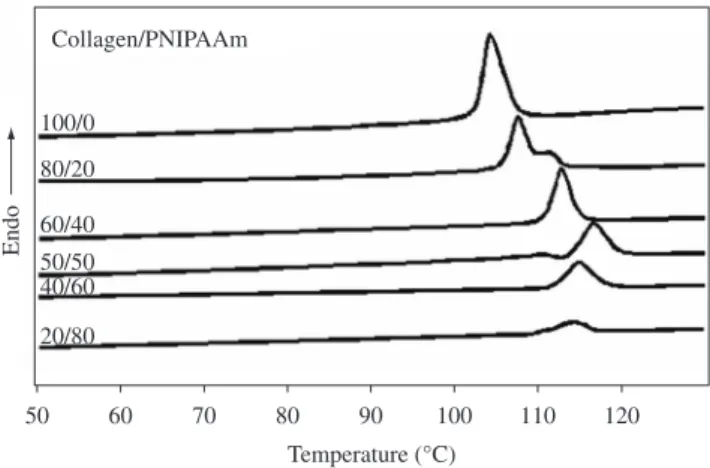
Non-dried samples. Results of DSC analysis carried out on uncross-linked and non-dried samples are reported in Figure 1 and Table 1.
Pure CLG showed an endothermic peak at 104 °C related to its denaturation process. The denaturation temperature (Td) increased in the samples up to 50 wt. (%) of PNIPAAm and then remained almost constant. The enthalpy of denaturation (ΔHd), on the other hand, did not change with the presence of a synthetic polymer.
These results indicate that PNIPAAm exerts a stabilizing effect on the uncross-linked CLG, overcoming the effect of bulk water that normally lowers its denaturation temperature28.
Dried samples. The dried samples showed a substantially similar trend (Figure 2). CLG is thermally stabilized by the presence of PNI-PAAm, as verified by the shifting of the denaturation peak towards higher temperatures, with no appreciable changes on the enthalpy of denaturation. As expected, the absence of water led to an increase in the Td of the dried collagen compared to the non-dried one.
Collagen/PNIPAAm
50 60
20/80 40/60 50/50 60/40 80/20 100/0
70 80
Temperature (°C)
90 100 110 120
Endo
The glass transition temperature (Tg) of PNIPAAm, in contrast to the Td CLG behavior, shifted to lower temperatures with increases in the CLG content (from 137 to 122 °C for 0/100 and 80/20 CLG/ PNIPAAm blends, respectively). Although it is difficult to observe the Tg at low concentrations of PNIPAAm, the decrease in the Tg values could be explained by the interactions of CLG and PNIPAAm. Col-lagen, which is a hydrogen donor, should form hydrogen bonds with the carbonyl group from PNIPAAm. The synthetic polymer contains a proton-accepting carbonyl moiety, while collagen presents hydroxyl and amino groups as side groups. Therefore, a hydrogen-bonding interaction may take place between these two chemical moieties in a blend of collagen and PNIPAAm. The formation of hydrogen bonds between the two different macromolecules competes with the inter-actions between molecules of PNIPAAm, resulting in a decreasing of Tg PNIPAAm values.
The calorimetric results obtained for uncross-linked CLG/PNI-PAAm blends, either dried or not, indicate that there are strong interactions between the synthetic and biological polymers. These interactions, probably due to the hydrogen bonding, appear to exert a thermal stabilizing effect on collagen and promote the shift of Tg to lower temperatures.
3.1.2. Cross-linked films
The cross-linking of the CLG/PNIPAAm mixtures was carried out as in the case of pure CLG where it was verified that the best results have been obtained by exposing the CLG films to the GTA vapors for 18 hours12.
Non-dried samples. In Figure 3 and Table 1 the typical DSC curves of non-dried and cross-linked samples and the values of temperature
and enthalpy of denaturation, as a function of CLG concentration are presented, respectively. As reported in previous works11,12, the
cross-link-ing method affects the biological polymer, which can be verified by the enhancement of its denaturation temperature and the related enthalpy.
By comparing the values on Table 1, we can observe that the influence of PNIPAAm on CLG denaturation seems smaller in the case of cross-linked samples. The cross-linking prevents an efficient interaction between the two components.
Dried samples. The denaturation of CLG is prevented by the stabilization due to the cross-linking promoted by GTA. This phenom-enon can be verified comparing Figures 2 and 4. The Td of pure CLG increases from 183 °C in the absence of cross-linking to 206 °C with GTA cross-linking. The same behavior is observed at all concentra-tions. As observed for the non-dried samples, the thermal stabilizing effect on CLG, related to the cross-linking, overcoming that one due to the interactions with PNIPAAm. Although it is difficult to observe the Tg in the films at low concentrations of PNIPAAm in Figure 4, it is possible to observe insignificant variations on the Tg of PNIPAAm in relation to the uncross-linked blends (Figure 2). The cross-link-ing of CLG macromolecules most likely diminishes the number of possible interactions with PNIPAAm through hydrogen bonding as observed in uncross-linked blends.
3.2. Thermal analysis - TG
Figure 5 illustrates typical TG curves of uncross-linked films. The cross-linked samples show a substantially similar trend. The desiccation treatment did not completely remove the water from the films, as it appears from the presence in all samples of the band at about 70 °C associated with the evolution of freely bound water. Pure
Table 1. DSC results (temperature and enthalpy of CLG denaturation process) for non-dried CLG/PNIPAAm blends (uncross-linked and cross-linked samples).
CLG (%) Uncross-linked Cross-linked
Tg PNIPAAm (°C) Td CLG (°C) ΔHd CLG (J.g-1) Tg PNIPAAm (°C) Td CLG (°C) ΔHd CLG (J.g-1)
100 - 104 35 - 112 37.5
80 122 108 33 135 118 34.8
60 111 113 33 138 111 38
50 123 117 33 140 114 36
40 127 115 33 140 109 34.4
20 130 114 34 140 114 27
0 137 - - 137 -
-Collagen/PNIPAAm
40 100/0 80/20
60/40 50/50
40/60 20/80
0/100
60 80 100 120
Temperature (°C)
140 160 180 200 220
Endo
Collagen/PNIPAAm
40 50
100/0
80/20
60/40
50/50 40/60 20/80
60 70 80 90 100 110 120 130
Temperature (°C)
Endo
Figure 3. DSC curves of cross-linked and non-dried samples. Stainless steel pans; heating rate of 5 °C/min.
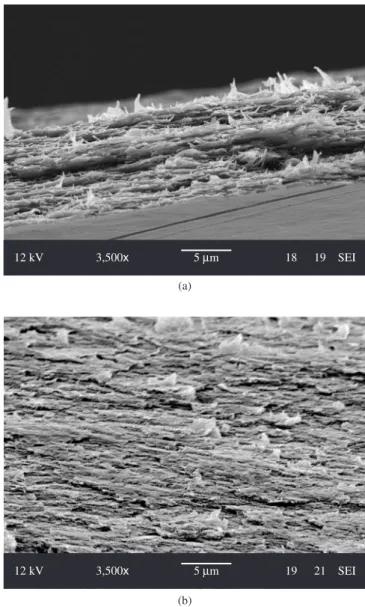
In the whole range of the composition studied, it was impossible to observe the presence of different phases, suggesting that strong interactions between the constituents are present, in agreement with the DSC data.
In comparison with the unlinked samples, films cross-linked with GTA seem to result in a more compact aggregation, which does not considerably change the original structure (Figure 7). It is still possible to observe the typical longitudinal disposition of the untreated collagen, although this kind of morphology is less evident after cross-linking. In all concentrations studied, SEM did not distinguish the presence of separated phases, using the indicated magnification grade.
4. Conclusions
The experimental results obtained in this work on mixtures of CLG/PNIPAAm, either cross-linked or uncross-linked with glutaral-dehyde, indicate that the components are thermodynamically incom-patible. However, there is good evidence that effective interactions, probably due to hydrogen bond formation, take place between the constituents. These interactions are more evident on the samples that
Collagen/PNIPAAm
50 60 80 100 120 140 160 180 200 220 240
100/0
80/20
60/40 50/50
40/60
20/80 0/100
Temperature (°C)
Endo
Figure 4. DSC curves of cross-linked and dried samples. Aluminum pans; heating rate of 10 °C/min.
W
eight (%)
100 90 80 70 60 50 40 30 20 10 0
Temperature (°C)
PNIPAAm/CLG
100 200 300 400 500 600 700 800
0/100 20/80 50/50 80/20 100/0
Figure 5. TG curves of uncross-linked films.
12 kV 3,500x 5Mm 18 19 SEI
(a)
12 kV 3,500x 5Mm 19 21 SEI
(b)
Figure 6. SEM micrographies of fractured section of uncross-linked samples: a) pure CLG; and b) CLG/PNIPAAm 40/60.
collagen is characterized by an additional two losses of weight. The first one, with maximum at about 200 °C, is related to the loss of structural water (strongly bound to the collagen); the second event with a maximum at 320 °C is related to decomposition of collagen molecule. The TG curve of PNIPAAm, beyond the transition due to the loss of freely bound water, shows another thermal event in the temperature around 400 °C, which is attributed to the loss of weight by the degradation of the synthetic polymer.
The curves of the blends show all the phenomena present in the pure components. We can observe that CLG is thermally more stable in the blends than the pure CLG, since the degradation temperature is shifted to higher temperatures. These temperatures are dependent on the blends concentration and we can explain this behavior by the thermal stabilizing effect due to interactions among the polymers primarily through hydrogen bonds. For the cross-linked blends, the thermal stabilizing effect on CLG is due to the cross-linking, as observed by the DSC results (Figures 3 and 4).
3.3. Morphological studies
were not cross-linked. In this respect, the most remarkable results are the PNIPAAm stabilizing effect on the denaturation temperature of CLG and the shift to higher temperatures of the PNIPAAm and CLG thermal degradation temperatures. The cross-linking with glutaraldehyde also promotes a thermal stabilizing effect on the biological polymer. The CLG denaturation temperature is enhanced after exposing the films to glutaraldehyde vapors, as a result of the cross-linking. On the other hand, cross-linking prevents the effective interactions among CLG and PNIPAAm, which were observed on the unlinked samples. In all concentrations studied, on both cross-linked or uncross-cross-linked samples, SEM micrographies showed that the morphology of the blends remains quite similar to that of pure collagen, indicating the longitudinal arrangement due to the fibrous structure of collagen.
Acknowledgments
Valdir Mano acknowledges with gratitude the research fellow-ship from the Coordenação de Aperfeiçoamento de Pessoal de Nível Superior (CAPES – Brazil).
Experimental assistance and discussions with Drs Paolo Giusti and Nicoletta Barbani (Pisa University – Italy) are greatly appreciated.
Figure 7. SEM micrographies of fractured section of cross-linked samples: a) pure CLG; and b) CLG/PNIPAAm 40/60.
12 kV 3,500x 5Mm 19 19 SEI
(a)
12 kV 3,500x 5Mm 18 25 SEI
(b)
References
1. Giusti P, Lazzeri L, Lelli L. Bioartificial polymeric materials; a new method to design biomaterials by using both biological and synthetic polymers. Trends in Polymer Science. 1993; 1:261-267.
2. Lazzeri L. Progress in bioartificial polymeric materials. Trends in Polymer Science. 1996; 4:249-252.
3. Giusti P, Lazzeri L, Barbani N, Lelli L, De Petris S, Cascone MG. Blends of natural and synthetic-polymers: a new route to novel bioma-terials. Makromolekulare Chemie, Macromolecular Symposia. 1994; 78:285-297.
4. Giusti P, Lazzeri L, Cascone MG. Bioartificial materials. In: Salomone JC, editor. The Polymeric Materials Encyclopedia. Boca Raton: CRC Press; 1996. p. 538-549.
5. Giusti P, Lazzeri L, Cascone MG, Seggiani M. Blends of synthetic and natural polymers as special performance materials. Makromolekulare Chemie, Macromolecular Symposia. 1995; 100:81-87.
6. Cascone MG. Dynamic-mechanical properties of bioartificial polymeric materials. Polymer International. 1997; 43(1):55-69.
7. Cascone MG, Barbani N, Cristallini C, Giusti P, Ciardelli G, Lazzeri L. Bioartificial polymeric materials based on polysaccharides. Journal of Biomaterials Science, Polymer Edition. 2001; 12(3):267-281.
8. Cascone MG, Giusti P, Lazzeri L, Pollicino A, Recca A. Surface charac-terisation of collagen-based bioartificial polymeric materials. Journal of Biomaterials Science, Polymer Edition. 1996; 7(10):917-924.
9. Cascone MG, Lazzeri L, Barbani N, Pollaco G, Pollicino A, Recca A, et al. Dehydro-thermally cross-linked collagen-poly(vinyl alcohol) blends: mechanical, biological and suface properties. Journal of Materials Sci-ence: Materials in Medicine. 1996; 7(5):297-300.
10. Barbani N, Lazzeri L, Cristallini C, Cascone MG, Pollaco G, Pizzirani G. Bioartificial materials based on blends of collagen and poly(acrylic acid). Journal of Applied Polymer Science. 1999; 72(7):971-976. 11. Barbani N, Cascone MG, Giusti P, Lazzeri L, Pollaco G, Pizzirani G.
Bioatificial materials based on collagen: 2. Mixtures of collagen and poly(vinylalcohol) cross-linked with gaseous glutaraldehyde. Journal of Biomaterials Science, Polymer Edition. 1995; 7(6):471-484. 12. Barbani N, Giusti P, Lazzeri L, Pollaco G, Pizzirani G. Bioartificial
materials based on collagen: 1. Collagen cross-linking with gaseous glutaraldehyde. Journal of Biomaterials Science, Polymer Edition. 1995; 7(6):461-470.
13. Barbani N, Lazzeri L, Lelli L, Bonaretti A, Seggiani M, Narducci P, et al. Physical and biological stability of dehydro-thermally crosslinked col-lagen-poly(vinyl alcohol) blends. Journal of Materials Science: Materials in Medicine. 1994; 5(12): 882-886.
14. Rubin AL, Miyata T, Stenzel KH. Collagen - medical and surgical applica-tions. Journal of Macromolecular Science, Part A. 1969; 3(1):113-118.
15. Gilbert DL, Lyman DJ. In vitro and in vivo characterization of synthetic polymer-biopolymer composites. Journal of Biomedical Materials Re-search. 1987; 21(5):643-655.
16. Kubota K, Fujishige S, Ando I. Single-chain transition of poly(N-isopropylacrylamide) in water. Journal of Physical Chemistry. 1990; 94(12):5154-5158.
17. Lim YH, Kim D, Lee DS. Drug releasing characteristics of thermo- and pH-sensitive interpenetrating polymer networks based on poly (N-isopropylacrylamide). Journal of Applied Polymer Science. 1997; 64(13):2647-2655.
18. Kaneko Y, Nakamura S, Sakai K, Kikuchi A, Aoyagi T, Sakurai Y, et al. Synthesis and swelling-deswelling kinetics of poly(N-isopropylacryla-mide) hydrogels grafted with LCST modulated polymers. Journal of Biomaterials Science, Polymer Edition. 1999; 10(11):1079-1091.
19. Peng T, Cheng Y-L. PNIPAAm and PMAA co-grafted porous PE mem-branes: living radical co-grafting mechanism and multi-stimuli responsive permeability. Polymer. 2001, 42(5):2091-2100.
21. Shtanko NI, Kabanov VYa, Apel PYu, Yoshida M, Vilenskii AI. Prepara-tion of permeability-controlled track membranes on the basis of “smart” polymers. Journal of Membrane Science. 2000; 179(1-2):155-161.
22. Zhang XZ, Yang YY, Chung TS. Effect of mixed solvents on char-acteristics of poly(N-isopropylacrylamide) gels. Langmuir. 2002; 18(7):2538-2542.
23. Stile RA, Burghardt WR, Healy KE. Synthesis and characterization of injectable poly(N-isopropylacrylamide)-based hydrogels that support tissue formation in vitro. Macromolecules. 1999; 32(22):7370-7379.
24. Mano V, Ribeiro e Silva MES, Barbani N, Giusti P. Blends composed of poly(N-isopropylacrylamide) and an ethylene/vinyl alcohol copolymer: thermal and morphological studies. Journal of Applied Polymer Science. 2004; 91(1):501-505.
25. Mano V, Ribeiro e Silva MES, Barbani N, Giusti P. Binary blends based on poly(N-isopropylacrylamide): miscibility studies with PVA, PVP, and PAA. Journal of Applied Polymer Science. 2004; 92(2):743-748.
26. Freitas RS. Extraction with phase behavior of temperature-sensitive gels. [Unpublished D. Phil. thesis]. Mineapolis: University of Minnesota; 1986.
27. Ribeiro e Silva MES, Dutra ER, Mano V, Machado JC. Preparation and thermal study of derived from acrylamide. Polymer Degradation and Stability. 2000; 67(3):491-495.