Engineering
www.abeq.org.br/bjchePrinted in BrazilVol. 34, No. 02, pp. 377 - 384, April - June, 2017 dx.doi.org/10.1590/0104-6632.20170342s20150613
OPTIMIZATION OF SOLID-STATE FERMENTATION
FOR BIOHERBICIDE PRODUCTION BY
Phoma
sp.
R. Klaic
1, D. Sallet
1, E. L. Foletto
1, R. J. S. Jacques
2,
J. V. C. Guedes
3, R. C. Kuhn
1*and M. A. Mazutti
1¹Department of Chemical Engineering, Federal University of Santa Maria, Av. Roraima, 1000, Santa Maria, RS, 97105-900, Brazil.
Phone: +55 55 3220 8691 E-mail: [email protected]
²Department of Soil Science, Federal University of Santa Maria, Av. Roraima, 1000, Santa Maria, RS, 97105-900, Brazil. ³Department of Plant Protection, Federal University of Santa Maria,
Av. Roraima, 1000, Santa Maria, RS, 97105-900, Brazil.
(Submitted: September 29, 2015; Revised: December 18, 2015; Accepted: January 21, 2016)
Abstract – In this work the bioherbicide production from Phoma sp. by solid-state fermentation was optimized. Agroindustrial residues such as bagasse, soybean bran and corn steep liquor were used as substrate. The bioherbicide was extracted from the fermented solid and the supernatant was applied for the control of the target plant. The evaluated responses in the bioassay were plant height, root length, fresh and dry weight, number of
lowers and phytotoxicity. The results in the bioassays demonstrated that the bioherbicide presented activity towards the target plant and the intensity of the efect was inluenced by the formulation of the fermentation
medium. The optimized condition for bioherbicide production was (wt%): moisture content 70.0, soybean bran content 30.0 and corn steep liquor (CSL) 20.0, it being possible to obtain an injury phytotoxicity level of 40. The bioherbicide showed a mode of action based on the inhibition of carotenoid biosynthesis.
Keywords: Bioherbicide; Bioassay; solid-state fermentation; Phoma sp.
INTRODUCTION
Weeds are one of the major contributing factors to yield loss in agricultural production worldwide (Boyetchoko et al., 2002; Charidattan and Dinoor 2000), because they compete with crop plants for light, water, nutrients, heat energy, carbon dioxide, and space (Boyetchoko et al., 2002; Barton, 2004; Penariol et al., 2008). Reductions may also be caused by the production of growth-inhibiting compounds due to allelopathy (Rosskopf et al., 1999).
While weeds contribute signiicantly to crop yield
losses, some of the reported negative impacts of agrochemicals such as residues in soil and water, spray drift, and weed species exhibiting herbicide resistance
underscore the importance of exploring alternatives to chemical herbicides (Boyetchoko et al., 2002). The alternative that has been used is biological control, where a microorganism or a secondary metabolite produced by it is
employed as control agent in a narrow ield of application
(Zhou et al., 2004; Green, 2014). However, there are few molecules produced industrially and commercialized. By the year 2010 there were only 11 commercially successful bioherbicides (Ash, 2010), this shows that there is a great market to be explored.
Many microorganisms can be used for bioherbicide production, including fungi from the genera Phoma sp. (Klaic et al., 2013; Klaic et al. 2015; Copping, and Duke, 2007) Some studies report the use of fungi from Phoma
et al. (2011) evaluated the action of Phoma macrostoma
as bioherbicide, whereas Zhang et al. (2012) used Phoma
sp. to obtain antimicrobial extracts. Parra et al. (2005) optimized the production of secondary metabolites of
Phoma sp. with herbicide activity.
A barrier for bioherbicide production is the development of an economically viable process (Mitchell, 2003). The production of a bioactive molecule is strictly related to the formulation of the medium and the type of fermentation. Solid state fermentation has been shown to be promising in the development of several bioprocesses/products and
ofers an alternative fermentation method that possesses
several biotechnological advantages over the conventional submerged fermentation (Pandey, 2003; Singhania et al., 2010). The substrates are often agroindustrial residues such as sugarcane bagasse, rice husk, wheat bran and soybean meal. In many cases, after fermentation the substrates are ground and applied in granular formulations of bioherbicides. Some researchers used extract obtained from fermented grains as bioherbicide (Hoagland et al., 2007).
Based on these aspects, the main objective of this work was to optimize the media composition for bioherbicide production from Phoma sp. by solid-state fermentation. Agroindustrial residues such as bagasse, soybean and corn steep liquor were employed as substrate. After the fermentation, the bioherbicide was extracted from the fermented solid and applied for the control of the target plant. The responses evaluated in the bioassay were the plant height, root length, fresh and dry weight, number of
lowers and phytotoxicity.
MATERIALS AND METHODS
Materials
Sugarcane bagasse was obtained in a microdistillery located at the Federal University of Santa Maria. The sample was dried, milled and sieved. The mean particle size of the bagasse used was 1.32 mm. The soybean bran was purchased in a local market and the mean particle size was 0.95 mm. Corn steep liquor (CSL) was obtained from Ingredion (Mogi Guaçu, SP, Brazil) and was used as received.
Microorganism, inoculum and fermentations
The strain of Phoma sp. NRRL Y-7571 was obtained from the National Center for Agricultural Utilization Research – EUA (ARS). The culture was maintained in potato dextrose agar (PDA) at 4-6°C and subcultured every 15 days. Cell production for pre-inoculum was from the incubation of fungi in a Petri dish containing PDA
media for 8 days at 28ºC. Afterwards, the Petri dish was washed with 5 mL of sterilized water and transferred to the fermentation medium.
The inoculum was cultivated in Erlenmeyers of 250 mL containing 50 mL of fermentation medium at 28°C, 120 rpm for 5 days in an orbital shaker (INNOVA 44R,
New Brunswick Scientiic). The composition was (g.L-1): glucose 20.0, peptone 10.0, yeast extract 7.5, (NH4)2SO4 2.0, FeSO4.7H2O 1.0, MnSO4.H2O 1.0 and MgSO4 0.5 (Parra et al., 2005).
Optimization of the fermentation medium
Fermentations were carried out in conical lasks (500
mL) containing 10 g of solid substrate at 28°C for 5 days in a chamber with temperature and humidity control (POL-EKO, model KK 350). Afterwards, the solid substrate was supplemented and the moisture content adjusted to the
speciied level. Each lask was covered with hydrophobic
cotton and autoclaved at 121°C for 20 min. Preliminary studies showed that no changes in moisture content of the substrate after autoclaving were detected. After cooling,
each lask was inoculated using 10 mL of inoculum.
The fermentation medium consisted of sugarcane bagasse (main substrate used as support and carbon source) supplemented with soybean bran, corn steep liquor (CSL) and initial moisture content. A Central Composite Rotatable Design (CCRD) with 14 runs plus 3 central points
was conceived to determine the efects of independent
variables on the production of phytotoxins with herbicidal action. The range of variables investigated was (wt%): soybean bran 8-32, CSL 8-32 and moisture content 50-80. The response evaluated in the experimental design was the level of injury caused by the fermented extract on the target plant.
Extraction of bioactive compounds
After fermentation, the bioactive compounds of each assay were extracted using 100 mL of distilled water in an orbital shaker at 100 rpm and 28°C during 1 h (INNOVA
44, New Brunswick Scientiic). The broth obtained from the extraction was iltered and stored to be further applied
in the bioassays.
Bioassay to evaluate bioherbicide activity
The herbicidal activity of fermented extract was determined using cucumber (Cucumis sativus L. variety
wisconsin) as the target plant. Although it is not a weed, this species is sensitive to synthetic herbicides and is frequently used in bioassays; moreover, it presents fast and uniform seed germination and does not exhibit dormancy.
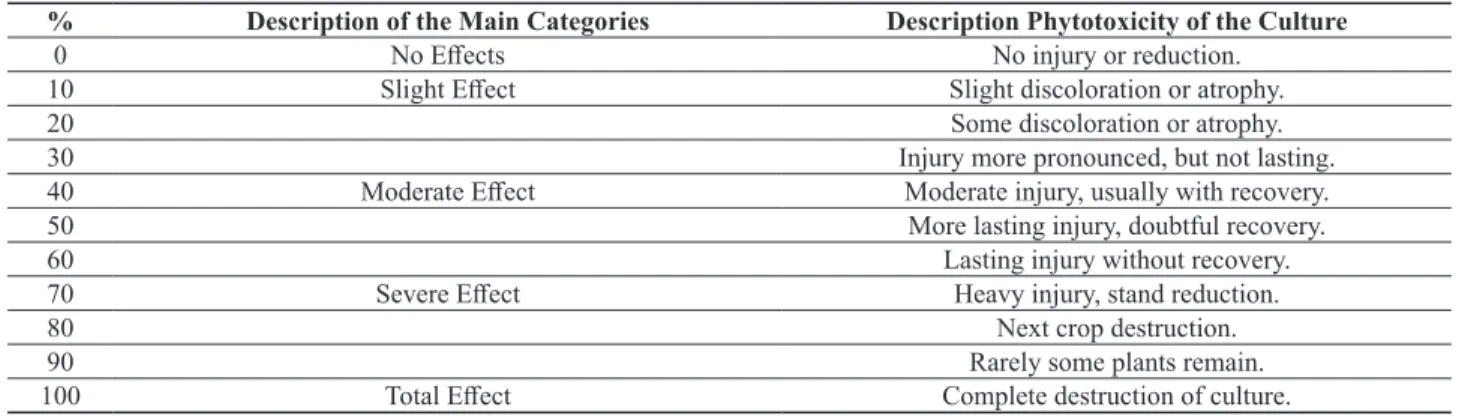
Table 1. Phytotoxic evaluation method in plants.
% Description of the Main Categories Description Phytotoxicity of the Culture
0 No Efects No injury or reduction.
10 Slight Efect Slight discoloration or atrophy.
20 Some discoloration or atrophy.
30 Injury more pronounced, but not lasting.
40 Moderate Efect Moderate injury, usually with recovery.
50 More lasting injury, doubtful recovery.
60 Lasting injury without recovery.
70 Severe Efect Heavy injury, stand reduction.
80 Next crop destruction.
90 Rarely some plants remain.
100 Total Efect Complete destruction of culture.
Reference: Frans and Crowley (1986)
containing 20 plants. The application of the bioherbicide was carried out after 15 days of cucumber cultivation, when the plants presented 2 to 3 leaves. Approximately 30 mL of bioherbicide was applied in each treatment using a garden sprayer. Control assays were performed using the culture medium and others using only water. The plants were
monitored during 21 days after application to verify the bioherbicidal action. The following aspects were evaluated for each treatment: plant height, root length, fresh weight,
dry weight, number of lowers and phytotoxicity. To
evaluate the phytotoxicity the scale of Frans and Crowley (1986), which is shown in Table 1, was used.
Statistical Analysis
The statistical analysis of the DCCR was carried out using the software Statistica® 8.0 (Statsoft Inc., Tulsa, OK, USA), considering a signiicance level of 90%. Tukey test
was carried out using the software Assistat® 7.7 (DEAG-CTRN-UFCG, Campina Grande, PB, Brazil), considering
a signiicance level of 95%.
RESULTS AND DISCUSSION
Table 2 presents the results obtained in the 17 runs of
the CCRD referring to the phytotoxicity of the bioherbicide
towards the target plant. More severe phytotoxic efects
were observed in runs 6, 8, 10, 15, 16 and 17. These treatments presented profound and discontinuous injury at a level ranging from 30-40. Runs 15, 16 and 17 (in triplicate
at the central point of the CCRD) also presented signiicant
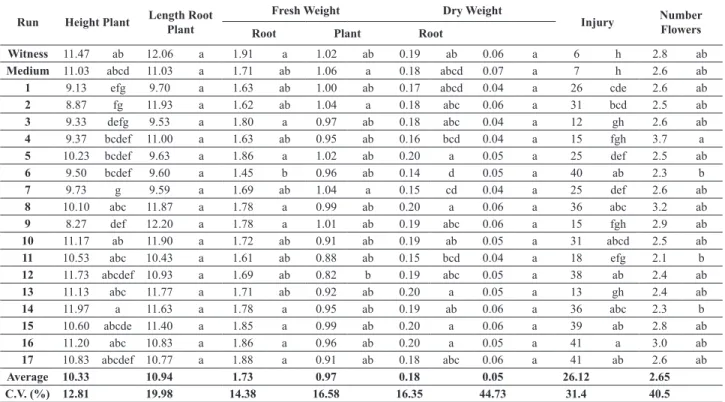
injury in the target plant and showed good reproducibility of the results. Similar levels of phytotoxicity were obtained when water and fermentation media were used in the control experiments (~7). The Tukey test (p<0.05) showed
statistically signiicant diferences in 13 runs of the CCRD
in comparison with the controls.
Table 2. Matrix of the CCRD to evaluate the inluence of independent variables on the bioherbicide production by solid-state
fermentation.
Run Moisture content
(wt%)
CSL (wt%)
Soybean bran (wt%)
Phytotoxicity (%)
1 50 (-1) 8 (-1) (8) -1 26
2 80 (1) 8 (-1) (8) -1 31
3 50 (-1) 32 (1) (8) -1 12
4 80 (1) 32 (1) (8) -1 15
5 50 (-1) 8 (-1) (32) 1 25
6 80 (1) 8 (-1) (32) 1 40
7 50 (-1) 32 (1) (32) 1 25
8 80 (1) 32 (1) (32) 1 36
9 40 (-1.68) 20 (0) 20 (0) 15
10 90 (1.68) 20 (0) 20 (0) 31
11 65 (0) 0 (-1.68) 20 (0) 18
12 65 (0) 40 (1.68) 20 (0) 38
13 65 (0) 20 (0) 0 (-1.68) 13
14 65 (0) 20 (0) 40 (1.68) 36
15 65 (0) 20 (0) 20 (0) 39
16 65 (0) 20 (0) 20 (0) 41
17 65 (0) 20 (0) 20 (0) 40
Table 3. Statistical analysis of the inluence of the bioherbicide from Phoma sp. on diferent parts of the target plant
Run Height Plant Length Root Plant
Fresh Weight Dry Weight
Injury Number Flowers Root Plant Root
Witness 11.47 ab 12.06 a 1.91 a 1.02 ab 0.19 ab 0.06 a 6 h 2.8 ab
Medium 11.03 abcd 11.03 a 1.71 ab 1.06 a 0.18 abcd 0.07 a 7 h 2.6 ab
1 9.13 efg 9.70 a 1.63 ab 1.00 ab 0.17 abcd 0.04 a 26 cde 2.6 ab
2 8.87 fg 11.93 a 1.62 ab 1.04 a 0.18 abc 0.06 a 31 bcd 2.5 ab
3 9.33 defg 9.53 a 1.80 a 0.97 ab 0.18 abc 0.04 a 12 gh 2.6 ab
4 9.37 bcdef 11.00 a 1.63 ab 0.95 ab 0.16 bcd 0.04 a 15 fgh 3.7 a
5 10.23 bcdef 9.63 a 1.86 a 1.02 ab 0.20 a 0.05 a 25 def 2.5 ab
6 9.50 bcdef 9.60 a 1.45 b 0.96 ab 0.14 d 0.05 a 40 ab 2.3 b
7 9.73 g 9.59 a 1.69 ab 1.04 a 0.15 cd 0.04 a 25 def 2.6 ab
8 10.10 abc 11.87 a 1.78 a 0.99 ab 0.20 a 0.06 a 36 abc 3.2 ab
9 8.27 def 12.20 a 1.78 a 1.01 ab 0.19 abc 0.06 a 15 fgh 2.9 ab
10 11.17 ab 11.90 a 1.72 ab 0.91 ab 0.19 ab 0.05 a 31 abcd 2.5 ab
11 10.53 abc 10.43 a 1.61 ab 0.88 ab 0.15 bcd 0.04 a 18 efg 2.1 b
12 11.73 abcdef 10.93 a 1.69 ab 0.82 b 0.19 abc 0.05 a 38 ab 2.4 ab
13 11.13 abc 11.77 a 1.71 ab 0.92 ab 0.20 a 0.05 a 13 gh 2.4 ab
14 11.97 a 11.63 a 1.78 a 0.95 ab 0.19 ab 0.06 a 36 abc 2.3 b
15 10.60 abcde 11.40 a 1.85 a 0.99 ab 0.20 a 0.06 a 39 ab 2.8 ab
16 11.20 abc 10.83 a 1.86 a 0.96 ab 0.20 a 0.05 a 41 a 3.0 ab
17 10.83 abcdef 10.77 a 1.88 a 0.91 ab 0.18 abc 0.06 a 41 ab 2.6 ab
Average 10.33 10.94 1.73 0.97 0.18 0.05 26.12 2.65 C.V. (%) 12.81 19.98 14.38 16.58 16.35 44.73 31.4 40.5
* Means followed by the same letter in the column do not show a statistical diference, by the Shapiro-Wilk test at 5% probability.
FBs =39.86 + 4.46 ⋅ M − 5.57 ⋅ M2+ 5.91 ⋅ S − 5.04 × S2− 3.80 ⋅ C2
The bioherbicidal activity of the fermented extracts was also investigated in terms of plant height, root length, fresh
and dry weight and number of lowers, with the results
presented in Table 3. The height of the plants for runs 1, 2,
3, 6, 7 and 9 presented statistically signiicant diferences
(p<0.05) in comparison with the controls. The lowest height (8.27 cm) was observed in run 9 and was about 3.2 cm lower than the control, whereas the greatest height (11.46 cm) was observed in run 14. The mean height of the
target in all runs was 10.33 cm, with a variation coeicient
of 13%. The root system was also monitored and the results
showed no statistical diference for fresh and dry weight of
roots. These results indicate that the bioherbicide produced
does not have an efect on the roots of plants. Concerning
the aerial part of the plant, the dry weight of runs 6 and
7 was statistically signiicant, presenting a weight about
24% lower than the control; the fresh weight of run 6 was
also statistically signiicant, presenting a weight about 20%
lower than the control.
From the data of Tables 2 and 3 it is seen that the bioherbicide has activity towards the target plant and that
the degree of injury was inluenced by the independent variables studied here. However, the inluence of each
variable on the response is not completely determined in the results discussed above. For this reason, the data of Table
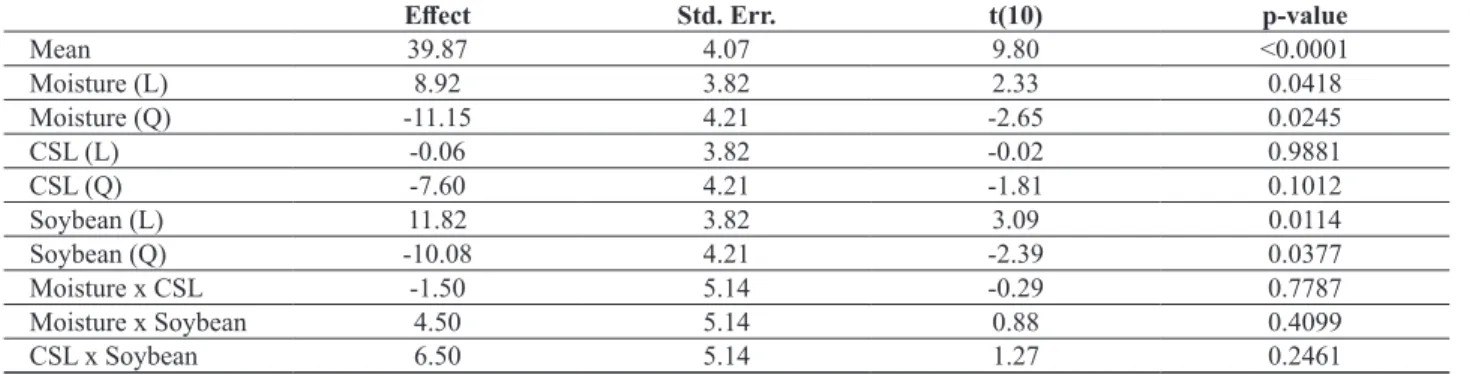
2 were used to compute the magnitude and signiicance of these efects, which are presented in Table 4. The CSL did not present a signiicant inluence on herbicidal activity; on the other hand, the efects of moisture and soybean bran were statistically signiicant (p<0.1) indicating a positive
inluence on the response with the increase of concentration
of both variables. Quadratic terms for soybean bran and
moisture content were statistically signiicant and both
were negative, indicating the presence of a maximum point for these variables in the evaluated range. Interaction terms
were not signiicant in the evaluated range.
The results presented in Table 4 were used to build a quadratic model expressing the herbicidal activity as a function of the independent variables. Eq. 1 presents the
signiicant terms of the model (p<0.1).
Table 4. Analysis of the efects of independent variables of theCCRD on the bioherbicide production.
Efect Std. Err. t(10) p-value
Mean 39.87 4.07 9.80 <0.0001
Moisture (L) 8.92 3.82 2.33 0.0418
Moisture (Q) -11.15 4.21 -2.65 0.0245
CSL (L) -0.06 3.82 -0.02 0.9881
CSL (Q) -7.60 4.21 -1.81 0.1012
Soybean (L) 11.82 3.82 3.09 0.0114
Soybean (Q) -10.08 4.21 -2.39 0.0377
Moisture x CSL -1.50 5.14 -0.29 0.7787
Moisture x Soybean 4.50 5.14 0.88 0.4099
CSL x Soybean 6.50 5.14 1.27 0.2461
L: linear term; Q: quadratic term and CSL: corn steep liquor where FBsis the phytotocixity of the bioherbicide, M, S and C are the coded moisture, soybean bran and corn steep liquor contents, respectively. The model was validated by analysis of variance (ANOVA). The calculated F-test for Eq. 1 was about 13 times greater than the tabulated one
(p=0.1) and the determination coeicient (R) was 0.8439. The high value for the determination coeicient indicated good itting of the experimental data, allowing the use of
the model to predict the bioherbicidal activity towards plant targets.
The validated model was used to determine the optimum
conditions for bioherbicide production and the results obtained are presented in Figs. 1, 2 and 3, which show
the inluence of moisture and CSL content, moisture and
soybean bran contents and CSL and soybean bran contents on the phytotoxicity of the bioherbicide, respectively. Analyzing these Figures together it is possible to delimit the optimum point for bioherbicide production that was a moisture content of 70%, soybean bran of 30% and CSL of 20 wt%. Under this condition, the maximum bioherbicide action on the target plant was around 40 on the scale used.
The action of a bioherbicide on the plant depends on absorption, translocation, metabolism and the plant sensitivity to the active compound. It is necessary for the compound to penetrate into the plant, translocate and reach the organelle where it will act. The same herbicide
may inluence various metabolic processes in the plant; however, the irst biophysical or biochemical injury that
it causes in the plant is characterized by its mechanism
of action. The sequence of all reactions to the inal action
of the product on the plant constitutes its mode of action. The knowledge of the mechanism of action and mode of action is an important step in the development of a bioherbicide. From analysis of bioassays some common symptoms among the treatments were observed, which allowed grouping of the possible mechanism of action of bioherbicide produced from Phoma sp.
Figure 2. Contour plots showing the inluence of moisture and soybean bran contents on the phytotoxicity of the bioherbicide produced. CSL (corn steep liquor) content was maintained at the central point of the CCRD.
Figure 3. Contour plots showing the inluence of CSL (corn steep liquor) and soybean bran contents on the phytotoxicity of the bioherbicide produced. Moisture content was maintained at the central point of the CCRD.
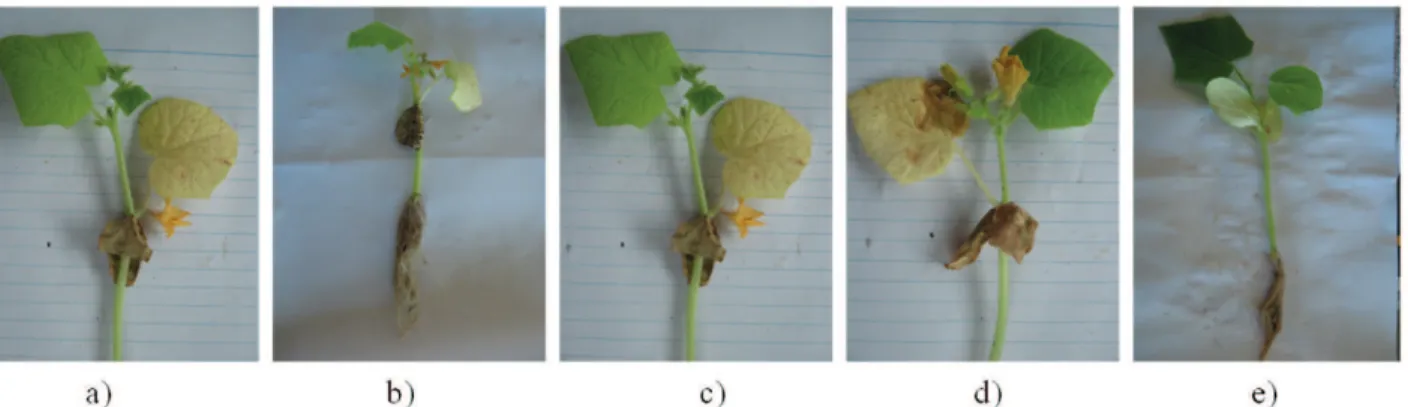
The main symptom observed in the experiments was the bleaching of the leaves that came into contact with the bioherbicide. The leaves that were born after the application did not show the symptom. Fig. 4 shows the injury caused by the bioherbicide in the experiments of the CCRD with the highest level. These symptoms are similar
Figure 4. Efect of bioherbicide on the target plant for some speciic runs of the CCRD: a) run 6; b) run 8; c) run 12; d) run 15; e) control.
CONCLUSIONS
In this work solid-state fermentation for bioherbicide production from Phoma sp was optimized. Results of the bioassays demonstrate that the bioherbicide presented activity towards the target plant and that the intensity of the
efect was inluenced by the formulation of the fermentation
medium. The most severe injury was seen in treatment 6,
with signiicant reduction of the height as well as fresh and
dry weight of the aerial parts. The optimized condition for bioherbicide production was at a moisture content of 70 wt%, soybean bran content of 30 wt% and CSL content of 20 wt%, it being possible to obtain an injury level of 40. The bioherbicide produced showed a mode of action based on the inhibition of carotenoid biosynthesis.
ACKNOWLEDGEMENTS
The authors thank CAPES for the scholarships and
FAPERGS for the inancial support of this work.
REFERENCES
Ash, G.J., The science art business of successful bioherbicides. Biological Control 52, 230–240 (2010).
Bailey, K.L., Pitt, W.M., Falk, S., Derby, J., The efects of
Phoma macrostoma on nontarget plant and target weed species. Biological Control, 58, 379–386 (2011).
Barton, J., How good are we at predicting the ield
host-range of fungal pathogens used for classical biological control of weeds? Biological Control, 31, 99–112 (2004).
Boyetchoko, S.M., Rosskopf, E.N., Caesar, A.J., Charudattan, R., Biological weed control with pathogens: Search for candidates to applications. Agriculture and Food Production, 2, 239–266 (2002). Charudattan, R., Dinoor, A., Biological control of
weeds using plant pathogens: accomplishments and limitations. Crop Protection, 19, 691–695 (2000). Copping, L.G., Duke, S.O., Natural products that have
been used commercially as crop protection agents. Pest Management Science, 63(6), 524-554 (2007).
Duke, S.O., Dayan, F.E., Modes of Action of Microbially-Produced Phytotoxins. Toxins 3, 1038-1064 (2011). Frans, R., Crowley, H., Experimental design and techniques
for measuring and analyzing plant responses to weed control practices. In: Southern Weed Science Society. Research methods in weed science, Clemson, 3ª ed., 29-45 (1986).
Green, J.M., Current state of herbicides in herbicide-resistant crops. Pest Management Science, 70, 1351-1357 (2014).
Hoagland, R.E., Boyette, C.D. Weaver, M.A., Bioherbicides: Research and risks. Toxin Reviews 26, 313–342 (2007).
Klaic, R., Kuhn, R.C., Foletto, E.L., Dal Prá, V., Jacques, R.J.S., Guedes, J.V.C., Treichel, H., Mossi, A.J., Oliveira, D., Oliveira, J.V., Jahn, S.L., Mazutti, M.A., An overview regarding bioherbicide and their production methods by fermentation. In: Vijai Kumar Gupta; Robert L. Mach; S. Sreenivasaprasad. (Org.). Fungal Bio-Molecules: Sources, Applications and Recent Developments. 1ed.Oxford: Wiley-Blackwell, 2015, v. 1, p. 183-200 (2015).
Klaic, R., Sallet, D., Souza, A.R.C., Guedes, J.V.C., Jacques, R.J.S., Foletto, E.L., Jahn, S.L., Kuhn, R.C., Mazutti, M.A., Biopesticide Patents. Recent Patents in Engineering. 7, 182-195 (2013).
Mitchell, K.J., Development of a submerged-liquid sporulation medium for the potential smartweed bioherbicide Septoria polygonorum. Biological Control, 27, 293–299 (2003).
Parra, R., Aldred, D., Magan, N., Medium optimization for the production of the secondary metabolite squalestatin S1 by a Phoma sp. combining orthogonal design and response surface methodology. Enzyme and Microbial Technology, 37, 704–711 (2005).
Penariol, M.C., Monteiro, A.C., Pitelli, R.A., 2008. Growth and sporulation of Bipolaris euphorbiae cultivated
under diferent nutritional conditions. Ciência Rural
38, 1907-1913.
Rosskopf, E.N., Charudattan, R., Kadir, J.B., Use of plant pathogens in weed control. Handbook of Biological Control (1999).
Singhania, R.R., Sukumaran, R.K., Patel, A.K., Larroche,
C., Pandey, A., Advancement and comparative proiles
in the production technologies using solid-state and submerged fermentation for microbial cellulases. Enzyme and Microbial Technology, 46, 541-549 (2010).
Zhang, L., Wang, S.Q., Li, X.J., Zhang, A.L., Zhang, Q., Gao, J.M., New insight into the stereochemistry of botryosphaeridione from a Phoma endophyte. Journal of Molecular Structure, 1016, 72–75 (2012).