Below-ground interactions for sustainable cropping systems
By MICHAEL J GOSS1, ISABEL BRITO2, MÁRIO CARVALHO2, SABARUDDIN KADIR3and AMARILIS DE VARENNES4 1
University of Guelph, Kemptville Campus, Kemptville K0G 1J0, Ontario, Canada 2
University of Évora, ICAAM, Apartado 94, 7002 - 540 Évora, Portugal 3
University of Sriwijaya, Faculty of Agriculture, Jl. Padang Selasa No. 524, Bukit Besar, Palembang, South Sumatra 30139, Indonesia
4
Technical University of Lisbon, Instituto Superior de Agronomia, Tapada da Ajuda, 1349-017 Lisbon, Portugal
Summary
Key aspects of cropping systems are described in terms of their impacts on soil, water and air resources. The importance of microbial symbiotic relations with crop plants are briefly
considered in the context of nutrient resource use efficiency and the resilience of plants to biotic and abiotic stress. It is argued that cropping systems need to include crops with fibrous root systems and legumes in the rotation to ensure sustainable use of resources. Three series of experiments are discussed that considered how the efficacy of rhizobia and indigenous arbuscular mycorrhizal fungi could be enhanced in sustainable cropping systems. Evidence is presented to demonstrate that there are potential benefits to crop production from improved management of soil resources through the adoption of reduced tillage practices coupled with suitable crop rotation and weed control.
Introduction
Cropping systems describe the temporal and spatial arrangements of crops together with the associated management of soil, water and vegetation. Although the aim of a cropping system may be to enhance the productivity of land per unit of input (Lal, 2003), it must be evaluated over several crop cycles to ensure sustainability of the resource base. Soil resource needs to be resilient to the forces of wind and water erosion and less susceptible to the loss of plant nutrients or transport of contaminants by leaching or in surface runoff. Water resources need to be
protected from excessive exploitation and contamination, while volatilization of ammonia and the release of gases, such as nitrous oxide and methane, to the atmosphere must be minimized. The total amount and the dynamics of soil organic matter, normally expressed in terms of carbon (soil organic carbon, SOC), are critical for these requirements and to maintain biological activity. Plant roots contribute to soil organic matter both by their death and decay and the release of mucilage from their apical regions. During their existence roots undergo extension and turnover; the latter occurring particularly within the various categories of branch roots (Goss and Watson, 2003). Fibrous root systems, typically associated with grasses, tend to result in greater root-length densities (the root-length of root per unit volume of soil) than do tap roots, which in turn can be faster growing. Larger values of root-length density help to enmesh soil particles and enhance the resistance of aggregates to disruptive forces. Extraction of water by roots helps increase the strength of aggregates as cementing agents, present in or derived from root-secreted mucilage or
decaying plant material, are brought into closer contact with soil particles as water menisci retreat from larger pores of the soil into finer ones (Goss and Kay, 2005).
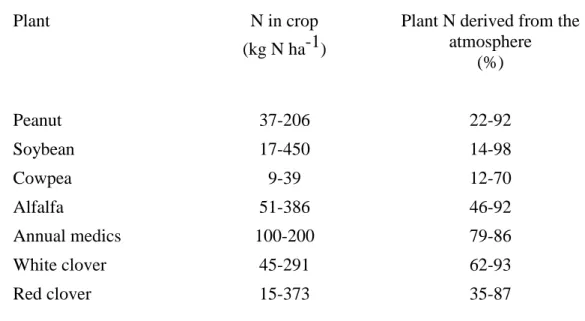
Over the last century and a half huge increases in agricultural production have come from the breeding of crop varieties that perform better, particularly being more resistant to disease, the development of more efficient and reliable systems of drainage and irrigation to meet the need for water and aeration, and the use of synthetic fertilizers to provide sufficient nitrogen (N) and phosphorus (P). Leguminous crops, particularly forage species, can obtain more than 80% of their N requirement from the atmosphere by biological N fixation through their symbiosis with rhizobia (Table 1). Some of the N fixed can be passed to non-fixing crops, for example to grass in a mixed stand with alfalfa or clover (Ta and Faris, 1987a; b), and after the legume crop has been harvested or ploughed under (Ebelhar et al., 1984; Sheaffer and Seguin, 2003).
Table 1. Estimates of crop N derived from N2-fixation by legumes
Plant N in crop
(kg N ha-1)
Plant N derived from the atmosphere (%) Peanut 37-206 22-92 Soybean 17-450 14-98 Cowpea 9-39 12-70 Alfalfa 51-386 46-92 Annual medics 100-200 79-86 White clover 45-291 62-93 Red clover 15-373 35-87
The effectiveness of biological N fixation in legumes can be greatly enhanced if arbuscular mycorrhizal fungi (AMF) also colonize the roots; with the impact being greater if that occurs at an early stage of seedling development (Goss and de Varennes, 2002; de Varennes and Goss, 2007). There is evidence that some N may pass directly between fixing and non-fixing plants in a mixed stand through AMF (Haystead et al., 1988; Frey and Schüepp, 1993). Uptake of mineral N released by the turnover of roots and nodules of legumes appears to be the more important mechanism (Goss et al, 2002; Haystead and Marriott, 1979). The role of AMF in supplying to their hosts nutrients that have limited mobility in soil, such as P and Zn, is well established. Direct uptake of P by roots from the soil can be so down-regulated in the presence of AMF that the only supply is through the fungal hyphae (Smith et al., 2004). Govindarajulu et al. (2005) showed that N can also move as ammonium ions (NH4+) from the fungi into host root cells. Mycorrhizas confer further benefits to the host crop, including reduced uptake of toxic metals (Arines and Vilariño 1989; Bethlenfalvay and Franson 1989), improved tolerance to drought (Augé 2004; Cho et al. 2006)and greater resistance to soil-borne pathogens (Harrier and Watson, 2004). Mycorrhizal fungi also contribute importantly to development and maintenance of soil structure (Goss and Kay, 2005). Cropping systems need to capture and exploit all the advantages
offered by both microbial symbioses. Ensuring the optimum rate of colonization of a new crop by both AMF and rhizobia should be an important objective of soil management options within the cropping system. Enhancing mycorrhizal associations can be achieved by inoculating with exotic strains or by promoting the activity of indigenous AMF (Bagyaraj, 1992). However, inoculation at the field scale requires such a large amount of material that it is considered
impractical (Fitter et al., 2011). The success of inoculation with AMF is also determined by their ability to compete with indigenous fungi (Gianinazzi-Pearson and Diem, 1982). Practices that could enhance the efficacy of indigenous AMF would be of considerable benefit.
Colonization can be initiated by three types of AMF propagule: spores, extraradical hyphae and hyphae from colonised roots fragments. Runner hyphae from a well-developed extraradical mycelium are quicker to initiate colonisation in a new host than other sources of inoculum (Martins and Read, 1997), particularly when the number of viable spores is limited (Read et al., 1976) or soil temperature is not optimal (Entry et al., 2002). Intensive tillage of soil will disrupt extraradical mycelium networks and limit the opportunities for colonization (Jasper et al., 1989). In contrast, adoption of tillage systems that minimise soil disturbance below the depth of seed placement can encourage persistence of the extraradical mycelium. In temperate climates better protection of the soil surface is afforded by fall sowing of crops that require vernalization before reproductive growth can begin. However, such crops are harvested much earlier than the
corresponding spring-sown varieties so increasing the period between components of a rotation. Under Mediterranean conditions varieties that have no requirement for vernalization are
commonly grown over winter, resulting in an even longer period between successive crops as sufficient precipitation is required before sowing to ensure plant establishment. But is the
longevity of the extraradical mycelium adequate under hot dry conditions in the absence of living host plants? Can the roots of the weeds, which germinate with the first rains, form a living bridge for mycelium networks between successive crops in the rotation? What effect soil disturbance has on the colonization is also important in developing strategies to optimize the viability of the extraradical mycelium.
Methodology
In the controlled environment pot studies that are discussed below, the underlying common experimental approach was based on that of Fairchild and Miller (1988). Essentially two different inoculum potentials of indigenous AMF were established by growing a base crop, firstly in a ‘pretreatment’ cycle, then in two or more ‘treatment’ cycles. Pots were filled with field soil that had been fully disrupted in passing through a 4-8 mm sieve. The soil was tamped to a bulk density of about 1.2 Mg m-2. At the end of the pretreatment cycle, pots were selected at random and for half the soil was removed as two or three layers, which were kept separate, and again passed through a sieve before being repacked into the same layers within the pot. Root material that had not passed through the sieve was cut into lengths of approximately 1 cm and returned to the soil layer from which they had been separated. These pots formed the ‘Disturbed’ treatment. The remaining pots formed the ‘Undisturbed’ treatment. At the end of each treatment cycle soil in the pots of the Disturbed treatment was again disrupted as described above.
Establishment of contrasting AMF inoculum potentials was defined by better growth of the host crop in at least the last of these treatment cycles. Further consequences of the differential
inoculum potential were then investigated on the growth and development of a ‘test’ crop,
a well-drained field. Nutrients were applied to ensure that plants of the last treatment cycle and the test crop showed no deficiency symptoms.
In the first series, clay pots of soil were buried in the field with their tops level with the soil surface in the Alentejo region of Portugal and left without water for the period from the harvest of wheat (Triticum aestivum L., cv. Coa) of the last treatment cycle (July) until October. Wheat was used as the test crop. Disruption of the soil in the disturbed treatment only occurred in the pretreatment and treatment cycles and was not carried out after the last of those cycles or as part of the preparation for planting the test crop. The initial cycles were each of 21 days and the test crop was sampled after 10, 21 and 35 days growth.
In the second study, maize (Zea mays, L.) was sown for the pretreatment and treatment cycles and soybean (Glycine max (L.) Merr.) was used as the test crop. Peat-based Rhizobium (Bradyrhizobium japonicum strain 532C) inoculum was placed at the bottom of a small hole formed by a piece of dowel and the pregerminated seed of the soybean was placed ontop and the soil eased back to cover the seed. To investigate early colonization the test crop (Glycine max (L.) Merr. cv. Korada) was sampled after 10, 23 and 49 days. To investigate the significance of soil P, Ca(H2PO4)2.H2O was added to pots at the start of the treatment cycles to achieve four levels of amendment, 0, 20, 40, and 80 mg P kg soil-1. These soybean plants (Glycine max (L.) Merr. cv. Evans) were sampled only at podfill (49 days).
For the third study, a mixture of Mediterranean weeds was grown in each pot during the pretreatment cycle for at least one month. The weeds selected were Persian ryegrass (Lolium rigidum Gaudin), wild oat (Avena sterilis L.) and littleseed canarygrass (Phalaris minor Retz.). For the ‘Undisturbed’ treatment the weeds were killed using herbicide while in the ‘Disturbed’ treatment shoots and roots were chopped and incorporated during soil disturbance. The wheat was sampled after 21 and 28 days.
Results
Despite a period of two months exposure to severe drying coupled with hot air temperatures and the absence of supporting plants, indigenous AMF were able to colonize the following wheat crop. The greater colonization was associated with the establishment of the crop in the absence of significant soil disturbance below the depth of seeding during the treatment cycles (Table 2). Table 2. Effect of soil disturbance during treatment cycles on arbuscular and hyphal
colonisation of roots in a wheat test crop, between 10 and 35 days after planting Proportional AM colonisation Previous soil treatment Days after emergence Hyphal Arbuscular Undisturbed 10 0.10 c 0.04 d Disturbed 0.07 c 0.02 d Undisturbed 21 0.19 b 0.11 c Disturbed 0.10 c 0.06 d Undisturbed 35 0.29 a 0.21 a Disturbed 0.21 b 0.15 b
Assuming development of an intact extraradical mycelium in the disturbed treatment was
restricted to the last treatment cycle, the difference in colonization must have been the result of a greater resilience of the mycelium that had been developed over the three or four cycles in the undisturbed treatment.
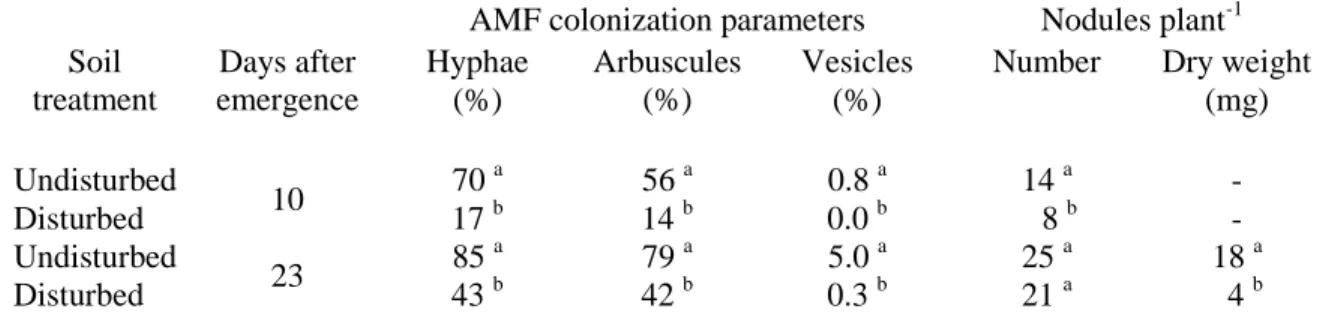
Table 3. Early effect of soil disturbance on AMF colonization and nodule formation in soybean
AMF colonization parameters Nodules plant-1
Soil treatment Days after emergence Hyphae (%) Arbuscules (%) Vesicles (%)
Number Dry weight
(mg) Undisturbed 10 70 a 56 a 0.8 a 14 a -Disturbed 17 b 14 b 0.0 b 8 b -Undisturbed 23 85 a 79 a 5.0 a 25 a 18 a Disturbed 43 b 42 b 0.3 b 21 a 4 b
For each date, values in a column followed by the same letter are not significantly different as estimated by the t-test at p<0.05.
The greater AMF inoculum potential associated with the undisturbed treatment resulted in faster formation of mycorrhizas in soybean (Table 3). However, by podfill roots were colonized by hyphae or arbusules to about 80% or more and differences induced by soil disturbance in these parameters were small or not statistically (Table 4). In contrast, the frequency of vesicles in roots from the disturbed treatment was only about half that of plants grown in undisturbed soil (Table 4); consistent with there being faster colonization by AMF in the absence of disturbance. The addition of large applications of P fertilizer tended to reduce colonization rates (Table 4). Table 4. The effect of P fertilizer application and soil disturbance on AMF colonisation in soybean roots at podfill (R5)
Treatment Soil disturbance Phosphorus applied (P mg kg-1 soil)
Undisturbed Disturbed 0 20 40 80
Hyphal 94 a 93 a 96 a 95 a 92 a 89 b
Arbuscular 79 a 78 b 85 a 81 ab 77 bc 72 c
Vesicular 15 a 8.9 b 14 a 13 a 12 a 7.9 b
Values followed by the same letter in the same row and under the same treatment are not significant at 5%
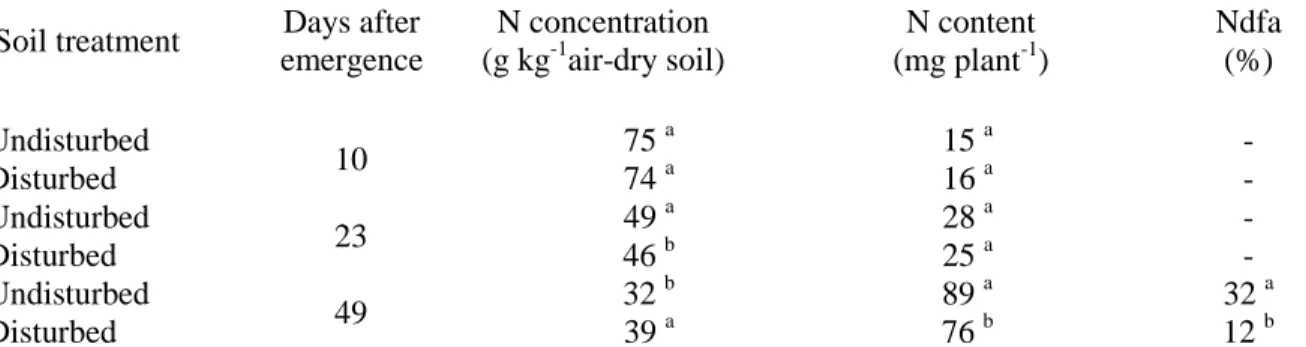
The faster colonization of the soybean roots by AMF was accompanied by earlier nodule formation (Table 3). When P levels in the soil were small the total weight of nodules from plants in disturbed soil was less than those from undisturbed soil although the number of nodules was about the same (Table 3). As P levels increased the number of nodules tended to increase, especially in undisturbed soil but differences in weight of nodules were greatly reduced (Data not shown). The proportion of N in the plant that was derived from the atmosphere was greater in undisturbed than disturbed soil (Tables 5 and 6) and was enhanced by the addition of P (Table 6).
Table 5. Effect of soil disturbance on the N content, N2 fixation, and use of soil N by soybeans
Soil treatment Days after emergence N concentration (g kg-1air-dry soil) N content (mg plant-1) Ndfa (%) Undisturbed 10 75 a 15 a -Disturbed 74 a 16 a -Undisturbed 23 49 a 28 a -Disturbed 46 b 25 a -Undisturbed 49 32 b 89 a 32 a Disturbed 39 a 76 b 12 b
For each date, values in a column followed by the same letter are not significantly different as estimated by the t-test at p=0.05. Ndfa – N derived from the atmosphere
The rate of N fixation measured at podfill in disturbed soil (Table 6) was consistent with the values obtained from the differences between N in nodulating and non-nodulating soybean isolines, 2.4 and 0.5 mg N per plant day-1 (Kadir, 1994).
Table 6. Proportion of N derived from the atmosphere at podfill of soybean as determined by 15N dilution and the daily rate of fixation measured as plant N derived from 15N gas applied to roots
Percentage of N derived from the atmosphere (by 15N Dilution)
P applied mgkg-1 0 20 40 80
Undisturbed 34 cA 79 bA 86 aA 81 aA
Disturbed 28 cB 59 bB 76 aB 82 aA
Rate of N fixation in disturbed soil
(mg N per plant day-1) 0.5 b ND ND 2.6 a
Values followed by the same letter (lower case) in the same row or under the same P treatment (upper case) are not significant at 5%. ND – Not determined
Arbuscular colonisation rate of wheat was enhanced 21 days after planting, in the treatment where weeds were controlled by herbicide rather than by soil disturbance. Enhanced AMF colonisation promoted early P acquisition and growth of the crop (Table 7). The method of weed control significantly affected wheat AM colonisation parameters after 14 and 21 days, with soil disturbance resulting in poorer AM colonisation (Table 8).
Table 7. Effect of weed control method on wheat growth and AM colonisation parameters after 21 days
Pretreatment Shoot weight
(g/pot) P uptake (mg/pot) Hyphal colonisation Arbuscular colonisation No Weeds 1.32 a 2.84 a 0.32 a 0.21 b Weeds - Systemic herbicide 1.22 ab 2.70 a 0.39 a 0.28 a - Soil Disturbed 1.02 b 2.03 b 0.22 b 0.18 b
Comparison of results for the ‘No weeds’ and ‘Systemic Herbicide treatments in Tables 7 and 8 suggest that the benefits of AM colonisation from extraradical mycelium associated with weed roots increased as that from other inoculum types decreased (difference between ‘No weeds treatments). The type of herbicide (contact or systemic) had no impact on colonisation of the wheat crop (Table 8).
Table 8. Effect of weed control method on AM colonisation in wheat
With weeds prior to wheat planting ‘No weeds’
Days after planting
Method of weed control
Systemic Herbicide Contact Herbicide Disturbance Hyphal colonisation 14 0.68 b 0.75 a 0.48 c 0.07 d 21 0.84 a 0.77 a 0.46 b 0.09 c Arbuscular colonisation 14 0.35 a 0.36 a 0.08 b 0.02 b 21 0.40 a 0.33 a 0.14 b 0.02 c
For each measured parameter means followed by the same letter are not significantly different (p≤0.05). Conclusions
Cropping systems need to include crops with fibrous root systems and legumes in the rotation to ensure sustainable use of resources. Coupled with tillage practices that limits soil disturbance to the depth of seed placement, crops can establish more effective symbioses with indigenous AMF. This can have important consequences in terms of greater resistance to drought and to soil-borne pathogens, improved utilization of P and other nutrients with slow mobility in soil but also the reduced availability of toxic elements. In addition, biological N fixation can be enhanced through interactions between AMF and rhizobia. Weeds may be a useful means of enhancing extraradical mycelium as a viable means of colonizing crops separated in time, particularly in warm dry periods.
References
Arines J, Vilariño A. 1989. Use of nutrient: phosphorus ratios to evaluate the effects of
vesicular arbuscular mycorrhiza on nutrient uptake in unsterilized soils. Biology and Fertility of Soils 8: 293–297.
Augé R M. 2004. Arbuscular mycorrhizae and soil/plant water relations. Canadian Journal of
Soil Science 84: 373–381.
Bagyaraj D J. 1992. Vesicular-arbuscular mycorrhiza: application in agriculture. Methods in
Microbiology 24: 359-373.
Bethlenfalvay G J, Franson R L.1989. Manganese toxicity alleviated by mycorrizae in
soybean. Journal of Plant Nutrition 12: 953–970.
Cho K, Toler H D, Lee J, Ownley B H, Stutz J C, Moore J L, Augé R M. 2006. Mycorrhizal
symbiosis and response of sorghum plants to combined drought and salinity stresses. Journal of Plant Physiology 163: 517–528.
Ebelhar S A, Frye W W, Blevins R L. 1984. Nitrogen from legume cover crops for no-tillage
Entry J A, Rygiewicz P T, Watrud L S, Donnelly P K. 2002. Influence of adverse soil
conditions on the formation and function of arbuscular mycorrhizas. Advances in Environmental Research 7: 123–138.
Fairchild G L, Miller M H. 1988. Vesicular-arbuscular mycorrhizas and the soil-disturbance
induced reduction of nutrient absorption in maize. II. Development of the effect. New Phytologist 110: 75-84.
Fitter A H, Helgason T, Hodge A. 2011. Nutritional exchanges in the arbuscular mycorrhizal
symbiosis: implications for sustainable agriculture. Fungal Biology Reviews 25: 68-72.
Frey B, Schüepp H. 1993. A role of vesicular-arbuscular (va) mycorrhizal fungi in facilitating
interplant nitrogen transfer. Soil Biology & Biochemistry 25: 651-658.
Gianinazzi-Pearson V, Diem H G. 1982. Endomycorrhizae in the tropics. In Microbiology of
Tropical Soils and Plant Productivity, pp. 209-251. Eds Y R Dommergues and H G Diem. The Hague: Martinus Nijhoff/Dr. W. Junk Publishers.
Goss M J, de Varennes A. 2002. Soil disturbance reduces the efficacy of mycorrhizal
associations for early soybean growth and N2 fixation. Soil Biology & Biochemistry
34: 1167-1173.
Goss M.J., de Varennes A, Smith P S, Ferguson J A. 2002. N2 fixation by soybeans grown with different levels of mineral nitrogen, and the fertilizer replacement value for a following crop Canadian Journal of Soil Science 82: 139-145
Goss M J, Kay B D. 2005. Chapter 9, Soil aggregation. In Roots and Soil Management:
Interactions between Root and the Soil. Agronomy Monograph No 48, Eds S F Wright and R W Zobel. Madison: ASA, CSSA, and SSSA.
Goss M J, Watson C A. 2003. The importance of root dynamics in cropping systems research.
Journal of Crop Production 8: 127-156.
Govindarajulu M, Pfeffer P E, Jin H, Abubaker J, Douds D D, Allen J W, Bücking H, Lammers P J, Shachar-Hill Y. 2005. Nitrogen transfer in the arbuscular mycorrhizal
Symbiosis. Nature 435: 819-835.
Harrier L A, Watson C A. 2004. The potential role of arbuscular mycorrhizal (AM) fungi in
the bioprotection of plants against soil-borne pathogens in organic and/or other sustainable farming systems. Pest Management Science 60: 149–157.
Haystead A, Malajczuk N, Grove T S. 1988. Underground transfer of nitrogen between
pasture plants infected with vesicular arbuscular mycorrhizal fungi. New Phytologist
108: 417-423.
Haystead A, Marriott C. 1979. Transfer of legume nitrogen to associated grass. Soil Biology &
Biochemistry 11: 99-104.
Jasper D A, Abbott L K, Robson A D. 1989. Soil disturbance reduces the infectivity of
external hyphae of vesicular- arbuscular mycorrhizal fungi. New Phytologist 112: 93-99.
Kadir, S. 1994. Interaction between infection with rhizobium and indigenous mycorrhizas on
nitrogen fixation and phosphorus nutrition in soybean. Ph.D. Thesis, Guelph: University of Guelph.
Lal R. 2003. Cropping systems and soil quality Journal of Crop Production 8: 33-52. Martins M A, Read D J. 1997. The effects of disturbance on the external mycelium of
arbuscular mycorrhizal fungi on plant growth. Pesqui Agropecu Brasil 32: 1183–1189.
Read D J, Koveheri H K, Hodson J. 1976. Vesicular-arbuscular mycorrhizal in natural
Sheaffer C C, Seguin P. 2003. Forage legumes for sustainable cropping systems. Journal of
Crop Production 8: 187-216.
Smith S E, Smith F A, Jakobsen I. 2004. Functional diversity in arbuscular mycorrhizal (AM)
symbioses: the contribution of the mycorrhizal P uptake pathway is not correlated with mycorrhizal responses in growth or total P uptake. New Phytologist 112: 93-99.
Ta T C, Faris M A. 1987a. Effects of alfalfa proportions and clipping frequencies on
timothy-alfalfa mixtures. I. Competition and yield advantages. Agronomy Journal: 79: 817-820.
Ta T C, Faris M A. 1987b. Effects of alfalfa proportions and clipping frequencies on
timothy-alfalfa mixtures. II. Nitrogen fixation and transfer. Agronomy Journal 79: 820-824.
de Varennes A, Goss M J. 2007. The tripartite symbiosis between legumes, rhizobia and
indigenous mycorrhizal fungi is more efficient in undisturbed soil. Soil Biology & Biochemistry 39: 2603-2607.