Guilherme Nuno Campos Góis
Licenciado em Ciências da EngenhariaSentiment Analysis
on Product-Service Systems
Dissertação para obtenção do Grau de Mestre em
Engenharia Eletrotécnica e de Computadores
Orientador: Rui Alexandre Nunes Neves da Silva, Associate Profes-sor,
NOVA University of Lisbon
Júri
Presidente: Professora Doutora Maria Helena Fino Arguente: Professor Doutor André Damas Mora
Sentiment Analysis on Product-Service Systems
Copyright © Guilherme Nuno Campos Góis, Faculdade de Ciências e Tecnologia, Univer-sidade NOVA de Lisboa.
A Faculdade de Ciências e Tecnologia e a Universidade NOVA de Lisboa têm o direito, perpétuo e sem limites geográficos, de arquivar e publicar esta dissertação através de exemplares impressos reproduzidos em papel ou de forma digital, ou por qualquer outro meio conhecido ou que venha a ser inventado, e de a divulgar através de repositórios científicos e de admitir a sua cópia e distribuição com objetivos educacionais ou de inves-tigação, não comerciais, desde que seja dado crédito ao autor e editor.
To everyone that is a part of my life. Specially dedicated to my grandparents.
Ac k n o w l e d g e m e n t s
"No one can pass through life, any more than he can pass through a bit of country, without leaving tracks behind, and those tracks may often be helpful to those coming after him in finding their way.- Robert Baden-Powell.
Durante a minha vida tive o privilégio de ter vários trilhos para me ajudarem no meu caminho. Muitas pessoas contribuíram para este caminho sendo que as citadas neste documento são apenas algumas das que mais me marcaram. Cumpre-me, antes de mais, agradecer a Deus, por ter colocado todas estas pessoas no meu caminho.
Em primeiro lugar, quero agradecer à minha mãe Marina, que durante toda a vida lutou para garantir que conseguia ultrapassar todas as adversidades; ao Jorge, meu “pai afetivo”, que desde muito cedo me considerou e me tratou como se seu filho fosse; aos meus avós Alcina e António Campos, que sempre me "estragaram"com mimos; ao meu pai Nuno, que soube balancear o ser confidente com o “dar na cabeça”; ao meu irmão Tomás, puto regila e sem emenda, que me ajudou a crescer com as suas birras; e, ao meu padrinho José Carlos Castanheira, pelo exemplo de trabalho e determinação que sempre foi para mim.
Num plano seguinte, mas talvez tão importante quanto o primeiro, quero agradecer a todos os meus amigos que me acompanharam neste percurso. Neste âmbito destaco o António Ferreira, por todas as aventuras que vivemos e mais recentemente pelas refeições revitalizantes que prepara; a Pipa, que me ajudou a ser capaz de viver com níveis eleva-dos de ruído; o Diogo Vieira, que conheço desde miúdo e com quem partilhei grandes momentos da minha juventude; o Paulo Pereira e à sua rigidez militar; a Mafalda Mar-tins, rapariga a quem agradeço especialmente o ter-me aturado na adolescência; o Flávio Jacinto, que me apresentou a realidade dos trabalhos de grupo da faculdade; o Ricardo Ferreira, por me ter apresentado desafios nos trabalhos de grupo; o Rui Baptista e à sua sempre alegre disposição; ao Gabriel grande colega e festivaleiro; a Lúcia Salvador e a Margarida Freixo, pelas casas nos dias de festa.
Agradeço também a todos os escuteiros agrupamento 1100 Parque das Nações, pelo crescimento pessoal e desenvolvimento de competências que me proporcionaram, bem como ao Rui Neves da Silva, pela orientação na escrita desta dissertação, e também conjuntamente ao Paulo Pina e à Rita Campos, que me possibilitaram a participação no ProjetoDiversity em que desenvolvemos este projeto.
de apoio), por ser ontem, hoje e amanhã a casa daqueles que por lá passam.
A b s t r a c t
The main goal of this dissertation is to develop a tool to help each company reduce the amount of failed product-service systems that were avoidable due previous experience. By using tools and ideas already available and build them in a way they can interact with each other, this tool aims to give designers a better as faster way to view data. This was identified as a possible improvement since for the past 20 years the economy evolved into a consumer driven market, this led to the development of an extremely competitive economy. Companies need to strive for innovation and quality of products and services, faster than never. Products and services also need to match the expectations and needs of customers. Analyzing where product and service systems are lacking in terms of customer requirements is crucial. Currently it might take some time for information to travel from customer to producer, since the connection may include stores and local representatives before reaching the products’ and services’ designers. Although this information is readily available in social networks, the issue resides in efficiently merging and showing it in a simple and meaningful way to the designer of new products and systems. By shortening the time spent for information travel between costumer and producer, might lead to better and more innovative products.
R e s u m o
O principal objetivo desta tese e desenvolver ferramenta que ajude as empresas a reduzir a quantidade de Sistemas Produto-Serviço falhados, que são evitaveis devido a experi-ências anteriores. Ao utilizar ferramentas e ideias já existes e desenha-las de uma forma integrada esta nova plataforma trará aos designers uma forma mais rápida de visuali-zar dados. Isto foi identificado como possível melhoria dado que nos últimos 20 anos a economia evoluiu para um marcado guiado pelo consumo.
Esta realidade levou a que os diversos mercados se tornassem muito mais competi-tivos. Às empresas impõe-se uma focalização na inovação e na garantia da qualidade dos seus produtos e serviços, os quais terão de ser adequados às necessidades do público alvo. Esta realidade levou a que os diversos mercados se tornassem muito mais compe-titivos. Às empresas impõe-se uma focalização na inovação e na garantia da qualidade dos seus produtos e serviços, os quais terão de ser adequados às necessidades do público alvo. Apesar desta informação ficar rapidamente disponível nas redes sociais, o problema prende-se com a capacidade de analisar toda essa informação de forma organizada e facilmente percetível. Ao encurtar-se o tempo de entre a partilha de opiniões entre consu-midor e produtor, potencia-se a criação de melhores sistemas produto-serviço. Se, além de se encurtar esta barreira temporal, conseguirmos também identificar palavras chave e quantificá-las, a informação partilhada com os produtores torna-se de mais fácil leitura, potenciando uma maior agilidade e rapidez na reação.
C o n t e n t s
List of Figures xv
List of Tables xvii
Acronyms xix
1 Introduction 1
1.1 Motivation . . . 1
1.2 Contributions . . . 2
1.3 Document Overview . . . 2
2 State of the Art 3 2.1 Social Networks . . . 3
2.2 Product-Service System . . . 5
2.3 Sentiment Analysis . . . 7
2.4 Natural Language Processing . . . 9
2.5 Product Similarities . . . 10
2.6 Visual Analytics . . . 12
2.7 Chapter Overview . . . 14
3 Concept 15 3.1 Introduction to Sentiment Analysis . . . 15
3.2 Strategy . . . 16
3.2.1 Sentiment Analysis . . . 16
3.2.2 How is Sentiment Analysis obtained? . . . 17
3.2.3 Obtaining Sentiment values . . . 18
3.2.4 Polarity . . . 18
3.2.5 Calculating Reach and Influence . . . 19
3.2.6 Global Sentiment . . . 20
3.2.7 Prediction . . . 20
3.3 Social Feedback Extraction . . . 25
4 System Architecture 27 4.1 Introduction . . . 27
C O N T E N T S 4.2 Data Tier . . . 29 4.3 Application Tier . . . 30 4.3.1 Opinion Modelling . . . 31 4.3.2 Opinion Monitoring . . . 31 4.3.3 Opinion Extraction . . . 32 4.4 Presentation Tier . . . 33 4.4.1 Tutorial . . . 33 4.4.2 Home . . . 33 4.4.3 Prediction . . . 41
4.5 Social Feedback Extraction . . . 42
5 Code Structure 45 5.1 Sentiment Analysis . . . 45
5.2 Social Feedback Extraction . . . 48
6 Results 51 7 Conclusion and Future Work 57 7.1 Conclusion . . . 57
7.2 Future Work . . . 58
Bibliography 59
L i s t o f F i g u r e s
2.1 Network Types . . . 4
2.2 Decentralized to Distributed . . . 5
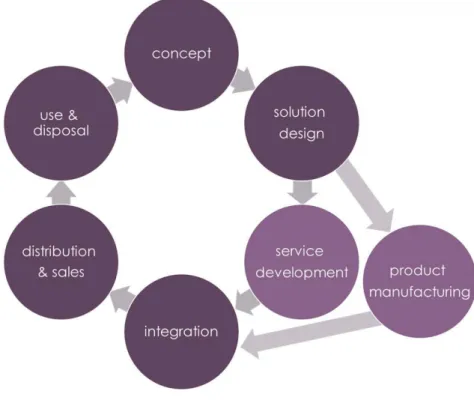
2.3 PSS Life Cycle . . . 6
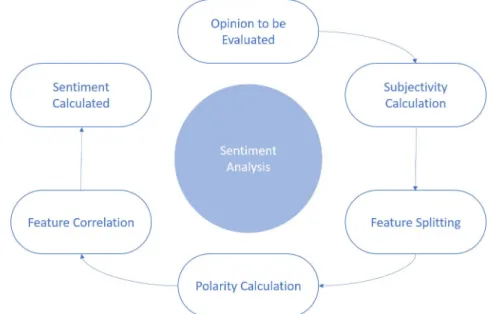
2.4 Example of a Sentiment Analysis Process . . . 8
2.5 Word Splitting on NLP Analysis - S: Sentence, NP: Noun Phrase, N: Noun, V: Verb, Q: Quantifier . . . 10
2.6 coreNLP Tokenization . . . 10
2.7 Extract from a 2005 Motorola Phone SPL [10] . . . 11
2.8 Scope of Visual Analytics . . . 12
2.9 The Visual Analytics Process . . . 13
3.1 Sentiment Analysis Conceptual Structure . . . 16
3.2 User feedback as driver to the extension of the PSS lifecycle . . . 17
3.3 Posts, Opinions, Reach and Influence . . . 18
3.4 Global Sentiment . . . 20
3.5 Global Sentiment Extrapolation . . . 20
3.6 Association of a Sentiment with existing Products and Services . . . 23
3.7 Example of rooted tree of Products . . . 24
4.1 Server Processing Architecture . . . 28
4.2 Database Architecture . . . 29 4.3 Author . . . 30 4.4 Opinion . . . 30 4.5 Opinion Modelling . . . 31 4.6 Opinion Monitoring . . . 31 4.7 Opinion Extraction . . . 32 4.8 Tutorial Notification . . . 33 4.9 Tutorial Example . . . 34
4.10 Sentiment Analysis Home Page . . . 34
4.11 Top 5 PSS Global Sentiment Chart Tooltip . . . 35
4.12 Opinion Modelling - Create Opinion Model . . . 35
4.13 Opinion Modelling - Sources and Accounts . . . 36
L i s t o f F i g u r e s
4.15 View Opinion Model . . . 37
4.16 Edit Opinion Model . . . 37
4.17 Opinion Extraction Page . . . 38
4.18 Opinion Extraction Page - Polarity Chart . . . 39
4.19 Opinion Extraction Page - Reach Chart . . . 39
4.20 Opinion Extraction Page - Sentiment Chart . . . 39
4.21 Opinion Extraction Page - Tag Cloud . . . 40
4.22 Opinion Extraction Page - Top 5 Opinions . . . 40
4.23 Opinion Extraction Page - Load Snapshot . . . 41
4.24 Opinion Extraction Page - Snapshot Example . . . 41
4.25 Opinion Extraction Page - Extrapolation Example . . . 42
4.26 Prediction Creation . . . 42
4.27 Prediction Results . . . 42
5.1 Sentiment Analysis Conceptual Architecture . . . 47
6.1 Product Tree Part 1 . . . 51
6.2 Product Tree Part 2 . . . 52
6.3 Product Tree Part 3 . . . 52
6.4 Services Tree . . . 52
6.5 My Motion Tennis PSS Sentiment . . . 53
6.6 My Style Boots PSS Sentiment . . . 53
6.7 My Brand Casual PSS Sentiment . . . 53
6.8 My Brand Casual Extraction Page . . . 54
6.9 My Brand Casual Extraction Page by Gender . . . 54
6.10 My Brand Casual Tag Cloud and Top 5 . . . 55
6.11 User Reply . . . 55
6.12 Prediction with a different Service . . . 55
6.13 Prediction of a New PSS . . . 56
L i s t o f Ta b l e s
3.1 Main concepts user in Sentiment Analysis . . . 17
5.1 APIs and Libraries used by Sentiment Analysis . . . 45
5.2 General Classes . . . 46 5.3 Extraction Classes . . . 47 5.4 Modelling Class . . . 47 5.5 Monitoring Classes . . . 48 5.6 Security Class . . . 48 5.7 Endpoints Classes . . . 48 5.8 Test Class . . . 48
5.9 APIs and Libraries used by SFE . . . 49
5.10 Amazon Classes . . . 49
5.11 Twitter Classes . . . 49
5.12 Facebook Classes . . . 49
Ac r o n y m s
CSM Cosine-Similarity Measure. LCA Lowest Common Ancestor. NLP Natural Language Processing. OSM Owned Social Media.
PDM Product Data Management. PSS Product-Service System. R&D Research and Development. SFE Social Feedback Extraction. SPL Software Product Line.
C
h
a
p
t
e
r
1
I n t r o d u c t i o n
This chapter contains the motivation that led to the work done, contribution to of the dissertation and an overview of the document structure.
1.1
Motivation
With every passing year, Internet is a bigger part of our lives. Almost everyone in Devel-oping and Developed countries has a social media footprint. Everyone has an opinion, a voice, thoughts that can be shared throughout continents fast and effortless with a click of a button. For companies the perception of their users is important, but filtering throughout everyone’s opinion takes time, and sometimes not all of them have the same importance.
Sentiment Analysis has been done by companies for years, trying to achieve better and more efficient products. Either by feedback forms, or in recent years by attending to costumer complaints and approvals on social media. The latest can take a lot of time given the number of costumers a company might have.
Each day more products are launched into the market, these were designed by com-panies trying to thrive in a consumer driven economy. At the same time costumers keep asking for newer products, services and combinations. Let’s take the example of phones, in the past 20 years costumers went from wanting a phone just for calls, to a mini portable computer that also receives calls. The key to success is to develop new and better products, this is what this tool is aimed at. This tool was also developed in partnership with the project Diversity, project funded by the European Union’s Horizon 2020 GA no:636692.
C H A P T E R 1 . I N T R O D U C T I O N
1.2
Contributions
Developing this tool might help companies reduce cost and improve on existing and future products. Designing an environment where multiple tools may be integrated, and companies can store knowledge for future use, helps companies design better and more successfully products for the costumer. By designing a tool capable of the previous statement, it is also expected that the market might take a better approach into Product-Service System creation.
1.3
Document Overview
The document starts with this chapter, where the motivation, as well as the contributions for the dissertation are presented. In the second chapter, the related state of the art is presented, giving an overview of network relations, sentiment extraction algorithms and PSS definition followed by the approach methodology on the third chapter. Server Archi-tecture is explained on chapter 3 where the deployment and operations of the platform are fully detailed. The Code Structure that allows this platform to analyze big amounts of data on chapter 5 and consequent results on the following chapter, being the document finished with the conclusions and future work in chapter 7.
C
h
a
p
t
e
r
2
S ta t e o f t h e A rt
In this chapter there will be provided current information about each part of the final solution, as how social networks are build and organized. What is a Product-Service Sys-tem, and when did the concept emerge. What is Sentiment Analysis, and why should the companies investigate this concept. Natural Language Processing and current solution. The benefits of analyzing products similarities. Finally, what is visual analytics and what should considered when using it.
2.1
Social Networks
Social Network Theory and Analysis, these are the area that study the currently emerging networks.
Network communication can be found all around us, human bodies have them [21], physics, politics, computer science, etc. Socially, in later years, networks have been developed using many important websites like Facebook, Twitter, Instagram. This has created a new opportunity for marketing and analysis. Since this work is mainly focused on feedback this research will focus more on that topic.
Before defining different network types, it is important to connect common definitions from social networks to common language.
• Nodes: In this case can be associated with Authors or Posts, may apply to a specific person or a post on social media depending if we are evaluating user network or posts networks
• Relations: This defines the tie between authors or posts. Ties where both nodes are related in the same way (e.g. Two different authors commented on same post) are called indirect.
C H A P T E R 2 . S TAT E O F T H E A R T
• Relationships: When relations are different on both ends, they are considered di-rected. These connections can be unilateral, when an author is replying to a post from a different author, or bilateral when multiple replies generate a conversation or debate.
• Weighted Relations: Not all ties are alike, some nodes may have stronger connec-tions while others might have a weaker bond between each other.
• Network: The collection of authors and ties. When multiple networks are created and overlapped it becomes one Multiplexed network. This evolved state is present in many social media, creating multiple and different relations between authors.
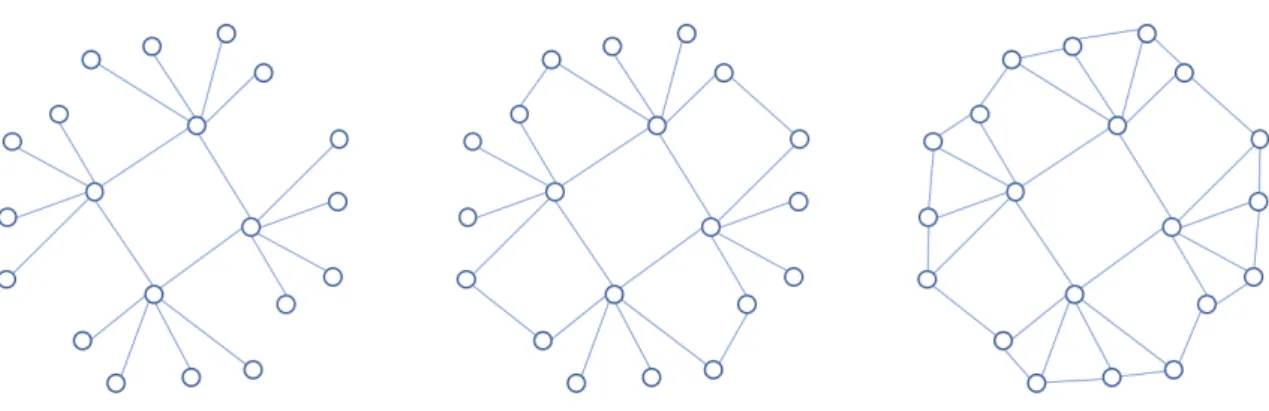
Figure 2.1: Network Types
Figure 2.1 shows some examples of network diagrams. Centralized networks are highly advantageous connection wise. Everyone can give information to each other within 2 steps but fail when the centralized node is offline for some reason, this stops the entire network.
Before internet, companies had to rely on centralized networks to gather feedback, some still do. By decentralizing, the number of nodes that fail when the upper node disappear is lower, although it still happens. The big advantage of this layout is that it can easily become a Distributed network. Outer and lower connection nodes can easily connect to each other and create redundancy [8].
Distributed networks occur when initially isolated nodes start to make connections with other nodes, something like in Facebook when a user starts adding friends-of-friends or following a page instead of waiting for a friend to share information from it figure 2.2. This means that everyone has the same, or close, importance in the network. A layout like this is extremely utopic when thinking about feedback analysis.
While everyone has their own valid opinion on a product, people like celebrities can spread their opinion faster than a kindergartner. Realistically, decentralized networks are the most common occurrence.
Social networks have changed the way of doing business [27]. Both on the competitive way, and how clients choose products based on the 4C’s model: Consumer wants and
2 . 2 . P R O D U C T- S E RV I C E S Y S T E M
Figure 2.2: Decentralized to Distributed
needs; Cost to satisfy; Convenience to buy and Communication [18]. In recent years multiple research has been done to assess how big data and social media are impacting success of businesses. By faster dissemination of experience and opinions. According to [28] these changes have even greater impact on the fashion industry. Usage of this plat-forms allows better communication to maintain favorable customer ratings, by providing a broader understanding of the market. By paying attention to factors like promotions, loyalty, service quality and brand loyalty, customers perceive their feedback is being heard, with this a company has a better chance to raise their consumer database.
While sales promotion has a good short-term impact on customer satisfaction [27], this kind of approach is not as impactful on social media when compared to direct contact with costumers, through support appreciation and complaints managements.
Social Networks influences consumers on multiple stages, some of them being, brand awareness, intent to purchase and satisfaction. Brand awareness is mostly about simple cues to costumers such as ads, while purchase intent is a more direct approach, the search of information regarding the product to best assess if it meets their expectations. Lastly customer satisfaction, elaboration of feedback to share opinions with other future costumers. Social media feedback can be divided into two types, OSM (Owned Social Media) and ESM (Earned Social Media). Specific pages or accounts created by companies are categorized as OSM while feedback any other place is called ESM. OSM is more relevant to the work to be developed [7].
2.2
Product-Service System
Is the 60’s a new idea surfaced, a change from product based to service-based businesses, allowing for industry improvements and for new jobs to be created. This paired with research stating that consumers see more value in products with better benefits led to a shift in mindset. Throughout the years both business operations evolved. Companies realized that merging them was the best way to satisfy customer needs. This generated a necessity for a new business concept, a Product Service System (PSS). This started with products and some services that fit together, until a carefully thought system that lets
C H A P T E R 2 . S TAT E O F T H E A R T
product and service necessities intertwine as if made specifically for each other [4].
Figure 2.3: PSS Life Cycle
A PSS has multiple life cycle stages, an overall overview can be seen on figure 2.3. Starting at the concept stage, companies elaborate the PSSs objectives and improvement to be successful. In this challenging stage, company needs to consider the interests of all stakeholders and the required mindset change. This is where knowledge about how others have fared is used to achieve better results sales-wise. After this fine-tuning and the design are completed, service and product manufacturing are developed in parallel to ensure that all objectives are met. Integration then guarantees that the product and services created are compatible before launching it to the market on the next stage. The final stage on a PSS life cycle is use & disposal, all the knowledge gathered from this last stage is then fed into the creation of future PSSs, making this a semi-closed cycle [23, 26].
In earlier developments of this concept, sustainability and environmental impact were the main goals of the required change. Since PSS relies on a well-defined feedback loop it is inheritable sustainable so, in later years, companies began shifting the focus onto customer satisfaction and economic benefits. One of key activities that PSS implementa-tion shines is control over the entire life cycle. By offering not only the product but also maintenance, installation, and dispose of product this concept shifts what were costumer responsibilities into the company [30]. This becomes particularly useful when seen from the costumer’s perspective by being relieved of these responsibilities, costumers have opportunity to create new value by better management of their resource utilization.
The process of adding values to product by adding services, creating a PSS, is called servitization. Throughout the years many companies found this approach to be successful.
2 . 3 . S E N T I M E N T A N A LY S I S
As early as the 60’s companies started developments in this new process. IBM and Cater-pillar realized that while their customers enjoyed their products, sometimes the required investment was too large for some smaller companies, so they started offering rental and leasing services. Xerox also discovered that by introducing a pay-per-user service, cus-tomers could keep track of costs and the quality of byproducts would be guaranteed, later Xerox bundled all services together into a yearly subscription, successfully transitioning from a sell focused company to a constant revenue. Michelin was also a pioneer on ser-vices by offering a pay-by-mile [17]. While most of the applications of servitization were successful there were some that failed, IBM was one of them, IBM survived by selling the product line to Lenovo and focusing on being a service-only company. Offering both systems on the same company environment, sometimes does not give the best results. So, most of these companies, in later years, split into two companies one for raw products business and another service-based.
The advantage of servitization is becoming more prominent with the rapid evolution of internet. With the digitization of information, Internet of Things (IoT) and Industry 4.0, companies can better track the movement of products and the utilization of services. In-formatization becomes important because it allows the enhancement of existing products or service-level agreements (SLAs) [12].
2.3
Sentiment Analysis
Sentiment Analysis, also known as Opinion Mining, refers to the use of computational algorithms to determine the attitude of the author of the statement. On cases likeThese sneakers are amazing the attitude is simple to infer, the real challenge starts when multiple figures of speech are in place, likeI bought these amazing sneakers and my feet feel like they are comfortably sitting under a boulder, in this case all adjectives are positive, but when the full sentence is read a negative reaction is discovered.
Sentiment Analysis can be split into different detection steps, basic evaluation by using adjective detection, objectiveness and feature.
While humans find it easy to infer double meaning in adjectives for machines the work becomes harder if only detecting adjectives is considered [25]. Natural Language Processing enhances the previous feature by evaluation the entire phrase, devising a Semantic Orientation Calculator to give scores to adjectives and then score them all together helps to better soften each adjectives weight in the final calculation [33].
Identifying the text opinion type (objective vs subjective) is also important [24], un-less clearly stated, determining this might prove a difficult task for machine learning. However, this might not be successful, given that the training is done by humans, and so subjectivity also plays a part in this definition [20].
Feature evaluation is another important step, companies more and more are develop-ing PSSs with multiple features. These features may have different impact on customer,
C H A P T E R 2 . S TAT E O F T H E A R T
Figure 2.4: Example of a Sentiment Analysis Process
which might only comment on specific features that left a very good, or very bad impres-sion [5, 13]. Furthermore, linking specific opinions to the correct feature or product gains importance when multiple instances of these are present on the same post, e.g. Sneakers are very comfortable, but they won’t keep the water out unless you use the WaterAway Spray, a little pricey but if you do then they are just perfect. The previous example refers to two dif-ferent products and gives two opposite opinions about each, and not in a clearly defined order, perfect is applied to both but only when used together. This concludes that for Sentiment Analysis to be successfully and relevant, relying simply on adjective polarity is not enough. A mix of all, as seen in figure 2.4, presents a more reliable method.
In practice detecting this kind of patterns becomes even harder on social networks, where more sporadic users rely on abbreviations to type faster, and typographic errors are also recurrent. However Social Networks public opinion sharing, almost always, are linked to a main post that, usually, are carefully written and that products are easily identifiable. One approach to circumvent the previous issue is assuming that all conver-sation under a certain post are talking about the same product. Doing this provides a simpler approach to feature detection [23]. Tags identification like Twitter #(Hash-tag) functionally, or Emoticons are other way to tackle this issue [16], while both methods have their own strength and might even complement each other, they are still far from the perfect method.
With the development and application of machine learning, Sentiment Analysis is abandoning the early stages and becoming a real future possible for companies to gather reliable information. It is expected that the traditional word-based evaluation will be replace by a more concept-centering aspect-level [31]. Some opinions rely on premises that are often not seen in word-based methods, e.g. These sneakers are extremely slippery in wet surfaces, slippery sole is easily identified as the feature talked about. However, its
2 . 4 . N AT U R A L L A N G UAG E P R O C E S S I N G
negative connotation is only applied because sneakers are supposed to be used in wet floors, if talking about how hard it is to walk with swim fins on sand a negative sentiment can be detected but swim fins are only supposed to be wore while swimming.
2.4
Natural Language Processing
Natural Language Processing (NLP) can be defined as a theoretically motivated range of computational techniques for analyzing and representing naturally occurring texts. These can be done at one or more levels of linguistic analysis for achieving human-like language processing for a range of tasks or applications [6]. The definition can the split into smaller definitions. Range of computational techniques since there are multiple methods, approaches to this analysis. Naturally occurring texts means that it is not language-bound the only requirements is that the analysis is done upon a language used by humans to communicate with each other. Levels of linguistic analysis since in most languages subtle changes in the way the phrase is constructed can give a different meaning to the words used, sarcasm for example. Human-like language processing infers that it can be considered an AI or Machine Learning derived technology, and since NLP is mostly used as a mean to a goal we reach the final definition for a range of tasks and applications.
The perfect NLP system must not only be able to process text but also infer meaning from it, translate it to another language and give its own reply about it. There is not a perfect way to successfully test a NLP system. One of the proposed test is the Turing Test, this test is considered successfully passed when a system cannot be distinguished from a human when answering from a terminal. This test has one flaw, the goal is well defined but intermediate evaluations are not possible [2]. The main barrier of successful NLP systems is the ambiguity found in all languages, these can be:
• Simple, a "mouse" can mean both the animal and the computer peripheral.
• Structural, "I saw him with glasses" it can both be interpreted as him having glasses on, or by the author only being able to see him by wearing glasses.
• Semantic, the word play is a good example of this, if asking both a DJ and a guitar player the same question "Play me some music" the outcome would be different. • Pragmatic, "Can you give me a ride?" Might be a yes/no question or a request for a
ride.
• Referential, "I saw Jack’s car being towed with a flat tire, ..." while the remainder of the sentence might clarify who had the flat tire, the flat tire might refer to Jack’s car or the tow truck
These ambiguities can also be considered as the linguistic levels identified earlier. Figure 2.5 shows one if the first steps of NLP, sentence splitting and tokenization. Sentence splitting is rather simple, e.g. "Mother died today. Or, maybe, yesterday; I
C H A P T E R 2 . S TAT E O F T H E A R T
Figure 2.5: Word Splitting on NLP Analysis - S: Sentence, NP: Noun Phrase, N: Noun, V: Verb, Q: Quantifier
can’t be sure" phrase becomes, "Mother", "died", "yesterday;", "I", "today.", "Or,", "can’t", "be", "maybe,", "sure.". Then tokenization process treats these all these single words into meaningful elements, this process, one the other hand, is quite complicated and many libraries and tools have already been developed, one of them coreNLP works in the following way [3].
Figure 2.6: coreNLP Tokenization
Punctuation marks are important to understand meaning so they become tokens by default,can’t is the equivalent of can not, so it’s also split. This specific library also tries to identify sentences. In this case the first 4 token were considered first sentence and the rest the second sentence. Different tokens might have the same meaning, i.e., gone or going can all be identified as the same lemma go, converting all word to singular form is also done in this step. In the next stage a parsing generates a tree to link token together and generate a tree like the one seen on figure 2.5
NLP can be applied on many scientific fields besides opinion mining, [9] found that applying this technology to electronic medical record could improve patient re-admission risk.
2.5
Product Similarities
On the topic of Sentiment Analysis, it is safe to assume that product similarity might prove useful when designing new PSS. As we see on smart phone topic it is expected that these have closer similarity, then comparing with an "old-school" phone. This calculation needs to consider multiple factors, for example target audience, components of product, utilization, features.
2 . 5 . P R O D U C T S I M I L A R I T I E S
Figure 2.7: Extract from a 2005 Motorola Phone SPL [10]
On figure 2.7 it is shown a breakdown of an old phone features. The process shown displays the possible of selecting features to find similarities and inferring products from features. Meaning that a company can pick a product and improve it with better features or pick features that might be relevant at the time and get an idea for a new PSS. This gives companies the power to target PSS development to what the target audience is expecting to receive, generating better revenue expectations and credibility.
Studies found that product similarity might not be equally effective on all market segments. When comparing two opposite quality brands it was found that on low end products product similarities matter little, while on the other hand when comparing two high end products similarities are largely considered by the costumer. Sustaining that on cheap products costumers look for saving while on high end more of a feature evaluation is considered [19]. Successful product similarity calculation can also be used for company similarity calculation, by comparing product diversity and similarity in software market, [11] found that companies could be classified as direct competitor when a specific threshold of product similarity was met. They also found that product and company similarity would suffer large changes after major demand shocks [11]. This reveals the importance of evaluating current similarity and the importance of R&D.
Regarding PSS, product and service similarity are equally important. Service reuse is difficult to achieve in an enterprise environment [1], not because it is not useful but because migration is inefficient. This leads to service duplication, so while the services are not the same, they remain very similar, evaluating this similarity is important to assure that the PSS is following the desired guidelines. The effect of exploitation on International Joint Ventures new product performance shifts from negative to positive as product similarity increases [14]. IJVs with local companies are important when a company tries to enter a new market on a new culture. The local company knows how the customers usually evaluate products, and what they are expecting. When this venture occurs, companies need to assess if they are not competing against the venture itself. To find this, product similarity evaluation is done on both companies, if the new products have high similarity with the ones currently on the market, exploitation is more effective while on lower similarity exploration is the best option. Given these facts of heterogenic and fragmented markets, the benefit of creating new product variants is to meet the
C H A P T E R 2 . S TAT E O F T H E A R T
requirements of individual customer groups as accurately as possible. The competence to offer customized solutions at a competitive price is therefore a key success factor for companies. [32]
Cost-wise development of entire new products creates a big investment strain on the company, that sometimes does not turn out as expected. Let’s give the example of Nokia phones, Nokia was once a big phone company, they kept investing on new, sturdier products. At some point in time the market changed, seeking lower lifespan products but with newer technology each time. Developing new product by recycling similar products enables to small investments throughout the development, and it allows for an easier focus change, depending on costumer reviews and market perception. Market is also volatile, what seems like a perfect deal today, might not be as good tomorrow. Developing services one by one while accessing their viability is the safest bet, especially for small companies.
2.6
Visual Analytics
Visual Analytics is the science of analytic reasoning supported by interactive visual inter-faces [34]. On today’s information driven society, it is not feasible for a person to analyze. Throughout the last decades, multiple automated tools were developed to help humans perceive of this data.
Due to the complexity required by some problems or systems, human interaction is al-ways required on the early stages of the analysis process. Therefore, Visual Analytics can combine the human mind advantages (creativity, flexibility and background knowledge) with current storage and processing power of machines, leading to a faster result calcula-tion of data. The human interaccalcula-tion is then limited to result analysis and interpretacalcula-tion, effectively reducing the impact of big data on the end user.
Figure 2.8: Scope of Visual Analytics 12
2 . 6 . V I S UA L A N A LY T I C S
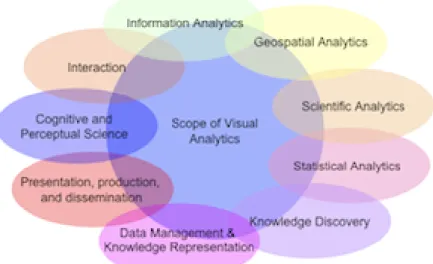
Visual Analytics overlaps with two others well know techniques (see figure 2.8), sci-entific and information analytics, there is no clear consensus on the boundaries of each field. While scientific visualization focuses on naturally structured data like MRI data or wind flows, information visualization if more often used to abstract data structures. Visual Analytics diverges from these two processes by focusing on coupling interactive visual representation with underlying analytic processes like data mining. This improves versus the other two field; Visual Analytics provides tool for more complex and high-level problems.
Visual Analytics improves human capabilities on six main areas [34]: • with the help of a visual resource it effectively expands human memory
• representation of large amounts of data in compact form, reduced search effort. • representing information depending on its relations makes for an easier pattern
recognition
• due to the large data capabilities allows for multiple event analysis at the same time • dynamic views provide 3D data analysis, opening many analysis perspectives when
compared to simple graphics
Figure 2.9: The Visual Analytics Process
The Visual Analytics process is depicted on figure 2.9. Although it is mostly cyclical, the first iteration requires a certain order. First stage is data transformation, Hetero-geneous data needs to be integrated, in a way that the result becomes a unified data structure that can later be processed. After transformation the analyst may pick two paths, visual analysis or automatic analysis, automatic analysis use data mining algo-rithms to create models. These models almost always require tweaking by the analyst.
C H A P T E R 2 . S TAT E O F T H E A R T
Alternating between automatic and visual analysis is what refines the models. Sometimes mistakes or misleading results might be found on this process. Finding these mistakes early on, helps developing sturdier and more confident models. If visual analysis is done first, then the analyst may steer model building to the information he is expecting to get from the process. The process final stage is getting knowledge from the gathered data and generating new data so that the model keeps getting more refined with each iteration. This knowledge is gathered from all processes, visualization, automatic analysis, previous models, etc.
The growing use of Visual Analysis tools in the design of complex systems, environ-mental informatics, and public policy, strengthens the case for exploring their use in Sustainable Lifecyle Designs [29]. These systems while helpful still have limitations, e.g. the data gathering process is mostly complex. The existing approaches for gathering and synthesizing information flows from lifecycles usually require adjustments, which leads to overhead work to implement this data.
2.7
Chapter Overview
This research led to better understanding how a social network can be mined for opinions. The importance of understanding relationships between users revealed how an approach to the current market could be improved. PSS life cycles itself, although well defined, do not have clear feedback loops which can also be improved. Sentiment Analysis proved to be a good approach to the identified issues on PSS life cycles using social networks feedback. NLP solutions allow the conversion of text inputs to sentiment values needed for analysis. Visual Analytics supports the creation feedback loops to improve model visualization. Although not directly related to the previous defined problem, product similarities allow for product comparison and possibly extrapolation of results.
C
h
a
p
t
e
r
3
C o n c e p t
On this chapter it is presented an overview of the development objectives and how the tool is going to tackle issues like, author influence, product similarity, among others.
3.1
Introduction to Sentiment Analysis
Sentiment analysis is used to acquire feedback from end-users and stakeholders across the life-cycle of the PSS. This feedback allows to better monitor and understand the general sentiment from users towards a PSS. PSSs containing just one Product are also permitted, even though it is not a PSS by definition and are currently rare in the market. Three focus groups were identified to achieve the functionalities that constitute Sentiment Analysis: opinion modelling, opinion extraction and opinion prediction. Further analysis of these modules derived into four functional groups:
• opinion modelling where users define which PSS to monitor for sentiment and where to look for them;
• opinion monitoring which regularly scans for new posts and processes them; • opinion extraction where user get the result from the processed opinions; and • opinion prediction where user can infer the evolution of sentiment for a specific
PSS by using data from similar PSSs and their opinion history
When a designer wants to get a better understanding of customer feedback and sen-timent towards a specific PSS, the designer defines the model that will guide the rest of the process (Define step on figure 3.1). Sentiment analysis requests inputs from Social Feedback Extraction to gather relevant data that will later be presented to the designer,
C H A P T E R 3 . C O N C E P T
Figure 3.1: Sentiment Analysis Conceptual Structure
this information may come from Facebook, Twitter or Amazon. The information shown to the designer considers all calculation done in reach and influence, and other important information (View step on figure 3.1). In the end the designer might want to take advan-tage of lessons learned from this PSS to improve it or design a new one (Prediction step on figure 3.1).
3.2
Strategy
3.2.1 Sentiment Analysis
Sentiment Analysis evaluates opinions, sentiments and attitudes towards multiple topics based on textual input. While the main goal is to identify the polarity towards the main object of the opinion, this discipline has the potential of tapping into the large pool of opinions that are social networks. For companies that successfully harness this potential it might provide cutting edge advantages against their competitors.
When considering PSS, and the possibility of extending operational life-cycles, the importance of opinions gains strength. It enables the possibility of driving the industry into new requirements and improvement that may develop new services and function-alities. Seen in figure 3.2 sentiment analysis can also be classified as the vehicle for communication between users and companies.
With the emerging of social network and the ability of users to share their opinion with the entire world with a simple click, users now have a stronger voice to influence companies and products. This also means that companies also have an easier access to what the users really want and need.
3 . 2 . S T R AT E G Y
Figure 3.2: User feedback as driver to the extension of the PSS lifecycle
3.2.2 How is Sentiment Analysis obtained?
Sentiment Analysis is based on opinions and posts. Users write posts about products and services. Other users then react to these posts, either by appreciating, depreciating or simply replying to it, creating conversations and discussions. These discussions reflect individual opinions and can either be aggregated by opinions for each post, or an overall opinion.
Table 3.1: Main concepts user in Sentiment Analysis
Term Description
Post Content published by a user on a social network, pro-viding a sentiment on a specific subject.
Original Post Post that originates a thread or conversation regard-ing a subject.
Comment Response to an original post.
Source Social network or communication medium where the post was created.
Opinion Intrinsic sentiment related to an object. This may be a conversation or a single post.
Polarity Value representing the degree of satisfaction or posi-tivity or negaposi-tivity of sentiment regarding the subject of the opinion. This value ranges from 100, very posi-tive to 0, very negaposi-tive.
Reach Level of propagation of an opinion measured in terms of view, likes and comments to the post.
Influence Effect of an author in other users calculated by the history of the conversations where this author partic-ipated, measured in terms of views, likes and com-ments to these past conversations.
Global Sentiment Sentiment emerging from existing opinions within a time interval and indicating a polarity towards the subject of sentiment.
Strength Number of posts created about the subject over a time interval.
Intensity Number of posts per user about the subject over a time interval.
C H A P T E R 3 . C O N C E P T
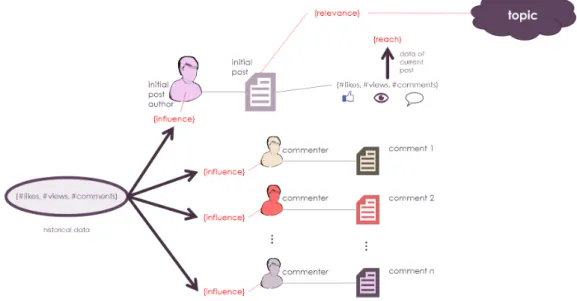
The process of Sentiment Analysis is based on posts that trigger conversations or discussions. An author creates an initial post about a topic and the audience eventually reads, likes and comments on it. The influence of an author depends on the audience the author has: this is measured not only by the number of people who read the post, but by their engagement in the conversation and by their own influence over their audiences. The audience of an individual message defines its reach, while the reach of past messages sets the influence of the author. Figure 3.3 depicts these concepts graphically.
Figure 3.3: Posts, Opinions, Reach and Influence
3.2.3 Obtaining Sentiment values
Since the dimension of social networks does not allow for an open search for a subject, the user has the responsibility of identifying the relevant sources to monitor. The desired sampling frequency is also necessary, this allows for the system to manage the number of times needed to pool the sources for new posts. Finally, the search can also be limited to a specific sub-set of posts (e.g. only posts about materials, only posts provided by people over 60) to discard any information identifieda priori as not relevant.
3.2.4 Polarity
Extracting Polarity from text is a complex field in computer science, the nuances of human speech, with the use of contrary modifiers like irony, present a challenge for computer understanding. Nevertheless, after testing and analysis of available tools the IBM Watson Natural Language Understanding was deemed the most effective with above 70% of correct assessment when compared to a human evaluation [15]. Watson NLU returns polarity values on the same range as mentioned earlier. This functionality is implemented by Social Feedback Extraction described on section 3.3.
3 . 2 . S T R AT E G Y
3.2.5 Calculating Reach and Influence
Not all opinions impact networks in the same way, especially with Social Networks. The amount of connections we have (friends, pages, games) impact how much people see our opinions. Outside the Internet, sharing an opinion is restricted to our immediate surroundings, even if the people we contact directly share it after some iterations the original author will no longer be known. On the Internet a single opinion might be read by a user on the other side of the world and credited to original author within few seconds.
The electronic word-of-mouth is critical for the success or failure of a PSS and depends on the reach of the message. As seen recently some TV Shows that were canceled were rebooted after the audience conveyed to the internet to ask for a continuation. Therefore, a message that has a wider audience has a bigger impact than one that is only able to reach a small amount of people. Although a bigger audience provides a more impactful opinion, it is not linear, diminishing returns are in effect when the connections to the original author is no longer direct but through a mutual connection. People are more likely to relate to people with the same opinion, or similar interests. This results in the inner circle of connections to be more affected then outer circles.
Conflicting opinions are found throughout all topics in social networks. Relation-ships between these opinions are even more complicated since they are multilateral. The influence of authors becomes a key factor. When two opinions compete in the same cir-cles, influence is crucial, both because typically authors with more influence are opinion leaders and because their opinions propagate indirectly more easily.
The influence of an author is determined by the reach of past posts. An author who usually reaches wider audience is usually one with a bigger influence.
Equation 3.1 is used to calculate the reach of a post:
reach(posti) = ωc. #comments(posti) φcommentsglobal + ωl.#likes(posti) φlikesglobal + ωv.#views(posti) φviewsglobal (3.1)
where φcommentsglobal means the average number of comments per post, globally,
within the universe of data present for that specific platform, posts on Facebook tend to have more interaction then on twitter.
Influence is calculated by the average comments, likes and views to an author’s post. As with reach equation 3.2 is used:
inf luence(authorj) = ωc.#comments(authorj) φcommentsglobal + ωl.#likes(authorj) φlikesglobal + ωv.#views(authorj) φviewsglobal (3.2) On both equations the variables ωc, ωl and ωv are weight variables to be set by the
C H A P T E R 3 . C O N C E P T
3.2.6 Global Sentiment
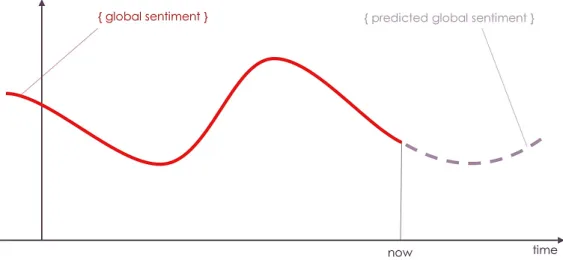
Global Sentiment shows variations of the overall sentiment over time towards a specific PSS as seen on figure 3.4. Its polarity is calculated by averaging the individual opinions of each interval, weighted by their respective reach.
Global Sentiment allows for designers to understand the acceptance variations to-wards a PSS or the goods it produces and identify possible future improvements.
Figure 3.4: Global Sentiment
3.2.7 Prediction
The main goal of predicting the global sentiment towards a PSS is to anticipate situation that require some type of strategy change by the company, specially targeted at the design team, see figure 3.5. Prediction can be calculated from a current trend analysis or by using analysis on previous company PSS and the sentiment that was calculated for them.
Figure 3.5: Global Sentiment Extrapolation
3 . 2 . S T R AT E G Y
3.2.7.1 Extrapolation
The simplest approach to prediction is based on the extrapolation of current time series to the near future. This relies on the usual projection techniques, e.g. least squares, where the user has the possibility of selecting the size of the estimation window and prediction horizon. The estimation window is the data set used to estimate the model parameters. In the case of the existence of cyclic patterns, a comprehensive model consolidates the information from previous cycles. For instance, it is possible that positive opinions on a seasonal PSS (e.g. boat rental) are more frequent in one specific season. As the length of the dataset increases, the prediction module identifies the existence of such patterns, using standard correlation techniques, and derive the extrapolation model accordingly. The variance of the estimation allows the computation of the confidence level. The extrapolation is based on models and fitting methods. Models relate an independent variable (the one we want to estimate) with one or several dependent variables. There are various models described in detail in numerous papers in the literature. Common models include: polynomials, exponential, Fourier series, Gaussian, power, sum of sines, etc. Fitting models define the parameters of the models, i.e. they fit the data to a model. The Opinion Prediction component will implement estimation of polynomial models to support the extrapolation, given by equation 3.3.
y =
n+1
X
i=1
pixn − i + 1 (3.3)
wheren is the order of the model, y is the output and x is the independent variable (time). Polynomials are often USED for this task for their simplicity, and ease of characterizing data using a global fit. One of the main advantages of a polynomial approach relies on the flexibility, for not highly complicated data, and due to their linearity, the fitting process is rather simple. The disadvantage is that higher orders tend to be unstable and with many oscillations, when the requirement for such oscillation is not necessary this effect is more present and while inside the data range the result might provide a good fit, it can diverge drastically outside it.
In this approach the need for an order above 3 is deemed necessary. This allows for linear results and seasonal concavities.
The third-degree polynomial as the structure of equation 3.4
y = p1x3+ p2x2+ p3x + p4 (3.4)
Fitting methods determine the coefficients that a parametric model uses to relate the response data to the predictor data. The 3rd order model has four coefficients, pi.
The result of the fitting process is an estimate of the model coefficients, ˆpi. To obtain the coefficient estimates, the least-squares method minimizes the summed square of residuals. The residual for the ith data point ri is defined as the difference between the observed
C H A P T E R 3 . C O N C E P T
response value yiand the fitted response value ˆyi, and is identified as the error associated
with the data as seen in equation 3.5
ri= yi−yˆi (3.5)
The summed square of residuals is given by
S = m X i=1 ri2= n X i=1 (yi−yˆi)2 (3.6)
Being m the amount of data points and S the sum of square error estimate. The extrapolation process follows the following step:
1. Opinion extraction sends the current data-set to be extrapolated
2. Using standard (3rd order) polynomial fit (equation 3.4, the data-set is modelled for the current time span
3. The predicted values are computed from the model obtained in 2, to a prediction horizon of 1/3 of the current data-set time span
4. The results are sent back to the opinion extraction processing for displaying together with the confidence levels
3.2.7.2 Sentiment Prediction
The second prediction option relies on the use of past knowledge to derive the expected acceptance of the market toward new combinations of products and service in a PSS. Taking this approach need to take into consideration critical thinking, using information from past posts about certain PSSs to estimate the feedback of a new PSS. The accuracy of this method will mostly rely on the similarity against already mapped and processed PSS, even if only an update is being done. The development of a PSS can range from a minor modification, to the creation of an entire new PSS. The tool should cover these and all situation in between.
The algorithms used for this calculation are of the utmost importance, verifying if enough data exists for an estimation should also be detected by the tool. A minimum input size should be present allowing for statistical treatment of data. Even when this minimum is met, the tool should provide an indicator accessing the level of confidence of the prediction of the PSS provided. Thus, the basic assumption for the Opinion Pre-diction approach is that the necessary data is available in the repositories to compute the predicted sentiment. Then, the computation of the confidence level will tell us if the prediction is of any value to the user, and in what extent.
As the repository of data grows, the sentiment towards existing PSSs is accumulated, the opinion prediction module creates a correlation between each product version and the observed sentiments, figure 3.6. The same is applied for service versions.
3 . 2 . S T R AT E G Y
Figure 3.6: Association of a Sentiment with existing Products and Services
When a new PSS design is considered, the module needs to access if it derives or not from a combination of existing products and services, the module then estimates the sentiment prediction from a combination of the past sentiment towards each of contained elements. On the other end if the services and products are new, the system then identifies similarity between the characteristics of these new elements and previously existing ones. The module computes the confidence level of the prediction the degree of similarity with the selected existing elements.
3.2.7.3 Similarity in hierarchical models
Cosine-Similarity Measure (CSM), usually used to define vector similarity based on the an-gle between them, has also been proven very popular for query-document and document-document similarity in text retrieval. This notion can be generalized to compare generic objects treated as vectors in an n-dimensional space, where n is the cardinality of the element domain. The cosine of the angle between two objects is then used as a measure of their similarity.
If these object models are enhanced with the addition of hierarchic relationships, an improved measure of similarity is inferred from common characteristics between objects.
Let U be a rooted tree, with all nodes carrying a distinct label. We do not impose any restrictions on the shape of U . Each node can have arbitrary fan-out, and the leaves of U can be at different levels.
Conventionally, the depth of a node is the number of edges between the root of U and that specific node. Considered any two leaves l1and l2 in U , the Lowest Common
C H A P T E R 3 . C O N C E P T
Figure 3.7: Example of rooted tree of Products
This LCA is always defined since the worst-case scenario occurs where the only common ancestor is the root node, and only one common ancestor can have the same depth. As seen on figure 3.7 LCA(r1, r2) = running, and LCA(c1, m1) = boots.
Identically to the standard Vector-Space Model’s on the matter of weights usage. For any two elements l1and l2the definition is as follows:
Sim(l1, l2) = ~l1.~l2=
2.depth{LCAU(l1, l2)}
depth(l1) + depth(l2) (3.7) This definition is consistent with the previous analysis, since the right side of this equation always lies between 1 and 0. Achieve 1 when, and only when, l1= l2, and 0
when the root is the LCA.
The Sentiment Prediction process follows the following steps:
1. Opinion prediction user interface sends the information about the specific prod-uct(s) and service(s) being selected to compose a new PSS.
2. Opinion prediction navigates through the trees of products and services and select all products and services with a degree of similarity above a threshold specified by the designer e.g. 75%.
3. Opinion prediction requests all opinion models (which includes the sentiment) of all PSS that include either similar product(s) or similar service(s).
4. Opinion prediction computes the statistical distribution of the sentiments for each product and service, weighted by the degree of similarity.
5. Opinion prediction computes the predicted sentiment by averaging the global sen-timent of all similar products and services. The predicted sensen-timent of the PSS is the average of these two results.
3 . 3 . S O C I A L F E E D BAC K E X T R AC T I O N
6. Predicted sentiment and the statistical distributions are sent to the opinion predic-tion user interface.
3.3
Social Feedback Extraction
This tool was designed by another partner in the consortium, it was adapted to serve the purpose required to test the work done in this dissertation.
Social Feedback Extraction (SFE) serves only two purposes:
• To search social media platforms (e.g. Twitter, Facebook) and retrieve at regular intervals posts from accounts being monitored by the opinion monitoring module. Posts in the current context represent not only textual data but also the relevant metadata, like account name, sex, location of author and likes and other reactions. • Provide an interface to external services that evaluate sentiment based on the textual
analysis.
These two purposes are rather simple, these functionalities were not included on the main system since the project developed defined this module as an external component. This tool is not the focus of this dissertation and for this reason is only mentioned for validation purposes.
C
h
a
p
t
e
r
4
S y s t e m A r c h i t e c t u r e
On this chapter is explained the overview of the system. What was built, how the dif-ferent modules interact with each other, and how the tool was designed to give the user meaningful information.
4.1
Introduction
Modern enterprises, acting at the global market, need powerful engineering environments to allow for multi-directional exchange of knowledge between product design, service de-sign and manufacturing as well as customers and suppliers. The exchange of knowledge must be assured along the entire life cycle of the product-service systems.
To support dynamic building of PSS, there is a need for collaboration among various actors across the value chain. This requires dynamic feedback loops exchanging knowl-edge between the design, manufacturing and product-service use phases. It is particularly important to analyze the combined feedback from the users of the product-services, both business customers and final consumers, to create or update the product-services.
The classical product engineering and PDM systems do neither meet the requirements concerning the effective support of concurrent PSS design, nor facilitate acquisition and re-use of tacit knowledge. Industrial companies need high flexibility from tools to allow capturing dynamically changing requirements and experience of various actors. On top of that, they need solutions to support knowledge sharing across the entire life-cycle and among various actors involved in dynamically changing value chains.
Cloud technologies, as emerging service-oriented knowledge-based systems, provide new possibilities for collaborative design of PSS within such distributed enterprise. These are adaptable to highly dynamic conditions under which enterprises are developing and manufacturing their product-services.
C H A P T E R 4 . S Y S T E M A R C H I T E C T U R E
Therefore, this system relies on a combination of cloud technologies and social soft-ware solutions to meet the requirements of distributed manufacturing enterprises allow-ing for effective PSS engineerallow-ing utilizallow-ing manufacturallow-ing intelligence and experience of all actors in the value chain, including both business customers and consumers. On top of that, the large amount of knowledge to be gathered and shared under dynamically changing conditions, and diffused to a wide spectrum of actors involved, having different expertise and working conditions/cultures, asks for effective context sensitive solutions for knowledge capturing, analysis and diffusion. The tiers that compose this software are:
• The presentation tier is the focal point for interaction with the user and explained on section 4.4
• A local dedicated database shared by all modules reside in the data tier. This tier is analyzed later, on chapter 4.2
• The application tier is composed of the processing layer and the data and integra-tion layer. The first processes interacintegra-tions with the user and manages the funcintegra-tion- function-ality needed for that. It handles communications with internal modules and with the data tier for manipulating the data that supports the processing layer. This later is analyzed on section 4.3
Figure 4.1: Server Processing Architecture
4 . 2 . DATA T I E R
4.2
Data Tier
MySQL is an open-source relational database management system and was the tool cho-sen for the job of designing a database to hold the amount of data generated figure 4.2.
Figure 4.2: Database Architecture
Starting at the source table, this table is used to keep track of which sources and accounts are being tracked, it also gives an option to assign a PSS instead of letting the software discover it automatically. Since recalculating the entire results from a source would be a waste of resources a last updated column keeps track of this info, so only new information is requested.
A social media user is called an author, it is identified by its unique id and the name of the platform itself. This way it is possible to distinguish users with the same name in different platforms. The fields influence, comments, likes, views and posts are calculated fields populated by the Data Processing Module. These keep information about the user impact on the social media.
Since it is expected that all replies remain on the topic of the original post, the set of original post and replies is defined as an Opinion. An Opinion can be identified with its own unique id, paired with social media source and the id of the author. The account field refers to the page or tag used in the social media chosen.
The posts table represent raw data received from the social network, apart from po-larity that is calculated based on the message using a Watson NLU.
Snapshots, Models and Tag Cloud are table more oriented for extraction and will be further analyzed on following chapters.
C H A P T E R 4 . S Y S T E M A R C H I T E C T U R E
Figure 4.3: Author
Figure 4.4: Opinion
4.3
Application Tier
Application Tier is composed of two modules available to the user and one for internal data calculations.
• Opinion Modelling: module where users define the targeted PSS and the sources to be used for acquiring posts and calculating opinions
• Opinion Extraction: module where users visualize the results of sentiment analysis for the existing data
• Opinion Monitoring: internal module responsible for managing opinion models, fetching information from social networks and calculating opinion values
4 . 3 . A P P L I C AT I O N T I E R
4.3.1 Opinion Modelling
Opinion Modelling is the process of defining search and visualization parameters. A Model contains information of what product is being monitored, from what sources and accounts see figure 4.2. One model may have more than one source and account, effectively allowing for one model for an entire product, and multiple models source specific without extra strain for the opinion monitoring module. A Model important option is source and account combination , at least one combination must be present otherwise there would be no information to fetch. Other options are the PSS that the model is analyzing, if it generates a final product, and data granularity. Granularity being a visual aspect, sometimes seeing values per week might be more interesting than seeing them per day. By default, the model start monitoring from the date of creation, option for a custom date exists and changes the first data point that the model will have on extraction.
Figure 4.5: Opinion Modelling
When a designer creates a new model or adds new sources to old models, this module checks if that specific combination already exists in the database. When a new combi-nation is entered, this module requests opinions monitoring to start fetching data from those sources. Date entered is important, this allows opinion monitoring to filter fetch data after the date defined.
4.3.2 Opinion Monitoring
C H A P T E R 4 . S Y S T E M A R C H I T E C T U R E
Once an opinion model is saved, opinion monitoring starts pooling for new posts at the defined frequency and processes opinions and sentiment. This is done at specific time of the day defined at server start, as to not overload the server at normal run-time. Monitoring starts by organizing what information it is going to fetched. Checking which source/account pair is required to be fetched, since some models might share these com-binations.
When these combinations are all ordered by social network, the monitoring model starts requesting data, data requests are done one social network at a time, but a thread pool assures that multiple accounts are queried at the same time.
As soon as the first new entry appears in the database another process starts. This process requests polarity calculations from Watson, this is also the longest process of the opinion monitoring, usually keeping the calculation from finishing, while all non-sentiment dependent calculations are done at the same time. Values like global opinion sentiment wait for this process to finish before being calculated. This module is also responsible for keeping track of the last time each source was pooled to keep the duplicate information fetched to a minimum.
4.3.3 Opinion Extraction
Whenever the designer wants to view results, the designer selects the corresponding model. Opinion extraction then provides the results, including number of opinions, distribution of polarity, sentiment, reach of opinions (i.e. their potential audience) over time, and variation of sentiment over time. A Tag Cloud and the most relevant posts for that model are also provided.
Figure 4.7: Opinion Extraction
These graphs shown by the opinion extraction, have the option to segment data, three options are available, gender, age and location. By using this option, instead of one line in the charts, there will be one for each option on the specific filter, by age (<30, 30-60, >60), location (East, West), and gender (Male, Female). Filtering out the results is also possible, by picking only one of each option, or even any combination of filter and segmentation.
A Tag Cloud containing the model most common words seen in posts is also presented, and allows filtering based on the presence of this word on opinions. If the designer sees a recurring word that is particularly negative for the PSS, the designer might choose to restrict showing only discussions where that word was used. The designer at any point
![Figure 2.7: Extract from a 2005 Motorola Phone SPL [10]](https://thumb-eu.123doks.com/thumbv2/123dok_br/15743129.1072782/31.892.130.717.156.311/figure-extract-motorola-phone-spl.webp)