C
OMPREHENDINGTHE TOPIC OFAPARAGRAPH:
A
FUNCTIONALIMAGINGSTUDYOFACOMPLEXLANGUAGEPROCESS(Compreendendo o tópico de um parágrafo: Um estudo de neuroimagem funcional sobre um processo lingüístico complexo)
Lêda Maria Braga TOMITCH
(Universidade Federal de Santa Catarina)
Sharlene D. NEWMAN
(Indiana University-EUA)
Patricia A. CARPENTER and Marcel Adam JUST
(Carnegie Mellon University-EUA)
ABSTRACT: This study uses fMRI (functional magnetic resonance imaging) to investigate the brain activity in a set of cortical areas in the task of main idea identification, when the topic sentence was presented in first versus in last position in a three-sentence paragraph. The participants were eight right-handed undergraduate students from Carnegie Mellon University, six male and 2 female, all native speakers of English. Each participant read twelve paragraphs, six in which the topic sentence was paragraph initial and six in which it was paragraph final, and each paragraph was presented word by word in the center of a screen, inside the scanner. The major finding of the current study is the differential response observed in the left and right hemispheres as to the location of the topic sentence within the paragraph. The left temporal region showed greater activation when the topic sentence was in final position than in initial position. The right temporal region, on the other hand, was affected only by sentence type, showing a greater response to topic sentences than support sentences, regardless of their location within the paragraph. KEY-WORDS: FMRI; Main idea identification; Discourse processing.
RESUMO: Este estudo utiliza a ressonância magnética funcional para investigar a atividade cerebral em áreas corticais durante a execução da tarefa de extração de idéias principais, quando a idéia principal é apresentada no início ou ao final de um parágrafo com três orações. Os participantes da pesquisa foram oito alunos de graduação da Universidade de Carnegie Mellon, todos destros, falantes nativos do inglês. Cada participante leu doze parágrafos, seis com a idéia principal no início e seis com a idéia principal no final do parágrafo, e cada parágrafo foi apresentado palavra por palavra,
no centro de uma tela, dentro do aparelho de ressonância magnética. O maior achado do presente estudo refere-se à resposta diferenciada observada nos hemisférios direito e esquerdo. A região temporal esquerda mostrou maior atividade cerebral quando a idéia principal era apresentada em posição final do que em posição inicial. A região temporal direita, por sua vez, só foi afetada pelo tipo de oração, mostrando uma maior atividade durante o processamento da idéia principal do que das idéias secundárias, independente da sua posição no parágrafo, inicial ou final.
PALAVRAS-CHAVE: Ressonância magnética funcional; Identificação de idéias principais; Processamento textual.
1. Introduction
Main idea identification is at the very heart of human thinking, being a skill required in everyday situations such as reading a message, interpreting an interlocutor’s utterance, listening to the news and attending a lecture. It is part of human nature to try to integrate incoming information or build a macrostructure containing the main points of the input, so that this information can be more easily stored in memory, related to other knowledge, and retrieved when needed (Kintsch & van Dijk 1978; van Dijk & Kintsch 1983). Despite its importance in human interaction, the process of main idea identification is little understood. Here, a text comprehension task is used to explore the process of identifying the main idea, or topic of a text.
et al 1993; Nichelli et al 1995; Dehaene et al 1997; St George et al. 1999; Robertson et al 2000; Mason & Just 2004; Tomitch, Newman & Just 2004). Lesion studies, however, have provided some insight into the underlying neural architecture that supports discourse comprehension. It has been found that patients with right hemisphere damage often experience difficulties at the discourse level even though their ability to comprehend at the word and sentence level are intact. For example, right hemisphere patients often have problems maintaining the theme of discourse (Brownell & Martino 1998), suggesting that the right hemisphere is responsible for main idea identification and maintenance.
The current study examines main idea identification by examining the effect of the position of the topic sentence in three-sentence paragraphs. There were two conditions that differed in the position of the main idea/ topic sentence in the paragraph: in first position – topic first and in last position– topic last. The topic sentence contained a superordinate theme that unified the concepts in the other sentences. The placement of the topic sentence dramatically affects how the coherence of the discourse is established and therefore, the ease at which the text is comprehended. The experimental design was intended to contrast the processes of integrating text details into a previously established theme, versus first storing details or dynamically integrating them prior to reading the statement of the topic, and then relating them to the topic.
constructing an organizing structure or schema for the text. Once the foundation has been built, the structure is then elaborated by mapping incoming information to the schema and shifting to develop new substructures when needed. SBF can be used to make several predictions regarding the results of the current study. SBF states that attempts to lay the foundation begin with the first phrase of the first sentence, regardless of the content of that phrase. Therefore, SBF would predict that the initiation of this content-free foundation formation process has no preference as to which sentence type comes first, either topic or support sentence. Also, according to SBF, in the topic last condition the topic of the text is available after the initiation of foundation formation. Therefore, a second prediction is that more substructures may be expected to be generated during the topic last condition compared to the topic first condition which indicates more “shifting” processing. This suggests that the increase in shifting is expected to result in a higher level of activation for the topic sentence when it is in the final position compared to when it is located in the initial position. This also suggests that the text representation generated when the topic is last is more complex and may be more memory intensive.
SBF is a psychological model of discourse processing and therefore, does not address the neural basis of text comprehension. One neural-based hypothesis concerning comprehension that does relate to discourse processing is the coarse coding hypothesis proposed by Beeman (1993; 1998; Beeman et al 1994). The coarse coding hypothesis proposes that the two hemispheres differ in the comprehensiveness of the representations they activate. According to this hypothesis, the left hemisphere uses fine (precise) semantic coding to selectively activate a small number of relevant meanings or features when processing language. The right hemisphere, on the other hand, is proposed to use a coarse semantic coding scheme in which it weakly activates a broad spectrum of related meanings and features, inducing diffusely activated semantic fields distributed over many representations. This type of coding scheme is thought to support inference generation, which is often necessary to connect events within a passage.
2. Method
Participants. The participants were eight right-handed undergraduate students from Carnegie Mellon University, six male and 2 female, all native speakers of English. All participants gave written, informed consent according to guidelines approved by the University of Pittsburgh and the Carnegie Mellon Institutional Review Boards. Participants were paid for their participation.
Materials. The experimental stimuli consisted of paragraphs adapted from naturally occurring expository texts. Each paragraph was rewritten in a way that it represented a complete text on its own, “a coherent piece of writing exhibiting both structure and texture…” (Davies 1995: 94). All sentences in each paragraph were equated for approximately the same number of words, ranging from 19 to 21, and also equated for number of characters, ranging from 110 to 130.
The main idea of each paragraph was identified on the basis of Cunningham and Moore’s (1986) definition of a main idea pertaining to the thesis sentence: “The single sentence in a paragraph or passage which tells most completely what the paragraph or passage as a whole states or is about” (p.7). The two supporting sentences in each paragraph presented details and information which illustrated, exemplified or gave support to the main point.
Now the rest of the world is discovering the power of olive oil, the most versatile fruit juice ever squeezed. (Topic Sentence)
Cosmetics are based on it, diamonds polished with it, and you can also burn it, and lubricate squeaky hinges with it. (First Support Sentence)
It is loaded with vitamin E, it has no cholesterol, and people who eat it have the lowest rate of heart disease. (Second Support Sentence)
Olive oil can be used for many different purposes such as polishing diamonds and preventing heart disease. True or false? (Probe)
Table 1: Sample paragraph.
Procedure. Participants were randomly assigned to the two versions of the experiment. No participant read the same paragraph more than once. Order of presentation of the paragraphs was randomized to minimize practice effects.
After reading each paragraph, participants answered true or false to whether a probe statement represented the main point in the paragraph. The probe questions contained details from each of the three sentences of the paragraph in order to encourage participants to generate a complete text representation. A probe deadline procedure was used and, on the basis of the results in a behavioral pilot study, participants had a maximum of 7 seconds to respond to the probe, after which it disappeared from the screen.
Each participant read twelve paragraphs, six in which the topic sentence was paragraph initial and six in which it was paragraph final. Although the number of trials per condition was not large, it was found to yield significant activation within the regions of interest. However, the number of trials may have caused “real” activation to not be detected due to low signal to noise. Because the goal of the study was to determine if there are processing differences related to the location of the topic sentence within temporal cortex, the current design was thought to be sufficient as a baseline experiment with future studies being planned based upon the current findings.
Four 24 second fixation periods (again, an “X” centered on the screen) were placed at the beginning, end, and at the two trisection points of the study, to obtain a baseline measure of activation.
Data Acquisition. Functional data were acquired in seven contiguous oblique axial slices situated in order to maximize coverage of the language processing regions (primarily Broca’s and Wernicke’s areas). The scanning was conducted on a 1.5T General Electric Signa scanner, with a TR=1500 ms, TE=50 ms, flip angle=90o, FOV=40x20 cm, matrix size=128x64
voxels, and 1 mm gap, resulting in a voxel size of 3.125 x 3.125 x 5 mm. The slice prescription was set so that the posterior, superior temporal cortex and the inferior frontal gyrus (primarily the superior portion) were adequately covered. Scanning was synchronized with stimulus presentation, the acquisition of the first slice occurring at the onset of each sentence presentation.
TE=4 ms, flip angle=40o, and FOV=24 cm. Functional maps were co-registered with the corresponding structural images.
Anatomical Regions of Interest (ROI). To compare the amount of activation in a given area between the two experimental conditions, anatomically-defined ROIs were drawn for each participant using the parcellation scheme described by Rademacher, Galaburda, Kennedy, Filipek, and Caviness (1992) and further refined by Caviness, Meyer, Makris, and Kennedy (1996). The schematic drawing in Figure 1 below displays most of the ROIs that were examined. This method uses limiting sulci and anatomically landmarked coronal planes to segment cortical regions and has been shown to provide more accurate anatomical localization than does morphing all participants’ brains into a common space (Nieto-Castanon et al 2003).
A staff research assistant defined the ROIs after extensive training on the Rademacher/Caviness parcellation scheme. The anatomical information in the structural images was displayed in the three orthogonal planes simultaneously and the ROIs were manually drawn on each functional slice. The inter-rater reliability of this ROI-defining procedure between two trained staff members was evaluated for four ROIs in two participants in another study. The reliability measure was obtained by dividing the size of the set of voxels that overlapped between the two raters by the mean of their two set sizes. The resulting eight reliability measures were in the 78-91% range, with a mean of 84%, as high as the reliability reported by the developers of the parcellation scheme (Just et al 2001).
Figure 1: Regions of Interest (ROIs).
Data Analysis. Activation was determined by using FIASCO (Eddy et al., 1996; Lazar et al 2001) to compare the average signal in each voxel during each of the four experimental conditions (topic sentence first, topic sentence last, support sentences first, support sentences last) with the fixation baseline condition using a t-test with a threshold of t > 4.0. Once t-maps were computed the data analysis quantified the changes in the fMRI-measured signal of the activated voxels by using a dependent measure which takes into account both the volume of activation and the percentage change in signal relative to a baseline level, sum signal intensity (see Keller et al 2003 for details). Sum signal intensity was calculated by summing the percent change in signal intensity for each active voxel within each a priori defined ROI. Group analysis was performed on the sum signal intensity measures obtained from each ROI. A 2x2x2 within-subjects ANOVA with hemisphere (left versus right), sentence type (topic versus support1) and sentence location (first versus last) was performed for each
ROI.
3. Results
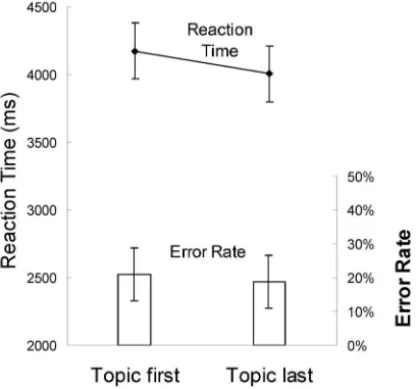
Behavioral Results. The reaction time and error rate related to the comprehension probe did not differ between conditions, as shown in Figure 2 below.
Figure 2: Reaction time to the comprehension probe and error rate as a function of topic sentence location.
Table 2: Activation levels (Sum Percent Signal Intensity).
First Last
ROI Support Topic Support Topic x y z L. Temporal Cortex 43.51 44.71 38.75 55.88 52.5 34.12 1.4 R. Temporal Cortex 14.36 21.78 15.87 22.92 -50.44 37.9 6.37 L. Inferior Frontal Gyrus 20.04 13.15 16.09 25.02 46.16 -12.91 21.88 R. Inferior Frontal Gyrus 3.1 2.64 2.24 2.7 -43.46 -19.05 23.98 L. Parietal Cortex 6.12 6.9 7.69 8.74 38.26 59.42 18.39 R. Parietal Cortex 1.92 3.18 1.2 1.61 -29.95 66.3 26.97 L. Dorsolateral Prefrontal
Cortex 1.83 1.14 1.63 2.31 39.47 -34.12 23.63 R. Dorsolateral Prefrontal
Cortex 0.78 0.71 0.9 0.67 -30.35 -45.08 18.67 L. Frontal Eye Fields 3.83 4.3 3.23 4.41 38.79 -5.11 38.21 R. Frontal Eye Fields 1.05 2 2.4 1.74 -44.68 -8.35 35.74 L. Extrastriate 20.89 24.45 20.16 23.53 30.94 76.22 -8.65 R. Extrastriate 7.93 11.1 9.84 12.72 -39.52 68.92 -6.06
Figure 3: Talairach averaged activation maps (A) Activation elicited by the topic sentence when presented first; B) Activation
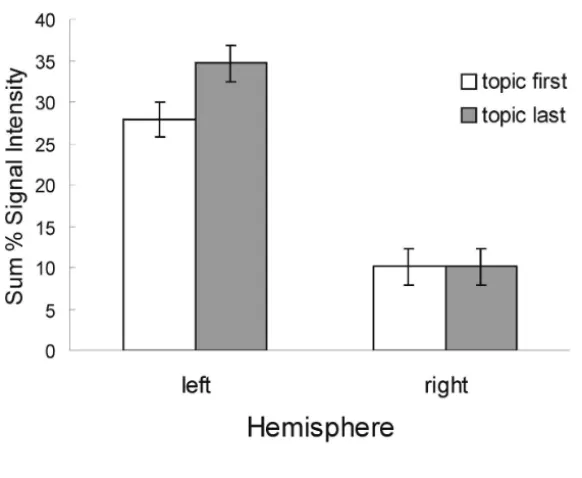
Figure 4: Left Hemisphere versus right hemisphere activation.
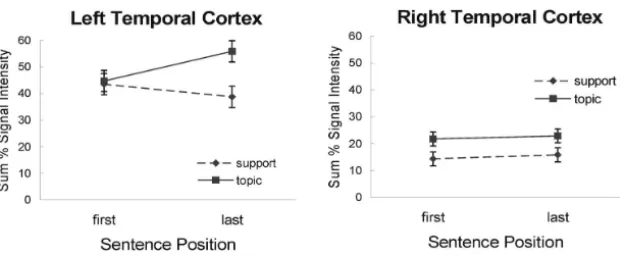
Figure 5: Activation levels observed in the temporal cortex
Figure 6: Activation levels observed in the inferior frontal gyrus
4. Discussion
The current study is a first attempt at exploring the underlying processes associated with topic identification. The major finding of the current study is the differential response observed in the left and right hemispheres to the location of the topic sentence within a paragraph. The two primary left hemisphere brain regions examined here (temporal cortex and inferior frontal gyrus) responded in similar ways, although to different degrees, to the topic location in this study: greater activation occurred when the topic sentence was in the final position than in the initial position. The right temporal region, on the other hand, was affected only by the sentence type, showing a greater response to topic sentences than support sentences, regardless of their location within the paragraph.
amount of “shifting” taking place during the topic last condition would be expected to result in greater activation for the topic last condition compared to the topic first condition. This predicted response was observed in the left temporal region, not the right, as shown in Figure 5. The left temporal region revealed a differential response to the topic location, with the topic sentence eliciting more activation when it was in the final position than when it was in the initial position. In addition, the support sentences showed the opposite effect: greater activation when they were located in the initial position compared to when they were in the final position. Thus, while the left hemisphere is involved in comprehension processes at all times, the introduction of coherence gaps increases its processing load. This increased processing load may be a function of an increased need to shift or reorganize the text representation in memory.
superior portion of Broca’s area, neither of which were scanned in the previous study. This difference in the anatomical regions examined is a significant one because these regions have been shown to be involved in different processes, particularly in the left hemisphere. For example, the anterior, inferior portion of Broca’s area (BA 45) has been found to be involved in semantic processing (Newman et al 2003; Fiez 1997; Wagner et al 2000) while the posterior, superior portion (BA 44) is more involved in syntactic processing (Dapretto et al 1999; Embick et al 2000; Newman et al 2003). Although there are fewer reports investigating the processing in the right hemisphere, similar differences may be expected. As a result of these methodological differences it is difficult to directly compare the studies and further research is needed to clarify this issue.
The current study seems to suggest a role for the left temporal and inferior frontal region in the shifting process. One possible explanation for the left temporal region’s involvement in shifting may be found in the region’s involvement in memory processing more generally. Consider the possibility that when reading a text various concepts activate a certain feature space within memory and as incoming information comes in, there is a check to see how much the new concept’s feature space overlaps with previous information. If the overlap is above some threshold, then it is possible that it is just added to the current representation. If not, then a “shift” happens and a new, or a more elaborate memory substructure is created. It may be that the left hemisphere is responsible for holding this representation on-line. There are many studies that associate left temporal and inferior frontal cortex to memory functions including semantic memory. For example, the superior portion of the inferior frontal gyrus is thought to become more involved during sentence comprehension when memory-demanding dependencies between elements in a sentence must be established (Fiebach, et al 2004; Cooke et al 2001; Fiebach et al 2001). In the current study, when the topic is in the final position similar memory-demanding dependencies must be established in order to relate the sentences within the paragraph.
and Gernsbacher and Robertson (1992) suggested that the definite article ‘the’ serves as a cue to map a representation of the current input and found the involvement of the right hemisphere. One of the consequences of having the topic sentence in the final position is that the preceding supporting sentences have unresolved anaphors. For example, the support sentence “It is loaded with vitamin E, it has no cholesterol, and people who eat it have the lowest rate of heart disease” does not state what “it” refers to. In contrast, when the topic sentence is in the initial position, such as “Now the rest of the world is discovering the power of olive oil, the most versatile fruit juice ever squeezed”, the topic of the paragraph is explicitly stated (olive oil in this case), facilitating the resolution of anaphors in the subsequent support sentences (it-olive oil). Therefore, in the current experiment, the mapping process may be expected to be cued more often when the topic sentence is located in the final position because only then can the recurring concepts be identified and interrelated.
The results presented here do suggest significant processing differences between the left and right hemisphere during text processing. According to the coarse coding hypothesis the left hemisphere activates a small number of representations to a high degree making it ideal for working/short-term memory language functions. Also, previous studies at the word and sentence level have shown that the left hemisphere is involved in memory intensive language processing such as semantic and syntactic processing. These processes occur at both the sentence and discourse level. However, because the left hemisphere is so involved in memory it may be that the text representation is stored/processed in the left hemisphere. If this is the case then its increased involvement when the topic is located at the end of a paragraph would be due to the reorganization or even the generation of this memory structure.
process of SBF in order to perform anaphor resolution and to begin to relate the information that was presented previous to the topic. This would coincide with the shifting processes taking place in the left hemisphere that are reorganizing/generating a memory structure. Knowledge of how to relate the new information with the old is needed before the text representation can be edited and this knowledge may be generated by the right hemisphere.
5. Conclusions
Discourse comprehension is a collaborative effort involving both the left and right hemisphere language areas, as these fMRI results show. The systematic activation observed in both hemispheres in our study suggests that the two hemispheres work in an integrated manner, each being differentially responsible for various aspects of language processing (Mazoyer et al 1993), but working together to achieve the more global role of discourse comprehension. The integrated manner in which the biology appears to execute discourse processing also suggests that the underlying cognitive processes are non-modular. For example, the data presented here suggests that the foundation is not formed irrespective of the content of the initial sentence and that the lexical/semantic processing of each individual sentence in a text dynamically influences the text representation.
Recebido em novembro de 2005 Aprovado em outubro de 2007 E-mail: [email protected]
REFERENCES
BAVELIER, D.; CORINA, D.; JEZZARD, P.; PADMANABHAN, S.; CLARK, V. P.;
KARNI, A.; PRINSTER, A.; BRAUN, A.; LALWANI, A.; RAUSCHECKER, J. P.;
TURNER, R. & NEVILLE, H. 1997. Sentence reading: A functional MRI
study at 4 Tesla. Journal of Cognitive Neuroscience9: 664-686.
BEEMAN, M. 1993. Semantic processing in the right hemisphere may
contribute to drawing inferences during comprehension. Brain and
_____. 1998. Coarse semantic coding and discourse comprehension. In: M. Beeman & C. Chiarello, (Eds.), Right hemisphere language
comprehension: Perspectives from cognitive neuroscience, pp. 255-284.
Mahwah, NJ: Lawrence Erlbaum Associates.
BEEMAN, M.; FRIEDMAN, R. B.; GRAFMAN, J.; PEREZ, E.; DIAMOND, S. &
LINDSAY, M. B. 1994. Summation priming and coarse coding in the
right hemisphere. Journal of Cognitive Neuroscience,6: 26-45.
BINDER, J. R. 1997. Neuroanatomy of language processing studied with
functional MRI. Clinical Neuroscience, 4: 87-94.
BOTTINI, G; CORCORAN, R.; STERZI, R.; PAULESU, E.; SCHENONE, P.; SCARPA,
P., et al. 1994. The role of the right hemisphere in the interpretation of figurative aspects of language. A positron emission t omography activation study. Brain, 117: 1241-53.
BRANSFORD, J. D. & JOHNSON, M. K. 1972. Contextual prerequisites for
understanding: some investigations of comprehension and recall.
Journal of Verbal Learning and Verbal Behavior, 11: 717-726.
BROWNELL, H. & MARTINO, G. 1998. Deficits in inference and social
cognition: The effects of right hemisphere brain damage on discourse. In: M. Beeman & C. Chiarello (Eds.), Right hemisphere language
comprehension: Perspectives from cognitive neuroscience (pp. 309-328).
Mahwah, NJ: Erlbaum.
BRUNSWICK, N.; MCCRORY, E.; PRICE, C. J. & FRITH, C. D. 1999. Explicit
and implicit processing of words and pseudowords by adult developmental dyslexics. A search for Wernicke’s Wortschatz? Brain, 122: 1901-1917.
CAPLAN, D.; ALPERT, N. & WATERS, G. 1999. PET studies of syntactic
processing with auditory sentence presentation. NeuroImage, 9: 343-351. CAVINESS, V. S. Jr.; MEYER, J.; MAKRIS, N. & KENNEDY, D. N. 1996.
MRI-based topographic parcellation of human neocortex: An anatomically specified method with estimate of reliability. Journal of Cognitive
Neuroscience, 8: 566-87.
COOKE, A.; ZURIF, E. B.; DEVITA, C.; ALSOP, D.; KOENIG, P.; DETRE, J.; GEE,
J.; PINANGO, M.; BALOGH, J. & GROSSMAN, M. 2001. Neural basis for
sentence comprehension: Grammatical and short-term memory components. Human Brain Mapping, 15: 80-94.
CUNNINGHAM, J.W. & MOORE, D.W. 1986. The confused world of main
DAPRETTO, M. & BOOKHEIMER, S. 1999. Form and content: Dissociating
syntax and semantics in sentence comprehension. Neuron, 24: 427-432.
DAVIES, Florence. 1995. Introducing reading. UK: Penguin Books.
DEHAENE, S.; DUPOUX, E.; MEHLER, J.; COHEN, L.; PAULESU, E.; PERANI, D.;
VANDE MOORTELE, P-F.; LEHERICY, S. & LEBIHAN, D. 1997. Anatomical
variablity in the cortical representation of first and second language.
NeuroReport, 8: 3809-3815.
EDDY, W.; FITZGERALD, M.; GENOVESE, C.; MOCKUS, A. & NOLL, D. 1996.
Functional imaging analysis software – computational olio. In: Proceedings in Computational Statistics. Physica-Verlag, Heidelberg, pp. 39-49.
EMBICK, D.; MARANTZ, A.; MIYASHITA, Y. et al. 2000. A syntactic
specialization for Broca’s area. Proceedings of the National Academy of
Science. USA, 97,6150-6154.
FIEBACH, C. J.; SCHLESEWSKY, M. & FRIEDERICI, A. D. 2001. Syntactic working
memory and the establishment of filler-gap dependencies: Insights from ERPs and fMRI. Journal of Psycholinguistic Research, 30: 321–338.
FIEBACH, C.J.; VOS, S.H. & FRIEDERICI, A.D. 2004. Neural correlates of
syntactic ambiguity in sentence comprehension for low and high span readers. Journal of Cognitive Neuroscience, 16: 1562-1575.
FIEZ, J. & PETERSEN, S. E. 1998. Neuroimaging studies of word reading.
Proceedings of the National Academy of Science, USA, 95, 914-921.
GERNSBACHER, M. A. 1990. Language comprehension as structure building.
Hillsdale, NJ: Lawrence Erlbaum Associates.
GERNSBACHER, M. A. 1995. The Structure Building Framework: What it
is, what it might also be, and why. In: B. K. Britton, & A. C. Graesser, (Eds.), Models of text understanding (pp. 289-311). Hillsdale, NJ: Erlbaum.
GERNSBACHER, M. A. 1997. Two decades of structure building. Discourse
Processes, 23:265-304.
GERNSBACHER, M. A. & ROBERTSON, R. R. W. 1992. Knowledge activation
versus sentence mapping when representing fictional characters’ emotional states. Language and Cognitive Processes, 7: 353-371. HAGOORT, P.; INDEGREY, P.; BROWN, C.; HERZOG, H.; STEINMETZ, H. & SEITZ,
FIEZ, J. A. 1997. Phonology, semantics, and the role of the left inferior
prefrontal cortex. Human Brain Mapping, 5: 79-83.
JUST, M. A.; CARPENTER, P. A.; KELLER, T. A.; EDDY, W. F. & THULBORN, K.
R. 1996. Brain activation modulated by sentence comprehension.
Science, 274: 114-116.
JUST, M. A.; CARPENTER, P. A.; MAGUIRE, M., DIWADKAR, V. & MCMAINS, S.
2001. Mental rotation of objects retrieved from memory: an fMRI study of spatial processing. Journal of Experimental Psychology: General, 130: 493-504.
KELLER, T. A.; CARPENTER, P. A. & JUST, M. A. 2001. The neural bases of
sentence comprehension: an fMRI examination of syntactic and lexical processing. Cerebral Cortex, 11: 223-237
KELLER, T. A.; CARPENTER, P. A. & JUST, M. A. 2003. Brain imaging of
tongue-twister sentence comprehension: Twisting the tongue and the brain. Brain and Language, 84: 189-203.
KINTSCH, W. & VAN DIJK, T. A. 1978. Toward a model of text
comprehension and production. Psychological Review, 85: 363-394. LAZAR, N. A.; EDDY, W. F.; GENOVESE, C. R. & WELLING, J. S. 2001. Statistical
Issues in fMRI for Brain Imaging. International Statistical Review, 69: 105-27.
MASON, R. A. & JUST, M. A. 2004. How the brain processes causal inferences
in text: A multiple process theory of the function of the language network in both hemispheres. Psychological Science, 15: 1-7.
MAZOYER, B.M.; TZOURIO, N.; FRAK, V.; SYROTA, A.; MURAYAMA, N.; LEVRIER,
O.; SALAMON, G.; DEHAENE, S.; COHEN, L. & MEHLER, J. 1993. The
cortical representation of speech. Journal of Cognitive Neuroscience, 5(4): 467-479.
MICHAEL, E. B.; KELLER, T. A.; CARPENTER, P. A. & JUST, M. A. 2001. An
fMRI investigation of sentence comprehension by eye and by ear: Modality fingerprints on cognitive processes. Human Brain Mapping, 13: 239-252.
NEWMAN, S. D.; JUST, M. A.; KELLER, T. A.; ROTH, J. & CARPENTER, P. A.
2003. Differential effects of syntactic and semantic processing on the subregions of Broca’s area. Cognitive Brain Research, 4: 297-307. NICHELLI, P.; GRAFMAN, J.; PIETRINI, P.; CLARK, K.; LEE, K. Y. & MILETICH,
NIETO-CASTANON, A.; GHOSH, S.S.; TOURVILLE, J.A. & GUENTHER, F. H.
2003. Region of interest based analysis of functional imaging data,
NeuroImage, 19: 1303-1316.
PETERSEN, S. E.; FOX, P. T.; POSNER, M. I.; MINTUN, M. & RAICHLE, M. E.
1989. Positron emission tomographic studies of the processing of single words. Journal of Cognitive Neuroscience, 1: 153-170.
PETERSEN, S. E.; FOX, P. T.; SNYDER, A. Z. & RAICHLE, M. E. 1990. Activation
of extrastriate and frontal cortical areas by visual words and word-like stimuli. Science,249: 1041-1044.
PUGH, K.; MENCL, E. W.; SHAYWITZ, B. A.; SHAYWITZ, S. E.; FULBRIGHT, R.
K.; SKUDLARSKI, P.; CONSTABLE, R. T.; MARCHIONE, K.; JENNER A.R.;
SHANKWEILER, D. P.; KATZ, L.; FLETCHER, J.; LACADIE, C. & GORE, J. C.
2000. The angular gyrus in developmental dyslexia: Task-specific differences in functional connectivity in posterior cortex. Psychological
Science, 11: 51-56.
PUGH, K.; SHAYWITZ, B.; CONSTABLE, T.; SHAYWITZ, S.; SKUDLARSKI, P.;
FULLBRIGHT, R.; BRONEN, R.; SHANKWEILER, D.; KATZ, L.; FLETCHER, J.
& GORE, J. 1996. Cerebral organization of component processes in
reading. Brain,119: 1221-1238.
RADEMACHER, J.; GALABURDA, A. M.; KENNEDY, D. N.; FLILIPEK, P. A. &
CAVINESS, V. S. 1992. Human cerebral cortex: localization, parcellation,
and morphometry with magnetic resonance imaging. Journal of Cognitive
Neuroscience, 4: 352-74.
ROBERTSON, D. A.; GERNSBACHER, M. A.; GUIDOTTI, S. J.; ROBERTSON, R. R.
W.; IRWIN, W.; MOCK, B. J. & CAMPANA, M. E. 2000. Functional
neuroanatomy of the cognitive process of mapping during discourse comprehension. Psychological Science, 11: 255-260.
SCHLOSSER, M. J.; AOYAGI, N.; FULBRIGHT, R. K.; GORE, J. C. & MCCARTHY,
G. 1998. Functional MRI of auditory comprehension. Human Brain
Mapping, 6: 1-13.
SHAYWITZ, B. A.; PUGH, K. R.; JENNER, A. R.; FULLBRIGHT, R. K.; FLETCHER,
J. M.; GORE, J. C. & SHAYWITZ, S. E. 2000. The neurobiology of reading
and reading disability (Dyslexia). In: M.L. Kamil, P.B. Mosenthal, P.D. Pearson & R. Barr (Eds.), Handbook of Reading Research, Vol. III. Mahwah, N.J.: Lawrence Erlbaum Associates.
ST GEORGE, M.; KUTAS, M.; MARTINEZ, A. & SERENO, M. I. 1999 Semantic
STROMSWOLD, K.; CAPLAN, D.; ALPERT, N. & RAUCH, S. 1996. Localization
of syntactic comprehension by positron emission tomography. Brain
and Language, 52: 452-473.
TOMITCH, L. M. B.; JUST, M. A. & NEWMAN, S. 2004. A neuroimagem
funcional na investigação do processo de leitura. In: Rodrigues, C. & Tomitch, L.M.B (orgs.). Linguagem e cérebro humano: contribuições
multidisciplinares. Porto Alegre, RS: ARTMED Editora.
VAN DIJK, T. A. & KINTSCH, W. 1983. Strategies of discourse comprehension.
New York: Academic Press.
WAGNER, A; KOUSTAAL, W.; MARIL, A. et al. 2000. Semantic repetition
priming for verbal and pictorial knowledge. Journal of Cognitive
Neuroscience, 9: 714-26.
WALDIE, K. & MOSLEY, J. 2000. Hemispheric specialization for reading