ISSN 1517-7076 artículo 11634, pp.653-658, 2015
Autor Responsable: Alberto Monsalve Fecha de envío: 29/12/ 2014 Fecha de aprobación: 01/06/2015
10.1590/S1517-707620150003.0067
Mechanical Behavior of a Twip Steel
(Twinning Induced Plasticity)
Alberto Monsalve1, Flavio De Barbieri1, Mauricio Gómez1, Alfredo Artigas 1, Linton Carvajal 1, Konstantin Sipos 1 , Oscar Bustos 1, Juan Pérez-Ipiña 2
1 Departamento de Ingeniería Metalúrgica, Facultad de ingeniería, Universidad de Santiago de Chile. Santiago, Chile.
2 Facultad de Ingeniería, Universidad del Comahue, Neuquén, Argentina. [email protected]
[email protected], [email protected];[email protected];[email protected]; [email protected];[email protected]
1. ABSTRACT
A TWIP steel (0.65%C; 22%Mn; 0.28%Cr; 0.16%Si) was produced in the laboratory by melting, casting, hot forging and hot rolling. The relationship between mechanical twinning fraction and mechanical behavior of this steel was studied through tension tests at the following temperatures: 25, 300, 325, 350, 375 and 400°C. Fracture toughness was measured from J integral evaluation at temperatures where the principal hardening mechanism is mechanical twinning and dislocation glide (325 and 375°C respectively), for which a set of CT samples were pre-cracked by fatigue and then loaded until fracture in accordance to ASTM 1820. The plastic strain energy absorbed by each sample during crack growth was studied, correlating twinning with the me-chanical response of the material, determining a decrease of plastic deformation energy around 375ºC, where the main deformation mechanism is strain hardening by dislocation glide and not mechanical twinning. Re-sults obtained by different mechanical tests show that mechanical twinning activates in a range of stacking fault energy in the range 18 to 50 mJ/m2.
Keywords: Twinning, plasticity, steel, stacking fault, manganese.
2. 1. INTRODUCTION
Steels which show twinning phenomena during plastic deformation are called TWIP steels. They are com-pletely austenitic at room temperature due to their high manganese contents, which complies the following relationship:
(1)
where represent their weight contents of Mn and C [1]. Usually these steels have a Mn con-tent between 15 and 30%, while carbon concon-tents stays between 0.1 and 0.8% weight percent. Additionally they can have some alloying elements such as Al, Si, Cr, Ti, V and Mo. Each of these elements changes the stacking fault energy (SFE). For example Al and Cu raise the SFE; while Si raises it only up to 3% contents, while higher contents lowers it, and Cr lowers it [2].
It has been proven that the stacking fault energy value establishes the mechanisms of plastic defor-mation: when SFE is less than 20 mJ/m2 martensitic transformation is favored. When the SFE is in a 20 to 47 mJ/m2 range, twinning is favored. At values higher than 47 mJ/m2 only dislocation glide is active [3].
654 Other aspects studied in TWIP steels, are the influence of %C on twinning, the effect of dynamic strain aging, the role of twinning on deformation hardening, the parameters which raise yield strength, recrys-tallization kinetics and texture formation.
Nevertheless their mechanical behavior on fatigue and fracture require further insight. On this subject it is important the works of Hamada et al. [5-7], who studied the properties on TWIP steels to fatigue, and Niendorf et al. [8,9], who studied the effect of previous deformation on the response to fatigue and crack growth of TWIP steels. Yet, work has to be done to explain the relationship between twinning and fatigue fracture for this type of steels. There is not information about fracture mechanics of this kind of steels ( ).
The aim of this study is to characterize the fracture response to fracture of a TWIP steel, correlating the presence of twins to this mechanical behavior measured through the calculation of the J max. parameter
2. MATERIALS AND METHODOLOGY
The chemical composition of the steel is shown in table 1
Table 1: Chemical composition of the TWIP steel (weight %).
%C %Si %Mn %Cr %Ni %V %Cu %Sn %N %P %S
0.65 0.162 22.14 0.028 0.043 0.05 0.028 0.035 0.03 0.06 0.007
Melting of the steel was carried out in an induction furnace, casting a 100 mm wide, 100 mm thick and 320 mm long ingot, weighing 25 kgf. The ingot was forged at 1,200°C to a 20 mm thick plate. Speci-mens 300 mm per 100 mm and 20 mm thick were cut and homogenized at 1,250°C during 40 min, then hot rolled at temperatures between 1,100 and 910°C, down to 15 mm thickness. The rolled steel was quenched in a salt-bath at 350°C, holding it for 10 min, and subsequently cooling it to room temperature in calm air. Cy-lindrical tensile test specimens of 12.5 mm diameter with the length parallel to the rolling direction were ma-chined.
Fracture toughness tests were carried out at the following temperatures: 25-300-325-350-375-400°C, measuring yield strength, ultimate tensile strength and total elongation to fracture. As the use of linear volt-age displacement transducers at high temperatures is not possible, strain measurement was made on the dis-placement of the horizontal beams of the tensile machine. A total of three samples were used for each tem-perature.
Compact Tension (CT) specimens were also prepared. Fatigue pre-cracking and fracture of the speci-mens were done according to ASTM 1820. Testing was carried out at 25, 325 and 375°C, calculating the Jmax
value for each case. Two samples for each temperature were used.
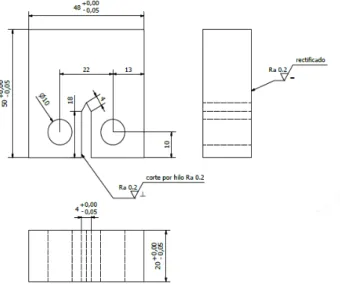
Tensile tests on pre-cracked compact tension specimens were carried out according to ASTM 1820. Figure 1 shows the geometry and size of the test specimen used.
Figure 1: Size of the used CT specimens.
655 static load of 5,000 N, and a variable cyclic load of 5,000 N between minimum and maximum. Then the specimens were tensile loaded until fracture at a speed of 1 mm/min in the tensile test machine. These speci-mens were tested at three different temperatures, 25°C, 325°C and 375°C in an electric resistance furnace. These three temperatures were chosen to get data to calculate the Jmax values for the two hardening
mecha-nisms, mechanical twinning and dislocation glide.
In the fracture tests carried out on these CT samples, the applied load versus displacement was regis-tered. Tthe maximum load was extracted, which corresponds to a technological parameter for comparing sim-ilar conditions for stable crack growth. In these steels with high ductility, when the maximum load is attained, there is no sudden unstable crack growth, the crack grows progressively at a controlled stable rate.
3. RESULTS
3.1 Metalographic analysis
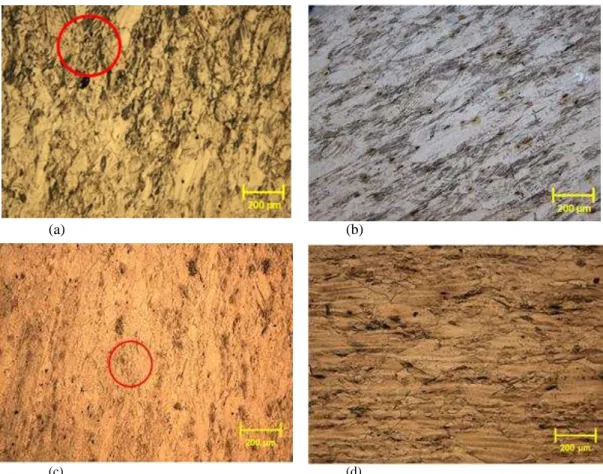
Figure 2 shows the steel microstructure after tensile testing at 25, 325, 375 and 400°C. As expected, twinning density decreases as testing temperature increases (zones marked with red circles). This phenomenon is ex-plained considering that the SFE value changes, and therefore the presence of mechanical twins decrease.
(a) (b)
(c) (d)
Figure 2: Microstructure after tensile testing at a) 25°C; (b) 325°C; (c) 375°C; (d) 400°C.
X-ray diffraction technique was used in order to quantify the twinning fraction, by means of the peak profile analysis. This analysis was carried out applying Rietveld method, using MAUD free license software.
3.2 Tension tests
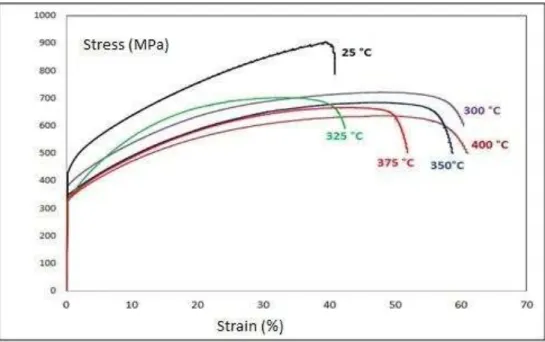
656 Figure 3 shows a decrease of yield strength and ultimate tensile strength (UTS) as test temperature in-creases. Elongation to fracture has high values, mostly due to the presence of both deformation mechanisms of twinning and dislocation glide. It clearly shows the influence of the different deformation mechanisms as temperature raises. The value of elongation depends strongly on these mechanisms. For example, at a 400°C there is practically no mechanical twinning and therefore elongation is exclusively due to dislocation gliding. Elongations at 25°C and 300°C are lower and are a product of the combination of mechanical twinning, dy-namic strain aging and dislocation glide. Finally, between 325°C and 350°C, mechanical twinning is the main deformation mechanism, as dynamic strain aging disappears at a temperature of 250°C, due to the fact that Portevin – Le Chatelier effect is not present at 300°C, as shown in Figure 2.
Figure 3: Tensile test curves at different temperatures
3.3 Fracture toughness test
Table 2 shows the values of elastic ( plastic ( ) and maximum ( ) obtained. Theory tells us that a steel that has only one hardening mechanism will have a J value, representative of the energy for crack growth, which increases with temperature due to the increase of ductility. Nevertheless the measured J inte-gral value for a TWIP steel is higher at 325°C than at 375°C. The decrease of Jmax can be explained by the
fact that dislocation glide is present at all tested temperatures, but mechanical twinning is only present up 325°C, so at temperatures higher than 325°C, dislocation glide is the unique active deformation mechanism. At 325°C mechanical twinning absorbs deformation energy, increasing fracture toughness.
Table 2: Values of , and at different temperatures in (kJ/m2).
Temperature (°C) ,
25 115.3 4358.5 4473.7
325 167.7 8323.8 8491.5
375 120.9 7572.6 7693.5
3.4 Micrographic analysis of the J integral test on the scanning electron microscope (SEM).
im-657 ages show the fractured samples at 375°C, where no mechanical twinning is observed.
(a) (b)
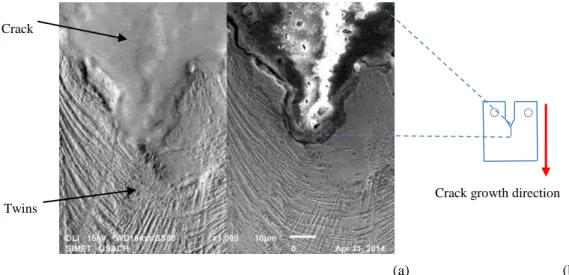
Figure 4: SEM Images of the surface the of the fractured sample at 325°C a) retro-dispersed electrons (b) secondary electrons .
(a) (b)
Figure 5: SEM Images of the surface of the fractured sample at 375°C a) retro-dispersed electrons (b) secondary
elec-trons.
4. DISCUSSION
There is a competition between both mechanisms of deformation: twinning and dislocation glide. At low temperatures, deformation by twinning is the main mechanism. At high temperatures, deformation by dislo-cation glide is possible. This is evident in figure 1, nevertheless, the influence of temperature must be consid-ered, due to the effect in the decrease of internal friction and then of the dislocation glide. From the metallo-graphic analysis it was possible to conclude that twinning was observed until 325°C, while at temperatures higher than 350°C, twinning does not appear. For this reason, an experiment at two temperatures was carried out (325 and 375°C) in order to study the effect of temperature on the fracture behavior of the steel. The au-thors have measured the twinning fraction at different temperatures, finding a value of 4.14 x 10⁻⁶ at 325°C and 2.4 x 10⁻⁹ for 375°C. These values of twinning fraction are typical at these temperatures. As can be de-duced, a strong decrease in the twinning fraction is measured when temperature increase. The measurement of the twinning fraction was made by means of X-ray diffraction, taken into account the shape and slip of the peaks in the diffractograms obtained [10].
The parameter used to characterize the fracture behavior of the TWIP steel was Jmax. The ASTM 1820
standard was applied to compute , and , by means of the data obtained from the register of load Crack growth direction Crack
Twins
658 versus displacement in the fracture tests. The higher values of corresponds to the experiment made at 325°C; the lower value was obtained at 25°C. These measurements confirm that the maximum toughness is related to that temperature with a high value of twinning fraction. This can be explained by the absorption of energy produced by twinning, phenomena that added to the increment of ductility with temperature, produces a maximum in at 325°C.
The optical and electronic microscopy analyses confirm the previous observations. In figures 4 and 5, it is possible to observe the fracture surface of the steel tested at 325 and 375°C. In the first case, the fracture surface exhibits a lot of twins, however at 375°C the fracture surface has no evidence of twins, confirming that twinning disappear at 375°C and the high value of is due to the presence of twins.
5. CONCLUSIONS
a) The TWIP phenomenon was verified through metallographic analysis of the steel after tensile testing at different temperatures. Mechanical twinning is present up to 325°C. Over this temperature dislocation glide is the only deformation mechanism operating.
b) The values of , y increase with temperature between 25 y 325°C, while these values decrease when the temperature raises to 375°C, which can be attributed to energy absorption by the mechanical twin-ning phenomena at lower temperatures.
6. ACKNOWLEDGEMENTS
The authors wish to thank DICYT USACH and the 1140241 FONDECYT project.
7. BIBLIOGRAPHY
[1] BOUAZIZ, O., ALLAIN, S., SCOTT, C.P., et al, “High manganese austenitic twinning induced plasticity steels: A review of the microstructure properties relantionships”, Current Opinion in Solid State and Materi-als Science, v.15, pp.141-168, 2011.
[2] PARK, K.T., KIM, G., KIM, S.K., et al, “On the transition of deformation model of fully austenitic steels at room temperature”, Met. Matter Int., v.16, n.1, pp. 1-6, 2010.
[3] GRASSEL, O., KRUGGER, L., FROMMEYER, G., et al, “High strength Fe-Mn (Al,Si) TWIP/TRIP steels development, properties, application”, Int. Journal of Plasticity, v.16, pp.1391-1409, 2000.
[4] OLSON, G.B., COHEN, M. “A General Mechanism of Martensitic Nucleation: Part I. General Concepts
and FCC → HCP Transformation”, Metallurgical Transactions A, v. 7A, 1897-1904, Dec. 1976.
[5] HAMADA, A.S., KARJALAINEN, L.P., PUUSTINEN, J. “Fatigue behavior of high Mn TWIP steel”, Material Science and Engineering A, v. 517, pp.68-77, 2009.
[6] HAMADA, S., KARJALAINEN, L.P., FERRAIUOLO, A., et al., “Fatigue behavior of four high Mn twinning induced plasticity steels”, Metallurgical and Materials Transactions A, v. 41A, pp.1102-1108, 2010. [7] HAMADA, A. S., KARJALAINEN, L.P. “High-cycle fatigue behavior of ultrafine-grained austenitic stainless and TWIP steels”, Materials Science and Engineering, v.527, pp. 5715-5722, 2010.
[8] NIENDORF, T., LOTZE, C., CANADINC, D., et al, “The role of monotonic pre deformation on the fa-tigue performance on a high Mn austenitic TWIP steel”, Material Science and Engineering A, v. 499, pp. 518-524, 2004.
[9] NIENDORF, T., RUBITSCHEK, F. MAIER, H., et al., “Frehn, Fatigue crack growth Microstructure rela-tionships in a high Mn austenitic TWIP steel”, Materials Science and Engineering A, v. 527, pp.2412-2417, 2010.