Interproximal wear
versus
incisors extraction to
solve anterior lower crowding: A systematic review
Natália Valli de Almeida1, Giordani Santos Silveira1,Daniele Masterson Tavares Pereira2, Claudia Trindade Mattos3,José Nelson Mucha4
How to cite this article: Almeida NV, Silveira GS, Pereira DMT, Mattos CT, Mucha JN. Interproximal wear versus incisors extraction to solve anterior lower crowding: A systematic review. Dental Press J Orthod. 2015 Jan-Feb;20(1):66-73. DOI: http://dx.doi.org/10.1590/2176-9451.20.1.066-073.oar
Submitted: February 07, 2014 - Revised and accepted: April 02, 2014
Contact address: Claudia Trindade Mattos E-mail: [email protected] » The authors report no commercial, proprietary or financial interest in the
prod-ucts or companies described in this article.
Objective: To determine by means of a systematic review the best treatment, whether interproximal wear or incisor extrac-tion, to correct anterior lower crowding in Class I patients in permanent dentition. Methods: A literature review was con-ducted using MEDLINE, Scopus and Web of Science to retrieve studies published between January 1950 and October 2013. In selecting the sample, the following inclusion criteria were applied: studies involving interproximal wear and/or extraction of mandibular incisors, as well as Class I cases with anterior lower crowding in permanent dentition. Results: Out of a total of 943 articles found after excluding duplicates, 925 were excluded after abstract analysis. After full articles were read, 13 were excluded by the eligibility criteria and one due to methodological quality; therefore, only fours articles remained: two retrospective and two randomized prospective studies. Data were collected, analyzed and organized in tables. Conclusion: Both interproximal wear and mandibular incisor extraction are effective in treating Class I malocclusion in permanent dentition with moderate anterior lower crowding and pleasant facial profile. There is scant evidence to determine the best treatment option for each case. Clinical decision should be made on an individual basis by taking into account dental characteristics, crowding, dental and oral health, patient’s expectations and the use of set-up models.
Keywords: Incisor. Angle Class I malocclusion. Tooth extraction.
DOI: http://dx.doi.org/10.1590/2176-9451.20.1.066-073.oar
1 Masters student of Orthodontics, Fluminense Federal University (UFF). 2 Specialist in Library science, Integrated Colleges of Jacarepaguá (FIJ) 3Adjunct professor, Department of Orthodontics, UFF.
4 Full professor, Department of Orthodontics, UFF.
Objetivo: determinar, por meio de uma revisão sistemática, o melhor tratamento entre desgastes interproximais e ex-tração de incisivos para a correção de apinhamento anteroinferior em pacientes Classe I com dentição permanente. Mé-todos: foram feitas buscas nas bases de dados eletrônicas MEDLINE, Scopus e Web of Science por artigos publicados de janeiro de 1950 até outubro de 2013. Os critérios de inclusão foram estudos que abordassem tratamentos com desgastes interproximais e/ou extração de incisivos inferiores, de casos Classe I com apinhamento anteroinferior na dentição per-manente. Resultados: dos 943 artigos encontrados após a remoção dos duplicados, 925 foram excluídos após a leitura dos resumos. Após leitura dos artigos completos, 13 foram excluídos pelos critérios de eligibilidade e um pela qualidade metodológica, restando quatro artigos, sendo dois retrospectivos e dois prospectivos randomizados. Os dados foram co-letados, analisados e organizados em tabelas. Conclusões: tanto o desgaste interproximal quanto a extração de incisivo inferior são tratamentos eficazes em Classe I na dentição permanente, com apinhamento anteroinferior moderado e perfil facial agradável. Há fracas evidências para determinar a escolha do melhor tratamento para cada caso. A decisão clínica deve ser tomada em bases individuais, considerando as características anatômicas dentárias, da severidade do apinhamen-to, condições de saúde dentária e bucal, expectativas dos pacientes e ensaio em modelos (set-up).
INTRODUCTION
A pleasant smile and proper alignment of ante-rior teeth are the main motivation for patients
seek-ing orthodontic treatment.1 In permanent dentition,
the mandibular anterior region is most susceptible2 to
patient’s dissatisfaction. It is the most common com-plaint, particularly among older adult patients due to
greater exposure of mandibular teeth at smiling.3
Orthodontic planning for this type of deiciency
may involve permanent teeth extraction1,4-26 or other
approaches that do not involve extractions, such as
in-terproximal wear,6-11,14,19,23,24,27-31 dental expansion,7-11,14
distraction osteogenesis of the mandibular
symphy-sis,32,33 as well as a combination of diferent techniques.14
The treatment of choice should be based on a number of features, such as type of malocclusion,
negative discrepancy,17,34 facial profile,8,10,11,17 Bolton’s
ratio,5 dental and periodontal conditions,1,5,14 and
pa-tient’s chief complaint. For a better prognosis,
diag-nostic,1,5,13,14,19 or virtual set-ups18 are indicated.
The aim of this study was to determine — in cases in which there is doubt as to the most appropriate procedure — the best treatment option between in-terproximal wear and incisor extraction to correct anterior lower crowding in Class I patients in perma-nent dentition and to achieve good facial esthetics.
MATERIAL AND METHODS
The guidelines and directives set by the Preferred Reporting Items for Systematic Reviews and Meta-Analysis, the PRISMA Statement, were adopted for
this review.35
The search, as well as the inclusion/exclusion cri-teria, were based on PICO format (Table 1).
For sample selection, the following inclusion crite-ria were applied: studies involving interproximal wear and/or extraction of mandibular incisors in cases of
anterior lower crowding and Class I malocclusion in permanent dentition. The exclusion criteria were: case reports; case series; laboratory studies; epidemiologi-cal studies; narrative reviews; opinion articles; studies involving orthognathic surgery, distraction osteogen-esis, extraction of premolars, syndromic and/or clet patients, supernumerary teeth and/or abnormal shape of teeth, transverse deiciencies, anterior crossbite, use of auxiliary devices; primary or mixed dentition and/or Class II or III malocclusion.
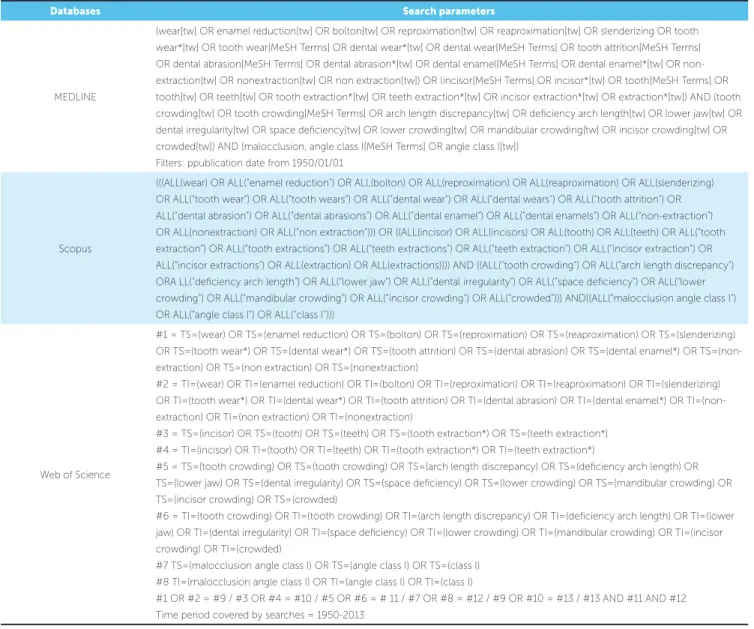
The literature review was conducted using MED-LINE (via PubMed), Scopus and Web of Science to retrieve studies that met the eligibility criteria and had been published from January 1950 to October 2013, without language restrictions. The combina-tions of words or terms used are described in Table 2. Duplicate articles were eliminated from the final search results. Titles and abstracts were read indepen-dently by two reviewers who analyzed the articles in light of the inclusion and exclusion criteria. All ar-ticles found to be compatible and somehow related to the question (Table 1) were reviewed. Disagree-ments between reviewers were settled in a consensus meeting held with a third investigator. The articles selected were fully read. The references of the articles included in the research were also analyzed in search of potential relevant articles that might not have been found in the selected databases.
The articles selected were assessed for method-ological quality according to a list based on
CON-SORT,36 whenever applicable, and modified by the
reviewers (Table 3). Disagreements were solved in consensus meetings, and articles were classified into high (≥13), moderate (<13 and ≥9) and low (<9) methodological quality.
Data were extracted from the articles by two re-viewers.
P = Population Angle Class I patients in permanent dentition presenting with lower anterior crowding.
I = Intervention Subjected to orthodontic treatment involving interproximal wear or extraction of a lower incisor.
C = Comparison Between the two types of treatment and the original characteristics of each malocclusion.
O = Outcome The best solution for each malocclusion.
Question What is the best treatment for lower anterior crowding in patients with Class I malocclusion in permanent
dentition, interproximal wear or incisor extraction?
Null hypothesis One treatment is no better than the other.
Databases Search parameters
MEDLINE
(wear[tw] OR enamel reduction[tw] OR bolton[tw] OR reproximation[tw] OR reaproximation[tw] OR slenderizing OR tooth wear*[tw] OR tooth wear[MeSH Terms] OR dental wear*[tw] OR dental wear[MeSH Terms] OR tooth attrition[MeSH Terms] OR dental abrasion[MeSH Terms] OR dental abrasion*[tw] OR dental enamel[MeSH Terms] OR dental enamel*[tw] OR non-extraction[tw] OR nonnon-extraction[tw] OR non non-extraction[tw]) OR (incisor[MeSH Terms] OR incisor*[tw] OR tooth[MeSH Terms] OR tooth[tw] OR teeth[tw] OR tooth extraction*[tw] OR teeth extraction*[tw] OR incisor extraction*[tw] OR extraction*[tw]) AND (tooth crowding[tw] OR tooth crowding[MeSH Terms] OR arch length discrepancy[tw] OR deiciency arch length[tw] OR lower jaw[tw] OR dental irregularity[tw] OR space deiciency[tw] OR lower crowding[tw] OR mandibular crowding[tw] OR incisor crowding[tw] OR crowded[tw]) AND (malocclusion, angle class I[MeSH Terms] OR angle class I[tw])
Filters: ppublication date from 1950/01/01
Scopus
(((ALL(wear) OR ALL(“enamel reduction”) OR ALL(bolton) OR ALL(reproximation) OR ALL(reaproximation) OR ALL(slenderizing) OR ALL(“tooth wear”) OR ALL(“tooth wears”) OR ALL(“dental wear”) OR ALL(“dental wears”) OR ALL(“tooth attrition”) OR ALL(“dental abrasion”) OR ALL(“dental abrasions”) OR ALL(“dental enamel”) OR ALL(“dental enamels”) OR ALL(“non-extraction”) OR ALL(nonextraction) OR ALL(“non extraction”))) OR ((ALL(incisor) OR ALL(incisors) OR ALL(tooth) OR ALL(teeth) OR ALL(“tooth extraction”) OR ALL(“tooth extractions”) OR ALL(“teeth extractions”) OR ALL(“teeth extraction”) OR ALL(“incisor extraction”) OR ALL(“incisor extractions”) OR ALL(extraction) OR ALL(extractions)))) AND ((ALL(“tooth crowding”) OR ALL(“arch length discrepancy”) ORA LL(“deiciency arch length”) OR ALL(“lower jaw”) OR ALL(“dental irregularity”) OR ALL(“space deiciency”) OR ALL(“lower crowding”) OR ALL(“mandibular crowding”) OR ALL(“incisor crowding”) OR ALL(“crowded”))) AND((ALL(“malocclusion angle class I”) OR ALL(“angle class I”) OR ALL(“class I”)))
Web of Science
#1 = TS=(wear) OR TS=(enamel reduction) OR TS=(bolton) OR TS=(reproximation) OR TS=(reaproximation) OR TS=(slenderizing) OR TS=(tooth wear*) OR TS=(dental wear*) OR TS=(tooth attrition) OR TS=(dental abrasion) OR TS=(dental enamel*) OR TS=(non-extraction) OR TS=(non TS=(non-extraction) OR TS=(nonTS=(non-extraction)
#2 = TI=(wear) OR TI=(enamel reduction) OR TI=(bolton) OR TI=(reproximation) OR TI=(reaproximation) OR TI=(slenderizing) OR TI=(tooth wear*) OR TI=(dental wear*) OR TI=(tooth attrition) OR TI=(dental abrasion) OR TI=(dental enamel*) OR TI=(non-extraction) OR TI=(non TI=(non-extraction) OR TI=(nonTI=(non-extraction)
#3 = TS=(incisor) OR TS=(tooth) OR TS=(teeth) OR TS=(tooth extraction*) OR TS=(teeth extraction*) #4 = TI=(incisor) OR TI=(tooth) OR TI=(teeth) OR TI=(tooth extraction*) OR TI=(teeth extraction*)
#5 = TS=(tooth crowding) OR TS=(tooth crowding) OR TS=(arch length discrepancy) OR TS=(deiciency arch length) OR TS=(lower jaw) OR TS=(dental irregularity) OR TS=(space deiciency) OR TS=(lower crowding) OR TS=(mandibular crowding) OR TS=(incisor crowding) OR TS=(crowded)
#6 = TI=(tooth crowding) OR TI=(tooth crowding) OR TI=(arch length discrepancy) OR TI=(deiciency arch length) OR TI=(lower jaw) OR TI=(dental irregularity) OR TI=(space deiciency) OR TI=(lower crowding) OR TI=(mandibular crowding) OR TI=(incisor crowding) OR TI=(crowded)
#7 TS=(malocclusion angle class I) OR TS=(angle class I) OR TS=(class I) #8 TI=(malocclusion angle class I) OR TI=(angle class I) OR TI=(class I)
#1 OR #2 = #9 / #3 OR #4 = #10 / #5 OR #6 = # 11 / #7 OR #8 = #12 / #9 OR #10 = #13 / #13 AND #11 AND #12 Time period covered by searches = 1950-2013
Table 2 - List of search parameters used in each database..
RESULTS
The search in the literature identiied 1,094 studies, 706 from MEDLINE, 240 from Scopus and 148 from Web of Science, which are all presented in a “Prism Flow
Diagram”35 (Fig 1). Ater excluding 151 repeated articles,
all titles and abstracts were read and those found to be un-related to the review were eliminated. Eighteen preselect-ed articles were read in full and the inclusion and exclusion criteria were applied. Five articles remained and were clas-siied according to the methodological quality assessment. One article was assigned as presenting low
meth-odological quality22 and was, therefore, not included in
this study. Four articles showed moderate quality,23-26
and none presented high quality (Table 4). Most articles
ofered insuicient sample description, both demograph-ically and in terms of sample size calculation.
Of the four studies included, two were randomized
prospective23,24 and two were retrospective studies.25,26
Only one article presented sample size calculation.25
In the study by Ileri et al,25 only the sample data for
inci-sor extraction (IE) were considered, given that no wear was mentioned in the non extraction (NE) group, and although the authors were contacted by e-mail, no re-sponse was given. Only the data from groups of interest
were extracted from the articles.23-26
Figure 1 - PRISMA flow diagram of database research results. Table 4 - Methodological quality scores for the selected articles. Items A to L are described in Table 3.
Table 3 - Methodological quality assessment - based on CONSORT.35
Methodological quality features assessed in the included studies Score
A Description of study objectives 1
B Study design (retrospective = 0 point; prospective = 1 point; randomized prospective = 2 points) 2
C Description of sample inclusion/exclusion criteria 1
D Intervention clearly described (reason for choosing the extracted tooth/performing the wear) 1
E Measures for evaluating the results described 1
F Determining the sample size (sample size calculation) 1
G Description of statistical analysis methods 1
H Sample description (demographic - age, sex and ethnicity) 1
I Sample description (overjet, overbite, perimeter discrepancy, Bolton, tooth form, oral health, proile) (0.5 point/item.
More than 6 items = 3 points) 3
J Description of treatment duration and follow-up (1 point each) 2
K Description of limitations, biases and inaccuracies of the study 1
L Operator calibration 1
Studies A B C D E F G H I J K L Points Quality
Dacre26 1 0 0.5 0 1 0 1 0.5 2 2 0 1 9 Moderate
Biondi22 0 0 0 1 1 0 0 0.5 1 0 0 0 3.5 Low
Germeç et al23 1 2 1 1 1 0 1 0.5 2 1 0 1 11.5 Moderate
Germec-Cakan et al24 1 2 1 1 1 0 1 0.5 1 1 1 1 11.5 Moderate
Ileri et al25 1 0 1 0 1 1 1 0.5 2 1 1 1 10.5 Moderate
Data analyzed in each study varied widely.
Ileri et al25 assessed changes in the PAR index and
Bolton ratio, and treatment included mandibular
in-cisor extraction. Dacre26 correlated cephalometric
measurements, overjet, overbite and initial interca-nine width also involving mandibular incisor
extrac-tion. Germeç et al23 analyzed the effect of
interproxi-mal wear on cephalometric measurements, overbite
and overjet. Germec-Cakan et al24 compared
interca-nine and intermolar widths, as well as pre and post-treatment arch perimeter after interproximal wear.
Only one study26 described sample follow-up. Three
studies24,25,26 mentioned treatment time.
Given that studies included different data, it was impossible to compare them directly and/or perform meta-analysis.
DISCUSSION
By the end of this research, only one
systemat-ic review37 with indications, contraindications and
effects of extracting a mandibular incisor in patients with different malocclusions, was found. Our re-view, however, had a different goal: to determine the advantages and disadvantages as well as the indi-cations and contraindiindi-cations of interproximal wear
versus incisor extraction for correction of anterior
MEDLINE (n = 706)
Total after duplicates were removed (n = 943)
Excluded after title and abstract were read (n = 925)
Excluded after the full text was read and the inclusion/exclusion criteria were applied (n = 13).
Reasons: These articles failed to describe the treatment performed in nonextraction cases; also, data from Class I, Class II and Class III groups were
presented in combination.
Excluded after eligibility criteria were applied (n = 1)
Articles included (n = 4)
Included
Eligibility
Selection
Identifica
lower crowding in patients in permanent dentition and Class I malocclusion.
Several clinical cases1,2,5,9,12-15,17-21,30,31,38 reported
interproximal wear or mandibular incisor extraction as potential therapies for mild or moderate anterior lower crowding in patients in permanent dentition, with Class I malocclusion and a pleasant facial profile. Nevertheless, there are yet few clinical trials or ran-domized controlled trials addressing this issue.
Of the 943 articles found after duplicates removal, only eighteen were selected for full reading. The arti-cles excluded after title and abstract reading included case reports or epidemiological research. Either that or the sample had undergone treatment for crossbite, distal movement of molars, surgical treatment and ex-traction of other permanent teeth. Some articles ad-dressed mixed and primary dentition, or only Class II or Class III malocclusion.
Of the eighteen16,22-26,37,39-49 articles included for
full reading, only five22-26 were selected for
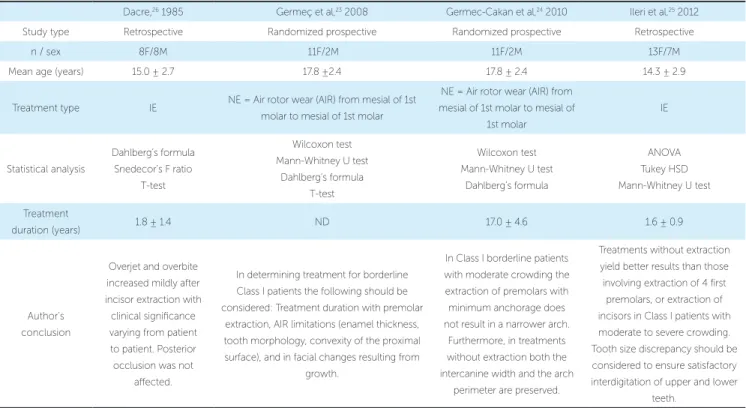
method-ological quality assessment. The reasons for exclusion were: no description of treatment used when refer-ring to nonextraction; lack of clear information on Table 5 - Data obtained from articles included.
F = females; M = males; IE = incisor extraction; NE = nonextraction (interproximal wear); ND = not declared.
Dacre,26 1985 Germeç et al,23 2008 Germec-Cakan et al,24 2010 Ileri et al,25 2012
Study type Retrospective Randomized prospective Randomized prospective Retrospective
n / sex 8F/8M 11F/2M 11F/2M 13F/7M
Mean age (years) 15.0 ± 2.7 17.8 ±2.4 17.8 ± 2.4 14.3 ± 2.9
Treatment type IE NE = Air rotor wear (AIR) from mesial of 1st
molar to mesial of 1st molar
NE = Air rotor wear (AIR) from mesial of 1st molar to mesial of
1st molar
IE
Statistical analysis
Dahlberg’s formula Snedecor’s F ratio
T-test
Wilcoxon test Mann-Whitney U test
Dahlberg’s formula T-test
Wilcoxon test Mann-Whitney U test
Dahlberg’s formula
ANOVA Tukey HSD Mann-Whitney U test
Treatment
duration (years) 1.8 ± 1.4 ND 17.0 ± 4.6 1.6 ± 0.9
Author’s conclusion
Overjet and overbite increased mildly after incisor extraction with clinical signiicance varying from patient to patient. Posterior occlusion was not
afected.
In determining treatment for borderline Class I patients the following should be considered: Treatment duration with premolar
extraction, AIR limitations (enamel thickness, tooth morphology, convexity of the proximal surface), and in facial changes resulting from
growth.
In Class I borderline patients with moderate crowding the extraction of premolars with minimum anchorage does not result in a narrower arch.
Furthermore, in treatments without extraction both the intercanine width and the arch
perimeter are preserved.
Treatments without extraction yield better results than those involving extraction of 4 first
premolars, or extraction of incisors in Class I patients with moderate to severe crowding. Tooth size discrepancy should be considered to ensure satisfactory interdigitation of upper and lower
teeth.
whether or not interproximal wear had been per-formed; treatment including dental arch expansion
or incisor protrusion;39,40,42-49 use of auxiliary
appli-ances;40 systematic review performed using some
other approach;37 description of clinical cases;16 and
whenever data from Class I, II and III groups were presented together, which precluded the use of data
from Class I patients, only.41
Only one22 out of the five articles selected for
methodological assessment was excluded due to low methodological quality and also because it failed to report the final results. Two out of the four articles included after qualifying addressed treatment with
incisor extraction25,26 while two reported using
inter-proximal wear.23,24
Mandibular wear performed in the study by
Ger-meç et al23 measured 5.1 ± 0.9 mm, with 2.0 ± 0.5 mm
in anterior lower teeth, only. To solve crowding of
4 mm to 8 mm, Sheridan50 advocates interproximal
reduction carried out mostly, but not exclusively, in the anterior segment. Wear should be limited to about 0.5 mm on each side of anterior teeth, and
50% of total enamel thickness.7 The areas of mandib-ular teeth where enamel thickness is greater are the
distal surfaces of lateral incisors2,7 and the mesial and
distal surfaces of canines.2
Germec-Cakan et al24 observed that cases in which
interproximal wear was carried out had a decrease in intermolar width whereas intercanine width and arch perimeter remained unchanged. This treatment allows the creation of a contact area between teeth,
which favors stability.6 When performed carefully,
interproximal wear yields a healthy dentition, which is not susceptible to periodontal disease and tooth
de-cay.29,51 There is a certain degree of concern,
how-ever, that a thin interdental alveolar septum might accelerate gingival attachment loss and the spread of
periodontal disease.52
According to Ileri et al,25 a PAR index
compari-son showed that malocclusions were corrected by ex-tracting mandibular incisors, which was indicated in
cases with mandibular anterior Bolton53 discrepancy
whereby the anterior ratio equals to 81.7 ± 4.5,25,
thereby corroborating other articles.5,13,16,17,18,25,37,38,54
This seems to suggest that in cases in which mandib-ular dental volume excess is smaller, the best
alterna-tive may be interproximal wear.15,16 The other groups
compared by Ileri et al25 (premolar extraction and
treatment without extraction) were assigned better scores after treatment, perhaps due to difficult inter-cuspation and/or overjet remaining in cases involving
mandibular incisor extraction.25 Thus, in these cases,
interproximal wear is indicated on maxillary anterior
teeth to correct remaining overjet.1,5 Priority should
be given to extracting incisors in patients with
de-creased overjet and overbite.13,16,18,20,37,38
Dacre26 showed in a follow-up of 16 patients, after
mandibular incisor extraction and retainer removal, that only five cases preserved good alignment, while seven had mild crowding relapse, one had moderate relapse, and three showed space opening. Intercanine width was slightly reduced, since extraction caused canines to move closer to the region where the dental
arch is narrower.26
Selection of the incisor to be extracted is usu-ally based on malposition, periodontal involvement,
color change, decay and/or fracture,1,18 factors which
are less likely to induce changes in profile,5,12 and arch
length.13 Loss of interdental papilla or formation of
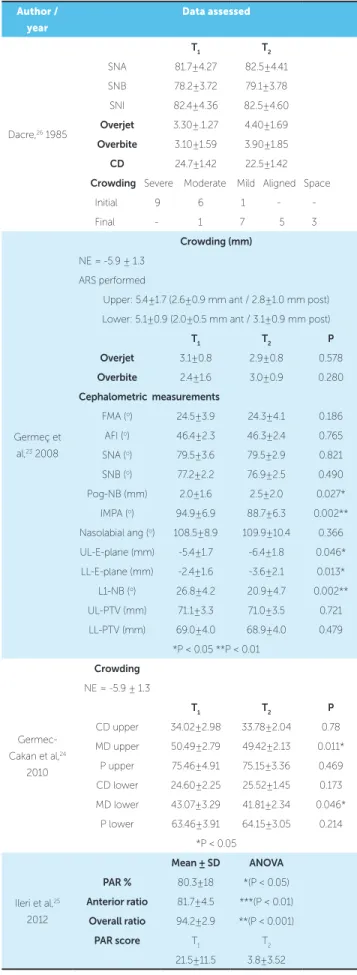
Table 6 - Data obtained from articles included.
Author / year
Data assessed
Dacre,26 1985
T1 T2
SNA 81.7±4.27 82.5±4.41
SNB 78.2±3.72 79.1±3.78
SNI 82.4±4.36 82.5±4.60
Overjet 3.30±.1.27 4.40±1.69
Overbite 3.10±1.59 3.90±1.85
CD 24.7±1.42 22.5±1.42
Crowding Severe Moderate Mild Aligned Space
Initial 9 6 1
Final - 1 7 5 3
Germeç et al,23 2008
Crowding (mm)
NE = -5.9 ± 1.3
ARS performed
Upper: 5.4±1.7 (2.6±0.9 mm ant / 2.8±1.0 mm post)
Lower: 5.1±0.9 (2.0±0.5 mm ant / 3.1±0.9 mm post)
T1 T2 P
Overjet 3.1±0.8 2.9±0.8 0.578
Overbite 2.4±1.6 3.0±0.9 0.280
Cephalometric measurements
FMA (o) 24.5±3.9 24.3±4.1 0.186
AFI (o) 46.4±2.3 46.3±2.4 0.765
SNA (o) 79.5±3.6 79.5±2.9 0.821
SNB (o) 77.2±2.2 76.9±2.5 0.490
Pog-NB (mm) 2.0±1.6 2.5±2.0 0.027*
IMPA (o) 94.9±6.9 88.7±6.3 0.002**
Nasolabial ang (o) 108.5±8.9 109.9±10.4 0.366
UL-E-plane (mm) -5.4±1.7 -6.4±1.8 0.046*
LL-E-plane (mm) -2.4±1.6 -3.6±2.1 0.013*
L1-NB (o) 26.8±4.2 20.9±4.7 0.002**
UL-PTV (mm) 71.1±3.3 71.0±3.5 0.721
LL-PTV (mm) 69.0±4.0 68.9±4.0 0.479
*P < 0.05 **P < 0.01
Germec-Cakan et al,24
2010
Crowding
NE = -5.9 ± 1.3
T1 T2 P
CD upper 34.02±2.98 33.78±2.04 0.78
MD upper 50.49±2.79 49.42±2.13 0.011*
P upper 75.46±4.91 75.15±3.36 0.469
CD lower 24.60±2.25 25.52±1.45 0.173
MD lower 43.07±3.29 41.81±2.34 0.046*
P lower 63.46±3.91 64.15±3.05 0.214
*P < 0.05
Ileri et al,25
2012
Mean ± SD ANOVA
PAR % 80.3±18 *(P < 0.05)
Anterior ratio 81.7±4.5 ***(P < 0.01)
Overall ratio 94.2±2.9 **(P < 0.001)
PAR score T1 T2
21.5±11.5 3.8±3.52
triangular space are examples of common undesirable
effects.13,16,37 From an esthetic point of view, teeth
with a triangular shape2,31 may benefit from
inter-proximal wear while those with a rectangular shape respond better to extraction.
Total treatment time was similar between the
studies by Ileri et al25 and Germec-Cakan et al;24 and
both were shorter when compared to the group in which premolars were extracted. Other authors also reported decreased treatment time due to incisor extraction.5,14,17,54
Patients with the following characteristics may benefit from mandibular incisor extraction:
Bolton’s tooth-size discrepancies ≥ 4 mm,5,12,13
,16,17,18,25,37,38,54 mild to moderate mandibular
crowd-ing,5,13,14,17-21,23,28,29,4 a tendency towards or moderate
Class III,1,16,37 Class I,1,12,13,16,17,18,20,25,26 or Class II
mal-occlusion,55 a pleasant facial profile,5,12,18,20 decreased
overjet and overbite,13,16,18,20,37,38 structurally and
peri-odontally compromised teeth, teeth with a
rectan-gular shape,1,18,19,37 supernumerary incisors,37 ectopic
eruption,37 TMD involving a retropositioned
mandi-ble,37 mild or nonexistent maxillary crowding,1,16,17,18,20
absence of or abnormality in the shape of maxillary
central or lateral incisors,17-20 patients with complete
growth,18,20 and treatment confirmed by set-up model
tests.1,5,13,14,18,19
Interproximal wear should be given priority when
aiming at conservative treatment2,30 with minor
chang-es in a pleasant profile,2,23,30 in Class I cases,2,9,23,24,30
cases without mandibular dental excess (Bolton
≤ 3 mm),15,16 mild to moderate mandibular
crowd-ing,2,16,23,24,30,31 normal overjet and overbite, low
inci-dence of caries,2 proper oral hygiene,31 teeth with a
triangular shape,2,31 potential for maxillary wear, and
treatment confirmed by set-up model tests.1,5,13,14,18,19
Several case reports1,2,5,9,12-15,17-21,30,31,38 addressing
the issue were not included, given their low evidence and inference that these cases were successful. Lack of high-methodological-quality articles is a limitation of the present study. Nevertheless, no studies have been found with good methodological quality comparing the two treatments in patients with Class I malocclu-sion, moderate crowding and pleasant facial profile.
However, there is credible evidence23,24,25 showing
that treatment involving interproximal wear and in-cisor extraction do help to improve malocclusion.
CONCLUSIONS
» Both mandibular incisor extraction and inter-proximal wear are effective to treat patients with Class I malocclusion with moderate anterior lower crowding, in permanent dentition and with a pleas-ant facial profile. There is, however, scpleas-ant evidence to determine the best treatment approach.
» Decreased overjet, overbite and Bolton’s tooth-size discrepancy were the most decisive parameters used to indicate mandibular incisor extraction.
» Clinical decision should be made on an indi-vidual basis by taking into account patient’s dental anatomical characteristics, crowding, dental and oral health conditions, expectations and the use of set-up models.
1. Kokich VO Jr. Treatment of a Class I malocclusion with a carious mandibular incisor and no Bolton discrepancy. Am J Orthod Dentofacial Orthop. 2000;118(1):107-13.
2. Harin J. Interproximal wear for the treatment of adult crowding. J Clin Orthod. 2000;34(7):424-33.
3. Motta AFJ, Souza MMG, Bolognese AM, Guerra CJ, Mucha JN. Display of the incisors as functions of age and gender. Aust Orthod J. 2010;26(1):27-32. 4. Pithon MM, Santos AM, Couto FS, Coqueiro RDS, Freitas LMA, Souza RA,
et al. Perception of the esthetic impact of mandibular incisor extraction treatment on laypersons, dental professional, and dental students. Angle Orthod. 2012;82(4):732-8.
5. Kokich VG, Shapiro PA. Lower incisor extraction in orthodontic treatment. Angle Orthod. 1984;54(2):139-53.
6. Tuverson DL. Anterior interocclusal relations. Part I. Am J Orthod Dentofacial Orthop. 1980;78(4):361-70.
7. Araújo SGA, Motta AFJ, Mucha JN. A espessura do esmalte interproximal dos incisivos inferiores. Rev SOB. 2005;5(2):93-106.
8. Germec-Cakan D, Taner TU, Akan S. Arch-width and perimeter changes in patients with borderline Class I malocclusion treated with extractions or without extractions with air-rotor wear. Am J Orthod Dentofacial Orthop. 2010;137(6):734.e1-7.
9. Mondelli AL, Siqueira DF, Freitas MRd, Almeida RR. Desgaste interproximal: opção de tratamento para o apinhamento. Rev Clín Ortod Dental Press. 2002;1(3):5-17.
35. Moher D, Liberati A, Tetzlaf J, Altman DG, Group Prisma. Preferred Reporting Items for Systematic Reviews and Meta-Analyses: The PRISMA Statement. Ann Int Med. 2009;151(4):264-70.
36. Moher D, Hopewel S, Schul KF, Montori V, Gøtzsche PC, Devereaux PJ, et al. CONSORT 2010 Explanation and Elaboration: updated guidelines for reporting parallel group randomised trials. J Clin Epidemiol. 2010;63(8):e1-37.
37. Zhylich D, Suri S. Mandibular incisor extraction: a systematic review of an uncommon extraction choice in orthodontic treatment. J Orthod. 2011;38(3):185-95.
38. Matsumoto MAN, Romano FL, Ferreira JTL, Tanaka S, Morizono EN. Lower incisor extraction: an orthodontic treatment option. Dental Press J Orthod. 2010;15(6):143-61.
39. Konstantonis D. The impact of extraction vs nonextraction treatment on soft tissue changes in Class I borderline malocclusions. Angle Orthod. 2012;82(2):209-17.
40. Weinberg M, Sadowsky C. Resolution of mandibular arch crowding in growing patients with Class I malocclusions treated nonextraction. Am J Orthod Dentofacial Orthop. 1996;110(4):359-64.
41. Uribe F, Holliday B, Nanda R. Incidence of open gingival embrasures after mandibular incisor extractions: a clinical photographic evaluation. Am J Orthod Dentofacial Orthop. 2011;139(1):49-54.
42. Aksu M, Kocadereli I. Arch width changes in extraction and nonextraction treatment in class I patients. Angle Orthod. 2005;75(6):948-52.
43. Basciftci FA, Usumez S. Efects of extraction and nonextraction treatment on class I and class II subjects. Angle Orthod. 2003;73(1):36-42.
44. Ismail SF, Moss JP, Hennessy R. Three-dimensional assessment of the efects of extraction and nonextraction orthodontic treatment on the face. Am J Orthod Dentofacial Orthop. 2002;121(3):244-56.
45. Hayasaki SM, Castanha Henriques JF, Janson G, Freitas MR. Inluence of extraction and nonextraction orthodontic treatment in Japanese-Brazilians with class I and class II division 1 malocclusions. Am J Orthod Dentofacial Orthop. 2005;127(1):30-6.
46. Akyalcin S, Hazar S, Guneri P, Gogus S, Erdinc AM. Extraction versus non-extraction: evaluation by digital subtraction radiography. Eur J Orthod. 2007;29(6):639-47.
47. Wes Fleming J, Buschang PH, Kim KB, Oliver DR. Posttreatment occlusal variability among angle Class I nonextraction patients. Angle Orthod. 2008;78(4):625-30.
48. Erdinc AE, Nanda RS, Işiksal E. Relapse of anterior crowding in patients treated with extraction and nonextraction of premolars. Am J Orthod Dentofacial Orthop. 2006;129(6):775-84.
49. Bowman SJ, Johnston LE. The esthetic impact of extraction and nonextraction treatments on Caucasian patients. Angle Orthod. 2000;70(1):3-10.
50. Sheridan JJ. Air-rotor Wear Update. J Clin Orthod. 1987;21(11):781-8. 51. Artun J, Kokich VG, Osterberg SK. Long-term efect of root proximity on
periodontal health after orthodontic treatment. Am J Orthod Dentofacial Orthop. 1987;91(2):125-30.
52. Vermylen K, Quincey GNTd, Wolfe GN, Hof MAVt, Renggli HH. Root proximity as a risk marker for periodontal disease: a case-control study. J Clin Periodol. 2005;32(3):260-5.
53. Bolton WA. Disharmony in tooth size and its relation to the analysis and treatment of malocclusion. Angle Orthod. 1958;28(3):113-30.
54. Safavi SM, Namazi AH. Evaluation of mandibular incisor extraction treatment outcome in patients with Bolton discrepancy using peer assessment rating index. J Dent. 2012;9(1):27-34.
55. Borzabadi-Farahani A. A review of the oral health-related evidence that supports the orthodontic treatment need indices. Prog Orthod. 2012;13(3):314-25.
10. Guerrero CA, Bell WH, Contasti GI, Rodriguez AM. Mandibular widening by intraoral distraction osteogenesis. Br J Oral Maxillofac Surg. 1997;35(6):383-92.
11. Del Santo Júnior M, English JD, Wolford LM, Gandini LG. Midsymphyseal distraction osteogenesis for correcting transverse mandibular discrepancies. Am J Orthod Dentofacial Orthop. 2002;121(6):629-38. 12. Grob DJ. Extraction of a mandibular incisor in a Class I malocclusion. Am J
Orthod Dentofacial Orthop. 1995;108(5):533-41.
13. Bayram M, Özer M. Mandibular incisor extraction treatment of a Class I malocclusion with Bolton Discrepancy: a case report. Eur J Dent. 2007;1(1):54-9.
14. Valinot JR. Mandibular incisor extraction therapy. Am J Orthod Dentofacial Orthop. 1994;105(2):107-16.
15. Raju DS, Veereshi A, Naidu DL, Raju BR, Goel M, Maheshwari A. Therapeutic extraction of lower incisor for orthodontic treatment. J Contemp Dent Pract. 2012;13(4):574-7.
16. Uribe F, Nanda R. Considerations in mandibular incisor extraction cases. J Clin Orthod. 2009;43(1):45-51.
17. Bahreman A-A. Lower incisor extraction in orthodontic treatment. Am J Orthod Dentofacial Orthop. 197;72(5):560-7.
18. Miller RJ, Duong TT, Derakhshan M. Lower incisor extraction treatment with the Invisalign System. J Clin Orthod. 2002;36(2):95:102. 19. Tuverson DL. Anterior interocclusal relations. Part II. Am J Orthod.
1980;78(4):371-93.
20. Owen AH. Single lower incisor extractions. J Clin Orthod. 1993;27(3):153-60. 21. Sheridan JJ, Hastings J. Air-rotor wear and lower incisor extraction
treatment. J Clin Orthod. 1992;26(1):18-22.
22. Biondi G. Extraction of a lower incisor in adult orthodontic treatment: An acceptable compromise? L’extraction d’une incisive inférieure dans le traitement orthodontique de l’adulte: Un compromis acceptable? Int Orthod. 2006;4:63-72.
23. Germeç D, Taner TU. Efects of extraction and nonextraction therapy with air-rotor wear on facial esthetics in postadolescent borderline patients. Am J Orthod Dentofacial Orthop. 2008;133(4):539-49.
24. Germec-Cakan D, Taner TU, Akan S. Arch-width and perimeter changes in patients with borderline Class I malocclusion treated with extractions or without extractions with air-rotor wear. Am J Orthod Dentofacial Orthop. 2010;137(6):734.e1-7.
25. Ileri Z, Basciftci FA, Malkoc S, Ramoglu SI. Comparison of the outcomes of the lower incisor extraction, premolar extraction and non-extraction treatments. Eur J Orthod. 2012;34(6):681-85.
26. Dacre JT. The long term efects of one lower incisor extraction. Eur J Orthod. 1985;7(2):136-44.
27. Peck H, Peck S. An index for assessing tooth shape deviations as applied to the mandibular incisors. Am J Orthod Dentofacial Orthop. 1972;61(4):384-401.
28. Sheridan JJ, Ledoux PM. Air-rotor wear and proximal sealants. J Clin Orthod. 1989;23(12):790-4.
29. Zachrisson BU, Nyoygaard L, Mobarak K. Dental health assessed more than 10 years after interproximal enamel reduction of mandibular anterior teeth. Am J Orthod Dentofacial Orthop. 2007;131(2):162-9.
30. Capelli Júnior J, Cardoso M, Rosembach G. Tratamento do apinhamento ântero-inferior por meio de desgaste interproximal. Rev Bras Odontol. 1999;56(4):107-3.
31. Nojima LI. Tratamento conservador de uma má oclusão Classe I de Angle, com atresia maxilar e apinhamento anterior. Dental Press J Orthod. 2011;16(5):163-71.
32. Del Santo M Jr, Guerrero CA, Buschang PH, English JD, Samchukov ML, Bell WH. Long-term skeletal and dental efects of mandibular symphyseal distraction osteogenesis. Am J Orthod Dentofacial Orthop. 2000;118(5):485-93.
33. Maia LGM, Gandini Jr LG, Gandini MREAS, Moraes ML, Monini AC. Distração osteogênica da sínfese mandibular como opção de tratamento ortodôntico: relato de caso. Rev Dental Press Ortod Ortop Facial. 2007;12(5):34-45.