173
CLINICS 60(2):173-176, 2005
From the Hypertension Unit, Heart Institute, Hospital das Clínicas, Faculty of Medicine, University of São Paulo – São Paulo/SP, Brazil.
E-mail: [email protected]
Received for publication on June 08, 2004. Accepted for publication on November 24, 2004.
LETTER TO THE EDITOR
INCREASED ARTERIAL DISTENSIBILITY AND
RENOVASCULAR HYPERTENSION IN GOLDENHAR
SYNDROME
Luciano F. Drager, Hélio Bernardes Silva, and Luiz A. Bortolotto
DRAGER LF et al. Increased arterial distensibility and renovascular hypertension in goldenhar syndrome. CLINICS 60(2):173-176, 2005.
This is a report of the successful angioplastic treatment of an association of renovascular hypertension with renal artery stenosis and the Goldenhar syndrome (a variant of oculoauriculovertebral dysplasia). For the first time to date, this association, which occurred in a 13-year-old girl, is reported. Additionally, increased arterial distensibility in spite of arterial hypertension was detected by noninvasive methods. The similarity of this finding and in those for other genetic diseases, suggests that the vascular lesions could be linked to the Goldenhar syndrome.
KEYWORDS: Goldenhar syndrome. Renovascular hypertension. Arterial distensibility.
Goldenhar syndrome, a variant of oculoauriculo-vertebral dysplasia, includes a wide spectrum of anomalies characterized by a combination of hemifacial microsomia and other findings such as epibulbar dermoids or lipodermoids, microtia, auricular appendages, mandibular hypoplasia, vertebral anomalies,1 and malformations in
sev-eral organs, including the heart.2 Embryologically, the
oculoauriculovertebral defect has been called an anomaly of the first branchial arch,2 but this alteration does not
ex-plain anomalies in the brain, heart, kidneys, or spine.3
Despite numerous case reports,the condition is still poorly understood. In the largest study describing phenotypic characteristics of 294 individuals with oculoauriculovertebral dysplasia and variants, 5% had car-diovascular abnormalities, including cardiomegaly, cardiac vessel anomalies, ventricular hypertrophy, atrial and ven-tricular septal defects, tetralogy of Fallot, arterial anoma-lies, aortic stenosis, and pulmonary artery anomalies.4
An unusual association of this syndrome and renovas-cular hypertension that has not yet been described is
re-ported in this paper. Moreover, an analysis of aortic disten-sibility by pulse wave velocity measurement and carotid distensibility with an echo-tracking device to evaluate pos-sible elastic disturbances of the large arteries associated with this syndrome are performed.
CASE REPORT
A 13-year-old girl was admitted with a recent diagnosis of stage 2 arterial hypertension according to the VII Joint National Comitee.5She had previously been diagnosed with
Goldenhar syndrome, characterized by fibroma in left fe-mur, asymmetry of legs, convergent strabismus in the left eye, corneal anomaly, epibulbar dermoids, facial asymme-try (Figure 1), mandibular hypoplasia, low implantation of the left ear, flat plane hemangioma on the left index finger, and vertebral abnormalities (facio-auriculo-vertebral spec-trum). In order to treat her hypertension, an antihyperten-sive therapy with a low sodium diet, captopril 50 mg/day, and propranolol 40 mg/day was introduced.
174
CLINICS 60(2):173-176, 2005 Increased arterial distensibility and renovascular hypertension
Drager LF et al.
truncus arteriosus was detected and was surgically repaired. Routine laboratory tests and echocardiography were normal. The electrocardiogram showed signs of left ven-tricular overload. Kidney ultrasonography showed a small right kidney (74 mm) and a normal left kidney (100 mm). Renal scintigraphy showed a decreased perfusion in the right kidney (20%) compared to the left kidney. A radioim-munoassay for the measurement of plasmatic renin activity detected a high level - 18 ng/mL/h (normal range, 01 to 2.3 ng/mL/h).
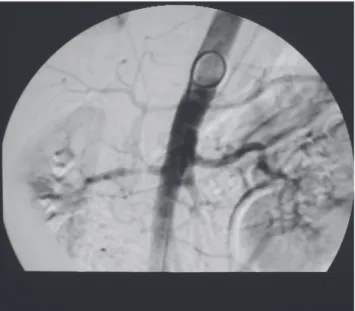
The digital arteriography showed a tightly stenotic le-sion (80%) in the proximal right renal artery (Figure 2). The patient underwent an aorto-right renal artery bypass with-out complications. Intraoperative anatomical findings of renal artery were compatible with the diagnosis of fibrodysplasia of the renal artery.
In order to evaluate arterial distensibility, a pulse wave velocity analysis by CompliorÒ was performed and revealed
a value of 5.4 m/s (lower than mean values obtained from 10 healthy age-matched women – 7.2 ± 1.2 m/s). A high definition ultrasound with an echo-tracking device (Wall Track SystemÒ) of carotid artery was also performed and
re-vealed a distensibility of 53.5 kPa-1 10-3 (higher than mean
values obtained from 10 healthy age-matched women –
20.7 ± 5 kPa-1 10-3), suggesting a high distensibility of the
large arteries in this patient (Figure 3).
Figure 1 - Reported patient, now aged 18. Patient has given written authorization for the publication of this picture.
Figure 2 - Renal arteriography showing right renal artery stenosis (arrow).
175
CLINICS 60(2):173-176, 2005 Increased arterial distensibility and renovascular hypertension Drager LF et al.
After four years, she remained asymptomatic, with her blood pressure under control with the use of enalapril 5 mg/ day and a preserved renal function. Renal scintigraphy showed an improvement of the right kidney flow.
DISCUSSION
For the first time to date, an association of renovascular hypertension with renal artery stenosis and Goldenhar syn-drome is reported. Additionally, an increased arterial dis-tensibility despite the arterial hypertension has been de-tected by noninvasive methods when what is usually ob-served is a reduced distensibility in large elastic arteries but an unchanged distensibility of middle size arteries.6
In Goldenhar syndrome, the main phenotypic findings include microtia, mandibular hypoplasia, vertebral anoma-lies, and epibulbar dermoids or lipodermoids. However, many patients have been reported presenting with associated multisystem complex anomalies within this disorder includ-ing alterations in respiratory, skin, skeletal, genitourinary, gastrointestinal, central nervous, muscular, and endocrine sys-tems.4 Cardiovascular abnormalities were described only in
5% of the cases. However, the real frequency of cardiovas-cular malformations of Goldenhar syndrome is unknown, since great variability is reported in the literature (5% to 58%).7 The main reason for this variation are selection bias
and differences in diagnostic criteria adopted.
Previous reports essentially described congenital heart diseases, and tetralogy of Fallot is the most common car-diac malformation encountered, occurring in 6 of 13 cases of Goldenhar syndrome.8 Other cardiovascular
malforma-tions reported include coarctation of the aorta, patent duc-tus arteriosus, transposition of the great arteries, dextrocar-dia with situs solitus, atrial and ventricular septal defects, anomalous origin of the coronary arteries, right-sided de-scending aorta, anomalous inferior and superior venae ca-vae, and arrhythmic disturbances, such as the Wolff-Parkinson-White syndrome. The reported patient had a sur-gically corrected patent ductus arteriosus. However, none of the previous reports mentioned arterial hypertension or renal artery stenosis in patients with Goldenhar syndrome.
Another unusual feature of this case is the increased dis-tensibility of aorta and carotid artery. This finding is simi-lar to those described in other genetic disorders, including Williams syndrome,9 Ehlers-Danlos syndrome,10 and Fabry
disease. In Williams syndrome, using the same echo-track-ing device we used, the authors demonstrated a higher ca-rotid distensibility related to the disruption of the elastin gene,9 while in patients with Ehlers-Danlos syndrome, a
lower pulse wave velocity was observed, as noted in the
reported patient, due to a deficiency of type II collagen oc-curring with this syndrome.10
A variety of diseases can lead to renovascular hyper-tension in childhood.11 Fibrodysplasia is the most frequent
cause, but thromboembolism, inflammatory stenoses, athero-sclerosis, tumors, retroperitoneal fibrosis, and genetic dis-orders are other possible causes. The most common geneti-cally determined disorder is neurofibromatosis, an auto-somal-dominant congenital dysplasia of ectodermal and mesodermal tissues characterized by café-au-lait spots, cu-taneous fibromas, neurofibromas and vascular lesions.12 In
adult patients with neurofibromatosis, the etiology of hy-pertension is commonly related to concomitant pheochro-mocytoma, while in pediatric patients it is usually related to renal artery stenosis.13 Unlike fibromuscular dysplasia,
neurofibromatosis often affects the intrarenal arteries and arterioles in the form of stenosis or bilateral saccular aneu-rysms.14 The vascular lesions in neurofibromatosis include
pure intimal lesions; advanced intimal lesions and medial changes; nodular aneurysmal lesions with loss of media el-ements; periarterial nodular abnormalities; and epithelioid lesions with marked cellular proliferation. In all of these forms, proliferation of spindle cells occurs within arterial walls and may be responsible for the associated internal elastic membrane disruption, degeneration, and protrusion into the media.14
Another possibility to consider in differential diagno-sis is Williams syndrome, also known as idiopathic hypercalcemia of infancy or the supravalvar aortic stenosis complex. This syndrome is characterized by hypercalcemia in infancy; short stature; “elfin facies”; mental retardation; and stenosis of the aorta, pulmonary, and peripheral sys-temic arteries.15 Like other genetically based disorders, such
as the Klippel-Trenaunay-Weber syndrome (cutaneous cap-illary malformation, abnormal development of the deep and superficial veins, limb asymmetry, and mixed vascular mal-formations), the renal lesions in these patients appear to be in the category of fibromuscular dysplasia.
176
CLINICS 60(2):173-176, 2005 Increased arterial distensibility and renovascular hypertension
Drager LF et al.
RESUMO
DRAGER LF e col. Aumento de distensibilidade arterial e hipertensão renovascular na Sindrome de Goldenhar. CLINICS 60(2):173-176, 2005.
Relatamos a associação de hipertensão renovascular por estenose de artéria renal e a Sindrome de Goldenhar (variante da displasia oculoauriculovertebral) em uma paciente do sexo feminino de 13 anos de idade. Este é o primeiro relato de tratamento por angioplastia. Além disso,
detectamos por métodos não invasivos um aumento da distensibilidade arterial, a despeito da hipertensão arterial. A similaridade destes achados com outras doenças genéticas sugere que as alterações vasculares presentes podem estar relacionadas à Síndrome de Goldenhar.
UNITERMOS: Síndrome de Goldenhar. Hipertensão renovascular. Distensibilidade Arterial.
REFERENCES
1. Gorlin RJ, Jue KL, Jacobsen U, Goldschmidt E. Oculoauriculovertebral dysplasia. J Pediatr 1963;63:991-9. 2. van Bever Y, van den Ende JJ, Richieri-Costa A.
Oculo-auriculo-vertebral complex and uncommon associated anomalies: Report on 8 unrelated Brazilian patients. Am J Med Genet 1992;44:683-90.
3. Sugar HS. The oculoauriculovertebral dysplasia syndrome of Goldenhar. Am J Ophtalmol 1966;62:678-82.
4. Rollnick BR, Kaye CI, Nagatoshi K, Hauck W, Martin AO. Oculoauriculovertebral dysplasia and variants: Phenotypic characteristics of 294 patients. Am J Med Genet 1993;26:361-75.
5. Chobanian AV, Bakris GL, Black HR, Cushman WC, Green LA, Izzo JL Jr, et al. The seventh report of the Joint National Committee on prevention, detection, evaluation, and treatment of high blood pressure. JAMA 2003;289:2560-72.
6. Mancia G, Giannattasio C. Arterial distensibility and pulse pressure. Measurements and clinical significance in hypertension. Clin Exp Hypertens 1999;21(5-6):615-33.
7. Kumar A, Friedman JM, Taylor GP, Patterson MW. Pattern of cardiac malformation in oculoauriculovertebral spectrum. Am J Med Genet 1993;46(4):423-6.
8. Greenwood RD et al. Cardiovascular malformations in oculoauriculovertebral dysplasia (Goldenhar syndrome). J Pediatr 1974;85:816-8.
9. Francois B, De Paepe A, Matton MT, Clement D. Pulse wave velocity recordings in a family with ecchymotic Ehlers-Danlos syndrome. Int Angiol 1986;5(1):1-5.
10. Lacolley P et al. Disruption of the elastin gene in adult Williams syndrome is accompanied by a paradoxical reduction in arterial stiffness. Clin Sci (Lond) 2002;103(1):21-9.
11. Ingelfinger JR. Renovascular disease in children. Kidney Int 1993;43(2):493-505.
12. Tilford DL, Kelsch RC. Renal artery stenosis in childhood neurofibromatosis. Am J Dis Child 1973;126(5):665-8. 13. Pollard SG, Hornick P, Macfarlane R, Calne RY. Renovascular
hypertension in neurofibromatosis. Postgrad Med J 1989;65:31-3.
14. Nakhoul F, Green J, Angel A, Ofer A, Ben-Izhak O, Lewin M. Renovascular hypertension associated with neurofibromatosis: two cases and review of the literature. Clin Nephrol 2001;55(4):322-6.