Hospital das Clínicas, São Paulo University Medical School – São Paulo/SP, Brazil.
Email: [email protected]
Received for publication on January 27, 2006. Accepted for publication on March 17, 2006.
ORIGINAL RESEARCH
HYPERTONIC SALINE SOLUTION INCREASES
CEREBRAL PERFUSION PRESSURE DURING
CLINICAL ORTHOTOPIC LIVER TRANSPLANTATION
FOR FULMINANT HEPATIC FAILURE: PRELIMINARY
RESULTS
Joel Avancini Rocha Filho, Marcel Autran C. Machado, Ricardo Souza Nani, João Plínio S. Rocha, Estela R. R. Figueira, Telesforo Bacchella, Maurício Rocha-e-Silva, José Otávio C. Auler Jr., and Marcel C. C. Machado
Rocha Filho JA, Machado MAC, Nani RS, Rocha JPS, FigueiraERR, Bacchella T et al. Hypertonic saline solution increases cerebral perfusion pressure during clinical orthotopic liver transplantation for fulminant hepatic failure: preliminary results. Clinics. 2006;61(3):231-8.
During orthotopic liver transplantation for fulminant hepatic failure, some patients may develop sudden deterioration of cerebral perfusion and oxygenation, mainly due to increased intracranial pressure and hypotension, which are likely responsible for postoperative neurological morbidity and mortality. In the present study, we hypothesized that the favorable effects of hypertonic saline solution (NaCl 7.5%, 4 mL/kg) infusion on both systemic and cerebral hemodynamics, demonstrated in laboratory and clinical settings of intracranial hypertension and hemorrhagic shock resuscitation, may attenuate the decrease in cerebral perfusion pressure that often occurs during orthotopic liver transplantation for fulminant hepatic failure.
METHODS: 10 patients with fulminant hepatic failure in grade IV encephalopathy undergoing orthotopic liver transplantation with intracranial pressure monitoring were included in this study. The effect on cerebral and systemic hemodynamics in 3 patients who received hypertonic saline solution during anhepatic phase (HSS group) was examined, comparing their data with historical controls obtained from surgical procedure recordings in 7 patients (Control group). The maximal intracranial pressure and the corresponding mean arterial pressure values were collected in 4 time periods: (T1) the last 10 min of the dissection phase, (T2) the first 10 minutes at the beginning of anhepatic phase, (T3) at the end of the anhepatic phase, and (T4) the first 5 minutes after graft reperfusion.
RESULTS: Immediately after hypertonic saline solution infusion, intracranial pressure decreased 50.4%. During the first 5 min of reperfusion, the intracranial pressure remained stable in the HSS group, and all these patients presented an intracranial pressure lower than 20 mm Hg, while in the Control group, the intracranial pressure increased 46.5% (P < 0.001). The HSS group was the
most hemodynamically stable; the mean arterial pressure during the first 5 min of reperfusion increased 21.1% in the HSS group and decreased 11.1% in the Control group (P < 0.001). During the first 5 min of reperfusion, cerebral perfusion pressure increased
28.3% in the HSS group while in the Control group the cerebral perfusion pressure decreased 28.5% (P < 0.001). Serum sodium
at the end of the anhepatic phase and 3 hours after reperfusion was significantly higher in the HSS group (153.00 ± 2.66 and 149.00 ± 1.73 mEq/L) than in the Control group (143.71 ± 3.30 and 142.43 ± 1.72 mEq/L), P = 0.003 and P < 0.001 respectively. CONCLUSION: Hypertonic saline solution can be successfully used as an adjunct in the neuroprotective strategy during orthotopic liver transplantation for fulminant hepatic failure, reducing intracranial pressure while restoring arterial blood pressure, promoting sustained increase in the cerebral perfusion pressure.
KEYWORDS: Hypertonic saline solution. Liver transplantation. Reperfusion. Anesthesia. Liver failure. Hepatic encephalopathy. Intracranial hypertension.
INTRODUCTION
coagulopathy complicating acute liver injury.1 Fulminant
he-patic failure results in progressive multi-organ failure with a dramatic impact in the brain. Brain edema is a frequent find-ing, occurring in up to 80% of patients with grade IV encepha-lopathy, which ultimately leads to intracranial hypertension (IH). These conditions are major causes of death in FHF.2,3
Many articles have highlighted the close relationship between the process that results in brain edema and the pathogenesis of hepatic encephalopathy (HE).3–5 The management of
pa-tients with FHF is aimed mainly in preventing or reversing increased intracranial pressure (ICP) associated with support treatment for other failed organs. The definitive treatment for patients with FHF is liver replacement.
During orthotopic liver transplantation (OLT), patients may develop sudden deterioration of cerebral perfusion and oxygenation, mainly due to the combination of increased in-tracranial pressure and hypotension, despite aggressive moni-toring and therapy.6–8 All current treatment modalities are far
from perfect and are associated with serious adverse events:9– 12 indiscriminate hyperventilation can lead to brain ischemia;
mannitol can cause renal insufficiency and rebound ICP el-evation; and barbiturates are associated with cardiovascular depression and prolonged coma.13 Failure to regain
con-sciousness or occurrence of significant postoperative neuro-logical sequelae despite satisfactory graft function has been reported,2,14,15 and may be caused by further brain damage
from events occurring during surgery, indicating that peri-transplantation neuroprotection must be improved.
Contemporary interest in hypertonic saline solution (HSS) was triggered in 1980, when Velasco et al16
demon-strated that a bolus injection of 7.5% NaCl (4 mL/kg) rap-idly restored arterial pressure in severely hemorrhaged dogs. In animal experiments, HSS consistently has been shown to reduce ICP consequent to head trauma.17 In
clini-cal trials, the beneficial effects of HSS during hemorrhagic shock in the presence of intracranial hypertension associ-ated with systemic hypotension have been noted.18,19
In-creasing evidence suggests important advantages in HSS resuscitation, namely, reduction in postresuscitation com-plications such as renal failure, coagulopathies, and acute respiratory distress syndrome, possibly by modulation of the systemic inflammatory response.20–22 The findings that
HSS induces favorable effects on both systemic and cer-ebral hemodynamics in laboratory and clinical settings of IH suggest a potential use of this solution during OLT for FHF. This study presents the preliminary results of the use of HSS during OLT for FHF.
PATIENTS AND METHODS
Ten patients with FHF undergoing OLT with ICP
moni-toring were included in this study. Systemic and cerebral hemodynamics effects of HSS infusion in 3 patients (HSS group) were compared to the data obtained from historical controls in 7 patients (Control group) who underwent liver transplants between January 1999 and December 2004. Only patients who had stage IV encephalopathy and at least 1 episode of IH (defined by ICP >20 mm Hg) before sur-gery were included in this study. The local hospital ethics committee (CAPPesq HCFMUSP) approved the study pro-tocol, and in the HSS group, written informed consent was obtained from next of kin.
The HSS group received HSS (NaCl 7.5%, 4 mL/kg) through a central line over a period of 10 minutes at the beginning of portal vein anastomosis. One of these patients (patient 2) received a half dose (2 mL/kg) at the beginning of anhepatic phase to control refractory IH occurred dur-ing native liver removal, and the remaindur-ing 2 mL/Kg was given at the scheduled time.
Monitoring of ICP was performed by intraparenchymal device (Camino Systems, San Diego, CA, USA) with con-tinuous recording during the operation. The maximal ICP and the corresponding mean arterial pressure (MAP) val-ues were collected during the following time periods: (T1) the last 10 min of the dissection phase, (T2) the first 10 minutes at the beginning of anhepatic phase, (T3) at the end of the anhepatic phase, and (T4) the first 5 minutes after graft reperfusion. Serum sodium was analyzed at 3 moments: at the beginning of surgery, at the end of anhepatic phase, and 3 hours after reperfusion.
The aim of management was to maintain a mean ICP below 20 mm Hg and cerebral perfusion pressure (CPP = MAP – ICP) above 50 mm Hg. Therapy to control ICP (mannitol, thiopental, hyperventilation, and head-up posi-tion at 30°) was instituted whenever the mean ICP became greater than 25 mm Hg.
Liver transplantation was either performed with pres-ervation of the recipient’s inferior vena cava during hepa-tectomy (“piggy-back” technique) or with resection of the recipient’s retrohepatic inferior vena cava without using veno-venous bypass (conventional technique). All livers were hypothermically preserved with iced Belzer UW cold storage solution (Bristol-Myers Squibb, Princeton, NJ, USA). Before reperfusion, liver grafts were flushed with 750 mL of lactated Ringer’s solution, via the portal vein. The hepatic artery was reconstructed after reperfusion.
After data collection, the corresponding CPP for each time period (T1 – T4) was calculated, and parameter evo-lution was analyzed as the difference between the time pe-riods. Data are presented as mean and standard deviation (Table 1). Statistical analysis was performed by t test; P <
RESULTS
In the 3 patients of the HSS group, the ICP decreased immediately after HSS infusion (36.3 ± 12.5 mm Hg at the beginning of anhepatic phase vs. 18.0 ± 4.6 mm Hg at the end of anhepatic phase) (Figure 1). In one patient (patient 2), a half dose of HSS administrated at the beginning of anhepatic phase lowered a mannitol refractory surge in ICP from 45 to 19 mm Hg. In this group, the ICP remained con-sistently below 25 mm Hg from HSS administration through graft reperfusion (18.0 ± 4.6 mm Hg after HSS in-fusion vs. 18.0 ± 1.0 mm Hg in the first 5 min after reperfusion), and no patient developed new episodes of in-tracranial hypertension (Table 1, Figure 1). During the first 5 minutes after reperfusion, all these patients presented ICP lower than 20 mm Hg.
In the Control group at the beginning of anhepatic phase, 3 patients presented IH and a CPP lower than the critical level of 40 mm Hg, requiring thiopental and man-nitol therapy. Intracranial pressure and CPP promptly nor-malized in all treated patients; no other episodes of
intrac-ranial hypertension occurred during the anhepatic phase. Cerebral perfusion pressure improved slightly during the anhepatic phase (42.6 ± 11.3 mm Hg at the beginning of the anhepatic phase vs. 53.3 ± 10.6 mm Hg at the end of the anhepatic phase), and at the end of this phase, all pa-tients presented an ICP below 25 mm Hg (Table 1, Fig-ures 1 and 2). During reperfusion, all patients in this group presented a rise in ICP (15.9 ± 3.0 mm Hg at the end of anhepatic phase vs. 23.3 ± 7.4 mm Hg within the first 5 min of reperfusion) (Table 1, Figure 1). Three of these pa-tients presented IH during reperfusion.
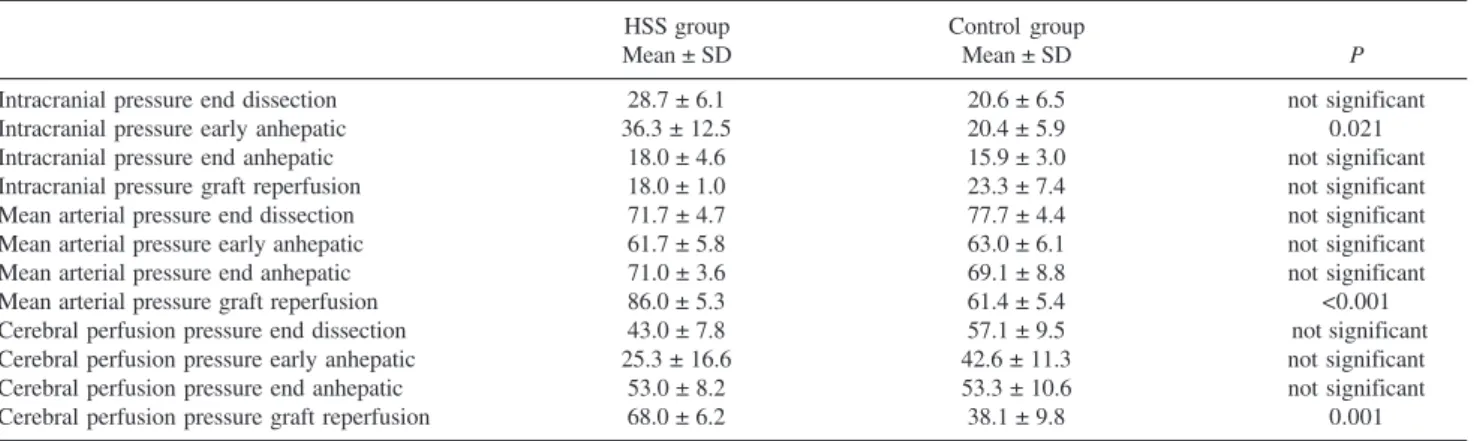
The HSS group presented a greater hemodynamic sta-bility than the Control group within 5 minutes after graft reperfusion (MAP, 86.0 ± 5.3 and 61.4 ± 5.4 mm Hg, re-spectively, P < 0.001) (Table 1, Figure 3). Increased
hemodynamic stability in the HSS group was also docu-mented by the absence of postreperfusion syndrome, as de-termined by MAP < 60 mm Hg within the first 5 minutes after reperfusion (0/3 in the HSS group vs 3/7 in the Con-trol group).
Cerebral perfusion pressure decreased in both groups Table 1 - Mean Systemic and Cerebral Hemodynamic Values (mm Hg)
HSS group Control group
Mean ± SD Mean ± SD P
Intracranial pressure end dissection 28.7 ± 6.1 20.6 ± 6.5 not significant
Intracranial pressure early anhepatic 36.3 ± 12.5 20.4 ± 5.9 0.021
Intracranial pressure end anhepatic 18.0 ± 4.6 15.9 ± 3.0 not significant
Intracranial pressure graft reperfusion 18.0 ± 1.0 23.3 ± 7.4 not significant
Mean arterial pressure end dissection 71.7 ± 4.7 77.7 ± 4.4 not significant
Mean arterial pressure early anhepatic 61.7 ± 5.8 63.0 ± 6.1 not significant
Mean arterial pressure end anhepatic 71.0 ± 3.6 69.1 ± 8.8 not significant
Mean arterial pressure graft reperfusion 86.0 ± 5.3 61.4 ± 5.4 <0.001
Cerebral perfusion pressure end dissection 43.0 ± 7.8 57.1 ± 9.5 not significant
Cerebral perfusion pressure early anhepatic 25.3 ± 16.6 42.6 ± 11.3 not significant
Cerebral perfusion pressure end anhepatic 53.0 ± 8.2 53.3 ± 10.6 not significant
Cerebral perfusion pressure graft reperfusion 68.0 ± 6.2 38.1 ± 9.8 0.001
Figure 3 – Mean Arterial Pressure Figure 2 – Cerebral Perfusion Pressure
at the beginning of the anhepatic phase (41.2% in the HSS group vs 25.4% in the Control group, NS). Cerebral perfusion pressure during the anhepatic phase rose 109.5% in the HSS group vs 25.1% in the Control group, P = 0.059.
The improvement in CPP during the anhepatic phase was secondary to a decrease in ICP (50.4% in the HSS group vs 22.1% in Control group) associated with an increase in MAP (15.1% in HSS group vs 9.7% in the Control group). Reperfusion was accompanied by a further increase of 28.3% in CPP in the HSS group, while in the Control group there was a decrease of 28.5%, (P < 0.001) (Figure 2).
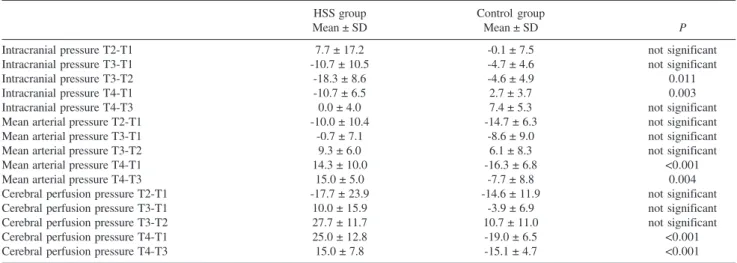
Dur-ing graft reperfusion, the HSS group had no ICP variation along with a MAP increase of 21.1%, whereas in the Con-trol group the ICP increased 46.5% and MAP decreased 11.1% (Table 2, Figures 1 and 3).
All patients in the HSS group had an intraoperative rise in serum sodium. Serum sodium at the end of anhepatic phase and 3 hours after reperfusion was significantly higher in the HSS group (153.00 ± 2.66 and 149.00 ± 1.73 mEq/ L) than in the Control group (143.71 ± 3.30 and 142.43 ±
1.72 mEq/L), P = 0.003 and P < 0.001, respectively. At 3
hours after graft reperfusion, all patients presented serum sodium levels close to normality (normal range, 135 – 148 mEq/L) (Figure 4).
In the HSS group, 1 patient developed primary graft nonfunction and died on the second postoperative day. The other 2 patients regained consciousness within first week after OLT without any neurological damage.
In the Control group, there was 3 early deaths. The 2 patients who experienced the lowest CPP during surgery died; one died 2 hours after reperfusion and the other 8 hours after surgery. The third patient never regained con-science despite satisfactory graft function and died from multiple organ failure. The remaining 4 patients regained conscience after OLT; 1 died from sepsis, and the other 3 made good recoveries.
DISCUSSION
cer-ebral hemodynamics in patients with FHF during OLT. In this study, HSS infusion led to an immediate decrease in ICP and to a marked rise in CPP. In all patients, the ICP remained consistently below 25 mm Hg from HSS admin-istration through graft reperfusion, and no patient devel-oped new episodes of IH. In our study, HSS proved to be effective in preventing and treating surges in ICP that of-ten occur in patients with cerebral edema undergoing OLT. The progressive rise in CPP between HSS administration and graft reperfusion was supported by the reduction and maintenance of ICP within security levels combined with more favorable hemodynamic profiles during reperfusion.
Several centers that perform liver transplantation for FHF have observed that patients for whom ICP had been controlled prior transplantation experience recurrence of increased ICP during surgery despite aggressive
monitor-ing and therapy. Intraoperative care requires judicious use of fluids and pressors to maintain hemodynamic profiles and avoid increases of ICP during the entire procedure. A decrease in CPP is observed during liver transplantation for FHF when a decrease in blood pressure and cardiac out-put may be associated with an increase in ICP.6-8 In FHF, a
systemic inflammatory response syndrome occurs in most of the patients,23 thus complicating hemodynamic and ICP
control during surgery. Failure to regain consciousness de-spite satisfactory graft function may be caused by further damage to the brain from these events that frequently oc-cur during surgery.
Evidence has been accumulating from case series and small randomized trials, showing that HSS may be an ef-fective treatment for brain edema and elevated ICP after head trauma.24,25 The beneficial effects of HSS during
Table 2 - Mean Systemic and Cerebral Hemodynamic Evolution (mm Hg)
HSS group Control group
Mean ± SD Mean ± SD P
Intracranial pressure T2-T1 7.7 ± 17.2 -0.1 ± 7.5 not significant
Intracranial pressure T3-T1 -10.7 ± 10.5 -4.7 ± 4.6 not significant
Intracranial pressure T3-T2 -18.3 ± 8.6 -4.6 ± 4.9 0.011
Intracranial pressure T4-T1 -10.7 ± 6.5 2.7 ± 3.7 0.003
Intracranial pressure T4-T3 0.0 ± 4.0 7.4 ± 5.3 not significant
Mean arterial pressure T2-T1 -10.0 ± 10.4 -14.7 ± 6.3 not significant
Mean arterial pressure T3-T1 -0.7 ± 7.1 -8.6 ± 9.0 not significant
Mean arterial pressure T3-T2 9.3 ± 6.0 6.1 ± 8.3 not significant
Mean arterial pressure T4-T1 14.3 ± 10.0 -16.3 ± 6.8 <0.001
Mean arterial pressure T4-T3 15.0 ± 5.0 -7.7 ± 8.8 0.004
Cerebral perfusion pressure T2-T1 -17.7 ± 23.9 -14.6 ± 11.9 not significant
Cerebral perfusion pressure T3-T1 10.0 ± 15.9 -3.9 ± 6.9 not significant
Cerebral perfusion pressure T3-T2 27.7 ± 11.7 10.7 ± 11.0 not significant
Cerebral perfusion pressure T4-T1 25.0 ± 12.8 -19.0 ± 6.5 <0.001
Cerebral perfusion pressure T4-T3 15.0 ± 7.8 -15.1 ± 4.7 <0.001
T2-T1: difference between beginning anhepatic and end dissection valuesT3-T1: difference between end anhepatic and end dissection valuesT3-T2: difference between end anhepatic and early anhepatic valuesT4-T1: difference between graft reperfusion and end dissection valuesT4-T3: difference between graft reperfusion and end anhepatic values
hemorrhagic shock in the presence of IH associated with systemic hypotension have also been noted.18,19
Interest-ingly, it was particularly useful to lower ICP in one of our patients who presented IH that was refractory to treatment with mannitol, confirming the already described effective-ness of HSS in lower ICP when previous therapy to con-trol IH has failed,24,26–28 pointing to HSS as an alternative
therapy when we did not consider reasonable to repeat a treatment that was not successful.
The primary mechanism of action of HSS therapy is rapid osmotic mobilization of cellular water into the blood volume. Increased cardiac effectiveness occurs because of a combination of increased preload (venous return) and re-duced afterload (vasodilatation).29,30 Increased contractility
also has been reported in several studies.31,32 Restoration of
normal intravascular physiology by HSS is achieved through a potent osmotic gradient across the cell membrane that causes a net shift of fluid from the cell (mainly en-dothelial and red blood cells) through the interstitium into the intravascular space.22,30 This solution also decreases the
swelling of most cell types including neural cells.33 The
re-flection coefficient for sodium chloride is 1.0 (that of man-nitol is 0.9), and under normal conditions, sodium has to be transported actively into the cerebrospinal fluid.13,34 The
effect of HSS on the peripheral vasculature and microcir-culation is generally to induce changes that increase flow. Capillary perfusion may be further augmented by the abil-ity of HSS to reverse specific cellular effects of ischemia-reperfusion.29 The systemic inflammatory response that
oc-curs in ischemia-reperfusion states promotes cytokine re-lease and increased reactive oxygen metabolites, which ul-timately cause microvascular damage, all of which can be attenuated by HSS administration.22 Hyperosmolarity
down-regulates the initial inflammatory activation of neutrophils and up-regulates immunologic protection provided by lymphocytes.29 Hepatocellular injury related to the
proc-ess of ischemia-reperfusion may contribute to patient morbity following liver resection for tumors, trauma, and transplantation.35 HSS decreases liver tissue damage after
hemorrhagic shock combined with ischemia and reperfusion of the liver.36 The effect of HSS on systemic
inflammation may help to reduce the severity of intracra-nial hypertension.22,29
The reperfusion time during OLT is a critical period characterized by hemodynamic instability and may be as-sociated with a high frequency of intraoperative cardiovas-cular complications.37 These complications may range in
severity from a transient hypotension to an acute hemodynamic deterioration known as postreperfusion syn-drome.38 In this study, infusion of HSS resulted in
avoid-ance of postreperfusion syndrome in all patients. The
ar-terial blood pressure attained levels even higher than those determined before the anhepatic phase without the need of supplementary vasoactive drugs. The net effect observed was the rise of 28.3% in CPP seen in the HSS group ver-sus the 28.5% decrease in CPP observed in Control group. In the present study, a bolus infusion of HSS consist-ently led to a decrease in the ICP of all patients while main-taining blood pressure and cardiac output. The restoration of arterial blood pressure along with reduced ICP are es-sential conditions for improving intraoperative CPP. The favorable nature of these effects was more remarkable dur-ing reperfusion, which has been demonstrated to be a pe-riod frequently associated with the risk of brain injury sec-ondary to elevated ICP and low CPP.6–8 In our study, the
beneficial effects of HSS infusion on CPP were sustained during the remaining surgical time, precluding the need for additional specific therapeutic measures to maintain CPP above critical levels.
Infusion of HSS may involve risks because it induces a rapid change in serum sodium concentration. Although cen-tral pontine myelinolysis is a hazardous complication, it is more likely to occur after rapid correction of chronic hyponatremia.39,40 In FHF, there is no chronic hyponatremia;
therefore, there seems to be no contraindication for its use. Indeed, hypertonic solutions benefited patients with FHF by decreasing ICP.5 There has never been a single case,
among more than 1,700 patients treated with HSS, of sei-zures, intracranial bleeding, central pontine myelinolysis, or neurological deterioration induced by the HSS.19,28 No
patient in the present series presented neurological com-plications.
The effects on intracranial, arterial blood, and cerebral perfusion pressures are most remarkable shortly after the administration of HSS, but they can also be observed over several hours and therefore may be useful during OLT un-til liver function is completely restored. In patient 2, the half-dose administration at the beginning of the anhepatic phase was also followed by hemodynamic improvement, which was sustained even after total vena cava clamping, suggesting that the potential benefits of HSS administra-tion prior to the anhepatic phase may result in avoidance of veno-venous bypass and high-dose hemodynamic pharmacologic support.
Despite the time factor for the Control group (7 patients studied in a 6-year period), the technological and clinical improvements during this period did not change the his-tory of this disease, and controlling IH remains a major challenge in FHF that is even now based on classical medi-cal management and with OLT still being the best option for these patients.
pa-tients with FHF during liver transplantation, as an adjunct neuroprotective measure that actually improves CPP, espe-cially when classical measures for neuroprotection against brain ischemia have failed.
CONCLUSION
Hypertonic saline solution can be successfully used in patients with fulminant hepatic failure during orthotopic
liver transplantation, reducing intracranial pressure while restoring arterial blood pressure and cerebral perfusion pres-sure. Despite the limited number of patients and the ab-sence of concurrent controls, these data highlight the need for controlled clinical trials evaluating its use as adjunct therapy for intracranial hypertension in fulminant hepatic failure and as first line therapy for neuroprotection during reperfusion in orthotopic liver transplantation for fulminant hepatic failure.
RESUMO
Rocha Filho JA, Machado MAC, Nani RS, Rocha JPS, Fi-gueiraERR, Bacchella T et al. Solução salina hipertônica aumenta a pressão de perfusão cerebral no transplante do fígado para hepatite fulminante: resultados preliminares. Clinics. 2006;61(3):231-8.
Neste estudo testamos a hipótese de que os efeitos benéfi-cos decorrentes da administração da solução salina hipertônica (NaCl 7,5%, 4 mL/kg) sobre a hemodinâmica sistêmica e cerebral na hipertensão intracraniana e no cho-que hemorrágico, possam atenuar a diminuição da pressão de perfusão cerebral que freqüentemente acompanha o transplante do fígado para hepatite fulminante.
MÉTODO: Foram estudados 10 pacientes com hepatite fulminante em encefalopatia grau IV e monitorização de pressão intracraniana submetidos ao transplante do fígado. A hemodinâmica sistêmica e cerebral de 3 pacientes que receberam solução salina hipertônica durante a fase anepática (Grupo SSH) foi analisada comparando com os dados obtidos de 7 pacientes transplantados anteriormente nas mesmas condições (Grupo Controle). Os valores de pressão intracraniana máxima e a correspondente pressão arterial média foram coletados em quatro tempos: (T1) nos últimos 10 min da fase de disseccão, (T2) nos primeiros 10 minutos da fase anepática, (T3) no final da fase anepática e (T4) nos primeiros 5 min da reperfusão RESULTADO: Imediatamente após a infusão da solução
salina hipertônica a pressão intracraniana diminuiu 50,4%. Nos primeiros 5 min da reperfusão a pressão intracraniana no Grupo SSH se manteve estável e todos os pacientes apre-sentavam pressão intracraniana menor que 20 mmHg en-quanto no Grupo Controle a pressão intracraniana aumen-tou 46,5% (p<0,001). O Grupo SSH apresenaumen-tou maior esta-bilidade hemodinâmica, nos primeiros 5 min da reperfusão hepática, a pressão arterial média no Grupo SSH aumentou 21,1% e no Grupo Controle diminuiu 11,1% (p<0,001). Nos primeiros 5 min da reperfusão a pressão de perfusão cere-bral no Grupo SSH aumentou 28,3% e no Grupo Controle diminuiu 28,5% (p< 0,001). A natremia no final da fase anepáica e após 3 horas da reperfusão foi significativamen-te maior no Grupo SSH (153.00 ± 2.66 and 149.00 ± 1.73 mEq/L) que no Grupo Controle (143.71 ± 3.30 and 142.43 ± 1.72 mEq/L), p=0.003 e p< 0.001 respectivamente. CONCLUSÃO: Estes resultados sugerem que a solução salina hipertônica pode ser utilizada com sucesso como medida neuroprotetora no transplante de fígado para hepatite fulminante, promovendo diminuição efetiva da pressão intracraniana e estabilidade cardiocirculatória, proporcionando aumento sustentado da PPC durante a cirurgia.
UNITERMOS: Solução salina hipertônica. Transplante do fígado. Reperfusão. Anestesia. Insuficiência hepática. Encefalopatia Hepática. Hipertensão intracraniana.
REFERENCES
1. Gill RQ, Sterling RK. Acute liver failure. J Clin Gastroenterol. 2001;33:191-8.
2. Bismuth H, Samuel D, Castaing D, Adam R, Saliba F, Johann M, et al. Orthotopic liver transplantation in fulminant and subfulminant hepatitis. The Paul Brousse experience. Ann Surg. 1995;222:109-19.
3. Vaquero J, Chung C, Cahill ME, Blei AT. Pathogenesis of hepatic encephalopathy in acute liver failure. Semin Liver Dis. 2003;23:259-69.
4. Jalan R. Intracranial hypertension in acute liver failure: pathophysiological basis of rational management. Semin Liver Dis. 2003;23:271-82.
5. Lai WK, Murphy N. Management of acute liver failure. Continuing Education in Anaesthesia, Critical Care & Pain. 2004;4:40-3. 6. Detry O, Arkadopoulos N, Ting P, Kahaku E, Margulies J, Arnaout W,
7. Lidofsky SD, Bass NM, Prager MC, Washington DE, Read AE, Wright TL, et al. Intracranial pressure monitoring and liver transplantation for fulminant hepatic failure. Hepatology. 1992;16:1-7.
8. Keays R, Potter D, O’Grady J, Peachey T, Alexander G, Williams R. Intracranial and cerebral perfusion pressure changes before, during and immediately after orthotopic liver transplantation for fulminant hepatic failure. Q J Med. 1991;79:425-33.
9. Lang EW, Chesnut RM. Intracranial pressure. Monitoring and management. Neurosurg Clin N Am. 1994;5:573-605.
10. Schwartz ML, Tator CH, Rowed DW, Reid SR, Meguro K, Andrews DF. The University of Toronto head injury treatment study: a prospective, randomized comparison of pentobarbital and mannitol. Can J Neurol Sci. 1984;11:434-40.
11. Smith HP, Kelly DL, Jr., McWhorter JM, Armstrong D, Johnson R, Transou C, et al. Comparison of mannitol regimens in patients with severe head injury undergoing intracranial monitoring. J Neurosurg. 1986;65:820-4.
12. Bingaman WE, Frank JI. Malignant cerebral edema and intracranial hypertension. Neurol Clin. 1995;13:479-509.
13. Suarez JI. Hypertonic saline for cerebral edema and elevated intracranial pressure. Cleve Clin J Med. 2004;71 Suppl 1:S9-13.
14. Vickers C, Neuberger J, Buckels J, McMaster P, Elias E. Transplantation of the liver in adults and children with fulminant hepatic failure. J Hepatol. 1988;7:143-50.
15. Emond JC, Aran PP, Whitington PF, Broelsch CE, Baker AL. Liver transplantation in the management of fulminant hepatic failure. Gastroenterology. 1989;96:1583-8.
16. Velasco IT, Pontieri V, Rocha e Silva M, Jr., Lopes OU. Hyperosmotic NaCl and severe hemorrhagic shock. Am J Physiol. 1980;239:H664-73.
17. Prough DS, Johnson JC, Poole GV, Jr., Stullken EH, Johnston WE, Jr., Royster R. Effects on intracranial pressure of resuscitation from hemorrhagic shock with hypertonic saline versus lactated Ringer’s solution. Crit Care Med. 1985;13:407-11.
18. Walsh JC, Zhuang J, Shackford SR. A comparison of hypertonic to isotonic fluid in the resuscitation of brain injury and hemorrhagic shock. J Surg Res. 1991;50:284-92.
19. Wade CE, Grady JJ, Kramer GC, Younes RN, Gehlsen K, Holcroft JW. Individual patient cohort analysis of the efficacy of hypertonic saline/ dextran in patients with traumatic brain injury and hypotension. J Trauma. 1997;42:S61-5.
20. Junger WG, Coimbra R, Liu FC, Herdon-Remelius C, Junger W, Junger H, et al. Hypertonic saline resuscitation: a tool to modulate immune function in trauma patients? Shock. 1997;8:235-41.
21. Mattox KL, Maningas PA, Moore EE, Mateer JR, Marx JA, Aprahamian C, et al. Prehospital hypertonic saline/dextran infusion for post-traumatic hypotension. The U.S.A. Multicenter Trial. Ann Surg. 1991;213:482-91.
22. Pascual JL, Khwaja KA, Chaudhury P, Christou NV. Hypertonic saline and the microcirculation. J Trauma. 2003;54:S133-40.
23. Rolando N, Wade J, Davalos M, Wendon J, Philpott-Howard J, Williams R. The systemic inflammatory response syndrome in acute liver failure. Hepatology. 2000;32:734-9.
24. Qureshi AI, Suarez JI. Use of hypertonic saline solutions in treatment of cerebral edema and intracranial hypertension. Crit Care Med. 2000;28:3301-13.
25. Shackford SR, Bourguignon PR, Wald SL, Rogers FB, Osler TM, Clark DE. Hypertonic saline resuscitation of patients with head injury: a prospective, randomized clinical trial. J Trauma. 1998;44:50-8. 26. Horn P, Munch E, Vajkoczy P, Herrmann P, Quintel M, Schilling L, et
al. Hypertonic saline solution for control of elevated intracranial pressure in patients with exhausted response to mannitol and barbiturates. Neurol Res. 1999;21:758-64.
27. Khanna S, Davis D, Peterson B, Fisher B, Tung H, O’Quigley J, et al. Use of hypertonic saline in the treatment of severe refractory posttraumatic intracranial hypertension in pediatric traumatic brain injury. Crit Care Med. 2000;28:1144-51.
28. Schwarz S, Georgiadis D, Aschoff A, Schwab S. Effects of hypertonic (10%) saline in patients with raised intracranial pressure after stroke. Stroke. 2002;33:136-40.
29. Kramer GC. Hypertonic resuscitation: physiologic mechanisms and recommendations for trauma care. J Trauma, 2003;54:S89-99. 30. Rocha e Silva M, Figueiredo LFP. Small volume hypertonic resuscitation
of circulatory shock. Clinics. 2005;60:159-172.
31. Kreimeier U, Bruckner UB, Niemczyk S, Messmer K. Hyperosmotic saline dextran for resuscitation from traumatic-hemorrhagic hypotension: effect on regional blood flow. Circ Shock. 1990;32:83-99.
32. Rocha-e-Silva M, Velasco IT, Nogueira da Silva RI, Oliveira MA, Negraes GA. Hyperosmotic sodium salts reverse severe hemorrhagic shock: other solutes do not. Am J Physiol. 1987;253:H751-62. 33. Rocha-e-Silva M. Hypertonic/hyperoncotic treatment for brain damage.
Crit Care Med, 2003;31:2559-60.
34. Fishman RA. Blood-brain barrier. In: Fishman RA, editor. Cerebrospinal fluid in diseases of the nervous system. Philadelphia: W. B. Saunders; 1992. p. 43-69.
35. Oreopoulos GD, Hamilton J, Rizoli SB, Fan J, Lu Z, Li YH, et al. In vivo and in vitro modulation of intercellular adhesion molecule (ICAM)-1 expression by hypertonicity. Shock. 2000;(ICAM)-14:409-(ICAM)-14; discussion 4(ICAM)-14- 414-5.
36. Ozguc H, Tokyay R, Kahveci N, Serdar Z, Gur ES. Hypertonic saline dextran alleviates hepatic injury in hypovolemic rats undergoing porta hepatis occlusion. Shock. 2003;19:383-7.
37. Kang YG, Freeman JA, Aggarwal S, DeWolf AM. Hemodynamic instability during liver transplantation. Transplant Proc. 1989;21:3489-92.
38. Aggarwal S, Kang Y, Freeman JA, Fortunato FL, Pinsky MR. Postreperfusion syndrome: cardiovascular collapse following hepatic reperfusion during liver transplantation. Transplant Proc. 1987;19:54-5.
39. Laureno R, Karp BI. Myelinolysis after correction of hyponatremia. Ann Intern Med. 1997;126:57-62.