
*Correspondence: M. F. Guerrero. Departamento de Farmacia, Facultad de Ciencias, Universidad Nacional de Colombia. AA: 14490. Bogotá, D.C. Co-lombia. E-mail: [email protected]
A
vol. 49, n. 4, oct./dec., 2013
Croton schiedeanus
Schltd prevents experimental hypertension in
rats induced by nitric oxide deficit
María Teresa Páez
1,2, Diana Catalina Rodríguez
1, Daniel Fernando López
1, Jorge Arturo Castañeda,
Diana Marcela Buitrago
1,3, Luis Enrique Cuca, Mario Francisco Guerrero
1,*1 Pharmacy Department, School of Sciences, National University of Colombia, Bogotá, D.C., Colombia, 2Faculty of Pharmaceutical Sciences of Ribeirão Preto, Universidade de São Paulo, São Paulo, SP, Brazil ,3Unidad de Investigación
Básica Oral, Faculty of Odontology, El Bosque University, Bogotá, D.C., Colombia, 4Chemical Department, School of Sciences, National University of Colombia, Bogotá, D.C., Colombia
Croton schiedeanus Schltd (N.V.: “almizclillo”) is a plant used in traditional medicine as an
antihypertensive in Colombia. It contains lavonoid, diterpenoid and fenilbutanoid metabolites that
have vasodilatation effects linked to the NO/cGMP pathway. This work aimed to assess the capacity
of a 96% EtOH extract to prevent the hypertension induced by nitric oxide (NO) deiciency in rats.
TheNO synthase inhibitor L-NAME (10 mg/kg/d, i.p) was administered during ive weeks to three groups of rats (6–7 animals): C. Schiedeanus (200 mg/kg/d, p.o), enalapril (reference, 10 mg/kg/d, p.o) and vehicle (control: olive oil 1 ml/kg/d, p.o). In addition, the blank group received only vehicle. The
arterial blood pressure (BP) and heart rate (HR) were measured daily for six weeks. After sacriicing the
animals, the aortic rings were isolated, contraction was triggered with phenylephrine (PE 10-6 M) and
relaxant responses were achieved with cumulative concentrations of acetylcholine (ACh, 10-10 – 10-4 M).
L-NAME increased the systolic arterial pressure in the control group, attaining mean values of 131 mm Hg at week 5, whereas the C. schiedeanus, enalapril and blank groups maintained blood pressure under 100 mm Hg. The capacity of PE to contract aortic rings was greater in the C. schiedeanus, enalapril and blank groups than in the control group (2157, 2005, 1910 and 1646 mg, respectively). The pEC50 values
for ACh were as follows: C. Schiedeanus (6.89) >enalapril (6.39) > blank (5.68) > control (5.09). These results give support to C. Schiedeanus as a natural antihypertensive source.
Uniterms: Croton schiedeanus/pharmacognosy. Almizelillo/use/hypertension prevention. Nitric oxide/
deicit. Hypertension/prevention. Plant extracts/vasodilatation effects. Medicinal plants.
Croton schiedeanus Schltd (NV: “almizclillo”) é utilizado na medicina tradicional da Colômbia para o tratamento da hipertensão arterial. Outras pesquisas demonstraram que a planta tem metabólitos como
os lavonoides, os diterpenoides e os fenilbutanoides, os quais têm comprovados efeitos vasodilatadores
vinculados com a via NO/GMPc. O objetivo deste estudo foi avaliar a capacidade do extrato de Croton schiedeanus Schltd em EtOH a 96% na prevenção da hipertensão induzida pela deiciência de óxido nítrico (NO), em ratos. O inibidor da NO sintetase L-NAME (10 mg/kg/d, ip) foi administrado durante
cinco semanas em três grupos de ratos (6-7 animais): C. schiedeanus (200 mg/kg/d, v.o.), enalapril
(referência, 10 mg/kg/d, v.o.) e o veículo (controle: azeite de oliva 1 mL/kg/d, v.o.). O grupo branco recebeu somente o veículo. A pressão sanguínea (BP) e a frequência cardíaca (FC) foram medidas
diariamente em um período de seis semanas. Após o sacrifício, os anéis aórticos foram isolados e contraídos, utilizando fenilefrina (PE 10-6 M) e as respostas para a relaxação foram obtidas com doses
acumulativas de acetilcolina (ACh, 10-10-10-4 M). Os resultados demonstraram que o L-NAME provocou incremento signiicativo da pressão nos ratos do grupo controle, obtendo-se valores médios de 131 mm
(6,89) > enalapril (6,39) > branco (5,68) > controle (5,09). Pode-se airmar que estes resultados dão
suporte à C. schiedeanus como fonte natural anti-hipertensiva.
Unitermos: Croton schiedeanus/farmacognosia. Almizelillo/uso/prevenção da hipertensão. Óxido nítrico/
déicit. Hipertensão/prevenção. Extratos vegetais/efeito vasodilatador. Plantas medicinais.
INTRODUCTION
Hypertension or high blood pressure is one of the main health issues in the world. If it is not controlled in an adequate way it can lead to severe consequences such as
cardiac failure, renal insuficiency, brain-vascular stroke,
heart attack and peripheral vascular disease. It is the primary and most common risk factor for heart disease, stroke and renal disease. One in six people worldwide, or nearly one billion, are affected by high blood pressure and it is estimated that this number will increase to 1.5 billion by 2025 (Kearney et al., 2005). Unlike most diseases, high blood pressure does not present any symptoms and is therefore called the “silent killer”. High blood pressure is prevalent in every part of the world, in every region of any nation and in every community (Chockalingam, 2008).
Endothelial dysfunction is one of the main underlying pathophysiological alterations in cardiovascular disorders like hypertension, coronary artery disease and heart failure. Nitric oxide (NO) plays an important role in the maintenance of endothelial integrity. If NO it is produced continuously in the physiological range it helps to protect
the endothelium from the challenges that inlammatory
molecules carry that induce thrombus, atheroma, apoptosis and smooth muscle cell proliferation (Mizuno et al., 2010).
Loss of the capacity to produce NO in an individual is accompanied by enhanced vulnerability to hypertension and related disorders as a result of increased oxidative stress in the vessels and myocardium (Taddei et al., 1992; Panza et al., 1993; Mason et al., 2006). Reduction in NO synthesis or increase in NO degradation leads to a decrease in cyclic guanosine monophosphate (cGMP) formation, which promotes vasoconstriction responses, platelet adhesion and proliferation of vascular smooth-muscle cells, favouring vascular hypertrophy and occlusive vascular disease (Forte, Copland, 1997).
Pharmacological and non-pharmacological measures that protect against endothelia dysfunction help to preserve cardiovascular function. Angiotensin converting enzyme inhibitors, statins and some beta blocking agents are examples of drugs that favour NO production, reduce oxidative stress and ameliorate endothelial lesions (Tzemos
et al., 2001; Tschöpe et al., 2002; Mason et al., 2004). Among medicinal plants that seem to favour the NO/
cGMP pathway is Croton schiedeanus Schltd, the scientiic
name of a plant known in Colombia as “almizclillo”. Infusions made from the leaves of this species are used in traditional medicine to treat high blood pressure in temperate parts of this country. The vasodilatory effect of ethanol extracts of C. schiedeanus has been described previously (Guerrero et al., 2001; Guerrero et al., 2002a) as well as their major metabolites and relaxant mechanisms related to the NO/cGMP pathway (Guerrero et al., 2002b; Guerrero et al., 2002c; Correa et al., 2008; Carrón et al., 2010). However, the capacity of this species to prevent
hypertension in rats induced by NO deicit has not yet been
examined in an experimental model.
The aim of this study was to assess the effect of a
C. schiedeanus ethanol extract upon hypertension induced
by the NO synthase inhibitor L-NAME (Nω-Nitro -L-arginine methyl ester hydrochloride) in Wistar rats.
MATERIAL AND METHODS
Extract Preparation
Plant material from C. schiedeanus Schltd was collected from the region of Tocaima, Cundinamarca, Colombia in June 2011. Its identity was confirmed by comparison with a specimen (Code No. COL 432164) classified by Dr. Jose Luis Fernandez and kept in the Herbarium of Natural Science Institute at the National University of Colombia. The aerial part (approx. 12 kg of stems and leaves) was dried in an oven with circulating air at 40 ºC during 48 hours. The dried up material was ground and the resulting powder percolated through dripping with
96% EtOH. Afterwards, it was iltered and concentrated
in a rotary evaporator under reduced pressure until it was completely dry. For pharmacological trials, the extract was suspended in olive oil to a concentration of 200 mg/mL.
Experimentation animals and treatments
9–11 weeks and weighing 280–320 g. The experimental procedure was approved by the institutional ethics committee. The animals were supplied by the Bioterium of the Pharmacy Department at the National University of Colombia, (UNCSB).
Animals were previously acclimated during two weeks and then randomly assigned to four treatment groups (n=6–7): C. schiedeanus plus L-NAME, enalapril plus L-NAME (as reference), vehicle: olive oil plus L-NAME (control), and vehicle without L-NAME (blank group). The dosage regimen was: C. schiedeanus, 200 mg/kg/d, p.o. (according to preliminary trials), enalapril, 10 mg/kg/d, p.o. and olive oil 0.1 mL/100 g. L-NAME, 10 mg/kg, i.p. was administered every 48 h to all groups except the blank group from week 1, seven days after C. schiedeanus, enalapril and olive oil administration had been started (week 0).
Measurement of Indirect blood pressure (IBP) and heart rate (HR)
Indirect blood pressure and heart rate were measured with a non-invasive method called the “tail cuff device”, placing the base of the rat’s tail into the light of an ultrasound transducer (Columbus Instruments 0133-002L,
model 59) capable of capturing the pulse signal and
blood pressure. When external pressure is generated, the intensity of the pulse signal disappears due to the occlusion of blood vessels; the signal reappears when occlusion is reduced; this phase of the pulse is considered as the systolic pressure (Van Vliet et al., 2000). The transducer was plugged into a digital analogue Blast (LabTrax WPI)
in order to visualize the results using speciic software
(DataTrax WPI program).
Aortic ring preparation
Male Wistar rats obtained from each experimental group (C.schiedeanus, enalapril, blank and control), were anaesthetized with ether and then sacrificed. The descending thoracic aorta was dissected and placed in a petri dish containing an oxygenated Krebs solution with the following composition (mM): NaCl 118.7; KCl 4.7; CaCl2 2.5; NaHC03 25.0; MgS04.7H20 1.2; Glucose 11.0 and ascorbic acid 0.1. The thoracic aorta rings (3–4 mm in length) were carefully excised and submerged in Allhin organ chambers containing 10 mL of Krebs solution bathing medium maintained at 37 ºC, pH between 7.38 and 7.42 ,and continuously gassed with a carbogen mixture of 95% O2 and 5% CO2. About 8–10 rings were obtained from each aorta.
Each ring was introduced inside an isolated organ
bath containing 10 mL of Krebs solution maintained at 37 oC with constant carbogenization. The ring was attached with two steel hooks, the inferior anchored to the bath and the upper connected to an isometric force transducer (Fort
10/WPI) coupled to an ampliication and digital-analogue
conversion system (Bridge 8/IsoDam, LabDataTrax, WPI) for signal analysis in the computer.
A basal tension of 2 g was applied to each preparation with a stabilization period of 60–90 min, during which the Krebs solution was changed every 10–15 min. Once equilibrium was reached, the aortic rings incubated in Krebs solution were exposed to 10-6 M FE until the contractile response reached a steady tension (approx. 40 minutes). Afterwards, acetylcholine (ACh) was added cumulatively every 30 s (from 10-10 to 10-4 M) in aliquots of 0.5 log units of concentration.
Solutions
The following drugs, salts and solutions were used: olive oil (Aceitesublime® G. Sensat), enalapril (Enalapril 5 mg LaFrancol®), Nω-nitro-L-arginine methyl ester, phenylephrine (FE), acetylcholine (Ach), propylene glycol, citric acid, sodium citrate, potassium chloride, magnesium sulphate, potassium hydrogen phosphate, EDTA, L-ascorbic acid, sodium chloride, calcium chloride, sodium bicarbonate, and glucose (Sigma®).
Statistical and data analysis
All the results are expressed as mean ± standard mean error (SME). Analysis of variance was performed
followed by the minimum signiicance difference (MSD)
test to identify groups responsible for differences in blood
pressure, heart rate and ring contraction, assuming p≤0.05 as signiicant. Dose–response curves of isolated aortic rings were analysed by a sigmoid curve-itting analysis to give the
negative log of the concentration of ACh producing a 50% in the maximal relaxant response (pEC50). SPSS® 20 and Excel® 2010 programs were used for data analysis.
RESULTS
Effects of C. schiedeanus on systolic arterial
pressure and heart rate
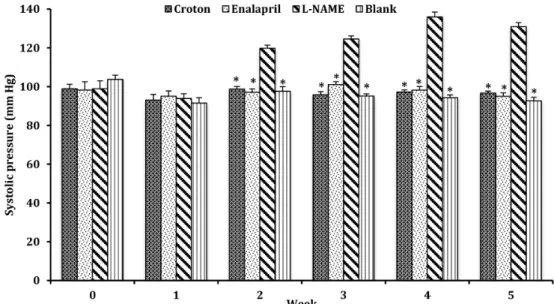
The mean systolic arterial pressure value at basal conditions (week 0) ranged from 99 to 104 mm Hg
(n=27) without signiicant differences between groups.
The increase in arterial pressure induced by L-NAME
of 136 ± 3 mm Hg. C. schiedeanus was able to maintain pressure values below 100 mm Hg during all weeks. The effect of the reference drug enalapril was similar to
C.schiedeanus and to the group of rats not exposed to
L-NAME (blank group) (Figure 1). The basal heart rate value was 436±36 ppm. There was a tendency to heart rate decrease in the C. schiedeanus and enalapril groups
that did not attain statistical signiicance (data not shown).
In vitro aortic ring studies
Stimulation of aortic rings with FE (1x10⁻⁶ M) resulted in a sustained contraction, greater in the C. schiedeanus, enalapril and blank groups than in the control group (2157±147, 1910±144, 2005±180 and 1646±146 mg, respectively, n=39, p>0.05). Cumulative addition of ACh (10-10 – 10-4 M) in rats previously exposed to L-NAME and treated with C. schiedeanus caused a greater relaxant response that reduced the contraction previously induced by FE to 42%. The ACh relaxant response was lower in the enalapril and blank groups (33 and 30%, respectively) and
signiicantly lower in the control group (rats exposed only
to L-NAME, 22%, p<0.05) (Figure 2). According to ACh pEC50 values, the ACh relaxant potency was as follows:
C. schiedeanus (6.89) > enalapril (6.39) > blank (5.68) > control (5.09) (Table I).
DISCUSSION
This study shows that a C. schiedeanus ethanolic
extract is able to prevent the hypertension induced by L-NAME in Wistar rats and, at the same time, improve the vascular relaxant response in isolated aortic rings. Previous works had shown the vasorelaxant effects induced by the active principles in this species, the flavonoid nature of these compounds, the probable synergistic effects induced by them and the importance of the NO/cGMP pathway in their mechanisms of action (Guerrero et
FIGURE 1 - Values of systolic blood pressure in Wistar rats treated with: (1) ethanolic extract of C. schiedeanus Schltd (200 mg/kg/day, p.o.) plus L-NAME (10 mg/kg, i.p.), (2) enalapril (reference drug, 10 mg/kg/day, p.o.) plus L-NAME (10 mg/kg, i.p.), (3) vehicle (control, olive oil 0.1 mL/100 g, p.o.) plus L-NAME (10 mg/kg, i.p.) and (4) vehicle (blank, olive oil 0.1 mL/100 g, p.o.). Results are expressed as means ± S.E.M. *p<0.05 with respect to the control group.
FIGURE 2 - Cumulative (10-10- 10-4 M) Acetylcholine
dose-response curves in intact aorta rings prepared from Wistar rats previously treated with: (1) ethanolic extract of Croton schiedeanus
TABLE I - pEC50(-log[EC50]) and % Emax values (% of maximal effect) induced by Ach (10-10- 10-4 M) in isolated aortic rings
contracted with FE (10-6 M) from Wistar rats previously treated with: (1) ethanolic extract of C. schiedeanus Schltd (200 mg/kg/
day, p.o.) plus L-NAME (10 mg/kg, i.p.), (2) enalapril (reference drug, 10 mg/kg/day, p.o.) plus L-NAME (10 mg/kg, i.p.), (3) vehicle (control, olive oil 0.1 mL/100 g, p.o.) plus L-NAME (10 mg/kg, i.p) and (4) vehicle (blank, olive oil 0.1 mL/100 g, p.o.). Results are expressed as means, iducial limits and S.E.M., respectively. *p<0.05 with respect to the control group
Treatment pEC50 % Emax
L-NAME plus C. schiedeanus 6.89 [6.85 – 6.92]* 41.9 ± 2.6*
L-NAME plus enalapril 6.39 [6.37 – 6.41] 33.2 ± 4.6
L-NAME plus vehicle (control) 5.09 [5.00 – 5.18] 22.4 ± 3.2
Vehicle (blank) 5.68 [5.66 – 6.59] 30.4 ± 4.9
al., 2002a; Guerrero et al., 2002b; Carrón et al., 2010). However, until now, the antihypertensive effect of this species administered p.o, had not been demonstrated in an experimental model of hypertension in rats.
The hypertension induced by L-NAME is a very useful model in searching for potential new drugs for hypertension. Several groups of antihypertensive drugs are active in this model, including: angiotensin converting enzyme inhibitors, angiotensin receptor blockers, calcium channel blockers and some diuretics and beta blocking drugs (Jover, Mimran, 2001; García et al., 2006). In addition, this model can show a cardio-protective effect of drugs against cardiovascular remodelling (Massion, Balligand, 2007). This indicates the pivotal role of NO in the physiology of the myocardium and vessels and the importance that alterations in this metabolite play in cardiovascular disorders like hypertension, coronary artery disease and heart failure. In fact, drugs that protect the myocardium and vessels favouring the effect of nitric oxide can reduce the morbidity and mortality of these disorders (von Luederand Krum, 2013). It is interesting to observe that C. schiedeanus prevents hypertension in a manner that is not inferior to the reference drug used in this study, enalapril.
The preservation of vascular function obtained with
C. schiedeanus became apparent examining the effect of
ACh in isolated aortic rings from Wistar rats previously treated with this extract and exposed at the same time to a
deicit in NO using L-NAME. Whereas the relaxant effect
of ACh was reduced in control rats, ACh attained a better relaxant response in rats treated with C. schiedeanus, even better than the reference drug or the group not exposed to an NO deficit (blank group). In addition, the vascular contractile capacity tended to increase as the result of previous treatment with C. schiedeanus, as has been seen with polyphenols compounds such as quercetin, among others, that increased NO availability (Duarte et al., 2001).
The importance of polyphenol compounds for preserving cardiovascular function and their link to the NO/ cGMP pathway has recently been reemphasized (Estruch
et al., 2013; Habauzitand Morand, 2012). This aspect
could be especially critical at the beginning of endothelia dysfunction, before a cascade of pathophysiological events that increase the cardiovascular lesion can take place. Foods rich in polyphenol compounds, such as coconut and tea, improve blood pressure and cholesterol levels, reducing endothelial dysfunction and, consequently, the predisposition to plaque formation and thrombus generation. C. schiedeanus would represent another
rich source of lavonoid compounds that help to protect
against disorders related to the progression of endothelial dysfunction.
The relation of the active metabolites from C.
schiedeanus, mainly the lavonoid compounds ayanin,
quercetin 3,7-dimethyl ether and quercetin 3,7-ethyl ether to the NO/cGMP pathway has been described previously (Guerrero et al, 2002a; Guerrero et al., 2002b). They seem to act in a synergistic fashion, favouring the persistence of NO, with the aim that this metabolite can activate the cascade of the cGMP pathway that ends in vasodilation
and thus reduce the inlammatory processes characteristic
of advanced hypertension, coronary artery disease and heart failure.
Although the scavenging properties of polyphenol compounds have been extensively studied, there is insufficient evidence that these compounds can
signiicantly reduce the impact of cardiovascular disorders
(Davison et al., 2010). C. schiedeanus would be one of these alternatives.
Isolated aortic rings represent a useful model to study potential vasodilator compounds. The aorta is not a resistance vessel, like the mesenteric artery, for instance, but a conductance vessel, and it is established that hypertension is a disorder due to an increase in resistance vessel tone. However, it is clear that several groups of antihypertensive drugs are active in this model, including: inhibitors of angiotensin converting enzyme (Arnal et al., 1994), angiotensin receptor blocking drugs (Zhang et al., 1995), beta blocking drugs (Lee et al, 1992) and calcium channel antagonists (Polster et al., 1990). Therefore, the vasodilation mechanism observed with C. schiedeanus
in isolated aortic rings show the potential utility of this species when a reduction in vascular tone is needed, as in the case of hypertension.
CONCLUSION
Inconclusion, C. Shiedeanus Schltd prevents experimental hypertension induced in rats with nitric
oxide deicit, improving the endothelium vasodilatation
response. These results give support to ethno botanic use
of C. schiedeanus as a natural antihypertensive agent.
ACKNOWLEDGMENTS
This work was supported by the Universidad Nacional de Colombia, (VRI/DIB, grant numbers: 12785 and 15329). Thanks to the Animalarium in the Pharmacy Department of this institution. Thanks to Juliane HARTNACK for her English style corrections.
CONFLICTS OF INTEREST
There have been no conlicts of interest in carrying
out this work.
REFERENCES
ARNAL, J.F.; BATTLE, T.; RASETTI, C.; CHALLAH, M.; COSTEROUSSE, O.; VICAUT, E.; MICHEL, J.B.; ALHENC-GELAS, F. ACE in three tunicae of rat aorta: expression in smooth muscle and effect of renovascular hypertension. Am. J. Physiol., v.267, p.1777-1784, 1994.
CARRÓN, R.; SÁNZ, E.; PUEBLA, P.; MARTÍN, M.L.; SAN ROMÁN, L.; GUERRERO, M.F. Mechanisms of relaxation induced by lavonoid ayanin in isolated aorta rings from wistar rat. Colomb. Méd., v.41, p.10-16, 2010.
CHOCKALINGAM, A. World hypertension day and global awareness. Can. J. Cardiol., v.24, p.441-444, 2008.
CORREA-HERNÁNDEZ, S.; PUEBLA-IBÁÑEZ, P.; CARRÓN, R.; MARTÍN-CALVO, L.; ROMÁN, L.; GUERRERO-PABÓN, M. Perfil vasodilatador de compuestos flavonoides y fenilbutanoides aislados de
Croton schiedeanus schlecht. Rev. Fac. Med. Unal., v.56, p.291-301, 2008.
DAVISON, K.; BERRY, N.M.; MISAN, G.; COATES, A.M.; BUCKLEY, J.D.; HOWE, P.R. Dose-related effects of
lavanol-rich cocoa on blood pressure. J. Hum. Hypertens.,
v.24, p.568-576, 2010.
DUARTE, J.; PÉREZ-PALENCIA, R.; VARGAS, F.; OCETE, M.A.; PÉREZ-VIZCAINO, F.; ZARZUELO, A.; TAMARGO, J. Antihypertensive effects of the lavonoid quercetin in spontaneously hypertensive rats. Br. J. Pharmacol., v.133, p.117-124, 2001.
ESTRUCH, R.; ROS, E.; SALAS-SALVADÓ, J.; COVAS, M.I.; PHARM, D.; CORELLA, D.; ARÓS, F.; GÓMEZ-GRACIA, E.; RUIZ-GUTIÉRREZ, V.; FIOL, M.; LAPETRA, J.; LAMUELA-RAVENTOS, R.M.; SERRA-MAJE, M.L.; PINTÓ, X.; BASORA, J.; MUÑOZ, M.A.; SORLÍ, J.V.; MARTÍNEZ, J.A.; MARTÍNEZ-GONZÁLEZ, M.A. Primary prevention of cardiovascular disease with a Mediterranean diet. N. Engl. J Med., v.368, p.1279-1290, 2013.
FORTE, P.; COPLAND, M. Basal nitric oxide synthesis in essential hypertension. Lancet, v.349, p.837-842, 1997.
GARCÍA-ESTAÑO, J.; ORTIZ, M.C.; O’VALLE, F.; ALCARAZ, A.; NAVARRO, E.G.; VARGAS, F.; EVANGELISTA, S.; ATUCHA, N.M. Effects of angiotensin-converting-enzyme inhibitors in combination with diuretics on blood pressure and renal injury in nitric oxide-deiciency-induced hypertension in rats. Clin. Sci., v.110, p.227-233, 2006.
GUERRERO, M.F.; CARRÓN, R.; MARTÍN, M.L.; SAN ROMÁN, L.; REGUERO, M.T. Antihypertensive and vasorelaxant effects of aqueous extract from croton schiedeanus schlecht in rats. J. Ethnopharmacol., v.75, p.33-36, 2001.
GUERRERO, M.F.; PUEBLA, P.; CARRÓN, R.; MARTÍN, M.L.; SAN ROMÁN, L. Quercetin 3,7-dimethyl ether, a vasorelaxant lavonoid isolated from croton schiedeanus schlecht. J. Pharm. Pharmacol., v.54, p.1373-1378, 2002c.
GUERRERO, M.F.; PUEBLA, P.; MARTÍN, M.L.; CARRÓN, R.; SAN ROMÁN, L.; REGUERO, M.T. Inhibitory effect of N(G)-nitro-L-arginine methyl ester on the anti-adrenergic response elicited by ayanin in the pithed rat. Planta Med., v.68, p.322-325., 2002b.
HABAUZIT, V.; MORAND, C. Evidence for a protective effect of polyphenols-containing foods on cardiovascular health.
Ther. Adv. Chronic Dis., v.3, p.87-106, 2012.
HALLIWELL, B. Dietary polyphenols: good, bad, or indifferent for your health? Cardiovasc. Res., v.73, p.341-347, 2007.
HU, M. Bioavailability of lavonoids and polyphenols: call to arms. Mol. Pharmacol., v.4, p.803-806, 2007.
JOVER, B.; MIMRAN, A. Nitric oxide inhibition and renal alterations. J. Cardiovasc. Pharmacol., v.38, suppl.2, p.65-70, 2001.
KEARNEY, P.M.; WHELTON, M.; REYNOLDS, K.; MUNTNER, P.; WHELTON, P.K. Global burden of hypertension: analysis of world wide data. Lancet., v.9455, p.217-223, 2005.
LEE, Y.S.; KIM, C.H.; YUN-CHOI, H.S.; CHANG, K.C. Cardiovascular effect of a naphthylmethyl substituted tetrahydroisoquinoline, YS 49, in rat and rabbit. Life Sci.,
v.51, p.67-74, 1992.
MASON, R.P.; KUBANT, R., JACOB, R.F.; WALTER, M.F.; BOYCHUK, B.; MALINSKI, T. Effect of nebivolol on endothelial nitric oxide and peroxynitrite release in hypertensive animals: role of antioxidant activity. J. Cardiovasc. Pharmacol., v.48, p.862-869, 2006.
MASON, R.P.; WALTER, M.F.; JACOB, R.F. Effects of HMG-CoA reductase inhibitors on endothelial function: role of microdomains and oxidative stress. Circulation, v.109, suppl.1, p.1134-1141, 2004.
MASSION, P.B.; BALLIGAND, J.L. Relevance of nitric oxide for myocardial remodeling. Curr. Heart Fail Rep., v.4, p.18-25, 2007.
PANZA, J.A.; QUYYUMI, A.A.; CALLAHAN, T.S.; EPSTEIN, S.E. Effect of antihypertensive treatment on endothelium-dependent vascular relaxation in patients with essential hypertension. J. Am. Coll. Cardiol., v.21, p.1145-1151, 1993.
POLSTER, P.; CHRISTOPHE, B.; VAN DAMME, M.; HOULLICHE, A.; CHATELAIN, P. SR 33557, a novel calcium entry blocker. I. In vitro isolated tissue studies. J. Pharmacol. Exp. Ther., v.255, p.593-599, 1990.
TADDEI, S.; VIRDIS, A.; MATTEI, P.; ARZILLI, F.; S A LV E T T I , A . E n d o t h e l i u m - d e p e n d e n t f o r e a r m vasodilation is reduced in normotensive subjects with familial history of hypertension. J. Cardiovasc. Pharmacol., v.20, suppl.12, p.193-195, 1992.
TSCHÖPE, C.; SCHULTHEISS, H.P.; WALTHER, T. Multiple interactions between the renin-angiotensin and the kallikrein-kinin systems: role of ACE inhibition and AT1 receptor blockade. J. Cardiovasc. Pharmacol., v.39, p.478-487, 2002.
TZEMOS, N.; LIM, P.O.; MACDONALD, T.M. Nebivolol reverses endothelial dysfunction in essential hypertension: a randomized, double-blind, crossover study. Circulation, v.104, p.511-514, 2001.
VAN VLIET, N.B.; CHAFE, L.L.; VLADAN, A.; SCHNYDER-CANDRIAN, S.; MONTANI, J.P. Direct and indirect methods used to study arterial blood pressure. J. Pharmacol. Toxicol. Methods, v.44, p.361-373, 2000.
VONLUEDER, T.G.; KRUM, H. RAAS inhibitors and cardiovascular protection in large scale trials. Cardiovasc.
Drugs Ther., v.27, p.171-179, 2013.
ZHANG, Q.; PFAFFENDORF, M.; ZWIETEN, V. Comparative effects of angiotensin II and its degradation products angiotensin III and angiotensin IV in rat aorta. Br. J. Pharmacol., v.116, p.2963-2970, 1995.
Received for publication on 15th April 2013
![TABLE I - pEC 50 (-log[EC 50 ]) and % E max values (% of maximal effect) induced by Ach (10 -10 - 10 -4 M) in isolated aortic rings contracted with FE (10 -6 M) from Wistar rats previously treated with: (1) ethanolic extract of C](https://thumb-eu.123doks.com/thumbv2/123dok_br/15413153.587015/5.892.66.825.234.349/maximal-induced-isolated-contracted-wistar-previously-treated-ethanolic.webp)
