Correspondence: M. Vitolo, Deapartamento de Tecnologia Bioquímico-Farmacêutica, Faculdade de Ciências Farmacêuticas, Universidade de Paulo, Av. Prof. Lineu Prestes 580, B.16-Cidade Universitária, 05508-000 - São Paulo - SP, Brasil. E-mail: [email protected]
A
rti
Pharmaceutical Sciences vol. 47, n. 2, apr./jun., 2011
Invertase, glucose oxidase and catalase for converting sucrose
to fructose and gluconic acid through batch and
membrane-continuous reactors
Aline Ramos da Silva, Ester Junko Tomotani, Michele Vitolo*
Department of Biochemical and Pharmaceutical Technology, Faculty of Pharmaceutical Sciences, University of São Paulo
Conversion of sucrose into fructose and gluconic acid using invertase, glucose oxidase and catalase was studied by discontinuous (sequential or simultaneous addition of the enzymes) and continuous (simultaneous addition of the enzymes in a 100 kDa-ultrailtration membrane reactor) processes. The following parameters were varied: concentration of enzymes, initial concentration of substrates (sucrose and glucose), pH, temperature and feeding rate (for continuous process). The highest yield of conversion (100%) was attained through the discontinuous (batch) process carried out at pH 4.5 and 37 ºC by the sequential addition of invertase (14.3 U), glucose oxidase (10,000 U) and catalase (59,000 U).
Uniterms: Sucrose/conversion. Fructose. Gluconic acid. Invertase. Glucose oxidase. Catalase.
Neste trabalho estudou-se a conversão da sacarose em frutose e ácido glicônico, usando as enzimas invertase, glicose oxidase e catalase, através do emprego de processo descontínuo (com adição sequencial ou simultânea das enzimas) e contínuo (adição simultânea das enzimas em reator com membrana acoplado à membrana de ultrailtração de 100 kDa). Os parâmetros variados foram: a concentração das enzimas, a concentração inicial dos substratos (sacarose e glicose), o pH, a temperatura e a vazão especíica de alimentação (processo contínuo). Obteve-se rendimento de 100%, quando a conversão foi conduzida por processo descontínuo em pH 4,5 e a 37 ºC com adição seqüencial das enzimas invertase (14,3 U), glicose oxidase (10.000 U) e catalase (59.000 U).
Unitermos: Sacarose/conversão. Frutose. Àcido glicônico. Invertase. Glicose oxidase. Catalase.
INTRODUCTION
Enzyme catalysis is a controlled process, which can be performed discontinuously (batch) or continuously, under mild pH and temperature conditions. Thereby, pH and temperature sensitive substances may be eficiently transformed into desired products. Enzymes - in soluble or insoluble forms - are also highly selective catalysts and may be used at the same time to carry out simultaneous reactions. In general, enzymatic processes do not generate environmental pollutants (Tomotani, Vitolo, 2010).
Enzymatic processes are an alternative to chemi-cal, extractive or microbial synthesis in order to obtain chemical, food and/or pharmaceutical products.
Bioca-talysis may often replace the traditional processes based on extraction (requires handling of a large amount of raw-materials), fermentation (requires strict aseptic procedures throughout the process) and chemical syn-thesis (high energy consumption, low enantioselectivity and high environmental pollution potential) (Tomotani, Vitolo, 2007).
(FOS) and gluconic acid using sucrose, by the action of invertase, glucose oxidase and catalase was described by Sheu et al. (2001).
Sucrose is a low cost commodity widely produced in Brazil (annual production s of over 30 million tons), which is subject to competition among several countries and to oscillation of the world market. Transformation of sucrose into more valuable commercial products - such as fructose and gluconic acid, both imported partially or totally by Brazil - may contribute to the diversiication of the national sugar alcohol market. The availability of this alternative would be advantageous in the event that world demand for sugar became low, causing a longer storage period of this product – an undesirable situation for two main reasons: saturation of storage areas in warehouses and deterioration of the product due to its high hygros-copic characteristics. Conversion of surplus sugar into fuel-ethanol would also not be inancially advantageous for the distilleries because processed sugar has a higher aggregate value than fuel-ethanol.
The aim of this work was to evaluate the disconti-nuous reactor as well as a contidisconti-nuous-membrane reactor for the direct conversion of sucrose into fructose and gluconic acid for sequential or simultaneous action of invertase, glucose oxidase and catalase.
MATERIAL AND METHODS
Material
The enzymes used were: invertase (EC.3.2.1.26) from Saccharomyces cerevisiae (purchased from BIO-CON® - 1 mL of invertase presents 1430 U, where 1 U = 1 mg TRS/min, measured at pH 4.6 and at 37 ºC; TRS- total reducing sugars); glucose oxidase (EC.1.1.3.4) from Aspergillus niger (from SIGMA® - 1 solid g has 5,000 U, where 1 U = 1 µmol of H2O2 formed /min, me-asured at pH 5.1 and at 37 ºC) and catalase (EC 1.11.1.6) from bovine liver (SIGMA® -1 solid mg has 2,950U, where 1 U = 1 µmol of H2O2 consumed /min, measured at pH 4.6 and 37 ºC). All of the other chemicals were analytical grade.
Methods
Effect of pH, temperature and substrate concentration on the activity of invertase and glucose oxidase (GO)
• Invertase
In a 250 mL-beaker, 108 mL of 0.01 M acetate buffer (pH 3.5; 4.0; 4.5; 5.0; 5.5 or 6.0) was added, after
immersion in a water bath at a set temperature (30 °C, 37 °C, 40 °C or 45 °C). After 10 minutes, an amount of sucrose was dissolved under agitation (100 rpm) in order to reach an initial concentration of 4, 6, 10, 15, 20, 30, 40 or 50 mM. After 5 minutes, a sample (0.5 mL) of the su-crose solution was taken (time zero), followed by addition of 12 mL of the invertase solution (3.43 U). Aliquots (0.5 mL) were taken every minute, up to 6 min of total reaction. Total reducing sugar concentration (TRS) was determined according to Arruda, Vitolo (1996).
Enzyme stability was evaluated by incubating an in-vertase solution (3.43 U) for 0 h; 0.5 h; 1 h; 10 h; 20 h and 30 h at pH 4.5 and 37 oC. The residual invertase activity was determined as previously described.
• Glucose Oxidase
In a 250 mL-beaker, 125 mL of 0.01 M acetate buffer (pH 4.0; 4.5; 5.0 or 5.5) was added, after immersion in a water bath at a set temperature (30 °C, 37 °C, 40 °C or 45 °C). During the entire process, air was bubbled into the reaction medium, in order to keep it saturated with oxygen (3 - 4 mg/L). An aliquot of the medium (1 mL) was remo-ved as a blank. After 10 minutes, an amount of glucose was dissolved under agitation (100 rpm) in order to reach an initial concentration of 4, 8, 10, 15, 20 or 25 mM. A sample of 1 mL of the glucose solution was taken to mea-sure the initial concentration of H2O2 (t=0). Subsequently, 25 mL of the GO solution (180 U) was added to the beaker and aliquots of 1 mL were taken every 10 min up to 1 h of total reaction. Each sample was immersed in a boiling water bath in order to stop the reaction. Measurement of H2O2 formed during the reaction was made according to Tomotani et al (2005).
Enzyme stability was evaluated by incubating GO solution (180U) for 0 h; 0.5 h; 1 h; 10 h; 20 h and 30 h at pH 4.5 and 37 oC. The residual GO activity was determined as previously described.
Effect of catalase on residual hydrogen peroxide determination
to the beaker until all the volumes of both solutions had been added after a 20-min reaction. Aliquots of 1 mL for the residual H2O2 determination were taken before each addition of hydrogen peroxide and catalase. The total re-action time was 30 minutes. In order to stop the rere-action, eppendorf tubes containing the samples were immersed in a boiling water bath. The residual amount of H2O2 was determined at 240 nm according to Tomotani et al (2005).
In order to verify the UV absorption at 240 nm by catalase, which could interfere in the H2O2 determination, a similar assay was performed, without addition of H2O2.
Hydrolysis of sucrose in a discontinuous process (batch)
In a 250 mL-beaker, 108 mL of 0.01 M acetate buffer (pH 4.5) was added, after immersion in a water bath at 37 °C. After 10 minutes, an amount of sucrose was dissol-ved under agitation of 100 rpm in order to achieve initial concentrations of 2, 4, 8, 16 or 32 g/L. After 5 minutes, 12 mL of a buffered solution of invertase (1.43 U, 2.86 U, 5.72 U or 14.3 U) was added to the beaker and aliquots (0.5 mL) were removed every 20 min up to 1h of total reaction. Samples were then incubated in a boiling water bath for 5 min. Total reducing sugar concentration (TRS) was determined according to Arruda, Vitolo (1996). The beginning of the reaction (t=0) corresponded to the irst sample removed before addition of invertase.
Oxidation of glucose in a discontinuous process (batch)
In a 250mL-beaker, 105 mL of 0.01 M acetate bu-ffer (pH 4.5) was added, after immersion in a water bath at 37 °C. During the entire process, air was bubbled into the reaction medium in order to keep it saturated with oxygen (3 - 4 mg/L). A sample of 1 mL was removed to be used as a blank. After 10 minutes, an amount of glucose was dissolved under an agitation of 100 rpm to achieve initial concentrations of 1, 2, 4, 8, or 16 g/L. An aliquot (1 mL) was taken to determine the initial hydrogen pero-xide concentration (time zero). Subsequently, 25 mL of a buffered solution containing glucose oxidase (1,000 U, 2,500 U, 5,000 U or 10,000 U) was added, followed by the addition of 2 mL of buffered catalase solution (5,900 U), which was repeated every 20 min up to 80min of reaction. Aliquots (1 mL) of the medium were removed, before the addition of catalase solution, every 20 minutes up to 2 h of total reaction. Immediately after withdrawal, each sample was immersed in a boiling water bath for 5 min. Residual H2O2 and consumption of TRS were determined according to Arruda, Vitolo (1996) and Tomotani et al
(2005), respectively.
Bioconversion of sucrose into fructose and gluconic acid in a discontinuous process with sequential addition of invertase and glucose oxidase/catalase
In a 150mL-beaker, 96 mL of 0.01 M acetate buffer (pH 4.5) was added, after immersion in a water bath at 37 °C. An amount of 3.84 g of sucrose was dissolved un-der agitation (100 rpm) to reach an initial concentration of 32 g/L. After 5 minutes, 24 mL of an aqueous solution of invertase was added (14.3 U). Every 10 minutes, 1 mL of the sample was removed up to 30min of total reaction. Before addition of the enzyme, an aliquot (1 mL) was taken to determine the initial amount of TRS (time zero). Subsequently, 55 mL of the hydrolyzed solution was taken from the original recipient and placed into a 100mL- be-aker. Twenty milliliters of a solution containing glucose oxidase (10,000 U) and catalase (59,000 U) were added. Aliquots (1mL) were removed every 20 minutes, up to 2h of total reaction, for analytical purposes.
Bioconversion of sucrose into fructose and gluconic acid in a discontinuous process with simultaneous addition of invertase and glucose oxidase/catalase
In a 150mL-beaker, 61 mL of 0.01 M acetate buffer (pH 4.5) was added, after immersion in a water bath at 37 °C. An amount of 3.84 g of sucrose was dissolved under agitation (100 rpm) to reach an initial concentration of 32 g/L. After 5 minutes, 59 mL of a buffered solution containing the enzymes was added [invertase (14.3 U), glucose oxidase (10,000 U) and catalase (59,000 U)]. A sample (1 mL) was taken every 20 minutes, up to 2 h of total reaction, for analytical purposes. The blank was the sample (1 mL) taken before addition of the enzymes.
Bioconversion of sucrose into fructose and gluconic acid by the simultaneous action of invertase, glucose oxidase and catalase in a membrane-continuous reactor
Analytical determinations
• Determination of total reducing sugars (TRS)
TRS was measured using the Somogyi-Nelson method as described previously (Arruda, Vitolo, 1996).
• Determination of hydrogen peroxide
Hydrogen peroxide concentration was determined from the absorbance at 240 nm. The standard-linear equation was y = 1.66x + 4.24x10⁻³ (r = 0.99998), where y and x are the absorbance and the amount of H2O2 (mg), respectively. Concentration of the standard solution used to obtain the standard plot was varied between 0.0608 and 0.608 mg of H2O2/mL (Tomotani et al., 2005).
RESULTS AND DISCUSSION
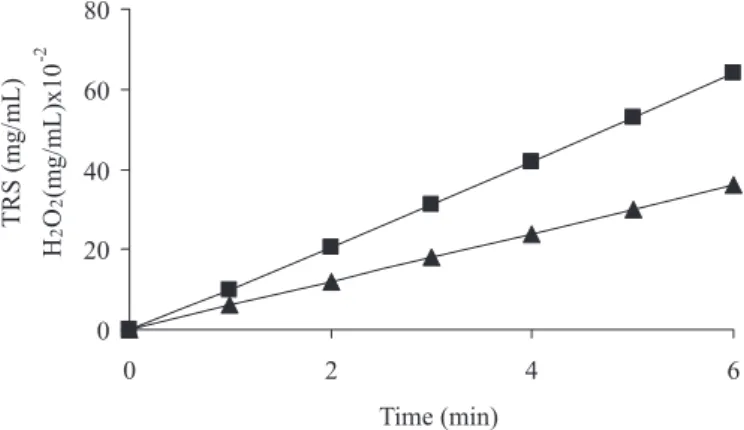
All data referring to the effect of pH, temperature and initial substrate concentration on the activity of in-vertase and GO was achieved by plotting concentration of TRS and/or H2O2 against reaction time, that is, all activities corresponded to initial velocities. For instance, Figure 1 shows the formation of TRS and H2O2 over time of sucrose hydrolysis and glucose oxidation reactions car-ried out as described above. Thus, activities of invertase (vI) and glucose oxidase (vGO) corresponded to 0.060 mg TRS/min.mL and 0.0107 mg H2O2/min.mL, respectively. The activity of invertase is approximately six-fold higher than GO activity which means that hydrolysis of sucrose occurs faster than glucose oxidation. This fact should be taken into account when both enzymes are used together.
It was previously established that a concentration of hydrogen peroxide above 1.3 mM (0.0442 mg/mL) causes a noncompetitive inhibitory effect on the activity of GO (Tomotani et al., 2005). A complicating factor is that hydrogen peroxide is an obligatory by-product formed when glucose is oxidized to gluconic acid by GO. As the initial glucose concentration employed in this work was 16 g/L, the inhibitory concentration limit of hydrogen peroxide should certainly have been reached and GO ac-tivity would have been reduced. For this reason, catalase was used as an auxiliary enzyme, to remove hydrogen peroxide.
However, due to the fact that catalase possesses a metallic ion as a prosthetic group (Scott, 1975), it pre-sents, in principle, the capability of absorbing UV-light at 240 nm, the same wavelength used to determine the con-centration of residual hydrogen peroxide. Therefore, all multienzymatic assays, except for the continuous process, were accompanied by a test with catalase only, in order to correct the absorbance at 240 nm (“blank assay”).
When a multienzymatic process is intended, factors that affect activities of the enzymes, such as pH and tempe-rature, must have be as close as possible to their optimum values. Therefore, by comparing the variation of invertase and GO activities against pH, it was observed that the
pHoptimum for both enzymes was 4.5 (Figure 2). This was a
quite good result insofar as the aim of this work was the di-rect conversion of sucrose into fructose and gluconic acid, using the previously mentioned enzymes. The pH value obtained is in agreement with the literature, in the range of pH 4.5-5.0 for both enzymes (Vitolo, 2004; Milovanovic
et al., 2007; Bao et al., 2001). Catalase - an auxiliary en-zyme in the process - was used at the pH of the operational condition (pH 4.5), although the highest activity and the lowest light absorption at 240 nm are reached at pH 6.8-7.0 (Kresse, 1990; Da Silva, 2010). A lower catalase activity at pH 4.5 was compensated by using a larger amount of enzyme than that actually needed at pH 7.0.
FIGURE 1 - Formation of TRS (p) and H2O2 (¾) resulting from sucrose hydrolysis by invertase and glucose oxidation by GO, respectively, as a function of time. The equations of straight lines are: (TRS) = 0.060xt – 3.6x10⁻⁵ (r = 0.99995)] and (H2O2) = 0.0107xt – 6.6x10⁻⁴ (r = 0.9998).
Table 1 shows that an increase of temperature from 30 °C to 45 °C promoted approximate 1.9 and 2.3 fold increases in invertase and GO activities, respectively. By applying the conventional Arrhenius’ method to the data in Table 1, the activation energies for the reactions catalyzed by invertase and GO were calculated. These were equal to 31 kJ/mol and 44kJ/mol, respectively. Therefore, sucrose hydrolysis by invertase requires about 30% less energy than glucose oxidation by GO. This result corroborates the highest activity of invertase over GO, as observed previously (Figure 1). Glucose oxidase followed the Van’t Hoff’s law, insofar as its activity doubled when the tempe-rature increased 10 °C (tempetempe-rature interval of 30 °C and 40 °C) (Table 1). Such a result is seldom described in the literature, because enzymes generally do not follow Van’t Hoffs’ law (Fullbrook, 1996).
Applying the conventional method of Linewe-aver-Burk, the kinetic constants for both enzymes
were determined (invertase: KM = 28.5 mM and
Vmax = 0.064 mg TRS/min.mL and GO: KM = 20.3 mM and Vmax = 0.0012 mg H2O2/min.mL) (Figure 3). The calcula-ted KM values for invertase and GO lie within the ranges mentioned in the literature, i.e., 26-40 mM (Milovanovic
et al., 2007; Dizge et al., 2008) and 18-32 mM (Simpson
et al., 2007; Hoshi et al., 2007), respectively.
From Table II, it can be seen that both enzymes were stable after 30 h at pH 4.5 and 37 ºC. Under these conditions, it could be speculated that both enzymes do not suffer modification in their respective molecular structures. According to the literature, invertase may have kept its molecules aggregated (De Queiroz et al., 1996), whereas GO kept its prosthetic groups Fe+2/Fe+3 and FAD/FADH2 in the reduced and oxidized forms, respectively (Tomotani, 2006; Simpson et al., 2007; Bao
et al., 2001). Consequently, conversion of sucrose into fructose and gluconic acid in a continuous multi enzyma-tic membrane reactor for 15 h, would most likely occur with the main enzymes (GO and invertase) in their ideal molecular conformation.
Sucrose hydrolysis by invertase, oxidation of glu-cose by GO, and decomposition of hydrogen peroxide by catalase, take place at different enzymatic velocities with invertase being the fastest. Invertase was therefore taken as a reference to adjust the reaction time in order to produce the amount of glucose necessary for the sub-sequent oxidation reaction by GO. In addition, hydrogen peroxide, an obligatory byproduct of this reaction, should be decomposed by catalase so its presence in the reaction medium would be kept under control.
Through exploratory tests, it was observed that sucrose hydrolysis, regardless of its initial concentration, should not be less than 30 min in length (Da Silva, 2010). Otherwise, the amount of glucose formed would be extre-mely high for eficient oxidation by GO, while excessive foaming would occur due to formation of a high amount of molecular oxygen, resulting from decomposition of hydrogen peroxide by catalase. Such uncontrolled foa-ming, mainly due to GO and catalase, would interfere negatively in the performance of discontinuous (splashing of its content) and continuous (intense bubbling inside the
TABLE I - Activities of invertase (vI) and glucose oxidase (vGO) at pH 4.5 and different temperatures
T (°C) vI x 10-2
(mg TRS /min.mL) vGO x 10
-3 (mg H2O2 /min.mL)
30 4.03 0.90
37 5.73 1.10
40 6.55 1.80
45 7.68 2.10
TABLE II - Residual activities of invertase and GO determined for 30 h at pH 4.5 and 37 °C
Test (h) vI x10-2
(mg TRS/mL.min) vGO x 10
-3 (mg H2O2 / min.mL)
0 7.55 1.44
0.5 7.60 1.40
1 7.50 1.39
10 7.62 1.41
20 7.24 1.46
30 7.30 1.43
outlet pipeline) reactors. Therefore, adjustments to the total activity of invertase and the initial concentration of sucrose were made.
Table III shows that, for a sixteen-fold increase in the initial concentration of sucrose, total invertase activity in the reaction medium should be increased ten-fold in order to achieve hydrolysis within the time interval of 30 to 60 min. Imbalance of the sucrose concentration/total invertase activity ratio could result from the increase of aggregation of invertase molecules due to a higher amount of enzyme in the reaction medium. As previously mentio-ned by De Queiroz et al. (1996), the greater the invertase molecule aggregation, the higher the catalytic activity.
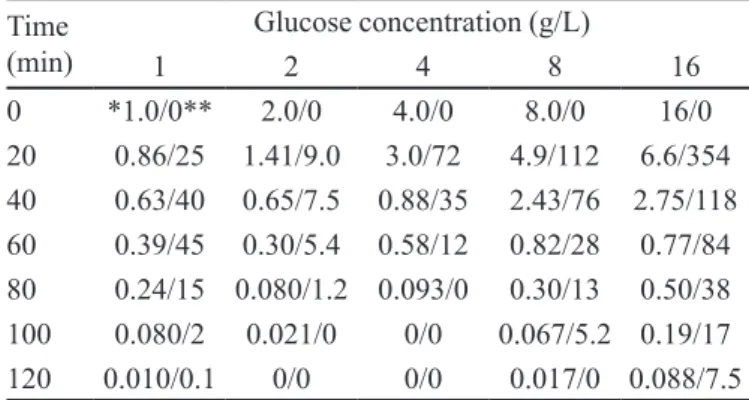
Table IV shows that the system consisting of GO/ catalase presented suitable activities for each initial con-centration of glucose. The amounts of TRS and hydrogen peroxide in the reaction media were insigniicant after 2 h of reaction. In this work, the initial concentration of glucose to be converted was established to be 16 g/L, in order to avoid intense foaming, which would result due to the combined effect of mechanical agitation, reduction of the supericial tension (due to the presence of enzymatic proteins) and the presence of molecular oxygen (from the decomposition of H2O2 by catalase).
Regarding the bioconversion [sucrose/(fructose + gluconic acid)] in a discontinuous reactor (sequential addition of enzymes), sucrose was completely consumed in 30 minutes and the glucose produced was converted into gluconic acid in about 40 minutes (Figure 4).
Considering the following equation: Y = 100 – (X – 50), where ‘Y’ is the yield (conversion of glucose into gluconic acid) and ‘X’ is TRS (sum of the amount of resi-dual glucose and fructose), it was concluded from Figure 4 (X = 50%) that glucose was totally oxidized.
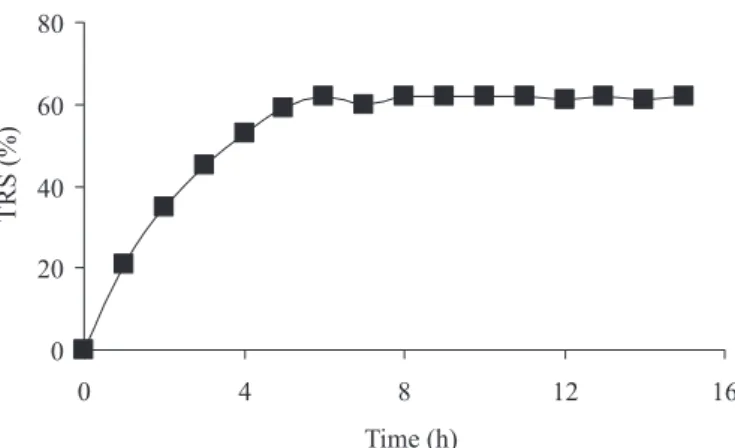
In a discontinuous process [sucrose/(fructose + gluconic acid)] performed by simultaneous action of the enzymes, the yield of the oxidation of glucose, calculated through Y = 100 – (X – 50), was around 85% (X = 65%)
(Figure 5). Figure 5 shows that TRS accumulates up to t = 20 min, decreasing thereafter. This behavior reveals that sucrose hydrolysis was not a limiting step of the overall reaction. This result points to the fact that sucrose hydrolysis occurs faster than glucose oxidation, as pre-viously discussed.
Comparing the discontinuous reactor protocols related to the simultaneous and sequential addition of the enzymes, the sequential method proved more effective. When the three enzymes were used at the same time, there was a need to adjust the amounts of each enzyme, in order to balance the length of hydrolysis, oxidation and decomposition reactions.
Despite the excellent conversion obtained through the discontinuous process, there is the additional issue to consider with regard to the recycling of the enzymes. Through the discontinuous process, recovery of the ca-talysts would only be eficient if they were immobilized in insoluble supports, which could be easily separated from the reaction media, when necessary. Although the immobilization approach would be efficient when one enzyme was employed, it would be far less eficient when two or more enzymes were used. In the present work, two non related events might be satisied simultaneously by the immobilization procedure, i.e., regarding invertase it would be assured that its molecules remained aggregated in octamers, a quite active form of the enzyme (Vitolo, 2004; De Queiroz et al., 1996), whereas for GO, it would
TABLE III - Total activity of invertase (U) for complete sucrose hydrolysis using different sucrose concentrations and respective reaction times (t*)
Sucrose (g/L) t* (min) vI (U)
2 60 1.43
4 40 2.86
8 40 5.72
16 30 10.4
32 40 14.3
TABLE IV - Residual glucose and hydrogen peroxide concentrations resulting from glucose oxidation by GO and from decomposition of hydrogen peroxide by catalase. The glucose solutions of 1 g/L, 2 g/L and 4 g/L were treated with 29,500 U of catalase and with 1,000 U, 2,500 U and 5,000 U of GO, respectively, whereas glucose solutions of 8 g/L and 16 g/L were treated with 10,000 U of GO and 59,000 U of catalase.
Time (min)
Glucose concentration (g/L)
1 2 4 8 16
0 *1.0/0** 2.0/0 4.0/0 8.0/0 16/0
20 0.86/25 1.41/9.0 3.0/72 4.9/112 6.6/354
40 0.63/40 0.65/7.5 0.88/35 2.43/76 2.75/118
60 0.39/45 0.30/5.4 0.58/12 0.82/28 0.77/84
80 0.24/15 0.080/1.2 0.093/0 0.30/13 0.50/38
100 0.080/2 0.021/0 0/0 0.067/5.2 0.19/17
120 0.010/0.1 0/0 0/0 0.017/0 0.088/7.5
be to guarantee its prosthetic groups in reduced (Fe+2) and oxidized (FAD) states (Tomotani, et al., 2005). To circu-mvent such a limitation, an alternative approach would be using a continuous stirred-tank reactor (CSTR), in which the enzymes were in the soluble form. A promising device might be a CSTR coupled with an ultrailtration membra-ne, i.e., a one-modulus membrane reactor (MR) (Neves, Vitolo, 2007; Tomotani, Vitolo, 2010).
The soluble forms of invertase, GO and catalase were used simultaneously inside an MR, which had been coupled with a 100-kDa-ultrailtration membrane. The effects of three parameters, i.e., invertase activity, tempe-rature and feeding rate, on the duration of the steady-state and on the conversion yield of the MR-continuous process were studied (Table V).
From Table V it is clear that temperatures higher than 37 oC are not favorable for the establishment of the steady-state within the reactor (tests 7 and 8). Probably, the decrease in dissolved oxygen concentration in the reaction medium leads to a condition of non saturation of GO, such that its FAD prosthetic group, which after glucose oxidation becomes FADH2 (reduced form), was not completely regenerated. In the end, only a fraction of GO molecules recover their full catalytic capability, which was insuficient to sustain the continuous process at the steady-state throughout the reaction time, i.e., the equilibrium condition is not reached (Miguel et al., 2007). The highest yield (84%) along with a steady-state duration of 11 h was achieved at vi = 18 U, D= 0.40 h-1 and 37 oC (Table V and Figure 6). Taking into account tests 1-5, an eight-fold variation of invertase activity (from 18 U to 143 U) and a 2.3 times variation in the feeding rate (from 0.32 h-1 to 0.72 h-1) led to a small variation in the steady-state duration (about 17%) and to a large variation in the yield attained (from 33% to 84%) (Table V). As high yields remaining for long steady-state periods are envisaged through a continuous process, then it becomes clear that a compromise between vI and D must be found for each process carried out under speciied operational conditions.
On one hand, the data presented shows that conversion [sucrose/(fructose + gluconic acid)] attained through con-tinuous and disconcon-tinuous MR processes, both carried out with the three enzymes in soluble forms, was practically the same (near 85%). On the other hand, for the discontinuous bioconversion, in which addition of enzymes was sequential,
FIGURE 4 - Discontinuous process performed by sequential addition of enzymes. In the irst stage (¾), sucrose hydrolysis by invertase (14.3 U) was performed. In the second stage (p), glucose (produced during the irst stage) was oxidized to gluconic acid by GO (10,000 U). Hydrogen peroxide was decomposed by catalase (59,000 U).
FIGURE 5 - Discontinuous process to convert sucrose to fructose and gluconic acid, performed in one step by adding invertase (14.3 U), glucose oxidase (10,000 U) and catalase (59,000 U) simultaneously.
TABLE V - Continuous bioconversion in a membrane reactor performed at pH 4.5 using an initial sucrose concentration of 32 g/L. Invertase activity, specific feeding rate (D) and temperature were varied. The activities of GO and catalase used were 10,000 U and 59,000 U, respectively. The length of the stationary state and the yield obtained in each test are given.
Test (n) vI (U) T D Yield
Duration of stationary state
(oC) (h-1) (%) (h)
1 143 37 0.72 47 11
2 143 37 0.32 33 12
3 72 37 0.53 73 10
4 36 37 0.44 79 12
5 18 37 0.40 84 11
6 18 30 0.40 68 9
7 18 40 0.42 73
-the yield was 100%. Therefore, a promising manner to trans-fer this result to a continuous MR process, would be to carry out the conversion separately by using two MRs coupled in series. In the irst reactor, sucrose hydrolysis would be perfor-med by invertase and the outlet solution (containing glucose and fructose) would be introduced into the second reactor, in which glucose would be oxidized to gluconic acid and H2O2 decomposed by GO and catalase, respectively. By doing so, immobilization of the enzymes, as required by the disconti-nuous process, might not be necessary, insofar as the MR can operate eficiently with several enzymes in a soluble form.
CONCLUSION
The main enzymes used (invertase and GO) pre-sented high activity at pH 4.5 and were stable for 30 h at the same pH and at the temperature of 37 ºC. The highest yield of conversion [sucrose/(fructose + gluconic acid] equal to 100%, was achieved in the discontinuous process with sequential addition of the enzymes. Nonetheless, a promising yield of around 85% was also obtained in the discontinuous and continuous processes (membrane re-actor) with simultaneous addition of the enzymes. Future studies of this bioconversion should involve its evaluation in a continuous process, by which two membrane reactors are connected in series, and where sucrose hydrolysis and glucose oxidation is performed sequentially.
ACKNOWLEDGEMENTS
The authors acknowledge the inancial grant from FAPESP (Fundação de Amparo à Pesquisa do Estado de São Paulo) and the invaluable assessment from Philip Barsanti.
REFERENCES
ANDREOTTI, D.Z.; TOMOTANI, E.J.; VITOLO, M. The Use of dehydrogenases for regenerating β-nicotinamide adenine coenzymes through discontinuous and continuous processes. In: EUROPEAN BIOMASS CONFERENCE AND EXHIBITION, 18., Lyon, 2010. Lyon: ETA-Florence, 2010. p.1367-1370.
ARRUDA, L.M.; VITOLO, M. Characterization of invertase entrapped into calcium alginate beads. Appl. Biochem. Biotechnol., v.8, p.23-33, 1996.
BAO, J.; FURUMOTO, K.; FUKUNAGA, K.; NAKAO, K. A kinetic study on air oxidation of glucose catalyzed by immobilized glucose oxidase for production of calcium gluconate. Biochem. Eng. J., v.8,p.91-102, 2001.
Da SILVA, A.R. Multienzyme conversion of sucrose into
fructose and gluconic acid in discontinuous and continuous reactors. São Paulo, 2010. 75p. [Dissertation of Master degree. Faculty of Pharmaceutical Sciences, University of São Paulo].
DE QUEIROZ, A.A.A; VITOLO, M.; DE OLIVEIRA, R.C.; HIGA, O.Z. Invertase immobilization onto radiation-induced graft copolymerized polyethylene pellets. Radiat. Phys. Chem., v.47, p.873-880, 1996.
DIZGE, N.; GUNAYDIN, O.; YILMAZ, F.; TANRISEVEN, A. Immobilization of invertase onto poly(3-methylthienyl methacrylate)/poly(3-thiopheneacetic acid) matrix. Biochem. Eng. J., v.40, p.64-71 2008.
FULLBROOK, P.D. Practical limits and prospects (kinetics). In: GODFREY, T.; WEST, S. (Eds.). Industrial enzymology. 2.ed. Ladon, UK: MacMillan Press LTD, 1966. p.516.
HOSHI, T.; SAGAE, N.; DAIKUHARA, K.; TAKAHARA, K.; ANZAI, J. Multilayer membranes via layer-by-layer deposition of glucose oxidase and Au nanoparticles on a Pt electrode for glucose sensing. Materials Science and Engineering: C, v.27, Issue 4, p.890-894, 2007.
KENNEDY, J.F.; PIMENTEL, M.C.B.; MELO, E.H.M.; LIMA-FILHO, J.L. Sucrose biosensor as an alternative tool for sugarcane Field samples. J. Sci. Food Agr., v.87, p.2266-2271, 2007.
KRESSE, G.B. Enzymes in Analysis and Medicine, Survey. In:
GERHARTZ, W. (Ed.). Enzymes in industry. Weinheim:
VCH, 1990. p.153-184.
MIGUEL, A.S.M.; VITOLO, M.; PESSOA-Jr, A. Fed-batch culture of recombinant S.cerevisiae for G6PDH production. Biochem. Eng. J., v.33, p.248-252, 2007.
MILOVANOVIĆ, A.; BOŽIĆ, N.; VUJČIĆ, Z. Cell wall invertase immobilization within calcium alginate beads. Food Chem.,v.104, p.81-86 2007.
NEVES, L.M.C., VITOLO, M. Use of glucose oxidase in a membrane reactor for gluconic acid production. Appl. Biochem. Biotechnol., v.136-140, p.161-170, 2007.
PANKE, S.; WUBBOLTS, M.G. Advances in biocatalytic synthesis of pharmaceutical intermediates. Curr. Opin. Chem. Biol., v.9, p.188-194, 2005.
SCOTT, D. Oxidoredutases. In: REED, G. (Ed.) Enzymes in food processing. New York: Academic Press, 1975. p.219-254.
SHEU, D.C.; LIO, P.J.; CHEN, S.T.; LIN, C.T.; DUAN, K. Production of fructooligosaccharides in high yield using a mixed enzyme system of β-fructofuranosidase and glucose oxidase. Biotechnol. Lett., v.23, p.1499-1503, 2001.
SIMPSON, C.; JORDAAN, J.; GARDINER, N. S.; WHITELEY, C. Isolation, puriication and characterization of a novel
glucose oxidase from Penicillium sp. CBS 120262
optimally active at neutral pH. Protein Expr. Purif., v.51, p.260-266, 2007.
TOMOTANI, E.J. Imobilização da Invertase em resina de
troca iônica (tipo Dowex®): seu uso na modificação da
sacarose. São Paulo, 2002. 161 p. [Dissertation of Master degree. Faculty of Pharmaceutical Sciences, University of São Paulo].
TOMOTANI, E.J.; VITOLO, M. Production of high-fructose syrup using immobilized invertase in a membrane reactor. J. Food Eng., v.80, p.662-667, 2007.
TOMOTANI, E.J.; NEVES, L.C.M.; VITOLO, M. Oxidation of glucose to gluconic acid by glucoseoxidase in membrane bioreactor. Appl. Biochem. Biotechnol., v.121, p.149-162, 2005.
TOMOTANI, E.J. Bioconversão de sacarose em ácido glicônico e frutose usando reator com membrana. São Paulo, 2006. 102 p. [Thesis of PhD degree. Faculty of Pharmaceutical Sciences, University of São Paulo].
TOMOTANI, E.J.; VITOLO, M. Inverted sugar syrup attained from sucrose hydrolysis using a membrane reactor. Braz. J. Pharm. Sci., v.46, n.3, p.571-577, 2010.
VITOLO, M. Invertase. In: SAID, S., PIETRO, R.C.L.R., (Eds.). Enzimas como agentes tecnológicos. Ribeirão Preto: Legis Summa, 2004. 412 p.