ABSTRACT: The aim of this study was to evaluate surface free energy (SFE), surface roughness (SR) and surface hardness (SH) of two commercially available materials for fabricating dental implant abutments. In addition, the specimens were investigated by scanning electron microscopy (SEM) to determine the surface morphology. Twenty ive discs (5 x 2 mm) of Ti-6Al-4V and Tilite (Ni-Cr-Ti) alloys were used in this study. Surface free energy was de -termined by the contact angle formed between a drop of distilled, deionized water and the surface of the specimen of each material. The surface roughness was measured with a mechanical proilometer and the surface hardness was evaluated by means of the Vickers hardness micro indentation test. SFE, SR and SH data were analyzed using one-way ANOVA (p < 0.05). Statistical differences (p < 0.05) were found between Ti-6Al-4V (36.2 erg.cm–2; 0.2 µm) and Tilite (30.9 erg.cm–2; 0.16 µm) for SFE and SR. However, the differences between the surface hardness values of Ti-6Al-4V (325.0 kg/mm2) and Tilite (324.3 kg/mm2) were not statistically signiicant (p > 0.05). Evaluations by SEM revealed different surface morphology. Within the limits of this study, it can be concluded that the Ti-6Al-4V and Tilite alloys showed differences in surface properties, except for surface hardness, suggesting that both alloys may be considered appropriate for producing abutments. Further studies are, however, necessary to elucidate the biological responses to implant abutments made with these alloys.
DESCRIPTORS: Surface properties; Dental implants; Titanium.
RESUMO: O objetivo deste estudo foi avaliar a energia livre de superfície (ELS), rugosidade supericial (RS) e du -reza de superfície (DS) de dois materiais disponíveis comercialmente para fabricação de “abutments” de implante. Em acréscimo, os espécimes foram investigados por microscopia eletrônica de varredura (MEV) para determinar a morfologia de superfície. Vinte e cinco discos de ligas de Ti-6Al-4V e Tilite (Ni-Cr-Ti) (5 x 2 mm) foram usados neste estudo. A energia livre de superfície foi determinada pela mensuração do ângulo de contato formado entre uma gota de água destilada e deionizada e a superfície do espécime para cada material. A rugosidade supericial foi mensurada com uso de um rugosímetro e a dureza de superfície foi avaliada por meio do teste de microdureza Vickers. Os dados foram analisados usando Análise de variância (P < 0,05). Foram encontradas diferenças signiicantes (P < 0,05) para os valores de ELS e RS entre Ti-6Al-4V (36,2 erg.cm–2; 0,2 µm) e Tilite (30,9 erg.cm–2; 0,16 µm). Entretanto, os valores de dureza de superfície não foram diferentes para ambos os materiais (Ti-6Al-4V - 325,0 kg/mm2 e Tilite - 324,3 kg/ mm2) (P > 0,05). A análise topográica dos materiais pela MEV revelou superfícies diferentes. Dentro das limitações deste estudo, concluiu-se que as ligas de Ti-6Al-4V e Tilite mostraram diferenças nas propriedades de superfícies, ex-ceto dureza, sugerindo que ambas as ligas são adequadas para a confecção de “abutments”. Entretanto, estudos são necessários para evidenciar as respostas biológicas aos “abutments” de implantes confeccionados com essas ligas. DESCRITORES: Propriedades de superfície; Implantes dentários; Titânio.
INTRODUCTION
The surface properties of the implant and its prosthetic abutments8 provide one of the most
im-portant conditions relating to the future success of implant procedures. Since these components penetrate through the gingival mucosa and are also
exposed to the oral cavity, they play an important role not only in biocompatibility but also in bacte-rial adhesion and stagnation.18
Biomaterial surface quality can be measured by a combination of physical, chemical and mechanical
* PhD Students; **Chair Professor – Department of Prosthodontics and Periodontology, School of Dentistry of Piracicaba, State University of Campinas.
2006;20(4):307-11
Evaluation of surface characteristics of Ti-6Al-4V and Tilite alloys
used for implant abutments
Avaliação das características de superfície das ligas de Ti-6Al-4V
e Tilite usadas para “abutments” de implantes
Emilena Maria Castor Xisto Lima* Wander José da Silva*
Juliana Silva Moura* Fernanda Faot*
Altair Antoninha Del Bel Cury**
properties and its surface structure.22 The
adhe-sion of microorganisms to solid intraoral substrata involves interactions between their surface com-ponents, and is influenced by their hydrophobicity and surface free energy (SFE) values.15 SFE has a
significant impact on the adhesion process, since high SFE substrata attract more microorganisms than low energy materials, and bacterial adhesion appears to be weak on surfaces with a low SFE.15
As regards surface roughness (SR), some stud-ies have reported a strong positive relationship between SR and the rate of supragingival bacte-ria.13,16,17 Moreover, SR interferes in biofilm
for-mation and maturation, and increases the area available for adhesion by a factor of 2 to 3,12,13,17
which may lead to severe problems with mucositis and peri-implantitis.22 Another important surface
characteristic of implant components is surface hardness (SH), which may indicate the resistance to roughening during professional or habitual oral hygiene procedures.14
There are a large number of implant systems available, and most of them are made of titanium, due to its low toxicity and high biocompatibility.8
In addition to titanium, Tilite alloy (Ni-Cr-Ti) has recently been introduced as an alternative to ma-terials available at present. Although there are no available data comparing surface characteristics of Tilite to those of Ti-6Al-4V, it has been stated that Tilite provides satisfactory marginal adapta-tion when used as superstructure for one-piece implant-supported dentures.6
Since there is a positive correlation between the surface characteristics of prosthetic implant components and plaque colonization, the aim of this study was to compare the surface characteris-tics and microstructures of two commercially avail-able materials, Ti-6Al-4V and Tilite alloy (Ni-Cr-Ti), used to manufacture implant abutments.
MATERIAL AND METHODS
Twenty five specimens measuring 5 mm in diameter and 2 mm in thickness, made of Ti-6Al-4V (Sandinox, São Paulo, SP, Brazil) and Tilite (composition: 76% Ni, 13.5% Cr, 6% Mo, 4% Ti) (Talladium Inc., Valencia, CA, USA) were used in this study. The discs were kindly donated by their respective manufacturers and their surface finish was the same as that of commercial abutments. Surface free energy and surface roughness values were obtained without any additional polishing on the surface of the materials.
Surface free energy (erg cm–2) was determined
with the deposition of 15 µl of distilled water on each specimen. This was done in triplicate and an average was calculated. The image of each sessile drop was captured using a digital camera (Mavika CD 350, Sony, Tokyo, Japan) immediately after its deposition, and the mean value of contact angles was determined using Autocad 2005 (Auto Desk, Sankt Augustin, USA).11 Then, surface free energy
was calculated using the cosine of the contact an-gles, in accordance with Minagi et al.11 (1985).
Surface roughness of the specimens was measured with a profilometer (Surfcorder SE 1700 Kozaka Industry, Kozaka, Tokyo, Japan) with a 0.01 µm resolution, calibrated at a specimen length of 0.25 mm, a 2.0 mm percussion of measure, and 0.5 mm/s. Six readings were made for each speci-men and a mean value was calculated. These pro-filometric traces were taken from the edge, in the middle and at the bottom part of the specimen.
Surface hardness was measured by the Vick-ers microhardness indentation method (Shimadzu model HMV 2000, Kyoto, Tokyo, Japan). Since a shiny surface is required for measuring the inden-tations, specimens were ground with 320, 400 and 600, 1,000 and 1,200-grit silicon carbide papers (Carbimet, Buehler, Lake Bluff, IL) in an Arotec APL-4 polishing machine (Arotec, São Paulo, SP, Brazil) under refrigeration, followed by polishing cloths and 3 µm diamond suspension (Metadi di-amond suspension, Buehler, Lake Bluff, IL). All discs were ultrasonically cleaned (Thornton T 740, Thornton-Inpec Eletrônica LTDA., Vinhedo, São Paulo, Brazil) for 10 min and dried. The Vickers hardness of each sample was calculated by means of three indentations made at a distance of 150 µm between them, with a load of 50 g for 10 s.
In addition, three discs of each alloy were used, as received from the manufacturers, for sur-face morphology evaluation, which was carried out with a scanning electron microscope (SEM; LEO 435 VP- Carl Zeiss SMT, Oberkochen, Germany). A 15 kV beam energy was used. The images were analyzed at 500 X and 1,500 X magnification.
Statistical analysis
Surface roughness, surface free energy and microhardness values were assessed using 1-way ANOVA considering the Tilite and Ti-6Al-4V groups. All analyses were performed at α = .05.
RESULTS
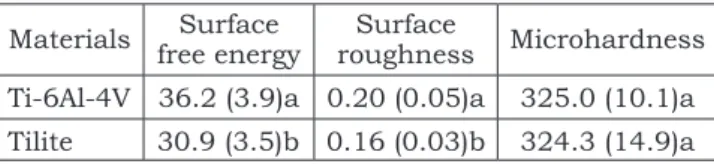
Mean surface free energy, surface roughness and surface hardness values for each material are presented in Table 1. The SFE and SR of Ti-6Al-4V were significantly higher (p < 0.05) than that of Tilite. But no significant differences (p > 0.05) in surface hardness between the materials were found.
A
a
b
A a
b
a
b
B
FIGURES 1, A-B- SEM of the Ti-6Al-4V alloy surface at 500 X (A) and 1,500 X (B) magniication; well-deined unidi -rectional microstructure with irregular scratches and defects (a) and small pits (b) resulting from machining.
a b
B
TABLE 1 - Mean values and standard deviations (n = 25) of surface free energy (erg.cm–2), surface roughness
(µm) and microhardness (Vickers kg/mm2) for the
Ti-6Al-4V and Tilite alloys.
Materials free energySurface roughnessSurface Microhardness
Ti-6Al-4V 36.2 (3.9)a 0.20 (0.05)a 325.0 (10.1)a Tilite 30.9 (3.5)b 0.16 (0.03)b 324.3 (14.9)a
Mean values followed by distinct letters differ significantly (p < 0.05).
The SEM micrographs (Figures 1, A-B, and 2, A-B) revealed that the surface morphology of the ma-terials are clearly distinct. Ti-6Al-4V showed a
well-FIGURES 2, A-B - SEM of the Tilite alloy surface at 500 X (A) and 1,500 X (B) magniication; well-deined surface
defined unidirectional microstructure with irregular scratches, small pits and turning marks (Figure 1, A-B) whereas Tilite (Figure 2, A-B) showed a well-de-fined surface texture with an equally smooth surface and only minor irregularities and light scratches.
DISCUSSION
The surface free energy of a solid surface gives a direct measurement of intermolecular interac-tions at interfaces and has a strong influence on wetting, adsorption and adhesion behavior.24 SFE
and wettability of materials can be determined by measuring the contact angle formed by a range of liquids on a given surface, using several different approaches.5,19 In the present study, Ti-6Al-4V had
higher SFE compared with Tilite, meaning that the former has a greater potential for initial bacteria colonization.15 In this study, however, only distilled
water with known surface tension (72.8 erg.cm2)
was used for contact angle measurements,5 which
could be a limitation for further discussions, since the polar and non-polar components of surface free energy were not determined.
Surface roughness has a major impact on mi-crobial colonization.14 Preferential retention occurs
on rough surfaces because on such surfaces bac-teria are more protected against shear forces and oral hygiene measures, thus giving the entrapped microbial cells time to become irreversibly attached to the surface.12 Brecx et al.2 (1983) stated that the
proliferation of the initially adhering microorgan-isms accounts for the major part of the micro-bial mass increase during early biofilm formation, which may explain the role of surface roughness in initial biofilm formation.1 The SR values found
in this study were 0.16 µm for the Tilite alloy and 0.2 µm for Ti-6Al-4V (Table 1). These results are in accordance with the range found for commercially available implant components.18,22,23 Some in vivo
studies suggested a threshold surface roughness for bacterial retention (0.2 µm), below which no further reduction in bacterial accumulation could be expected.1 Thus, every dental material needs
its own treatment modality in order to obtain and maintain a surface as smooth as possible.
SEM images showed different surface topogra-phies between the materials (Figures 1, A-B, and 2, A-B). Based on the surface areas investigated, the density of the local defects (merely deviation from a uniform surface structure) appeared to be higher on the Ti-6Al-4V surface compared with the Tilite sur-face, but no quantitative analysis was performed.
According to information given by the man-ufacturers, Ti-6Al-4V is subjected to a chemical etching process, whereas Tilite does not receive any chemical treatment. Carlsson et al.3 (1988)
and Carr et al.4 (1997) stated that the use of an
acid etch, such as that with hydrochloric acid, sul-furic acid and nitric acid, produced micro-cavities on the surface that varied according to the type, concentration and temperature of the acid, which may produce an unsuitable, rough surface and affect the resistance of the material.21
Surface hardness may explain the risk for sur-face roughening of the abutments of several im-plant systems during professional cleaning or even during habitual oral hygiene procedures.1,7 For SH,
there were no statistical differences between the Ti-6Al-4V and Tilite alloys (Table 1). The SH values found in this study are in agreement with those of Quirynen et al.14 (1994) who observed Vickers
hardness values for abutments varying from 154 for Branemark to 340 for Steri-OSS.
With regard to professional cleaning, special care should be taken when ultrasonic scaling, metal instruments20 and air powder abrasive
sys-tems are used, because these methods lead to in-creased surface roughness. According to McCollum et al.9 (1992) only methods that do not damage the
abutment surface or enhance biofilm accumulation should be used for maintenance and prophylaxis. Meschenmoser et al.10 (1996) stated that the
in-strument recommended for professional hygiene is the plastic curette. Although there are no studies about the influence of professional hygiene meth-ods on surface roughness and structural modifica-tions of implant abutments made of Tilite, because of the similarity in their surface hardness values, it probably presents the same behavior as that of Ti-6Al-4V.
CONCLUSION
Within the limits of this study, it can be con-cluded that the Ti-6Al-4V and Tilite alloys showed differences in surface characteristics, except for surface hardness. Further studies are, however, necessary to elucidate the biological responses to implant abutments made with these materials.
ACKNOWLEDGEMENTS
REFERENCES
1. Bollen CM, Lambrechts P, Quirynen M. Comparison of surface roughness of oral hard materials to the threshold surface roughness for bacterial plaque retention: a review of the literature. Dent Mater. 1997;13(4):258-69.
2. Brecx M, Theilade J, Attstrom R. An ultrastructural quan-titative study of the significance of microbial multiplica-tion during early dental plaque growth. J Periodontal Res. 1983;18(2):177-86.
3. Carlsson L, Rostlund T, Albrektsson B, Albrektsson T. Im-plant fixation improved by close fit. Cylindrical imIm-plant- implant-bone interface studied in rabbits. Acta Orthop Scand. 1988;59(3):272-5.
4. Carr AB, Gerard DA, Larsen PE. Quantitative histomorpho-metric description of implant anchorage for three types of dental implants following 3 months of healing in baboons. Int J Oral Maxillofac Implants. 1997;12(6):777-84. 5. Combe EC, Owen BA, Hodges JS. A protocol for
determin-ing the surface free energy of dental materials. Dent Mater. 2004;20(3):262-8.
6. Costa HMF, Rodrigues RCS, Matos MGC, Ribeiro RF. Evalu-ation of the adaptEvalu-ation interface of one-piece implant-sup-ported superstructures obtained in Ni-Cr-Ti and Pd-Ag alloys. Braz Dent J. 2003;14(3):197-202.
7. Fox SC, Moriarty JD, Kusy RP. The effects of scaling a tita-nium implant surface with metal and plastic instruments: an in vitro study. J Periodontol. 1990;61(8):485-90. 8. Kasemo B. Biocompatibility of titanium implants: surface
science aspects. J Prosthet Dent. 1983;49(6):832-7. 9. McCollum J, O’Neal RB, Brennan WA, van Dyke TE,
Hor-ner JA. The effect of titanium implant abutment surface irregularities on plaque accumulation in vivo. J Periodontol. 1992;63(10):802-5.
10. Meschenmoser A, d’Hoedt B, Meyle J, Elssner G, Korn D, Hammerle H et al. Effects of various hygiene procedures on the surface characteristics of titanium abutments. J Periodontol. 1996;67(3):229-35.
11. Minagi S, Miyake S, Inagaki K, Tsuru H, Suginaka H. Hydrophobic interaction in Candida albicans and Candida tropicalis adherence to various denture base resin materi-als. Infec Immun. 1985;47(1):11-4.
12. Nakazato G, Tsuchiya H, Sato M, Yamauchi M. In vivo plaque formation on implant materials. Int J Oral Maxillofac Implants. 1989;4(4):321-6.
13. Quirynen M, Bollen CM. The influence of surface roughness and surface-free energy on supra- and subgin-gival plaque formation in man. A review of the literature. J Clin Periodontol. 1995;22(1):1-14.
14. Quirynen M, Bollen CM, Willems G, van Steenberghe D. Comparison of surface characteristics of six commer-cially pure titanium abutments. Int J Oral Maxillofac Im-plants. 1994;9(1):71-6.
15. Quirynen M, Marechal M, Busscher HJ, Weerkamp AH, Arends J, Darius PL et al. The influence of surface free energy on planimetric plaque growth in man. J Dent Res. 1989;68(5):796-9.
16. Quirynen M, Marechal M, Busscher HJ, Weerkamp AH, Darius PL, van Steenberghe D. The influence of sur-face free energy and sursur-face roughness on early plaque formation. An in vivo study in man. J Clin Periodontol. 1990;17(3):138-4.
17. Quirynen M, van der Mei HC, Bollen CM, Schotte A, Marechal M, Doornbusch GL et al. An in vivo study of the influence of the surface roughness of implants on the mi-crobiology of supra- and subgingival plaque. J Dent Res. 1993;72(9):1304-9.
18. Sawase T, Wennerberg A, Hallgren C, Albrektsson T, Baba K. Chemical and topographical surface analysis of five different implant abutments. Clin Oral Implants Res. 2000;11(1):44-50.
19. Sipahi C, Anil N, Bayramli E. The effect of acquired salivary pellicle on the surface free energy and wettability of different denture base materials. J Dent. 2001;29(3):197-204. 20. Speelman JA, Collaert B, Klinge B. Evaluation of
different methods to clean titanium abutments. A scan-ning electron microscopic study. Clin Oral Implants Res. 1992;3(3):120-7.
21. Wennerberg A, Albrektsson T, Andersson B. Design and surface characteristics of 13 commercially available oral implant systems. Int J Oral Maxillofac Implants. 1993;8(6):622-33.
22. Wennerberg A, Albrektsson T, Andersson B, Krol JJ. A histomorphometric and removal torque study of screw-shaped titanium implants with three different surface to-pographies. Clin Oral Implants Res. 1995;6(1):24-30. 23. Wennerberg A, Sennerby L, Kultje C, Lekholm U. Some
soft tissue characteristics at implant abutments with dif-ferent surface topography. A study in humans. J Clin Peri-odontol. 2003;30(1):88-94.
24. Zhao Q, Liu Y, Abel EW. Effect of temperature on the surface free energy of amorphous carbon films. J Colloid Interface Sci. 2004;280(1):174-83.