www.reumatologia.com.br
REVISTA BRASILEIRA DE
REUMATOLOGIA
Original article
Quality of life in adults and elderly patients with
rheumatoid arthritis
Izabela Roma
a,*,
Mariana Lourenço de Almeida
a, Naira da Silva Mansano
a,
Gustavo Arruda Viani
b, Marcos Renato de Assis
a, Pedro Marco Karan Barbosa
a,ca Faculdade de Medicina de Marília, Marília, SP, Brazil
b Department of Radiotherapy and Oncology, Faculdade de Medicina de Marília, Marília, SP, Brazil c Hospital das Clínicas de Marília, Faculdade de Medicina de Marília, Marília, SP, Brazil
a r t i c l e i n f o
Article history:
Received 8 October 2013 Accessed 20 March 2014
Keywords:
Quality of life Rheumatoid arthritis Elderly
a b s t r a c t
Objective: To analyze and compare quality of life (QoL) in adults and elderly patients with rheumatoid arthritis (RA).
Methods: This was a cross-sectional quantitative study. The tools include the Medical Out-comes Study Short Form-36 (SF-36), the Disease Activity Score 28 (DAS-28), the Assessment Health Questionnaire (HAQ), the Beck Depression Inventory (BDI) and the 6-Minute Walk
Test (6MWT). Data analysis was done by descriptive statistics, Student’s t test and linear
regression test, with signiicance level of p <0.05.
Results: The sample consisted of 99 patients diagnosed with RA, divided into adults and el-derly. Those considered adults were 18-59 years-old and those with 60 years or older where considered elderly. In SF-36, the groups showed the pain domain as the most compromised and the emotional aspects domain as the less compromised. Both showed moderate
lev-el of disease activity and mild disability. Applying the t test, it was found that there was
no signiicant difference between groups with respect to QoL, functional ability, depres-sion and disease activity. The difference was signiicant in the 6MWT, in which the elderly achieved an average of 330.8 m, and the adults, 412.2 m (p=0.000). In linear regression, a signiicant correlation (r=-0.31) between the 6MWT and increasing age was noted.
Conclusion: QoL and functional capacity in RA were affected in adults and the elderly. How-ever, the results showed no signiicant difference between groups, with the exception of the 6MWT.
© 2014 Sociedade Brasileira de Reumatologia. Published by Elsevier Editora Ltda. All rights reserved.
* Corresponding author.
E-mail: [email protected] (I. Roma).
Qualidade de vida de pacientes adultos e idosos com artrite reumatoide
Palavras-chave:
Qualidade de vida Artrite reumatoide Idoso
r e s u m o
Objetivo: Analisar e comparar a qualidade de vida (QV) de pacientes adultos e idosos com artrite reumatoide (AR).
Métodos: Trata-se de um estudo transversal, quantitativo. Os instrumentos aplicados
in-cluem o Medical Outcomes Study-36 Short Form (SF-36), o Disease Activity Score 28 (DAS-28), o
Health Assestment Questionnaire (HAQ), o inventário de depressão de Beck e o Teste de
Cami-nhada de 6 Minutos (TC6). A análise dos dados foi feita por estatística descritiva, teste tde
student e teste de regressão linear, sendo adotado nível de signiicância de p<0,05.
Resultados: A amostra foi constituída por 99 pacientes com diagnóstico de AR, divididos em adultos e idosos. Foram considerados adultos aqueles de 18 a 59 anos, e idosos aqueles com 60 anos ou mais. No SF-36 os grupos apresentaram o domínio dor como o mais comprome-tido e o domínio aspectos emocionais como menos compromecomprome-tido. Ambos apresentaram
nível moderado de atividade da doença e deiciência leve. Aplicando-se o teste t,
constatou--se que não há diferença signiicativa entre os grupos no que diz respeito à QV, capacidade funcional, depressão e atividade da doença. A diferença foi signiicativa no TC6, no qual os idosos obtiveram uma média de 330,8 m, e os adultos 412,2m, com um p=0,000. Na regres-são linear houve correlação signiicativa (r=-0,31) entre a distância percorrida no TC6 e o aumento da idade.
Conclusão: A QV e a capacidade funcional na AR mostrou-se afetada nos adultos e nos idosos; porém, os resultados mostraram que não há diferença entre os grupos com exce-ção do TC6.
© 2014 Sociedade Brasileira de Reumatologia. Publicado por Elsevier Editora Ltda. Todos os direitos reservados.
Introduction
In recent years, Brazil and the world are undergoing changes in the population pyramid with the increasing number of elderly people and consequent prevalence of chronic degen-erative diseases, including rheumatoid arthritis.1-3
Rheumatoid arthritis (RA) is a chronic inlammatory, autoimmune, systemic, progressive disease with unknown aetiology that causes progressive damage to the musculo-skeletal system, involving small and large joints and leading to pain, deformity and even an irreversible bone and carti-lage destruction.4-6
RA attacks approximately 0.5% to 1% of the world popula-tion, with predominance of 2-3 times more in females. It af-fects all age groups, but is more prevalent among 40-60-year people.4,5 In Brazil, a prevalence of up to 1% was found in the
adult population; it is estimated that 1.3 million of people are affected.4
In addition to problems related to pain and inlammation that arise from the disease, patients with RA are also affected by psychological problems such as anxiety and depression. Studies show that the development of RA is closely related to increases in anxiety and depression, with prevalence of 13%-47%, and these disorders are 3 times more prevalent in patients with RA.7,8
Patients with RA exhibit signiicant functional impair-ment, with a consequent reduction in quality of life (QoL).3-5
Studies show that patients with RA have a lower QoL, when
compared to those without the disease. Apparently, QoL is affected in the physical and mental components, as well as in the functional capacity. These studies also relate worse QoL with those patients with very active disease, a more in-tense pain and functional disability.9-16
Quality of life is a multidimensional concept that incor-porates all aspects of human life, including physical, func-tional, emofunc-tional, social and spiritual dimensions.17 It relates
the self-perception of the individual expectations, standards and concerns within the context of the culture and value systems in which these people live.18
Knowing that RA can lead to profound changes in peo-ple’s health and autonomy, especially in a growing and vul-nerable group as the elderly, the assessment of QoL in this population deserves to be considered. Thus, this study aims to analyze and compare the QoL of adults and elderly pa-tients with RA followed-up at an outpatient rheumatology service in a teaching hospital, in order to identify the inlu-ence of age on the QoL of patients with RA.
Materials and methods
A cross-sectional quantitative study on a sample of patients with RA at an outpatient specialized service of a university hospital in Marília, São Paulo, was performed.
in the study, including cognitive and physical abilities. Pa-tients with some type of comprehension deicit that would limit the interview – for instance, those with hearing or vi-sual disabilities and limited mobility (i.e., wheelchairs users) – were excluded.
The study was approved by the Ethics Committee in Re-search of the Faculty of Medicine of Marília (Protocol number 477/12).
After the informed consent, a questionnaire concerning sociodemographic aspects of patients and clinical aspects of the disease. Next, the questionnaires of QoL evaluation, functional capacity, disease activity and depression were ap-plied.
To assess QoL, the generic instrument SF-36 was used. To assess functional capacity the HAQ, a speciic question-naire for patients with rheumatoid arthritis, was applied. The 6MWT was used to assess the physical itness of the patients. Other instruments used were: the DAS-28, which assesses disease activity, and the BDI, which shows the pres-ence of depressive symptoms.
As to the analysis of data, to detect differences between the means of the two study groups (adults and elderly), we used the Student’s t test. The scores with p-value <0.05 were tested to assess whether there is a linear relationship with increasing age, through linear regression. The analyses were performed with the software SPSS v20. A signiicance level of p <0.05 was considered.
Results
In this study, 99 (61 adults and 38 elderly) patients with a diagnosis of RA according to the American College of Rheu-matology (ACR) criteria were studied.4 We considered as
el-derly subjects aged 60 years or more, according to the WHO classiication of elderly people for developing countries, and as adults those between 18 and 59 years.
In the description of the sociodemographic characteris-tics listed in Table 1, it appears that in both groups there is a predominance of white race, female and married individu-als. As for the level of education, most adults completed el-ementary school, and many elderly people have never stud-ied.
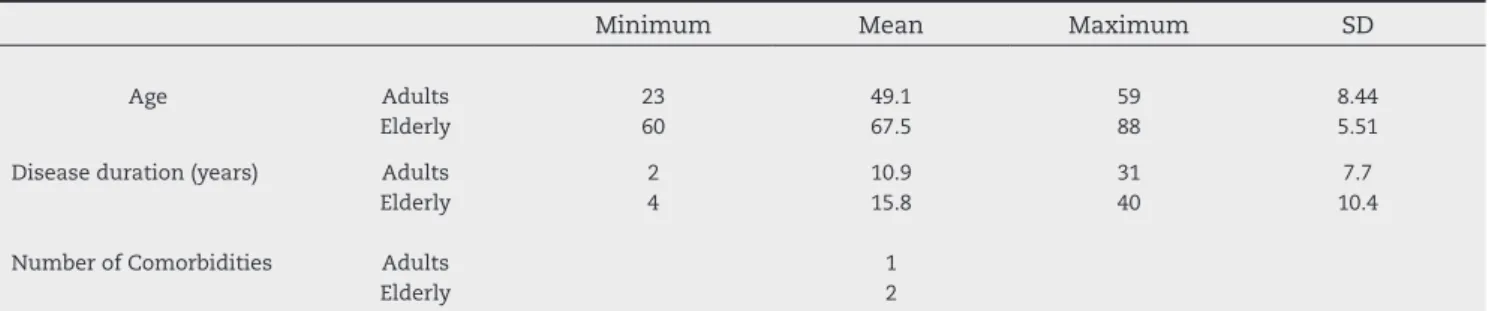
The results related to age, disease duration and comor-bidities of the two groups are shown in Table 2. The mean age for the adult group was 49 years, with a standard devia-tion (SD) of 8.44; for the elderly group, the mean age was 67,5
years (SD=5.51). The mean duration of disease for the adult group was 10.9 years (SD=7.7); as for the elderly group, was 15.8 years (SD=10.4).
As for the number of comorbidities, the elderly had an average of two comorbidities, and most of them (60%) had hypertension; as for the adult group, its participants have an average of one comorbidity, also with prevalence of hyper-tension, totalling 45%.
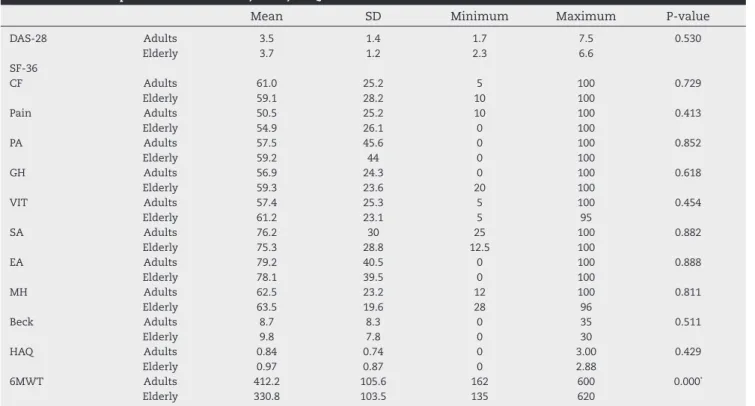
Regarding disease activity measured by DAS-28, both groups showed an average consistent to moderate activity disease. With the Student’s t test, it was found that the dif-ference between groups was not signiicant (p-value=0.530). Regarding the assessment of QoL by SF -36 questionnaire, the scores obtained in eight domains for adults ranged from 50.5 to 79.2, and the pain domain was the most affected in these patients; and the emotional aspects domain was the least compromised. In the elderly, the scores ranged from 54.9 to 78.1, and here again the pain domain was the most compromised, and the emotional aspects domain was the least compromised.
It was veriied that the elderly had worse averages versus
adults only in the following domains: physical functioning, social function and emotional aspects. In other domains of the SF -36 questionnaire (as pain, physical appearance, gen-eral health, vitality and mental aspects), a better outcome for the elderly was found. Comparing the averages of the
Table 1 – Sociodemographic characteristics (%)
Adults Elderly
Race Caucasian Brown Black
62.3 24.6 13.1
57.9 26.3 15.8 Marital State
Married Single Divorced Widower In cohabitation Gender
Female Male
55.7 21.3 9.8 8.2 4.9
90.2 9.8
63.2 15.8 10.5 10.5 0
86.8 13.2 Schooling
Illiterate Elementary Fundamental High school College
11.5 26.2 31.1 26.3 4.9
44.7 28.9 23.7 2.6 0
Table 2 – Age, disease duration, and number of comorbidities
Minimum Mean Maximum SD
Age Adults
Elderly
23 60
49.1 67.5
59 88
8.44 5.51
Disease duration (years)
Number of Comorbidities
Adults Elderly
Adults Elderly
2 4
10.9 15.8
1 2
31 40
groups using the Student’s t test in order to obtain a more reliable evaluation, we found that there was no statistical signiicance in all domains of the SF-36, i.e., no difference in QoL between adult and elderly subjects with RA. Means, SDs, minimums and maximums, and p-values for the groups are represented in Table 3.
On BDI, elderly subjects presented average scores consis-tent with mild depression; as for adults, absence of depres-sion or minimal depressive symptoms were found. In the Student’s t test, a signiicant difference between the groups was not perceived (p=0.511), i.e., the difference between adults and the elderly with respect to depression was not signiicant.
Considering the average of HAQ, an instrument that mea-sures functional ability in relation to the activities of daily life, the results showed that both groups had mild disabil-ity. In the Student’s t test, no signiicant difference between adult and elderly groups (p = 0.429) was found.
In 6MWT, the elderly scored an average of 330.8 meters, while adults achieved an average of 412.2 m, given that the reference value for healthy adults is 400-700 meters.19,20
Ap-plying the Student’s t test, we obtained a signiicant differ-ence between adults and the elderly, where p=0.000.
Table 3 shows the averages, minimums, maximums, standard deviations and p-values for all the questionnaires above mentioned.
For the 6MWT, we applied the linear regression model, and a signiicant correlation, r = -0.31 (p = 0.001), was found. Thus, we can consider that the older the subject, the shorter the distance on the 6MWT (Fig. 1).
Discussion
This study showed a female predominance in both groups, which was expected due to the fact that RA preferentially af-fect women at a ratio of 3:1,4 that was also demonstrated in
other studies involving the subject, which also showed a pre-dominance of women in their samples.10,21-23 The prevalence
of women in the elderly group may also be explained by the remarkable feminization of the ageing process.24
Regarding the duration of the disease, our sample had a mean of 10.9 years for adults and 15.8 years for the elderly, which draws attention to a population possibly with irrevers-ible joint damage. Similar studies analyzed samples with a mean duration of illness similar to that found in this study, which allows us to formulate reliable comparisons.13,22,25,26
The result of the DAS-28, an instrument that measures the activity of the disease, showed that the mean of our groups corresponded to a moderate activity; this can be explained by the fact that the patients surveyed had been already under medical care at an outpatient rheumatology service.
Most of the studies that examine the assessment of RA activity also use samples with moderate disease.13,14,22,27 There
was no signiicant difference between the results of DAS-28 between adults and the elderly.
With regard to QoL, both groups had worse scores in the pain domain, with 50.5 for adults and 54.9 for the elderly.
In general, the adults showed worse averages in the do-mains of pain (50.5), general health (56.9), vitality (57.4) and physical aspects (57.5), and the best averages in the domains
Table 3 – Scores of questionnaires: DAS-28, SF-36, HAQ, BECK and of 6MWT
Mean SD Minimum Maximum P-value
DAS-28 Adults Elderly 3.5 3.7 1.4 1.2 1.7 2.3 7.5 6.6 0.530 SF-36 CF Adults Elderly 61.0 59.1 25.2 28.2 5 10 100 100 0.729 Pain Adults Elderly 50.5 54.9 25.2 26.1 10 0 100 100 0.413 PA Adults Elderly 57.5 59.2 45.6 44 0 0 100 100 0.852 GH Adults Elderly 56.9 59.3 24.3 23.6 0 20 100 100 0.618 VIT Adults Elderly 57.4 61.2 25.3 23.1 5 5 100 95 0.454 SA Adults Elderly 76.2 75.3 30 28.8 25 12.5 100 100 0.882 EA Adults Elderly 79.2 78.1 40.5 39.5 0 0 100 100 0.888 MH Adults Elderly 62.5 63.5 23.2 19.6 12 28 100 96 0.811
Beck Adults 8.7 8.3 0 35 0.511
Elderly 9.8 7.8 0 30
HAQ Adults Elderly 0.84 0.97 0.74 0.87 0 0 3.00 2.88 0.429
6MWT Adults 412.2 105.6 162 600 0.000*
Elderly 330.8 103.5 135 620
emotional (79.2), social (76.2), mental health (62.5) and func-tional capacity (61).
It is remarkable that the domains related to physical health affected most the QoL of patients with RA, than the domains relating to mental health. Other studies also reveal that adult patients with RA have lower QoL,23,28 especially in
domains relating to physical aspects, pain and vitality. In studies using the division of the eight domains of the SF-36 questionnaire in physical and mental components, the physical component appears as the most affected in all of these studies.11,14,16,22,27
As for the elderly, these participants had worse averages for the SF-36 domains of pain (54.9), functional capacity (59.1), physical aspects (59.2), and general health (59.3); and best aver-ages for the domains of emotional aspects (78.1), social (75.3), mental (63.5) and vitality (61.2). These data can be compared with those of a study assessing QoL of elderly patients with RA and OA, in whom the worst averages involved general health, physical health, mental health, pain, sleep and energy. In this study, the questionnaire used was not the SF-36, but a module of the Center for Disease Control and Prevention (CDC).23
In another study, also conducted with the aim to assess the QoL of the elderly, but with no specii cations for RA or any other type of disease, the worse averages in the SF-36 occurred in the domains physical aspects, pain and general health status,29 which allow us to conclude that the issues
re-lated to the physical component, functional capacity and pain are the most affected in the elderly, with or without RA.
In this study, no difference in QoL among adults and elder-ly with RA was noted, which is somewhat surprising, as it was believed that older people with RA would report worse QoLs due to the ageing process itself and the concurrent changes. However, studies were published with similar results, as a survey conducted by Khanna et al.12 in the United States,
that aimed to analyze the impact of self-reported arthritis in an adult population. The authors applied six questionnaires assessing QoL, among them the SF-36, and, as a result, ob-tained an improvement of QoL in the age group 65-74 years,
when comparing data with those subjects with 35-64 years. Surprised, the authors clarii ed this result by explaining that the healthiest subjects in the age group of 35-64 years may be very busy; or, perhaps, the less healthy subjects in the group 65-74 years may be too sick or frail to participate in the survey.
Although not specii c for RA, some studies compared QoL among the elderly in order to identify whether age inl u-ences QoL. The study of Pimenta et al.29 shows a comparison
between QoL of young and elderly subjects with a more ad-vanced age, all of them retired, resulting in higher scores for those older individuals with regard to functioning capacity, pain, vitality, social functioning and mental health, similarly to another study with the same objective, which also demon-strated that QoL seems not to decline with age.30
In our study, although the elderly had worse averages for the adults in the functional, social and emotional capacities, this difference was not signii cant, as well as in the other do-mains of the SF-36, in which the scores were very close.
This result can be explained thanks to the enormous vari-ability of the ageing process, which makes the heterogeneity of the elderly greater than in young people, as they are more susceptible to environmental inl uences; in addition, the pe-culiar characteristics of ageing and the sociocultural context render even more complicated the measurement of QoL in this age group.
In agreement with Haddad,31-32 we must understand that
the ageing process promote natural changes in these sub-jects. There is a difference, however, between the physiologi-cal ageing, which occurs due to chronologiphysiologi-cal age, and the pathological ageing, that affects even not older people, by depending mainly on how the person deals with the disease and with their difi culties. Some elderly people tend to refrain from obligations and from their social and professional roles, while others take a more active attitude, by getting involved in physical and recreational activities, not shying away from social interaction.
In his book, Spilker states that the conclusions about the QoL of elderly people should be highly individualized,33 as
there are large individual differences among the elderly, more than in any other age group. There are differences in almost all kinds of characteristics, including physical, mental, psy-chological, socioeconomic and health conditions. The author explains that many elderly people can remain fairly healthy and with good functional ability until their late years, main-taining their physical, mental and social characteristics, pro-vided they have healthy habits and lifestyles, and that means adaptability and sufi cient functional reserve for most daily activities.
The fact that there is no difference between QoL of adults and elderly with RA in this study can also be explained by the use of a generic questionnaire for the assessment of QoL, not specii c to the elderly population, a group that has specii c characteristics that differ from younger age groups, especially because they passed through various social situations such as retirement, widowhood, dependency, and loss of autonomy and social roles. Then, there is the need for multidimensional instruments that can capture the variability of the elderly, and that more faithfully assess QoL in this age group.
Grimley-Evans raises some problems in the application of QoL questionnaires in older people,34 since we must suspect Fig. 1 – Dispersion curve showing the correlation between
increasing age and performance in 6MWT
Observed Linear
that the elderly will have more dificulty in answering to con-cepts on the likelihood of to make decisions, unlike younger adults. This author also alert to the tendency of an optimis-tic assessment among the elderly on their health status and their well-being, or even to ignore the symptoms because they believe that these are part of the natural ageing process.
The lack of correlation between QoL and age does not mean that one should underestimate the assessment of el-derly patients with RA, as they have speciic characteristics and must be treated according to their needs.
In our country, the old-age stereotypes and the confusion between normal and pathological ageing slow, and even pre-vent, an appropriate treatment which can have negative ef-fects on QoL of the elderly.34-35 This stereotypical view is also
reinforced by part of the health professionals, who tend to explain symptoms or complaints brought by the elderly as be-ing part of the agebe-ing process, which leads to the omission and neglect, preventing treatment, rehabilitation and healing. As we tried to demonstrate, although the characteristics of ageing and the sociocultural context increase the complexity of measuring QoL of older people, this assessment should be performed without underestimating the particularities of the ageing process.
In short, we believe that two assessments of QoL can never be equal; all individuals have speciic identities with regard to the physical, emotional, social and spiritual aspects. Each as-sessment shows an individual experience can be limited by the particular environment of the individual, or by a speciic time.
In BDI, an instrument that assesses the presence of depres-sive symptoms, the elderly presented an average consistent with symptoms of mild depression, and the adults showed absence of depression or minimal depressive symptoms, al-though this difference was not signiicant (p=0.511).
In previous studies, it is possible to identify that there is a higher prevalence of depressive symptoms in people with RA, compared to those who do not have the disease.26,36
Dario et al.7 showed that the development of RA is closely
related to increases in anxiety and depression, being three times more prevalent in patients with RA. An association among these disorders and recurrent pain, obesity, physical inactivity and social or functional limitations was found.
Although there is no consensus in the literature as to the origin of the higher prevalence of depressive symptoms in RA, we found it important to evaluate the subjects participating in our study with respect to these symptoms, probably be-cause their presence aggravates the complaints related to RA, hindering the continuity of health care, which often worsens the clinical condition and interfere with the assessment of QoL.
With respect to HAQ, an instrument that measures func-tional ability, the results of this study showed no signiicant difference between adults and the elderly, which can be ex-plained by the same reason on the results obtained with SF-36, since the elderly tend to optimistically assess their health status and ignore their symptoms, by believing that they are part of the ageing process. This fact can be demonstrated by the outcome of the 6MWT, a test that assesses physical it-ness on a practical level. With this test, the elderly had lower averages versus the adults, and a signiicant correlation with increasing age was noted, with p <0.05.
In the 6MWT, the subject walks the farthest distance pos-sible within 6 minutes; it is not pospos-sible to distort the data or ignore the symptoms. The results show that the elderly in our study have lower functional capacity than adults in this test, and that the older the person is, the less the distance walked.
Other studies have also shown a correlation between increasing age with less distance in the 6MWT.36-39 In these
studies, when applying the 6MWT in healthy people aged 50 to 85 years-old, it was observed that the distance covered on the test decreases with increasing the age of the subjects.
However, if we compare our data with those obtained by Pires et al.,36 who evaluated the results of the 6MWT in
differ-ent age groups, it is eviddiffer-ent that our adults and elders with RA had a lower mean in the test, compared to those in the study. The adults in Pires et al. study achieved a mean of 606.3 m, whereas our group of adults obtained a mean of 412.2 m. The same happened with the elderly: in that study, the mean for this group was 447.2 m, and the elderly with RA in our study achieved 330.8 m.
In another study, conducted by Steffen et al.,37 the aim was
to obtain data for four physical tests conducted with elderly people, among them the 6MWT. The elderly people in this study had an average of 486.2 m, while in our study the el-derly with RA achieved a mean of 330.8 m.
Troosters et al.39 also evaluated the 6MWT in healthy older
subjects. As a result, they found a mean of 631 m, higher than that for the elderly in our study.
It is believed that the signiicant difference in the distance walked among adults and elderly people in our study may be explained by the physiological changes resulting from the ageing process itself, as the decrease in overall muscle strength and changes of heart and lung function. This result may also have been inluenced by the duration of the disease, which is high in both groups, and by the disease activity at the time of the test, which interferes with the physical perfor-mance of patients. The existing comorbidities in individuals of the sample may also affect the results of the physical test; the exclusion of this variable from our study was not possible, whereas it would be hard to ind elderly people without some associated comorbidity.
Conclusions
In this study, adult and elderly subjects with RA had a low QoL, as assessed by HAQ and SF-36.
Except by 6MWT, there is no difference between adult and elderly groups with RA. The data obtained were equivalent as the questionnaires used (SF-36, HAQ, DAS-28, and BECK); i.e., no difference regarding QoL, functional capacity, disease se-verity, and presence of depressive symptoms among adults and elderly with RA.
In view of the results obtained, it is suggested that, during the implementation of actions aiming at improving the QoL of the elderly, the magnitudes and differences of each group are taken into account with respect to what its components value, in their pursuit of wellness in the old age.
Conlicts of interest
The authors declare no conlicts of interest.
R E F E R E N C E S
1. Wong LLR, Carvalho JA. O rápido processo de
envelhecimento populacional do Brasil : sérios desaios para as políticas públicas. Rev Bras Estud Popul. 2006;23:5-26. 2. World Health Organization - WHO. Envelhecimento ativo:
uma política de saúde. Brasília (DF): Organização Pan-Americana da Saúde; 2005. Available from: http://bvsms. saude.gov.br/bvs/publicacoes/envelhecimento_ativo.pdf. [Cited 2013 Apr 25].
3. Lee TJ, Park BH, Son HK, Song R, Shin KC, Lee EB et al. Cost of illness and quality of life of patients with rheumatoid arthritis in South Korea: Value Health. 2012;15(1 Suppl):S43-9. Available from: http://www.ispor. org/consortiums/asia/ViH/3rdIssue/Cost-of-Illness-and- Quality%20of%20Life-of-Patients-with-Rheumatoid-Arthritis-in-South-Korea.pdf. [Cited 2013 Mar 20]. 4. Mota LMH, Cruz BA, Brenol CV, Pereira IA, Fronza LSR,
Bertolo MB, Freitas MVC, Silva NA, Louzada-Junior P, Giorgi RDN, Lima RAC, Pinheiro GRC. Consenso da Sociedade Brasileira de Reumatologia 2011 para o diagnóstico e avaliação inicial da artrite reumatoide. Rev Bras Reumatol. 2011;51:207-19.
5. Mota LMH, Cruz BA, Brenol CV, Pereira IA, Rezende-Fronza LS, Bertolo M B, Freitas MVC, Silva NA, Louzada-Júnior P, Giorgi RDN, Lima RAC, Pinheiro GRC. Consenso 2012 da Sociedade Brasileira de Reumatologia para o tratamento da artrite reumatoide. Rev Bras Reumatol. 2012;52:152-74. 6. Goeldner I, Skare TL, Reason ITDM. Artrite reumatoide : uma
visão atual. J Bras Patol Med Lab. 2011;47:495-503.
7. Dario AB, Faraco HC, Gevaerd MS, Domenech SC. Alterações psicológicas e exercício físico em pacientes com artrite reumatoide. Motricidade. 2010;6:21-30. Available from: http://revistas.rcaap.pt/motricidade/article/view/142/131. [Cited 2013 May 29]
8. Mella LFB, Bértolo MB, Dalgalarrondo P. Depressive symptoms in rheumatoid arthritis patients. Rev Bras Psiquiatr. 2010;32:257-63.
9. Brandão L, Ferraz MB, Zerbini CAF. Avaliação da qualidade de vida na artrite reumatoide: revisão atualizada. Rev Bras Reumatol. 1997;37:275-81.
10. Mota LMH, Laurindo IMM, Santos Neto LL. Avaliação prospectiva da qualidade de vida em uma coorte de pacientes com artrite reumatoide inicial. Rev Bras Reumatol. 2010;55:249-61.
11. Corbacho MI, Dapueto JJ. Avaliação da capacidade funcional e da qualidade de vida de pacientes com artrite reumatoide. Rev Bras Reumatol. 2010;50:31-43.
12. Khanna D, Maranian P, Palta M, Kaplan RM, Hays RD, Cherepanov D, Fryback DG. Health-related quality of life in adults reporting arthritis: analysis from the National Health Measurement Study. Qual Life Res. 2011;20:1131-40. Available from: http://www.ncbi.nlm.nih.gov/pmc/articles/ PMC3156343/.[Cited 2013 Apr 15]
13. Haroon N, Aggarwal A, Lawrence A, Agarwal V, Misra R. Impact of rheumatoid arthritis on quality of life. Mod Rheumatol. 2007;17:290-5.
14. Bedi GS, Gupta N, Handa R, Pal H, Pandey RM. Quality of life in Indian patients with rheumatoid arthritis. Qual Life Res. 2005;14:1953-8.
15. Mathew J, Antony J, Eremenco S, Paul B V, Jayakumar B, Philip J. Health-related quality of life in rheumatoid arthritis patients in South India. Singapore Med J. 2009;50:800-3. Available from: http://smj.sma.org.sg/5008/5008a9.pdf. [Cited 2013 May 5].
16. Salafi F, Carotti M, Gasparini S, Intorcia M, Grassi W. The health-related quality of life in rheumatoid arthritis, ankylosing spondylitis, and psoriatic arthritis: a comparison with a selected sample of healthy people. Health Qual Life Outcomes. 2009;7:1-12. Available from: http://www. pubmedcentral.nih.gov/articlerender.fcgi?artid=2674445&tool =pmcentrez&rendertype=abstract. [Cited 2013 Mar 15]. 17. Bowling A. Measuring disease: a review of disease-speciic
quality of life measurement scales. 2nd ed. Philadelphia (PA): Ann Bowling. 2001:1-19. Available from: http://mcgraw-hill. co.uk/openup/chapters/0335206417.pdf. [Cited 2013 Apr 15] 18. The Whoqol Group. The World Health Organization quality
of life assessment (WHOQOL): position paper from the World Health Organization. Soc Sci Med. 1995;41:1403-10.
19. Rezende R, Nogueira A, Oliveira D, Dal S, Malaguti C, Nove U et al. An update and standardization proposal for the six-minute walk test. 2009;22:249-59.
20. American Thoracic Society. ATS Statement: guidelines for the six-minute walk test. Am J Respir Crit Care Med. 2002;166:111-17. Available from: www.atsjournals.org. [Cited 2013 Apr 10]
21. Louzada Junior P, Dias B, Souza B, Toledo RA, Ciconelli RM. Análise descritiva das características demográicas e clínicas de pacientes com artrite reumatoide no Estado de São Paulo. Rev Bras Reumatol. 2007;47:84-90.
22. Nicassio PM, Kay MA, Custodio MK, Irwin MR, Weisman MH.An evaluation of a biopsychosocial framework for health- related quality of Life and disability in rheumatoid arthritis. J Psychosom Res. 2011;71:79-85.
23. Dominick KL, Ahern FM, Gold CH, Heller D a. Health-related quality of life among older adults with arthritis. Health Qual Life Outcomes. 2004 [cited 2013 May 25];2:1-22. Available from: http://www.pubmedcentral.nih.gov/articlerender.fcgi?a rtid=324570&tool=pmcentrez&rendertype=abstract22. 24. Negreiros TCGM. Sexualidade e gênero no envelhecimento.
Alceu. 2004;5:77-86. Available from: http://revistaalceu.com. puc-rio.br/media/alceu_n9_negreiros.pdf. [Cited 2013 Apr 15] 25. Yacoub YI, Amine B, Laatiris A, Hajjaj-Hassouni N.
Rheumatoid factor and antibodies against citrullinated peptides in Moroccan patients with rheumatoid arthritis: association with disease parameters and quality of life. Clin Rheumatol. 2012;31:329-34.
26. Costa AFC, Brasil MAA, Papi JA, Azevedo MNL. Depressão, ansiedade e atividade de doença na artrite reumatoide. Rev Bras Reumatol. 2008;48:7-11.
27. Rupp I, Boshuizen HC, Dinant HJ, Jacobi CE, Van Den Bos GA. Disability and health-related quality of life among patients with rheumatoid arthritis: association with radiographic joint damage, disease activity, pain, and depressive symptoms. Scand J Rheumatol. 2006;35:175.
28. Ciconelli RM, Ferraz MB, Santos W, Meinão I, Quaresma MR. Tradução para a língua portuguesa e validação do questionário genérico de avaliação de qualidade de vida SF-36 (Brasil SF-SF-36). Rev Bras Reumatol. 1999;39:143-50. 29. Pimenta FAP, Simil FF, Torres HOG, Amaral CFS, Rezende CF,
30. Maues CR, Paschoal SMP, Jaluul O, Jacob W, França CC. Avaliação da qualidade de vida: comparação entre idosos jovens e muito idosos. Rev Soc Bras Clin Med. 2010;8:405-10.
31. Haddad EGM. A velhice em movimento. Gerontologia. 1993;1:29-30.
32. Haddad EGM. A ideologia da velhice. São Paulo: Cortez, 1986.
33. Spilker B. Quality of Life and Pharmacoeconomics in Clinical Trials. 2 ed. 1995.
34. Evans JG. Quality of life assessments and elderly people. In: Hopkins A, editor. Measures of quality of life and the uses to which such measures may be put. Londres: Royal College of Physicians of London, 1992:107-16.
35. Paschoal SMP. Desaios da Longevidade: qualidade de vida. Mundo saúde. 2005;29:608-11.
36. Pires SR, Oliveira AC, Parreira VF, Britto RR. Teste de caminhada de seis minutos em diferentes faixas etárias e índices de massa corporal. Rev Bras Fisioter. 2007;11:147-51. 37. Steffen TM, Hacker TA, Mollinger L. Age- and
gender-related test, berg balance scale, timed up and go test, and community-dwelling elderly people: six-minute walk age-
and gender-related test performance in gait speeds.Phys
Therm. 2002;82:128-37.
38. Enright PL, Sherrill DL. Reference equations for the six-minute walk in healthy adults. Am J Respir Crit Care Med. 1998;158:1384-7. Available from: http://www.atsjournals.org/ doi/pdf/10.1164/ajrccm.158.5.9710086. [Cited 2013 Jul 13]. 39. Troosters T, Gosselink R, Decramer M. Six minute walking