Received on 05/16/2011. Accepted on 03/05/2012. The authors declare no confl ict of interest. Financial Support: Coordenação de Aperfeiçoamento de Pessoal de Nível Superior (CAPES), providing grants to the following authors: Diogo Homann, Suelen Meira Góes, and Chris Andreissy Breda. Ethics Committee: CEP/ HC: 2284.178/2010-07.
Department of Physical Education, Universidade Federal do Paraná – UFPR.
1. Master in Physical Education, Research Nucleus on the Quality of life, Department of Physical Education, Universidade Federal do Paraná – UFPR 2. PhD in Sports Science and Physical Education, Universidade de Coimbra; Professor of the Physical Education Course, Center for Motor Behaviour Studies, Department of Physical Education, UFPR
3. Master in Physical Education, Center for Motor Behaviour Studies, Department of Physical Education, UFPR
4. Master in Internal Medicine, UFPR; Assistant Professor, Discipline of Rheumatology, UFPR; Chief of the Fibromyalgia Outpatient Clinics, Hospital de Clínicas, UFPR 5. PhD in Health of Children and Adolescents, UFPR; Professor of the Physical Education Course, Research Nucleus on the Quality of Life, Department of Physcial Education, UFPR
Correspondence to:Diogo Homann. Rua Coração de Maria, 92 (BR-116, km 92) – Jardim Botânico. CEP: 80215-370. Curitiba, PR, Brasil. E-mail: [email protected]
Stress perception and depressive symptoms:
functionality and impact on the quality
of life of women with fi bromyalgia
Diogo Homann1, Joice Mara Facco Stefanello2, Suelen Meira Góes3,Chris Andreissy Breda3, Eduardo dos Santos Paiva4, Neiva Leite5
ABSTRACT
Introduction: Depression is one of the most frequent psychiatric comorbidities in patients with fi bromyalgia (FM), and chronic stress might be one of the triggering events of the characteristic FM symptoms. Objectives: To compare depres-sive symptoms and stress perception between women with and without FM, in addition to investigate the relationship between those characteristics and the functionality and the impact on the quality of life of those patients. Methods: The study included 20 women with FM (FM group) and 20 healthy women (control group). The following instruments were used: Beck Depression Inventory, Perceived Stress Scale-10, Health Assessment Questionnaire, Fibromyalgia Impact Questionnaire, and Visual Analogue Scale for pain (0–10 cm). Results: The FM group showed higher severity of the depressive symptoms (24.10 ± 11.68) and greater perception of stress (25.10 ± 4.82) as compared with those of the control group (10.20 ± 12.78, P < 0.01; and 15.45 ± 7.29, P < 0.01; respectively). A higher incidence of depressive symptoms was observed in the FM group (75%) than in the control group (25%) (χ2 = 10.00, P < 0.01). In the FM group, a positive
correlation was observed between the depressive symptoms and perceived stress (r = 0.54, P < 0.05), pain (r = 0.58, P < 0.01), impaired functionality (r = 0.56, P < 0.01), and impact on the quality of life (r = 0.46, P < 0.05). In this group there was also correlation between perceived stress and impaired functionality (r = 0.50; P < 0.05). Pain showed no relationship with perceived stress. Conclusion: The relationship between stress, depression and functionality seems to be part of a complex mechanism, which might affect the quality of life of patients with FM.
Keywords: pain, psychological stress, depression, fi bromyalgia.
© 2012 Elsevier Editora Ltda. All rights reserved.
INTRODUCTION
Fibromyalgia (FM) is characterized by chronic pain, which is accompanied by some symptoms such as fatigue, morning stiffness, changes in sleep, and depression.1 Depression is one of the most frequent psychiatric comorbidities in patients with FM, with a prevalence of 20%–80%.2 In fact, patients with
FM are approximately fi ve times more likely to experience depression than healthy individuals.3 Even without a formal diagnosis, depressive symptoms affect approximately 40% of those patients.4
stands out.6 It is worth noting that 42% of those individuals identify chronic stress as the trigger event of their symptoms.6
Acute stressing events are believed to precede the depres-sive symptoms,7 because the daily generation of stress might play a role in both maintaining and increasing the probability of the depression recurrence. Thus, stress generation can ac-count for the frequent chronic course of depression.8
However, the causal relation between stress and depression in FM does not seem to be linear, but repetitive, and, frequently, patients get stuck in a vicious cycle.9 Thus, both acute and chronic stresses are involved in triggering depression, and the negative effects of the chronic condition seem to amplify the as-sociation between acute daily events and depressive symptoms.10 The depressive symptoms impair the quality of life of patients with FM11,12 by increasing the sensation of pain and the perception of functional disability.13,14 In fact, depression is an independent predictor of the physical performance variation in those patients.15 Thus, factors that intensify the depressive symptoms should be controlled to guarantee the improvement in the quality of life of patients with FM.
Data on the relationship between stress, functionality, depressive symptoms and quality of life of patients diagnosed with FM are still scarce. To identify that relationship is para-mount to provide a more effective treatment to that population. This study aimed at comparing the psychological aspects (perception of stress and depressive symptoms) between women with and without FM and at investigating the possible relationship of those aspects with pain, functionality, and qual-ity of life in women with FM.
METHODOLOGY
Type of the study and subjects of study
This descriptive-comparative cross-sectional study was approved by the Committee of Ethics and Research in Human Beings of the Hospital de Clínicas of the Universidade Federal do Paraná (CEP/HC-UFPR, protocol #2284.178/2010-07), Curitiba, PR, Brazil, and followed the guidelines of the Resolution 196/96 of the National Health Board on research involving human beings.
This study comprised 40 women aged between 29–52 years and divided into the following two groups: 1) FM group – 20 women diagnosed with FM according to the American College of Rheumatology (ACR) criteria1 and originated from the Rheumatology Outpatient Clinics of the HC/UFPR; 2) control group (CG) – 20 healthy women, paired by age and Body Mass Index (BMI), originating from the community and employees of the UFPR. The selection for the FM group was intentional, based on information from the medical records made available
by that Rheumatology Outpatient Clinics. The inclusion cri-teria established were as follows: age between 20–55 years, BMI between 18.50–39.99 kg/m2, neither psychiatric nor neurologic disorders diagnosed, and availability to participate in the study.
After providing written informed consent, the partici-pants underwent anthropometric assessment and physical examination to identify the tender points (TP). Then, the following instruments were applied: Beck Depression Inventory (BDI), Perceived Stress Scale-10 (PSS-10), Health Assessment Questionnaire (HAQ), Fibromyalgia Impact Questionnaire (FIQ), and Visual Analogue Scale (VAS) for pain (0–10 cm).
Anthropometric assessment and physical examination
Body mass (digital scale) and height (fi xed wall-mounted stadiometer) were measured according to the Anthropometric Standardization Reference Manual16 for obtaining the BMI, classifi ed according to the World Health Organization.17
The TP were assessed in both groups by the same examiner using the digit pressure technique, with strength equivalent to 4 kgf in each painful point, according to the ACR.1
Assessment of perceived stress
To assess perceived stress, the PSS-10, proposed by Cohen et al.18 and validated for the Brazilian population by Reis et al.,19 was used.
The PSS-10 is a self-reported global measure of the degree to which situations in one’s life are appraised as stressful. The scale comprises 10 items relating events and situations that occurred in the last 30 days. Each item is assessed by use of a Likert scale, in which 0 means never, and 4, very often. Of the 10 items, six refer to negative aspects (1, 2, 3, 6, 9, and 10) and four refer to positive aspects (4, 5, 7, and 8). For the fi nal score, the four positive items should be inversely punctuated and, then, all items should be added. The results can vary from 0–40, and a higher score indicates greater perception of stress.19
Assessment of the depressive symptoms
proved to be a sensitive instrument to assess depression in patients with FM.23
The BDI comprises 21 items that assess depressive at-titudes and symptoms, with four options of answer (0–3). The higher the score obtained, the greater the severity of the aspect assessed. The cut-off points depend on both the nature of the sample and the objectives of the study. In non-diagnosed samples, the recommended cut-off points are: ≤ 15 (normal or mild depression), 16–20 (dysphoria), and > 20 (depression).22 Despite the different approaches used to identify depression, Gorenstein et al.21 have reported that a score greater than 16 already indicates its possibility.
Assessment of functionality
Functionality was measured by use of the HAQ proposed by Fries et al.24 in its version translated and validated for the Brazilian population.25 The HAQ is divided into the following eight compo-nents: dressing and grooming; arising; eating; walking; hygiene; reach; grip; and common daily activities. Each component is ap-proached in two or three questions, in a total of 20 questions. Each question offers four answering options (0–3), and the individual should pick one. The higher the score, the greater the individual’s disability. A fi nal score was categorized as follows: 0–1, mild to moderate diffi culty; 1–2, moderate diffi culty to severe disability; and 2–3, severe to very severe disability.26
Assessment of the impact on quality of life
To assess the impact of FM on the participants’ quality of life, the FIQ proposed by Burckhardt et al.27 and translated and validated for the Brazilian population was used.28 The FIQ is a specifi c questionnaire developed to assess the FM impact on the quality of life of the patients and is composed of the following ten items: physical functioning; well-being; work missed; work diffi culty; pain; fatigue; stiffness; sleep; anxiety; and depression. The FIQ questions should be answered based on the re-spondent’s perception of the last seven days. The fi nal score varies from 0–100, and the highest score indicates the greatest impact of FM on quality of life.
Assessment of pain severity
A 10-cm VAS, in which 0 stands for lack of pain and 10 stands for unbearable pain, was used. In the present study, the sever-ity of pain (milder, stronger and intermediate) was assessed in the last week and at the time of the assessment. The mean of four measurements refl ects pain severity more accurately than one single measure, avoiding both underestimating and overestimating that characteristic by the individuals.29
Statistical treatment
The data were analyzed by using the Statistica software (Statsoft Inc., version 7.0). The normality of the data was checked by using the Shapiro-Wilk test, and the homogeneity of the variances, when comparing both groups, by using the Levene’s test. Pearson correlation and the independent t test were used for the parametric data, and the Spearman correla-tion and the Mann-Whitney U test, for the non-parametric data. The chi-square test was used to assess differences regarding proportions. The signifi cance level of P ≤ 0.05 was adopted.
RESULTS
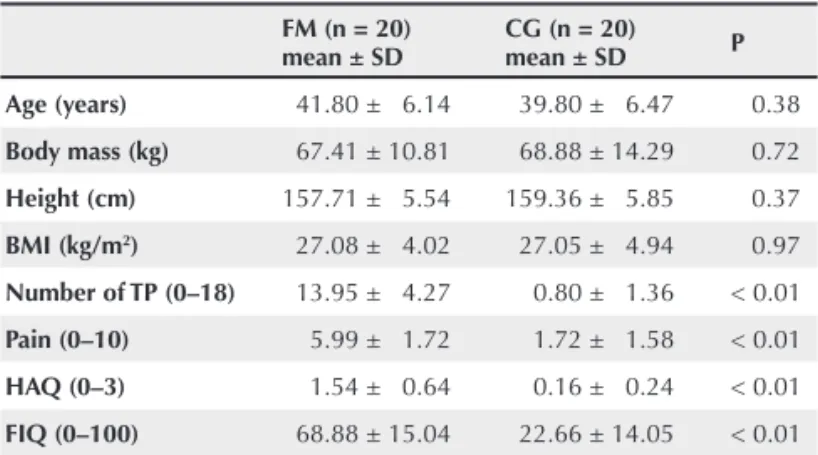
Table 1 shows the general characteristics of the sample. The FM group had a greater number of TP, greater pain severity, more diffi culty in performing daily activities, and a greater impact on the quality of life as compared with those of the CG.
The BDI scoring is shown in Figure 1. Patients with FM have more severe depressive symptoms, and the proportion of those patients with possible depression (≥ 16 points) was 75%
versus 25% in the CG (χ2 = 10.00; P < 0.01).
The PSS-10 scoring is shown in Figure 2. The FM group had a higher perception of stress (FM group: 25.10 ± 4.82
versus CG: 15.45 ± 7.29).
Table 2 shows the correlations between the variables as-sessed in the study for the FM group. Although stress had a positive correlation only with greater diffi culty in performing daily activities and greater depression, depression was found to correlate with most of the variables studied (pain, functionality, stress, and impact on quality of life).
Table 1
General characteristics of the sample
FM (n = 20) mean ± SD
CG (n = 20) mean ± SD P
Age (years) 41.80 ± 6.14 39.80 ± 6.47 0.38
Body mass (kg) 67.41 ± 10.81 68.88 ± 14.29 0.72
Height (cm) 157.71 ± 5.54 159.36 ± 5.85 0.37
BMI (kg/m2) 27.08 ± 4.02 27.05 ± 4.94 0.97
Number of TP (0–18) 13.95 ± 4.27 0.80 ± 1.36 < 0.01
Pain (0–10) 5.99 ± 1.72 1.72 ± 1.58 < 0.01
HAQ (0–3) 1.54 ± 0.64 0.16 ± 0.24 < 0.01
FIQ (0–100) 68.88 ± 15.04 22.66 ± 14.05 < 0.01
DISCUSSION
The proportion of individuals with FM with depressive symp-toms was signifi cantly higher as compared with those of the CG (75% and 25%, respectively). In addition, the impact on quality of life was higher in the FM group (68.88 ± 15.04
versus 22.66 ± 14.05 on the CG). Recently, Aguglia et al.30 have found similar results, reporting that 83.3% of the patients had depressive symptoms and worse quality of life. Studies carried out in Brazil have also found a high prevalence of depressive symptoms. Martinez et al.31 have found that 80% of the patients with FM reported more depressive symptoms as compared with healthy individuals (12%). Berber et al.13 have concluded that approximately two thirds of the patients studied had a depressive condition.
The results found in the present study differed from those by Santos et al.,32 who have used the same instrument to as-sess depressive symptoms in patients with FM. While in this study the mean results (24.10 ± 11.68 for the FM group, and 10.20 ± 12.78 for the CG) indicate a depressive setting, those authors have indicated a dysphoric setting (17.75 ± 11.23 for patients, and 9.50 ± 6.44 for controls).
The depressive symptoms correlated with a higher number of the variables studied. That is, the higher the intensity of the depressive symptoms, the higher the pain severity, the diffi cul-ties in performing the daily chores, the perceived stress, and the negative impact on the quality of life. The relationship between the depressive symptoms and the impairment in the quality of life, mainly related to aspects of physical functionality and pain perception, has also been reported in a previous study carried out in Brazil.13
Some authors2,33 have suggested that, due to the close re-lationship between certain symptoms of FM, mainly pain and psychiatric disorders, a pathophysiological overlapping for those processes might exist. Evidences indicate that certain brain areas involved in the generation of emotions are also involved in pain modulation. Thus, depression could amplify painful signs. In addition, depression is associated with changes in some neurotransmitters, which can reduce the modulatory effect of the pain inhibitory system.34
Individuals suffering from chronic pain and depression, including those with FM, have reduced functionality as com-pared with those without depression.35
In the present study, the impairment in performing daily chores differed between both groups, with the FM group showing moderate diffi culty to severe disability. In addition, among the patients, the higher the pain severity reported, the greater the diffi culty in performing daily activities. In fact, Table 2
Correlation between pain, functionality, quality of life, perception of stress, and depression in the FM group
No. of TP Pain HAQ FIQ PSS-10 BDI
No. of TP –
Pain 0.11 –
HAQ 0.33 0.47* –
FIQ 0.36 0.48* 0.41 –
PSS-10 0.07 0.32 0.50* 0.32 –
BDI 0.31 0.58** 0.56* 0.46* 0.54* –
TP: tender points; HAQ: Health Assessment Questionnaire; FIQ: Fibromyalgia Impact Questionnaire; PSS-10: Perceived Stress Scale; BDI: Beck Depression Inventory.
*P ≤ 0.05; **P ≤ 0.01.
Figure 2
Comparison of the stress perceived between the group of patients with fi bromyalgia (FM) and the control group (CG).
32 30 28 26 24 22 20 18 16 14 12 10 8 6 4 2 0 P ercei ved St res s Scal e (0 –4 0 ) FM CG
25.10 ± 4.82
15.45 ± 7.29
P < 0.01
Figure 1
Comparison of the severity of the depressive symptoms between the group of patients with fibromyalgia (FM) and the control group (CG).
B eck D ep res si o n I n ven to ry (0 –6 3 ) 38 36 34 32 30 28 26 24 22 20 18 16 14 12 10 8 6 4 2 0 FM CG
P < 0.01
24.10 ± 11.68
pain accounts for generating a 40% variation in functionality, when assessed by using the HAQ.36
Not only pain intensity seems to infl uence that relationship, but also the number of TP, because a signifi cant correlation was found between that number and the diffi culty in performing daily functional activities (according to the HAQ).37 However, in the present study, no relationship was found between the TP and any other variable assessed, contrary to other fi ndings, in which the presence of the TP can refl ect a measure of altered response to stress,38,39 leaving areas of the body more sensitive. The patients assessed had a higher perception of stress, confi rming the fi ndings of other authors, who have reported an important impact of that variable on FM and the severity of its symptoms.40 Patients with FM have shown a greater perception of stress as compared with healthy controls,41 and a greater perception of psychological stress as compared with patients with other chronic pain types.35
When investigating the relationship between pain and stress in patients with FM and healthy individuals, Ferreira et al.42 have found no signifi cant difference in the number of stressing events between both groups, attributing their result to the way patients cope with stress, and not only to the intensity of the events experienced. Differently, Becker et al.43 have reported a relationship between high levels of stress and that syndrome, in addition to the existence of an interaction between the apo-lipoprotein E gene polymorphism and stress in FM.
In the present study, the stress perceived in the FM group showed no direct relationship to pain. This suggests that the degree patients perceive the life situations as stressing does not directly relate to the fact that they feel pain. However, stressful experiences have been associated with changes in pain thresh-old,44depending on the type of stress experienced (physical or emotional), as well as on its intensity and duration.45
The relationships between reduced functionality, stress, and depression found in the present study can indicate that the im-pairment in performing daily activities was a stress-generating factor for the FM group. Considering that the effects of negative chronic conditions seem to amplify the association between acute daily events and depression,10 the relationship between functionality impairment and higher perception of stress can make patients with FM more susceptible to the appearance of depressive symptoms. Knowing the relationship between those variables and their intensity is important to elaborate adequate strategies for the treatment of FM.
CONCLUSIONS
Patients with FM have reduced functionality, greater perception of stress, and more severe depressive symptoms than healthy individuals.
Greater pain severity, reduced functionality, greater percep-tion of stress, and greater impact on the quality of life showed a direct relationship with depressive symptoms in patients with FM. The impaired functionality in that group related to a greater perception of stress, but not to the quality of life. Stress showed no relationship to pain severity in patients with FM.
It is worth noting the relationship between stress, depres-sion and functionality as part of a complex mechanism that can interfere with the quality of life of patients with FM.
ACKNOWLEDGEMENTS
REFERENCES
1. Wolfe F, Smythe HA, Yunus MB, Bennett RM, Bombardier C, Goldenberg DL et al. The American College of Rheumatology 1990 Criteria for the Classification of Fibromyalgia. Report of the Multicenter Criteria Committee. Arthritis Rheum 1990; 33(2):160–72.
2. Fietta P, Fietta P, Manganelli P. Fibromyalgia and psychiatric disorders. Acta Biomed 2007; 78(2):88–95.
3. Berger A, Dukes E, Martin S, Edelsberg J, Oster G. Characteristics and healthcare costs of patients with fi bromyalgia syndrome. Int J Clin Pract 2007; 61(9):1498–508.
4. Kato K, Sullivan PF, Evengård B, Pedersen NL. Importance of genetic infl uences on chronic widespread pain. Arthritis Rheum 2006; 54(5):1682–6.
5. Okifuji A, Turk DC, Sherman JJ. Evaluation of the relationship between depression and fi bromyalgia syndrome: Why aren’t all patients depressed? J Rheumatol 2000; 27(1):212–9.
6. Bennett RM, Jones J, Turk DC, Russell IJ, Matallana L. An internet survey of 2,596 people with fi bromyalgia. BMC Musculoskelet Disord 2007; 8:27.
7. Hammen C. Stress and depression. Annu Rev Clin Psychol 2005; 1:293–319.
8. Liu RT, Alloy LB. Stress generation in depression: A systematic review of the empirical literature and recommendations for future study. Clin Psychol Rev 2010; 30(5):582–93.
9. Van Houdenhove B, Luyten P. Stress, depression and fi bromyalgia. Acta Neurol Belg 2006; 106(4):149–56.
10. Hammen C, Kim EY, Eberhart NK, Brennan PA. Chronic and acute stress and the prediction of major depression in women. Depress Anxiety 2009; 26(8):718–23.
11. Tander B, Cengiz K, Alayli G, Ilhanli I, Canbaz S, Canturk F. A comparative evaluation of health related quality of life and depression in patients with fi bromyalgia syndrome and rheumatoid arthritis. Rheumatol Int 2008; 28(9):859–65.
12. Gormsen L, Rosenberg R, Bach FW, Jensen TS. Depression, anxiety, health-related quality of life and pain in patients with chronic
fi bromyalgia and neuropathic pain. Eur J Pain 2010; 14(2):127.e1–8. 13. Berber JSS, Kupek E, Berber SC. Prevalence of depression and
its relationship with quality of life in patients with fi bromyalgia syndrome. Rev Bras Reumatol 2005; 45(2):47–54.
14. Börsbo B, Peolsson M, Gerdle B. The complex interplay between pain intensity, depression, anxiety and catastrophising with respect to quality of life and disability. Disabil Rehabil 2009; 31(19):1605–13. 15. Jones CJ, Rutledge DN, Aquino J. Predictors of physical performance
and functional ability in people 50+ with and without fi bromyalgia. J Aging Phys Act 2010; 18(3):353–68.
16. Lohman TG, Roche AF, Martorel R. Anthropometrics standardization reference manual. Champaign: Human Kinetics Books; 1988.
17. Obesity: preventing and managing the global epidemic. Report of a WHO consultation. World Health Tech Rep Ser 2000; 894:i–xii, 1–253. 18. Cohen S, Kamarck T, Mermelstein R. A global measure of perceived
stress. J Health Soc Behav 1983; 24(4):385–96.
19. Reis RS, Hino AA, Añez CR. Perceived stress scale: reliability and validity study in Brazil. J Health Psychol 2010; 15(1):107–14. 20. Beck AT, Ward CH, Mendelson M, Mock J, Erbaugh J. An inventory
for measuring depression. Arch Gen Psychiatry 1961; 4:561–71. 21. Gorenstein C, Andrade L. Validation of a Portuguese version of the
Beck Depression Inventory and the State-Trait Anxiety Inventory in Brazilian subjects. Braz J Med Biol Res 1996; 29(4):453–7. 22. Gorenstein C, Andrade L. Inventário de Depressão de Beck –
propriedades psicométricas da versão em português. In: Gorenstein C, Andrade L, Zuardi AW (eds.). Escalas de Avaliação Clínica em Psiquiatria e Psicofarmacologia. São Paulo: Lemos Editorial; 2000. 23. Burckhardt CS, O'Reilly CA, Wiens AN, Clark SR, Campbell SM,
Bennet RM. Assessing depression in fi bomyalgia patients. Arthritis Care Res 1994; 7(1):35–9.
24. Fries JF, Spitz P, Kraines RG, Holman HR. Measurement of patient outcome in arthritis. Arthritis Rheum 1980; 23(2):137–45. 25. Ferraz MB, Oliveira LM, Araujo PM, Atra E, Tugwell P. Crosscultural
reliability of the physical ability dimension of the health assessment questionnaire. J Rheumatol 1990; 17(6):813–7.
26. Bruce B, Fries JF. The Health Assessment Questionnaire (HAQ). Clin Exp Rheumatol 2005; 23(5 Suppl. 39):S14–8.
27. Burckhardt CS, Clark SR, Bennett RM. The fi bromyalgia impact questionnaire: development and validation. J Rheumatol 1991; 18(5):728–33.
28. Marques AP, Barsante Santos AM, Assumpção A, Matsutani LA, Lage LV, Pereira CAB. Validation of the Brazilian version of the Fibromyalgia Impact Questionnaire (FIQ). Rev Bras Reumatol 2006; 46(1):24–31.
29. Jensen MP, Turner JA, Romano JM, Fisher LD. Comparative reliability and validity of chronic pain intensity measures. Pain 1999; 83(2):157–62.
30. Aguglia A, Salvi V, Maina G, Rossetto I, Aguglia E. Fibromyalgia syndrome and depressive symptoms: comorbidity and clinical correlates. J Affect Disord 2011; 128(3):262–6.
31. Martinez JE, Ferraz MB, Fontana AM, Atra E. Psychological aspects of Brazilian women with fi bromyalgia. J Psychosom Res 1995; 39(2):167–74.
32. Santos AMB, Assumpção A, Matsutani LA, Pereira CAB, Lage LV, Marques AP. Depressão e qualidade de vida em pacientes com
fi bromialgia. Rev Bras Fisioter 2006; 10(3):317–24.
33. Maletic V, Raison CL. Neurobiology of depression, fi bromyalgia and neuropathic pain. Front Biosci 2009; 14:5291–338.
34. Bair MJ, Robinson RL, Katon W, Kroenke K. Depression and pain comorbidity: a literature review. Arch Intern Med 2003; 163(20):2433–45.
35. White KP, Nielson WR, Harth M, Ostbye T, Speechley M. Chronic widespread musculoskeletal pain with or without fi bromyalgia: psychological distress in a representative community adult sample. J Rheumatol 2002; 29(3):588–94.
37. Martinez JE, Fujisawa RM, de Carvalho TC, Gianini RJ. Correlation between the number of tender points in fi bromyalgia, the intensity of symptoms and its impact on quality of life. Rev Bras Reumatol 2009; 49(1):32–8.
38. Wolfe F. The relation between tender points and fi bromyalgia symptom variables: evidence that fi bromyalgia is not a discrete disorder in the clinic. Ann Rheum Dis 1997; 56(4):268–71. 39. Schochat T, Raspe H. Elements of fibromyalgia in an open
population. Rheumatology (Oxford) 2003; 42(7):829–35.
40. González-Ramírez MT, García-Campayo J, Landero-Hernández R. The role of stress transactional theory on the development of fi bromyalgia: a structural equation model. Actas Esp Psiquiatr 2011; 39(2):81–7.
41. Stisi S, Venditti C, Sarracco I. Distress infl uence in fi bromyalgia. Reumatismo 2008; 60(4):274–81.
42. Ferreira EAG, Marques AP, Matsutani LA, Vasconcelos EG, Mendonça LLF. Avaliação da dor e estresse em pacientes com
fi bromialgia. Rev Bras Reumatol 2002; 42(2):104–10.
43. Becker RM, da Silva VK, Machado FS, dos Santos AF, Meireles DC, Mergener M et al. Interação entre qualidade do meio ambiente, estresse e a variação do gene APOE na determinação da suscetibilidade à
fi bromialgia. Rev Bras Reumatol 2010; 50(6):617–24.
44. McEwen BS, Kalia M. The role of corticosteroids and stress in chronic pain conditions. Metabolism 2010; 59(SUPPL. 1):S9–15. 45. Imbe H, Iwai-Liao Y, Senba E. Stress-induced hyperalgesia: