2012 Jan.-Feb.;20(1):27-34 www.eerp.usp.br/rlae
Corresponding Author: Vanda Elisa Andres Felli
Universidade de São Paulo. Escola de Enfermagem Departamento de Orientação Proissional Av. Dr. Enéas de Carvalho Aguiar, 419 Bairro: Cerqueira Cesar
CEP: 05.403-000 São Paulo, SP, Brasil E-mail: [email protected]
Cross-cultural adaptation of the Work Disability Diagnosis Interview
(WoDDI) for the Brazilian context
Vivian Aline Mininel
2Vanda Elisa Andres Felli
3Patrick Loisel
4Maria Helena Palucci Marziale
5The Work Disability Diagnosis Interview (WoDDI) is a structured interview guide developed by the University of Sherbrooke, Canada to help clinicians detect the most important
work-related disability predictors and to identify one or more causes of prolonged absenteeism. This
methodological study aims for the cross-cultural adaptation of the WoDDI for the Brazilian context. The method followed international guidelines for studies of this kind, including the
following steps: initial translation, synthesis of translations, back translation, evaluation by
an expert committee and testing of the penultimate version. These steps allowed obtaining
conceptual, semantic, idiomatic, experiential and operational equivalences, in addition to
content validity. The results showed that the translated WoDDI is adapted to the Brazilian context and can be used after training.
Descriptors: Translating; Work Capacity Evaluation; Occupational Health; Diagnosis of
Health Situation in Specific Groups.
1 Supported by Work Disability Prevention Canadian Institutes of Health Research (CIHR) Strategic Training Program grant(s)
FRN: 53909.
2 RN, Ph.D. in Sciences, Researcher, Escola de Enfermagem, Universidade de São Paulo, SP, Brazil. E-mail: [email protected].
3 RN, Ph.D. in Nursing, Associate Professor, Escola de Enfermagem, Universidade de São Paulo, SP, Brazil. E-mail: [email protected].
4 Physician, Professor, Dalla Lana School of Public Health, University of Toronto, Canada. E-mail: [email protected].
5 RN, Ph.D. in Nursing, Full Professor, Escola de Enfermagem de Ribeirão Preto, Universidade de São Paulo, WHO Collaborating Centre
Adaptação transcultural do Work Disability Diagnosis Interview (WoDDI) para o contexto brasileiro
O Work Disability Diagnosis Interview(WoDDI) é um guia de entrevista estruturada,
desenvolvido pela Universidade de Sherbrooke (Canadá), para ajudar os proissionais
de saúde a detectarem os fatores preditivos de maior importância para incapacidades
relacionadas ao trabalho, e a identiicarem uma ou mais causas de absenteísmo
prolongado do trabalho. Este estudo metodológico objetivou a adaptação transcultural do
WoDDI para o contexto brasileiro. O método obedeceu às recomendações internacionais
para esse tipo de estudo, contemplando as seguintes fases: tradução inicial, síntese
das traduções, retrotradução, avaliação por comitê de especialistas e teste da versão
pré-inal. Tais etapas permitiram o alcance das equivalências conceitual, semântica,
idiomática, experiencial e operacional, além da validação de conteúdo. Os resultados
demonstraram que o WoDDI traduzido está adaptado para a realidade brasileira e pode
ser utilizado após treinamento prévio.
Descritores: Tradução; Avaliação da Capacidade de Trabalho; Saúde do Trabalhador;
Diagnóstico da Situação de Saúde em Grupos Especíicos.
Adaptación transcultural del Work Disability Diagnosis Interview (WoDDI) para el contexto brasileño
El Work Disability Diagnosis Interview(WoDDI) es una guía de entrevista estructurada
desarrollada por la Universidad de Sherbrooke (Canadá), para ayudar a los profesionales
de la salud a detectar los predictores de mayor importancia para personas con trastornos
relacionados con el trabajo y para identiicar una o más causas de ausentismo prolongado
del trabajo. Este estudio metodológico se dirige a la adaptación transcultural (WoDDI)
para el contexto brasileño. El método siguió las recomendaciones internacionales para
este tipo de estudio, el que comprende las siguientes etapas: traducción inicial, síntesis
de las traducciones, retraducción, revisión del comité de expertos y prueba de la versión
pre-inal. Estas medidas permitieron obtener la equivalencia conceptual, semántica,
idiomática y la experiencia operacional, además de la validación del contenido. Los
resultados mostraron que el WoDDI traducido se adapta a la realidad brasileña e puede
ser utilizado, después de la capacitación previa.
Descriptores: Traducción; Evaluación de Capacidad de Trabajo; Salud Laboral;
Diagnóstico de la Situación en Salud en Grupos Especíicos.
Introduction
The relationship of Brazilian workers with their
work context has translated into exhaustion, recurrent leave, and early retirement, all resulting from a fragile,
disconnected national policy with operational problems.
Research with workers from the hospital industry veriies
this statement and indicates the urgency of intervention
actions in this scope(1-6).
This proile of morbidity among workers results
from an environment conducive to the development of disabilities—a context that generates mixed feelings of
suffering and pleasure and exposes workers to multiple workloads, leading to recurrent leave and long periods
or isolated events of absenteeism, which mask reality.
According to Social Security data, musculoskeletal
disorders are the main causes of reported occupational disease in Brazil(7). In general, people with such disorders
present substantial degrees of disability, poor rates of
return to work, and high socioeconomic costs associated with time off work(8).
Despite the irrefutable relationship between musculoskeletal disorders and the development of
disabilities, other equally relevant intervenient factors are not always considered, such as the current social
security policy, organizational barriers and sociocultural
context. Psychosocial variables also clearly inluence the
rehabilitation process of injured workers and the results
www.eerp.usp.br/rlae
The professionals working in the initial assessment
process, rehabilitation and professional reintegration of workers, do not assign the proper value to this context,
whether they are linked to the National Institute of
Social Security (INSS)*, to employers or public health services, they perform their activities isolated from any
cooperation or communication. These professional do not have the tools enabling them to delineate the real
situation of impairment and mainly rely on diagnostic exams as evidence of injury.
No studies addressing the support provided to
professionals in the analysis of cases, in the deinition
of periods of leave, planning of connected actions
to rehabilitate workers and provide them with the conditions to return to work, were found in the literature
review. At least, nothing was found that matched the complexity of the situation, not restricted only to
individual health conditions, but also addressing the work environment, relationships with other workers
and superiors, participation of employers during the process, history of leave, integration of actions directed
to the workers, and addressing the workers’ fears and expectations as well as those of their family members.
There are some research instruments already
validated in Brazil that support part of this process, especially in relation to the validation of the workers’
health conditions(9-12). These research tools are
extremely useful in evaluating certain factors related to
occupational disability, but they fragment the analysis by workers’ body segments or by their ability to perform
tasks, deepening the focus of analysis.
For this reason, this study emerged from the unprecedented intent to adapt an interview guide
that establishes the situational diagnosis of work-related disability to the Brazilian context, under the
various perspectives that involve this context. For that, a cross-cultural adaptation of the Work Disability
Diagnosis Interview was conducted(13). It is a structured interview guide originally written in French, developed
by the Sherbrooke University in Canada to help health
professionals to detect the major predictors of work-related disabilities and identify one or more causes of
prolonged absenteeism(14).
Unlike other research tools investigating
health-related situations, the WoDDI is grounded in its own innovative methodology to approach disabilities, which
constitutes the Sherbrooke Model(15). This interview
guide ills in an important gap in knowledge and also
provides tools for health professionals to identify occupational disabilities early.
The WoDDI contains open questions concerning
physical, psychosocial, occupational and administrative factors, distributed into ten areas totaling 28 pages as
described in Figure 1.
Sections Analyzed items
1. History of present illness 1.1 Age; 1.2 Position or function; 1.3 Reason for consultation; 1.4 Date of the accident/onset of symptoms; 1.5 Current illness (including description of the accident); 1.6 Pathway; 1.7 Previous or current treatments; 1.8 Previous exams; 1.9 Medical consultation; 1.10 Connotation of the provided diagnosis.
2. Pain syndrome 2.1 Characteristics of current pain; 2.2 Join stiffness; 2.3 Intermittent claudication; 2.4 Cauda equine syndrome; 2.5 Pain change factors; 2.6 Modes of pain management; 2.7 Degree of pain.
3. Current and previous health status 3.1 Personal history; 3.2 General health state; 3.3 Medications; 3.4 Allergies.
4. Physical assessment 4.1 General assessment; 4.2 Observations and exams; 4.3 Inspection; 4.4 Palpation and percussion; 4.5 Peripheral pulses; 4.6 Spinal mobility; 4.7 Segment mobility; 4.8 Myotomes; 4.9 Dermatomes; 4.10 Atrophy; 4.11 Osteotendinous reflex; 4.12 Signs of nerve root compression; 4.13 Segmental muscle strength; 4.14 Sensitivity; 4.15 Central nervous system Exam; 4.16 Other exams (when pertinent).
5. Lifestyle 5.1 Leisure, sports, home chores (activities and frequency); 5.2 Drug consumption.
6. Social and family history 6.1 Social family situation; 6.2 Interpersonal relationships.
7. Financial situation 7.1 Income; 7.2 ; Legal dispute.
8. Work environment 8.1 Work context; 8.2 Work situation; 8.3 Work Regime; 8.4 Description of work tasks
9. Worker’s perceptions and expectations 9.1 Perceptions concerning return to work (conditions, periods, barriers and facilitators, fears, etc.); 9.2 Expectations; 9.3 Self-applied questionnaires.
10. Analysis of results and recommendations 10.1 Clinical abstract; 10.2 Presence of red flags; 10.3 weighted ISIT (Personal, Administrative, Ergonomic); 10.4 Factors conducive to a potential return to work; 10.5 Recommendations.
Figure 1 – Sections and items addressed by the WoDDI
Rev. Latino-Am. Enfermagem 2012 Jan.-Feb.;20(1):27-34.
Indicators for Work-Related Disability (ISIT)* and
Red Flags are identiied in these ten areas. The ISIT
are related to causes of prolonged disability and are
classiied into: Personal (P), Administrative (A) and
Ergonomic (E). Red Flags indicate suspected severe
pathologies and require immediate speciic medical care.
The administration of WoDDI requires the participation
of two already trained clinicians over a period of two to
ive hours including a meeting for the interview, case
discussion, and elaboration of recommendations. The
time spent and corresponding costs, even though not
usual, relect a considerable gain for the interviewed
workers, since this interview guide enables an early return
to work, representing gains in cost-effectiveness(13).
After data collection, the interviewers meet to
consider the Indicators, establish the Work-Related
Disability Diagnosis (DSIT) and deine an intervention
plan. It is extremely important to pay attention to ISIT
and Red Flags throughout the interview because these
support the proposition of intervention plan to return to
work.
Method
This methodological study of cross-cultural
adaptation was conducted according to international
guidelines(16-18) and approved by the Ethics Research
Committee at the University Hospital of São Paulo
(Protocol CEP-HU/USP 818/08 – SISNEP-CAAE
0030.0.198.198.08). All the participant subjects
voluntarily signed free and informed consent forms. The
adaptation of WoDDI was authorized by the Center for
Action in Work Disability and Rehabilitation (CAPRIT) at
the Sherbrooke University, Canada, which retains the
copyrights of the interview guide.
Cross-cultural adaptation procedures
Initial translation: two translations were made of
the WoDDI French version to the Portuguese spoken
in Brazil by two bilingual translators with distinctive
backgrounds and knowledge, whose mother language
was Portuguese. The irst translator was familiar
with concepts addressed in the interview guide to be
translated and with the translation of health-related
material. The second translator was not familiar with the
concepts to be translated or with the clinical or medical
ields.
Synthesis of the translations: a structured report
of the synthesis of the two translations was developed
based on the two independent versions, addressing
the items and justiication of the inal consensus. A
consolidated version was developed based on this
synthesis.
Back translation: the produced version was then
back-translated into French. This stage of the process
took place in Montreal, Canada in cooperation with the
CAPRIT team. Two independent bilingual translators
whose mother language was French independently
worked on the back translations indicating divergences
and doubts. Once the back translations were inalized,
a face-to-face meeting took place in Canada with
researchers from both countries to consolidate the
back-translated version.
Expert committee: aiming to develop the
penultimate version of the interview guide to be applied
in the pretest, the committee was composed of six
health professionals with considerable experience in
treating Repetitive Strain Injury (RSI) and Work-Related
Musculoskeletal Disorders (WRMD) and professional
rehabilitation belonging to the Work-Related
Musculoskeletal Disorders Study Group at the University
Hospital of São Paulo. The version was analyzed in three
meetings with an average duration of four hours each
for conceptual, semantic, idiomatic, experiential and
operational equivalence, as well as Content Validity
Percentage(19-20), using the focal groups(21) technique to
achieve consensus. The original questionnaire and all
translations and back translations were provided, as
well as the corresponding reports (explanation of the
rationale used in each decision). Unlike other methods,
the experts did not receive the material in advance for
individual analysis. All had access to copies during the
committee’s meetings and instructions to analyze for
equivalence; the copies were also projected during the
meetings(15). A minimum Content Validity percentage of
90% was adopted among the experts in the event total
consensus was not achieved(19-20).
Penultimate version test: to verify the
comprehensiveness of the interview guide, the version
validated by the Experts Committee was applied to a
sample of 30 workers linked to the University Hospital of
São Paulo while in work leave for work-related reasons.
A physician and a nurse, already trained for this purpose,
applied the WoDDI. Each professional applied his/her
www.eerp.usp.br/rlae
part of the interview and at the end both reunited to
consider the ISIT identiied. The professionals took
two hours on average to conduct the interview. Data
collection was performed in the hospital’s Primary Health
Care Unit between August 2008 and May 2010.
Because the instrument combines many ways
of approaching the interviewee, adjustments were
considered in questions that were dificult to comprehend,
observed in at least 15% of the participants(22), and also
in dificulties found by the interviewers to apply tests,
maneuvers, and the physical assessment.
Results
Even though one of the translators presented a
more accurate version in relation to the context of the
initial translation, both translations were very close to the
literal meaning contained in the WoDDI original version.
Discussion during the meeting sought to synthesize the
translations and included the topic of the 69 terms that
diverged in the two translations. After consensus was
reached concerning these terms, a consolidated version
of the initial translation was attained.
The WoDDI’s consolidated version was back
translated into French to ensure that the translated
version relected the content of the items in the original version. The back translation process clariied some
dubious terms that were discussed during the synthesis
of the translations that were due to comprehension
dificulties. In this stage, another 27 terms were changed
- a fairly small number considering the various terms
composing the WoDDI (the questionnaire is composed
of approximately 3,000 words), which conirms the
reliability of the translation process held in Brazil.
The analysis of conceptual, semantic, idiomatic,
experiential and operational equivalence and content
validation conducted by the Experts Committee were
mainly directed to the practical applicability of the
terms used in the interview. All items contained in the
WoDDI, regardless of having been altered or not, were
collectively evaluated by the Committee. A total of 27
terms presented Content Validity Percentage below 90%
and for this reason they were changed, suppressed or
new terms were added.
The penultimate version, established by the Experts
Committee, was submitted to a pretest in a sample
Characteristics Frequency %
Gender
Female 30 100.0
Age
0-29 years old 1 3.3
30-39 years old 3 10.0
40-49 years old 17 56.7
50-59 years old 9 30.0
Function
Nursing auxiliary or technician 20 66.7
Kitchen assistant 4 13.3
Cleaning auxiliary 3 10.0
Administrative assistant 2 6.7
Laboratory technician 1 3.3
Work sector
Nursery 4 13.3
Food and Nutrition Service 4 13.3
Medical Clinics 3 10.0
Adult Emergency Department 3 10.0
Child Emergency Department 3 10.0
Administrative Sector 2 6.7
Pharmacy 2 6.7
Cleaning 2 6.7
Pediatrics 2 6.7
Rooming-in 1 3.3
Surgery Clinic 1 3.3
Primary Health Care Unit 1 3.3
Adult Intensive Care Unit 1 3.3
Child Intensive Care Unit 1 3.3
Table 1 – Distribution of socio-demographic
characteristics of the participants in the pretest
The period between the date of work leave, recorded
in the hospital’s Personnel Department, and the date the
interview was held, was used to compute the period of
work leave; previous work leave events were not taken
into account. Hence, this period varied from one month
to approximately six months (17.4±23.6), while time
working at the hospital varied from ive and 27 years
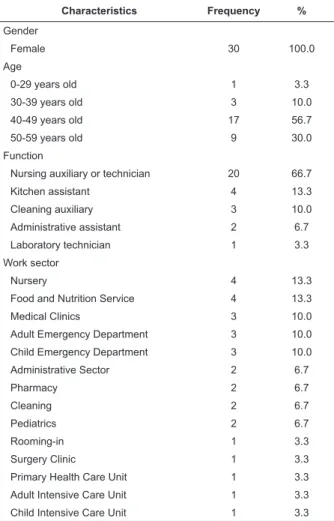
(15.3±6.6). The cause of leave was most frequently
related to WRMD, reported by 25 individuals (83.3%),
followed by depression in ive individuals (16.7%).
In some cases, WRMD seemed to be associated with
depression; in these cases, the main cause of leave was
considered for the noted classiication.
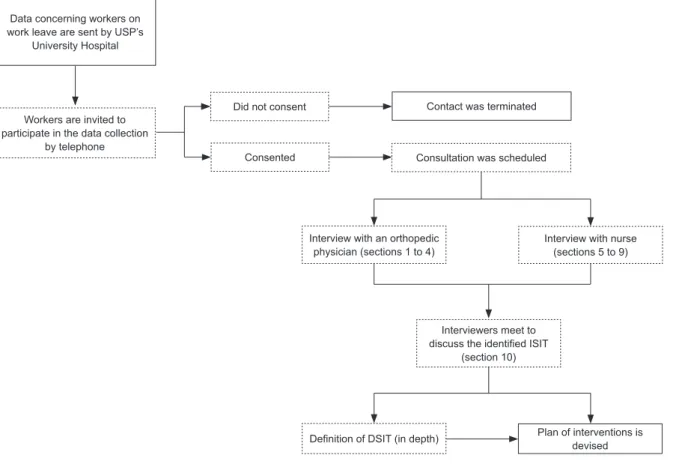
The pretest was put into operation according to the
steps presented in Figure 2.
of the target population composed of 30 individuals,
Rev. Latino-Am. Enfermagem 2012 Jan.-Feb.;20(1):27-34.
Figure 2 – WoDDI put into operation
Data concerning workers on work leave are sent by USP’s
University Hospital
Workers are invited to participate in the data collection
by telephone
Did not consent
Consented
Contact was terminated
Consultation was scheduled
Interview with an orthopedic physician (sections 1 to 4)
Interview with nurse (sections 5 to 9)
Interviewers meet to discuss the identified ISIT
(section 10)
Definition of DSIT (in depth) Plan of interventions is devised
Two perspectives concerning comprehensibility
were evaluated in the pretest stage: the irst is related to
the interviewees’ understanding of questions, for which
a minimum percentage of 85% was established(21); the
second refers to the dificulties found by the interviewers
in the application of the interview. Eighteen items were
changed based on these criteria.
As a inal result of the cross-cultural adaptation
process, a manual with instructions on how to apply
the WoDDI was developed in order to provide tools for
the professionals using it at work. For successful data
collection, one needs to fully understand the sections
and questions composing the questionnaire to evaluate
the suficiency of answers provided by the interviewees.
Hence, following the order of the sections proposed in
the WoDDI, the meanings of questions are presented
as well as some synonyms that may help interviewers
at the time they apply the interview, according to two
examples presented in Figure 3.
Section 2: Pain Syndrome
2.1.1 Site of pain
Interpretation: to identify the site of pain. For that, there is a figure to describe the site and pain pathway: cervical, dorsal, dorsolumbar, lumbar, lumbosacral, shoulder, arm, elbow, forearm, wrist, hand, hip, thigh, knee, leg, ankle, foot or other. Check the correct side of pain (left or right).
Ways to question: where is your pain located? Where does it hurt? What part of your body hurts?
Section 4: Physical Assessment
4.12 Signs of root compression
a) Tripod maneuver: place the respondent in supine position; bend one knee forming a 90º angle. Make dorsiflexion in one foot, also forming a 90º angle. Check whether it is positive or negative in both limbs. If the interviewee manifests sciatica, the Tripod Maneuver will be positive, otherwise negative. The following figure shows this maneuver:
a)
www.eerp.usp.br/rlae
The deinition of concepts and meanings of ISIT
composing the WoDDI were extracted from a document containing instructions concerning the interview guide developed by the Canadian researchers. These are available in detailed form to facilitate the understanding
of and deliberation over each Indicator. This material was freely translated and adapted to Portuguese based on WoDDI training, discussions with the research team in Canada and with the Experts Committee, and on
experience acquired while applying the pretest, as well. Similarly, the protocol containing the steps to be
taken when Red Flags are identiied as recommended by
CAPRIT was also translated and adapted. This protocol
indicates what actions should be taken if the interviewee presents indications of severity.
Discussion
The WoDDI cross-sectional adaptation process
complied with recommendations internationally adopted for this type of study, ensuring conceptual, semantic, idiomatic, experiential, and operational equivalence of the interview guide(16-18), as well as Content Validity(19-20).
It is worth noting it was an important achievement to perform the back translation in the instrument’s country of origin due to the possibility of discussing potential doubts and uncertainties accruing from the translation
process with the instrument’s developers. Since the back translation process evaluates the consistency of the initial translation, it aids in the correction of errors that may be related to the literal translation itself, or to
the interpretation embedded in the translated term. It is possible that performing the back translation in the country of origin would not confer such an advantage if not for the discussion that took place among the
researchers from both countries.
Even though this is not a recurrent practice in processes of cross-cultural adaptation and there is no indication of it in the literature, we believe, based on
this experience, that opting for this procedure is very relevant in the case of instruments with open questions. When this phase cannot be performed in the country of origin, we recommend a meeting with the instrument’s
developers immediately after back translation to clarify potential doubts and/or uncertainties in order to facilitate and enrich analysis with the Experts Committee. The discussion in the focus groups with the
committee were enriching in this phase of the process. Even though this technique is not largely applied in cross-cultural adaptation studies, the achievement of
consensus through a collective process of relection on a
given item’s content showed it might be a new method to evaluate qualitative research instruments.
Another difference from the norm that corroborated
this stage of cross-cultural adaptation was that the experts attended a training program in advance covering the use of the interview guide in Brazil. As a previous contact with WoDDI had already been established,
including a hypothetical application of it during training, the experts knew the proposed items and areas, which optimized discussions and reaching consensus. As a
inal result, irrelevant, inadequate or ambiguous items
were suppressed and replacements, more appropriate to the target population, were created while keeping the general concept of the changed items and ensuring the
understanding of the translated inal version(23).
Unlike some self-applied questionnaires in which the interviewee reads and answers questions in an independent way, the questions contained in the interviews are asked by an interlocutor who can
use auxiliary synonyms for words not understood by respondents, as long as the original meaning of the question is not compromised.
To facilitate the application of the instrument by
the interviewer, an instruction manual was developed. It contains auxiliary questions for items that present any
potential dificulty of understanding that might not be
detected in the pretest. The objective was to maintain
the original question and support the interviewer in cases where the respondent does not understand the question or answers it incorrectly.
The questions, tests, maneuvers and exams, as
well as ISIT and Red Flags, are conceptualized and detailed in this manual to ensure full understanding for the interviewer at the time of the interview. Even though these are extremely clarifying strategies they
do not replace training professionals in the use of the
WoDDI prior to performing the interviews. Training is a necessary and indispensable premise for realizing all the potential contained in this interview guide.
Conclusion
This study’s results show that the Work Disability Diagnosis Interview guide is successfully adapted for the Brazilian situation and can be used by professionals and
services interested in work-related disability.
Even though it was analyzed in the context of hospitals, this interview guide can (and should) be applied in the various productive sectors of Brazil because
it enables the investigation of intervenient dimensions in the process of disability and return to work.
Even though data obtained during the application of the WoDDI were not analyzed at this point, they are
Rev. Latino-Am. Enfermagem 2012 Jan.-Feb.;20(1):27-34.
Received: Jan. 20th 2011
Accepted: June 14th 2011 themselves, their health and work relations, in addition
to a complete physical assessment that resulted in a detailed situational diagnosis of the case. Moreover,
the establishment of bonds with workers during the
interviews greatly advanced the inal interpretation of
data obtained from the respondents.
References
1. Magnago TSBS, Lisboa MTL, Griep RH, Kirchhof ALC,
Camponogara S, Nonnenmacher CQ, et al. Condições de
trabalho, características sociodemográficas e distúrbios
musculoesqueléticos em trabalhadores de enfermagem. Acta Paul Enferm. 2010;23(2):187-93.
2. Sancinetti TR, Gaidzinski RR, Felli VEA, Fugulin FMT,
Baptista PCP, Ciampone MHT, et al. Absenteísmo: doença
na equipe de enfermagem: relação com a taxa de
ocupação. Rev Esc Enferm USP. 2009;43(2):1277-83. 3. Schimidt DRC, Dantas RAS, Marziale MHP, Laus
AM. Estresse ocupacional entre profissionais de enfermagem do bloco cirúrgico. Texto Contexto Enferm.
2009:18(2):330-7.
4. Gurgueira GP, Alexandre NMC, Corrêa-Filho HR.
Self-reported musculoskeletal symptoms among nursing personnel. Rev. Latino-Am. Enfermagem.
2003;11(5):608-13.
5. Barboza DB, Soler ZASG. Nursing absenteeism: occurrences at a university hospital. Rev. Latino-Am.
Enfermagem. 2003;11(2):177-83.
6. Silva DMPP, Marziale MHP. Absenteeism of nursing
workers from a university hospital. Rev. Latino-Am. Enfermagem. 2000;8(5):44-51.
7. Ministério da Previdência e Assistência Social (BR).
Anuário Estatístico de Acidente do Trabalho 2008. Brasília, 2008 [acesso 16 ago. 2009]. Disponível
em: http://www.previdenciasocial.gov.br/arquivos/
office/3_091028-191015-957.pdf
8. Lloyd C, Waghnorn G, McHugh C. Musculoskeletal disorders and comorbid depression: implications for
practice. Aust Occ Ther J. 2008;55:23-9.
9. Vigatto R, Alexandre NM, Corrêa-Filho HR.
Development of a Brazilian Portuguese version of the Oswestry Disability Index: cross-cultural adaptation,
reliability, and validity. Spine. 2007;32(4):481-6. 10. Orfale AG, Araújo PMP, Ferraz MB, Natour J.
Translation into Brazilian Portuguese, cultural adaptation
and evaluation of the reliability of the Disabilities of the Arm, Shoulder and Hand Questionnaire. Braz J Med Biol
Res. 2005;38(2):293-302.
11. Alexandre NMC, Barros ENC. Cross-cultural
adaptation of the Nordic musculoskeletal questionnaire. Int Nurs Rev. 2003;50(2):101-7.
12. Nusbaum L, Natour J, Ferraz MB, Golderberg J.
Translation, adaptation and validation of the Roland-Morris Questionnaire - Brazil Roland-Roland-Morris. Braz J Med
Biol Res. 2001;34(2):203-10.
13. Durand MJ, Loisel P, Hong QN, Charpentier N. Helping clinicians in work disability prevention: the
Work Disability Diagnosis Interview. J Occu Rehabil. 2002:12(3):191-204.
14. Loisel P, Charpentier N, Felli VAE, Durand MJ, Costa-Black K, Mininel VA, et al. Cross-cultural adaptation of the
Work Disability Diagnostic Interview (WoDDI) for a Brazilian context. Report present to Réseau provincial de recherche
en adaptation-réadaptation (REPAR); 2007. 10 p.
15. Loisel P, Durand P, Abenhaim L, Gosselin L, Simard R,
Turcotte J, el al. Management of occupational back pain:
the Sherbrooke model Results of a pilot feasibility study. Occup Environ Med. 1994;51:597-602.
16. Beaton DE, Bombardier C, Guillemin F, Ferraz MB. Guidelines for the process of cross-cultural adaptation
of self-report measures. Spine. 2000;25(24): 3186-91. 17. Guillemin F. Cross-cultural adaptation and validation
of health status measures. Scand J Rheumatol. 1995;24(2):61-3.
18. Guillemin F, Bombardier C, Beaton D. Cross-cultural
adaptation of health-related quality of life measures: literature review and proposed guidelines. J Clin
Epidemiol. 1993;46:14-32.
19. Wynd CA, Schmidt B, Schaefer MA. Two quantitative
approaches for estimating content validity. West J Nurs Res.2003;25(5):508-18.
20. Tilden VP, Nelson CA, May BA. Use of qualitative methods to enhance content validity. Nurs Res.
1990;39(3):172-5.
21. Chiesa AM, Ciampone MHT. Princípios gerais para
abordagem de variáveis qualitativas e o emprego da
metodologia de grupo focais. Brasília: Classificação
Internacional das Práticas em Saúde Coletiva; 1999. p.
306-24.
22. Ciconelli RM, Ferraz MB, Santos W, Meinão I,
Quaresma MR. Tradução para a língua portuguesa
e validação do questionário genérico de avaliação
de qualidade de vida SF-36 (Brasil SF-36). Rev Bras
Reumatol. 1999;39(3):143-50.
23. Alexandre NMC, Guirardello EB. Adaptación cultural
de instrumentos utilizados en salud ocupacional. Rev