Removal of Organic Matters from
Pharmaceutical Effluents Using Activated
Carbon Prepared from Jute Sticks as
Adsorbent
Dipesh Joshi, Shiva Pandeya, Kul Prasad Gharti*
Department of Pharmacy, Institute of Medicine, Tribhuvan University, Kathmandu, Nepal PO Box: 1524, Kathmandu, Nepal
Email address: [email protected] Phone number: +977-1-4422972
ABSTRACT
Adsorption by charcoal is one of the efficient and economic methods used for the treatment of pharmaceutical effluents. In the current study, activated carbon was prepared from jute sticks and the reduction in chemical oxygen demand level of pharmaceutical effluent was determined. Jute sticks were washed and grounded to 1 mm particle size. It was chemically activated by using phosphoric acid and its surface area was determined. The chemical oxygen demand (COD) level of effluent taken from a pharmaceutical company in Kathmandu was determined. The reduction of COD level by the charcoal prepared from jute sticks was determined and compared with that reduced by the commercial sample. The experimental equilibrium data was correlated using Freundlich and Langmuir adsorption isotherm. The COD of the effluent sample was found to be 224 mg/L. The COD level was reduced to 188 mg/L and 96 mg/Ls by 0.1 g and 0.5 g respectively of Self Prepared Charcoal (SPC) whereas the COD level was reduced to 196 mg/L and 108 mg/L by 0.1 g and 0.5 g respectively of Commercial Charcoal (CC). The COD removal efficiency was found to be 57.14% and 51.78% with 0.5g of SPC and CC respectively. The study showed that activated charcoal can be successfully prepared from jute sticks and can be successfully used to reduce the COD level in pharmaceutical effluents and is more effective than commercial charcoal available in the market.
Key Words: Activated Charcoal, Adsorption isotherm, COD, Effluent, Jute sticks.
INTRODUCTION
Along with industrialization, the problem of environmental pollution is increasing by the day. In Nepal, in recent years, the number of pharmaceutical industries is on the rise. These industries generate huge amount of waste every day. River systems are the primary means for disposal of waste, especially the effluents, from industries that are near them. These effluents can alter the physical, chemical and biological nature of the receiving water body. High levels of pollutants in river water systems cause an increase in biological oxygen demand (BOD), chemical oxygen demand (COD), total dissolved solids (TDS), total suspended solids (TSS), toxic metals such as Cd, Cr, Ni and Pb and fecal coliform and hence make such water unsuitable for drinking, irrigation and aquatic life (1).
In recent years, increasing awareness of the environmental impact of COD has prompted a demand for the purification of industrial waste waters prior to discharge into natural waters. This has led to the introduction of more strict legislation to control water pollution. A number of conventional treatment technologies have been considered for treatment of waste water contaminated with organic substances. Among them, adsorption process is found to be the most effective method. Adsorption as a wastewater treatment process has aroused considerable interest during recent years. Commercial activated carbon is regarded as the most effective material for controlling the organic load (2). In the last few years, special emphasis has been placed on the preparation of activated carbons from several agricultural by-products due to the growing interest in low-cost activated carbons from renewable sources, especially for application in wastewater treatment (3).
The objective of the current study was to prepare charcoal from jute sticks and its subsequent chemical activation to remove organic matters from pharmaceutical effluents and compare it with commercially available charcoal.
monitoring of impact of industrial effluents on nearby rivers and the environment is lacking, such study helps to develop a sustainable method for environment cleaning from the effluents from pharmaceutical industries.
MATERIALS AND METHODS Effluent sample
Effluent sample was collected from a pharmaceutical company located in Kathmandu. The composite sample was collected. After collection, the sample was preserved below pH 2 by adding sulfuric acid.
Preparation of charcoal from jute sticks
The charcoal was prepared by chemical activation method as stated by Asadullah et al (5). The preparation was done in two steps. First of all, collected jute sticks were washed with potable water. Then, they were washed twice with distilled water and dried in oven at 90-100oC for 16 hours. Then they were broken into small pieces and then grounded to 1 mm size in mixer grinder. The jute stick powder was soaked in phosphoric acid solution (the ratio being 1:1), kept overnight and put in muffle furnace. It was heated up to 200oC for 30 min, then the temperature was increased to 450oC and kept at this temperature for 1 hour. The product was repeatedly washed with hot distilled water and then with dilute NaOH till the phosphoric acid was removed and pH was around 8. Then it was again washed with hot distilled water till the pH was 7. Finally, the AC sample was dried at 105 ◦C for 24 hours and stored in a desiccator ready for use.
Determination of Surface Area
The surface areas of both commercial activated charcoal (CC) and self-prepared charcoal (SPC) were determined by the method as described by Ghimire et al6. In this method, the adsorption of acetic acid (AA) onto CC and SPC was studied and Langmuir isotherm was plotted using adsorption data. The value of the slope obtained from Langmuir isotherm was used to calculate the surface area.
The formula is:
S =
N
21
10
m
/mol
b
1
−20 2×
×
×
Where,
N = Avogadro’s number (6.023×10²³). S = Specific surface area
b = Slope obtained from Langmuir Isotherm
Determination of COD
The COD test was carried out as per the method described by Ademiluyi et al (7).
First, 10 ml of 0.25N potassium dichromate solution was added to 20 ml of wastewater sample in a 250 ml round-bottom flask. 1 g of silver sulfate and 40 ml of concentrated sulfuric acid were added in small portions with thorough swirling, until the silver sulfate was completely dissolved. A few glass beads were added to serve as anti-bumping aid, and the flask was connected to reflux condenser. The mixture was heated gently for 10 minutes, after which the content of the flask was cooled. Then, 50 ml of distilled water was flushed through the condenser and it was cooled. 2 drops of indicator solution were added and it was titrated with 0.1N standardized ferrous ammonium sulfate (FAS) solution until there was a change of color from yellow-green via blue-green to reddish brown. A blank value was determined in the same way with 20ml of distilled water.
The COD value was calculated by the formula:
COD (mg/L) = (B −A )N x 8000 V
Where,
• B & A are the volumes in ml of FAS used in titrating dichromate in the blank and sample after refluxing
• N is the normality of FAS • V is the volume of sample in ml
Batch Adsorption Studies
concentrations after adsorption were determined. The percentage removal of COD and Langmuir and Freundlich isotherms were plotted from the data. From the graph of Langmuir and Freundlich, different constants and parameters of Langmuir and Freundlich were determined.
Data Management and Analysis
All the data during the experiment and the results obtained from the experiment were recorded instantly and were analyzed using Microsoft Excel 2007.
RESULT AND DISCUSSION Surface area of charcoal
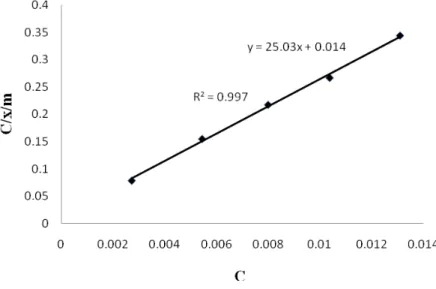
The Langmuir constant, ’b’ for SPC and CC were found to be 25.03 and 32.99 respectively (Figures 1 & 2). Thus, the respective specific surface areas were found to be 5053.25 m2/mol and 3833.98 m2/mol.
Figure 1: Langmuir Isotherm for the adsorption of AA by SPC
Figure 2: Langmuir Isotherm for adsorption of AA by CC
COD Level in Effluent and Reduction of COD Level
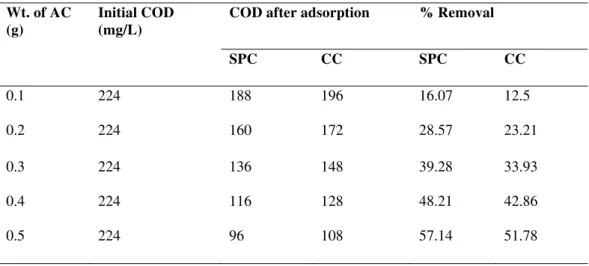
effluent by CC and SPC is shown in Table 1. The percentage removal of COD by CC ranged from 12.5% by 0.1 g to 51.78% by 0.5 g whereas for SPC, it ranged from 16.07% by 0.1 g to 57.14% by 0.5 g.
Table 1: Percentage Removal of COD by SPC and CC
Wt. of AC (g)
Initial COD (mg/L)
COD after adsorption % Removal
SPC CC SPC CC
0.1 224 188 196 16.07 12.5
0.2 224 160 172 28.57 23.21
0.3 224 136 148 39.28 33.93
0.4 224 116 128 48.21 42.86
0.5 224 96 108 57.14 51.78
Adsorption Isotherms
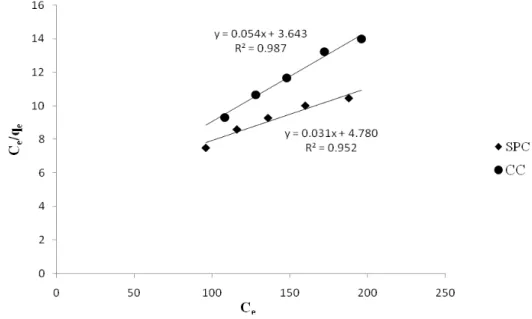
The adsorption of COD by SPC and CC gave linear relationship with both Langmuir and Freundlich isotherm. The correlation coefficient was found to be greater than 0.95 in all the cases showing good fit to both the Langmuir and Freundlich isotherms. However, SPC showed a good fit to Freundlich isotherm model than the Langmuir owing to its higher R2 values for the former. The condition was just the opposite for CC where the Langmuir isotherm model showed a higher R2 value than Freundlich isotherm model. The results are shown in Figures 4 and 5.
Figure 5: Langmuir Isotherm for COD adsorption by charcoal
The constants of Freundlich and Langmuir isotherms were determined. They are tabulated in Table 2.
Table 2: Adsorption Isotherm constants and correlation coefficient for charcoal
Charcoal Freundlich Isotherm Constants Langmuir Isotherm Constants KF 1/n R2 KL qm R2 RL
SPC 1.726 0.435 0.988 0.006485 32.258 0.952 0.4077
CC 2.742 0.305 0.966 0.01482 18.519 0.987 0.2315
The chemical activation of jute sticks conferred upon it a high surface area which could probably be because of the development of pores and attachment of functional groups in the surface due to chemical activation at high temperature.
Thus, SPC showed higher COD removal tendency than the CC for the same amount used. The study of Amuda et al (8) also showed similar results i.e., acid activated charcoal had better COD removal than commercial charcoal at all concentrations used. The adsorption is directly related with the surface area of the adsorbent as shown by many studies. The more is the surface area, the more is the space available for adsorption. Hence, the higher COD removal efficiency of SPC can be attributed to its higher surface area.
For a favorable adsorption, the value of 1/n should be between 0 and 1 which is followed in both cases.
The values of 1/n for SPC and CC are 0.435 and 0.305 respectively. The values for KF were found to be 1.726 and 2.742 respectively for SPC and CC. Previous studies have shown the values of KF between 0.191 and 146.30.
The maximum adsorption capacities were found to be 32.258 and 18.519 mg/g for SPC and CC which are higher than that shown by study of Aluyor and Badmus (6.46 mg/g). The values of RL i.e. separation factor was found to be 0.4077 and 0.2315 respectively for SPC and CC. The values of RL between 0-1 suggests the favorable adsorption of COD by both SPC and CC.
CONCLUSION
industries. This would be of benefit not only to the manufacturing industry in terms of minimizing cost of COD treatment, but also to minimize the impact on the environment.
ACKNOWLEDGEMENT
The authors would like to acknowledge Mr. Prakash Bist, Chemidrug Industries Pvt. Ltd. for the support in carrying out this study.
REFERENCES
[1] I. Kanu, O. K. Achi. Industrial effluents and their impact on water quality of receiving rivers in Nigeria. Journal of Applied Technology in Environmental Sanitation. 2011; 1(1): 75-86.
[2] E. O. Aluyor, O. A. M. Badmus. COD removal from industrial wastewater using activated carbon prepared from animal horns. African Journal of Biotechnology. 2008; 7(21): 3887-3891.
[3] A. A. Ahmad, B. H. Hameed. Reduction of COD and color of dyeing effluent from a cotton textile mill by adsorption onto bamboo-based activated carbon. Journal of Hazardous Materials. 2009; 172: 1538–1543.
[4] K. Qureshi, I. Bhatti, R. Kazi, A. K. Ansari. Physical and chemical analysis of activated carbon prepared from sugarcane bagasse and use for sugar decolorisation. International Journal of Chemical and Biological Engineering. 2008; 1(3): 144-148.
[5] M. Asadullah, M. Asaduzzaman, M. S. Kabir, M.G. Mostofa, T. Miyazawa. Chemical and structural evaluation of activated carbon prepared from jute sticks for brilliant green dye removal from aqueous solution. Journal of Hazardous Materials. 2010; 174: 437-443. [6] K. N. Ghimire, K. P. Bohara. University experimental physical chemistry. Kathmandu: Quest Publication; 2008.
[7] F.T. Ademiluyi, S. A. Amadi, N. J. Amakama. Adsorption and treatment of organic contaminants using activated carbon from waste Nigerian bamboo. Journal of Applied Sciences and Environmental Management. 2009; 13(3): 39-47.