Quality assurance of the serologic diagnosis
of Chagas’ disease
Estela N. Cura
1and Elsa L. Segura
2A quality assurance program of the Chagas’ disease laboratory network of Argentina has been conducted by the National Reference Center since 1988, with the aim of assessing the reliabil-ity of serologic test results. Chagas’ disease is endemic in Argentina, but the prevalence of sero-positivity for Trypanosoma cruzi among 18- to 20-year-old men decreased from 5.8% in 1981 to 1.8% in 1994. About 600 laboratories form the Chagas’ disease laboratory network, with main central laboratories in each of the 24 provinces in Argentina. The quality assurance program promotes regular use of good laboratory practice and internal and external quality control to improve performance of the participants; it also provides technical assistance and guidelines. Eventual corrective measures are discussed in workshops. Results of the first exter-nal evaluation by proficiency testing of serum panels and confirmation of results for 58 of the main laboratories reveal that from 1988 to 1994 the rate of agreement has increased.
ABSTRACT
Chagas’ disease is caused by the fla-gellate protozoan Trypanosoma cruzi. The disease is endemic in 17 American countries, where it is estimated that 16–18 million people are infected with the parasite, and another 90 million are at risk of infection (1). The infec-tion is transmitted mainly through a triatomine vector. Interhuman trans-mission is second in sanitary impor-tance and may occur through blood
transfusion (2), from mother to child (3, 4), and through organ transplanta-tion (5).
Laboratory diagnosis is done by demonstrating the presence of the par-asite—e.g., xenodiagnosis or the Strout method (6, 7)—and is efficient in the acute phase of infection when the sen-sitivity is about 100%; after a few weeks, efficiency decreases to less than 50%. Use of polymerase chain reaction, a more sensitive method that can detect parasite DNA, is currently un-der study (8). Furthermore, the onset of infection is usually unnoticeable and is followed by a long asymptomatic period (range: 5–15 years). Thus, other methods are needed to diagnose the latent and chronic phases of infection, such as detecting specific antibodies to
T. cruziin the patients’ serum (9, 10). Many serologic techniques have been developed to detect T. cruzi
anti-bodies, including complement fixation (11, 12), direct agglutination (DA), in-direct hemagglutination (IHA) (9, 10, 12), indirect immunofluorescence (IIF)
(13), and enzyme-linked
immuno-sorbent assay (ELISA) (12, 14, 15). The parasite antigens used in these meth-ods vary widely, from whole cells (IIF and DA) to crude cell extracts (IHA and ELISA), to defined molecules or peptides (ELISA) (15–17).
The sensitivity of the tests varies
between 99% and 99.8% (9, 10, 18);
when two or three tests are performed simultaneously, the sensitivity ranges from 99.7% to 100% (18). Their speci-ficity (false-positive results from
non-T. cruzi-infected individuals) ranges from 2.11% to 2.59% (9, 18). In relation to other diseases such as malaria, ame-biasis, and tuberculosis, the only cross-reactions observed were with Leishma-nia and Trypanosoma rangeli(9, 18).
1 Instituto Nacional de Parasitología “Doctor Mario Fatala Chaben,” Ministerio de Salud y Acción Social, (1063) Buenos Aires, Argentina. Mailing address: Estela N. Cura, Instituto Nacional de Pa-rasitología “Doctor Mario Fatala Chaben,” Minis-terio de Salud y Acción Social, Av. Paseo Colón 568, (1063) Buenos Aires, Argentina.
Many efforts have been directed to-ward standardizing serologic methods (12–14, 16, 19, 20) and reagents (15–17), and it has been recommended that at least two serologic tests be used to confirm a diagnosis (2, 19). No system-atized and overall quality control pro-grams are currently being conducted in Chagas serology, even though the validity of laboratory results always depends on the quality of conditions before, during, and after the serologic tests are performed (21, 22).
Since 1987 we have carried out a quality assurance program with the Chagas’ disease laboratory network by promoting good laboratory practice, using internal and external quality con-trol, and giving technical assistance and procedure guidelines (23). The aim of the program is to improve the perfor-mance of participating laboratories and to assess the reliability of the results obtained with serology testing. In rela-tion to the accuracy of the narela-tional ref-erence laboratory itself, a South Ameri-can group (Argentina, Bolivia, Brasil, Chile, Paraguay, and Uruguay) has been working since 1992 with an inter-national reference serum panel for the control of Chagas serology.
We report here the results of profi-ciency tests conducted by the National Reference Center (NRC) for Chagas’ disease in Argentina since 1988 and performed with 58 main laboratories belonging to the Chagas’ disease labo-ratory network.
MATERIALS AND METHODS
Two materials were used to evalu-ate the performance of participating laboratories: proficiency panels and sera for the confirmation of results.
Proficiency panels
Serum samples were collected from about 100 infected and noninfected patients in the daily routine of clinical and laboratory diagnosis in the NRC for Chagas’ disease in Argentina. These sera were tested by three differ-ent serologic tests performed at the
same time: IHA (12, 16), IIF (13, 16), and ELISA (12, 15, 16).
Sera classification criteria
Serum samples were classified as nonreactive when all three serologic tests gave negative results against T. cruziantigens and as reactive when all three tests were positive. The cutoff titer of IHA and IIF tests was 1/32; for ELISA the cutoff was an optical den-sity (OD) of 0.200. Reactive serum sam-ples were classified as highly reactive when they showed 1/128 or higher titers for IHA and IIF tests and an OD higher than 0.300 for ELISA. Serum samples were classified as weakly reactive when they showed titers for IHA and IIF between 1/32 and 1/64 and an OD for ELISA ranging from 0.200 to 0.300.
Pooling and conditioning of panel samples
The sera were pooled into three groups—nonreactive, highly reactive, and weakly reactive—with no more than 10 samples per group.
As a biosecurity measure, sera were tested for hepatitis B surface antigen and then inactivated at 56 °C for 30 minutes. The samples were filtered through a membrane filter (pore size: 0.45 m), fractionated in glass
contain-ers, and lyophilized. Coded samples were then distributed for the NRC with instructions for processing them (21, 23, 24).
Sera for confirmation of results
During 1989, 1990, and 1994 the par-ticipating peripheral laboratories sent 40 to 200 tested serum samples to the NRC for confirmation of results. Ap-proximately 50% of each group of sera consisted of specimens with reactivity to T. cruzi. Samples were preserved in buffered glycerin and stored at room temperature until shipment (25). They were then air-mailed to the NRC, where they arrived within 7 days. The quality
of individual specimens on arrival was scored from “very good” to “not suit-able for diagnosis” because of contam-ination, lack of proper identification, or poor conditioning.
Design of the Quality Assurance Program
Experiments were devised for the laboratory network in Argentina as part of a quality assurance program for the serologic diagnosis of Chagas’ disease. The program included activi-ties performed by the NRC and 58 other laboratories. The NRC is in charge of the normativeness of
diag-nosis (19, 23), standardization and
control of reagents, training and up-dating of laboratory personnel (12), and evaluation of laboratory perfor-mance. The network laboratories are in charge of establishing internal qual-ity control programs.
Internal quality control program. Laboratories were asked to establish internal programs to systematize con-trols including personnel training, selection of analytical methods, and control of reagents, equipment, and procedures. The NRC provided tech-nical assistance for these activities, and a quality control procedure guideline (23) was distributed as well.
To validate the entire analytical process, daily aliquots of reactive and nonreactive control sera were analyzed together with samples from routine tri-als, and control curves were plotted. IHA and IIF titers were plotted as log-arithms to the base 2. Titers are the re-ciprocal of the highest serial serum dilution giving a reactive result on the test (26). For ELISA, ODs were plotted. According to acceptance criteria, the daily result of the reactive control sera should fall within the arithmetic mean ± 2 standard deviations. Both parame-ters were computed with at least 30
continuous daily measures (21, 22).
Nonreactive control sera must always be nonreactive.
control sera were required to repro-duce the reactive and nonreactive re-sults in all daily routines.
External evaluation of laboratory per-formance. There were two kinds of external quality control: 1) proficiency tests with unknown control sera pan-els as recommended by the World
Health Organization (WHO) (22, 24),
and 2) confirmation of results of sera submitted to the NRC by participating laboratories.
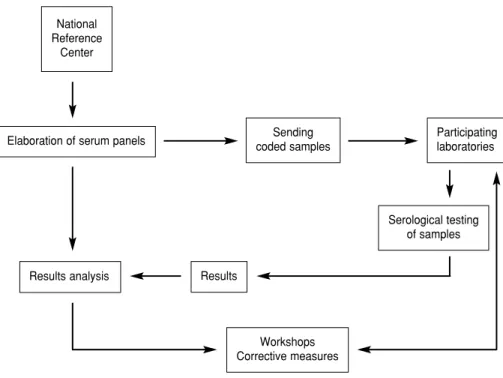
Proficiency tests. To conceal their identity, participating laboratories were identified by code numbers. Each laboratory received results of the over-all analysis as well as an individual report, together with suitable recom-mendations. The probable sources of error and implementation of corrective measures were discussed in several workshops (Figure 1).
Participating laboratories were di-vided into two groups according to their function and the reagents used. Group 1 included laboratories per-forming serologic diagnosis with two quantitative tests using reagents manu-factured by the NRC. Group 2 included those laboratories that performed blood banks controls with commercial screening kits. Both groups received two to four lyophilized control serum samples (27) to be included in the rou-tine serologic analysis.
The results were analyzed for agree-ment, and a kappa index was calcu-lated for each control (28).
Analytical methods and reagents.
The following quantitative analytical methods were used for Group 1 labo-ratories: IHA (12), IIF (13), and ELISA (15), with antigens obtained from cul-tured epimastigotes of T. cruzi (Tula-huen strain). These tests were per-formed with reagents produced and controlled by the NRC as described (12) and were used by all participating laboratories in Group 1.
The laboratories in Group 2 per-formed the screening in blood banks
with the following qualitative tests: IHA, DA, and latex agglutination
(16), with commercially obtained
diagnostic kits. The following com-mercial kits were used: IHA was from Biocientífica S.A. Argentina, Poly-chaco S.A.I.C. Argentina, and Wiener Lab. Argentina; DA was from Poly-chaco S.A.I.C. Argentina and Wiener
Lab. Argentina; and latex was from Polychaco S.A.I.C. Argentina and Wiener Lab. Argentina.
RESULTS
Tables 1 and 2 show the results ob-tained with proficiency tests per-FIGURE 1. Proficiency testing of serum panels
TABLE 1. Proficiency tests performed in 1988–1994 by Group 1 laboratories of the Chagas’ disease laboratory network in Argentina, with agreement of results obtained by using the indirect hemagglutination method to test control serum samples
Control serum samples Participating
Year laboratories HR WR NR Kappa index
1988 21 21/21 18/21 36/42 0.71
1989 24 24/24 21/24 48/48 0.75
1990 32 32/32 30/32 64/64 0.95
1991 29 ND 28/29 29/29 0.97
1992 25 ND 25/25 25/25 1.00
1993 20 ND 19/20 18/20 0.86
1994 32 32/32 32/32 63/64 0.98
Note:Agreements: samples giving results within the permitted range and nonreactive (NR) samples. Kappa index was calcu-lated with results of weakly reactive (WR) and NR sera. HR, highly reactive; ND, not done.
National Reference
Center
Elaboration of serum panels
Results analysis
Sending coded samples
Participating laboratories
Serological testing of samples
Results
formed by Group 1 laboratories dur-ing the period 1988–1994 with IHA, IIF, and ELISA. For highly reactive samples, no false-negative results were reported in any of the control tests. However, false-negative results occurred with IHA and IIF for the weakly reactive control samples. With regard to nonreactive sera, a low pro-portion of false-positive results was reported: 6/42 for IHA and 9/42 for IIF during the first control test in 1988 and 2/20 for IHA and 1/18 for IIF in
1993. The kappa index value showed an apparent decrease in the number of false-negative results over a period of years as a result of the corrective measures undertaken by this group of laboratories.
Results of the analysis by the National Institute for Research on the Epidemiology of Chagas’ Disease ( Ins-tituto Nacional de Investigación Epide-miológica del Chagas) of the serum pan-els selected, conditioned, and shipped by Group 1 laboratories are shown in
Table 3. In nonreactive serum panels, in which no discordant results are per-mitted, there was a decrease from six to one discordant results in 1994, with respect to previous years, because of the use of corrective measures.
In 1989, 50% of the laboratories sub-mitted serum panels suitable for diag-nosis; this proportion improved to 25/30 of the laboratories in 1990 and to 19/21 in 1994 (Table 3). Nearly 30% of the shipments were scored as “very good” in the three controls.
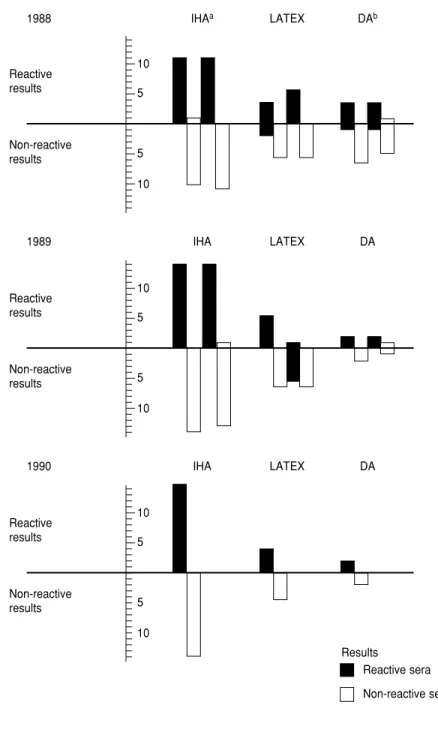
The results of testing the profi-ciency of the blood bank screening tests (Group 2 laboratories) are shown in Figure 2. Results were grouped by the analytical method. A large vari-ation was observed between the results of IHA and the other tests. In all laboratories, IHA performed bet-ter than the three other serologic methods used during the 3-year study (1988–1990).
DISCUSSION
The external evaluation results pre-sented here for two groups of labora-tories performing serologic tests for the diagnosis of T. cruzi infection re-veal a progressive increase in the rate of agreement of results since the pro-gram was implemented. Group 1 was composed of the main laboratories scattered throughout the country and used the NRC as a unique source of reagents. Sources of diagnostic error at the start of the program could be ex-plained by lack of standardization of procedures in participating laborato-ries. On the other hand, laboratories belonging to Group 2 were in the same city and chose their own reagents. Pos-sible causes of error were discussed among all participants, and corrective measures were introduced, such as use of two tests in each laboratory, person-nel training, and routine use of control sera.
Laboratory performance improved after coordinated work and the appli-cation of corrective measures based primarily on the installation of an in-ternal quality control system. This pro-cess resulted from participating activi-TABLE 2. Proficiency tests performed in the period 1988–1994 by Group 1 laboratories of
the Chagas’ disease network in Argentina, with agreement of results obtained by using indi-rect immunofluorescence and enzyme-linked immunosorbent assay (ELISA)ato test control serum samples
Control serum samples Participating
Year laboratories HR WR NR Kappa index
1988 21 21/21 20/21 33/42 0.68
1989 20 20/20 20/20 40/40 1.00
1990 28 28/28 27/28 55/56 0.95
1991 24 ND 24/24 24/24 1.00
1992 22 ND 22/22 22/22 1.00
1993 18 ND 18/18 17/18 0.94
1994 17 17/17 17/17 33/34 0.96
aResults for 1994 correspond to ELISA.
Note:Agreements: samples giving results within the permitted range and nonreactive (NR) samples. Kappa index was calcu-lated with results of weakly reactive (WR) and NR sera. HR, highly reactive; ND, not done.
TABLE 3. Agreement of results of serum panels submitted by Group 1 laboratories to the NRC of Chagas’ disease serologic diagnosis in Argentina, with the number of serum sam-ples in each panel ranging from 40 to 100
Year
1989 1990 1994
Participating laboratories 31 35 32
Serologic tests performed IHAa–IIFb IHA–IIF IHA–ELISAc
Laboratories submitting serum
panels adequate for diagnosis/total 14/28 25/30 19/21
Laboratories with 100% Non-reactive samples 6 19 18
agreement of results Reactive samples 10 13 12
Laboratories with 99–80% Non-reactive samples 6 6 1
agreement of results Reactive samples 4 12 6
Laboratories with 79–75% Non-reactive samples 2 . . . .
agreement of results Reactive samples . . . 1
aIHA = Indirect hemagglutination. bIIF = Indirect immunofluorescence.
ties, such as workshops and on-site supervision by the NRC. Moreover, a guideline of quality control proce-dures (23), including good laboratory
practices, was distributed and dis-cussed during the workshops. As in other programs, the importance of personnel training and continuing
education is of paramount importance in this system (24, 26). As reported, these steps help avoid an important source of error, namely deficiencies in technical performance (29).
A collaborative study carried out by WHO throughout the Americas in 1983 (20) compared the results of Cha-gas’ disease serodiagnosis obtained by several laboratories with serum panels from the endemic areas of the conti-nent. Differences among assays as well as in the criteria about endpoint read-ings were found. Difficulties were attributed mainly to the absence of definite reference criteria as well as to variations among reagents and techniques (20).
Laboratory diagnosis of Chagas’ disease in Argentina has been normal-ized; thus, at least two standardized serologic tests are now available (19). However, many factors affect the reli-ability of serologic results, as well as of those obtained by other analytical
methods (21, 22). Development and
improvement of reagents and tech-niques are a key to obtaining the most accurate diagnosis (15, 17). How-ever, to obtain reproducible results by indirect diagnosis, it is necessary for all laboratories involved to use validated and controlled kits as well as standardized diagnostic procedures (10, 16, 19). The only way to guaran-tee results appears to be by system-atic installation of internal and exter-nal quality controls (21, 22), which has thus become the objective of our study.
Quality control systems have been recommended by WHO for health lab-oratories performing serologic tests (21, 24), and they are widely used in clinical chemistry (22). To detect and correct areas where errors might arise, proficiency testing programs provide a convenient way to check the performance of laboratories by comparing results obtained with the same samples. These external quality control programs for serologic tests used to diagnose conditions other than Chagas’ disease have been established in some countries, such as France (30), Germany (31), and the United States (32).
Results
Reactive sera Non-reactive sera
aIHA = Indirect hemagglutination. bDA = Direct agglutination.
FIGURE 2. External quality control of 19 blood bank laboratories of Argentina using com-mercial screening tests for Chagas’ disease. Results of serum samples are grouped according to analytical method
10 5
5 10
1988 IHAa LATEX DAb
Reactive results
Non-reactive results
10 5
5 10
1989 IHA LATEX DA
Reactive results
Non-reactive results
10 5
5 10
1990 IHA LATEX DA
Reactive results
1. World Health Organization. Control of Chagas’ disease. Technical report series no 811. Geneva: WHO; 1991:1–95.
2. Schmunis GA. Trypanosoma cruzi, the etiologic agent of Chagas’ disease: status in the blood supply in endemic and nonendemic countries [review]. Transfusion1991;31:547–557. 3. Schmunis GA, Szarfman A, Coarasa L,
Guil-leron C, Peralta JM. Anti-Trypanosoma cruzi agglutinins in acute human Chagas’ disease. J Trop Med Hygiene 1980;19:170–178.
4. Blanco SB, Cura EN, Tulián L, Chuit R, Hur-vitz A, Villalonga C, et al. Detección de la madre y el niño chagásico en la transmisión materno infantil. Medicina (B Aires) 1993;53 (suppl 1):44.
5. Riarte A, Lauricella M, Campanini A, Sinagra A, Lansetti JC, Alvarez M, et al. Transmisión de la infección por T. cruzi mediante trans-plante renal. Evolución y tratamiento. Medi-cina (B Aires)1993;53(suppl 1):78.
6. Segura EL. Xenodiagnosis. In: Brener RR, Stoka AM, eds. Chagas’ disease vectors. Volume II: Anatomic and physiological aspects. Boca Raton, FL: CRC Press; 1987. p. 41– 45. 7. Strout RG. A method for concentrating
hemo-flagellates. J Parasitol1962;48:100.
8. Avila HA, Borges Pereira J, Thiemann O, De Paiva E, Degrave W, Morel CM, et al. Detec-tion of Trypanosoma cruziin blood specimens of chronic chagasic patients by polymerase chain reaction amplification of kinetoplast minicircle DNA: comparison with serology and xenodiagnosis. J Clin Microbiol1993;31: 2421–2426.
9. Camargo ME. An appraisal of Chagas disease serodiagnosis. In: Wendel S, Brener Z, Ca-margo ME, Rassi A, eds. Chagas disease (Ameri-can trypanosomiasis): its impact on transfusion and clinical medicine.São Paulo, Brazil: Cart-graf; 1992. p. 165–178.
10. Cura EN, de Titto EH, Segura EL. El diagnós-tico y su control de calidad en la infección por T. cruzi. In: Madoeri RJ, Madoeri C, Cámera MI, eds. Actualizaciones en la enfermedad de Chagas. Córdoba, Argentina: Organismo Ofi-cial del Congreso Nacional de Medicina; 1992. p. 125 –132.
11. Rosenbaum M, Cerisola JA. La reacción de fijación del complemento para el diagnóstico de la enfermedad de Chagas. I. Técnica. Prensa Medica Argentina1958;45:1551–1560. 12. Instituto Nacional de Chagas. Actualización
en enfermedad de Chagas y otras parasitosis.
In: Manual de Laboratorio,7th ed. Buenos Aires, Argentina: Instituto Nacional de Chagas; 1994. p. 1–90.
13. Alvarez M, Cerisola JA, Roweder RW. (1968). Test de inmunofluorescencia para el diagnós-tico de la enfermedad de Chagas. Bol Chil Pa-rasitol 1968;23:4–9.
14. Camargo ME, Ferreira WA, Peres BA, Pre-viato LM, Sharfstein J. Trypanosoma cruzi anti-bodies. In: Methods of enzymatic analysis. Vol-ume XI: Antigens and antibodies 2, 3rd ed. Weinheim, Federal Republic of Germany: Bergmeyer VCH Verlagsgesellschaft mbH D-6940; 1986. p. 368–382.
15. Cura EN, Ruíz AM, Velázquez E, Malagrino N, Örn A, Segura EL. Estandarización de un kit confirmación (FATALAKIT) para el inmuno-diagnóstico de la infección por el Trypanosoma cruzi. Medicina (B Aires)1993;53(suppl 1):182. 16. Guimaraes MCS. Chagas’ disease serology. In:
Pan American Health Organization/World Health Organization, ed. Specifications and eva-luations methods for immunological reagents. Washington, DC: PAHO/WHO; 1984. p. 1–153. (PNSP/84-08).
17. Simonsen Stolf AM. Trypanosoma cruzi anti-gens in serodiagnosis. In: Wendel S, Brener Z, Camargo ME, Rassi A, eds. Chagas disease (American trypanosomiasis): its impact on trans-fusion and clinical medicine.São Paulo, Brazil: Cartgraf; 1992. p. 195–202.
18. Wendell S, Gonzaga AL. Chagas’ disease and blood transfusion: a new world problem? Vox Sang 1993;64:1–12.
19. Ministerio de Salud y Acción Social. Normas para el Diagnóstico de la Infección Chagásica. Resolución Ministerio Salud y Acción Social no. 2373. Ley no. 22360 de la República Argen-tina; 1988.
20. Camargo ME, Segura EL, Kagan IG, Pacheco Souza JM, de Rocha Cavalheiro J, Yanousky JF, et al. Three years of collaboration of the standardization of Chagas’ disease sero-diagnosis in the Americas: an appraisal. Bull Pan Am Health Organ1986;20:233–244. 21. Taylor RN, Huong AY, Fulford KM,
Przy-byszwski VA, Hearn TL. In: Centers for Dis-ease Control, ed. Control de calidad de las prue-bas inmunológicas. Atlanta, GA: Centers for Disease Control; 1979. p. 1–105. (Publication no. CDC 798376).
22. Uldall A. Quality assurance in clinical chemistry. Scand J Clin Lab Invest 1987;47 (Suppl 187):1–96.
23. Cura EN, de Titto EH, Segura EL. Control de calidad del inmunodiagnóstico de Chagas. In: Instituto Nacional de Investigación Epidemio-lógica del Chagas. Manual de procedimientos. Buenos Aires, Argentina: INDIECH; 1992. p. 1– 43.
24. World Health Organization, ed. External qual-ity assessment of health laboratories. Geneva: WHO; 1981:1–23. (Euro Reports and Study no 36).
25. Subias E, Yanovsky J, Alvarez M, Segura EL. Conservation of blood samples for epidemio-logical research on Chagas’ disease [abstract]. J Protozool1983;30:164.
26. Taylor RN. Measurement of variation and sig-nificance in serological tests. Ann N Y Acad Sci 1983;420:13–21.
27. Uldall A. Practical aspects of internal quality assurance. Ann Ist Super Sanid1991;2:411–418. 28. Riegelman RK, Hirsch RP. Cómo estudiar un estudio y probar una prueba: lectura crítica de la literatura médica, 2nd ed. Washington, DC: Organización Panamericana de la Salud; 1992. (Publicación científica 531).
29. Heier HE, Kornstad L. External national qual-ity control of blood typing 1983–92. Signifi-cance for quality assurance in transfusion medicine. Tidsskr Nor Laegeforen 1993;113: 3155–3158.
30. Petithory JC. Organization and interest of ex-ternal quality assesment in parasitology. Ara-bian J Lab Med 1988;14:145–146.
31. Janitschke K, Seitz HM, Disko R. External quality assurance in the laboratory diagnosis of parasitic infections in Germany. Med Micro-biol Lett1994;3:272–278.
32. Taylor RN, Fulford KM. Assesment of labora-tory improvement by the Centers for Disease Control diagnostic immunology proficiency testing program. J Clin Microbiol 1981;13: 356–368.
Manuscript received on 21 August 1996. Revised version accepted for publication on 27 October 1997.
El Centro Nacional de Referencia ha llevado a cabo desde 1988 un programa de garan-tía de calidad en la red de laboratorios para el diagnóstico de la enfermedad de Cha-gas en Argentina. El propósito ha sido evaluar la confiabilidad de los resultados de la prueba serológica. La enfermedad de Chagas es endémica en Argentina, pero la prevalencia de seropositividad a Trypanosoma cruzien hombres de 18 a 24 años bajó de 5,8% en 1981 a 1,8% en 1994. Alrededor de 600 laboratorios forman la red para el diagnóstico de la enfermedad de Chagas, que cuenta con un laboratorio central en cada una de las 24 provincias argentinas. El programa para la garantía de la calidad promueve la aplicación continua de las buenas prácticas de laboratorio y se vale de controles de calidad internos y externos para mejorar el rendimiento de los partici-pantes. También provee asistencia técnica y sienta parámetros normativos. Cualquier enmienda que resulte necesaria se discute en talleres de trabajo. Los resultados de la primera evaluación externa en que investigó la exactitud de las pruebas serológicas y la confirmación de los resultados obtenidos en 58 de los principales laboratorios reve-lan que de 1988 a 1994 la tasa de concordancia mejoró.
RESUMEN
Garantía de calidad en el
diagnóstico serológico de la
enfermedad de Chagas
V Curso-taller OPS/OMS-CIESS sobre Legislación de la Salud:
problemas emergentes de los procesos de cambio II
Fechas: 31 de agosto a 4 de septiembre de 1998
Lugar: México, D.F., México
La División Jurídico Social del Centro Interamericano de Estudios de Seguridad Social (CIESS) y la División de Salud y Desarrollo Humano de la OPS organizan este taller que pre-tende abrir un espacio docente en el que se pueda discutir el marco regulatorio del finan-ciamiento de la salud y la seguridad social. Entre las variables de análisis y debate se conside-rarán los regímenes contributivos y no contributivos, las dicotomías creadas entre los diversos actores por los modelos actualmente en vigencia, las personas en quienes recae con frecuen-cia el subsidio, la concertación intersectorial y la conservación de derechos en el tránsito entre sistemas, así como la necesidad de rescatar los componentes de equidad y eficiencia en el entendido de que son principios no excluyentes, sino complementarios.
Información:
CIESS División Jurídico Social
Fax: (525) 595-06-44 o
Organización Panamericana de la Salud División de Salud y Desarrollo Humano