LAPAROSCOPIC PARTIAL CYSTECTOMY IN BLADDER CANCER –
INITIAL EXPERIENCE
MIRANDOLINO B. MARIANO, MARCOS V. TEFILLI
Section of Urology, Hospital Mãe de Deus, Porto Alegre, Rio Grande do Sul, Brazil
ABSTRACT
Proposal: The authors present their initial experience with a selected group of patients who underwent laparoscopic partial cystectomy for treating bladder cancer.
Materials and Methods: In the period from June 1997 to April 2000, 6 patients, aged be-tween 38 and 76 years, having transitional cell carcinoma of the bladder, were identified as candidates to partial cystectomy. The procedure employed consisted in laparoscopic partial cystectomy and lym-phadenectomy with exclusive intracorporeal suture technique.
Results: The proposed procedure was completed in all cases. Mean surgical time was 205 minutes and mean blood loss was 200 mL. There were no significant complications during both intra-and post-operative period. Two patients (33%) presented urinary extravasation of less than 50 mL, with spontaneous resolution. Mean hospitalization period was 4 days (2 to 6). The histological analy-sis of the resected specimens revealed transitional cell carcinoma, stage pT1G3 in case 1, pT2aG2 in cases 2 to 4, pT2bG2 in case 5 and pT3aG3 in case 6. The resection margins, as well as lymph nodes, were free of neoplasia. One patient developed local and metastatic disease, and was treated with salvage chemotherapy. No other case of local or systemic recurrence was observed with a mean follow-up of 30 months.
Conclusions: Laparoscopic partial cystectomy can be an alternative surgical method for treat-ing selected cases of patients with transitional cell carcinoma of the bladder.
Key words: bladder neoplasms; carcinoma; cystectomy; laparoscopy
Int Braz J Urol. 2004; 30: 192-8
INTRODUCTION
Radical cystectomy is the most effective therapy for patients with bladder cancer and remains as the treatment of choice for muscle-invasive dis-ease (1). The success of laparoscopy in the most di-verse urological procedures led to its employment in complex pelvic surgeries and in the treatment of blad-der cancer (2-5). In selected patients having bladblad-der carcinoma, open partial cystectomy can be performed with similar results and lower morbidity when com-pared with series of radical cystectomy (6,7).
We report here our initial experience with a selected group of patients with transitional cell carci-noma of the bladder who were treated with laparoscopic partial cystectomy.
MATERIALS AND METHODS
All cases underwent a throughout clinical as-sessment and radiological and endoscopic examina-tions for staging the neoplasia. The location, tumor mobility and histological type with grade of invasion were determined by endoscopic assessment, bi-manual examination under anesthesia and resection and/or biopsies material, respectively. The staging system adopted in our work was the TNM as pro-posed by the American Joint Committee on Cancer (AJCC) (8). None of the patients who underwent laparoscopic partial cystectomy presented evidences of extravesical or systemic tumoral involvement at the time of surgery neither had undergone any form of neoadjuvant treatment.
Classic partial cystectomy is contra-indicated in patients with multiple vesical tumors, in the pres-ence of in situ carcinoma, or with tumors involving the bladder neck or the posterior urethra. The selec-tion criteria for laparoscopic partial cystectomy were: single invasive bladder neoplasia located far from the bladder neck or trigone, with no evidence of tumor in other vesical locations according to randomized bi-opsies, especially in situ carcinoma; bladder with good capacity, with the possibility of obtaining a tumor-free margin of 1,5 to 2 cm; absence of recent history of superficial tumors; and patients with tumors in blad-der diverticula.
SURGICAL TECHNIQUE
The surgical preparation for the laparoscopic partial cystectomy is similar to that of open surgery, including the use of mild laxatives for colon hygiene and admission on the day of procedure, with an 8-hour fasting. Crossed testes and blood reservation are routinely performed. All patients receive antibiotic prophylaxis that is started at the moment of anesthetic induction. The procedure is performed under general anesthesia with orotracheal intubation and insertion of vesical and nasogastric catheters, with the latter being removed at the end of the surgery. Ureteral cath-eterization for eventual identification and/or protec-tion of ureters is performed whenever the lesion is too close to the ureteral meatus.
With the patient under general anesthesia and in Trendelenburg position, the transperitoneal
ap-proached is made with 5 ports, similarly to the tech-nique described for laparoscopic radical prostatec-tomy (4,9). A 10/11 mm trocar is inserted at the level of the umbilical scar and the 0-grade optics is then inserted for reviewing the cavity and inserting the other ports under direct view (Figure-1). The trocars are arranged in the shape of an inverted V, with the vertex at the umbilicus level for the optics, other 2, measuring 10/11 mm, placed adjacent and below the camera for the working forceps and ultrasonic scal-pel, respectively, and another 2, measuring 5 mm, lat-erally close to the antero-superior iliac spine for the aspirator and the auxiliary clamp forceps.
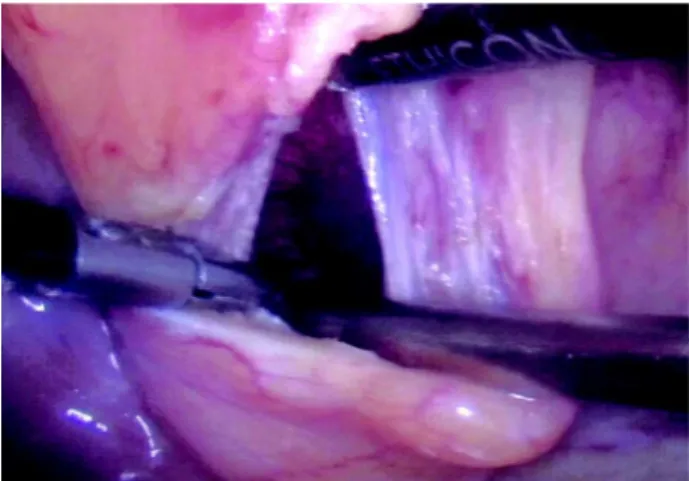
Pelvic lymphadenectomy is performed from the bifurcation of the common iliac vessels following the external and internal iliac vessels along their full length, having the genitofemoral nerve as the lateral limit (4). The empty bladder is posteriorly dissected with the incision of the peritoneum adjacent to the Douglas’ cul-de-sac, and is also completely released from the anterior abdominal wall, thus allowing ac-cess to the retropubic space. The bladder should be widely mobilized in order to provide enough wall di-mensions for the safety margins and vesical closure without tension. A small cystotomy is performed on the bladder dome aiming to inspect the tumor area in-side the bladder. Once it is open, while keeping the urethral stent clamped, the bladder rapidly distends with gas, which makes the inspection easier (Figures-2 and 3). The ultrasonic scalpel is used for peritumoral dis-section with a safety margin measuring at least 1.5 to 2 cm of apparently normal vesical tissue (Figure-4).
Figure 1 – Initial laparoscopic viewing of the bladder following umbilical puncture (0-grade optics).
Figure 2 – Cystotomy for intravesical inspection with optics. Note that the bladder is distended by gas, since the Foley cath-eter is clamped, making this surgical step easier.
Figure 3 – Laparoscopic view of the tumor area to be resected. Figure 4 – Technical transoperative detail of laparoscopic par-tial cystectomy.
Figure 5 – Final aspect of the resected area closed in 2 planes with intracorporeal continuous suture.
In the first 2 years, the patients in this series were followed by cystoscopy and urinary cytology every 3 months and by pelvic and abdominal com-puterized tomography and chest radiography every 6 months. If there were no signs of local o systemic recurrence after this period, the exams above were repeated, respectively, semestrally and yearly.
RESULTS
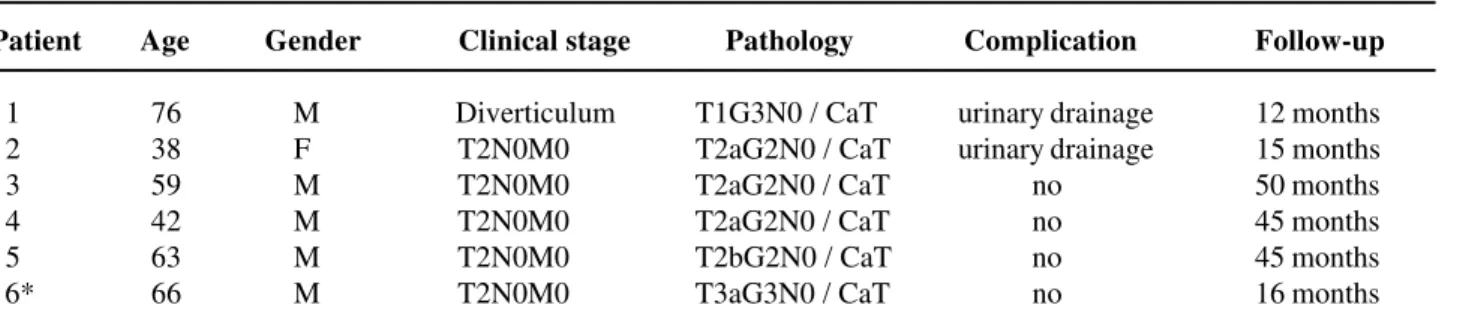
General data relative to patients is listed in Tables 1 and 2. All 6 procedures were completed by laparoscopically without transoperative complications. Sugical time ranged from 150 to 260 minutes (mean = 205 minutes), with blood loss estimated between 100 and 300 mL (mean = 200 mL). Mean hospitalization time was 4 days; 3 patients were released from hospi-tal up to the third post-operative day, 1 was released on the fourth day, and 2 patients remained in hospital until the sixth post-operative day due to urinary drain-age by tubular drain of up to 50 mL.
The histological examination of the resected specimens revealed stage pT1G3 in case 1, pT2aG2 in cases 2 to 4, pT2bG2 in case 5 and pT3aG3 in case 6. Lymph nodes and resection margins were free from neoplasia.
All patients remained continent and with nor-mal renal function. With a mean follow-up of 30 months (12 to 50 months) no local or vesical recur-rence was detected in 5 patients. One patient presented local-regional disease and metastases in bone and liver after 9 months of follow-up, and was treated with salvage chemotherapy.
DISCUSSION
Some studies have demonstrated that laparoscopic radical cystectomy is feasible, involv-ing lower morbidity, a quicker return of the patient to his/her daily activities and a shorter hospitalization period (3,4,7,10). Other technical advantages with the method include non-performance of laparotomy,
re-Table 2 – Trans- and post-operative parameters of the present series.
1 2 3 4 5 6
240 180 150 200 240 260
100 150 200 150 80 300
6 6 3 4 2 3
-100 mg 30 mg 60 mg
Patient Surgical time (min) Blood loss (mL) Hospital stay (days) Opioids (meperidine - dose)
Table 1 – Patients’ data.
Patient Age Gender Clinical stage Pathology Complication Follow-up
1 76 M Diverticulum T1G3N0 / CaT urinary drainage 12 months 2 38 F T2N0M0 T2aG2N0 / CaT urinary drainage 15 months 3 59 M T2N0M0 T2aG2N0 / CaT no 50 months 4 42 M T2N0M0 T2aG2N0 / CaT no 45 months 5 63 M T2N0M0 T2bG2N0 / CaT no 45 months 6* 66 M T2N0M0 T3aG3N0 / CaT no 16 months
duction in blood loss, lower level of post-operative pain and excellent esthetic results.
Partial cystectomy must be reserved for a group of patients with bladder cancer that comply with strict selection criteria (11-15). Those with single muscular invasive lesion, with no evidence of in situ carcinoma or previous history of superficial multiple tumors, without involvement of trigone or posterior urethra and where a safety margin of at least 1.5 to 2 cm can be obtained would be good candidates to par-tial cystectomy. Other potenpar-tial indications for using the technique are vesical tumors enclosed in diver-ticula and possibly some cases of urachal adenocar-cinoma that involve the bladder neck (6,7,11).
In this initial series of laparoscopic partial cystectomy the transperitoneal approach was used with 5 working ports. The use of 5 punctures seems to technically make the procedure easier due to pro-viding 2 lateral punctures with 5-mm trocars for us-ing the aspiration and one additional auxiliary for-ceps for traction and/or withdrawal, with the latter being highly useful especially during posterior dis-section of the bladder, for the reconstructive time and in pelvic lymphadenectomy. In the inevitable com-parison with open partial cystectomy, performed by extraperitoneal approach, we have considered to use the laparoscopic extraperitoneal approach in the near future, though we are quite satisfied with the results of laparoscopic transperitoneal approach for all our cases, from nephrectomies to radical cystectomies, with low morbidity rates. We get the impression that the transperitoneal access allows an easier approach, with wider viewing and working fields.
Vesical closure, which is totally intracorporeal, was performed with continuous absorbable suture in 2 planes in the way it is traditionally performed. Two of the 6 patients presented low-volume urinary drainage that resolved spontaneously within a few days. Such fact reinforces the need of 2 important technical pre-cautions: 1) the bladder should be widely mobilized both anteriorly and posteriorly in order to allow for its easy and tension-free closure and 2) the surgeon should properly master the techniques of intracorporeal su-ture, which, once the learning curve is overcome, are very precise due to the ideal luminosity and the in-crease in the vision field provided by the camera. The
surgeon who chooses this approach should also be prepared for the possibility of transoperative ureteral lesion and laparoscopic ureteral reimplantation. Fi-nally, though the camera provides a better visualiza-tion of the area to be removed, we continue to rou-tinely obtain transoperative freezing biopsies of the vesical margins before their closure.
The patients need minimal analgesics and none of them required parenteral medication after 36 hours from the procedure (Table-2). Additionally, very low rates of post-operative complications were ob-served, following the trend in the majority of pub-lished series on laparoscopic procedures in urology (2-5,9,10).
In relation to hospitalization time following laparoscopic surgeries, and using the increasing ex-perience with radical prostatectomy, we considered that differences reported in the literature do not re-sult from the endourologic procedure itself, but to the local health system. In the United States, mean hospitalization time following radical prostatectomy is 2 to 3 days, clearly shorter than European series of laparoscopic radical prostatectomies (9,15). Ameri-can reports confirm such fact, since laparoscopic radi-cal prostatectomies performed more recently have shown a mean hospital stay of 1,6 days (15). Mean hospitalization time in our series of laparoscopic par-tial cystectomies was 4 days, reminding that in 2 cases there was urinary extravasation and the patients re-mained in hospital for 6 days as a cautionary mea-sure. As larger experience is acquired, the hospital-ization period should be shortened.
The comparison between our data and his-torical series, mostly from the 70s, in terms of mor-bidity, is hard to be done and no conclusion can be drawn from those. However, we could observe an incidence of urinary fistula of approximately 15%, indexes of operative wound infection around 10% and hospitalization period of 1 to 3 weeks (11). There is no well described data concerning surgical time, amount of analgesics employed, bleeding and perfor-mance of lymphadenectomies, among others, for proper comparison.
unde-niable risk of neoplastic cellular implantation. The issue of local and working port recurrences in laparoscopy is controversial and, to this moment, lacks a definitive answer. Peritoneal metastases following laparoscopy have also been sporadically reported, in conditions that are often associated with advanced disease, neoplastic ascites and others, especially gy-necologic and gastrointestinal cancers (16-19).
In this initial experience with laparoscopic partial cystectomy, we performed lymphadenectomy and the entire bladder release before accomplishing the cystotomy, in order to minimize the handling of local tissues after the bladder opening. Once the re-section of the specimen is concluded, it is immedi-ately placed in the extraction pouch, which is closed and left in the iliac fossa for removal at the end of the surgery. One of the patients with high grade tu-mor developed local recurrence and metastatic dis-ease, a common fact in cases of high grade bladder carcinoma. We did not identify recurrence in the working ports, neither was this fact observed in the available reports of laparoscopic radical cystectomy and radical prostatectomy, though there are isolated reports on port implantation following laparoscopic pelvic lymphadenectomy in patients with advanced transitional cell carcinoma of the bladder, which is known to have a high dissemination potential (2-5,10,16). In this aspect, a valuable piece of infor-mation is provided by historical data on partial cys-tectomy due to bladder cancer: local recurrences in operative wounds or cystectomy sites were uncom-mon, and measures such as neoadjuvant radiotherapy or intravesical instillations are probably unneces-sary before partial cystectomy (6,11,13). However, a local recurrence has been a constant concern when treating transitional cell carcinoma of the urinary tract by endourology.
There are several publications relative to laparoscopic partial cystectomy in benign bladder diseases, mostly addressing the treatment of vesical endometriosis and, sporadically, other benign rarities such as pheochromocytoma (17-19). In relation to the use of laparoscopic partial cystectomy in transitional cell carcinoma of the bladder, there are no descrip-tions in the literature to this moment. An unique re-port, relating therapies of vesical preservation and
laparoscopy, was made by Gerber and colleagues who used neodymium: yttrium-aluminum-garnet laser (Nd:YAG laser) with combined cystoscopy and laparoscopy in 5 patients with non-invasive transi-tional cell carcinoma of the bladder who were candi-dates to radical cystectomy. Laparoscopy was used to keep the intestinal loops away from the bladder and to monitor the use of intravesical laser, and in 2 cases the bladder serosal surface was treated with la-ser by laparoscopic route as well. Results were quite poor after 9 months, with 4 of the 5 patients develop-ing systemic disease (20).
While reviewing the literature, it is clear that many issues concerning isolated surgical procedures for vesical preservation in bladder carcinoma remain incompletely evaluated. Classic series of partial cys-tectomy achieve considerable 5-year survival rates, ranging from 50% to 70% when strict selection crite-ria are employed (6,7,11,12). It must be stressed, how-ever, that less than 10% of patients in large series reporting bladder cancer have criteria for indicating partial cystectomy (12-14). Our initial series with selected patients presents disease-free survival rates around 80%, with a mean follow-up of 30 months. Finally, though the majority of authors do not recom-mend laparoscopic radical cystectomy before the sur-geon has properly mastered the technique of laparoscopic radical prostatectomy, the laparoscopic partial cystectomy is relatively easier to be performed, though some experience with urologic laparoscopic pelvic surgery is required, as well as skills in intracorporeal suture (4,5).
CONCLUSIONS
REFERENCES
1. Montie JE, Straffon RA, Stewart BH: Radical cystec-tomy without radiation therapy for carcinoma of the bladder. J Urol. 1984; 131: 477-82.
2. Guillonneau B, Vallancien G: Laparoscopic radical prostatectomy: the Montsouris experience. J Urol. 2000; 163: 418-22.
3. Denewer A, Kotb S, Hussein MBB, El-Maadawy M: Laparoscopic assisted cystectomy and lymphadenec-tomy for bladder cancer: initial experience. Worl J Surg. 1999; 23: 608-11.
4. Türk I, Deger S, Winkelmann B, Schönberger B, Liening AS: Laparoscopic radical cystectomy with continent urinary diversion (rectal sigmoid pouch) performed completely intracorporeally: the initial 5 cases. J Urol. 2001; 165: 1863-6.
5. Gill IS., Fergany A., Klein, EA: Laparoscopic radical cystoprostatectomy with ileal conduit performed com-pletely intracorporeally: the initial 2 cases. Urology. 2000; 56: 26-9.
6. Sweeney P, Kursh ED, Resnick, MI: Partial cystec-tomy. Urol Clin North Amer. 1992; 19: 701-11. 7. Cummings KB, Mason JT, Correa RJ Jr, Gibbons RP:
Segmental resection in the management of bladder carcinoma. J Urol. 1978; 119: 56-8.
8. American Joint Committee on Cancer: AJCC Cancer Staging Manual. Urinary bladder. Philadelphia, Lippincott-Raven. 1977, 5th ed.; 241-6.
9. Abbou CC, Salomon L, Hoznek A: Laparoscopic radi-cal prostatectomy: preliminary results. Urology. 2000; 53: 630-4.
10. Puppo P, Perachino M, Ricciotti G, Bozzo W: Laparoscopically assisted transvaginal radical cystec-tomy. Eur Urol. 1995; 27: 80-4.
11. Brannan W, Oschrer MG, Fuselier HA Jr, Landry GR: Partial cystectomy in the treatment of transitional cell carcinoma of the bladder. J Urol. 1978; 119: 213-5. 12. Ricos TJV., Solsona NE: Surgical treatment of urinary
bladder cancer. Indications, technics, and general re-sults. Arch Esp Urol. 1999; 52: 577-85.
13. Laufer M: Transurethral resection and partial cystec-tomy for invasive bladder cancer. Semin Urol Oncol. 2000; 18: 296-9.
14. Herr HW, Scher HI: Neoadjuvant chemotherapy and partial cystectomy for invasive bladder cancer. J Clin Oncol. 1994; 12: 975-80.
15. Gill IS, Zippe CD: Laparoscopic radical prostatectomy: technique. Urol. Clin. North Amer. 2001, 28: 423-36. 16. Andersen JR., Steven K: Implantation metastasis after laparoscopic biopsy of bladder cancer. J Urol. 1995; 153: 1047-8.
17. Kozlowski PM, Mihm F, Winfield HN: Laparoscopic management of bladder pheochromocytoma. Urology. 2001; 57: 365.
18. Nexhat C, Nexhat F, Nezhat CH, Nasserbakht F, Rosati M, Seidman DS: Urinary tract endometriosis treated by laparoscopy. Fertil Steril. 1996; 66: 920-4. 19. Chapron C, Dubuisson JB, Jacob S, Fauconnier A, Da
Costa Vieira, M: Laparoscopy and bladder endometrio-sis. Gynecol Obstet Fértil. 2000; 28: 232-7.
20. Gerber GS, Chodak GW, Rukstalis DB: Combined laparoscopic and transurethral neodymium: yttrium-aluminum-garnet laser treatment of invasive bladder cancer. Urology. 1995; 45: 230-3.
Received: September 29, 2003 Accepted after revision: April 2, 2004
Correspondence address: Dr. Mirandolino Batista Mariano Rua Costa, 30 / 803
Porto Alegre, RS, 90110-270, Brazil Fax: + 55 51 3231-7247