CHALLENGING CLINICAL CASES
379
Bilateral isolated Epididymal Agenesis in a 32 year old man
_______________________________________________
Yadollah Ahmadi Asr Badr
1, Reza Sari Motlagh
1, Ehsan Sepehran
11 Department of Urology, Tabriz University of Medical Sciences, Iran
ABSTRACT
ARTICLE
INFO
______________________________________________________________ ______________________
Epididymal agenesis is defined as the absence of the epididymis totally or segmentally, unilateral or bilateral, which is secondary to the Wolffian duct malformation (1). Rete testis, epididymis, vas deferens and seminal vesicle are believed to develop from Wol-ffian ducts.
Key words:
Epididymis; Leydig Cells; Testosterone; congenital [Subheading]
Int Braz J Urol. 2015; 41: 379-81
_____________________ Submitted for publication: June 08, 2014
_____________________ Accepted after revision: June 25, 2014
INTRODUCTION
Testosterone secretion produced by Leydig cells leads to vas deferens development arising from nephric duct (Wolffian duct) between eighth and twelfth gestational week.
The appendix epididymis is the remnant of cranial nephric duct and a portion of nephric duct that is contiguous with the testis develops to epididymis .
Congenital anomalies of accessory struc-tures of testis are commonly combined with ano-malies of testicular descent into the inguinal canal or sexual maldevelopment, albeit, some cases of isolated anomalies or as a part of some
syndro-mes have been reported (1). Epididymal anomalies (i.e., fused caput medusa, epididymal tail, elonga-ted epididymis, and epididymal atresia) are seen in 35%-75% of patients with cryptorchidism.
Congenital absence of the vas deferens (CAVD) commonly is secondary to cystic fibro-sis transmembrane conductance regulator (CFTR) gene mutation. Two types of CAVDs are: conge-nital bilateral absence of the vas deferens (CBA-VD), usually because of CFTR gene mutation; and congenital unilateral absence of the vas deferens (CUAVD) that is commonly concomitant with ip-silateral anomalies of kidney and seminal vesicle. CUAVD is commonly secondary to different disor-ders of mesonephric duct morphogenesis before
IBJU| BILATERAL ISOLATED EPIDIDYMAL AGENESIS
380
the 7th gestational week (1). Epididymal agenesis may be partial or complete in these conditions.Isolated epididymal agenesis have been re-ported only in animals, rams and bulls, and there is not any report of this condition in human, yet.
CASE REPORT
A 32 year-old patient without any history of previous surgery or drug use with 3 years of infertility got surveyed. At physical examination, secondary sex characteristics were completely de-veloped and external genitalia (i.e., penis, meatus, and scrotum) were normal. Both testes were loca-ted in the scrotum with normal size and shape and related vasa deferentia were normal.
Prostatic volume was about 20cc, symme-tric, and soft at digital rectal examination (DRE).
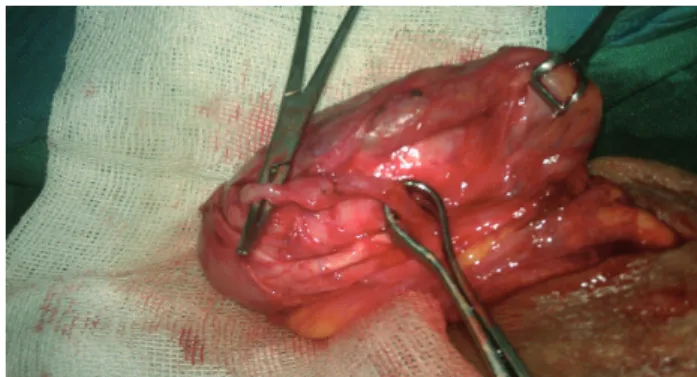
Semen analysis revealed normal semen volume and normal range of semen fructose, but azoospermia. Seminal vesicles and ejaculatory ducts were normal at transrectal ultrasonography (TRUS). Hormones (i.e., FSH, Testosterone) were in normal range. Based on clinical examinations, imaging and laboratory studies, we decided to operate the patient and vasoepididymostomy was our selected surgery. A longitudinal incision in scrotal midline raphe made a good exposure of both testes and tis-sues inside both hemiscrotum. Vasa deferentia were dissected toward the attachment sites to testes. There was no evidence of epididymis in any hemiscrotum and vas deferens was directly attached to the testis (Figures 1 and 2). The vasoepididymostomy was not possible, thus, biopsy of both testes was performed for pathological assessments and freezing for future artificial reproductive surgeries.
DISCUSSION AND FUTURE PERSPECTIVES
Because the epididymis, vas deferens, rete testis and seminal vesicle, altogether are develo-ped from Wolffian ducts (1), therefore, epididymal anomalies are typically seen concomitant with other anomalies in organs that are developed from Wolffian ducts. Any epididymal agenesis in ani-mals in previous case reports was unilateral (2, 3), but our patient had bilateral epididymal agenesis. Along with fetal development, the effect of
tes-Figure 1 - Vas deference inserted to testis directly.
Figure 2 - Bilateral epididmal agenesis.
tosterone on Wolffian duct leads to development of epididymis, vas deferens, and other organs that are related to Wolffian duct. Sometimes in disor-ders of sex development, evidences of incorrect or imperfect effect of testosterone on sex organs are seen, but isolated lack of epididymis has not been reported yet.
Because of isolated epididymal agenesis with normal development of testes and vasa de-ferentia in our patient, this anomaly is probably due to unknown fetal mutation after vasal deve-lopment. Because of normal range of testosterone and normal development of other testosterone de-pendent organs, it is not reasonable that hormo-nes interfere with this anomaly.
CONFLICT OF INTEREST
IBJU| BILATERAL ISOLATED EPIDIDYMAL AGENESIS
381
REFERENCES
1. McCullough R, Marshall FF, Berry SJ, Detweiler C. The influence of epididymal agenesis on the development and maturation of the testis: experimental model and clinical correlations. Urol Res. 1984;12:165-70.
2. Ladds PW, Briggs GD, Foster RA. Epididymal aplasia in two rams. Aust Vet J. 1990;67:457-8.
3. University of Bern, Institute of Genetics. Available at. http:// www.genetics.unibe.ch/content/rubrik/aplasia_of_the_ epididymis/index_eng.html viewed 21 February 2014.
_______________________ Correspondence address: Reza Sari Mtlagh, MD Department of Urology Tabriz University of Medical Sciences,