ABSTRACT
Purpose: A great number of small renal lesions have now been detected. Nowadays, partial nephrectomy has more frequently been adopted for surgical treatment of earlier stage disease. Previous studies have associated patient, institu-tional, and health care system factors with surgery type. The aim of this study was to compare the diagnosis and treatment of renal cell carcinoma (RCC) according to hospital type, public versus private, in our country.
Materials and Methods: We retrospectively evaluated 183 patients with RCC who underwent radical nephrectomy or nephron-sparing surgery between 2003 and 2007 in two hospitals, one private and one public. Patient demographic, clini-cal, surgery, and pathologic characteristics were analyzed.
Results: The radical nephrectomy rate was higher at the public hospital than at the private hospital (75% vs. 57%, p = 0.008). Overall, patients at the public hospital presented larger tumors than did the patients who were cared for privately.
Furthermore, small renal masses were signiicantly more prevalent in private care (57.8% vs. 28.3%). Patients at the public hospital showed a higher incidence of capsular invasion (p = 0.008), perirenal fat invasion (p < 0.01), lymph node involvement (p < 0.001), and a lower incidence of initial tumors. pT1 tumors were reported in 41% of patients at the public hospital and in 72% at the private hospital (p < 0.001).
Conclusion: Patients with RCC cared for at our public referral hospital showed a more advanced stage than RCC treated at the private institution.
Key words: nephrectomy; carcinoma; renal cell; neoplasm staging; prognosis Int Braz J Urol. 2011; 37: 584-590
Approximately 200 000 new cases of re-nal cell cancer (RCC) are diagnosed all over the world every year, constituting the third most com-mon genitourinary cancer, following bladder and prostate cancers (1). Indeed, RCC is one of the most lethal urological tumors; it is believed that 40% of RCC-diagnosed patients will die as a re-sult of such disease, approximately 100 000 deaths per year all over the world (2). Moreover, the an-nual incidence of RCC has increased 2.5%, which
is attributed at least in part to the widespread use
of non-speciic abdominal imaging (3,4). The cur -rent RCC series in literature shows that 60-70% of the patients are asymptomatic at the diagnosis (5). This change in the incidental presentation of renal mass doubled the prevalence of the local-ized disease from 1975 to 1995 (6,7). Paradoxi-cally, despite diagnosis and early treatment, there has been an increase in the overall and
disease-speciic mortality rates in the last twenty years,
according to SEER (Surveillance, Epidemiology, and End Results Program) database (8). In spite of
Signiicant Heterogeneity in terms of Diagnosis and Treatment of
Renal Cell Carcinoma at a Private and Public Hospital in Brazil
Marcos F. Dall’Oglio, Rafael Coelho, Roberto Lopes, Alberto A. Antunes, Alexandre Crippa,
Cesar Camara, Katia R. M. Leite, Miguel Srougi
University of São Paulo, Medical School, Urology Division, São Paulo, Brazil and Instituto do
Câncer do Estado de São Paulo Octávio Frias de Oliveira
that, there are groups of patients with small, non-aggressive tumors which can be dealt with with conservative treatment or with only surveillance.
In Brazil there have been no data collected
addressing the epidemiological proile of RCC.
Therefore, the current incidence of incidental and symptomatic tumors and their respective staging and treatment is not known. The aim of this study was to evaluate the symptoms at diagnosis (inci-dental and symptomatic), the size of the tumors, the type of surgery performed (radical and conser-vative), the TNM stage and the anatomopathologi-cal characteristics of the sporadic RCC who are treated in two tertiary hospitals, one public and another private, in our country.
MATERIALS AND METHODS
We performed a retrospective study in which we reviewed prospectively collected data from 183 patients who underwent surgical treatment for RCC between July 2003 and December 2007 in two ter-tiary hospitals in Brazil. Ninety-three patients were
treated at a public hospital (Hospital das Clínicas da Faculdade de Medicina de Sao Paulo), and ninety patients at a private hospital (Sociedade Beneicente de Senhoras Hospital Sírio-Libanês-Sao Paulo).
The data evaluated included the clinical pre-sentation at the diagnosis (incidental or symptom-atic), the type of surgery performed (conservative or radical) and anatomo-pathological characteristics (histological type, presence of sarcomatous
differen-tiation, Furhman’s nuclear grading system, presence
of microvascular invasion, tumor size and TNM stage) 14. These characteristics were comparatively analyzed between the public and private hospital pa-tients.
Postoperative follow-up included abdomi-nal computed tomography and/or ultrasonography and hematological exams every four months during the two initial years, and every six months from the
third to the ifth year. When the last consultation had
taken place more than three months earlier, there
was a telephone conirmation of the patient’s current
health condition.
For the statistical analysis the student’s
t-test and chi-square t-test were used. Results with
p-values inferior to 5% (p < 0.05) were considered signiicant. Both institutions’ review boards ap -proved the study prior to accruing the patients, and informed consent was signed by all participants.
RESULTS
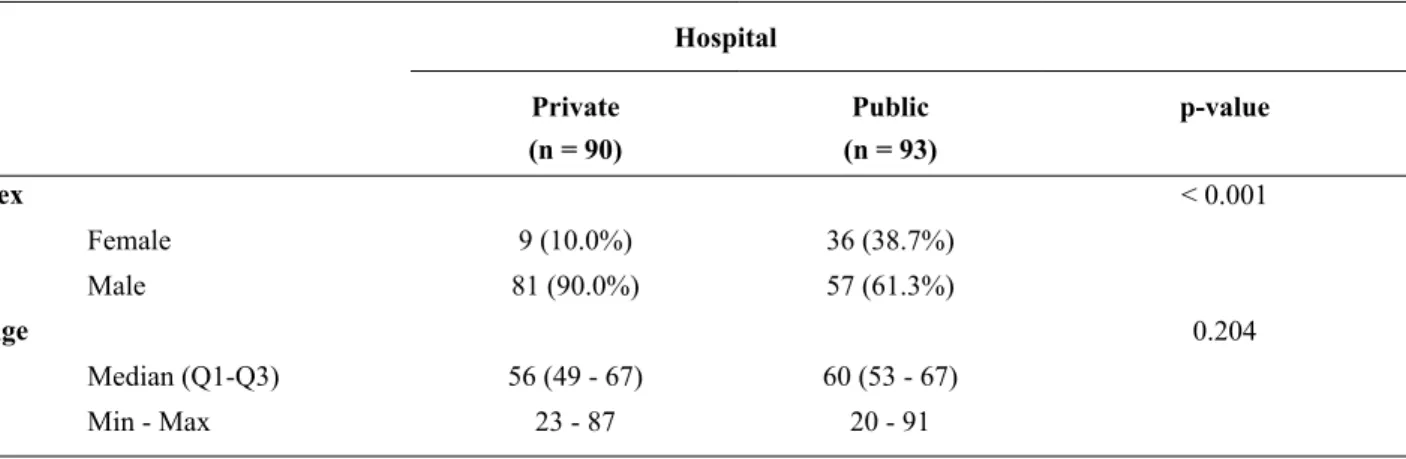
The median age was equivalent in both groups (56 vs. 60 years; p = 0.204). There was pre-dominance of male patients at the private hospital
compared to the public hospital (90% vs. 61. 3%; p <
0.001) (Table-1).
The diagnosis of the symptomatic tumors at the public hospital is 47.3% vs. 33.3% (Table-2). At the private hospital, there was a higher rate of patients with hematuria, whereas the public hospital showed a higher rate of patients presenting the classical triad
Table 1 - Demographic data.
Hospital
Private
(n = 90)
Public
(n = 93)
p-value
Sex < 0.001
Female 9 (10.0%) 36 (38.7%)
Male 81 (90.0%) 57 (61.3%)
Age 0.204
Median (Q1-Q3) 56 (49 - 67) 60 (53 - 67)
Table 2 - Clinical presentation of RCC and type of surgery performed.
Hospital
Private (n = 90)
Public (n = 93)
p-value
Clinical Presentation 0.059
Incidental 60 (66.7%) 47 (52.8%)
Symptomatic 30 (33.3%) 42 (47.3%)
Surgery Performed 0.008
Partial 39 (43.3%) 23 (24.7%)
Radical 51 (56.7%) 70 (75.3%)
Table 3 - Symptoms at diagnosis.
Hospital
Symptoms Private Public
Hematuria 8 (8.6%) 47 (52.2%)
Pain 10 (10.7%) 28 (31.1%)
Weight Loss - 6 (6.6%)
Metastasis 4 (4.4%) 7 (7.5%)
Palpable Mass 5 (5.5%) 8 (8.6%)
Hematuria / Pain / Palpable Mass 9 (10%) 13 (13.9%)
Others 7 (7.7%)
-(hematuria/pain/palpable mass). It is also worth not-ing that more patients presented metastatic disease at diagnosis at the public hospital when compared to the private hospital (Table-3).
The proportion of conservative surgery prac-tically doubles at the private hospital (p = 0.008)
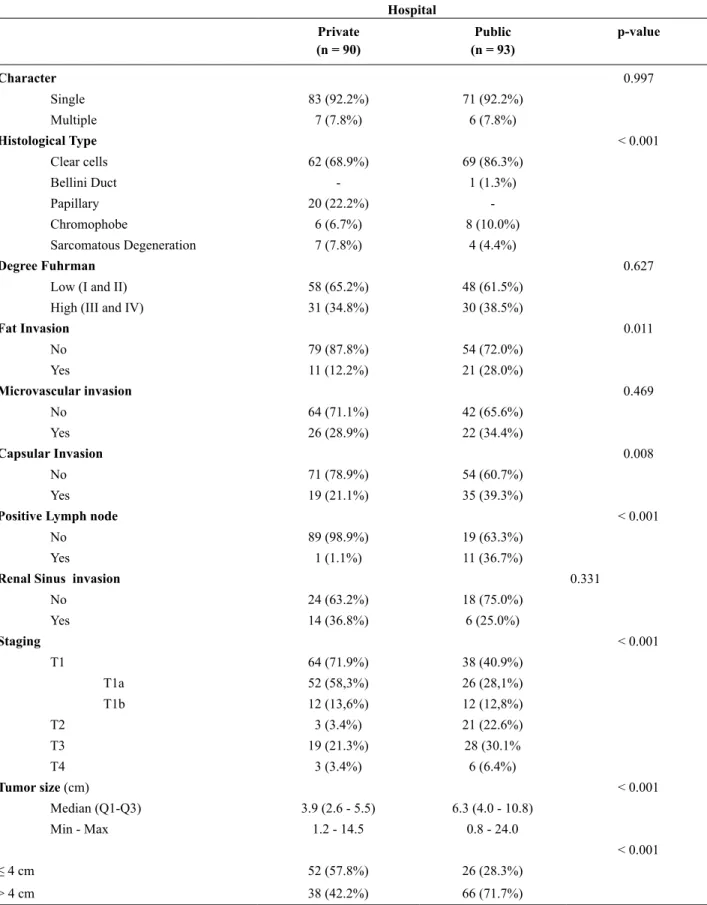
(Table-2). The median tumor size was signiicantly
different in both hospitals (Table-4): the median size was smaller than 4 cm at the private hospital and
larger than 6 cm at the public hospital (p < 0.001). Another remarkable inding is that 58% of the tumors
at the private hospital are smaller than 4 cm against only 28% at the public hospital (p < 0.001).
The pathological characteristics of the RCC in both hospitals are represented in Table-4. The public hospital patients presented locally advanced tumors, with higher percentage of capsular invasion (p = 0.008), perirenal fat invasion (p = 0.01), and
presence of lymph node metastasis (p < 0.001). The
percentage of pT1 tumors was higher at the private
Hospital Private
(n = 90)
Public (n = 93)
p-value
Character 0.997
Single 83 (92.2%) 71 (92.2%)
Multiple 7 (7.8%) 6 (7.8%)
Histological Type < 0.001
Clear cells 62 (68.9%) 69 (86.3%)
Bellini Duct - 1 (1.3%)
Papillary 20 (22.2%)
-Chromophobe 6 (6.7%) 8 (10.0%)
Sarcomatous Degeneration 7 (7.8%) 4 (4.4%)
Degree Fuhrman 0.627
Low (I and II) 58 (65.2%) 48 (61.5%)
High (III and IV) 31 (34.8%) 30 (38.5%)
Fat Invasion 0.011
No 79 (87.8%) 54 (72.0%)
Yes 11 (12.2%) 21 (28.0%)
Microvascular invasion 0.469
No 64 (71.1%) 42 (65.6%)
Yes 26 (28.9%) 22 (34.4%)
Capsular Invasion 0.008
No 71 (78.9%) 54 (60.7%)
Yes 19 (21.1%) 35 (39.3%)
Positive Lymph node < 0.001
No 89 (98.9%) 19 (63.3%)
Yes 1 (1.1%) 11 (36.7%)
Renal Sinus invasion 0.331
No 24 (63.2%) 18 (75.0%)
Yes 14 (36.8%) 6 (25.0%)
Staging < 0.001
T1 64 (71.9%) 38 (40.9%)
T1a 52 (58,3%) 26 (28,1%)
T1b 12 (13,6%) 12 (12,8%)
T2 3 (3.4%) 21 (22.6%)
T3 19 (21.3%) 28 (30.1%
T4 3 (3.4%) 6 (6.4%)
Tumor size (cm) < 0.001
Median (Q1-Q3) 3.9 (2.6 - 5.5) 6.3 (4.0 - 10.8) Min - Max 1.2 - 14.5 0.8 - 24.0
< 0.001
≤ 4 cm 52 (57.8%) 26 (28.3%)
> 4 cm 38 (42.2%) 66 (71.7%)
DISCUSSION
There were marked differences in the clinical presentation, type of surgery performed and
histolog-ical indings of the RCC treated at public and private
hospitals in Brazil. The median size of RCC detected at the private hospital was 2.4 cm, smaller than those detected at the public hospital. Nephron-sparing surgery was performed in half of the patients at the public hospital when compared to the private
one. Furthermore, whereas approximately 60%
of the patients operated on at the private hospital had tumors smaller than 4 cm, more than 70% of the public hospital patients presented tumor larg-er than 4 cm. pT1 RCC tumors occurred in 72% of the private hospital patients and in only 40% of the public hospital patients. Therefore, the fact that the public hospital is an academic teaching environment and the private is essentially a pri-vate practice probably did not play such an im-portant role in determining the surgical approach in our study as did the tumor stage.
Differences in RCC histology between the groups reported in the present study may be associated with the disparate median tumor siz-es. Patients with small renal masses (SRM) were probably less frequently referred to the public hospital, since it is a tertiary referral institution.
Radical nephrectomy was a rather com-mon option in the public hospital, comprising 75% of renal surgeries, whereas at the private hos-pital, radical nephrectomy was performed in 57% of the cases. Long-term functional results for the patients who have undergone radical and conser-vative nephrectomy are very different . Lau et al. (9) have reported that the progression towards re-nal insufficiency (creatinine > 2 mg/dL) ten years after the renal surgery occurred in 22.4% of the patients who were submitted to radical nephrec-tomy versus 11.6% after partial nephrecnephrec-tomy.
RCC is a classically aggressive tumor; in clinical series from developed countries, one-third of the patients present metastasis at the di-agnosis (10). Indeed, more than 40% of the RCC patients die due to that disease (11). The risk of death caused by RCC may be higher in develop-ing countries like Brazil, especially in public hos-pitals. In our study, symptomatic and metastatic tumors comprised 47% and 15%, respectively, of the tumors treated at public hospitals and 33% and 4% of the tumors treated at private hospitals. In the United States, 25-30% of the patients ini-tially present with metastatic RCC (12).
cidental diagnosis occurred in 67% of Brazilian private hospital patients and 53% of public hospi-tal patients. Since the Brazilian public health sys-tem is based on universal coverage for approxi-mately 203 million people, of which 68% have no private health insurance, medical visits and tests are often delayed due to long waiting lists (17).
The 2002 TNM presented a new proposal for the RCC stage, especially in T1 tumors (small-er than 7 cm, restricted to the kidney) (14). RCC stage T1 includes tumors with different outcomes.
For instance, the likelihood of death within ten
years for a patient with a 5- cm, low-degree RCC is less than 3%; however, a high-degree 5-7 cm RCC has a 40% likelihood of death in ten years (18). In Brazilian private and public hospitals ap-proximately 72% and 41% of the patients present-ed stage pT1 tumors, respectively. Considering that life expectancy for T1 tumors is much higher, we can expect a higher RCC mortality at the Bra-zilian public institutions than at private hospital, a rather peculiar characteristic for our country. At the public hospital the classical triad (hematuria/ pain/palpable mass), identified in 28% of the pub-lic hospital patients and 8% of the private hospital patients, respectively - can still be found.
An important limitation is that both are distinct pathology services and the surgeon’s ex-perience at the private hospital is higher. The data from public hospitals on diagnosis of metastatic disease are probably underestimated, and it is possible that data are actually higher.
Currently, renal masses are detected inci-dentally, with smaller sizes constituting the ideal
cases for conservative surgery (19,20). However,
recent series from developed countries showed that conservative kidney surgery has been under-utilized; only 9.6% of the surgeries carried out due to RCC are conservative (21). In this context, our study showed that nephron-sparing surgery was carried out in 43% and 24% of private and public hospital individuals, respectively. Although not broadly representative, these two particular hos-pitals may indirectly reflect the patterns of care in the private and public health systems in Brazil. Nonetheless, an external validation of these find-ings is needed to confirm this discrepancy.
CONCLUSIONS
Patients with RCC operated on at a tertiary public hospital in Brazil showed a more techni-cally advanced histopathological evaluation than those treated at a private institution, reflecting the different standards of treatment that patients may undergo according to their socioeconomic level.
CONFLICT OF INTEREST
None declared.
REFERENCES
1. Jemal A, Siegel R, Ward E, Hao Y, Xu J, Thun MJ: Cancer statistics, 2009. CA Cancer J Clin. 2009; 59: 225-49.
2. Wotkowicz C, Libertino JA: Renal cell cancer: radical nephrectomy. BJU Int. 2007; 99: 1231-8. 3. Chow WH, Devesa SS, Warren JL, Fraumeni JF Jr:
Rising incidence of renal cell cancer in the United States. JAMA. 1999; 281: 1628-31.
4. Lam JS, Belldegrun AS, Pantuck AJ: Long-term outcomes of the surgical management of renal cell carcinoma. World J Urol. 2006; 24: 255-66. 5. Parsons JK, Schoenberg MS, Carter HB: Inciden
-tal renal tumors: casting doubt on the efficacy of early intervention. Urology. 2001;57: 1013-5. 6. Hock LM, Lynch J, Balaji KC: Increasing inci
-dence of all stages of kidney cancer in the last 2 decades in the United States: an analysis of sur-veillance, epidemiology and end results program data. J Urol. 2002; 167: 57-60.
7. Jayson M, Sanders H: Increased incidence of serendipitously discovered renal cell carcinoma. Urology. 1998; 51: 203-5.
8. Hollingsworth JM, Miller DC, Daignault S, Hol -lenbeck BK: Rising incidence of small renal mass-es: a need to reassess treatment effect. J Natl Can-cer Inst. 2006; 98: 1331-4.
9. Lau WK, Blute ML, Weaver AL, Torres VE, Zincke
H: Matched comparison of radical nephrectomy vs
10. Lam JS, Shvarts O, Leppert JT, Figlin RA, Bellde -grun AS: Renal cell carcinoma 2005: new frontiers in staging, prognostication and targeted molecular therapy. J Urol. 2005; 173: 1853-62.
11. Srinivasan R, Armstrong AJ, Dahut W, George DJ: Anti-angiogenic therapy in renal cell cancer. BJU Int. 2007; 99: 1296-300.
12. Crispen PL, Uzzo RG: The natural history of un-treated renal masses. BJU Int. 2007; 99: 1203-7. 13. Janzen NK, Kim HL, Figlin RA, Belldegrun AS:
Surveillance after radical or partial nephrectomy for localized renal cell carcinoma and management of recurrent disease. Urol Clin North Am. 2003; 30: 843-52.
14. Sobin LH, Wittekind Ch: TNM classification of malignant tumors. 6th ed. New York, Wiley-Liss. 2002; pp. 193-5.
15. Knight DA, Stadler WM: Prognostic factors in lo-calized renal cell cancer. BJU Int. 2007; 99: 1212-6.
16. Coll DM, Smith RC: Update on radiological im-aging of renal cell carcinoma. BJU Int. 2007; 99: 1217-22.
17. Brasil. Instituto Brasileiro de Geografia e Estatísti -ca. Um panorama da saúde no Brasil: acesso e uti-lização dos serviços, condições de saúde e fatores
de risco e proteção à saúde 2008. Brasília, DF: Ministério da Saúde; Ministério do Planejamento,
Orçamento e Gestão; 2008. Available from: http:// www.ibge.gov.br/home/estatistica/populacao/ panorama_saude_brasil_2003_2008/default.shtm.
[cited 2010 Set 12]
18. Lau WK, Cheville JC, Blute ML, Weaver AL,
Zincke H: Prognostic features of pathologic stage
T1 renal cell carcinoma after radical nephrectomy. Urology. 2002; 59: 532-7.
19. Frank I, Blute ML, Cheville JC, Lohse CM, Weav
-er AL, Zincke H: Solid renal tumors: an analysis
of pathological features related to tumor size. J Urol. 2003; 170: 2217-20.
20. Patard JJ, Dorey FJ, Cindolo L, Ficarra V, De La Taille A, Tostain J, et al.: Symptoms as well as tumor size provide prognostic information on pa-tients with localized renal tumors. J Urol. 2004; 172: 2167-71.
21. Hollenbeck BK, Taub DA, Miller DC, Dunn RL, Wei JT: National utilization trends of partial ne-phrectomy for renal cell carcinoma: a case of un-derutilization? Urology. 2006; 67: 254-9.
______________________ Submitted for publication:
May 25, 2010
___________________ Accepted after revision:
April 11, 2011
____________________
Correspondence address:
Dr. Marcos F. Dall’Oglio
Rua Barata Ribeiro, 398, 5º Andar São Paulo, SP, 01308-000, Brazil
Fax: +55 11 3159-3618