Mathematics Teachers’ Professional Identity Development in
Communities of Practice: Reifications of Proportional Reasoning
Teaching
Desenvolvimento da Identidade Profissional de Professores de Matemática
em Comunidades de Prática: Reificações do Ensino do Raciocínio
Proporcional
Márcia Cristina de Costa Trindade Cyrino*
Abstract
In the last decade, the Study and Research Group on the Education of Teachers who teach Math – GEPEFOPEM (Brazil) investigated teacher education groups constituted as Communities of Practice – CoPs. The objective of this paper is to discuss the focus of one of these CoPs when working with Proportional Reasoning and the practice elements of four CoPs, which promoted the development of their members’ professional identity. The data was collected through an analysis of meaning negotiation processes, mobilized knowledge and the CoPs dynamics based on different groups interactions and written production of their members. The analysis showed that self-knowledge, beliefs and concepts, professional self-knowledge, vulnerability, and the sense of agency became the focal points of the CoPs during the study of proportional reasoning as well as the practice elements of the four CoPs that promoted the professional identity development of, namely: shared repertoires, reports and discussions on their pedagogical practices, the existence of an open and flexible work plan, the opportunity to discuss their written productions, vulnerability experiences, the search for a sense of agency balance, connections among observations and empirical interpretations and a broader theoretical background, reports and discussions on previous meetings. Factors such as respect, trust, challenge, solidarity, projects negotiations, dynamics and actions, valorization of the singularities, and professional practices of teachers are essential for the constitution of the professional identity of these professionals and for the cultivation and maintenance of these groups.
Keywords: Teachers’ Professional Identity. Mathematics Teachers Education. Communities of Practice. Proportional Reasoning.
Resumo
Na última década o Grupo de Estudo e Pesquisa sobre Formação de Professores que Ensinam Matemática – GEPEFOPEM (Brasil) investigou grupos de formação de professores que se constituíram como Comunidades de Prática – CoPs. Este artigo tem como objetivos discutir o que se tornou ponto de enfoque na prática de uma dessas CoPs no trabalho com o Raciocínio Proporcional e elementos da prática de quatro CoPs que promoveram o desenvolvimento da identidade profissional de seus membros. Para obtenção das informações analisamos os processos de negociação de significados, os conhecimentos mobilizados, e a dinâmica das CoPs a partir das interações nos diferentes grupos e da produção escrita de seus membros. A análise evidenciou que o
autoconhecimento, as crenças e concepções, os conhecimento profissionais, a vulnerabilidade e o sentido de agência se tornaram pontos de enfoque da CoP no estudo do raciocínio proporcional, bem com os elementos da prática das quatro CoPs que promoveram o desenvolvimento da identidade profissional, nomeadamente: os repertórios compartilhados, relatos e discussões de suas práticas pedagógicas, existência de um plano de trabalho aberto e flexível, oportunidade de discutir suas produções escritas, experiências de vulnerabilidade, busca de equilíbrio do sentido de agência, conexões entre as observações e interpretações empíricas e um referencial teórico mais amplo, relatos e discussões de encontros anteriores. Fatores como respeito, confiança, desafio, solidariedade, negociação dos empreendimentos, dinâmicas e ações, valorização das singularidades e das práticas profissionais dos professores se mostram férteis e fundamentais à constituição da identidade profissional desses professores e ao cultivo e manutenção desses grupos.
Palavras-chave: Identidade Profissional de Professores. Formação de Professores que Ensinam Matemática.
Comunidades de Prática. Raciocínio Proporcional.
1 Introduction
The number of studies on the mathematics teacher education has increased in the last
years; especially those in search for professional development programs that prepare teachers to
understand and face current educational challenges (SOWDER, 2007; PONTE; CHAPMAN,
2008; SIMON, 2008; JAWORSKI, 2011). Several are the challenges imposed on the teacher,
namely the processes of teaching and learning, the tension between epistemological and
cognitive plans, the complexity and diversity of the classroom, the construction and
implementation of a curriculum to meet current social demands and the new teacher’s roles.
These studies show the complexity of the developmental process and the need to think
about the interactions among the different intrinsic aspects of teacher education programs,
such as: mathematics knowledge; mathematics teaching knowledge; the understanding of how
students learn; the development of teachers’ professional identity; future teachers’ knowledge,
expectations, conceptions and interests; teachers educators’ characteristics, knowledge and
concepts as well as of other participants of the development program; objectives, evaluation
criteria, curriculum and program organization; objectives and organization of the educational
system, pedagogical materials and educational research, among others.
In Brazil, researchers who participate in teacher development programs have worked
to understand and articulate these aspects in order to promote learning and professional
identity development opportunities for future teachers and for teachers who teach
mathematics. According to Cyrino (2009, p. 95), “[...] the efforts of this area are targeted [...]
to give a new direction to the development of these professional taking into consideration the
The Study and Research Group on the Education of Math teachers – Gepefopem, based at Universidade Estadual de Londrina (UEL) – has investigated, in the last twelve years, mathematics teachers initial and continuing education perspectives to identify factors that may
intervene in the process of constituting the identity of these professionals. The analysis of
these perspectives showed the little efficacy of teacher education programs based on training
courses, since they hardly ever take into account the different needs of the teacher’s practice.
Considering that proposals for teacher education programs must take into account the
singularities of the teacher’s teaching practices and the factors that affect these practices, the Gepefopem proposed, starting in 2008, the creation of study groups involving in-service
mathematics teachers, future mathematics teachers and researchers, to constitute Communities
of Practice - CoPs (WENGER, 1998), and assumed them as investigation scenarios.
The present article discusses the focus of one of these CoPs during their work on
Proportional Reasoning and the practice elements of four CoPs which promoted the
development of their members’ professional identity. To do so, the theoretical aspects related
to teacher education and professional identity development in Communities of Practice is
introduced, together with those related to Proportional Reasoning. Next, the methodological
approaches adopted by this work and the analyses that led us to make some considerations on
the theme of this article are described.
2 Teacher education in Communities of Practice and professional identity development
Communities of practice1 of teachers who teach mathematics have been presented in
the literature as a rich and fertile soil to explore the learning processes of future teachers and
teachers who teach mathematics (LLINARES, 2002; GRAVEN, 2005; CYRINO;
CALDEIRA, 2011; NAGY; CYRINO, 2014; GARCIA, 2014; OLIVEIRA, 2014).
According to Wenger, McDermott and Synder (2002),a CoP presuppose the existence
of three fundamental and structural aspects: a domain of knowledge, a community of people
and the shared practice. The domain is the element that mobilizes members CoP to contribute
and participate in the community in the search for affirmation of its objectives, actions,
initiatives, and enhancement of its members; it is the element that legitimizes the existence of
the community. The community refers to the environment in which people interact, learn and
1
build relationships; it is the “[...] the social fabric of learning” (p.28). The practice is defined as
“a set of frameworks, ideas, tools, information, styles, language, stories, and documents that community members share. Whereas the domain denotes the topic the community focuses on,
the practice is the specific knowledge the community develops, shares, and maintains.” (p.29). As the practice of coherence source community, Wenger (1998) proposes three interrelated
dimensions: mutual engagement, joint enterprise, and shared repertoire of ways of doing things.
Graven and Lerman (2003) emphasize that, although research on mathematics teachers’ education has created contexts that enable to learning and describe what teachers learn in
social terms, little studies has been done to explain how those contexts enable learning.
Therefore, GEPEFOPEM decided to analyze the elements of the practice of Communities of
Practice of teachers who teach mathematics that promote learning and, consequently, the
development of teachers’ professional identity.
The development of the professional identity is a complex process that includes the
personal, professional, intellectual, moral and political aspects of the groups to which the subjects
are involved (BEIJAARD et al., 2004; KELCHTERMANS, 2009; PONTE; CHAPMAN, 2008;
OLIVEIRA; CYRINO, 2011). It consists not only of what others think or say about us, although
that is also part of our way of living, but also of how we see ourselves and our capacity to reflect
on our experience. According to Wenger (1998) “identity in practice is defined socially not
merely because it is reified in a social discourse of the self and of social categories, but also
because it is produced as a lived experience of participation in specific communities (p. 151)”. We perceive the teacher’s professional identity as a set of interconnected
beliefs/concepts and knowledge about his/her work, associated to autonomy (vulnerability and
sense of agency) and political commitment. The set of beliefs/concepts teachers have about
themselves and their profession, of what it means to be “an excellent teacher” and the type of
teacher they want to be, among other things, are interconnected and affect the knowledge they
develop about their work. This knowledge includes content knowledge, general pedagogical
knowledge and pedagogical content knowledge2, curriculum knowledge, knowledge about the
students, knowledge about the objectives, purposes and educational values and their historical
and philosophical foundations, knowledge of the educational context (SHULMAN, 1986,
1987) and an understanding of the classroom practices.
2
To develop the teacher’s professional identity, a space in their education process is necessary to favor the emergence of vulnerabilities and the appropriation of the values and
norms of the profession. Oliveira and Cyrino (2011) highlight the fact that this vulnerability
is not something that weakens and paralyzes,
[...] but one that allows us to hold back for some more or less long and more or less frequent moments, our certainties and convictions, which makes us question ourselves. It is also vulnerability in the sense of exposing ourselves to others and, consequently, becoming “the target of criticism and argumentations” (p. 112).
It is the kind of vulnerability that allows developing teachers3 to recognize their difficulties
and limitations; deal with the resulting conflicts and dilemmas related to the teaching practice and
recognize mistakes as mutual learning opportunities. To prevent this vulnerability to turn into
weaknesses, it is necessary to implement actions that, by using instituted spaces, promote the
rethinking of their practices, beliefs/concepts and offer them opportunities to develop knowledge to
overcome their difficulties and limitations. These spaces must help develop the (future) teacher’s capacity to face any vulnerability with a sense of agency (OLIVEIRA; CYRINO, 2011).
Within the social perspective of learning, this agency stops being regarded as an
individual capacity or quality to be evaluated as a measure by the interaction between the
individual component (attributes and inclinations) and the tools and structures of the social
scenario. “This way, it makes sense to talk about a “mediated agency” (OLIVEIRA; CYRINO,
2011, p. 114). During the development of teachers in Communities of Practice, their members
have the opportunity to reflect on and interpret the social requisites and norms of their (future)
practice, as well as act upon different contexts in which these practices operate (regardless of
the embarrassments), and, consequently, develop a sense of agency as they position
themselves and develop autonomy, “by taking into account their perspectives, knowledge and potentials” (OLIVEIRA; CYRINO, 2011, p. 114).
For Wenger (1998), an identity is developed in social contexts (CoPs) through the
ways their members negotiate meanings. An identity is “a way of talking about how learning
changes who we are and creates personal histories of becoming in the context of our
communities” (WENGER, 1998, p. 5). Learning is seen as a social practice which takes place in the context of our routine experiences with the world in a process of meaning negotiation.
Meaning negotiation presupposes an interaction between two other processes: the
participation process and the reification process.
By making a parallel between practice and identity, Wenger (1998) states that “[...]
developing a practice requires the formation of a community whose members can engage with
one another and thus acknowledge each other as participants” (p. 149). This process of recognition produces negotiation regarding the way of being of the people involved in the
community, i.e., it involves a negotiation of its members’ identities. It is impossible to think
of identity and practice in isolation, because as shown in Table 1 “identity and practices are
mirror images of each other” (WENGER, 1998, p. 149) (Table 1).
Table 1 – Parallel between practice and identity; Source: (WENGER, 1998, p. 150)
practice as ... Identity as ...
negotiation of meaning (in terms of participation and reification)
negotiated experience of self (in terms of participation and reification)
community membership
shared history of learning learning trajectory
boundary and landscape nexus of multi-membership
constellations belonging defined globally but experienced locally
Thus, it is necessary to consider the social groups in which we are involved, the relations we
establish in them, the activities developed, the type of resources used and the stories that are shared
and constructed. Learning is seen as a permanent process of constituting an identity of those who
participate in a CoP, in order to deal with the demands/problems inherent to the teachers’ pedagogical
act. In this paper, we identified some learning experiences related to Proportional Reasoning based on
what has become the focus in the practice of one of the CoPs which we investigated.
3 Proportional reasoning
Proportional reasoning can be used in problem-solving inside and outside the school
context. In the school context, proportional reasoning is considered one of the most relevant
points in arithmetic learning, and the basis for more complex mathematical concepts
involving proportion/proportionality in Geometry and Algebra, e.g.: to investigate
proportionality surfaces, to examine properties of similar triangles, to investigate scaling
problems, to examine number patterns, to translate the algebraic representation to a graphical
representation, to define trigonometric functions.
According to Cai and Sun (2004) proportional reasoning is an important road for the
development of algebraic reasoning and for the students’ understanding of the meaning of functions.
However, Proportional Reasoning cannot be adopted as a synonym for proportionality but as a
necessary condition for the comprehension of contexts and mathematics applications that involve
proportion/proportionality (LESH; POST; BEHR, 1988). The mobilization of Proportional
Reasoning may happen during the development of strategies and freer procedures, without being
attached to formulas or algebraic resources such as the rule of three when identifying multiplicative
relations among numerical quantities in a problem and when selecting, organizing and making
explicit quantities that covariate among themselves as well as those that remain constant, among
others. The work with proportionality should not be restricted to the use of algebraic resources in a
mechanical fashion, depending on the memorization of rules and formulas.
Proportional reasoning refers to detecting, expressing, analyzing, explaining, and providing evidence in support of assertions about proportional relationships. The word reasoning further suggests that we use common sense, good judgment, and a thoughtful approach to problem-solving, rather than plucking numbers from word problems and blindly applying rules and operations. (LAMON, 2005, p. 4).
Proportional Reasoning involves covariance and invariance notions and multiplicative
comparisons between ratios, and requires the capacity to interpret, store and process a set of
information that mobilizes quantitative and qualitative aspects of knowledge (LESH; POST;
BEHR, 1988; CRAMER; POST; BEHR, 1989). Among the quantitative aspects is the ability to
solve mathematical algorithms correctly, think of numerical quantities in relative terms, conceive
ratio as a constant relation (even with the covariation of the quantities that generated it). The
qualitative aspects, on the other hand, involve the capacity to identify situations in which
numerical quantities relate in a multiplicative and not additive way; the capacity to interpret, relate
and analyze in a conscious way these quantities and the numerical results found in the solution of
problems, assessing pertinence of these values, their dimensions and meanings within the context
of problems; the capacity to identify and distinguish situations that involve relations which are
directly/inversely proportional to those that do not present such types of multiplicative relations.
For Lamon (2005), proportional reasoning involves a minimum set of concepts,
operations, contexts, representations and forms of thinking which are widely interrelated
(forming a network – Figure 1) and key to its development, namely: the different interpretations of the rational number represented by the form ; measurement; invariance and
covariance relations; relative thinking; unitization (composing and decomposing of units of
Figure 1 – Elements necessary for the development of proportional reasoning; Source: (LAMON, 2005, p.9)
By presenting and relating these elements necessary for the development of
proportional reasoning, Lamon (2005) does not overlook the broad and intricate process of
constitution of mathematical knowledge. Although they are presented in Fig. 1 with dots
(knots), they represent different ideas and concepts that have an impact on the whole network.
Reasoning proportionally involves the understanding:
of meanings underlying the fraction representation ( with b0) of rational
numbers, which are associated to different contexts - part-whole relationship,
measurement, quotient, ratio or rate, operator (KIEREN, 1980) -, involving first
order relations of the part-part type (ratio, e.g.) or part-whole type;
of second order relations that can be established between two or more of these
representations of the type , with b0 and d0 (proportionality relations,
equivalence or comparisons involving the notion of order: greater, smaller, the same).
These different interpretations of fraction registration may be seen as varied forms of
measurements. According to Lamon (2005):
– a part-whole fraction measures the multiplicative relationship of a part to the whole to which it belongs;
– a ratio measures relative magnitude; a rate such as speed is a quantification of motion; – a quotient is a measure of how much 1 person receives when m people share n objects; – an operator is a measure of some change in a quantity from a prior state;
– as a measure, a rational number directly quantifies a quality such as length or area. (LAMON, 2005, p.40).
The understanding of the measurement idea is based on three important mathematical
principles (LAMON, 2005):
i) the compensatory principle: the smaller the considered unit the greatest the amount
of units needed to measure something and vice-versa; b a
d c b a
ii)the approximation principle: a measure is always an approximation, therefore it is
possible to manipulate measurement units to make them as precise as necessary;
iii)the recursive partitioning principle: a measurement unit can be subdivided into
smaller parts and equal parts, as many times as needed to get a precise measure.
This measure/measurement idea is connected to relative thinking (another knot in the
network, Figure 1). By comparing measures, as in the case of live beings heights in two
distinct moments of their growth, it is possible to identify the occurrence of variations in the
measurements in relative and absolute terms: the difference between the final and initial
height of a tree results in a numerical quantity, a linear measure, indicated by a determined
unity such as centimeters, millimeters, etc. (an absolute variation). However, the comparison
established between this linear quantity, registered in two distinct tree growth moments and
its initial height results in a growth rate, a comparison indicating a relative variation, signaled
by units such as the percentage (%).
According to Lamon (2005), to reason in relative terms demands greater abstraction
from individuals than to reason in absolute terms (reasoning based on visualization, counting
and the direct measurement of quantities). Through relative thinking, individuals are capable
of measuring more complex and abstract quantities and those which cannot be measured
directly with the use of specific instruments or immediate counting. They are quantities
resulting from comparisons/relations between quantities of sometimes distinct nature such as
speed, density, inclinations, concentration, among others.
The characterization of “Quantities and Covariation” is related to the capacity to
identify and measure quantities and to notice how these quantities vary (co-vary) when related.
The process of identifying, quantifying quantities (direct or indirectly through relative
thinking/thinking) and of analyzing which ones go (or not) under alterations (which ones
co-vary or remain invariant), and how these alterations take place (in a multiplicative way,
directly or inversely proportional), promotes the development of more powerful forms of
reasoning (such as the Proportional Reasoning) which go beyond recognition of obvious
information in analyzed contexts.
The process of unitization4 is directly related to the process of reasoning up and down
and to the concept of fractions equivalence. The unitization can be characterized as a process
of reorganizing the quantities with which one works, (re)grouping them in order to develop
subgroups that continue to represent the same total quantities, i.e., the wholes or referential
units remain the same but are represented by different fraction forms, which means“[...] to
conceptualize a quantity in terms many different-sized pieces” (LAMON, 2005, p. 80). For this author, to unitize is a subjective and natural process for individuals, which must be
constantly provoked in order to promote greater reasoning freedom.
To unitize quantities, maintaining their proportionality relations, is developed through
reasoning up and down, a mental procedure that involves calculating in a progressive way,
from any fraction, the proportionality relations equivalent to the whole (referential unit) and
then to find proportional relations for the any other fractions of this whole, based on the
already found relations or vice-versa.
The registration of numerical quantities in fraction representation is rooted in the equal
sharing or division idea, in the act of unit partitioning, being discrete or continuous, into
disjointed, finite and equal sections, i.e., the divided parts do not superpose one another, and
all of them being result of the partition are part of the unit (LAMON, 2005). This process is
essential to understand the fraction representation of rational numbers, decimal
representations and the concept of equivalence between fractions. The idea to realize divisions
in a unit and then establishing comparisons between the quantities obtaining by these
divisions is also related to measurement.
Considering the importance of proportional reasoning for mathematics and for the
development of problem-solving strategies which go beyond the mechanical reproduction of
formulas, its study was one of the projects negotiated by one of the teacher development CoPs,
which will be used as an example in this paper to show the elements of the practice that
promoted the development of the professional identity of its members.
4 Methodological aspects
The design of this study combines intervention and research, characterized as intervention
research (KRAINER, 2003). For the author, this type of research is “[...] most of the times process-oriented and context-limited, generated by a continuous interaction and communication
with the practice” (p. 98). In an intervention research, researchers neither position themselves outside the practice nor investigate their own practice in order to improve it. The researcher/
teacher educator plays a double role: that of an investigator who aims at “increasing his/her own understanding and theoretical knowledge to be able to share them with the scientific community”
The current study deals with the elements of practice of four study groups, constituted
as Communities of Practice of teachers who teach mathematics, that offer learning and
professional identity development opportunities for their members. These CoPs were
organized in four cities in the State of Paraná, and each one counts on the participation of six
to nine Basic Education teachers, one to four future teachers and one to three researchers5.
The dynamics assumed in each group (community) promoted the creation of CoPs,
because the practices developed by the participants legitimized and promoted the engagement,
respect and mutual trust, sharing experiences and knowledge, trading in shares and enterprises,
related to the themes discussed in each group (domain). I.e., each group of teachers who teach
mathematics (community) was willing to discuss a subject (domain) in an education context
(practice). To this end, each group established mutual engagements in the realization of the
joint enterprise, which required a shared repertoire.
In regards to data collection methods, in all CoPs audio registration of the sessions,
(future) teachers’ written records (tasks’ solutions and, reflections on meetings in a notebook or moodle platform) and field notes produced by the teacher educators were used.
Data analysis was continuous (GRAVEMEIJER; COBB, 2006) and helped assess and
guide discussions and identify the participants’ learning experiences through meaning
negotiation processes. The search for elements that offer opportunities for these learnings and,
consequently, the constitution of the participants’ professional identity was adopted as a parameter for the analysis.
To exemplify the CoPs’ dynamics, the meaning negotiation processes and the knowledge
mobilized, to identify professional identity aspects, the next section introduces a practice episode
from the “Community of Practice of Teachers who Learn and Teach Math –CoP PAEM”6
(which
meets more than four years), coordinated by Tânia Marli Rocha Garcia, as part of the joint
enterprise Proportional Reasoning Study, more specifically in actions 1 and 4 (see below), which
involved the solution and discussion of proportion/proportionality problems, the analysis of some
of the used strategies and the teachers’ justifications, with the support of the literature.
The joint enterprise “Proportional Reasoning Study”, which lasted 10 months, included five linear actions that did not follow a linear trajectory. In action 1, members of the
5
In the context of these teacher development practices, these researchers were called teacher educators, namely: Márcia Cristina de Costa Trindade Cyrino; Márcia Cristina Nagy; Cristina Cirino de Jesus; Loreni Aparecida Ferreira Baldini; Tânia Marli Rocha Garcia; Lais Maria Costa Pires de Oliveira; Márcio Roberto Rocha.
community solved the problems proposed by the teacher educator, which involved
proportion/proportionality, and discussed resolution strategies collectively. The teacher
educator challenged the participants to use strategies distinct from “the rule of threealgorithm”
they normally used. In action 2, as suggested by the CoP members, three texts on proportional
reasoning were studied including: the key structures involved in its development; the role of
the understanding of the different rational number interpretations; the importance of
proportional reasoning for the development of the students’ mathematical thinking and the
comprehension of abstract mathematical concepts. In action 3, group participants were
challenged to propose problems involving proportion/proportionality. These problems were
solved and discussed collectively, emphasizing solution strategies, the problem statement and
other mathematical ideas involved. In action 4, the participants discussed some strategies and
justifications presented in action 1 based on the synthesis prepared by the teacher educators
with the support of the literature (action 2). In action 5, each participant had to propose a
problem with the potential to mobilize proportional reasoning and coordinate discussions on
the resolution strategies presented by the CoP members.
During the period in which the data were collected, the CoP-PAEM was constituted of
six Basic Education teachers (Bia, Clea, Eva, Tina, Iara e Ada)7, a future mathematics teacher
(Luiz) and three researchers (Tânia, Laís and Márcio). During the analysis of this episode, the
learning trajectories of the community members were discussed through the forms of
participation (actions and interactions) and reifications (contents, projections, interpretations)
that they experienced during the process.
5 CoP-PAEM in the study of Proportional Reasoning
Action 4 was proposed by one of the teachers, Eva, and negotiated in the group. Based
on the written productions and discussions in action 1, the teacher educator prepared a table
with a synthesis of the strategies and justifications negotiated by the participants on five
problems. The problems involved a wide variety of situations, such as missing value problems,
rate speed, mixture, density, scaling, conversion, consumption, pricing. The present paper
introduces the discussions originated from the synthesis of the work developed with one of
these problems, “The price of coffee”, which although it is not exactly real was selected by the diversity of strategies and intensity of meaning negotiations that occurred.
Table 2 –Problem “The price of coffee”; Source: Adapted from (LAMON, 2005, p. 12-3)
In a gourmet coffee shop, two types of beans are combined and sold as the House Blend. One bean sells for R$8,00 and the other for R$14,00. The shop owner mixes up a batch of 50 Kg at a time and sells the House Blend for R$ 10,00. How many Kg of each kind of coffee go into the blend?
The problem statement represents a situation in which the comprehension of relative
thinking and measurement is necessary after identifying the covariant identities (type 1 and type
2 beans). Table 3 shows the written records and respective description of strategies, followed by
the justification for the different solutions discussed by the participants in Action 1.
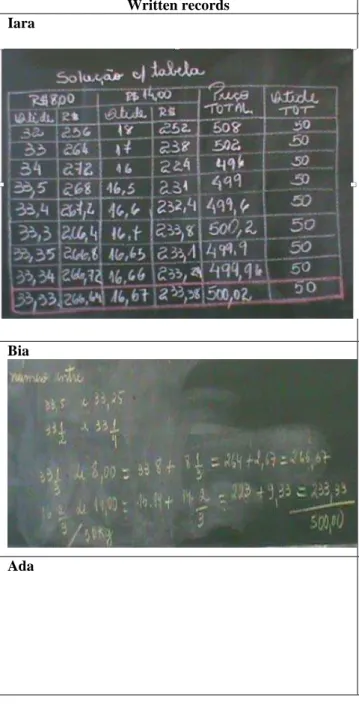
Table 3 – Written records of solutions and description with justification; Source: Researchers (Meeting on July 3, 2012)
Written records Description of the strategy and justification
Iara Organizes the data in a table and tries, through
successive approximations, to solve the problem. Operates with the total quantities (in kg) suggested by the problem and uses decimal representation with approximations.
Iara: I used a table to solve it [...] I thought this
way... he mixed 50 kg altogether and is going to sell it for 10 reais /kg. So, it means that he is going to collect 500 reais. Then I went on multiplying the quantity of one and then of the other, until arriving
at 500 reais… [...]
[...] Then I got from the quantity two numbers that when added resulted in 50, then 32 with 18 [...] 33, 17 and then I went on subtracting [...] then I stopped between 33 and 34 [...]34 is going to arrive at 496 and 33, 512. [...] then I got 33,5 and went on subtracting until 33,3 when I realized that it went over 20 cents, then I continued
subtracting [...] and reached a solution, let’s say an
approximate solution, but very close.
Bia Organizes the data in a table and tries, through
successive approximations, to solve the problem. Operates with the total quantities (in kg) suggested by the problem and uses decimal representation in the first five lines. From this point onwards, approximation attempts are done using a fraction representation.
Bia: Until line 4 I did the same as Iara. When I got
here, instead of going to 33.4 I went to 33 and ¼. When I put 33 and 1/4, it went a bit over, then, I thought I was between 1/2 and ¼ and I put 1/3. Then I got 33 kg and 1/3 for one bean and 16 kg and 2/3 for the other.
Ada Makes attempts with successive approximations to
find a solution to the problem using percentages. Operates with partial quantities (100g).
Ada: I even started with a table but then I quit. I
then I started: 40%, 60% and went on approximating [...] then was 65, once every 5, [...] making approximate calculations [...] then I arrived at the value corresponding to1 kg. Then I multiplied. [...] I was checking the difference [...] then I arr ived at a value between 33 and 34. I got it but with a difference of 4 cents which at the end, when multiplied, this difference disappears.
Luiz Builds a system of equations using the x and y
variables to indicate the desired quantities.
{8, + ,+ = =
Luiz: In the beginning I did like Iara and then I
stopped because I was getting a very high value [...] I did something wrong... [...] I put 10 instead of 500. [...] because 8x + 14y should give 500. [...] at the end that gives 100 over 6 that is 50 over 3.
Tânia presents Lamon’s resolution (2005) Places the quantities of each bean type on a number line.
Tânia: Places bean A of 8 reais on one side and bean B
on the other side. If he uses 50 kg of bean A and nothing of bean B, he will be in this position here (point A), 8 reais per kg. If he uses 50 kg of bean B and nothing of bean A, he is going to have all from bean B (point B) of 14 reais. If he uses half and half, he is going to have 11 reais/kg [...] but I want to keep it at 10 reais. [...] 11 is between 8 and 14. So, what I want is 10. I want to keep this price. How would you interpret it to arrive at that result by looking at this scheme?
Iara: We need more 2/3 of that of 8 and 1/3 of that of
14.
Tânia: 1/3 of what? Eva: of 25
Tânia: it’s 1/3 of 25, because ... look up to here is 25,
isn’t? Here is 50, from here to here is 25, the other 25 are there, then it’s more 1/3 of 25 and bean B is the
difference, or it can also be 25 less 1/3 of 25... [There is an implicit proportionality]
In action 4, a table similar to Table 3 was presented so that participants of the CoP and
the teacher educator could analyze the strategies and justifications described and identify and
highlight, in the resolutions and arguments, signs of Proportional Reasoning mobilization,
Table 4 systematizes some professional identity aspects that became the focus of the
discussions in actions 1 to 4, taking into consideration what was reified and mobilized.
Table 4 –Aspects of the Teacher’s Professional Identity mobilized by members of the CoP
-PAEM during the resolution and discussion of the problem “The price of coffee”. Source: Researchers (Meetings realized on July 3, 2012 and April 23, 2013)
Aspects of the Teacher’s Professional
Identity
What was reified/ mobilized Evidences
Self-knowledge
Selfconfidence. Self-esteem. Self-image.
Bia: I’ve got to tell you something: yesterday, working with my students, I think it was the first time I left the room like this, satisfied, you know? [The students] understood, what is really fine is that they understood!! [...] It was amazing!
Acknowledgement of the fact that the teacher needs to study.
Ada: I think teachers don’t have time to study [...]
because I’m having difficulty finding time to study
[...] We get stuck with [proportional] reasoning. How are we going to develop this type of reasoning if we don’t study?
Participation in the CoP-PAEM as an emotional support for teachers.
Bia: I call these “therapy sessions” moments. Eva: This sharing of ideas with colleagues [...]
seems to open up our minds, give more security.
Tina: It’sreally a “therapy session”, we get nervous
sometimes [...] with things that happen at school and with this conversation, we leave here more relaxed.
Beliefs and
conceptions Belief/Concepts change.
Clea: Something I learned a lot was to look for
several ways to solve [a question] . Before I used to see only one way of doing things. [...] Like with the coffee problem, I never imagined I could solve the
problem that way. It’s highly stimulating.
Professional knowledge:
mathematics specific knowledge
Relative Reasoning and measurement
Recursive partition principle: to get a precise measurement it is necessary to subdivide the measurement unit into equal and increasingly smaller subunits. By dividing the unit in smaller pieces a fraction will appear.
Tânia: What did Iara do after 33,3?
Bia: As she was looking for precision, she used
another decimal place, another measure [...] It was refined. She went on partitioning: a tenth of a kilogram, a hundredth of a kilo.
Tina: Iara used decimal register. And Bia used
fractions register. [...] This idea of knowing that it is between 1/2 and ¼ is a measurement idea, isn’t it?
Bia: Then, when it arrived at 33 and a half with 15
and a half we got 499 reais, I did 33 and 250 , then it went over a bit; then I thought, it must be number between 33 and ½ and 33 and ¼, then I tested again with 33 and 1/3... I arrived at 500 reais.
Relative thinking and measurement
Rational numbers density property: allows increasingly closer measurement approximations. There is an infinite number of fractions between any pair of fractions, no matter how close they are.
Iara: Yes, then I was subtracting,[...] then I
stopped there between 33 and [...] 34 which almost gets there to arrive at 496 and 33 will arrive at 512, then I had to put a number in the middle, then I got 33.5 and started subtracting until I arrived at 33.3 and realized that it had gone over 20 cents, then I started subtracting again. But I was very close. [...] then working with approximate data 16.67 approximately of the 14 reais coffee and 33.33 of
the other… since it is a decimal.
Relative thinking and measurement
Iara: Her (Bia’s) result was more exact because
Approximation principle: how to decide the necessary precision for a determined context.
number then I think that Bia’s result is more
correct.
Relative thinking
(multiplicative)
Percentage Representation.
Ada: If I find for 1 kg [...] how many grams of each
type [...] by 50 (total mix).
Cléa: That’s why she used percentages.
Quantity and Covariation
Verbalize and Symbolize mutable relations: highlight important quantifiable characteristics observing whether the quantities are changing or not under that situation, and if they are, observe changes directions relations. Recognize that variable quantities are not always related.
Tina: In the table it is possible to see that one
increases and the other decreases [...] even without a multiplicative relationship, [...] because it had to arrive at 50, the sum was 50. [...] I think it’s proportional because I already knew that one had more than the other.
Iara: On the straight line (representation), on the
top she places the prices and below the quantities. There is a covariance relation. If we look at the price, each space represents one real. On the line below, it goes from 50 to 0 and from 0 to 50. From point A to point B, there are six spaces, then, each space represents 1/6 of 50 or 1/3 of 25. So, from the 11 reais position to the 10 reais position there must be a decrease of 1/3 for bean B (1/3 of 25) and add 1/3 of bean A (1/3 of 25).
Up and down reasoning: the
strategy for this reasoning starts by its initial fraction, goes through a unitary fraction, a unit, and, finally, arrives at the desired fraction.
Luiz: She (Ada) worked with another unit, another
whole. She reduced it to a smaller quantity (1 Kg) to then find what was requested (50 Kg). She used another whole (1 kg).
Unity flexibilization: To round
up before multiplying will increase error by rounding up.
Ada: I arrived there between 33 and 34. I got it but
there was a difference of 4 cents, which at the end, through multiplication, this difference disappears.
Luiz: With an approximation, the final amount
would give this difference.
Professional knowledge:
Pedagogical mathematics knowledge
To solve problems without algebraic resources, using only one “reasoning”, mobilizes proportional reasoning.
Tina: Many times, to place x and y may not make
any sense to the student. She needs to know who is x
and who is y. That’s why proportional reasoning is
important even before using the letter [...] It is
important to see in the table what’s fixed and what varies. It’s an important resource.
The importance to discuss the role of different types of representations and context adequacy.
Iara: When I teach fractions I compare them with
decimals. The fraction is also to indicate an inexact division. So this representation is also important.
Tina: Even with 1/3, he will have to know how
many grams that represents. There is not a most correct answer. It depends on the context. The scale measures in decimals.
Students’ difficulties in learning mathematics can be related to teaching that emphasizes resources and formal representations.
Clea: Many times the teaching of mathematics does
not promote the development of reasoning, prioritizing rules and algorithms. Maybe the difficulties students have lie on this fact.
A problem can be solved through resources and different strategies.
Clea: Something I learned a lot here wa s to look
for several ways to solve [a question] . Because I was a lot like this, I saw only one way of doing thing and had difficulty accepting that students did differently.
Vulnerability
Difficulty to consider other strategies and ways of thinking mathematically.
Laís: [It’s difficult] to get rid of the devices, of the
algebra side. It’s automatic to do it using rules,
immediately structures [the algorithm] . Many
times, you don’t interpret the problem.
Recognition of one practice that prioritizes rules and algorithms.
Iara: Sometimes we use formulas without thinking
about what we are doing.
Confrontation of ideas and opinions.
Tânia: If you had to validate one or another
solution with the students, would make a difference
between this answer (Iara’s answer) and this one (Bia’s answer)?
Bia: No, the two are correct.
Iara: (Bia’s) was more exact because she used the
fraction 1/3. [...] if it were a n exact number then I
think Bia’s is the most correct, not mine.
Sense of agency and political commitment
The teacher needs to be responsible for curriculum management: selection and organization of contents taking into consideration time and material conditions.
Bia: We have an extremely extensive curricular
matrix, filled with contents! [...] We had to rethink this matrix and work well with contents which are
more important. There’s a lot to work and we end
up working with everything [but superficially] .
What’s important for the student?
When CoPs participants analyzed their own solutions and justifications, it was possible
to see that they created meaning for the elements that Lamon (2005) considers important for
proportional reasoning, and which were the object of study in action 2 (considered little
productive by CoPs’ members in some moments, for contemplating discussions of texts
unrelated to the practice). The meaning negotiations based on their own solutions and
justifications (in action 4) promoted learning of the theory studied in action 2 and an articulation
with the teacher’s professional practice, revealing aspects of his/her professional identity.
The next section discusses practice elements which were common to CoP-PAEM and
the other three CoPs, which promoted the development of their members’ professional identity.
6 CoPs’ practice elements that promoted the development of the professional identity of
their members
Based on the analysis of the practices adopted by the four CoPs investigated in this
study, we characterized eight elements that promoted the development of the professional
identity of their members, namely: shared repertoires, reports and discussions on their
pedagogical practices, the existence of a flexible and open work plan, the opportunity to
discuss their written productions, vulnerability experiences, the search for balance in the sense
of agency, connections between observations and empirical interpretations and a broader
theoretical background, reports and discussions on previous meetings.
In the four CoPs, shared repertoires included reification and participation aspects,
namely: routines, mathematical and pedagogical concepts, classroom and teacher
processes, which supported the domain of the communities. In one of the groups, the
opportunity to produce manipulative material for the classroom and explore their potentials
through the preparation and resolution of tasks associated with these materials was also part
of the repertoire. The shared repertoire becomes more coherent not as an activity, symbol or
specific artifact, but as part of a community practice in search for an articulated enterprise. It
is a meaning negotiation resource and it reflects a story of mutual engagement in the
community practice.
The opportunity to reflect on/discuss their pedagogical practices was another
element in the context of the CoPs that promoted (future) teachers’ learning. As the numbers
of meetings increased, CoPs members were feeling more “comfortable” and secure to talk
about facts that took place in the classroom (practicum), ask questions about mathematical
contents or the teaching of these contents. These discussions led to choice of themes and texts
to be studied and preparation of tasks to be used in the classroom, based on texts
recommendations.
Teachers and future teachers had the opportunity to reflect on the application of these
tasks in the classroom, and they were challenged to restructure them (task and application), if
necessary. CoPs participants who listened to the reports expressed their understanding of the
possibilities and limitations of those involved during the development of the tasks, indicating
that they could have made similar choices, offering suggestions for new teaching practices.
Such manifestations of recognition and solidarity legitimated the practice of these (future)
teachers and posed some challenges to them, i.e., provoking them to rethink their own
classroom practices as well as recognize, collectively, the existence of difficulties and
therefore the need for new learning experiences.
According to the (future) teachers, this was a breakthrough, considering that to be able
to develop a teaching practice they never experienced before, neither as students nor in their
teacher development process, is very complex, constituting a teaching practice they only
knew from a theoretical standpoint. It was also possible to verify that, besides being satisfied
for being able to share experiences and doubts related to their teaching practice, this moment
also promoted an approximation between (future) teachers and teacher educator, since they
experience similar problems and dilemmas.
The existence of a flexible and open work plan promoted an approximation between
(future) teachers and teacher educators, minimizing the distance that usually exists between
teachers. Actions, joint enterprises, dynamics and themes were always negotiated by the CoPs
members in order to meet their desires and professional needs.
Another element within the context of the CoPs that promoted learning by teachers
was the opportunity to discuss and reflect on their written productions, being committed
to the justifications for their statements. During the solution of mathematical tasks, the
(future) teachers could share different solution registers, procedures and strategies. As a result,
they started valuing/recognizing the resolutions presented by their students. The process of
meaning negotiation was organized around the reflection on the defined objectives, clarity of
the statements and the exploration of the potentials of a determined task potential, resulting in
reifications through the participation of members of the community thus leading to learning.
The possibility to question and be questioned favored the process of meaning negotiation and
the creation of a communicative space.
By discussing their productions and knowledge about their profession (future) teachers
experienced vulnerability and were challenged to question their certainties and convictions.
This helped them develop a sense of agency, i.e., they had the opportunity to conciliate what
must be done and what needs to be mobilized in relation to themselves (knowledge, beliefs,
feelings, emotions), taking into consideration context conditions (access, resources, support).
These experiences helped them to question and get involved in meaning negotiations, i.e.,
they helped them guide their own learning process through full participation and processes of
reification.
Situations of vulnerability helped CoPs members to understand that they are inherent
conditions of the professional practice, and that they originate from “the relational nature of
the profession and is related to the ethical character of the relation” (OLIVEIRA; CYRINO,
2011), once they may affect the efficacy of the actions and decisions of the teacher, which
will always be subjected to criticism and judgements. However, it is possible to balance their
sense of agency and minimize the negative feelings generated during the process.
During CoPs practices, members had opportunities to establish connections between
observations and empirical interpretations and a broader theoretical background. By
interacting with others and using their knowledge and pedagogical practices, (future) teachers
felt the need to resort to a theoretical background to trigger new meaning negotiations and,
therefore, new learning experiences. By learning new forms of reasoning (from colleagues or
texts), the participants had the opportunity to respect and validate the information mobilized
during the meetings. This practice associated with the long-term coexistence promoted the
To reflect on the teacher development process based on reports and discussions of
previous meetings was one practice element adopted by the CoPs which allowed (future)
teachers to accept the challenge to provoke communicative interactions through inquisitive
questionings in the study groups and in the classrooms. The statements of some (future)
teachers show that this type of development, which privileges the work developed from the
articulation of enterprises defined by the community and creates conditions for the
recognition of experiences and the sharing of repertoires and knowledge, allows the meaning
negotiations and therefore the development of learning and professional identity experiences.
7 Final considerations
The participation of (future) teachers in these educational activities was marked by the
development of “mutual engagement” and a “participation identity” (WENGER, 1998). In
this perspective, Wenger, McDermott and Snyder (2002, p. 28) state that “a strong community promotes interactions and relationships based on mutual respect and trust. It fosters the
voluntary action of sharing ideas, exposing our own ignorance, making difficult questions and
listening carefully”. The changes identified during the CoPs’ practice and the establishment of a routine of pondered and systematic reflection presented themselves as key points to support
the development of the teacher’s professional identity.
The search for an approximation between the university and the school and the
opportunity of teachers and future teachers to work collectively, prepare/organize possible
materials and works to be developed in the classroom, share experiences, study and discuss
mathematical concepts, work individually or in small groups solving problems and working
on tasks to discuss resolutions collectively, participate actively in their development processes,
expose their limitations without feeling embarrassed marked the practice of these CoPs and
created a fertile soil for the constitution and strengthening of their professional knowledge.
Aspects such as respect, trust, challenge, solidarity, enterprises negotiation, dynamics
and actions, valorization of singularities and the teachers’ professional practices also constituted a fertile soil for the development of the professional identity of these professionals
and for the cultivation and maintenance of these groups through the establishment of
relationships between teacher educators and developing teachers.
Teacher education proposals that value the experiences, repertoires and knowledge of
those involved, as well as that assume that learning takes place through meaning negotiations,
Acknowledgements
The author would like to thank the participants who voluntarily contributed to the completion
of this study, the Coordination of Improvement of Higher Education Personnel
(CAPES/Brazil) and the Council for Scientific and Technological Development (CNPq/Brazil)
by financial support.
References
BEIJAARD, D.; MEIJER, P. C.; VERLOOP, N. Reconsidering research on teachers’ profesional identity. Teaching and teacher education, New York, v. 20, n. 2, p. 107-128. 2004.
CAI, J.; SUN, W. Developing Students’ Proportional Reasoning: a Chinese Perspective. In: LITWILLER, B.; BRIGHT, G. (Ed.). Making sense of fractions, ratios and proportions: 2002 Yearbook. 2 ed. Reston: National Council of Teachers of Mathematics, 2002. p. 195 – 205.
CRAMER, K.; POST, T.; BEHR, M. Interpreting Proportional Relationships. Mathematics Teacher, Reston, v. 82, n. 6, p. 445-452, sep. 1989.
CYRINO, M.C.C.T. Comunidades de prática de professores como espaço de investigação sobre a formação de professores de matemática. In: BATISTA, I. L.; SALVI, R. F. (Org.). Pós-graduação em
ensino de ciências e educação matemática: um perfil de pesquisas. Londrina: EDUEL, 2009. p.
95-110.
CYRINO, M. C. C. T.; CALDEIRA, J. S. Processos de negociação de significados sobre pensamento algébrico em uma comunidade de prática de formação inicial de professores de Matemática. Revista
Investigações em Ensino de Ciências, Porto Alegre, v.16, n.3, p. 373-401, dez. 2011.
GARCIA, T. M. R. Identidade Profissional de Professor de Matemática em uma Comunidade de
Prática. 2014. 161 f. Tese (Doutorado em Ensino de Ciências e Educação Matemática) – Centro de
Ciências Exatas, Universidade Estadual de Londrina, Londrina, 2014.
GRAVEMEIJER, K. P. E.; COBB, P. Design research from the learning design perspective. In: VAN DEN AKKER, J. J. H.; et al. (Ed.). Educational design research. London: Routledge, 2006. p. 17-51.
GRAVEN, M.; LERMAN, S. Book Review. Journal of Mathematics Teacher Education, Netherlands, v.6, n.2, p.185-194, abr./jun. 2003.
GRAVEN, M. Mathematics teacher retention and the role of identity: Sam’s story. Pythagoras, Port
Elizabeth, n. 61, p. 1-10, jun. 2005.
JAWORSKI, B. Situating Mathematics Teacher Education in a Global Context. In: BENARZ, N. et al. (Ed.). International Approaches to Professional Development of Mathematics Teachers. 1 ed. Ottawa: University of Ottawa Press, 2011. p. 2-50.
KARPLUS, R.; PULOS, S.; STAGE, E. K. Early adolescents’ proportional reasoning on ‘rate’ Problems. Educational Studies in Mathematics, New York, v.14, n.3, p. 219–233, aug.1983.
KIEREN, T. E. The rational number construct – Its elements and mechanism. In: KIEREN, T. E. (Ed.), Recent
Research on Number Learning. Columbus: ERIC/SMEAC, 1980. p. 125–150.
KRAINER, K. Teams, communities & networks. Journal of Mathematics Teacher Education, Netherlands, v.6, n.2, p. 93-105, abr/jun. 2003.
LAMON, S. J. Teaching fractions and ratios for understanding: Essential content knowledge and instructional strategies for teachers. 2th edition. Mahwah: Lawrence Erlbaum Associates, 2005.
LAVE, J.; WENGER, E. Situated learning: legitimate peripheral participation. Cambridge: Cambridge University Press, 1991.
LESH, R.; POST, T.; BEHR, M. Proportional Reasoning. In: HIEBERT, J.; BEHR, M. (Ed.). Number
Concepts and Operations in the Middle Grades. Reston: Lawrence Erlbaum & National Council of Teachers
of Mathematics. 1988. p. 93-118.
LLINARES, S. Participation and reification in learning to teach: the role of knowledge and beliefs. In: LEDER, G. C.; PEHKONEN, E.; TÖRNER, G. (Org.), Beliefs: a hidden variable in mathematics education?. Dordrecht: Kluwer Academic Publishers, 2002. p. 195-209.
NAGY, M. C.; CYRINO, M. C. C. T. Aprendizagens de professoras que ensinam Matemática em uma Comunidade de Prática. Revista da FAEEBA – Educação e Contemporaneidade, Salvador, v. 23,
n.41, p.149-163, jan/jul 2014.
OLIVEIRA, L.M.C.P. Aprendizagens no empreendimento estudo do raciocínio proporcional. 2014. 209f. Dissertação (Programa de Pós-Graduação em Ensino de Ciências e Educação Matemática) – Centro de Ciências Exatas, Universidade Estadual de Londrina, Londrina, 2014.
OLIVEIRA, H. M.; CYRINO, M.C.C.T. A formação inicial de professores de Matemática em Portugal e no Brasil: narrativas de vulnerabilidade e agência. Interacções, Lisboa, v. 7, p. 104-130, ago. 2011.
PONTE, J. P.; CHAPMAN, O. Preservice mathematics teachers' knowledge and development. In: ENGLISH, L. D. (Ed.). Handbook of international research in mathematics education. 2. ed. New York: Routledge, 2008. p. 225-263.
POST, T.; CRAMER, K.; HAREL, G.; KIERNEN, T.; LESH, R. Research on rational number, ratio and proportionality. In: Proceedings of the twentieth annual meeting of the north american chapter of the international group for the psychology of mathematics education, PME-NA XX , Raleigh, 1998.
Proceedings… Raleigh: ERIC, 1998. v.I. p.89-93.
SHULMAN, L. S. Those who understand: knowledge growth in teaching. Educational Researcher, Washington, v.15, n.2, p.4-14, feb. 1986.
SHULMAN, L. S. Knowledge and teaching: foundations of the new reform. Harvard Educational
Review, Cambridge, v.57, n.1, p.1-22, feb. 1987.
SIMON, M. A. The challenges of mathematics teacher education in an era of mathematics education reform. In: JAWORSKI, B; WOOD, T. (Ed.). The international handbook of mathematics teacher
education: mathematics teacher educator as a developing profissional. Rotterdam: Sense Publisher,
2008. p. 17-29.
SOWDER, J. T. The mathematical education and development of teachers. In: LESTER, F. (Ed.). Second
WENGER, E. Communities of practice: learning, meaning and identity. New York: Cambridge University Press, 1998.
WENGER, E.; MCDERMOTT, R.; SNYDER, W. M. Cultivating communities of practice. Boston: Harvard Business School Press, 2002.