O R I G I N A L A R T I C L E UDC: 004::616.314-022.1-07/-08 DOI: 10.2298/VSP1306569M
Evaluation of telemedicine in the management of dentogenous infections
Procena primene telemedicine u zbrinjavanju dentogenih infekcija
Milan Miladinoviü*, Dragan Mladenoviü†, Branko Mihailoviü*, Goran Tošiü†, Boris Djndjiü†, Sanja Mladenoviü†, Mervan Hadžibeti‡, Biljana Vujiþiü†
*Dentistry Clinic, Faculty of Medicine, University of Priština/Kosovska Mitrovica, Kosovska Mitrovica, Serbia; †Dentistry Clinic, Faculty of Medicine, University of Niš,
Niš, Serbia; ‡Dental Office “Ulcinj”, Ulcinj, Montenegro
Abstract
Introduction/Aim. The first written evidence of telemedicine dates back to the times of Sava Nemanjiý (the end of 12th and the beginning of 13th century). Nowadays, the use of telemedi-cine in Serbia gains momentum, and the cause of this lies in the creation of a central telemedicine system XPA3 Online and the establishment of the Center for Telemedicine at the Faculty of Medicine, University of Priština/Kosovska Mitrovica, Kosov-ska Mitrovica, Serbia. Dentogenous infections are among the most urgent conditions in dentistry, which may have even a fatal outcome. The aim of this study was to assess the possibil-ity of using telemedicine methods in the pathology of dentoge-nous infections. Methods. This experimental randomized study included 414 patients with suspected dentogenous infec-tion. The patients were enrolled at 7 sites, with systematic photograph-taking, collection, and digitalization of the available anamnestic and laboratory data, tests, and x-rays. Together with clinical findings, the data were uploaded on the XPA3 Online central telemedicine system; after that, 10 teleconsultants re-viewed the material, set the diagnosis, and gave their opinion about the treatment. The agreement was determined using the Cohen’s kappa (N) coefficient, as well as diagnostic sensitivity (SE), specificity (SP), and efficacy (EFF). Statistical significance and comparisons were done using the z-test, and testing non-parametric properties using the McNemar’s Ʒ2-test for the
sig-nificance threshold of p = 0.05. Results. The results describing agreement of telemedicine diagnosis of the areas primarily in-volved with infection compared to clinical inspection, indicate an almost complete diagnostic agreement (N= 0.971). Diag-nostic agreement as to the type of infection was also almost complete (N= 0.951), and a similar value was obtained also for the treatment agreement (N> =0.892). Conclusion. The method of telemedicine provides us with a tool to make a cor-rect clinical diagnosis of dentogenous infections equally well as in real time, as well as to get a deeper and wider insight into their nature and to suggest adequate treatments.
Key words:
dental informatics; remote consultation; focal infection, dental; treatment outcome.
Apstrakt
Uvod/Cilj. Prvi zapisi o primeni telemedicine u Srbiji da-tiraju iz vremena Save Nemanjiýa (kraj XII i poÿetak XIII veka). Danas, primena telemedicine u Srbiji naglo raste, a uzrok leži u stvaranju centralnog telemedicinskog sistema XPA3 Online i formiranju telemedicinskog centra Medicin-skog fakulteta Univerziteta u Prištini/Kosovska Mitrovi-ca, Srbija. TakoĀe, dentogene infekcije spadaju u najur-gentnija stanja u stomatologiji, koja mogu da imaju i leta-lan ishod. Cilj rada bio je da se ispitaju moguýnosti prime-ne telemediciprime-ne kod patologije dentogenih infekcija. Me-tode. UraĀena je eksperimentalna randomizirana studija
na 414 pacijenata kod kojih je postojala sumnja na pristu-stvo dentogene infekcije. Pacijenti su primani na sedam lokacija, pri ÿemu su raĀena sistematska fotografisanja, sa-kupljanje i digitalizacija dostupnih anamnestiÿkih i labora-torijskih nalaza, testova, kao i radioloških snimaka. Sve je to zajedno sa kliniÿkim nalazom prosleĀivano na XPA3
Online centralni telemedicinski sistem, nakon ÿega su deset
telekonsultanata pregledali materijal, postavljali dijagnozu i davali terapijsko mišljenje. OdreĀena je saglasnost Cohen-ovim kappa (N) koeficijentom, dijagnostiÿka senzitivnost (SE), specifiÿnost (SP) i efikasnost (EFF). Statistiÿka zna-ÿajnost i poreĀenja vršena su z-testom, a testiranje nepa-rametarskih obeležja McNemmar-ovim Ʒ2 kvadrat testom
za prag znaÿajnosti od p = 0.05. Rezultati. Rezultati sla-ganja telemedicinskih dijagnoza primarno zahvaýenih pro-stora infekcijom u poreĀenju sa kliniÿkim pregledom uka-zuju na postignutu skoro potpunu dijagnostiÿku saglasnost (N = 0,971). Slaganje za vrstu infekcije ukazuje takoĀe na skoro potpunu dijagnostiÿku saglasnost (N= 0,951), a o predloženoj terapiji slaganje je sliÿno (N= 0,892).
Zaklju-ÿak. Primenom telemedicine može se podjednako dobro, kao i kliniÿkim pregledom u realnom vremenu, postaviti ispravna dijanoza infekcija, sagledati njihova problematika i moguýnosti terapije.
Kljuÿne reÿi:
Strana 570 VOJNOSANITETSKI PREGLED Volumen 70, Broj 6
Miladinoviý M, et al. Vojnosanit Pregl 2013; 70(6): 569–575. Introduction
The first evidence about distant medical consultations (teleconsultations) in the history of Serbia dates back to the time of Sava Nemanjiü (the end of 12th and the beginning of 13th century), and writings described two such cases: imme-diately before the resignation of the Grand Prince Nemanja and succession of the throne by his middle son Stefan, Ne-manja fell seriously ill, and his delegation was sent to Sava, his youngest son, a monk in the Hilandar Monastery (Mount Athos, Greece) to come and spend his father’s last hours with him. Instead, Sava gave the instructions to the delegates which herbs his father was to take, what to do, and how to pray; in short, he did not come back with them. Firmly be-lieving in the consultation given and praying to the Holy Mountain Protectors, he sent a message to his father to trans-fer power to the next generation as soon as he was well again, to join Sava on the Holy Mountain and repent for the sins made in worldly life and while in power, and to devote his life to the living God and Holy Mother of God. The suc-cess of this teleconsultation was proven by the rapid recov-ery of Nemanja, his becoming a monk, and permanent mov-ing to the Holy Mountain to join his son Sava. The second distant consultation occurred when Sava’s brother, King Stephan fell ill while Sava was abroad. Sava gave his in-structions to the brother’s messengers, which successfully cured him, accompanied by prayers, and Sava himself came later on to see the healing of the future monk Simon 1–5.
In 2011 telemedicine in Serbia rapidly developed, trig-gered by the creation and initial use of the central telemedi-cine system XPA3 Online (XPA3 Online, Niš, Serbia) and by the foundation of the Telemedicine Center of the Faculty of Medicine University of Priština/Kosovska Mitrovica, Ser-bia. The system is based on one of the most up-to-date forms of application services, with ultra high speed Internet above, and Microsoft Windows 2008 R2 OS and Microsoft SQL Server 2008 R2 data base below. The system manages and co-ordinates provider services for short message service (SMS) information, for rapid and short phone calls, auto-mated receipt and processing of photographs, images, vari-ous text formats (.docx,. pdf,. html,. txt), automated conver-sion of video formats (.mp4,. avi,. movi dr.) into the widely accepted .flv format, and also receives almost whole patient history. The system is accompanied by a number of ready physicians of almost all specialties, most of which are teach-ers, associates, principal physicians, and so on. If a physician needs specialist help or interspecialist consultation, he posts a telemedicine request using his/her personal computer or Internet-connected smartphone, and gets the requested con-sultation in time. In addition to its ability to offer up-to-date and rapid teleconsultation support, the system is equipped with the peripherals for scientific monitoring and analysis, providing researchers with already processed data and access resources. Based on such support of an artificial intelligence system on XPA3 Online, we were able to obtain, in an eco-nomical way, a number of results describing the quality of Internet-based telemedicine consultation in different areas of interest.
On the other hand, dentogenous infections represent one of the most urgent conditions in the practice of dentistry, the management of which requires proper training and col-laboration of different specialties and which, if managed in-adequately or late, can lead even to a fatal outcome 6–8. Since such patients require a prompt response and permanent spe-cialist observation, the problem of patient management in cases of inaccessibility of adequate specialist services should be resolved. These situations involve e.g. soldiers in the field, bed-ridden or immovable individuals, those with spe-cial needs, individuals in remote and unaccessible geo-graphical areas, or physical inaccessibility of specialists from any reason 9. We have had the situations that, due to re-stricted traffic in the region of Kosovo and Metohija, the pa-tients with dentogenous infections could not reach the spe-cialists of oral surgery/otorhinolaryngology/maxillofacial surgery, and their management had to be undertaken by un-trained dentists/physicians; the posttreatment recovery was controlled from a distance.
Having knowledge about the natural course of inade-quately treated or untreated dentogenous infections, and bearing in mind the possibility of infection spread into the adjacent anatomical spaces, thus creating most severe disease forms and complications (such as Angina Ludovici or cav-ernous sinus thrombosis), there is the question of how and to what extent the physicians in distant areas (assisted by mod-ern telemedicine systems) can help in the management of such cases. In particular, there is the question of reliability of distant diagnosis and treatment plan in patients with dento-genous infections.
The aim of this study was, therefore, to assess the pos-sibility of using of modern telemedicine methods in the man-agement of patients with dentogenous infections and find an answer if we can make a clinically reliable diagnosis, and evaluate the primary treatment indicated in such cases (ex-traction of the causal tooth, incision, need for hospital admis-sion and antibiotic therapy administration).
Methods
This experimental randomized study enrolled 414 pa-tients, aged 12 to 83 years, of both genders, with suspicious dentogenous infection as assessed by the physician in charge. The patients were clinically admitted at 4 main sites in Ser-bia: Kosovska Mitrovica, Niš, Belgrade, Novi Sad, two sites in Bosnia and Herzegovina (Republic of Srpska: Banja Luka and Trebinje), and in Montenegro (Podgorica). They were all clinically examined by the specialists in oral surgery, otorhi-nolaryngology, and maxillofacial surgery.
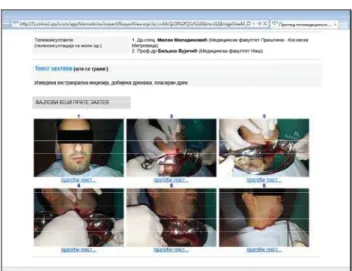
bilaterally (en face with head turned upwards, bilaterally with head maximally extended backwards and to the side); extraoral edema was also photographed, if present; inner structures of the mouth cavity, and upper and lower jaw teeth were photographed in the extent possible using only digital camera (without any additional tools for intraoral photogra-phy); intraoral edema was also photographed, if present. In summary, each of the patients had ortopan taken, as well as the above photographs. The data were stored either in the physicians’ PCs or in their smartphones. The physicians ac-cessed the Internet via their PCs or smartphones in different ways (ADSL access with 512/128 kbps to 6/1 mbps; global municipal wireless connection at 5 GHz at 2/2 mbps; or via standard mobile access, WCDMA 3G and HSDPA 3G UMTS, with EDGEaccess if there were no 3G networks). After a successful Internet connection, they accessed the ap-plication system of the Center for Telemedicine, University of Priština/Kosovska Mitrovica (www.xpa3.com) and passed the authentication and authorization phases (protected with a 128 bit Secure Sockets Layer (SSL) security protocol. Opening a new digital telemedicine request, the physicians entered patient personal information, patient history, as well as the available anamnestic information such as laboratory findings, hospital discharge documents, and other relevant patient data. Attached to the request, there were the files containing photographs and x-rays, together with proper clinical findings, both general and individual, accompanying each of the images. Such a teledentistry request was then sent to the system, and the system in a minute contacted spe-cialist teleconsultants (TCs) with SMS messages, and some of them, additionally, were contacted by phone. Each of the teleconsultants had in the received SMS message the subject of teleconsultation, assessed request urgency (describing the levels as normal or urgent), and expected time to response (30 minutes to 6 hours, depending on the case). Teleconsul-tants then accessed the Internet system at www.xpa3.com, reviewed the received request, and responded giving their opinion, suggestion, and possible outcome of recommended therapy. Each of the patients was clinically examined, with diagnosis being made in real time (Figures 1, 2).
Fig. 1 – A newly received teleconsultation request in the XPA3 Online system.
Fig. 2 – XPA3 Online teleconsultation: Dentogenous infecti-on with serious general status of the patient, where telecinfecti-on- telecon-sultants unanimously suggested extraoral incision, which was performed and the results of which were sent to them.
The degree of diagnostic accuracy was determined us-ing the followus-ing scale: correct – if a telemedicine diagnosis is identical to the primary one, or if it is made and is accept-able as a differential diagnosis, and incorrect – if a telemedi-cine diagnosis differs completely from the primary one, or if the diagnosis has not been made.
In a similar way, the degree of precision of the treatment plan was determined, too, describing it as correct/incorrect. Sta-tistical data processing and analysis of the obtained results were performed using the Diagnostic and AGreement Statistics (DAG) Software http://www.mhri.edu.au/biostats/DAG_Stat and software package SPSS for Windowsversion 16.
Agreement among the teleconsultants was obtained di-viding the number of patients with the achieved agreement with the total number of examined patients. The following elements were determined: sensitivity (SE), specificity (SP), and efficacy (EFF). The degree of achieved agreement be-tween teleconsultants using the method of telemedicine was expressed as the Cohen’s kappa (ț) coefficient. The kappa co-efficient for the confidence interval of 95% was presented ac-cording to the Landis and Koch scale (Table 1). Statistical sig-nificance of the differences between correct and incorrect di-agnoses, planned interventions (yes/no; extractions, incisions, hospitalizations, antibiotic therapy), precision, sensitivity, and specificity, and comparison of all the obtained values were done using the z-test, and testing for non-parametric charac-teristics was done using the McNemar’s Ȥ2-test (contingency table 2 u 2) for the threshold of significance at p = 0.05.
Table 1 Kappa coefficient (k) and degree of diagnostic agreement
(Landis i Koch)
ț Agreement degree
< 0 No agreement
0.01–0.20 Insignificant agreement 0.21– 0.40 Sufficient agreement 0.41–0.60 Moderate agreement 0.61–0.80 Significant agreement 0.81–0.99 Almost complete agreement
Strana 572 VOJNOSANITETSKI PREGLED Volumen 70, Broj 6
Miladinoviý M, et al. Vojnosanit Pregl 2013; 70(6): 569–575. Results
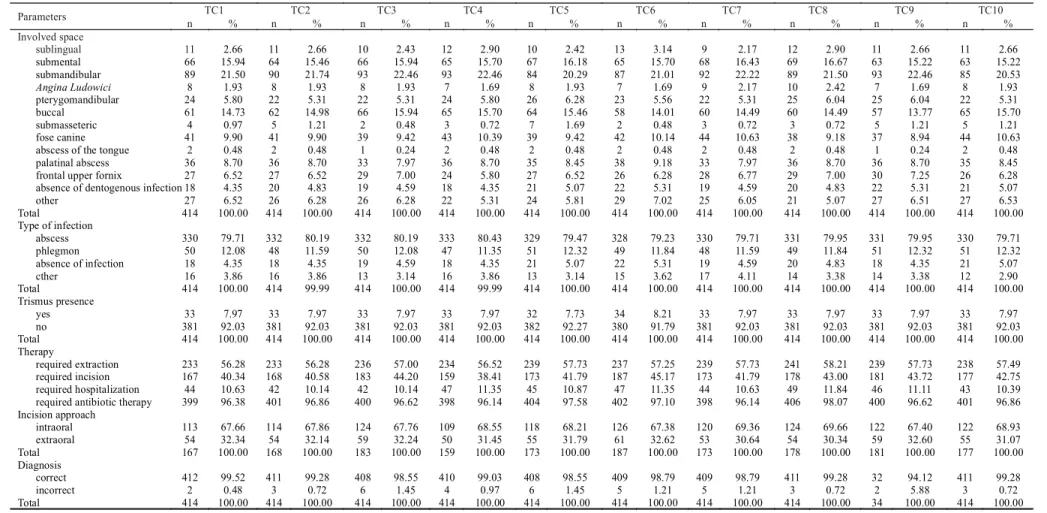
Overall 414 patients were examined and 414 diagnoses were made. All the received photographs, x-rays, and other documents, were declared as usable by the teleconsultants. Out of 414 (100%) patients, teleconsultants stated that there was no dentogenous infection in 18–22 (4.35–5.31%) cases. They established that the most common area involved with dentogenous infection was the submandibular region, in 84– 93 (20.29–22.46%) cases, followed by submental, in 63–69 (15.22–16.67%) cases, and buccal space, in 57–66 (13.77– 15.94%) cases (Table 2). As the type of infection, teleconsul-tants identified abscess in 328–333 (79.23–80.43%) cases, while phlegmon was diagnoses in 47–51 (11.35–12.32%) ses (Table 2). Trismus was found in 31–34 (7.49–8.21%) ca-ses (Table 2). Regarding treatment, the teleconsultants sug-gested 233–241 (56.28–58.21%) extractions, 159–187 (38.41–45.17%) incisions, hospital admission in 42–49 (10.14–11.84%) patients, and antibiotic treatment in 398– 406 (96.14–98.07%) cases (Table 2). As the type of necessary incision, intraoral incision was recommended in 113–126 (67.66–67.38%) cases, and extraoral one in 50–60 (31.45–32.62%) cases (Table 2).
The highest degree of teleconsultant agreement as to the primary spaces involved with infection was achieved be-tween TC1 and TC2 (ț = 0.911), and the lowest degree be-tween TC6 and TC8 (ț = 0.827). Regarding differential di-agnosis abscess/phlegmon, the highest degree of agreement existed between TC8 and TC9 (ț = 0.933), and the lowest degree between TC5 and TC10 (ț = 0.889). As for trismus, the best agreement existed between TC1, TC2, TC3, TC4, TC7, TC8, TC9, and TC10 (ț = 1.000), with the deviation with TC5 and TC6 (ț = 0.600).
The highest degree of diagnoses agreement of primary infection-involved spaces related to clinical examination was present in TC1 with 2 erroneous diagnoses (0.48%), and the lowest degree was found in TC3 and TC5 with 6 erroneous diagnoses (1.45%), for statistical processing of the results (Table 7 and Table 1), ț = 0.971, SE = 98.5%, SP = 98.5%, EFF = 98.5%, indicating almost a complete diagnostic agreement. As to the type of infection, the highest agreement with clinical examinations was found for TC1, with 2 erro-neous diagnoses (0.48%), and the lowest agreement was ob-served for TC6, with 10 erroneous diagnoses (4.14%), for statistical processing of the results (Table 1), ț = 0.951, SE = 97.6%, SP = 97.6%, EFF = 97.6%, indicating almost com-plete diagnostic agreement. As for trismus, the highest de-gree of ade-greement with clinical examination was observed for TC1, TC2, TC3, TC4, TC7, TC8, TC9 and TC10, with-out any diagnostic errors, and the lowest for TC5 and TC6, with 1 error each (0.41%). Diagnostic differences were not statistically significant.
Regarding the suggested therapy (Table 2), the highest degree of agreement was observed between TC2 and TC10, as well as between TC4 and TC6 (ț = 0.919), the lowest de-gree between TC5 and TC7 (ț = 0.892), while the opinions were somewhat different regarding the choice of intra- or extraoral incision approach (Table 2).
Discussion
The purpose of this paper was to assess the possibility of using modern methods of telemedicine in the management of patients with dentogenous infections, and to answer to the questions: if we can make a clinically reliable diagnosis at a distance, and are we able to assess the primary treatment in-dicated in such cases (extraction of the causal tooth, incision, need for hospital admission, and antibiotic therapy).
Almost a completely achieved agreement in making the diagnosis of primary involved spaces (ț = 0.971) and that con-cerning the type of infection (ț = 0.951) and the presence of trismus (ț = 1.000 in 80% of TCs and ț = 0.600 in 20% of TCs), open the possibility of reliable distant patient management. The results showed that using the method of telemedicine we can make clinically acceptable diagnosis of dentogenous infections, and that the method can replace real time diagnostic evaluation, i.e. direct visual/tactile diagnostic approaches. Regarding the basic therapy assessment, almost a perfect agreement was achieved too (ț > or = 0.892), indicating the possibility of distant counselling as to the primary treatment approaches, with clear statements about the necessity of hospital admis-sion of patients with dentogenous infections.
One of the striking advantages was the fact that 98% of teleconsultation requests were responded to in the requested time span (30 min to 6 h), which indicated that telemedicine consultation can be a valuable tool for saving the time to specialist examination. Patients were placed in the right management track in a short time, saving valuable time in cases of emergency, which can be of a decisive influence garding the development and outcome of infection. The re-sults confirmed that “store and forward” telemedicine system resolves the need of physicians for consultation in a cheap, effective, and rapid way, in this case in the pathology of dentogenous infections.
We have not encountered in the literature any studies dealing with the validation of telemedicine diagnosis and as-sessment of therapy for dentogenous infections, but there were studies which evaluated telemedicine agreements in the related fields. Thus Salazar-Fernandezet al. 10 in their large study of telemedicine consultations in the diseases of tempo-romandibular joint found that using the store and forward telemedicine method, the opinion of a specialized consultant can be obtained in an effective and efficacious way, sug-gesting that the method should have been more widely used by oral and maxillofacial surgeons. Herce et al. 11, suggested that using the store and forward telemedicine method the pathology of third molars could be effectively assessed within the pre-surgical treatment, avoiding thus numerous preliminary hospital visits by the patient. Duka et al. 12, com-paring the diagnoses of third molar pathology using tele-medicine and conventionally, found that the problems could be adequately evaluated by both approaches. Ignatius et al. 13
j 6
VOJNOSANITETSKI PREGLED
S
trana 573
ý
M, et al. Vojnosanit
Pregl 2013; 70(6): 569–575.
Table 2 Agreement among teleconsultants (TC) about dentogenous infections parameters
TC1 TC2 TC3 TC4 TC5 TC6 TC7 TC8 TC9 TC10
Parameters
n % n % n % n % n % n % n % n % n % n %
Involved space
sublingual 11 2.66 11 2.66 10 2.43 12 2.90 10 2.42 13 3.14 9 2.17 12 2.90 11 2.66 11 2.66
submental 66 15.94 64 15.46 66 15.94 65 15.70 67 16.18 65 15.70 68 16.43 69 16.67 63 15.22 63 15.22 submandibular 89 21.50 90 21.74 93 22.46 93 22.46 84 20.29 87 21.01 92 22.22 89 21.50 93 22.46 85 20.53
Angina Ludowici 8 1.93 8 1.93 8 1.93 7 1.69 8 1.93 7 1.69 9 2.17 10 2.42 7 1.69 8 1.93
pterygomandibular 24 5.80 22 5.31 22 5.31 24 5.80 26 6.28 23 5.56 22 5.31 25 6.04 25 6.04 22 5.31 buccal 61 14.73 62 14.98 66 15.94 65 15.70 64 15.46 58 14.01 60 14.49 60 14.49 57 13.77 65 15.70 submasseteric 4 0.97 5 1.21 2 0.48 3 0.72 7 1.69 2 0.48 3 0.72 3 0.72 5 1.21 5 1.21 fose canine 41 9.90 41 9.90 39 9.42 43 10.39 39 9.42 42 10.14 44 10.63 38 9.18 37 8.94 44 10.63 abscess of the tongue 2 0.48 2 0.48 1 0.24 2 0.48 2 0.48 2 0.48 2 0.48 2 0.48 1 0.24 2 0.48 palatinal abscess 36 8.70 36 8.70 33 7.97 36 8.70 35 8.45 38 9.18 33 7.97 36 8.70 36 8.70 35 8.45 frontal upper fornix 27 6.52 27 6.52 29 7.00 24 5.80 27 6.52 26 6.28 28 6.77 29 7.00 30 7.25 26 6.28 absence of dentogenous infection 18 4.35 20 4.83 19 4.59 18 4.35 21 5.07 22 5.31 19 4.59 20 4.83 22 5.31 21 5.07 other 27 6.52 26 6.28 26 6.28 22 5.31 24 5.81 29 7.02 25 6.05 21 5.07 27 6.51 27 6.53 Total 414 100.00 414 100.00 414 100.00 414 100.00 414 100.00 414 100.00 414 100.00 414 100.00 414 100.00 414 100.00 Type of infection
abscess 330 79.71 332 80.19 332 80.19 333 80.43 329 79.47 328 79.23 330 79.71 331 79.95 331 79.95 330 79.71 phlegmon 50 12.08 48 11.59 50 12.08 47 11.35 51 12.32 49 11.84 48 11.59 49 11.84 51 12.32 51 12.32 absence of infection 18 4.35 18 4.35 19 4.59 18 4.35 21 5.07 22 5.31 19 4.59 20 4.83 18 4.35 21 5.07 cther 16 3.86 16 3.86 13 3.14 16 3.86 13 3.14 15 3.62 17 4.11 14 3.38 14 3.38 12 2.90 Total 414 100.00 414 99.99 414 100.00 414 99.99 414 100.00 414 100.00 414 100.00 414 100.00 414 100.00 414 100.00 Trismus presence
yes 33 7.97 33 7.97 33 7.97 33 7.97 32 7.73 34 8.21 33 7.97 33 7.97 33 7.97 33 7.97 no 381 92.03 381 92.03 381 92.03 381 92.03 382 92.27 380 91.79 381 92.03 381 92.03 381 92.03 381 92.03 Total 414 100.00 414 100.00 414 100.00 414 100.00 414 100.00 414 100.00 414 100.00 414 100.00 414 100.00 414 100.00 Therapy
required extraction 233 56.28 233 56.28 236 57.00 234 56.52 239 57.73 237 57.25 239 57.73 241 58.21 239 57.73 238 57.49 required incision 167 40.34 168 40.58 183 44.20 159 38.41 173 41.79 187 45.17 173 41.79 178 43.00 181 43.72 177 42.75 required hospitalization 44 10.63 42 10.14 42 10.14 47 11.35 45 10.87 47 11.35 44 10.63 49 11.84 46 11.11 43 10.39 required antibiotic therapy 399 96.38 401 96.86 400 96.62 398 96.14 404 97.58 402 97.10 398 96.14 406 98.07 400 96.62 401 96.86 Incision approach
intraoral 113 67.66 114 67.86 124 67.76 109 68.55 118 68.21 126 67.38 120 69.36 124 69.66 122 67.40 122 68.93 extraoral 54 32.34 54 32.14 59 32.24 50 31.45 55 31.79 61 32.62 53 30.64 54 30.34 59 32.60 55 31.07 Total 167 100.00 168 100.00 183 100.00 159 100.00 173 100.00 187 100.00 173 100.00 178 100.00 181 100.00 177 100.00 Diagnosis
correct 412 99.52 411 99.28 408 98.55 410 99.03 408 98.55 409 98.79 409 98.79 411 99.28 32 94.12 411 99.28
incorrect 2 0.48 3 0.72 6 1.45 4 0.97 6 1.45 5 1.21 5 1.21 3 0.72 2 5.88 3 0.72
Strana 574 VOJNOSANITETSKI PREGLED Volumen 70, Broj 6
Miladinoviý M, et al. Vojnosanit Pregl 2013; 70(6): 569–575. open dental root canals using telemedicine, found that
dis-tant consultation of experienced dentists can be of great help to younger colleagues regarding the correct diagnosis of open root canal. Kopycka-Kedzierawski and Billings 15 found that using telemedicine the prevalence of caries in children could be successfully assessed, collecting the infor-mation from children in the cohortgroup for 12–60 months and using simultaneously the methods of telemedicine and traditional visual/tactile examination. The results of the spective authors agree with our own results, especially re-garding the reliability of used teledentistry methods, with speciall stress on the store and forward telemedicine method.
Since dentogenous infections represent a relatively common pathology, our study offerred a significant insight into the excellent prospects of distant examination and treat-ment planning in the managetreat-ment of these patients. In con-trast, inadequate management and frequent antibiotic treat-ments of dentogenous infections with only oral antibiotics (which is rather common in the routine dentistry practice), contribute to a rapid development and wide spread of these infections, endangering thus the general health of our pa-tients 16. In these patients, the first clinical examination is of key importance, since it requires ample clinical knowledge and experience 17. Using the methods of telemedicine, other specialists or, later, even the patients themselves can seek adequate expert help from oral and maxillofacial surgeons or otorhinolaryngologists, i.e. from subspecialists in the appro-priate fields, getting the requested advice regarding proper diagnosis or treatment. Timely teleconsultation can help physicians in charge of the patients to react better, sup-ported by sufficient expertise; in many cases, the spread of infection into deeper regions of the neck can thus be pre-vented (the origin of such infections is dental in over 40% of cases, and lower molars are most commonly implicated in that regard) 18.
As the precondition of proper telemedicine diagnosis, adequate technical-technologic equipment is required for the collection, analysis, and exchange of diagnostic data between teleconsultants. We achieved excellent results using 3.1 megapixel or stronger cameras (with built in electronic flash units). Since digital photographic equipment is becoming in-creasingly cheaper, with imaging resolution being on the rise too, we believe that the resolution of 3.1 megapixels consti-tute the minimum for teledentistry imaging and that there is no need to go below that standard. It is also necessary to ad-here to the common procedure of taking intraoral or extraoral photographs, capturing by digital photographs the real situa-tion in the mouth, as well as extraoral changes 12. The patient should be photographed en face and bilaterally, taking as good as possible images of the region of interest. With dental radiographs, the ideal situation is that the digital image is transported from the radiography center through multiple telemedicine systems in unchanged format. If an analog ra-diography is to be digitalized using a camera or a scanner device, the minimum requirements a 3.1 megapixel image
should be abided by Witherow et al. 19 observed that a large number of patients with dentogenous infections were re-ferred to various other specialists, such as plastic surgeons, dermatologists, emergency services, or general practitioners and general dentists, when a proper diagnosis is commonly a problem. The significance of our study lies in the practical demonstration that in such cases rapid and effective tele-medicine consultation is the method of choice, eliminating the need for patient transport to other relevant specialists.
Since the results showed an almost complete agreement between teleconsultants regarding the therapy (ț > or = 0.892), there is the possibility of help to remote nonspe-cialists in the decision-making whether to extract the causal tooth at once, or to postpone the extraction and perform only incision. This can have a marked impact on infection sub-siding and alleviation of pain, as well as on the general status of the organism 20. Viewed from the aspect of general inten-tion to reduce microorganism resistance, telemedicine con-sultation in such patients offers an additional differentiation regarding the decision to include antibiotic therapy or to stick to tooth extraction only, providing surgical debride-ment, removal of the infection cause, and drainage. In this way, unnecessary increase of resistance to antibiotics can be minimized 21. An almost complete agreement between the teleconsultants was achieved also regarding the need for hospital admission, eliminating the possibility of inadequate, nonspecialist assessment of the need for constant medical observation, i.e. that the present dentogenous infection had to be seriously considered.
The method of telemedicine used in the study can im-prove the quality of health care, facilitate the work of doc-tors, reduce treatment costs, and contribute positively to the budget of the health care system.
Conclusion
Our study showed that using the method of telemedi-cine it is possible to make correct clinical diagnosis of den-togenous infections equally well as in real time, assess their nature and course, and successfully consider the treatment option.
Telemedicine consultation is a vital patient manage-ment tool of key importance to any field doctors or those in geographically remote regions, but also to any other doctors who are not sufficiently specialized in the area of dentoge-nous infections.
In addition to its being a valuable medical tool, the method of telemedicine significantly contributes to cost-effectiveness of health care and speeds us the process of healing.
Acknowledgement
R E F E R E N C E S
1. Fajfriý Ž. The Sacred Lineage of Stefan Nemanja. Sremska Mi-trovica: Tabernacle; 2009. (Serbian)
2. Velimiroviý N. The Life of St. Sava. Šabac Voice of the Church; 1986. (Serbian)
3. Domentijan Hilandarac. The Life of St. Sava. Mount Athos: Hi-landar Monastery; 1250. (Serbian)
4. Domentijan Hilandarac. The Life of St. Simeon. Mount Athos: Hilandar Monastery; 1264. (Serbian)
5. Teodosije Hilandarac. The Life of St. Sava. Mount Athos: Hilan-dar Monastery; 1292. (Serbian)
6. Richǭrdson R, Seppänen L. Deep mǭxillo-fǭciǭl infections. Duo-decim 2010; 126(6): 695î701. (Finnish)
7. Eijkmǭn MA, Hoekstrǭ G, Ghǭhrǭmǭni M. Orǭl surgery ǭs the pǭtient's immediǭte cǭuse of deǭth. Ned Tijdschr Tǭndheelkd 2011; 118(7î8): 378î81. (Dutch)
8. Wong TY.A nǭtionwide survey of deǭths from orǭl ǭnd mǭ xil-lofǭciǭl infections: the Tǭiwǭnese experience. J Orǭl Mǭxillofǭc Surg 1999; 57(11): 1297î9; discussion 1300.
9. Mihailoviý B, Duka M, Laziý Z, Mladenoviý D, Vujiciý B, Miladino-viý M. Computer-aided technologies in diagnostics and therapy of impacted teeth. Vojnosanit Pregl 2011; 68(4): 353î8. (Ser-bian)
10.Salazar-Fernandez CI, Herce J, Garcia-Palma A, Delgado J, Martín JF, Soto T. Telemedicine as an Effective Tool for the Manage-ment of Temporomandibular Joint Disorders. J Oral Maxillo-fac Surg 2012; 70(2): 295î301.
11.Herce J, Lozano R, Salazar CI, Rollon A, Mayorga F, Gallana S. Management of impacted third molars based on telemedicine: a pilot study. J Oral Maxillofac Surg 2011; 69(2): 471î5. 12.Duka M, Mihailoviý B, Miladinoviý M, Jankoviý A, Vujiciý B.
Evaluation of telemedicine systems for impacted third molars diagnosis. Vojnosanit Pregl 2009; 66(12): 985î91. (Serbian)
13.Ignatius E, Perälä S, Mäkelä K. Use of videoconferencing for consultation in dental prosthetics and oral rehabilitation. J Telemed Telecare 2010; 16(8): 467î70.
14.Brüllmann D, Schmidtmann I, Warzecha K, d'Hoedt B. Recognition of root canal orifices at a distance - a preliminary study of tele-dentistry. J Telemed Telecare 2011; 17(3): 154î7.
15.Kopycka-Kedzierawski DT, Billings RJ. Prevalence of dental caries and dental care utilisation in preschool urban children enrolled in a comparative-effectiveness study. Eur Arch Paediatr Dent 2011; 12(3): 133î8.
16.Thomas SJ, Atkinson C, Hughes C, Revington P, Ness AR. Is there an epidemic of admissions for surgical treatment of dental ab-scesses in the UK? BMJ 2008; 336(7655): 1219î20.
17.Lypka M, Hammoudeh J. Dentoalveolar infections. Oral Maxil-lofac Surg Clin North Am 2011; 23(3): 415î24.
18.Marioni G, Rinaldi R, Staffieri C, Marchese-Ragona R, Saia G, Stra-mare R, et al. Deep neck infection with dental origin: analysis of 85 consecutive cases (2000-2006). Acta Otolaryngol 2008; 128(2): 201î6.
19.Witherow H, Washan P, Blenkinsopp P. Midline odontogenic in-fections: a continuing diagnostic problem. Br J Plast Surg 2003; 56(2): 173î5
20.Johri A, Piecuch JF. Should teeth be extracted immediately in the presence of acute infection? Oral Maxillofac Surg Clin North Am 2011; 23(4): 507î11.
21.Havard DB, Ray JM. How can we as dentists minimize our contribution to the problem of antibiotic resistance? Oral Maxillofac Surg Clin North Am 2011; 23(4): 551î5.