JOURNAL OF NANO- AND ELECTRONIC PHYSICS Р А А - А Р
Vol. 5 No 1, 01002(3pp) (2013) Том5№ 1, 01002(3cc) (2013)
2077-6772/2013/5(1)01002(3) 01002-1 2013 Sumy State University
Hydration-Induced Local Molecular Structures in Nano-Layered Clay Particles
K. Sato
*, K. Numata
Department of Environmental Sciences, Tokyo Gakugei University, Koganei, 184-8501 Tokyo, Japan
(Received 06 September 2012; published online 28 March 2013)
Positronium (Ps) annihilation spectroscopy and thermogravimetry and differential thermal analysis (TG-DTA) were conducted for synthetic smectite clay minerals to investigate local molecular structures i n-duced by water adsorption and desorption. The TG curves indicate the weight loss of ~ 3.5 wt , ~ 2.5 wt , and ~ 2.0 wt for saponite, hectorite, and stevensite due to dehydration, in accordance with DTA endothermic peaks around 332 K, 350 K, and 345 K. It is found based on the results of Ps lifetime spectroscopy that the presence of angstrom-scale open space is sensitively dependent on water adsorption and desorption in smectite clay minerals.
Keywords: Smectite, Clay mineral, Positronium.
PACS numbers: 78.70.Bj, 68.43. – h
The article was reported at the 2nd International Conference «Nanomaterials: Applications Properties-2012»
1. INTRODUCTION
Inorganic layered compounds known as clay miner-als are of widespread importance for environmental materials as, e.g. functional catalyst, gas sensor, ad-sorption and separation technology, and so on [1]. In addition, they are increasingly of importance for deal-ing with the global environmental issues as, e.g., soil functionality [2] and giant earthquake nucleation [3]. Characteristic properties of clay minerals have been believed to be mostly correlated with hydration and dehydration occurring at the interlayer with typical spacing of a few nanometers. X-ray diffraction (XRD) [4], infrared spectroscopy [5], neutron diffraction and scattering [6], and nuclear magnetic resonance (NMR) spectroscopy [7], combined with thermal analysis (TG-DTA/DSC) have been extensively employed for investigating hydration and dehydration properties. It is now widely accepted that interlayer cations plays an essential role in understanding the hydration mecha-nism. In the present study, the local molecular struc-tures induced by water adsorption and desorption are investigated for three kinds of smectite clay minerals by positronium (Ps), positron-electron bound state like hydrogen atom.
2. EXPERIMENTAL PROCEDURE
The following synthetic smectite clay minerals pro-vided by Kunimine Industries Co. Ltd., Japan were examined in this study: Na-type saponite (54.71 SO2, 5.02 % Al2O3, 0.03 % Fe2O3, 30.74 % MgO, 2.15 % Na2O, 0.07 % CaO, 0.67 % SO3, 6.64 % H2O), Na-type hectorite (56.41 % SO2, 0.04 % Al2O3, 27.50 % MgO, 1.12 % Li2O, 6.32 % Na2O, 0.14 % CaO, 1.10 % SO3, 7.35 % H2O), and Na-type stevensite (56.70 % SO2, 0.05 % Al2O3, 27.51 % MgO, 6.90 % Na2O, 0.13 % CaO, 1.18 % SO3, 7.48 % H2O). The particle size is approxi-mately 45 nm in diameter.
Dehydration behavior was investigated by thermo-gravimetry and differential thermal analysis (TG-DTA
2020SA, BRUKER AXS Co. Ltd.) at a heating rate of 5 K∙min– 1 under N2 atmosphere with -alumina (-Al2O3) standard material.
The sizes of open spaces and their fractions were investigated by positronium (Ps) annihilation lifetime spectroscopy [8-10].A fraction of energetic positrons injected into samples forms the bound state with an electron, Ps. Singlet para-Ps (p-Ps) with the spins of the positron and electron antiparallel and triplet or-tho-Ps (o-Ps) with parallel spins are formed at a ratio of 1 : 3. Hence, three states of positrons: p-Ps, o-Ps, and free positrons exist in samples. The annihilation of p-Ps results in the emission of two γ-ray photons of 511 keV with lifetime ~ 125 ps. Free positrons are trapped by negatively-charged parts such as polar elements and annihilated into two photons with the lifetime ~ 450 ps. The positron in o-Ps undergoes two-photon annihilation with one of the bound electrons with a lifetime of a few ns after localization in ang-strom-scale pores. The last process is known as o-Ps pick off annihilation and provides information on the free volume size R through its lifetime τo-Ps based on the Tao-Eldrup model:[11-12]
1
0 0
1 2
0.5 1 sin
2
o Ps
R R
R R
, (2.1)
K. SATO,K. NUMATA J.NANO-ELECTRON.PHYS. 5, 01002 (2013)
01002-2 3. RESULTS AND DISCUSSION
Fig. 1 shows TG-DTA data for the hydrated sapo-nite, hectotrite, and stevensite. The TG curve for the saponite begins to decrease drastically upon heating and continues to decrease up to 423 K with the weight loss of ~ 3.5 wt %. This is due to desorption of water molecules from Na + cations in interlayers, which coin-cides with an endothermic peak around 332 K in the DTA curve. The TG curves observed for hectorite and stevensite exhibit the weight loss of ~ 2.5 wt % and ~ 2.0 wt %, respectively, indicating dehydration beha-vior similar to that of the saponite. The endothermic peaks in the DTA curve for the hectorite and stevensite appears around 345 K and 350 K, respectively, which are significantly higher than for the saponite. The re-sults indicate that water molecules more strongly ad-sorbed onto Na + cations in the order of saponite, hec-torite, and stevensite.
Fig. 2 shows positron lifetime spectra for the hy-drated saponite (a), hectorite (b), and stevensite (c) as well as those of dehydrated samples. The significant changes owing to dehydration can be clearly seen in the lifetime spectra for three samples. The lifetime spec-trum for the hydrated saponite was analyzed with re-spect to three components of lifetimes. On the other hand, four-component analysis was performed for the dehydrated saponite. The lifetime spectra for both the samples of the hydrated and dehydrated hectorite were analyzed with respect to four components of lifetimes. Four-component analyses were successfully conducted for both the samples of the hydrated and dehydrated stevensite as well. The longest-lived component τ4 and second longest-lived component τ3 are attributable to pick-off annihilation of o-Ps associated with angstrome-scale open spaces in smectite clay minerals.
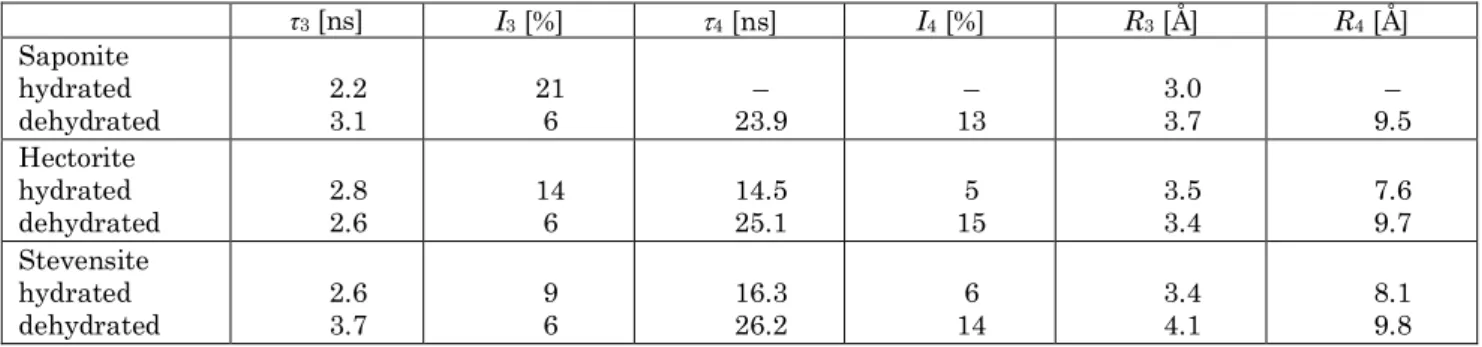
Table 1 lists evaluated lifetimes of o-Ps pick-off an-nihilation τ3 and τ4 and corresponding open space sizes R3 and R4 together with their relative intensitites (I3 and I4) observed for three smectite samples. The life-time τ3 of ~ 2 ns was observed for the hydrated sapo-nite. After dehydrating at 423 K for 8 h in vacuum at ~ 10 – 5 Torr, a very long lifetime τ4 of ~ 24 ns appears with its fraction I4 ~ 13 %. The size of open space de-rived from lifetime τ3 through Eq. (2.1) is ~ 3 Å in ra -dius, whereas the size derived from lifetime τ4 is
~ 10 Å. For the hydrated hectorite, the lifetimes of o-Ps pick-off annihilation
3 (~ 3 ns) and τ4 (~ 15 ns) corre-sponding to the open spaces with the sizes of ~ 4 Å and ~ 8 Å are evaluated with their relative intensities I3 (~ 14 %) and I4 (~ 5 %). After dehydrating, the lifetimeτ4 and its intensity I4 increase up to ~ 25 ns and ~ 15 %, respectively. This indicates that the size of open space increases together with its fraction. The lifetimes of o -Ps pick-off annihilation τ3 (~ 3 ns) and τ4 (~ 16 ns) cor-responding to the open spaces with the sizes of ~ 3 Å and ~ 8 Å are observed for the hydrated stevensite with their relative intensities I3 (~ 9 %) and I4 (~ 6 %). Simi-larly to the hectorite, dehydration at 423 K for 8 h in vacuum increases the lifetime τ4 and intensity I4 up to ~ 26 ns and 14 %, respectively.
It is of great intrest that Ps annihilation spectrosco-py reveals the angstrom-scale open spaces susceptible
300 400 500 600 700
8 6 4 2 0
W
ei
g
h
t l
o
ss
[
%
]
Temperature [K] Hectorite 345 K
Hectorite
Stevensite
Saponite Stevensite
Saponite
350 K
en
d
o
332 K
Fig. 1– TG-DTA data for saponite (solid lines), hec-torite (dashed lines), and stevensite (dotted lines)
10 20 30 40 50
10-4 10-3 10-2 10-1 100
(a) Saponite
hydrated
dehydrated
P
ea
k
n
o
rm
a
li
ze
d
c
o
u
n
ts
Time [ns]
10 20 30 40 50
10-4 10-3 10-2 10-1 100
(b)
dehydrated
hydrated
Hectorite
P
a
ek
n
o
rm
a
li
ze
d
c
o
u
n
ts
Time [ns]
10 20 30 40 50
10-4 10-3 10-2 10-1 100
hydrated dehydrated (c) Stevensite
P
ea
k
n
o
rm
a
li
ze
d
c
o
u
n
ts
Time [ns]
HYDRATION-INDUCED LOCAL MOLECULAR STRUCTURES… J.NANO-ELECTRON.PHYS.5, 01002 (2013)
01002-3
Table 1– o-Ps pick-off lifetimes 3 and τ4 and corresponding open space sizes R3 and R4 together with their fractions I3 and I4 observed for three smectite samples
τ3 [ns] I3 [%]
4 [ns]
I4 [%] R3 [Å] R4 [Å]Saponite hydrated dehydrated
2.2 3.1
21 6
– 23.9
– 13
3.0 3.7
– 9.5 Hectorite
hydrated dehydrated
2.8 2.6
14 6
14.5 25.1
5 15
3.5 3.4
7.6 9.7 Stevensite
hydrated dehydrated
2.6 3.7
9 6
16.3 26.2
6 14
3.4 4.1
8.1 9.8
to water adsorption and desorption for three smectite samples. The size of smaller open space R3 shows in-significant changes regardless of water adsorption and desoprption (see Table 1). The interlayer spaces for the dehydrated smectite completely shrink Na + cations infilling up the hexagonal cavity of silicate tetrahedron, as confirmed by XRD experiments [16]. Generally, theyexpand together with water molecules adsorbed onto the Na + cations in the interlayer spaces due to hydration. It is thus unlikely that the smaller open space without significant change of open space size (3 Å ~ 4 Å) corresponds to the interlayer space.
The larger open space with its size R4 ranging from ~ 7 Å to ~ 10 Å is in turn too large to relate with the interlayer space. It is thus infered the persence of ang-strom-scale open spaces that have been unconsidered for the molecular model of inorganic layered materials so far.
4. CONCLUSIONS
Three kinds of smectite clay minerals, saponite, hec-torite, and stevensite were investigated by positronium (Ps) annihilation spectroscopy and thermogravimetry and differential thermal analysis (TG-DTA). Based on the results of TG-DTA, hydration is found to occur easi-er in the ordeasi-er of saponite, hectorite, and stevensite. Ps lifetime spectroscopy reveals that the presence of ang-strom-scale open space is sensitively dependent on hy-dration / dehyhy-dration state of smectite clay minerals.
ACKNOWLEDGEMENTS
Discussion with K. Fujimoto (Tokyo Gakugei Universi-ty) and K. Kawamura (Okayama UniversiUniversi-ty) is gratefully appreciated. This work was partially supported by a Grant-in-Aid of the Japanese Ministry of Education, Sci-ence, Sports and Culture (Grant Nos. 21540317 and 23740234).
REFERENCES
1. K. Selvam, M. Swaminarthan, Chem. Lett.36, 1060 (2007). 2. I.M. Young, J.W. Crawford, Science304, 1634 (2004). 3. C.A.J. Wibberley, T. Shimamoto, Nature436, 689 (2005). 4. J.M. Cases, I. Bérend, M. Francois, J.P. Uriot, L.J. Michot,
F. Thomas, Clay. Clay Miner.45, 8 (1997).
5. J.L. Bishop, C.M. Pieters, J.O. Edwards, Clay. Clay Miner.
42, 702 (1994).
6. C. Poinsignon, Solid State Ionics97, 399 (1997). 7. A. Delville, M. Letellier, Langmuir11, 1361 (1995). 8. K. Sato, H. Murakami, K. Ito, K. Hirata, Y. Kobayashi,
Macromolecules42, 4853 (2009).
9. K. Sato, K. Fujimoto, M. Nakata, T. Hatta, J. Phys. Chem.
C115, 18131 (2011).
10.K. Sato, J. Phys. Chem. B115, 14874 (2011). 11.S.J. Tao, J. Chem. Phys.56, 5499 (1972).
12. M. Eldrup, D. Lightbody, J.N. Sherwood, Chem. Phys.63, 51 (1981).
13. K. Ito, T. Oka, Y. Kobayashi, Y. Shirai, H. Saito, Y. Honda, Y. Nagai, M. Fujinami, A. Uedono, K. Sato, T. Hirade, A. Shimazu, H. Hosomi, K. Sakaki, J. Appl. Phys.104, 0261021 (2008).
14. K. Ito, T. Oka, Y. Kobayashi, Y. Shirai, K. Wada, M. Matsumoto, M. Fujinami, T. Hirade, Y. Honda, H. Hosomi, Y. Nagai, K. Inoue, H. Saito, K. Sakaki, K. Sato, A. Shimazu, A. Uedono, Mater. Sci. Forum 607, 248 (2009).
15.P. Kirkegaard, M. Eldrup, Comput. Phys. Commun.7, 401 (1974).