Synthesis of Zinc Aluminate (ZnAl
2O
4) Spinel and Its Application as Photocatalyst
Suellen Battistona,Caroline Rigoa, Eric da Cruz Severoa,Marcio Antonio Mazuttia,
Raquel Cristine Kuhna, André Gündelb, Edson Luiz Folettoa*
aDepartment of Chemical Engineering, Federal University of Santa Maria – UFSM, CEP 97105-900, Santa Maria, RS, Brazil
bFederal University of Pampa – UNIPAMPA, University Campus, CEP 96413-170, Bagé, RS, Brazil
Received: October 3, 2013; Revised: April 18, 2014
ZnAl2O4 spinel was synthesized by co-precipitation using ammonia as precipitating agent, followed by thermal treatment at 750 °C. The structural properties of particles were investigated by X-ray diffraction (XRD), atomic force microscopy (AFM), differential thermal analysis (DTA), and N2 adsorption/desorption isotherms (BET) techniques. The photocatalytic activity was evaluated in the degradation of organic pollutant in aqueous solution under sunlight. The results showed that the ZnAl2O4 particles exhibited a mesoporous structure, and a promising photocatalytic activity for the degradation of pollutant molecules.
Keywords: ZnAl2O4, synthesis, characterization, co-precipitation, photocatalysis
1. Introduction
ZnAl2O4 is a spinel type oxide1, which have high
chemical and thermal stability, high mechanical resistance and low surface acidity2-4, being suitable for a wide
range of applications, such as optical coating or host matrix, high temperature ceramic material, catalyst and catalyst support5-7. In recent years, ZnAl
2O4 spinel has
been largely used as catalyst in several reactions such as degradation of gaseous toluene8, ethanol steam reforming9,
hydroformylation and hydrogenation3,10, combustion of
soot under NOx/O2 atmosphere
11, transesterification of
vegetable oil12 and iso-butane combustion13.
The photocatalytic degradation of organic pollutants in the water such as dye14-16, phenol17 and pesticide18 using
different semiconductor materials has attracted much attention recently. ZnAl2O4 is also a semiconductor material suitable for
ultraviolet (UV) photoeletronic application19 due it wide
energy bandgap (about 3.8 eV)20. A few studies involving the
degradation of organic dyes using ZnAl2O4 as a photocatalyst are reported in the literature. Recently ZnO/ZnAl2O4
nanocomposite has been evaluated for the photodegradation of methyl orange dyeunder artificial UV light irradiation21.
Foletto et al.22 observed satisfactory photocatalytic activity
of ZnAl2O4 particles for degradation of Procion Red dye from aqueous solution. The photocatalytic activity of mechanochemically synthesized gahnite (ZnAl2O4) was tested
for the degradation of Chromium Acidic Black dye under UV light irradiation23. ZnAl
2O4 nanospheres synthesized
by a wet chemical solution-phase method exhibited a good photocatalytic activity in degrading Rhodamine B dye24.
Photocatalytic evaluation under UV irradiation shows that the ZnO/ZnAl2O4 microspheres exhibit highly enhanced photodegradation performance to Methylene Blue dye in comparison with the commercial ZnO powder25.
In this context, the aim of this work was to synthesize ZnAl2O4 particles by co-precipitation and subsequent thermal treatment and to evaluate their capacity in the degradation of tannery dye molecules under solar irradiation. The particles synthesized were characterized by X-ray diffraction (XRD), atomic force microscopy (AFM), differential thermal analysis (DTA) and surface area (BET).
2. Experimental
2.1.
Synthesis and characterization of the
catalyst
Aluminum nitrate [Al(NO3)3.9H2O, analytical grade] and zinc nitrate [Zn(NO3)2.6H2O, analytical grade] were
used as aluminum and zinc sources, respectively. The aqueous solution of zinc nitrate (11.88 g in 20 mL) was added into aqueous solution of aluminum nitrate (30 g in 20 mL). Afterwards, the appropriate amount of aqueous solution of ammonia (28 wt.%) was added to the resulting solution, and the mixture was stirred until complete precipitation at pH = 8.5. The powder was filtered, washed with distilled water, and dried. Afterwards, the solid was treated at 750 °C[26] for 3.5 h to obtain the ZnAl
2O4 particles.
The resulting powder was characterized by X-ray diffraction, atomic force microscopy, differential thermal analysis (DTA) and Brunauer-Emmett-Teller (BET) methods. X-ray diffraction (XRD) pattern was obtained using a Bruker D8 Advance diffractometer. The X-ray source was Cu-K radiation, powered at 40 kV and 40 mA. Data were collected from 25-70° (2θ) with a step size of 0.03° and a count time of 35 s. The crystallite size of the sample was estimated using the Scherrer’s equation27 (Equation 1) applied to the
peak at 2θ = 36.75° (see XRD in Figure 1):
0.9
cos d
B ⋅ λ =
⋅ ⋅ θ (1)
where d is the average crystallite size, λ is the wavelength of X-ray, B is the peak width at half maximum height and θ the Bragg’s angle. The morphology of particles was examined by atomic force microscopy (AFM) (Agilent Technologies 5500 equipment). The Brunauer-Emmett-Teller (BET) surface area measurements were carried out by N2 adsorption-desorption at 77 K using an ASAP 2020 instrument in the range of relative pressure (P/Po) of 0 to 0.99. Differential thermal analysis (DTA) was carried out on Netzsch STA 409 analyzer at a heating rate of 10 °C min–1
at an airflow rate of 50 mL min–1.
2.2.
Photocatalytic activity
The photocatalytic experiments under sunlight were carried out in a transparent vessel (Øint. = 10 cm) between 10.00 am and 4.00 pm during the month of April/2013 (autumn season) at Santa Maria City (29° 43’ 23” S and 53° 43’ 15” W), Brazil. The scheme of the reaction system used in this work can be found a previous work28.
The photocatalytic degradation of Direct Black 38 dye (molecular weight = 781.7 g mol–1; see chemical structure
in a previous work29) was studied in dye concentrations of
80 to 200 mg L–1. Prior to photoirradiation, the suspension
containing the dye and zinc aluminate powder (catalyst/ solution ratio = 1.0 g L–1) was subjected to ultrasonic
dispersion for 15 min. Firstly, the homogenised suspension was magnetically stirred in the dark to establish the adsorption equilibrium. Afterwards, the dye solution (200 mL) was stirred with a magnetic stirrer under sunlight being withdraw aliquots at certain periods of time. These aliquots were centrifuged before the analysis of colour. The concentration of dye in aqueous solution was determined by spectrometry (Spectro vision T6-UV model), at λ
máx = 590 nm [30].
3. Results and Discussion
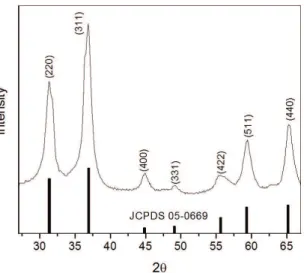
The XRD pattern for ZnAl2O4 is shown in Figure 1. All the diffraction peaks can be perfectly indexed to face-centered cubic spinel-structured ZnAl2O4
[31]. The
characteristic peaks at 2θ of 31.2°, 36.75°, 44.7°, 49.1°, 55.6°, 59.3° and 65.3° are corresponding to (220), (311), (400), (331), (422), (511), and (440) diffraction planes31,32.
The peaks and intensities of the synthesized powder and that of standard present similar behavior. This indicates the complete formation of ZnAl2O4spinel phase in the
experimental condition employed in this work. In addition, no impurities were detected in the synthesized sample. The average crystallite size estimated by applying the Scherrer equation was about 25 nm. The average crystallite size was also determined by atomic force microscopy, as showed in Figure 2. AFM image revealed an agglomerate of crystallites, com size smaller than 50 nm, corroborating with the result of XRD.
Nitrogen adsorption-desorption isotherms and pore size distribution for the ZnAl2O4 sample are presented in Figure 3. According to IUPAC classification33, the isotherms
are of type IV, representing predominantly characteristics
Figure 1. XRD pattern of ZnAl2O4 and (insert) reference ZnAl2O4
(JCPDS Card No. 05-0669)31.
Figure 2. AFM of ZnAl2O4 powder.
of mesoporous structure. The mesoporous structure was confirmed by analysis of pore size distribution (see insert in Figure 3), which shows spectra of pore diameter with defined maxima in mesoporous region. Therefore, ZnAl2O4 had mesopores, most likely due to the interparticles and out-of-order porosity. The pore size distribution curve displays a wide distribution with an average pore size of about 8.3 nm. Additionally, the total pore volume and surface area were 0.20 cm3 g–1 and 93 m2 g–1, respectively. It is well known that
the properties of catalyst materials are related to their porous structure. The presence of a large pore size is considered as fundamental for ceramic materials used in field of catalysis. DTA curve for the synthesized ZnAl2O4 sample is presented in Figure 4. From this Figure, it is observed that the absence of any exothermic peak on the DTA curve of ZnAl2O4 spinel indicates that no recrystallization process occurs at temperature up to 900 °C. This result shows a good thermal stability at high temperature of the spinel structure of ZnAl2O4 phase, a fundamental property for use as catalyst
The effect of the initial dye concentrations on the photocatalytic degradation have been investigated from 80 to 200 mg L–1 and the results are shown in Figure 5. The
degradation of the dye molecules was negligible by direct photolysis. The degradation of the dye was only observed with the simultaneous presence of catalyst and sunlight. The results showed that the increase of the dye concentration in the aqueous medium decrease the degradation efficiency. Increase in the dye concentration from 80 to 200 mg L–1
decrease the degradation from 99 to 30 % in 240 min of solar irradiation. The increase in dye concentration decreases the path length of photon entering into the dye solution. At high dye concentration a significant amount of sunlight may be absorbed by the dye molecules rather than the catalyst and this may reduce the catalytic efficiency34. This phenomenon
can be also justified by the number of active sites at the ZnAl2O4/H2O interface. Thus, at low concentration of dye, there are too many water molecules that will be adsorbed on the available ZnAl2O4 particles, producing hydroxyl
radicals and leading to fast oxidation process. Otherwise, at high concentration of dye there is a small proportion of adsorbed water molecules on the catalyst surface because the number of available active sites remains the same. Consequently, competitive adsorption among the dye and water molecules increases and leads to a decrease of the photodegradation rate35.
4. Conclusions
The ZnAl2O4 particles synthesized by co-precipitation followed by calcination at 750 °C presented a mesoporous structure, with a surface area of 93 m2 g–1 and average
size crystallite of about 25 nm. Due to its good thermal stability at high temperature, ZnAl2O4 particles can be used as catalyst supports in several reactions at high temperatures. Herein, it was demonstrated that the efficiency of the photocatalytic process depends on the dye concentration. The highest degradation efficiency was obtained at initial concentration of 80 mg L–1. The
results indicated that the ZnAl2O4 spinel obtained by co-precipitation followed by calcination exhibited promising characteristics to be used for photodegradation of dye pollutants under sunlight and can be used for the treatment of dye wastewater.
Figure 3. N2 adsorption/desorption isotherms and (insert) pore
diameter distribution of ZnAl2O4 particles.
Figure 4. DTA curve of the synthesized ZnAl2O4 sample.
Figure 5. Photocatalytic activity of the ZnAl2O4 photocatalystat
References
1. Stringhini FM, Foletto EL, Sallet D, Bertuol DA, Chiavone-Filho O and Nascimento CAO. Synthesis of porous zinc
aluminate spinel (ZnAl2O4) by metal-chitosan complexation
method. Journal of Alloys and Compounds. 2014; 588:305-309.
http://dx.doi.org/10.1016/j.jallcom.2013.11.078
2. Zawadzki M, Miśta W and Kępiński L. Metal-support effects of
platinum supported on zinc aluminate. Vacuum. 2001;
63:291-296. http://dx.doi.org/10.1016/S0042-207X(01)00204-4
3. Wrzyszcz J, Zawadzki M, Trzeciak AM and Ziółkowski JJ. Rhodium complexes supported on zinc aluminate spinel as catalysts for hydroformylation and hydrogenation: preparation
and activity. Journal of Molecular Catalysis A: Chemical.
2002; 189:203-210. http://dx.doi.org/10.1016/S1381-1169(02)00073-0
4. Nilsson M, Jansson K, Jozsa P and Pettersson LJ. Catalytic
properties of Pd supported on ZnO/ZnAl2O4/Al2O3 mixtures
in dimethyl ether autothermal reforming. Applied Catalysis
B: Environmental. 2009; 86:18-26. http://dx.doi.org/10.1016/j. apcatb.2008.07.012
5. Tzing WS and Tuan WH. The strength of duplex Al2O3
-ZnAl2O4 composite. Journal of Materials Science Letters.
1996; 15:1395-1396. http://dx.doi.org/10.1007/BF00275286
6. Phani AR, Passacantando M and Santucci S. Synthesis and characterization of zinc aluminum oxide thin films by sol–gel
technique. Materials Chemistry and Physics. 2001; 68:66-71.
http://dx.doi.org/10.1016/S0254-0584(00)00270-4
7. Zawadzki M, Wrzyszcz J, Strek W and Hreniak D. Preparation and optical properties of nanocrystalline and nanoporous Tb doped alumina and zinc aluminate. Journal of Alloys Compounds. 2001; 12:279-282. http://dx.doi.org/10.1016/ S0925-8388(01)01031-3
8. Li X, Zhu Z, Zhao Q and Wang L. Photocatalytic degradation of gaseous toluene over ZnAl2O4 prepared by different methods:
A comparative study. Journal of Hazardous Materials. 2011;
186:2089-2096. PMid:21242028. http://dx.doi.org/10.1016/j. jhazmat.2010.12.111
9. Galetti AE, Gomez MF, Arrúa LA and Abello MC. Ni catalysts
supported on modified ZnAl2O4 for ethanol steam reforming.
Applied Catalysis A: General. 2010; 380:40-47. http://dx.doi. org/10.1016/j.apcata.2010.03.024
10. Lenarda M, Casagrande M, Moretti E, Storaro L, Frattini R and Polizzi S. Selective catalytic low pressure hydrogenation of acetophenone on Pd/ZnO/ZnAl2O4. Catalysis Letters. 2007; 114:79-84. http://dx.doi.org/10.1007/s10562-007-9046-4 11. Zawadzki M, Staszak W, Suárez FEL, Gómez MJI and López
AB. Preparation, characterisation and catalytic performance
for soot oxidation of copper-containing ZnAl2O4 spinels.
Applied Catalysis A: General. 2009; 371:92-98. http://dx.doi. org/10.1016/j.apcata.2009.09.035
12. Pugnet V, Maury S, Coupard V, Dandeu A, Quoineaud AA, Bonneau JL et al. Stability, activity and selectivity study of a zinc aluminate heterogeneous catalyst for the transesterification
of vegetable oil in batch reactor. Applied Catalysis A:
General. 2010; 374:71-78. http://dx.doi.org/10.1016/j. apcata.2009.11.028
13. Staszak W, Zawadzki M and Okal J. Solvothermal synthesis and characterization of nanosized zinc aluminate spinel used in
iso-butane combustion. Journal of Alloys and Compounds. 2010;
492:500-507. http://dx.doi.org/10.1016/j.jallcom.2009.11.151
14. Silva LJV, Foletto EL, Dorneles LS, Paz DS, Frantz TS and Gundel A. ZnO electrodeposition onto gold from recordable compact discs and its use as photocatalyst
under solar irradiation. Brazilian Journal of Chemical
Engineering. 2013; 30:155-158. http://dx.doi.org/10.1590/ S0104-66322013000100017
15. Collazzo GC, Paz DS, Jahn SL, Carreño NLV and Foletto EL. Evaluation of niobium oxide doped with metals in
photocatalytic degradation of leather dye. Latin American
Applied Research. 2012; 42:51-54.
16. Collazzo GC, Jahn SL and Foletto EL. Removal of Direct Black 38 dye by adsorption and photocatalytic degradation
on TiO2 prepared at low temperature. Latin American Applied
Research. 2012; 42:55-60.
17. Paz DS, Foletto EL, Bertuol D, Jahn SL, Collazzo GC, Silva SS et al. CuO/ZnO coupled oxide films obtained by the electrodeposition technique and their photocatalytic activity
in phenol degradation under solar irradiation. Water Science
and Technology. 2013; 68:1031-1036. PMid:24037153. http:// dx.doi.org/10.2166/wst.2013.345
18. Lhomme L, Brosillon S and Wolbert D. Photocatalytic degradation of pesticides in pure water and a commercial agricultural solution on TiO2 coated media. Chemosphere. 2008; 70:381-386. PMid:17709129. http://dx.doi.org/10.1016/j. chemosphere.2007.07.004
19. Wang Y, Liao Q, Lei H, Zhang XP, Ai XC, Zhang JP et al. Interfacial reaction growth: morphology, composition, and
structure controls in preparation of crystalline ZnxAlyOz
nanonets. Advances Materials. 2006; 18:943-947. http://dx.doi.
org/10.1002/adma.200502154
20. Chen XY, Ma C, Zhang ZJ and Wang BN. Ultrafine
gahnite (ZnAl2O4) nanocrystals: Hydrothermal synthesis
and photoluminescent properties. Materials Science and
Engineering: B. 2008; 151:224-230. http://dx.doi.org/10.1016/j. mseb.2008.09.023
21. Zhao X, Wang L, Xu X, Lei X, Xu S and Zhang F. Fabrication
and photocatalytic properties of novel ZnO/ZnAl2O4
nanocomposite with ZnAl2O4 dispersed inside ZnO network.
AIChE Journal. 2012; 58:573-582. http://dx.doi.org/10.1002/ aic.12597
22. Foletto EL, Battiston S, Simões JM, Bassaco MM, Pereira
LSF, Flores EMM et al. Synthesis of ZnAl2O4 nanoparticles
by different routes and the effect of its pore size on the
photocatalytic process. Microporous and Mesoporous
Materials. 2012; 163:29-33. http://dx.doi.org/10.1016/j. micromeso.2012.06.039
23. Fabian M, Elias A, Kostova N, Briančin J and Baláž P.
Photocatalytic activity of nanocrystalline gahnite (ZnAl2O4)
synthesized by ball milling. In: Proceedings of the 12th
International Multidisciplinary Scientific GeoConference; 2012; Bulgaria. Bulgaria; 2012. v. 3, p. 491-498.
24. Zhao L, Li XY and Zhao J. Fabrication, characterization and
photocatalytic capability of ZnAl2O4 nanospheres. Advanced
Materials Research. 2012; 518-523:736-739.
25. Huo R, Kuang Y, Zhao Z, Zhang F and Xu S. Enhanced
photocatalytic performances of hierarchical ZnO/ZnAl2O4
microsphere derived from layered double hydroxide precursor
spray-dried microsphere. Journal of Colloid and Interface
Science. 2013; 407:17-21. PMid:23899457. http://dx.doi. org/10.1016/j.jcis.2013.06.067
26. Anchieta CG, Sallet D, Foletto EL, Silva SS, Chiavone-Filho O and Nascimento CAO. Synthesis of ternary zinc spinel oxides and their application in the photodegradation of organic
pollutant. Ceramics International. 2013; 40(3):4173-4178.
http://dx.doi.org/10.1016/j.ceramint.2013.08.074
27. Cullity BD and Stock SR. Elements of X-Ray Diffraction.
28. Collazzo GC, Foletto ELF, Jahn SL and Villetti MA. Degradation of Direct Black 38 dye under visible light
and sunlight irradiation by N-doped anatase TiO2 as
photocatalyst. Journal of Environmental Management. 2012;
98:107-111. PMid:22257572. http://dx.doi.org/10.1016/j. jenvman.2011.12.029
29. Foletto EL, Weber CT, Paz DS, Mazutti MA, Meili L, Bassaco MM et al. Adsorption of leather dye onto activated carbon prepared from bottle gourd: equilibrium, kinetic and
mechanism studies. Water Science and Technology. 2013;
67:201-209. PMid:23128640. http://dx.doi.org/10.2166/ wst.2012.555
30. Foletto EL, Battiston S, Mazutti MA and Jahn SL. Adsorption of a leather dye on mesoporous struvite obtained from swine
wastewater. Chemical Engineering Communications. 2013;
200:1027-1038. http://dx.doi.org/10.1080/00986445.2012. 737383
31. Miron I, Enache C and Grozescu I. Doped zinc aluminate
spinel synthesized by hydrothermal method. Digest Journal of
Nanomaterials and Biostructures. 2012; 7:967-972. 32. Wei X and Chen D. Synthesis and characterization of nanosized
zinc aluminate spinel by sol–gel technique. Materials
Letters. 2006; 60:823-827. http://dx.doi.org/10.1016/j. matlet.2005.10.024
33. International Union of Pure and Applied Chemistry, IUPAC, Pure and Applied Chemistry. 1985, vol. 57, p. 603.
34. Muruganandham M and Swaminathan M. Photocatalytic decolourisation and degradation of Reactive Orange 4 by
TiO2-UV process. Dyes Pigments. 2006; 68:133-142. http://
dx.doi.org/10.1016/j.dyepig.2005.01.004
35. Ishiki RR, Ishiki HM and Takashima K. Photocatalytic
degradation of imazethapyr herbicide at TiO2/H2O interface.