BGD
6, 2697–2721, 2009Phosphatase activity on an Arctic glacier
M. Stibal et al.
Title Page
Abstract Introduction
Conclusions References
Tables Figures
◭ ◮
◭ ◮
Back Close
Full Screen / Esc
Printer-friendly Version
Interactive Discussion
Biogeosciences Discuss., 6, 2697–2721, 2009 www.biogeosciences-discuss.net/6/2697/2009/ © Author(s) 2009. This work is distributed under the Creative Commons Attribution 3.0 License.
Biogeosciences Discussions
Biogeosciences Discussionsis the access reviewed discussion forum ofBiogeosciences
Phosphatase activity and organic
phosphorus turnover on a high Arctic
glacier
M. Stibal, A. M. Anesio, C. J. D. Blues, and M. Tranter
Bristol Glaciology Centre, School of Geographical Sciences, University of Bristol, Bristol, BS8 1SS, UK
Received: 29 January 2009 – Accepted: 4 February 2009 – Published: 27 February 2009
Correspondence to: M. Stibal ([email protected])
BGD
6, 2697–2721, 2009Phosphatase activity on an Arctic glacier
M. Stibal et al.
Title Page
Abstract Introduction
Conclusions References
Tables Figures
◭ ◮
◭ ◮
Back Close
Full Screen / Esc
Printer-friendly Version
Interactive Discussion Abstract
Arctic glacier surfaces harbor abundant microbial communities consisting mainly of het-erotrophic and photoautotrophic bacteria. The microbes must cope with very low con-centrations of nutrients and with the fact that both the dissolved and debris-bound nu-trient pools are dominated by organic phases. Here we provide evidence that
phospho-5
rus (P) is deficient and limiting in the supraglacial environment on a Svalbard glacier, we show how the microbial community responds to the P stress and we quantify the contribution of the microbes to the cycling of the dominant organic P in the supraglacial environment. Incubation of cryoconite debris revealed significant phosphatase activity in the samples (19–67 nmol MUP g−1h−1), which was controlled by the concentration of
10
inorganic P during incubations and had its optimum at around 30◦C. The phosphatase
activity rates measured at near-in situ temperature and substrate concentration imply that the available dissolved organic P can be turned over by microbes within∼3–11 h
on the glacier surface. By contrast, the amount of potentially bioavailable debris-bound organic P is sufficient for a whole ablation season. However, it is apparent that some
15
of this potentially bioavailable debris-bound P is not accessible to the microbes.
1 Introduction
Glacier surfaces, often referred to as supraglacial environments, are dominated by rel-atively simple, yet abundant and active, microbial communities which consist mainly of heterotrophic and photoautotrophic bacteria (S ¨awstr ¨om et al., 2002; Kaˇstovsk ´a et
20
al., 2005; Hodson et al., 2008; Anesio et al., 2009). The microbes are concentrated in cryoconite holes (Stibal et al., 2006), cylindrical water-filled depressions which form on glaciers when dark, mostly wind-borne debris deposited on the surface melts down into the ice (Wharton et al., 1985). The debris is, along with atmospheric aerosol deposition, the principal source of these organisms, as well as of the majority of
nu-25
BGD
6, 2697–2721, 2009Phosphatase activity on an Arctic glacier
M. Stibal et al.
Title Page
Abstract Introduction
Conclusions References
Tables Figures
◭ ◮
◭ ◮
Back Close
Full Screen / Esc
Printer-friendly Version
Interactive Discussion
are present in mainly organic phases, as residue of microbial and/or plant cells and decayed organic matter (Stibal et al., 2008a,b). This implies that inorganic nutrients are rapidly sequestered by microbial processes and that organic nutrients may too be recycled relatively rapidly.
It has been shown that supraglacial microbes are nutrient-limited in the aqueous
5
phase. Phosphorus (hereafter, P) is assumed to be the limiting nutrient due to the very low concentrations found in supraglacial waters, which are usually<0.1 µM (Mindl et al., 2007; S ¨awstr ¨om et al., 2007; Stibal and Tranter, 2007). However, the overwhelming majority of P on glaciers is bound to the debris (S ¨awstr ¨om et al., 2002; Hodson et al., 2005; Stibal et al., 2008b), as are the microorganisms and their activity (S ¨awstr ¨om et
10
al., 2002; Hodson et al., 2007; Anesio et al., 2009). Thus, using only water samples and dissolved nutrient concentrations for assessing potential P limitation in this environment is clearly insufficient, and P cycling associated with the debris must also be considered. The first study to address nutrient limitation in the supraglacial environment in this more complex way examined the biogeochemical stoichiometry of both water and debris
15
(Stibal et al., 2008b). A strong P limitation in the aqueous phase was found, despite the presence of potentially bioavailable P within the debris. This, together with the fact that the majority of P is present in the organic form, both in the transitory dissolved pool and the major debris-bound pool (Stibal et al., 2008b), poses the question whether the supraglacial microbes are in any way adapted to such conditions.
20
Phosphatases are used by microbes to cleave the phosphate ion off complex
P-containing organic molecules (dissolved organic phosphorus or DOP) which are not readily bioavailable. Free phosphate can then be taken up into cells (Price and Morel, 1990). Production of phosphatase by microbes and its activity is therefore an efficient means of coping with, and may be an indication of, P deficiency in the environment
25
BGD
6, 2697–2721, 2009Phosphatase activity on an Arctic glacier
M. Stibal et al.
Title Page
Abstract Introduction
Conclusions References
Tables Figures
◭ ◮
◭ ◮
Back Close
Full Screen / Esc
Printer-friendly Version
Interactive Discussion
al., 2007). However, no data from Arctic environments are available to date, nor is the knowledge whether phosphatase activity is associated with a particular component of the microbial community.
Here we quantify and localise the phosphatase activity of the microbial community in cryoconite debris samples from Werenskioldbreen, a Svalbard glacier, using
spec-5
trofluorometry for bulk activity measurements, and epifluorescence microscopy for the localisation of the activity. We discuss the capacity of supraglacial microbes to use organic P as a source for their metabolic processes and the potential turnover rates of organic P in the supraglacial environment. This is of great significance for the whole Arctic ecosystem, as the activity of supraglacial microbes and its limitations may have
10
a considerable impact on carbon and nutrient cycling in the cryosphere (Hodson et al., 2005, 2008; Stibal et al., 2008a; Anesio et al., 2009).
2 Methods
2.1 Study site and sampling
Werenskioldbreen is a small polythermal-based valley glacier in southwest
Spitsber-15
gen, Svalbard (77◦04′N; 15◦15′E). The ablation or melt season during which liquid
water is available takes place for several weeks to months in summer. The concentra-tion of total dissolved phosphorus (TDP) in the surface waters on Werenskioldbreen is very low (5.2 to 8.5 µg l−1, or
∼0.17–0.28 µM), with DOP being a very important
compo-nent (>80% of TDP; Stibal et al., 2008b). Cryoconite holes cover∼1.5% of the surface
20
of the ablation zone, with ∼12 g of debris per m2, and so Werenskioldbreen is
esti-mated to contain over 200 000 kg of debris (Stibal et al., 2008a). The cryoconite debris contains∼2.2 mg of total P per g, and a significant part (∼57%) of this debris bound P is organic, as determined by wet chemical sequential extraction. The amount of readily available P for microbes within the debris is, however, relatively small (∼0.16 mg g−1; 25
Werenskiold-BGD
6, 2697–2721, 2009Phosphatase activity on an Arctic glacier
M. Stibal et al.
Title Page
Abstract Introduction
Conclusions References
Tables Figures
◭ ◮
◭ ◮
Back Close
Full Screen / Esc
Printer-friendly Version
Interactive Discussion
breen mainly consists of heterotrophic bacteria, photoautotrophic cyanobacteria and microalgae (Stibal et al., 2006; Stibal and Tranter, 2007).
A bulked sample of cryoconite debris was collected from several holes on Werenski-oldbreen on 3 September 2007. The holes were frozen solid at the time of sampling. The debris was removed from the holes with an ethanol-sterilised ice axe, placed into
5
sterile 100 ml HDPE bottles and frozen to−20◦C. The samples were transported to the
UK and stored in a freezer at−20◦C in the dark for 4 months until aliquots were melted
for individual experiments. We expect that the microbes can cope with this means of storage reasonably well since they are exposed to freezing on a regular basis in winter (∼8 months).
10
2.2 Dissolved phosphorus analysis
The initial concentrations of both inorganic and organic dissolved P in the experimental samples were determined in order to compare them with in situ values and to choose appropriate P additions for the enrichment experiments. Ten milligrams of debris was weighed into tubes, and 5 ml of 5 mM bicarbonate buffer (pH=8.2) was added. The
15
tubes were then briefly vortexed, and the samples filtered through 0.2 µm glass mi-crofibre filters. Soluble reactive P (SRP), i.e. dissolved inorganic P species, was de-termined spectrophotometrically at 880 nm in 1 cm disposable polycarbonate cells in a Shimadzu UV-Mini 1240 spectrophotometer (Shimadzu, Kyoto, Japan), using the standard molybdenum blue method (Murphy and Riley, 1962). The detection limit was
20
0.015 µM. Samples for TDP were acidified with potassium persulphate, autoclaved at 121◦C and 15 psi for 1 h (Je
ffries et al., 1979), and analysed for SRP as above. DOP was calculated as the difference between TDP and SRP.
2.3 Quantitative analysis of phosphatase activity
The activity of phosphatase was quantified in the cryoconite samples from
Werenski-25
BGD
6, 2697–2721, 2009Phosphatase activity on an Arctic glacier
M. Stibal et al.
Title Page
Abstract Introduction
Conclusions References
Tables Figures
◭ ◮
◭ ◮
Back Close
Full Screen / Esc
Printer-friendly Version
Interactive Discussion
controlled incubations. The hydrolysis product 4-methylumbelliferone (MU) was anal-ysed by spectrofluorometry.
Samples were incubated in acid-washed 15 ml polypropylene centrifuge tubes. 10 mg (wet weight) of freshly melted cryoconite debris was weighed into tubes, and 5 ml of 5 mM bicarbonate buffer (pH=8.2) was added, along with the desired amount of MUP
5
(final concentration ranging from 0 to 500 µM). The tubes were then briefly vortexed, and incubated for up to 3 h either in the dark or at 50 µmol photons m−2s−1. This light in-tensity had been shown sufficient for isolation and growth of a range of cryoconite pho-toautotrophs (A. M. Anesio, unpublished data). Eight incubation temperatures ranging from 0 to 40◦C were used in order to assess the optimum temperature for the enzyme.
10
Denatured blanks were prepared by boiling the samples for 10 min and cooling prior to MUP addition. Blanks containing no MUP were also incubated in order to evaluate background fluorescence of the debris and potential liberation of interfering compounds over the course of incubations. All the samples were centrifuged at 1000 rpm for 1 min immediately before analysis. Blanks containing only bicarbonate buffer and MUP were
15
prepared and measured in order to assess the fluorescence of spontaneously hydrol-ysed MUP, which was then subtracted from the samples fluorescence. Approximately 0.03–0.05% of MUP hydrolysed immediately after being added to samples, indepen-dent of the concentration (linear between 0.01–100 µM MUP,R2>0.99).
The samples were analysed with a SPEX Fluorolog-3 spectrofluorometer (Horiba
20
Jobin Yvon, Edison, NJ, USA) with a xenon lamp. The excitation wavelength was set to 365 nm and the emission was detected at 450 nm. Phosphatase activity was expressed as nmol of MU accumulated per gram of debris per hour using emission coefficients obtained from calibrations (0.001–0.5 µM MU;R2>0.99) and correcting for quenching. The MU accumulation was considered equivalent to MUP dephosphorylation.
25
BGD
6, 2697–2721, 2009Phosphatase activity on an Arctic glacier
M. Stibal et al.
Title Page
Abstract Introduction
Conclusions References
Tables Figures
◭ ◮
◭ ◮
Back Close
Full Screen / Esc
Printer-friendly Version
Interactive Discussion
to sequester only 5–7% of MU, with the background fluorescence of the debris being negligible (equivalent to<1 nM MU), and so was used in the experiments.
Selected samples were enriched with inorganic P in the form of KH2PO4in order to test the effect of readily available P on phosphatase activity. The P additions were from 0.3 to 10 µM. The immediate effect of P addition was tested by incubating the samples
5
with MUP immediately after the enrichment for 30 min in the dark. The long-term effect was tested by incubating the samples for 24 h at the elevated P concentrations, followed by adding MUP and incubating for 30 min.
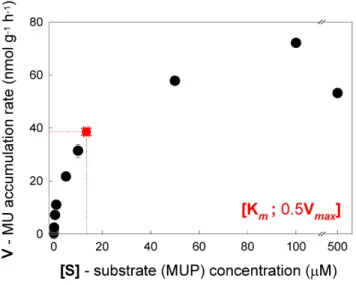
The phosphatase activity was assumed to follow Michaelis-Menten kinetics, and the parametersKm (the Michaelis constant; the substrate concentration at which the
re-10
action rate reaches half of its maximum value) and Vmax (the maximum rate of the reaction) were estimated using the Eadie-Hofstee equation, a linearised form of the Michaelis-Menten model,
V =Vmax−Km V
[S]
whereV is the reaction rate (nmol g−1h−1) and [S] is the substrate concentration (µM).
15
The reaction rate, V, was measured at ten substrate concentrations ranging from 0.01 to 500 µM with eight replicates per assay.
2.4 Phosphatase activity visualisation and localisation
Enzyme-labelled fluorescence (ELF) was used to localise the activity of p hosphatase within the cryoconite debris. Cryoconite debris samples were stained either with
ELF-20
97 only or counterstained with the DNA stain SYBR Gold, and then observed using epifluorescence microscopy in order to determine the total microbial abundance and the localisation of phosphatase activity sites. Chlorophyll autofluorescence was used to show whether photoautotrophic microorganisms were associated with phosphatase activity.
BGD
6, 2697–2721, 2009Phosphatase activity on an Arctic glacier
M. Stibal et al.
Title Page
Abstract Introduction
Conclusions References
Tables Figures
◭ ◮
◭ ◮
Back Close
Full Screen / Esc
Printer-friendly Version
Interactive Discussion
Samples were incubated in a similar manner as those for bulk activity measure-ments. Ten milligrams (wet weight) of freshly melted cryoconite debris was weighed into acid-washed 15 ml polypropylene centrifuge tubes, and 4.75 ml of deionised wa-ter was added. The tubes were incubated for 30 min at 5◦C, either in the dark or at 50 µmol photons m−2s−1, and the samples were then fixed by adding 250 µl of
5
formaldehyde (final concentration 1.9%). One millilitre of the sample was then trans-ferred to a clean 2 ml Eppendorf tube. Blanks containing no debris were also incubated in order to evaluate potential contamination during handling.
ELF-97 (solution A, ELF-97 Endogenous Phosphatase Detection Kit E6601, Invitro-gen, Eugene, OR, USA) was diluted 20 times with the detection buffer (solution B) and
10
100 µl was added to the Eppendorf tube. The samples were stained for 15 min in the dark and filtered onto a 0.2 µm Anodisc filter (Whatman, Maidstone, UK). Dried filters were then placed onto 100 µl drops of SYBR Gold (Invitrogen, Eugene, OR, USA) for 15 min, dried and mounted on microscopic slides with anti-fade agent (solution C).
The number of SYBR Gold stained cells was enumerated in 20 randomly selected
15
fields with an Olympus BX41 epifluorescence microscope (Olympus Optical, Tokyo, Japan) using the filter block U-N31001 (excitation 480 nm, emission 535 nm; Chroma Technology, Rockingham, VT, USA). The presence and localisation of yellow-green fluorescing ELF alcohol precipitate was recorded using the filter block U-MWU2 (exci-tation 330–385 nm, emission 420+; Olympus Optical, Tokyo, Japan). Each precipitate
20
was counted as one site of activity. Cells showing red chlorophyll autofluorescence were also enumerated using this filter block. Ten experimental and two blank filters were enumerated, and the average blank counts were then subtracted from the exper-imental samples.
3 Results
25
BGD
6, 2697–2721, 2009Phosphatase activity on an Arctic glacier
M. Stibal et al.
Title Page
Abstract Introduction
Conclusions References
Tables Figures
◭ ◮
◭ ◮
Back Close
Full Screen / Esc
Printer-friendly Version
Interactive Discussion
for 82±2.9% of total dissolved P in the samples. The microbial abundance in the
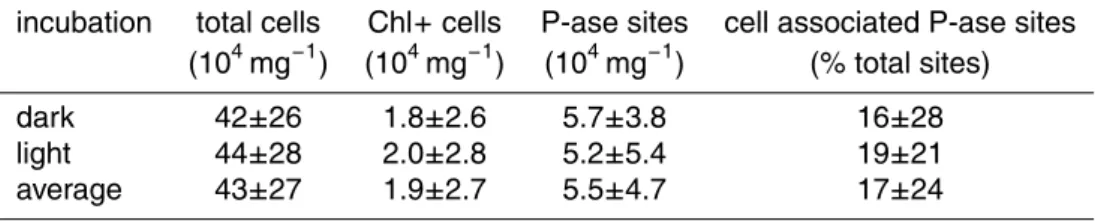
ex-perimental samples was ∼4.3×10⁸ cells per gram of debris and approximately 4%
of the cells were chlorophyll-containing photoautotrophs (Table 1), mostly filamentous cyanobacteria from the group Oscillatoriales. Low numbers of eukaryotic green algae were also found.
5
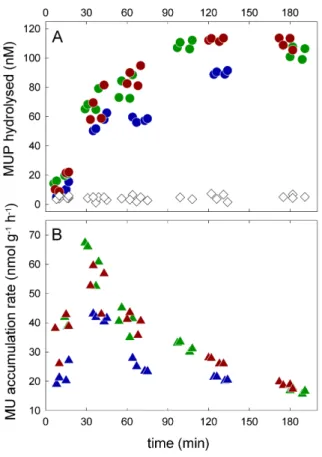
The accumulation of 4-methylumbelliferone (MU), the product of enzymatic dephos-phorylation of the substrate analogue 4-methylumbelliferylphosphate (MUP), in the samples over the course of incubations with MUP is shown in Fig. 1a. The temporal variation in the rate of the process, calculated from the amount of MU and the time of incubation, is shown in Fig. 1b. The rate varied between 19–67 nmol of MUP
dephos-10
phorylated per gram of cryoconite debris per hour. A peak (∼40–67 nmol MUP g−1h−1)
was reached between 30–45 min after the beginning of all incubations, with a decline afterwards to∼20 nmol MUP g−1h−1. The denatured samples showed no significant
accumulation of MU over time (Fig. 1a). Figure 2 shows the substrate response curve for phosphatase in the samples. The calculated maximum rate for the reaction,
15
Vmax, was 77±2.6 nmol MUP g−1h−1, and Km, the substrate concentration at which V=1
2Vmax, was 13±1.2 µM.
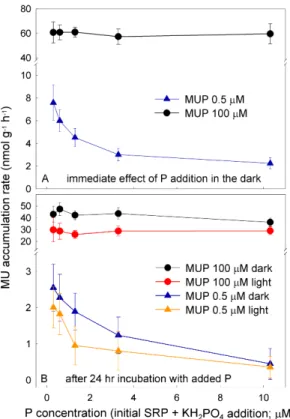
Addition of inorganic P in the form of KH2PO4 had an immediate and significantly negative effect on phosphatase activity rates during incubations with the substrate (MUP) concentration close to the ambient value (0.5 µM). The phosphatase rates in
20
non-enriched samples were between 5.8 and 11 nmol MUP g−1h−1, and decreased
with increasing concentration of SRP to 1.7–3.1 nmol MUP g−1h−1 in samples en-riched with 10 µM P (Fig. 3a). By contrast, no immediate effect was evident at the saturating concentration of MUP. Here, the phosphatase rates were between 47 and 73 nmol MUP g−1h−1, with no significant difference between the samples (Fig. 3a).
25
Figure 3b shows the effect of P addition after 24-h incubations. There was
a significant decrease in phosphatase activity in the most enriched (+10 µM P)
samples (to 36±3.4 nmol MUP g−1h−1) when exposed to the saturating substrate
BGD
6, 2697–2721, 2009Phosphatase activity on an Arctic glacier
M. Stibal et al.
Title Page
Abstract Introduction
Conclusions References
Tables Figures
◭ ◮
◭ ◮
Back Close
Full Screen / Esc
Printer-friendly Version
Interactive Discussion
(43±6.7 nmol MUP g−1h−1 in non-enriched samples). No significant di
fferences be-tween samples with different P additions were found for the illuminated samples, and the rates were between 14–45 (28±6.3) nmol MUP g−1h−1. A significant negative
ef-fect of P addition in both dark and illuminated samples was observed at the near-in situ concentration, despite the great variability in phosphatase activity between samples
5
(Fig. 3b). The rates of MUP dephosphorylation were significantly higher in samples that underwent a short incubation than in same-treatment samples pre-incubated for 24 h (p<0.01, t-test for dependent samples).
The phosphatase activity was significantly higher in the dark samples
(43±6.1 nmol MUP g−1h−1 at 100 µM MUP, 1.5
±0.9 nmol MUP g−1h−1 at 0.5 µM 10
MUP) than in the illuminated ones (28±6.3 nmol MUP g−1h−1 at 100 µM MUP,
1.2±0.8 nmol MUP g−1h−1 at 0.5 µM MUP), independent of the substrate
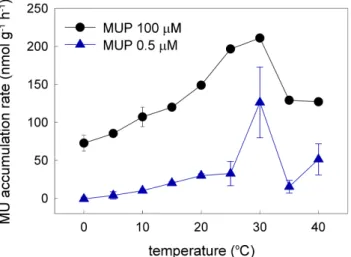
concentra-tion (Fig. 3b). Figure 4 shows the temperature response of phosphatase activity in the samples. The activity increased with increasing temperature and reached its maxi-mum at∼30◦C (210±2.3 nmol MUP g−1h−1at 100 µM MUP, 130±46 nmol MUP g−1h−1 15
at 0.5 µM MUP), and steeply declined at higher temperatures.
Table 1 shows the numbers of phosphatase activity sites in the samples. The pres-ence of phosphatase activity sites, both free and cell-associated, was often bound to the surface of debris particles (Fig. 5a–c and d–f). Large clusters of phosphatase activ-ity sites were also observed in breaking eukaryotic cells. Most sites (>80%) were free,
20
and were not associated with any DNA-stained cells. Approximately 17% of the sites were associated with microbial cells. Figure 5g shows a red-autofluorescing cyanobac-terial filament with some phosphatase activity sites attached. In such cases it was not possible to unambiguously determine whether the phosphatase was produced by the photoautotroph or by heterotrophic cells adhered to the filament sheath. No
signifi-25
BGD
6, 2697–2721, 2009Phosphatase activity on an Arctic glacier
M. Stibal et al.
Title Page
Abstract Introduction
Conclusions References
Tables Figures
◭ ◮
◭ ◮
Back Close
Full Screen / Esc
Printer-friendly Version
Interactive Discussion
4 Discussion
4.1 P deficiency in the supraglacial environment
Significant phosphatase activity was detected in cryoconite debris samples from the surface of Werenskioldbreen, which indicates that the microbes within the debris are in some way P-stressed (Cembella et al., 1984; Price and Morel, 1990; Dyhrman and
5
Palenik, 1999). This finding is further supported by the decrease in phosphatase ac-tivity after inorganic P additions (Fig. 3a, b), which is considered to be a sign of P defi-ciency (Cembella et al., 1984). Since this was determined at the near-in situ substrate concentration (0.5 µM), we argue that P is deficient and limiting in the supraglacial envi-ronment of Werenskioldbreen. Other factors, such as the very high total dissolved
nu-10
trient (TDC:TDP and TDN:TDP) ratios found in cryoconite waters (∼1400:1 and∼60:1,
respectively; Stibal and Tranter, 2007; Stibal et al., 2008b), also support this notion. Wet chemical sequential extraction suggests that there is likely to be sufficient poten-tial bioavailable P within the debris for the microbial need (Stibal et al., 2008b), but our results may indicate that a proportion of this potentially bioavailable debris-bound P is
15
not accessible to some cells, and hence that crude wet chemical sequential extraction may overestimate potentially bioavailable P.
No inhibitory effect of inorganic P addition was observed at the saturating substrate concentration (100 µM), except in the 24-h incubations in the dark. The reason for this is unclear. The possibility that the microbes can adapt to a high OP concentration or to
20
a high DOP:SRP ratio by favouring phosphatase production and/or making it insensitive to SRP addition is not supported when phosphatase activity is plotted against the DOP proportion in TDP (data not shown).
The only previously reported phosphatase activity rates from the glacial ecosystem come from the microbial communities of Taylor Valley in Antarctica. Phosphatase
activ-25
ity was determined in samples from cryoconite holes and the overlying ice from several glaciers, with recorded rates of∼20 nmol l−1h−1in cryoconite holes and<5 nmol l−1h−1
phos-BGD
6, 2697–2721, 2009Phosphatase activity on an Arctic glacier
M. Stibal et al.
Title Page
Abstract Introduction
Conclusions References
Tables Figures
◭ ◮
◭ ◮
Back Close
Full Screen / Esc
Printer-friendly Version
Interactive Discussion
phatase activity in a subglacial discharge from Taylor Glacier. The rates were up to∼20 nmol l−1h−1 in the ice melt and up to
∼60 nmol l−1h−1 in the slush ice slurry
(Mikucki et al., 2004). A more detailed study on phosphatase activity and P deficiency was conducted in the permanently ice-covered lakes in Taylor Valley (Dore and Priscu, 2001). The results of the phosphatase activity measurements showed similar rates, up
5
to 50 nmol l−1h−1, with the Michaelis constant Km between 2.4–3.8 µM and the maxi-mum rate Vmax∼50 nmol l−1h−1.
In this study, we determined phosphatase activity in cryoconite holes on a mass basis (i.e., nmol g−1h−1). The reason why we relate the activity to the debris mass is
that virtually all microbial cells and their activity are associated with the debris (Hodson
10
et al., 2007). Nevertheless, in order to compare our results with the Antarctic data, we converted our values from nmol g−1h−1 to nmol l−1h−1. We did this by using a
conversion factor of 2, since the debris:water ratio used in our experiments is equivalent to 2 g per litre. However, in the absence of information about the debris:water ratio in the Antarctic studies, caution must be exercised when comparing these data with ours.
15
The comparison is further complicated by the fact that we could not use the natural debris:water ratio in our experiments due to the technical problems described above, and the fact that the SRP and DOP concentrations in the experimental samples were
∼10 times higher than those in situ. This was a result of a stable water column, shaking
the tubes and using a high pH buffer, as opposed to flowing dilute supraglacial melt
20
with a pH of∼5.4 in the field (Stibal et al., 2008a). However, the SRP:DOP ratio in the experimental samples was consistent with the in situ one (Stibal et al., 2008b).
Our converted phosphatase activity rate values at 5◦C are
∼38–130 nmol l−1h−1and
the calculated maximum activity rate Vmax is ∼150 nmol l−1h−1, which is somewhat
higher than the Antarctic data. Our Km (13 µM), the substrate concentration at which
25
concentra-BGD
6, 2697–2721, 2009Phosphatase activity on an Arctic glacier
M. Stibal et al.
Title Page
Abstract Introduction
Conclusions References
Tables Figures
◭ ◮
◭ ◮
Back Close
Full Screen / Esc
Printer-friendly Version
Interactive Discussion
tions are similar within cryoconite holes on Werenskioldbreen and the Taylor Valley lakes (0.75 and 0.62 µg l−1, respectively), the DIN:SRP ratios are mostly higher in the
Antarctic lakes (50–3700) than in the holes (∼200) (Dore and Priscu, 2001; Stibal et al., 2008b). The lake water also lacks the P-rich debris which is present in cryoconite holes on Werenskioldbreen. This is consistent with cryoconite holes on
Werenskiold-5
breen being less P-stressed than the Taylor Valley lakes.
4.2 Environmental effects on phosphatase activity
The time course of phosphatase activity and the accumulation of the product shown in Fig. 1a, b has a number of implications. First, no or very little active enzyme is likely to be preserved in cryoconite holes when they are frozen solid. This is indicated by the
10
very low initial activity rates and product concentrations, and it is in contrast with the high time-zero activity determined in Antarctic lakes (Dore and Priscu, 2001). Second, the cryoconite microbial community reacts upon the P deficiency in the environment immediately after melting by producing fresh phosphatase. The phosphatase activity was reduced after ∼30–45 min in our experiments (Fig. 1b). This may be explained 15
by the inhibition of phosphatase caused by the product itself (Cembella et al., 1984). Other negative factors, such as carbon and/or nitrogen limitation, may have played a role during the incubations and thus reduced the phosphatase activity. The nega-tive effect of inorganic P on the phosphatase activity rates (Fig. 3) indicates that most of the phosphatases produced are inducible, or triggered by the environment, rather
20
than constitutive, or constantly produced by the cells independently of the environment (Jansson et al., 1988).
The lower phosphatase activity determined in samples pre-incubated for 24 h (Fig. 3a, b) may be explained by dissolution of debris and/or initial microbial phos-phatase activity after melting and consequent release of SRP into solution, with a
sub-25
BGD
6, 2697–2721, 2009Phosphatase activity on an Arctic glacier
M. Stibal et al.
Title Page
Abstract Introduction
Conclusions References
Tables Figures
◭ ◮
◭ ◮
Back Close
Full Screen / Esc
Printer-friendly Version
Interactive Discussion
dynamic response to environmental changes in terms of phosphatase activity.
The temperature effect on phosphatase activity shown in Fig. 4 agrees well with pre-vious studies from other freshwater environments (Healey and Hendzel, 1979; Jans-son et al., 1988), including Antarctic lakes (Dore and Priscu, 2001), with an optimum at∼30◦C. This means that the microbes on the glacier surface, or at least their phos-5
phatases, are not adapted to very low temperatures, and that their potential to utilise DOP is higher and may be used when they are transported into a higher-temperature downstream environment. This finding also supports the assertion that most microbes on glaciers are not indigenous and probably originate from nearby soil and freshwater ecosystems (Stibal and Tranter, 2007; Stibal et al., 2008a).
10
4.3 Distribution and association of phosphatase activity with microbial cells
The higher phosphatase activity in the dark (Fig. 3b) suggested that most of the activity may be associated with heterotrophic microbes. Therefore, we used enzyme-labelled fluorescence (ELF) in order to gain an insight into the distribution of phosphatase ac-tivity within the cryoconite community. ELF had been used for direct localisation of
15
phosphatase activity and its association with different functional groups or species of microorganisms in various environments, including a mesotrophic mountain lake (Ne-doma et al., 2003) and cyanobacteria-dominated oligotrophic wetland benthic mats (Sirov ´a et al., 2006), where the phosphatase activity was mostly unassociated with photoautotrophs. Our observations suggest that most phosphatase activity (∼80%) in 20
the supraglacial environment of Werenskioldbreen is not directly associated with mi-crobial cells. Hence, it is not possible to distinguish between the heterotrophic and autotrophic contribution with confidence. The free phosphatase is probably supplied by excretion from growing bacteria and/or algae, as is often the case in lakes (Jansson et al., 1988). This also means that the free phosphatase and the products of its activity
25
may be available for all the microbes, and that there is no competitive advantage with either heterotrophs or photoautotrophs regarding P availability.
BGD
6, 2697–2721, 2009Phosphatase activity on an Arctic glacier
M. Stibal et al.
Title Page
Abstract Introduction
Conclusions References
Tables Figures
◭ ◮
◭ ◮
Back Close
Full Screen / Esc
Printer-friendly Version
Interactive Discussion
very clear. However, as intracellular phosphatases usually become inactive if they are released from the cell and exposed to the surrounding environment (Jansson et al., 1988), we assume that they are less important than inducible extracellular phos-phatases produced specifically to cope with environmental P stress. This is also sup-ported by the inhibition of the activity by inorganic P addition.
5
4.4 Potential DOP turnover
In order to estimate the organic P turnover in situ we used the phosphatase activity rates measured at conditions simulating the supraglacial environment as close as pos-sible. We used a near-in situ substrate concentration (0.5 µM) and a low temperature (5◦C). We acknowledge the limitations of the laboratory approach, since we could
10
not use the natural debris:water ratio and the pH and P concentration in the incuba-tions were higher than those in the field. This may cause an overestimation of the organic P utilisation potential in the field. However, it is also important to realise that MUP represents only a part of all substrate available for phosphatase (i.e., DOP) in the experiments, and so the actual rates of DOP hydrolysis may be higher than the
15
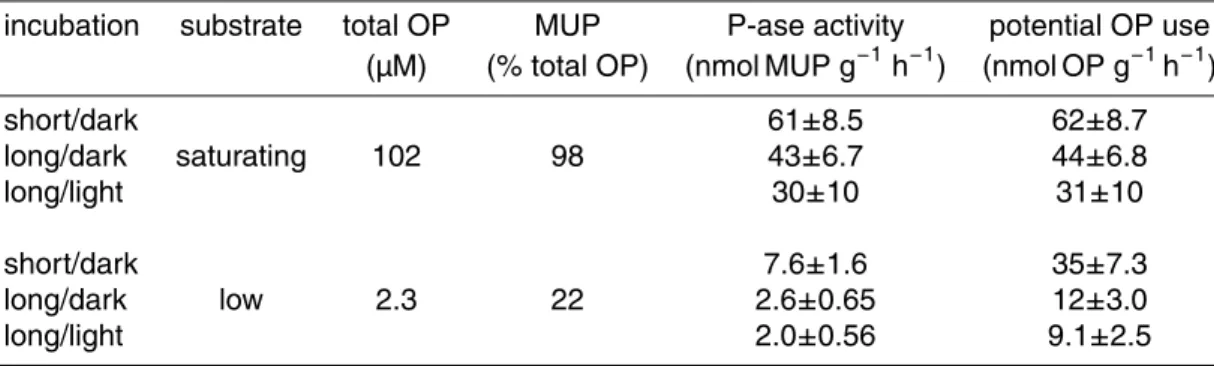
numbers shown in Figs. 3 and 4. Table 2 shows the actual rates calculated using the measured DOP concentration and the MUP additions. The difference between 0.5 and 100 µM MUP is still statistically significant. Therefore, we consider the respective ad-justed phosphatase activity rates (9–35 nmol OP g−1h−1; equivalent to
∼18–70 nmol of
DOP per litre per hour; Table 2) a reasonable approximation of the in situ DOP
util-20
isation potential (Jansson et al., 1988), with the lower values (∼9 nmol OP g−1h−1 or ∼18 nmol DOP l−1h−1) being probably more realistic.
If DOP, whose concentration in cryoconite holes on Werenskioldbreen is ∼0.2 µM
(Stibal et al., 2008b), were preferentially utilised, its turnover rate by microbial pro-cesses would be between ∼2.9–11 h. This is slower than in the Taylor Valley lakes,
25
Weren-BGD
6, 2697–2721, 2009Phosphatase activity on an Arctic glacier
M. Stibal et al.
Title Page
Abstract Introduction
Conclusions References
Tables Figures
◭ ◮
◭ ◮
Back Close
Full Screen / Esc
Printer-friendly Version
Interactive Discussion
skioldbreen contains∼1.2 mg of OP per gram (Stibal et al., 2008b), i.e.∼39 µmol g−1.
Given the per gram rates, the debris-bound OP could be turned over in∼1100–4300 h
or∼46–180 days. This means that the organic phosphorus reservoir within the debris
may supply P for the whole community over the entire ablation season. However, as discussed above, it is possible that some of the potentially bioavailable organic P in the
5
debris is not accessible to some of the microbes, given the crude means of determina-tion of this parameter by wet chemical sequential extracdetermina-tion.
5 Conclusions
The supraglacial microbes live in a P-deficient environment. Inorganic P is scarce and likely to be rapidly depleted. The microbes respond to this stress by producing and
10
excreting phosphatases, and thus are able to recycle organic P liberated from dead cells and from organic matter which is brought to the glacier surface on a regular basis. However, the quality of the imported organic matter and the efficiency of its utilisation by the supraglacial microbes remains unknown and needs to be addressed in future research.
15
Acknowledgements. This research was supported by BIOTRACS, an EU-funded EST fellow-ship (MEST-CT-2004-514262) for MS, and a NERC grant NE/D007321/1 for AMA. We thank Stanislav ˇReh ´ak and Josef ˇReh ´ak Jr. for field assistance.
References
Anesio, A. M., Hodson, A. J., Fritz, A., Psenner, R., and Sattler, B.: High microbial activity on
20
glaciers: importance to the global carbon cycle, Global Change Biol., 15, 955–960, 2009. 2698, 2699, 2700
Cembella, A. D., Antia, N. J., and Harrison, P. J.: The utilization of inorganic and organic phos-phorus compounds as nutrients by eukaryotic microalgae: A multidisciplinary perspective, Part 1., CRC Crit. Rev. Microbiol., 10, 317–391, 1984. 2699, 2707, 2709
BGD
6, 2697–2721, 2009Phosphatase activity on an Arctic glacier
M. Stibal et al.
Title Page
Abstract Introduction
Conclusions References
Tables Figures
◭ ◮
◭ ◮
Back Close
Full Screen / Esc
Printer-friendly Version
Interactive Discussion
Dore, J. E. and Priscu, J. C.: Phytoplankton phosphorus deficiency and alkaline phosphatase activity in the McMurdo Dry Valley lakes, Antarctica, Limnol. Oceanogr., 46, 1331–1346, 2001. 2699, 2708, 2709, 2710, 2711
Dyhrman, S. T. and Palenik, B.: Phosphate stress in cultures and field populations of the dinoflagellateProrocentrum minimum detected by a single-cell alkaline phosphatase assay,
5
Appl. Environ. Microbiol., 65, 3205–3212, 1999. 2707
Foreman, C. M., Sattler, B., Mikucki, J. A., Porazinska, D. L., and Priscu, J. C.: Metabolic activity and diversity of cryoconites in the Taylor Valley, Antarctica, J. Geophys. Res., 112, G04S32, doi:10.1029/2006JG000358, 2007. 2699, 2707
Healey, F. P. and Hendzel, L. L.: Fluorometric measurement of alkaline phosphatase activity in
10
algae, Freshwater Biol., 9, 429–439, 1979. 2710
Hodson, A. J., Mumford, P. N., Kohler, J., and Wynn, P. M.: The High Arctic glacial ecosystem: new insights from nutrient budgets, Biogeochemistry, 72, 233–256, 2005. 2699, 2700 Hodson, A., Anesio, A. M., Ng, F., Watson, R., Quirk, J., Irvine-Fynn, T., Dye, A., Clark, C.,
McCloy, P., Kohler, J., and Sattler, B.: A glacier respires: quantifying the distribution and
res-15
piration CO2flux of cryoconite across an entire Arctic supraglacial ecosystem, J. Geophys.
Res., 112, G04S36, doi:10.1029/2007JG000452, 2007. 2699, 2708
Hodson, A., Anesio, A. M., Tranter, M., Fountain, A. G., Osborn, M., Priscu, J., Laybourn-Parry, J., and Sattler, B.: Glacial ecosystems, Ecol. Monogr., 78, 41–67, 2008. 2698, 2700
Jansson, M., Olsson, H., and Pettersson, K.: Phosphatases: origin, characteristics and function
20
in lakes, Hydrobiologia, 170, 157–175, 1988. 2699, 2708, 2709, 2710, 2711
Jeffries, D. S., Dieken, F. P., and Jones, D. E.: Performance of the autoclave digestion method for total phosphorus analysis, Water Res., 13, 275–279, 1979. 2701
Kaˇstovsk ´a, K., Elster, J., Stibal, M., and ˇSantr ˚uˇckov ´a, H.: Microbial assemblages in soil mi-crobial succession after glacial retreat in Svalbard (High Arctic), Microb. Ecol., 50, 396–407,
25
2005. 2698
Mikucki, J. A., Foreman, C. M., Sattler, B., Lyons, W. B., and Priscu, J. C.: Geomicrobiology of Blood Falls: an iron-rich saline discharge at the terminus of the Taylor Glacier, Antarctica, Aquat. Geochem., 10, 199–220, 2004. 2699, 2707, 2708
Mindl, B., Anesio, A. M., Meirer, K., Hodson, A. J., Laybourn-Parry, J., Sommaruga, R., and
30
Sattler, B.: Factors influencing bacterial dynamics along a transect from supraglacial runoff
BGD
6, 2697–2721, 2009Phosphatase activity on an Arctic glacier
M. Stibal et al.
Title Page
Abstract Introduction
Conclusions References
Tables Figures
◭ ◮
◭ ◮
Back Close
Full Screen / Esc
Printer-friendly Version
Interactive Discussion
natural waters, Anal. Chim. Acta, 26, 31–36, 1962. 2701
Nedoma, J., ˇStrojsov ´a, A., Vrba, J., Kom ´arkov ´a, J., and ˇSimek, K.: Extracellular phosphatase activity of natural plankton studied with ELF97 phosphate: fluorescence quantification and labelling kinetics, Environ. Microbiol., 5, 462-472, 2003. 2710
Price, N. M. and Morel, F. M. M.: Role of extracellular enzymatic reactions in natural waters,
5
in: Aquatic Chemical Kinetics: Reaction Rates of Processes in Natural Waters, edited by: Stumm, W., Wiley, New York, 235-257, 1990. 2699, 2707
S ¨awstr ¨om, C., Mumford, P., Marshall, W., Hodson, A., and Laybourn-Parry, J.: The microbial communities and primary productivity of cryoconite holes in Arctic glacier (Svalbard 79◦N), Polar Biol., 25, 591–596, 2002. 2698, 2699
10
S ¨awstr ¨om, C., Laybourn-Parry, J., Gran ´eli, W., and Anesio, A. M.: Heterotrophic bacterial and viral dynamics in Arctic freshwaters: results from a field study and nutrient-temperature ma-nipulation experiments, Polar Biol., 30, 1407-1415, 2007. 2699
Sirov ´a, D., Vrba, J., and Rejm ´ankov ´a, E.: Extracellular enzyme activities in benthic cyanobac-terial mats: comparison between nutrient-enriched and control sites in marshes of northern
15
Belize, Aquat. Microb. Ecol., 44, 11–20, 2006. 2710
Stibal, M., ˇSaback ´a, M., and Kaˇstovsk ´a, K.: Microbial communities on glacier surfaces in Sval-bard: impact of physical and chemical properties on abundance and structure of cyanobac-teria and algae, Microb. Ecol., 52, 644–654, 2006. 2698, 2701
Stibal, M. and Tranter, M.: Laboratory investigation of inorganic carbon uptake by
cry-20
oconite debris from Werenskioldbreen, Svalbard, J. Geophys. Res., 112, G04S33, doi:10.1029/2007JG000429, 2007. 2699, 2701, 2707, 2710
Stibal, M., Tranter, M., Benning, L. G., and ˇReh ´ak, J.: Microbial primary production on an Arctic glacier is insignificant in comparison with allochthonous organic carbon input, Environ. Microbiol., 10, 2172–2178, 2008a. 2699, 2700, 2708, 2709, 2710
25
Stibal, M., Tranter, M., Telling, J., and Benning, L. G.: Speciation, phase association and poten-tial bioavailability of phosphorus on a Svalbard glacier, Biogeochemistry, 90, 1–13, 2008b. 2699, 2700, 2707, 2708, 2709, 2711, 2712
Wharton Jr., R. A., McKay, C. P., Simmons Jr., G. M., and Parker, B. C.: Cryoconite holes on glaciers, BioScience, 35, 499–503, 1985. 2698
BGD
6, 2697–2721, 2009Phosphatase activity on an Arctic glacier
M. Stibal et al.
Title Page
Abstract Introduction
Conclusions References
Tables Figures
◭ ◮
◭ ◮
Back Close
Full Screen / Esc
Printer-friendly Version
Interactive Discussion Table 1. Abundance of all microbial and chlorophyll-containing (Chl+) cells, and the number
of phosphatase activity (P-ase) sites and their association with microbial cells within cryoconite debris from Werenskioldbreen (mean±sd,n=60). No statistical differences between dark and light incubations were found (p>0.05, t-test for independent samples).
incubation total cells Chl+cells P-ase sites cell associated P-ase sites (104mg−1
) (104mg−1
) (104mg−1
) (% total sites)
dark 42±26 1.8±2.6 5.7±3.8 16±28
BGD
6, 2697–2721, 2009Phosphatase activity on an Arctic glacier
M. Stibal et al.
Title Page
Abstract Introduction
Conclusions References
Tables Figures
◭ ◮
◭ ◮
Back Close
Full Screen / Esc
Printer-friendly Version
Interactive Discussion Table 2. Organic P utilisation potential as calculated from phosphatase activity rates in
non-enriched samples shown in Figs. 3 and 4. The differences in rates in same-type incubations be-tween saturating and low substrate concentrations are significant (p<0.01; t-test for dependent samples). The potential OP utilisation rates from the low near-in situ substrate concentrations were used for the OP turnover estimate.
incubation substrate total OP MUP P-ase activity potential OP use (µM) (% total OP) (nmol MUP g−1
h−1
) (nmol OP g−1
h−1
)
short/dark 61±8.5 62±8.7
long/dark saturating 102 98 43±6.7 44±6.8
long/light 30±10 31±10
short/dark 7.6±1.6 35±7.3
long/dark low 2.3 22 2.6±0.65 12±3.0
BGD
6, 2697–2721, 2009Phosphatase activity on an Arctic glacier
M. Stibal et al.
Title Page
Abstract Introduction
Conclusions References
Tables Figures
◭ ◮
◭ ◮
Back Close
Full Screen / Esc
Printer-friendly Version
Interactive Discussion Fig. 1.Phosphatase activity in cryoconite samples from Werenskioldbreen. The initial substrate
(MUP) concentration was 100 µM and saturating. The samples were incubated in the dark at 5◦C.
BGD
6, 2697–2721, 2009Phosphatase activity on an Arctic glacier
M. Stibal et al.
Title Page
Abstract Introduction
Conclusions References
Tables Figures
◭ ◮
◭ ◮
Back Close
Full Screen / Esc
Printer-friendly Version
Interactive Discussion Fig. 2. Substrate response curve for phosphatase in cryoconite samples from
Werenskiold-breen (mean±sd,n=8). The red circle denotes the point [Km; 12Vmax] calculated from
BGD
6, 2697–2721, 2009Phosphatase activity on an Arctic glacier
M. Stibal et al.
Title Page
Abstract Introduction
Conclusions References
Tables Figures
◭ ◮
◭ ◮
Back Close
Full Screen / Esc
Printer-friendly Version
Interactive Discussion Fig. 3.Effect of P addition on the phosphatase activity rate in cryoconite samples from
Weren-skioldbreen at saturating (100 µM) and near-in situ (0.5 µM) concentrations of the substrate.
BGD
6, 2697–2721, 2009Phosphatase activity on an Arctic glacier
M. Stibal et al.
Title Page
Abstract Introduction
Conclusions References
Tables Figures
◭ ◮
◭ ◮
Back Close
Full Screen / Esc
Printer-friendly Version
Interactive Discussion Fig. 4. Temperature response of phosphatase activity in cryoconite samples from
BGD
6, 2697–2721, 2009Phosphatase activity on an Arctic glacier
M. Stibal et al.
Title Page
Abstract Introduction
Conclusions References
Tables Figures
◭ ◮
◭ ◮
Back Close
Full Screen / Esc
Printer-friendly Version
Interactive Discussion Fig. 5. Visualisation of phosphatase activity in cryoconite debris from Werenskioldbreen. (A–