Pak. J. Anal. Environ. Chem. Vol. 17, No. 1 (2016) 33 – 37
Study of Zinc Leaching of EAF Flue Dust Using Sodium
Hydroxide
Ahsan Abdul Ghani
1, Junaid Saleem
1,2*, Zeeshan A Hameed
3, Hira Lal
1and
Muhammad Shoaib
11Department of Chemical Engineering, University of Karachi, Karachi, Pakistan 2
Department of Mechanical Engineering, DHA Suffa University, Karachi, Pakistan 3
Department of Quality Assurance, Peoples Steel Mills Ltd., Karachi, Pakistan *Corresponding Author Email: [email protected]
Received 01 February 2016, Revised 16 June 2016, Accepted 29 June 2016
---Abstract
During the production of steel from Electric Arc Furnace (EAF), large amount of by-product called EAF flue dust is generated. The major proportion of flue dust is comprised of Zn (41.5 % wt.). Different phases identified by XRD analysis are zincite, franklinite and magnetite with zincite being dominant. In this study, we have performed flue dust treatment using sodium hydroxide as leaching medium. Different concentrations of alkali were used to optimize maximum recovery of Zn. XRF and Wet Chemical method were used to characterize the dust samples both before and after leaching. The optimum alkali concentration for selective leaching of zinc was found to be 4 M with a zinc recovery of 90 %.
Keywords:EAF dust, Leaching, Sustainable environment, Zinc recovery.
---Introduction
In steel-making plant, the production of Electric Arc Furnace (EAF) dust is 1–2 % of total steel obtained that contains a considerable amount of hazardous metallic wastes [1][2]. This dust is classified as a hazardous waste class I, code K061 by the Environmental Protection Agency (EPA). The most hazardous metals according to EPA classification are lead, cadmium and chromium (VI), whereas zinc, due to its comparatively large amount present is the most valuable component [1,3–7]. Zinc sulphide and zinc carbonate are the main source of zinc production however it is partly produced from various complexes and wastes such as zinc ash, zinc dross, EAF dusts, scraps and slags by pyrometallurgical, hydrometallurgical or their combination processes [8][9].
The flue dust is either directly thrown to landfill without any pretreatment to remove hazardous components or added into the air as
pollutant. In addition, it has been observed that this flue dust is rich in valuable metals such as Zn and Fe which may be recovered using standard recovery procedure [10]. The department of mineral resources of Pakistan reported that this dust consisted of 25–50 wt.% zinc, 10–40 wt.% iron, which is around 225–500 MT of zinc and around 90–400 MT of iron. The major processes to dispose this dust are chemical stabilization, vitrification, pyrometallurgy, and hydrometallurgy. Hydrometallurgy is widely used for zinc recovery due to economic and environmental benefits [11– 13].
In Pakistan several types of zinc-containing waste materials are available. These include electric arc furnace flue dust, zinc scrap and spent dry cell batteries. Among them, the major proportion of zinc is found in EAF flue dust. The contents of Zn, Fe and Pb in EAF dust
st th th
according to global perspective are shown in (Fig. 1) [18]–[24]. It is noted that the highest percentage of zinc is available in Pakistani EAF flue dust, which is mainly due to the use of 100 % automotive galvanized scrap. As these metals are present in the form of metal oxides and are harmful to the environment, therefore it is strictly prohibited as per the guidelines of EPA to dispose-off the flue dust either in the air or as landfills without treatment. Hence to meet economic benefits and environmental constrains, it is necessary to recover valuable metals from the flue dust.
Until now, extensive research efforts have been conducted to optimize kinetic parameters of hydrometallurgical method leading to maximized zinc recovery. The primary work focused on utilization of the leaching reagent such as sulfuric acid [2,14–21]; hydrochloric acid [22,23]; nitric and citric acids [12]; and sodium hydroxide [1,3,9,11,24–26]. All the leaching agents showed different affinity towards different metals, zinc being the most attractive. Sulfuric acid is widely used leaching medium for both zinc and iron; although it requires electrowinning step for the purification of zinc, whereas sodium hydroxide selectively removes zinc at low concentrations thus avoiding need of electrowinning [3].
In this paper, hydrometallurgical technique using alkaline leaching from an EAF dust is investigated, aiming at maximum recovery of zinc. Sodium hydroxide was chosen as leaching agent as it is effective in the dissolution of zinc, lead and other toxic heavy metals without significant dissolution of iron, thus reducing the hazardous character of solid residue.
Materials and Methods
Chemical composition of the sample was determined by wet chemical method (WCM). Trace elements were analyzed as pressed pellet through Axiosmax, WD-XRF spectrometer of 3KW X-ray tube. The pressed pellets were prepared at 6:1 (sample: binder) with the help of Omnian standard application of PANalytical origin. For mineralogical phase identification, the EAF dust
sample was examined by X-ray diffractometer (Model JDX-3532, JEOL Ltd., Tokyo, Japan) using CuKa radiation of wavelength, λ = 1.5418 A°. (Fig. 2) shows the diffraction patterns of the dust.
Figure 1.Comparison of Global EAF Dust Composition
A small unit was developed to leach out metals from their metal oxide present in EAF Dust. The unit comprised of a glass vessel of 0.5 L covered with a polycarbonate disk of same size as of the beaker. The disk consisted of two openings, one for mechanical agitator having adjustable revolutions and second for thermometer. The temperature was maintained using Isomantle having thermostat for temperature control. To study kinetics, leaching experiments were performed with solution of 400 ml of different alkali concentrations (2, 4, 6 and 8 M NaOH) at 90
0
C. The sample weight was taken as 8 g, measured on analytical weight balance. A solution with alkali-to-EAF dust ratio (ml/g) of 50 was used.
st th th
revealing clear solutions. Residue left on the filter paper weighed, dried in oven at around 110 oC. The elementary analysis of residual samples were carried out in order to determine elements composition using PANalytical XRF spectrophotometer.
Results and Discussion
Characterization of samples
The chemical composition of EAF flue dust depends on types of steel, quality of scraps being processed, operating conditions, recycling of dust, efficiency of de-dusting plant to capture the dust and molten metal to slag thermodynamic reactions. Chemical composition of dust samples was provided in (Table 1), which shows that it is rich in valuable metals including Zn 41.446 %, Fe 15.471 % and Pb 2.03 %. In addition, Na, K and Ca are also present around 1 % each, that can be easily leached out by ion exchange technique [14]. Heavy metals like Pb & Cd as well as halides of Cl are also found. They all are beyond the range of disposable landfills as per EPA, USA. (Recommended safe limits for EAF flue dust are Cd: 0.19, Pb: 0.37 mg/L).
Table 1. Chemical Composition by Wet Chemical & XRF Spectrometer.
Comp Mg K Ca Cr Mn Fe Cu Zn Pb
% 0.694 1.019 0.914 0.260 0.905 15.471 0.226 41.446 2.03
Leaching reaction
The reactions of main species occurring in the sample and their stoichiometry can be stated as follows:
ZnO + 2NaOH→ Na2ZnO2(aq) + H2O(l) (1)
ZnFe2O4+2NaOH→Na2ZnO2(aq) +Fe2O3(s)+H2O(l) (2)
PbO + 2NaOH→ Na2PbO2(aq) + H2O(1) (3)
FeO + 4NaOH→ Na4FeO3(aq) + 2H2O(1) (4)
Fe2O3+ 6NaOH→ 2Na3FeO3(aq) + 3H2O(1) (5)
Fe3O4+ 14NaOH→ Na4FeO3(aq) + 2Na5FeO4(aq) + 7H2O(1) (6)
X-ray diffraction pattern
For the identification of all possible phases, X-ray diffraction of the EAF dust have been performed. (Fig. 2) shows the XRD patterns of untreated EAF dust as well as alkali treated EAF dust with concentrations of 2M, 4M, 6M and 8M. The dominant phases identified by XRD analysis are zincite, franklinite and magnetite. In EAF dust, zinc is found in the forms of zinc oxide (zincite– ZnO) and zinc ferrite (franklinite–ZnFe2O4),
whereas iron is mainly in the form of franklinite and magnetite (Fe3O4). Zinc oxide has four distinct
peaks with 2θ of 31.77°, 34.42°, 36.24° and
47.57°. The graph shows that ZnFe2O4and Fe3O4
have the same diffraction patterns. Phases with low fractions such as quartz, CaFe2O5, etc. have also
been identified with suppressed peaks in the background. Peak of ZnO phase was found decreasing with increase in alkali concentration.
Effect of alkali concentration on metal recovery
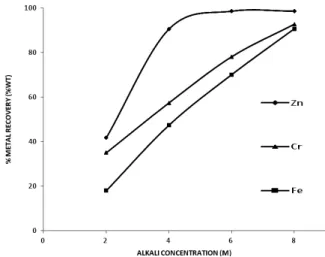
The effect of alkali concentrations was investigated at 120 minutes by keeping other conditions constant as liquid-to-solid ratio of 50 ml/g and temperature 90 oC in the concentration range of 2 - 8 M. The results obtained are shown in (Fig. 3). From these tests, it could be deduced that the recovery of zinc, iron and chromium are functions of alkali concentrations; increase in concentration of alkali increases the leaching of zinc preferentially. However, when concentration increases beyond 4 M, it has only little effect on the leaching (Fig. 3). Thus, a concentration of 4 M NaOH should be sufficient for selective extraction of zinc. The highest zinc recovery obtained was 98 % at 8 M concentration of alkali. In case of iron and chromium, percent recovery vary linearly with concentration in increasing order and the highest recovery obtained were 90 % and 92 % respectively at 8 M concentration of caustic soda which is lesser than that of zinc.
Figure 3.% Recovery of different metals vs. concentrations (at 2h leaching time, 300 rpm and 90o
C.)
Effect of alkali concentration on metal
composition
The effect of concentration was investigated for metals left in the residue after completion of leaching. From (Fig. 4) it could be deduced that at 900C, as the concentration of alkali increases, composition of Zn and Fe decreases in the residue thus increasing the recovery. This
confirms that at 8 M concentration, highest % of Zn is leached. The dissolution of zinc is very high, for all concentrations in comparison to other metals, tending to a maximum value of zinc extraction. From 2 M to 4 M, almost 85 % zinc and 45 % of iron was reduced, while from 4 M to 8 M the reduction in zinc and iron are 82 % and 80 % respectively; therefore 4 M is best for selective leaching of zinc.
Figure 4.Metal composition % in residue w.r.t concentrations 2M, 4M, 8M at 2h leaching time, 300 rpm and 90oC.
Comparison of metal composition
Table 2 shows the composition of metals before and after the leaching of EAF dust with alkaline solution at 6 M and 900C. It confirms that zinc has maximum extraction efficiency in comparison to other metals as it is 80 % reduced while iron and lead are reduced to 28 % and 66 % respectively.
Table 2.The chemical composition of the zinc extraction residue before and after Alkali leaching when treated at a concentration of 6 M.
Sample Zn % Fe % Pb %
Before Leaching 41.45 15.47 2.03
After Leaching 8.11 11.24 0.68
Conclusion
Based on results achieved in the laboratory study, it was found that major portion of zinc present in an EAF dust is zincite, with some portion of zinc ferrite and iron oxide as confirmed
Zn Fe
Metals
%
M
e
ta
l
C
o
m
p
o
si
ti
o
n
40
30
20
10
st th th
by X-ray diffraction analysis. The characterization of as received EAF dust sample was carried out which revealed the following composition: 41.446 % Zn, 15.471 % Fe and 2.03 % Pb. It was deduced through experimentation that the concentration of 4 M is the optimum for selective leaching of zinc from EAF dust using alkaline solution. It was also observed that the highest zinc recovery was 98 % after leaching for 2 h with 8 M NaOH solution with other heavy metals such as chromium and iron. The investigation of the residue using XRF showed that the impurities such as Ca, Mg and K were in negligible level, which was further confirmed by XRD results due to the suppressed peaks. In addition, presence of low iron content in the solution obtained after leaching eliminates the need for the electrowinning process for zinc separation.
Acknowledgement
The authors would like to acknowledge Higher Education Commission (HEC) Pakistan for the financial support with project grant number 21-470. Authors are also grateful to Peoples Steel Mills Ltd., HEJ Research Institute of Chemistry, University of Karachi, NED University of Engineering & Technology to provide necessary support.
References
1. C. Jarupisitthorn, T. Pimtong and G. Lothongkum, Mater. Chem. Phys.77 (2002) 531.
2. M. Cruells, A. Roca and C. Núnẽz, Hydrometallurgy 31 (1992) 213.
3. A. J. B. Dutra, P. R. P. Paiva and L. M. Tavares,Miner. Eng.19 (2006) 478.
4. R. A. Shawabkeh, Hydrometallurgy 104 (2010) 61.
5. T. Sofilić, A. Rastovčan-Mioč, Š. Cerjan-Stefanović, V. Novosel-Radović and M. Jenko,J. Hazard. Mater.109 (2004) 59. 6. G. Lee and Y. Song,Miner. Eng. 141 (2007)
33.
7. Enrironmental Prot. Agency (EPA), Website
http//www3.epa.gov/epawaste/laws-regs/state/revision/frs/fr95.pdf (1991).
8. M. K. Jha, V. Kumar and R. J. Singh, Resour. Conserv. Recycl. 33 (2001) 1. 9. M. Erdem and M. Yurten, J. Min. Metall.
Sect. B Metall.51 (2015) 89.
10. H. Mordoǧan, T. Çïçek and A. Işik, Turkish
J. Eng. Environ. Sci.23 (1999) 199.
11. H. Gao, Z. Zhang, Y. Lai, J. Li and Y. Liu,J.
Cent. South Univ. Technol. (Engl. Ed.) 17
(2010) 967.
12. I. H. Lee, Y. J. Wang and J. M. Chern, J.
Hazard. Mater.123 (2005) 112.
13. M. S. Lutandula and G. N. Kashala, J.
Environ. Chem. Eng.1 (2013) 600.
14. F. Kukurugya, T. Vindt and T. Havlík, Hydrometallurgy 154 (2015) 20.
15. M. Kul, K. O. Oskay, M. ŞİMŞİR, H. Sübütay and H. Kirgezen,Trans. Nonferrous
Met. Soc. China.,25 (2015) 2753.
16. T. Havlik, K. Frantisek and A. Miskufova,J. Jan,(2015) 1.
17. T. Havlik, F. Kukurugya, D. Orac, L. Parilak, World Metall. - ERZMETA 65 (2012) 48. 18. Antti KEKKI, J. AROMAA and O.
FORSEN, Physicochem. Probl. Miner.
Process.48 (2012) 599.
19. P. E. Tsakiridis, P. Oustadakis, A. Katsiapi, and S. Agatzini-Leonardou, J. Hazard.
Mater.179 (2010) 8.
20. T. Havlik, B. Souza, A. Bernardes and I. Schneider,Miskufova, J. Hazard. Mater. 135 (2006) 311.
21. T. Havlik, M. Turzakova, S. Stopic and B. Friedrich,Hydrometallurgy, 77 (2005) 41. 22. Š. Langová, J. Leško and D. Matýsek,
Hydrometallurgy, 95 (2009) 179.
23. J. Niemczewska, R. Cierpiszewski and J. Szymanowski,Desalination, 162 (2004) 169. 24. F. M. F. Santos, P. S. Pina, R. Porcaro, V. A. Oliveira, C. A. Silva and V. A. Leão, Hydrometallurgy, 102 (2010) 43.
25. D. K. Xia and C. A. Pickles,Miner. Eng., 12 (1999) 693.