Ocean Sci., 8, 713–732, 2012 www.ocean-sci.net/8/713/2012/ doi:10.5194/os-8-713-2012
© Author(s) 2012. CC Attribution 3.0 License.
Ocean Science
An operational model for the West Iberian coast: products and
services
M. Mateus1, G. Riflet1, P. Chambel2, L. Fernandes1, R. Fernandes1, M. Juliano3, F. Campuzano1, H. de Pablo1, and R. Neves1
1MARETEC, Instituto Superior T´ecnico, Universidade T´ecnica de Lisboa, Av. Rovisco Pais, 1049-001, Lisboa, Portugal 2HIDROMOD, Rua Rui Teles Palhinha, n◦4, 1◦, Lei˜ao, 2740-278 Porto Salvo, Portugal
3LAMTec, Laboratory of Marine Environment and Technology, University of the Azores, Praia da Vit´oria, Azores, Portugal
Correspondence to:M. Mateus ([email protected])
Received: 28 February 2012 – Published in Ocean Sci. Discuss.: 12 April 2012 Revised: 6 August 2012 – Accepted: 6 August 2012 – Published: 31 August 2012
Abstract.This paper presents the structure and application of a regional scale operational modelling tool for the West Iberian coast, and discusses its potential for products and ser-vices for both scientific and coastal management activities. The forecasting suite includes nested hydrodynamic mod-els forced with up-to-date meteorological forecast data and large-scale model results. The present status of the system and its recent upgrades are reviewed, offering a general de-scription of the main components of the system: the forcing data, the circulation model, the model outputs and the vali-dation methodology of model results. Seasonal differences in temperature, salinity and current velocity fields are illustrated and show satisfactory reproduction of the top and deep layer thermodynamics. The system provides boundary forcing for a number of local-scale model applications via downscaling of the solution and enables potential products and services from which civil society will benefit.
1 Introduction
The development of nowcasting and forecasting systems dur-ing the last decades is responsible for significant scientific and technical achievements related to operational oceanog-raphy (Le Traon et al., 2009). Numerical models have be-come irreplaceable tools to link operational oceanography to marine affairs because they continuously provide state esti-mates and forecasts of coastal ocean state. The importance of numerical modelling in operational activities is already established at scales ranging from the coastal (De Mey and
Proctor, 2009 and references included in this Special Issue) to the global ocean (Bell et al., 2009).
Over the last decades several operational modelling sys-tems have been developed with different levels of com-plexity, objectives and end-users (Zhuang et al., 2011). Re-cent EU-funded projects such as the European COastal-shelf sea OPerational observing and forecasting system project (ECOOP), with participation of 72 institutions, highlight the relevance of operational systems for the ocean. Several op-erational platforms combining data gathering and modelling systems have been produced or upgraded in the progress of such projects (e.g. Zhuang et al., 2011; Stanev et al., 2011; Kordzadze and Demetrashvili, 2011; Korotaev et al., 2011).
714 M. Mateus et al.: An operational model for the West Iberian coast
environments. MyOcean product Mediterranean Sea Ultra High Resolution Sea Surface Temperature Analysis was used to validate the MOHID-PCOMS. Argo floater data from IFREMER (French Research Institute for Exploration of the Sea) is also used for validation purposes.
The paper is arranged as follows: Section 2 describes the operational forecasting model scheme implementation. Some regional scale results are presented in Sect. 3, followed by the discussion of the relevance and major challenges of the system in Sect. 4. Section 5 gives a conclusion and an outlook on the work in progress and on future work.
2 The implementation
2.1 The MOHID model
The model used in this operational platform is the MOHID model (www.mohid.com). MOHID is a Portuguese acronym for MOdelac¸˜ao HIDrodinˆamica. It is an open-source geo-physical regional circulation model based at MARETEC, a research group at Instituto Superior T´ecnico (IST) in Portu-gal. MOHID is a free-surface, baroclinic model, which uses the hydrostatic and Boussinesq approximations and a rotat-ing Cartesian reference frame with angular rotation rate−→ following the seminal primitive ocean equations proposed by Bryan (1997). It solves the equations of advection–diffusion of temperatureT, salinityS, and horizontal momentumρu andρv, respectively expressed in Eqs. (1) to (3).It also solves the equation of continuity to determine the vertical velocity wand the water elevationη(Eq. (4)). The densityρis solved with the UNESCO state equation as a function ofS,T and pressurep (Fofonoff and Millard, 1983).ρ0 is a reference
density of seawater near the surface. ∂
∂t
Z
V
T dV+
I
A
(−→n ·−→v)T dS=
I
A
(−→n ·−K−−T→∇)T dS+SST .(1)
∂ ∂t Z V SdV+ I A
(−→n ·−→v)SdS=
I
A
(−→n ·−−→KS∇)SdS+SSS. (2)
∂ ∂t Z V − →
vdV+
I
A
(−→n ·−→v)−→vdS
| {z }
Advection
+
Z
V
2−→×−→vdV
| {z }
Coriolis acceleration
=
I
A
(−→n ·−−→υT∇)−→v
| {z }
Turbulent stress
− g(η−z)−→n
| {z }
Barotropic force −c(t )
η
Z
z
ρ−ρ0 ρ0 dz
− →n
| {z }
Baroclinic force (3) − patm ρ0 − →n
| {z }
Atm pressure
+ 8−→n
|{z}
Gravitational potential
+ c(t )−→τ
| {z }
Surface and bottom stress
dS.
V is an orientable control volume fixed relative to the ref-erence frame origin;Ais its surface and−→n is its outwards normal vector.SST andSSSare the source and sink terms of
their respective properties. They take into account the sensi-ble and latent heat as well as solar radiation with light pen-etration in the temperature equation.patmis the atmospheric
pressure,8 is the gravitational potential which is the sum of the Earth gravitational potential with the astronomical tide potential.gis the vertical component of the gravitational pull near the Earth’s surface, where it is considered constant.−→τ represents the wind and bottom stresses which are calculated proportionally to the square of the relative velocity between interfaces. ∂t∂ is the explicit time derivative,zis the vertical coordinate and−→∇ is the gradient operator.c(t )is a ramp co-efficient function, devised to slowly activate the baroclinic force and the surface stress during the spin-up period, de-fined byTt
c ift < Tc, otherwise it is equal to one. The
ramp-ing periodTcis set to six inertial periods (rotation period of
the Earth).−−→υT∇ ≡
υH∂x∂ , υH∂y∂ , υV∂z∂
is a vector combi-nation of the turbulent viscosity vector −υ→T =(υH, υH, υV)
with the gradient operator. Analogous vector combinations are made with the temperature and salinity turbulent diffu-sion vectors, respectively −K→T and
−→
KS. Turbulent diffusion
is determined separately between its horizontal component and vertical component, often being used as constant turbu-lent diffusions along the horizontal for regional ocean appli-cations, whereas a higher order turbulent closure model is usually chosen to determine the vertical turbulent diffusions. The equations for the vertical turbulent kinetic energy and the eddy dissipation rate due to viscosity (Burchard, 2002) are solved using the GOTM (General Ocean Turbulence Model) solver (Ruiz-Villarreal et al., 2005), embedded in the MO-HID code, from which the model parameterized according to Canuto et al. (2001) is chosen.
M. Mateus et al.: An operational model for the West Iberian coast 715
force, the MOHID model uses a z-level approach for any type of vertical coordinate. This methodology integrates the hor-izontal density gradient always in the Cartesian space. The bottom stress is calculated semi-implicitly for numerical sta-bility reasons.
2.2 Model setup
The online one-way nested modelling system consists of two model configurations. First, a 2-D barotropic model with 0.06◦ of resolution forced only with the FES2004 (Finite Element Solution) tidal atlas (Lyard et al., 2006; Lef`evre et al., 2002), using a Blumberg and Kantha (1985) radi-ation scheme and covering the geographic area 33.5◦N– 45.9◦N and 13.5◦W–4.2◦W. Second, the 2-D (two dimen-sional) model becomes the online external reference tidal so-lution to the West Iberia 3-D (three dimensional) baroclinic model with the same horizontal resolution, covering the re-gion 34.4◦N–45.0◦N and 12.6◦W–5.5◦W (Fig. 1) and with 50 vertical layers, where the bottom 43 are in Cartesian coor-dinates and the top 10 m are 7 sigma coordinate layers. The Cartesian coordinate is not limited like a sigma coordinate over variable topography and steep slopes. Indeed, sigma co-ordinate is known to induce spurious up-sloping velocities due to the pressure gradient term (Beckmann and Haidvo-gel, 1993). Therefore, the Cartesian coordinate is a practi-cal choice in a domain characterized by an abyssal plain, a continental shelf, a very steep shelf slope and large canyons. On the other hand, coastal upwelling and freshwater buoyant plumes coming from river discharges are two regional fea-tures that yield complex stratification patterns near the sur-face and, thus, require a good vertical resolution. The sigma coordinate has the advantage of being a topographically-following coordinate and, thus, provides the same vertical relative resolution near the surface, either in areas with 10 m depth or less than 1 m.
The bathymetric baseline data for both 2-D and 3-D mod-els is the SRTM 30” database. The 3-D model is also forced with a full offline baroclinic solution, the Mercator-Oc´ean Psy2V3 (Psy 2 stands for the Greek letter followed by an integer which codenames a specific region of the North-Atlantic, whereas V3 stands for version 3 of the system) hindcast and forecast for Western Iberia (Cailleau et al., 2010; Drillet, 2005) until December 2010 and the Mercator-Oc´ean Psy2V4 (the upgraded version of the same region) from January 2011 onwards, with a coarser horizontal res-olution than the MOHID model domain (1/12◦)and with the same vertical Cartesian coordinate discretization (to reduce interpolation errors). The absence of tide in the Mercator so-lution is handled by linearly superimposing the 2-D model tidal reference solution to the Mercator reference solution ac-cording to the methodology described by Leit˜ao et al. (2005). Specifically, it consists of performing a mathematical sum at open boundaries of the reference solutions for the level and for the velocities linearly interpolated every time step of the
Fig. 1.West Iberia baroclinic model bathymetry bounded by 5.5◦–
12.6◦W and 34.4◦–45.0◦N, and with a 0.06◦ spatial resolution.
Baseline data from SRTM 30”.
model. The composite tidal reference solution is then applied with a Flather (1976) radiation scheme to the 3-D model. The 3-D model is then submitted to a FRS (Flow Relaxation Scheme) to the Mercator solution foru, v, S andT , follow-ing the methodology described in Martinsen and Engedahl, 1987.
A ten-cell width frame at the border is setup where an ex-ponentially decreasing relaxation time scale is applied, rang-ing from 3×10⁴s inside the domain to 108s close to the
open boundary. The flow relaxation scheme adds small cor-rections to the model results by diminishing deviations from the reference solution (in occurrence, the reference is the Mercator-Oc´ean baroclinic solution composed linearly with the FES2004 tide solution). In particular, this should allow for eddies coming from outside the domain to spread inside the nested domain. However, eddies generated inside the do-main that are absent from the reference solution are not suited to be transported outside of the domain, and instead are dis-sipated by the kinetic energy dissipation rate. Discrepancies between the reference solution and the model solution near the open boundary are expected as both models were setup with different surface forcing and contain different physi-cal processes (tide is absent in the Mercator-Oc´ean solution). In practice, model results residing inside the ten-cell width frame should be considered as part of the open-boundary sys-tem.
716 M. Mateus et al.: An operational model for the West Iberian coast
are assumed. For the extrapolation procedure, the nearest-neighbour approach was used. Both models have 50 iden-tical layers. Additionally, a null velocity field and sea level field with null gradient are assumed. For the spin-up proce-dure, a methodology based on a ramped increase in forcing (baroclinic force, wind stress) was implemented (Leit˜ao et al., 2005).
Furthermore, the system is one-way coupled offline with the atmospheric forecast model MM5 (Mesoscale Meteoro-logical Model 5) running at IST (Sousa, 2002; http://meteo. ist.utl.pt) for the West Iberian coast, providing forecast of 10 m height wind speed, air temperature, mean sea level pres-sure, surface humidity, cloud cover, downward long wave ra-diation and solar rara-diation with a spatial resolution of 9 km and with hourly frequency. The atmospheric model is forced with the forecasts provided by the GFS (Global Forecast Sys-tem). The surface heat flux is parameterized using bulk quan-tities of both the atmosphere and water. The net shortwave and the downward longwave radiation terms are provided directly by the atmospheric model, while the upward long-wave radiation and the turbulent fluxes are calculated by the hydrodynamic model using its own SST (sea surface tem-perature) and the relevant atmospheric parameters. Changes in water volume due to evaporation and precipitation are ig-nored. River runoff is a very important feature, particularly in the study of surface coastal circulation where buoyant fresh-water plumes pay an important contribution. At this point, it is absent in the regional model, but will be added soon in the next version to come. A biharmonic filter (Delhez and Deleersnijder, 2007) replaces horizontal turbulent viscosity in the model configuration.
2.3 MOHID-PCOMS operational system
Since its first introduction as a pre-operational model (Riflet et al., 2008), the West Iberian coast model has evolved and is now running daily in full operational mode with a 3-day fore-cast and keeps a best-guess result historical timeline. This op-erational system, consisting of the numerical model setup de-scribed above, along with Visual Basic and MATLAB scripts and an OPeNDAP/THREDDS (Open-source Project for a Network Data Access Protocol/Thematic Realtime Environ-mental Distributed Data Services) server running in a hy-brid Windows/Linux operating system network environment, is called MOHID-PCOMS. Best-guess results are dissemi-nated to the internet, where data is made freely available at http://opendap.mohid.com:8080/thredds/catalog.html in the scope of EASYCO European project (COllaborative Euro-pean Atlantic water quality forecasting SYstem). The new MOHID-PCOMS operational system is built such that it can easily be replicated to other domains with different regional scales. Currently, a number of local models are coupled to the MOHID-PCOMS in offline mode, with a similar methodogy used as for the MOHID-PCOMS. They also provide 3-day forecast with historical best-guess hindcast. The results of the
these models at the local scale have a potential of utility for civil institutions and the general public, but also are of inter-est to the scientific community, in particular regarding cou-pled physical–biogeochemical research. Both their domains and their utility will be addressed ahead.
3 The results: a brief description of model behaviour
Two examples of the forecast have been selected to demon-strate the operation of the MOHID-PCOMS regional fore-casting system, which adds the tide when compared to the Mercator-Oc´ean solution. These examples correspond to winter and summer seasons when circulation features and temperature patterns are different from each other. Accurate river discharges are soon to come and should also improve the surface and subsurface results over the continental shelf when compared with the Mercator-Oc´ean solution.
3.1 Forecast for winter season
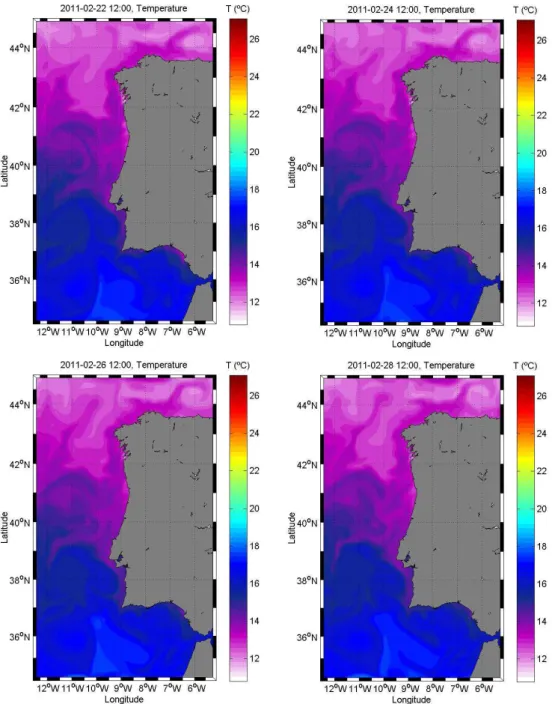
Sea surface temperature and salinity fields predicted by the model for the winter conditions are presented in Fig. 2 and Fig. 3. Horizontal distribution of the temperature is typi-cal for the winter period, with a range between 11–18◦C and a strong north to south gradient, with warmer waters observed in the southern area. Colder water near-shore is particularly visible along the SW (south-west) coast, denot-ing the existence of a winter episode of wind induced up-welling front. Winter upup-welling events are unusual in the area since northerly winds prevail mostly during summer, which is when the Azores anti-cyclone centre (a prominent process that influences the wind patterns over Iberia and the whole European Atlantic arc) moves northward; however, they do happen and there are some studies addressing them (Varela et al., 2010). Likewise, salinity also shows a marked north to south gradient, with higher salinity values associated with warmer water masses present in the south of the domain.
M. Mateus et al.: An operational model for the West Iberian coast 717
Fig. 2.Snapshots of sea surface temperature predicted by the model from 22 to 28 February 2011.
temperature results for the same location denote the presence of an upwelling episode.
3.2 Forecast for summer season
The second example of forecast concerns the summer pe-riod between 4 and 10 July 2011. Model predictions for the horizontal distribution temperature and salinity are shown in Fig. 5 and Fig. 6, respectively. The surface waters gradually warm up until the end of spring, but the southward tempera-ture gradient is still evident. By the beginning of July, tem-peratures throughout the domain are between 17 and 23◦C,
with the exception of the coastal area in Cape Finisterre where upwelled waters are around 13◦C, and in the south of the domain where lenses of warm water reaches values between 24 to 27◦C. Throughout summer the surface tem-peratures keep this range of variation in the domain. Salinity follows the same general pattern as in the winter forecast, with higher values observed in the south of the domain.
718 M. Mateus et al.: An operational model for the West Iberian coast
Fig. 3.Snapshots of sea surface salinity predicted by the model from 22 to 28 February 2011.
by the 10th of July it is well depicted in the south-western tip of Portugal around the St. Vicente cape.
The surface velocity pattern for the analysed summer pe-riod is shown in Fig. 7. It is interesting to note that the re-gional circulation pattern is different from the winter circula-tion. The general structure of the regional circulation during this period is characterized by a lower number of eddies with reduced radius, as expected during summer warming of the upper layer. Nevertheless, a southward coastal current is also observed as a result of the upwelling regime observed in this time period, with higher velocity values particularly noticed on the NW (north-west) coast.
4 Discussion
4.1 Model validation
M. Mateus et al.: An operational model for the West Iberian coast 719
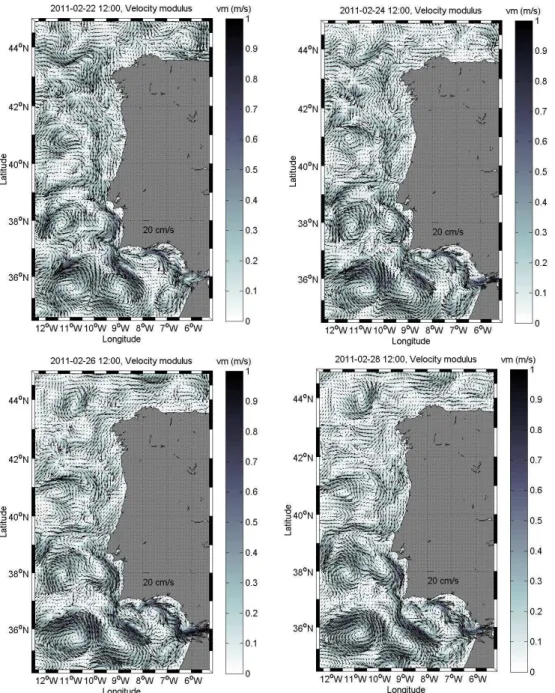
Fig. 4.Snapshots of sea surface current field predicted by the model from 22 to 28 February 2011.
quantitative validation of the best-guess simulated 2-D sur-face fields as well as selected best-guess vertical tempera-ture and salinity profiles are carried out using regular satellite remote sensing measurements and deep profiling floats (see Korotaev et al., 2011).
Efforts are made to validate the physical properties of the model by comparing simulated SST with remote sens-ing data on a systematic basis. For the SST data, merged infrared and microwave sensor products were used be-cause they provide information in regions with frequent cloud cover. The products came from the Mediterranean Sea Ultra High Resolution Sea Surface Temperature Analysis
(MyOcean catalogue product ID: SST-MED-SST-L4-NRT-OBSERVATIONS-010-004-a).
720 M. Mateus et al.: An operational model for the West Iberian coast
Fig. 5.Snapshots of sea surface temperature predicted by the model from 4 to 10 July 2011.
monthly averaged data. However, some considerations must be taken into account when comparing model results with remote-sensing imagery. The skin temperature is regarded as the temperature of the model that should be compared with remote-sensing SST imagery but is not a direct output of the model. On the other hand, the bulk temperature, which is the average temperature of the layers, is a direct output of the model. The bulk temperature should be post-processed to generate a skin temperature. Currently, only bulk temper-ature of the surface layer is compared with remote-sensing SST imagery and skin temperature is not computed, i.e.
M. Mateus et al.: An operational model for the West Iberian coast 721
Fig. 6.Snapshots of sea surface salinity predicted by the model from 4 to 10 July 2011.
time and space (linear interpolation) for the position of the buoy (for all vertical levels), and statistical analyses are per-formed (bias, RMSE,r, etc.) for both profiles. This proce-dure is performed for temperature and salinity separately. A T–Sdiagram (Temperature–Salinity) is constructed with the Argo data and another with the model data, and both are com-pared visually. Some examples of validation of forecasted SST are shown in Fig. 8 and Fig. 9 for the days 25 February and 7 July, respectively, which are considered in the next sub-section analysing forecast results. The figures show that sim-ulated and observed surface temperature fields are in a good agreement to each other. Both the simulated and measured
SST patterns for 25 February equally reflect the main fea-tures of the temperature field, namely the north to south gra-dient of temperature characterized by higher temperature in the south and decreasing northward. Also, both model results and data show lower temperature values along the southern and south-western coasts of Portugal. Validation results show that the model simulates adequately the thermodynamics of the top sea layer.
722 M. Mateus et al.: An operational model for the West Iberian coast
Fig. 7.Snapshots of sea surface current field predicted by the model from 4 to 10 July 2011.
fields, namely the cold water mass along the west coast as a result of wind-induced upwelling.
Statistics were calculated by averaging over the entire modelled domain. The mean difference in the two winter maps (Fig. 8) is equal to –0.008◦C, with RMSE equal to 0.467◦C and the correlation coefficient 0.961. The differ-ence between measured and simulated SST in most parts of the area is in the range of±1.5◦C, with more significant dif-ferences occurring in the vicinity of frontal zones, as would be expected due to miss-location of the front in the two fields. In comparison, the corresponding mean difference in the two summer maps (Fig. 9) is equal to 0.22◦C, with a RMSE of
0.726◦C and a correlation coefficient of 0.941. In this case the difference between measured and simulated SST in most parts of the area is in the range of±2◦C.
M. Mateus et al.: An operational model for the West Iberian coast 723
Fig. 8.Sea surface temperature (SST) maps on 25 February 2011 retrieved from remote sensing data (upper left panel), simulated by the model (upper right panel), and their difference (lower pannel). Linear fit between model and data, and results from basic statistical analysis are also shown.
The comparisons show good qualitative and quantitative agreement between the forecasted and observed temperature fields. In most cases the difference does not exceed 1.5◦C, but sometimes there are some marked differences in near-shore areas where the spatial resolution of the model imposes some limitations. This is an expected outcome since offshore regions often validate better than near-shore ones (Holt and James, 1999).
Differences of up to 0.5◦C are expected between different satellite sensors and between satellite and in-situ
measure-Fig. 9.Sea surface temperature (SST) maps on 7 July 2011 retrieved from remote sensing data (upper left panel), simulated by the model (upper right panel), and their difference (lower pannel). Linear fit between model and data, and results from basic statistical analysis are also shown.
724 M. Mateus et al.: An operational model for the West Iberian coast
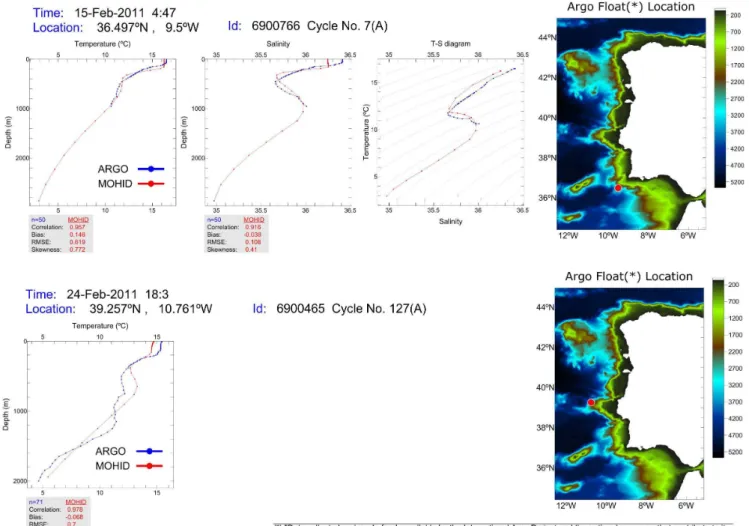
Fig. 10.Simulated temperature and salinity profiles for February 2011 compared with Argo data. The locations of the buoy are represented in the maps by a red circle. Statistical results are also present for each parameter.
than during winter. So, it is argued that a higher error is yielded in the model during summer when modelling the mixed layer at the surface. Therefore, a higher difference is expectable during summer between the model top layer bulk temperature and the satellite SST. This difference between seasons is seen in the results.
Based on the presented results, the predicted sea surface temperature (Fig. 8 and Fig. 9) compares well with measure-ments, underlining the capacity of the hydrodynamic model and the adequateness of the high resolution surface forcing and good lateral boundary conditions. An exhaustive valida-tion of SST is now underway and will allow a detailed as-sessment of model performance.
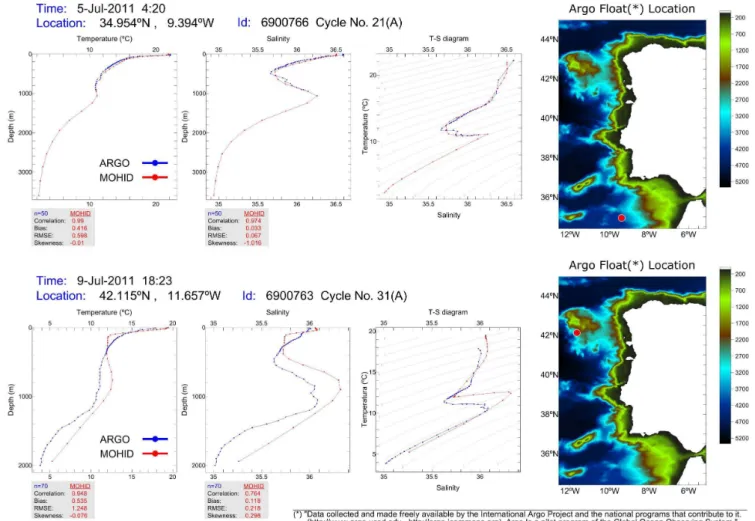
Validation using Argo profiling floats (Fig. 10 and Fig. 11) suggests that the model reproduces reasonably well features such as upper layer thermodynamics, vertical stratification of thermohaline fields and the permanent pycnocline. How-ever, a conclusive result on the skill of the model to ade-quately reproduce the vertical structure of these properties over the entire domain and over time requires a more
thor-ough validation exercise. As mentioned before, this effort is hindered by the lack of Argo data found in this region. Also, those instruments are programed to operate in regions where the bathymetry is greater or equal to 2000 m depth, limiting the validation processes on coastal waters. Satellite altimetry, another important source of data for open ocean operational modelling, also becomes less applicable because of the errors of the altimeter in coastal areas.
M. Mateus et al.: An operational model for the West Iberian coast 725
Fig. 11.Simulated temperature and salinity profiles for July 2011 compared with Argo data. The locations of the buoy are represented in the maps by a red circle. Statistical results are also present for each parameter.
region, and it should soon be made available for near future validation of the MOHID-PCOMS.
The permanent eddy present in the south-west region of the map in Figs. 8 and 11 is not present in the baroclinic reference solution and is not present in remote-sensing im-agery; it is therefore spurious. This type of trapped spurious eddy near the open boundary may occur due to ill parame-terized boundary conditions or due to inconsistent forcing; however, the critical aspect is the quality of the flow over the continental shelf and near the regions of river influence. 4.2 Applications
It is intended that operational systems provide the infrastruc-ture to support marine decision making in several areas, and provide relevant information on the dynamics of the marine environment. The specific and complex dynamics of coastal regions present major challenges for the scientific commu-nity in terms of numerical forecasting (Zhuang et al., 2011). Also, complex topography and coastlines impose the need for downscaling. The regional forecasting system here
pre-sented can address such requirements and provide significant information by being a base for further developments and applications besides the prediction of physical and chemical parameters such as temperature, current fields and salinity. 4.2.1 Marine safety
Portugal has the third largest Exclusive Economic Zone (EEZ) in Europe and the 10th largest in the world. Offshore ship traffic is intense because several international waterways cross the Portuguese EEZ such as the Motorway of the Sea of Western Europe, with hundreds of ships circulating daily along the Portuguese coast. This fact confers upon Portugal great responsibility in terms of maritime security, as well as on prevention and response to marine pollution.
726 M. Mateus et al.: An operational model for the West Iberian coast
Fig. 12.Smaller scale and local model applications that use the results from MOHID-PCMOS as lateral boundary conditions, ei-ther in hindcast or forecast simulations: (1) Viana do Castelo, (2) Leix˜oes, (3) Ria de Aveiro, (4) Mondego estuary and adjacent coastal area, (5) Nazar´e canyon, (6) Tagus coastal area, (7) Set´ubal canyon, and (8) Sines.
extensively and where their skill is established. The MOHID model has already been used in this context (Santoro et al., 2011). The MOHID-PCOMS results have been used to pro-vide boundary conditions to smaller scale local models ap-plied to pollution prevention and port management at some sites along the Portuguese coast, namely at Viana do Castelo, Leix˜oes and Ria de Aveiro (Fig. 12).
In a similar way, inert, oil and HNS spill forecasting sys-tems are capable of providing information on demand and supporting the marine authorities in case of an emergency, either related with onshore or offshore activities. Oil spill models usually have a 3-D numerical model to calculate the pollutant transport (vertical movement), as well as its weathering (dispersion, evaporation, emulsification, dissolu-tion, beaching and sedimentation). Oil spill operational mod-els have proven to be particularly useful in accidents in-volving cargo ships (Perivoliotis et al., 2011;Gonz´alez et al., 2008;Breivik et al., 2011), thus becoming widespread dur-ing the last decades. Some of these operational systems have developed into Marine Security Decision Support Systems
(DeSS) capable of use and exchange with other systems (e.g. Perivoliotis et al., 2011), thus leading to the creation of the European Decision Support System (EuroDeSS).
The first operational model for West Iberia was developed in the aftermath of the Prestige oil spill on Galician waters using the MOHID model to estimate the extension and pat-terns of the oil plume dispersion (Carracedo et al., 2006; Bal-seiro et al., 2003). At this moment a preliminary system is already available for West Iberia, having at its core a model for oil and inert spills already built in MOHID. The system provides estimations about oil spill evolution, the evolution of ship debris, floating containers or man overboard, and uses the MOHID-PCOMS solution for the necessary information about atmospheric and marine conditions.
Additionally, search and rescue events involving human lives (like man overboard situations) are obviously relevant. A number of search and rescue operations take place along the Portuguese coast every year. These are mostly related to fishing boats that get stranded in open waters and to near coast episodes of fishers, swimmers or beach goers who are taken by the sea. According to the Portuguese Statistics Insti-tute (INE), during 2010 there were 7 registered ship founder-ing episodes, accountfounder-ing for the loss of 13 human lives and more than 70 injured fishermen (INE, 2011).
Up to this moment there were no operational systems run-ning for the Portuguese coast with search and rescue capabil-ities. All model applications made in this context have been ad hoc. As such, one of the major applications of the oper-ational model here discussed can be the support of search and rescue operations by providing the major circulation pat-terns along the Portuguese coast. The vast majority of rescue operations occur close to the coast, meaning that for better estimates a high horizontal resolution is needed to allow the model to assist searches near the shore and in bays. While the MOHID-PCOMS operational model lacks such horizontal resolution, estimates are valuable nevertheless because they can be used as boundary conditions to local high resolution models in a nested configuration.
4.2.2 Marine resources
M. Mateus et al.: An operational model for the West Iberian coast 727
Fig. 13.MOHID-PCOMS forecast for potential impacted areas by the tracking ofOstreopsis cf. ovatabloom position. The forecast was used for the decision-making process, leading to the closure of several beaches in a major tourist spots in Portugal (panel in the lower-right side; image retrieved from a national newspaper).
Until now some joint efforts between ocean modellers and the fishing industry have been promoted in the Euro-pean Atlantic arc, such as the ICES (International Council for the Exploration of the Sea) Working Group Operational Oceanographic Products for Fisheries and the Environment. MOHID-PCOMS has the potential to provide significant in-formation related to fishing resources (Navas et al., 2011; G´enio et al., 2008), and its results can be explored in the future in this context. The modular nature of the MOHID model means that it may be used with several modules al-ready available, such the larvae dynamics module (Santos et al., 2005), allowing the possibility for an expansion to the operational capabilities in the future.
By estimating the hydrodynamic regime in the area, this operational modelling platform also has the structure to pro-vide data that can be applied to other marine resources. The straightforward approach of coupling a Lagrangian particle-tracking model to MOHID-PCOMS gives the possibility of addressing a number of processes related to marine re-sources. A wide variety of these models linked to hydrody-namic models have been used in order to analyse the dis-persion process of specific phenomena. Oil spills, early life stages of fish (eggs and larvae), and algal blooms are among the most common marine phenomena tracked using the La-grangian approach (e.g. Brickman and Frank, 2000; Huggett et al., 2003; Gonz´alez et al., 2008; Stumpf et al., 2009). These processes are described by a set of particles with different
characteristics such as concentration, age or size, and with specific initial values.
Harmful algal blooms (HABs), for example, can have a potential negative impact on marine resources (Davidson et al., 2009; Escalera et al., 2006; Silke et al., 2005; Trainer et al., 2010), therefore posing serious constraints to the sus-tainable development of coastal areas. HABs are a common occurrence in Portuguese water, both along the coast and off-shore (Moita et al., 2003; Vale, 2012; Escalera et al., 2010; Palma et al., 2010). An ocean colouring technique applied to remote-sensing imagery can be used to track these blooms, but this technique is also limited for low-biomass or in sub-surface blooms, and it lacks the predictive skills to infer bloom transport beforehand. Operational model, on the other hand, can fill this gap by tracking the transport of the bloom once it is detected. From a management perspective, a major concern is also the ability to predict where a bloom is likely to be transported over a few days from its last known loca-tion. Under these circumstances, even a rudimentary forecast system can be useful and could be used as a baseline for fu-ture improvements (Velo-Su´arez et al., 2010; Wynne et al., 2011).
728 M. Mateus et al.: An operational model for the West Iberian coast
Fig. 14.Zonal section of the south-western coast of Portugal, showing the vertical structure for some properties from the MOHID-PCOMS model coupled with one of the ecological models available in the MOHID. The section location is represented by the red line.
model was used to forecast bloom transport and aggrega-tion/dispersion (Fig. 13) over a 3-day period, in collaboration with the National Institute for Biological Resources (INRB-IPIMAR). Model predictions for the potential areas under the influence of the bloom were then used to assist local authori-ties in the decision-making process of flagging the beaches in those areas. Assuming a risk of the presence of harm-ful algae, an alert was issued as a safety measure and
M. Mateus et al.: An operational model for the West Iberian coast 729
4.2.3 Coastal and marine environment
One of the most significant contributions from operational models for the study of marine environments is the volume of data that they generate and that can be stored as a synop-tic description of the state of the ocean. These data records can either be used to study physical and biogeochemical pro-cesses, for example, or as lateral boundary conditions for smaller scale or local models, in hindcast or forecast mode.
There is a growing realisation that the biogeochemical state of our seas cannot be inferred from their physical prop-erties alone (e.g. Blackford et al., 2004), and there is a re-quirement for explicit operational modelling of the combined physical, chemical and biological systems. In response to this need, coupled oceanic circulation and ecosystem op-erational models are being used with more frequency (Za-lesny and Tamsalu, 2009; Siddorn et al., 2007). The coupled hydrodynamic–ecological operational modelling has been implemented in MOHID-PCOMS with different ecological models.
The potential to simulate biogeochemical processes along the coast and in depth has been tested with an ecological complex model (Mateus, 2012; Mateus et al., 2012), and the preliminary results (Fig. 14) showed that the model is able to reproduce some known ecological features, such as the nutrient depletion in surface layers and the sub-superficial chlorophyll maximum. This coupled modelling approach is the basis to understand the link between physical, chemical and ecological processes occurring in the shelf area. As seen in the example in Fig. 14, the results show the clear rela-tion between thermal stratificarela-tion, nutrient availability and diatom abundance, highlighting the importance of the physi-cal structure of the ocean in the primary production patterns. The information drawn from this model application can be further used to identify the underlying processes of HAB for-mation associated with thin layers, such asDinophysis acuta blooms that are known to occur along the Portuguese coast (Moita et al., 2006). However, the high computational cost of such application hinders its use in an operational way, and currently there is an operational application providing fore-cast for ecology using a simpler NPZ (nutrient, phytoplank-ton, zooplankton) model.
The horizontal grid size of MOHID-PCOMS is eddy per-mitting but may be insufficient to resolve on-shelf mesoscale eddy processes, where a characteristic Rossby radius is ex-pected to be ∼3 km. However, the results are used to cas-cade down to smaller domain applications with higher res-olution where needed. Results from MOHID-PCOMS have been used this way in several applications of local models (Fig. 12). Some of these models run in hindcast mode to study local processes, for example the applications to the Ria de Aveiro to simulate water quality processes, and Nazar´e and Setubal canyons to study sediment dynamics. Other ap-plications are from local operational systems nested with MOHID-PCOMS, such as the Tagus coastal and estuarine
area model and the Sines model. In the first case the solution cascades down to smaller domain models used (1) to study the effect of local streams on microbiologic water quality in beaches, (2) to evaluate the impact of a submarine outfall on the water quality and ecological processes in the surround-ing area, and (3) as boundary conditions for the Tagus opera-tional model. In the second situation the local model is used to assess the influence of a thermal plume from a thermoelec-tric power plant on the coastal dynamics.
5 Conclusions
We have presented an operational oceanography system for the West Iberian waters forced by ocean and atmospheric model results provided by local thematic data centres. Po-tential use cases that deal with problems related to coastal management, marine pollution and safe navigation were ad-dressed, as well as the relevance of the model in providing information to oceanographic studies.
The system is validated by data retrieved from the My-Ocean catalogue. The predicted results of the operational system are exported to a web-based data system for real-time dissemination to the public (http://opendap.mohid.com: 8080/thredds/catalog.html). As such, it provides information on the state of the sea, and it provides prediction to all sectors of society: governments, industries, local actors, research and academic groups, and the general public.
The MOHID-PCOMS model has been shown to be an ef-fective modelling tool. The results presented show that this operational tool adequately represents some hydrologic fea-tures of the region and their seasonal differences in dynami-cal processes. The operational system structure is ready to be used in an operational environment where products and ser-vices can be provided on request, either for the present day as short-term forecast, or for past events. This is a significant step towards a community model resource with a good po-tential to become a data source on the state of the ocean and a management tool to support local studies along the West Iberia coast.
Improvements to the model are underway, namely the in-clusion of river discharge along the coast and an increase in spatial resolution in near-coast areas where upwelling is fre-quent. Local models coupled offline are also currently being used, and they will soon run operationally and provide more detailed information on the local state of the sea.
Acknowledgements. This work is partially supported by European FP projects MyOcean (FP7 – SPACE-2007-1) and ASIMUTH (FP7 – SPACE – 261860), and projects EASYCO and ARCOPOL under the INTERREG IV Atlantic Area Program.
730 M. Mateus et al.: An operational model for the West Iberian coast
References
Arakawa, A.: Computational design for long-term numerical inte-gration of the equations of fluid motion: Two-dimensional in-compressible flow. Part I, Journal of Computational Physics, 1, 119-143, 1966.
Balseiro, C. F., Carracedo, P., G´omez, B., Leit˜ao, P. C., Montero, P., Naranjo, L., Penabad, E., and P´erez-Mu˜nuzuri, V.: Tracking the Prestige oil spill: An operational experience in simulation at MeteoGalicia, Weather, 58, 452-458, 2003.
Beckmann, A., and Haidvogel, D. B.: Numerical Simulation of Flow around a Tall Isolated Seamount. Part I: Problem Formu-lation and Model Accuracy, Journal of Physical Oceanography, 23, 1736-1753, 1993.
Bell, M. J., Lef`ebvre, M., Le Traon, P.-Y., Smith, N., and Wilmer-Becker, K.: GODAE: the global Ocean data assimilation experi-ment, Oceanography, 22, 14–21, 2009.
Blackford, J. C., Allen, J. I., and Gilbert, F. J.: Ecosystem dynamics at six contrasting sites: a generic modelling study, Journal of Ma-rine Systems, 52, 191-215, DOI 10.1016/j.jmarsys.2004.02.004, 2004.
Blumberg, A. F., and Kantha, L.: Open Boundary Condition for Cir-culation Models, Journal of Hydraulic Engineering, 111, 237-255, 1985.
Breivik, Ø., Allen, A. A., Maisondieu, C., and Roth, J. C.: Wind-induced drift of objects at sea: The leeway field method, Ap-plied Ocean Research, 33, 100-109, 10.1016/j.apor.2011.01.005, 2011.
Brickman, D., and Frank, T.: Modelling the dispersal and mortality of Browns bank egg and larval haddock (Melanogrammus ae-glefinus), Can. J. Fish. Aquat. Sci., 57, 2519–2535, 2000. Bryan, K.: A Numerical Method for the Study of the Circulation
of the World Ocean, Journal of Computational Physics, 135 154-169, 1997.
Burchard, H.: Applied Turbulence Modelling in Marine Waters, no. 100 in Lecture Notes in Earth Sciences, Springer, 2002. Cailleau, S., Chanut, J., Levier, B., Maraldi, C., and Reffray, G.: The
new regional generation of Mercator Ocean system in the Iberian Biscay Irish (IBI) area, Mercator Quarterly Newsletter, 34, 5-15, 2010.
Canuto, V. M. V., Howard, A., Cheng, Y., and Dubovikov, M. S. M.: Ocean Turbulence. Part I: One-Point Closure Model-Momentum and Heat Vertical Diffusivities, Journal of Physical Oceanogra-phy, 31, 1413-1426, 2001.
Carracedo, P., Torres-L´opez, S., Barreiro, M., Montero, P., Balseiro, C. F., Penabad, E., Leitao, P. C., and P´erez-Mu˜nuzuri, V.: Im-provement of pollutant drift forecast system applied to the Pres-tige oil spills in Galicia Coast (NW of Spain): development of an operational system, Marine Pollution Bulletin, 53, 350-360, 2006.
David, H., Moita, M. T., Laza-Mart´ınez, A., Silva, A., Mateus, M.,
de Pablo, H., and Orive, E.: First bloom ofOstreopsis cf. ovatain
the continental Portuguese coast, Harmful Algae News 45, 2011. Davidson, K., Miller, P. I., Wilding, T., Shutler, J., Bresnan, E.,
Ken-nington, K., and Swan, S.: A large and prolonged bloom of
Kare-nia mikimotoiin Scottish waters in 2006, Harmful Algae, 8, 349-361, 2009.
De Mey, P., and Proctor, R.: Assessing the value of GODAE prod-ucts in coastal and shelf seas, Ocean Dynamics, 59, 1-2, 2009.
Delhez, E., and Deleersnijder, E.: Overshootings and spurious os-cillations caused by biharmonic mixing, Ocean Modelling, 17, 183-198, 2007.
Drillet, Y.: Meddies in the Mercator North Atlantic and Mediter-ranean Sea eddy-resolving model, Journal of Geophysical Re-search, 110, 1-16, 2005.
Escalera, L., Reguera, B., Pazos, Y., Morono, A., and Cabanas, J. M.: Are different species of Dinophysis selected by climatologi-cal conditions?, Afr J Mar Sci, 28, 283-288, 2006.
Escalera, L., Reguera, B., Moita, T., Pazos, Y., Cerejo, M., Cabanas, J. M., and Ruiz-Villarreal, M.: Bloom dynamics of Dinophysis acuta in an upwelling system: In situ growth versus transport, Harmful Algae, 9, 312-322, 10.1016/j.hal.2009.12.002, 2010. Fiuza, A. F. G., Hamann, M., Ambar, I., del Rio, G. D., Gonzalez,
N., and Cabanas, J. M.: Water masses and their circulation off western Iberia during May 1993, Deep-Sea Res Pt I, 45, 1127-1160, 1998.
Flather, R. A.: A tidal model of the north-west European continental shelf, Memoires de la Societe Royale des Sciences de Liege, 6, 141-164, 1976.
Fofonoff, N. P., and Millard, R. C.: Algorithms for computation of fundamental properties of seawater, Unesco technical papers in marine science, 44, 1983.
G´enio, L., Sousa, A., Vaz, N., Dias, J. M., and Barroso, C.: Ef-fect of low salinity on the survival of recently hatched veliger of Nassarius reticulatus (L.) in estuarine habitats: A case study of Ria de Aveiro, Journal of Sea Research, 59, 133-143, 10.1016/j.seares.2007.09.001, 2008.
Gonz´alez, M., Ferrer, L., Uriarte, A., Urtizberea, A., and Ca-ballero, A.: Operational Oceanography System applied to the Prestige oil-spillage event, Journal of Marine Systems, 72, 178-188, 10.1016/j.jmarsys.2007.07.005, 2008.
Holt, J. T., and James, I. D.: A simulation of the southern North Sea in comparison with measurements from the North Sea project, Part 1, Temperature, Continental Shelf Research, 19, 1087-1112, 1999.
Huggett, J., Fr´eon, P., Mullon, C., and Penven, P.: Modelling the transport success of anchovy Engraulis encrasicolus eggs and larvae in the southern Benguela: the effect of spatio-temporal spawning patterns, Mar. Ecol. Prog. Ser., 250, 247–262, 2003. INE: Estat´ısticas da Pesca 2010, Instituto Nacional de Estat´ıstica,
Lisboa, Portugal, 101, 2011.
Kordzadze, A. A. and Demetrashvili, D. I.: Operational forecast of hydrophysical fields in the Georgian Black Sea coastal zone within the ECOOP, Ocean Sci., 7, 793–803, doi:10.5194/os-7-793-2011, 2011.
Korotaev, G. K., Oguz, T., Dorofeyev, V. L., Demyshev, S. G., Kubryakov, A. I., and Ratner, Yu. B.: Development of Black Sea nowcasting and forecasting system, Ocean Sci., 7, 629–649, doi:10.5194/os-7-629-2011, 2011.
Le Traon, P.-Y., Larnicol, G., Guinehut, S., Pouliquen, S., Ben-tamy, A., Roemmich, D., Donlon, C., Roquet, H., Jacobs, G., Griffin, D., Bonjean, F., Hoepffner, N., and Breivik, L. A.: Data assembly and processing for operational oceanog-raphy: 10 years of achievements, Oceanography, 22, 56–69, doi:10.5670/oceanog.2009.66., 2009.
M. Mateus et al.: An operational model for the West Iberian coast 731
Lef`evre, F., Lyard, F. H., Le Provost, C., and Schrama, E. J. O.: FES99: A Global Tide Finite Element Solu-tion Assimilating Tide Gauge and Altimetric InformaSolu-tion, J. Atmos. Ocean. Tech., 19, 1345–1356,
doi:10.1175/1520-0426(2002)019<1345:fagtfe>2.0.co;2, 2002.
Leit˜ao, P., Coelho, H., Santos, A., and Neves, R.: Modelling the main features of the Algarve coastal circulation during July 2004: A downscaling approach, J. Atmos. Ocean Sci., 10, 421–462, 2005,
http://www.ocean-sci.net/10/421/2005/.
Lyard, F., Lefevre, F., Letellier, T., and Francis, O.: Modelling the global ocean tides: modern insights from FES2004, Ocean Dy-nam., 56, 394–415, doi:10.1007/s10236-006-0086-x, 2006. Martins, F., Neves, R., and Leit˜ao, P. C.: A three-dimensional
hy-drodynamic model with generic vertical coordinate, Hydroinfor-matics, 98, 1403–1410, 1998.
Martins, F., Leit˜ao, P., Silva, A., and Neves, R.: 3D modelling in the Sado estuary using a new generic vertical discretization ap-proach, Ocean. Ac., 24, S51–S62, 2001.
Martinsen, E. A. and Engedahl, H.: Implementation and testing of a lateral boundary scheme as an open boundary condition in a barotropic ocean model, Coast. Eng., 11, 603–627, 1987. Mateus, M.: A process-oriented model of pelagic biogeochemistry
for marine systems. Part I: Model description, J. Mar. Syst., 94, S78–S89, doi:10.1016/j.jmarsys.2011.11.008, 2012.
Mateus, M., Leit˜ao, P. C., de Pablo, H., and Neves, R.: Is it relevant to explicitly parameterize chlorophyll synthesis in marine ecological models?, J. Mar. Syst., 94, S23–S33, doi:10.1016/j.jmarsys.2011.11.007, 2012.
Methot Jr., R. D.: Stock Assessment: Operational Models in Sup-port of Fisheries Management, in: The Future of Fisheries Sci-ence in North America, edited by: Beamish, R. J. and Rothschild, B. J., Fish Fish. Ser., Springer Science + Business Media B.V., 137–165, 2009.
Moita, M. T., Oliveira, P. B., Mendes, J. C., and Palma, A. S.: Dis-tribution of chlorophyll a and Gymnodinium catenatum associ-ated with coastal upwelling plumes off central Portugal, Acta. Oecologia, 24, 125–132, 2003.
Moita, M. T., Sobrinho-Goncalves, L., Oliveira, P. B., Palma, S., and Falcao, M.: A bloom of Dinophysis acuta in a thin layer off north-west Portugal, Afr. J. Mar. Sci., 28, 265–269, 2006. Navas, J. M., Telfer, T. C., and Ross, L. G.: Application of 3D
hy-drodynamic and particle tracking models for better environmen-tal management of finfish culture, Cont. Shelf Res., 31, 675–684, doi:10.1016/j.csr.2011.01.001, 2011.
Oddo, P. and Guarnieri, A.: A study of the hydrographic conditions in the Adriatic Sea from numerical modelling and direct obser-vations (2000–2008), Ocean Sci., 7, 549–567, doi:10.5194/os-7-549-2011, 2011.
Oliveira, P. B., Nolasco, R., Dubert, J., Moita, T., and Peliz, A.: Surface temperature, chlorophyll and advection patterns during a summer upwelling event off central Portugal, Cont. Shelf Res., 29, 759–774, doi:10.1016/j.csr.2008.08.004, 2009.
Palma, S., Mouri˜no, H., Silva, A., Bar˜ao, M. I., and Moita, M. T.: Can Pseudo-nitzschia blooms be modeled by coastal upwelling in Lisbon Bay?, Harmful Algae, 9, 294–303, doi:10.1016/j.hal.2009.11.006, 2010.
Peliz, A., Rosa, T. L., Santos, A. M. P., and Pissarra, J. L.: Fronts, jets, and counter-flows in the Western Iberian upwelling system,
J. Mar. Syst., 35, 61–77, 2002.
Peliz, A., Dubert, J., Santos, A. M. P., Oliveira, P. B., and Le Cann, B.: Winter upper ocean circulation in the Western Iberian Basin – Fronts, Eddies and Poleward Flows: an overview, Deep-Sea Res Pt. I, 52, 621–646, doi:10.1016/j.dsar.2004.11.005, 2005. Perivoliotis, L., Krokos, G., Nittis, K., and Korres, G.: The Aegean
sea marine security decision support system, Ocean Sci., 7, 671– 683, doi:10.5194/os-7-671-2011, 2011.
Riflet, G., Juliano, M., Fernandes, L. L., Leit˜ao, P. C., and Neves, R.: Operational Ocean forecasting of the Portuguese waters, Merca-tor Quarterly Newsletter, 30, 20–32, 2008.
Robinson, L. A. and Frid, C. L. J.: Dynamic ecosystem mod-els and the evaluation of ecosystem effects of fishing: can we make meaningful predictions?, Aquat. Conserv., 13, 5–20, doi:10.1002/Aqc.506, 2003.
Ruiz-Villarreal, M., Bolding, K., Burchard, H., and Demirov, E.: Coupling of the GOTM turbulence module to some three-dimensional ocean models, in: Marine Turbulence: Theories, Ob-servations, and Models. Results of the CARTUM Project, edited by: Baumert, H. Z., Simpson, J. H., and Sundermann, J., Cam-bridge University Press, 225–237, 2005.
Santoro, P., Fernandez, M., Fossati, M., Cazes, G., Terra, R., and Piedra-Cueva, I.: Pre-operational forecasting of sea level height for the Rio de la Plata, Appl. Math. Model, 35, 2462–2478, doi:10.1016/j.apm.2010.11.065, 2011.
Santos, A. J. P., Nogueira, J., and Martins, H.: Survival of sardine larvae off the Atlantic Portuguese coast: a pre-liminary numerical study, Ices J. Mar. Sci., 62, 634–644, doi:10.1016/j.icesjms.2005.02.007, 2005.
Siddorn, J. R., Allen, J. I., Blackford, J. C., Gilbert, F. J., Holt, J. T., Holt, M. W., Osborne, J. P., Proctor, R., and Mills, D. K.: Modelling the hydrodynamics and ecosystem of the North-West European continental shelf for operational oceanography, J. Mar. Syst., 65, 417–429, doi:10.1016/j.jmarsys.2006.01.018, 2007. Silke, J., O’Beirn, F., and Cronin, M.: Karenia: an exceptional
di-noflagellate bloom in western Irish waters, summer 2005, Marine Institute, Galway, Ireland, 44, 2005.
Sousa, T.: Previs˜ao Meteorol´ogica em Portugal Continental uti-lizando o modelo operacional e de investigac¸˜ao MM5, Instituto Superior T´ecnico, Lisbon Technical University, 2002.
Stanev, E. V., Schulz-Stellenfleth, J., Staneva, J., Grayek, S., See-mann, J., and Petersen, W.: Coastal observing and forecasting system for the German Bight – estimates of hydrophysical states, Ocean Sci., 7, 569–583, doi:10.5194/os-7-569-2011, 2011. Stumpf, R. P., Tomlinson, M. C., Calkins, J. A., Kirkpatrick, B.,
Fisher, K., Nierenberg, K., Currier, R., and Wynne, T. T.: Skill as-sessment for an operational algal bloom forecast system, J. Mar. Syst., 76, 151–161, doi:10.1016/j.jmarsys.2008.05.016, 2009. Trainer, V. L., Pitcher, G. C., Reguera, B., and Smayda, T. J.: The
distribution and impacts of harmful algal bloom species in east-ern boundary upwelling systems, Prog. Oceanogr., 85, 33–52, doi:10.1016/j.pocean.2010.02.003, 2010.
Vale, P.: Two simple models for accounting mussel contamina-tion with diarrhoetic shellfish poisoning toxins at Aveiro lagoon: Control by rainfall and atmospheric forcing, Estuarine, Coast. Shelf Sci., 98, 94–100, doi:10.1016/j.ecss.2011.12.007, 2012.
Varela, M., ´Alvarez-Ossorio, M. T., Bode, A., Prego, R., Bern´ardez,
732 M. Mateus et al.: An operational model for the West Iberian coast
Galician Upwelling Core: The Sound of Corcubi´on (NW Spain), J. Sea Res., 64, 260–272, doi:10.1016/j.seares.2010.03.004, 2010.
Velo-Su´arez, L., Reguera, B., Gonz´alez-Gil, S., Lunven, M., Lazure, P., N´ezan, E., and Gentien, P.: Application of a 3D Lagrangian
model to explain the decline of aDinophysis acuminatabloom
in the Bay of Biscay, J. Mar. Syst., 83, 242–252, 2010.
Wynne, T. T., Stumpf, R. P., Tomlinson, M. C., Schwab, D. J., Watabayashi, G. Y., and Christensen, J. D.: Estimating cyanobac-terial bloom transport by coupling remotely sensed imagery and a hydrodynamic model, Ecol. Appl., 21, 2709–2721, 2011.
Zalesny, V. B. and Tamsalu, R.: High-resolution modeling of a marine ecosystem using the FRESCO hydroecological model. Izvestiya, Atmos. Ocean. Phys., 45, 108–122, 2009.