REVISTA
BRASILEIRA
DE
ANESTESIOLOGIA
OfficialPublicationoftheBrazilianSocietyofAnesthesiologywww.sba.com.br
SCIENTIFIC
ARTICLE
Oxygen
concentrators
performance
with
nitrous
oxide
at
50:50
volume
Jorge
Ronaldo
Moll
a,
Joaquim
Edson
Vieira
b,∗,
Judymara
Lauzi
Gozzani
c,
Lígia
Andrade
Silva
Telles
Mathias
caHospitalGeraldeBonsucessodoMinistériodaSaúde,RiodeJaneiro,RJ,Brazil
bDepartamentofSurgery,FaculdadedeMedicina,UniversidadedeSãoPaulo,SãoPaulo,SP,Brazil
cFaculdadedeCiênciasMédicasdaSantaCasadeSãoPaulo,SãoPaulo,SP,Brazil
Received18March2013;accepted10June2013 Availableonline11October2013
KEYWORDS
Oxygeninhalation therapy;
Nitrousoxide; Equipmentand supplies; Anesthesia; Inhalation;
Developingcountries
Abstract
Backgroundandobjectives: Fewinvestigationshaveaddressedthesafetyofoxygenfrom con-centratorsfor use inanesthesiainassociation withnitrous oxide. Thisstudy evaluated the percent of oxygen from a concentrator in association with nitrous oxide in a semi-closed rebreathingcircuit.
Methods:Adultpatientsundergoinglowrisksurgerywererandomlyallocatedintotwogroups, receivingafreshgasflowofoxygenfromconcentrators(O293)orofoxygenfromconcentrators andnitrousoxide(O293N2O).Thefractionofinspiredoxygenandthepercentageofoxygenfrom freshgasflowweremeasuredevery10min.TheratioofFiO2/oxygenconcentrationdelivered
wascomparedatvarioustimeintervalsandbetweenthegroups.
Results:Thirtypatientswerestudiedineachgroup.Therewasnodifferenceinoxygenfrom concentratorsovertimeforbothgroups,buttherewasasignificantimprovementintheFiO2
(p<0.001)forO293groupwhileasignificantdecline(p<0.001)forO293N2O.TheFiO2/oxygen
ratiovariedinbothgroups,reachingaplateauintheO293group.Pulseoximetrydidnotfall below98.5%ineithergroup.
Conclusion:TheFiO2inthemixtureofO293andnitrousoxidefellduringtheobservationperiod
althoughoxygensaturationwashigherthan98.5%throughoutthestudy.Concentratorscanbe consideredastablesourceofoxygenforuseduringshortanestheticprocedures,eitherpureor inassociationwithnitrousoxideat50:50volume.
©2013SociedadeBrasileiradeAnestesiologia.PublishedbyElsevier EditoraLtda.Allrights reserved.
∗Correspondingauthor.
E-mail:[email protected](J.E.Vieira).
0104-0014/$–seefrontmatter©2013SociedadeBrasileiradeAnestesiologia.PublishedbyElsevierEditoraLtda.Allrightsreserved.
Introduction
Thehighpriceofoxygencanencouragetheinstallationof oxygen concentrators.1,2 In Brazil a previous investigation
suggestedthatsavingsrelatedtotheuseofaconcentrator over10yearsinanon-profithospitalreached19.5million dollars.3 The oxygenfromconcentrators representsacost
ofUS$0.0015mL−1.Itisworthtonoticetheofferingofthis systemasanoxygensourcesetupaperfectcompetitionin thismarketinBrazilandreduceditsfinalpricenationwide. A number of studies using oxygen concentrators with open ventilation systems concluded that the efficacy and reliabilityofsuchdevicesmakethemasuitablealternative tooxygencylindersinthedevelopingworld.4---6
Oxygenconcentratorsusezeolite molecularsieve tech-nology,whichcanproduceupto95%pureO2.Briefly,room airisdrawnintotheoxygenconcentratorthroughaseries of filters to remove dust and bacteria. The concentrator containstwocolumnsofthezeolitemolecularsievewithin a canister. The sieve adsorbs nitrogen from the air as it is forced throughunder pressure. The sieve allowsO2 to passthroughalongwiththe0.93%argonpresentintheair. Syntheticzeoliteisusedfortheproductionofoxygen.The concentratorhasbeenshowntobereliableandcost effec-tiveforprovidingoxygeninlocationswherecylindersmay notalwaysbeavailable.7However,littleisknownaboutthe
associationofoxygenfromconcentratorswithnitrousoxide duringmechanicalventilationinanesthesia.
Thisstudyevaluatedthepercentofoxygenfroma con-centratorin association withnitrous oxidefor procedures lastingatleast100mininasemi-closedrebreathingcircuit.
Methods
AfterapprovalbytheEthicsResearchCommitteeof Hospi-talGeraldeBonsucessodoMinistériodaSaúde,cityofRio deJaneiro,adultpatientsundergoinglowrisksurgerywere invitedtoparticipate,gavewritten informedconsentand wererandomlyallocatedintotwogroups,either receiving afresh gas flow (FGF)of 1000mLmin−1 oxygenfrom con-centrator(O293)ora FGFof500mLmin−1 ofoxygenfrom concentratorplus500mLmin−1nitrousoxide(O293NO).The only exclusioncriterionwasthe presenceof anylung dis-ease. The oxygen used in this investigation was provided byoxygenconcentratorconnectedtomedicalgaspipeline systems,providinganoutputpressureof4.08---5.09kgcm−2 (EniplanFerri---EngenheirosAssociadosFerriLt.,COE2x20 model, RioGrandedoSul, Brazil).Nitrous oxidewas pro-vided from gas pipeline system originated from standard tanks.
Patientsbreathedunderamask withoxygen from con-centratorataflowof8.0Lmin−1for3mininasemi-closed rebreathing circuit. Following this period, anesthesiawas inducedwithsequentialintravenousadministrationof Fen-tanyl 5.0mcgkg−1, propofol 1.5mgkg−1 and atracurium 0.5mgkg−1.Aftertrachealintubation,acontrolled mechan-ical ventilation system with a CO2 absorber was used to provide atidalvolumesufficient tomaintainexhaled CO2 between30 and35mmHg.Maintenance ofanesthesiawas achieved with isoflurane and the FGF of 1Lmin−1. One side-streamvalve(CardioCap5---GEDatex-OhmedaHelsink,
Finlandia)betweentheinspiratoryunidirectionalvalveand theY-piecetoconnectwiththepatientallowedtheinspired andexpiredfractionsof volatileanesthetics, carbon diox-ide(ETCO2),oxygen(FiO2)andnitrousoxide(FiN2O)tobe monitored,andanotherside-streamvalve(Capnomac---GE Datex-OhmedaHelsink,Finlandia),locatedat thedelivery portthroughwhichthegasesaredeliveredfromthemachine tothesystems,monitoredthepercentageofoxygen deliv-eredfromconcentratorbymeansof paramagneticoxygen analysis.Thesamplesderivedfromthesesidestreamvalves wereventedtoatmosphere(Fig.1).Themeasurementsof oxygenratiosineither groupwereexpectedtoreach sta-bility,consideringtheconsumptionofoxygenshouldbeat least200mLmin−1throughouttheintraoperativeperiod.
Thevariablesstudiedweretheconcentrationofinspired oxygen,aswellasthefractionofinspiredoxygenmeasured every10min after intubationuntil theend of anesthesia. Arterialpressure,heartrateandpulseoximetryvalueswere obtained at the beginning of anesthesia as well as every 10minuntiltheendoftheprocedure.TheratioofFiO2to oxygenconcentrationdeliveredbytheconcentrator(O293) wascomparedatintervalsbetweenthegroups.Theresults arepresentedasmedianand25---75percentilesormeanand standarddeviation whennormalitywasachieved.Analysis of variance for repeated measures was used to compare datafromthedifferent timeintervalswithingroups. Stu-dent’sttestwasusedtocomparetheage,weight,height andbodymassindex.Chi-squarewasusedtocomparethe gender ratio.The hypothesis considered a previous inves-tigationwith oxygen concentrator asthe sole source and wherethemeanFiO2differencewasconsideredthetarget differenceandtheuseofanomogramforcalculating sam-plesizegiveasampleof25---30patients.3,7Allcomparisons
wereconsideredstatisticallysignificantwhenp<0.05.The statistical package Sigma Stat for Windows,version 2.03, SPPSInc.wasused.
Results
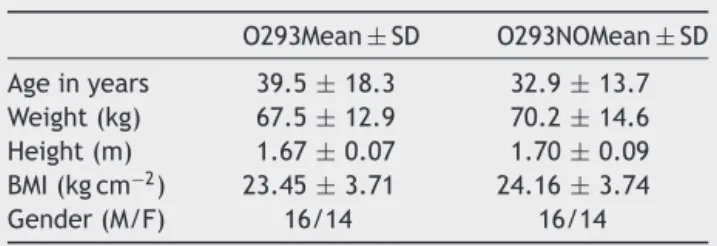
Sixtypatientsofbothsexesformedthesample,with30in eachgroup,includingASAphysicalstatusoneandtwo.There wasnostatisticallysignificantdifferencebetweenthetwo groupsforgender, age,weight,heightor bodymassindex (Table1).
The mean values and standard deviations of delivered oxygenconcentrationandinspiredoxygenpercentwere reg-isteredforbothgroups(Fig.2).Therewasnodifferencein thedeliveredoxygenconcentrationfromconcentratorover time(FriedmanrepeatedmeasuresANOVA,p=0.084).There wasasignificantimprovementintheFiO2(p<0.001),which waslowerat 10mincomparedto40min andup,andfrom
Table1 Patients’characteristics.
O293Mean±SD O293NOMean±SD
Ageinyears 39.5±18.3 32.9±13.7
Weight(kg) 67.5±12.9 70.2±14.6
Height(m) 1.67±0.07 1.70±0.09
BMI(kgcm−2) 23.45±3.71 24.16±3.74
Figure1 Monitoringofgasesintherespiratorysystem.Placesforgasesmonitoring:CardioCap5measuredfractionsofvolatile anesthetics,carbondioxide(ETCO2),oxygen(FiO2)andnitrousoxide(FiN2O),andCapnomacmeasuredthegasesdeliveredfrom
themachinetothesystems.Thesamplesderivedfromthesesidestreamvalveswereventedtoatmosphere.
0.70 0.80 0.90 1.00 1.10 1.20
0.00 20.00 40.00 60.00 80.00 100.00 120.00
FiO2/Oxygen O293
Time of observation (min)
O2+N2O
O2
Figure2 FiO2/O2ratioovertime,fromO293orinassociation
withnitrousoxide.
20comparedto50minandup(Tukeytest,p<0.05).There wasalsonodifferenceinthedeliveredoxygenconcentration overtimeforthefreshoxygenflowfromconcentratorinthe groupreceivingoxygenandnitrousoxide(p=0.153). How-ever,FiO2showedasignificantdecline,from52%at10minto
40%attheendofanesthesia(p<0.001).Therewasno dif-ferencewithininterval10throughout40min,butfrom50 upto100minallvaluesregisteredfrom10to40minwere significantlydifferent(Tukey,p<0.05).
These measurements reflected in the ratio of fraction inspiredandfresh oxygenflow (FiO2/oxygen flow)in both
groups. In the group receiving oxygen from the concen-trator (O293) the ratio improved over time (p<0.001). In the group receiving oxygen and nitrous oxide, the FiO2/oxygen flow ratio decreased over time (p<0.001).
The inhalational anesthetics percentiles were keptat the
anesthesiologist discretion and exhaled CO2 were kept
within the expected margins, 32.47±1.59mmHg in the O293group,and32.63±1.69mmHgintheO293NOgroup.
Pulseoximetrywaslowerbeforetheinduction of anes-thesia and valuesdiffered between groups (97.7±1.2 vs.
99.1±0.5 for O293NO and O293, respectively; p<0.001, Studentt).Followinginduction thehemoglobin(Hb) satu-rationdidnotfallbelow98.5%ineithergroup.
Discussion
ThisstudyshowedthattheFiO2inthemixtureofO293and
N2Ofellfrom52%to41%duringtheobservationperiod.
Oxy-gensaturationwashigherthan98.5%throughoutthestudy andtheratioofoxygensuppliedandinspiredbecamestable overtime,butwaslowerthanone.
Thisinvestigationconfirmsstabilityofoxygensaturation showedbypreviousstudiesusingoxygenfromconcentrators inananesthesiacircuitwithacarbondioxideabsorberand aFGFof500mLperminute.8,9Althoughafreshoxygenflow
ofupto0.5Lmin−1mayresultinasignificantaccumulation ofargoncomparedtohigheroxygenflowsof1.0and2.0L perminute,10thisstudysuggeststhatbothFiO
2andHb
sat-urationarestableovertimewhenusingaoxygenflowequal toorgreaterthan0.5Lmin−1 duringgeneralanesthesiaof healthyadultsinsemi-closedrebreathingcircuitsystem.
The association of oxygen from a concentrator and nitrous oxide has previously been studied under low FGF and it was suggested that the fraction of argon gas was smallandpronetofallingbetween60and120minbutthat thenitrousoxideconcentrationincreased.10Amixture
com-posedof33%oxygencouldthreatenthefinalconcentration due to the accumulation of argon.8 An adjusted
as low as 0.5Lmin−1 showed no complications and could beconsideredsafeandwithoutadditionalriskofhypoxia, in rebreathing systems and closed circuits, according to measurementsofO2concentrationintheinspiredgas.11As pointedout,iftheoxygenusedasfreshgasisfromoxygen concentrators, argonconcentrationmayincrease asmuch as2%.Argonisinertandhasnotoxiceffectonothergases, e.g.,oxygenandotherpotentinhaledagents.12
Inthepresentinvestigationtheuseof50%oxygenfrom aconcentratorpromptedtheFiO2tofallfrom52%to41%, althoughtheratioofofferedandinspiredoxygenreached aplateau.Thenitrousoxideuptakebythepatientishigh initiallybutdecreasesovertime--- thismeansthattherewill beapreponderanceofnitrousoxideoveroxygeninthegas remaininginthebreathingsystemaftergasuptake bythe patient.Thisgaswillbeventedtowaste(offthecircuit),but theoxygenconcentrationinthesystemwillfalltowardsthe fractionofoxygenthatremains afterthegas uptake.The N2Oaltersthefinaloxygenofferedinthebreathingsystem, sincethepercentageofoxygenfromtheconcentratordid notfallatanytimeineithergroup.
Incontrast,theexclusiveuseofoxygenfroma concen-trator caused the FiO2 to increase,with a stableratioof offeredandinspiredoxygen.This behavioristheresultof nitrogenbroughttothebreathingsystembythepatientfrom dissolved volumesin muscle and fat, which comes outof solutionoverthefollowing houraftertheintubation.This rateof nitrogen excretiondecreases over time---and this maybeareasonwhytheFiO2increasedinthepureoxygen group.
Theseresultsmayaddtotheliteraturethatoxygenfrom concentrators are cost-effective, reliable and convenient forsupplyingoxygen,especiallyinunderdevelopedregions andonlow budgets,13 presentingresults thatsuggest
oxy-genfromconcentratorprovideastableFGFwhenaddedto nitrous oxide 50:50 volume. Pressurized oxygen cylinders are expensive when including the cost of transportation, whileproperlymaintainedoxygenconcentratorscanprovide a highly effective low-cost and easy-to-use solution for healthfacilitiesindevelopingcountries.Areturnon invest-mentmay beachievedwithin1---2years.14 In describing a
modern practice management, an anesthesia department in an underserved country hospitalestablished as a norm theuseof oxygenconcentratorin ordertoreduce oxygen costs.15
The use of nitrous oxide remains a source of contro-versy in anesthesia. The Evaluation of Nitrous oxide In a GasMixtureforAnaesthesia(ENIGMA)trialreportedthatthe useofnitrousoxideincreasespostoperativecomplications and may contribute to neurocognitive dysfunction in the young and elderly. However, current evidence in support of a more widespread proscription in clinical practice is unconvincing.16,17Giventhatnitrousoxide-related
anesthe-sia casualties arerare but usuallyprosecute, theyalmost invariablyattractsignificantmediaattention.18Swedenhas
thusceasedtheuseofnitrousoxidewithnodissatisfaction fromanesthesiologistsandnoincreasein theuseofother anestheticagents,asexpected.19Notwithstanding,arecent
largestudyinnon-cardiacsurgerysuggeststheuseofthisgas intheintraoperativeperiodwasassociatedwithdecreased oddsof30-daymortalityanddecreasedoddsofin-hospital mortality/morbidity.20
Oxygen concentrators provide a consistent and less expensivesourceofoxygeninhealthfacilitieswherepower suppliesarereliable.Thethreatofahypoxicmixturearising fromaccumulationofargonshouldbeguardedagainstusing anoxygenanalyzerintheinspiredgascircuit,aswellasa pulseoximetry.
The FiO2 in themixture ofO293 andnitrous oxidefell during the observation periodalthough oxygen saturation washigherthan98.5%throughoutthestudy.Concentrators canbeconsideredastablesourceofoxygenforuseduring shortanestheticprocedures, either pure or in association withnitrousoxideat50:50volume.
Authorship
JorgeRonaldoMolldesignedthestudy,conductedthe acqui-sition and analysis of data, prepared and reviewed the manuscript;Joaquim Edson Vieira reviewed and analyzed thedataandpreparedthemanuscript;JudymaraLauzi Goz-zanidesignedthestudyandpreparedthemanuscript;Lígia AndradeSilvaTelles Mathiasdesignedthe study,prepared andreviewedthemanuscript.
Conflicts
of
interest
Theauthorsdeclarenoconflictsofinterest.
References
1.Friesen RM, Raber MB, Reimer DH. Oxygen concentrators: a primary oxygen supply source. Can J Anaesth. 1999;46: 1185---90.
2.ArrowsmithLW.Oxygenconcentratorsformedicalgaspipeline systems.JInstHospEng.1989;43:6---8.
3.MollJR,MollAVS,GuttmanA,etal.Usinasconcentradorasde oxigênio: evoluc¸ão da frac¸ão inspirada de oxigênioe reper-cussõesnopacienteanestesiadoem sistemacomabsorvedor de CO2. Estudo piloto.Rev Bras Anestesiol.2007;57:649---57 [Portuguese].
4.Carter JA, Baskett PFJ, Simpson PJ. The ‘Permox’ oxygen concentrator.Its modeofaction,performance andpotential application.Anaesthesia.1985;40:560---5.
5.FentonPM.TheMalawianaestheticmachine.Experiencewith anewtypeofanaestheticapparatusfordevelopingcountries. Anaesthesia.1989;44:498---503.
6.ShrestshaBM,SinghBB,GautamMP,etal.Theoxygen concen-tratorisasuitablealternativetooxygencylindersinNepal.Can JAnaesth.2002;49:8---12.
7.WhitleyE,BallJ.Statisticsreview3:samplesizecalculation. CritCare.2002;6:335---41.
8.ParkerCJ,SnowdonSL.Predicted andmeasuredoxygen con-centrationsinthecirclesystemusinglowfreshgasflowswith oxygen supplied by an oxygen concentrator. Br J Anaesth. 1988;61:397---402.
9.FriesenRM.Oxygenconcentratorsandthepracticeof anaes-thesia.CanJAnaesth.1992;39:R80---9.
10.Grano JT,Roberts AL, Bigley AJ.Determination ofthe mini-malfreshgasflow tomaintainatherapeuticinspiredoxygen concentrationinasemiclosedanesthesiacirclesystemusing
an oxygen concentrator as the oxygen source. Technical
Report.Houston:TexasUniv. HealthScienceCenterat Hous-ton. School of Nursing; 2001. HSC-SN-00-022. Available at:
11.Rathgeber J,Züchner K, KietzmannD, etal. Efficiency ofa mobileoxygenconcentratorformechanicalventilationin anes-thesia.Studieswithametaboliclungmodelandearlyclinical results.Anaesthesist.1995;44:643---50.
12.Brattwall M, Warrén-Stomberg M, Hesselvik F, et al. Brief review:theoryandpracticeofminimalfreshgasflow anesthe-sia.CanJAnaesth.2012;59:785---97.
13.MokuoluOA,AjayiOA.Useofanoxygenconcentratorina Nige-rianneonatalunit:economicimplicationsandreliability.Ann TropPaediatr.2002;22:209---12.
14.L’Her P,TchouaR, HutinR, etal. Theproblem ofoxygenin developingcountries.MedTrop(Mars).2006;66:631---8.
15.ShankarKB,MoseleyHS,MushlinPS,etal.Anaesthesiain Bar-bados.CanJAnaesth.1997;44:559---68.
16.Sanders RD,Weimann J,Maze M. Biologiceffects of nitrous oxide: a mechanistic and toxicologic review. Anesthesiology. 2008;109:707---22.
17.MylesPS,LeslieK,ChanMT,etal.Avoidanceofnitrousoxide forpatientsundergoingmajorsurgery:arandomizedcontrolled trial.Anesthesiology.2007;107:221---31.
18.HerffH,PaalP,vonGoedeckeA,etal.Fatalerrorsinnitrous oxidedelivery.Anaesthesia.2007;62:1202---6.
19.EnlundM,EdmarkL,RevenäsB.Ceasingroutineuseofnitrous oxide--- afollowup.BrJAnaesth.2003;90:686---8.