hysteroscopy: a preplanned prospective
observational study with 200 cases
Preditores de intravasamento durante histeroscopia cirúrgica:
um estudo observacional prospectivo com 200 casos
eduardode alMeida nogueira Felipe Ventura sessa4 claudio peixoto crispi2
Abstract
PURPOSE: To verify the predictors of intravasation rate during hysteroscopy. METHODS: Prospective observational study (Canadian Task Force classiication II-1). All cases (n=200 women; 22 to 86 years old) were treated in an operating room setting. Considering respective bag overill to calculate water balance, we tested two multiple linear regression models: one for total intravasation (mL) and the other for absorption rate (mL.min-1). The predictors tested (independent
variables) were energy (mono/bipolar), tube patency (with/without tubal ligation), hysterometry (cm), age≤50 years, body surface area (m2), surgical complexity (with/without myomectomy) and duration (min). RESULTS: Mean intravasation
was signiicantly higher when myomectomy was performed (442±616 versus 223±332 mL; p<0.01). In the proposed multiple linear regression models for total intravasation (adjusted R2=0.44; p<0.01), the only signiicant predictors
were myomectomy and duration (p<0.01).In the proposed model for intravasation rate (R2=0.39; p<0.01), only
myomectomy and hysterometry were signiicant predictors (p=0.02 and p<0.01, respectively). CONCLUSIONS: Not only myomectomy but also hysterometry were signiicant predictors of intravasation rate during operative hysteroscopy.
Resumo
OBJETIVO: Testar preditores do ritmo de intravasamento durante histeroscopia cirúrgica. MÉTODOS: Estudo prospectivo observacional (classiicação: Canadian Task Force II-1) incluindo casos conduzidos em centro cirúrgico (n=200 mulheres;
22 a 86 anos de idade). Considerando os erros de aferição nas embalagens de solução de irrigação para calcular o balanço hídrico, nós testamos dois modelos de regressão linear múltipla: um para intravasamento total (mL) e outro para ritmo de intravasamento (mL.min-1). Os preditores testados (variáveis independentes) foram energia (mono/
bipolar), permeabilidade tubária (com/sem ligadura tubária), histerometria (cm), status ovariano (idade≤50 anos),
área de superfície corporal (m2), complexidade de cirurgia (com/sem miomectomia) e tempo de ressecção (min). RESULTADOS: O intravasamento médio foi signiicativamente maior quando miomectomia foi realizada (442±616 versus
223±332 mL, p<0,01). No modelo proposto para intravasamento total (R2 ajustado=0,44; p<0,01), os únicos
preditores signiicativos foram miomectomia e tempo de duração (p<0,01). No modelo proposto para a taxa de intravasamento (R2=0,39; p<0,01), somente miomectomia e histerometria foram preditores signiicativos (p=0,02
e p<0,01, respectivamente). CONCLUSÕES: Não só a miomectomia mas também a histerometria são preditores signiicativo da taxa de intravasamento durante histeroscopia cirúrgica.
Anesthsiology and Gynecology Services, Instituto Nacional de Saúde da Mulher, da Criança e do Adolescente Fernandes Figueira, Fundação Oswaldo Cruz – FIOCRUZ – Rio de Janeiro (RJ), Brazil.
1Anesthesiology Service, Instituto Nacional de Saúde da Mulher, da Criança e do Adolescente Fernandes Figueira, Fundação Oswaldo
Cruz – FIOCRUZ– Rio de Janeiro (RJ), Brazil.
2Centro de Vídeo-endoscopia São Paulo – CEVESP-Barra – Rio de Janeiro (RJ), Brazil.
3Anesthesiology Service, Hospital Central da Polícia Militar – HCPM-RJ – Rio de Janeiro (RJ), Brazil.
4Felow at CNPq, Instituto Nacional de Saúde da Mulher, da Criança e do Adolescente Fernandes Figueira, Fundação Oswaldo Cruz –
FIOCRUZ – Rio de Janeiro (RJ), Brazil. Conlict of interests: none.
Keywords
Hysteroscopy/adverse effects Minimally invasive surgical procedures Safety management Uterine myomectomy
Palavras-chave
Histeroscopia/efeitos adversos Procedimentos cirúrgicos minimamente
invasivos Conduta de segurança Miomectomia uterina
Correspondence
Márlon de Freitas Fonseca Avenida Rui Barbosa, 716 – Flamengo Zip code: 22250-020 Rio de Janeiro (RJ), Brazil
Received
09/01/2014
Accepted with modiications
10/30/2014
DOI: 10.1590/S0100-720320140005139
Introduction
Besides transurethral resection of the prostate, opera-tive hysteroscopy (OH) is an endoscopic surgery in which undesirable absorption of irrigation luids is a major risk factor for complications1-5. Distension media, if absorbed systemically in suficient amounts, can trigger adverse events, including life-threatening complications. Consequently, the Practice Committee of the Advanced Minimally Invasive Gynecology Worldwide (AAGL) has recently stated that understanding the physical properties and the potential risks associated with the use of the various distending media is critical for the safe performance of hysteroscopic procedures6. Operative hysteroscopy has been the treatment of choice in symptomatic patients with a submucous myoma with diameter of 6 cm or less7 whereas the excessive intravasation of the luid used to distend and irrigate the uterine cavity has been the main complication during hysteroscopic myo-mectomy8,9. Complications such as cardiovascular collapse and non cardiogenic pulmonary edema may occur if large volumes of any distension media are rapidly absorbed10-14. Still, luid overload becomes quite dangerous when a solu-tion lacks electrolytes (i.e. sodium) because of the risk of cerebral edema and dilutional hyponatremia15-17, condition in which immediate intensive approach is necessary18.
In endoscopic resections, both monopolar (which needs non-electrolytic solutions as distension luid) or bipolar (more expensive technique, which accepts electrolytic/ ionic solutions19,20) probes can be used for performing hysteroscopic adhesiolysis, resection of uterine septum, endometrium, polyps and ibroids10,13,21-24. In fact, both techniques have been widely used over the last decade14,25,26. Recently, we have hypothesized that endoscopic surgeries with bipolar energy are associated with higher absorption of irrigation luid due to higher permissibility of pressure and surgical time when an electrolytic solution is used.
Although resection time is an obvious issue regarding total luid absorption during endoscopic surgeries, other risk factors for luid overload during OH (i.e. complex myomectomy or large/ample adhesiolysis) are not completely elucidated because no studies have tested (and quantiied) their independent con-tribution or relation to luid loss8. Yet, there is few published information concerning predictors of complications associated to OH10,14. The objective of this study was to assess (under a multivariate context) potential predictors of intravasation rate in order to improve the prompt identiication of risky cases by both anesthetists and hysteroscopists.
Methods
In this preplanned prospective observational, we as-sessed 200 consecutive hysteroscopic surgeries performed from April 2007 to March 2008. The inclusion criterion
was all women submitted to OH with resectoscope under identically controlled intrauterine distension pressure.
Patients were anesthetized in an operating room setting using general (88%) or spinal (12%) anesthesia according to clinical criteria and patients’ preferences. The cervical canal was dilated to Hegar 10 or 11 before the rigid resectoscope pass into the uterine cavity. The same hysteroscopy equipment was used for every case: a slightly fore-oblique 30° telescope with an outer diameter of 4 mm and an internal/external sheaths of 10 mm outer diameter that provide a constant inlow and outlow of distension luid for generating a con-tinuous and eficient low system inside the uterine cavity.
With respect to intrauterine pressure, intra-operatory distension of the uterus was identically performed with Stryker® Endoscopy Pump (USA) with no suction sys-tem. The maximal luid pressure (superior limit) was set to 100 mmHg and the luid exit of resectoscope was kept opened for permitting minimal resistance to low. Trans-operatory intrauterine distension pressure was then determined by a dynamic luid column (irrigation low >0) with values below 100 mmHg. When this condition was not enough to guarantee a good operatory ield and higher pressure was necessary, the cases were then excluded.
Both monopolar and bipolar probes were included in this study. As customary, we previously selected patients to use mono or bipolar diathermy probe after discussing the beneit-cost ratio for each surgery as well as consider-ing the economic resources of each individual. No scientiic interest inluenced this step. When the monopolar probe was chosen, we used a mixture composed of Sorbitol/Manitol 2.7/0.54% (178 mOsm/kg; Frezenius Kabi® or B. Braun® 1000 mL bags) as non-electrolytic distension luid (without ionic solutes); this solution permits a perfect cut and coagu-lation, which was performed with a rigid continuous low operative hysteroscope (Karl Storz® Endoskope - Germany). Monopolar hysteroscopic endometrial ablation, when indi-cated, was performed with a 5 mm loop wire diameter and rollerball device. When the bipolar probe was chosen, we used Normal Saline 0.9% (308 mOsm/kg; Frezenius Kabi® or Halex lstar® 1000 mL bags) as the uterine distention media, and the Gynecare® Versapoint Electrosurgical System (Johnson & Johnson Gateway -USA) bipolar resectoscope was used to perform the surgery; the loop and the bipolar shaver electrode were used to perform endometrectomy.
≤50years (pre-menopause). All surgeries in which a ibroid resection was made were included in the myomectomy group, no matter what other procedures were also performed. Others were grouped in the without-myomectomy group. Large/ample adhesiolysis (3 cases) were also included in myomectomy group because it is also known to be a very risky procedure for overload8. Hysterometry (cm) was determined immediately before surgery, when patients had just gone under anesthesia. Body surface area (SA) was calculated for each individual according the formula: SA (m2) = [weight (kg) x height (cm)/3,600]½. Total surgical time (min) integrated the period between the beginning and the end of the uterus pressurization.
In a pilot approach, we assessed overill of the solution bags for actual measurement of pumped luid, as recommended in previous studies5,8. The actual volume (mL) was previ-ously veriied in three samples of each commercial product with a 1,000 mL graduated glass cylinder (scale=5 mL), and the respective averages were used to calculate luid balance at each surgery. With respect to overill in Sorbitol/ Manitol 2.7/0.54% bags, the actual volume of a 1,000 mL bag averaged 1,014 mL from Frezenius Kabi® (1,011 to 1,016 mL) and 1,022 mL from B Braun® bags (1,016 to 1,025 mL). In Normal Saline 0.9%, the actual volume of a 1,000 mL bag averaged 1,013 mL from Frezenius Kabi® (1,000 to 1,023 mL) and 1,024 mL in Halex lstar® (1,012 to 1,037 mL). Commercial products were then identiied and respective volumetric factors were used for correcting luid balance in each surgery.
In all cases, the same trained nurse was responsible for the trans-operatory luid balance under express supervision of the anesthesiologists (MFF and EAN). The volume of distension solution that was absorbed was checked after each 2,000 mL of pumped solution. After considering respective bag overill for correcting total luid balance, we calculated two different endpoints as dependent variables (targets): total intravasation and mean absorptionrate.
This study was previously approved by the Research Ethics Committee of Instituto Nacional de Saúde da Mulher, da Criança e do Adolescente Fernandes Figueira – Fundação Oswaldo Cruz (CEP IFF-FIOCRUZ Number 0045.0.008.000-07, Comissão Nacional de Ética em Pesquisa, Ministério da Saúde do Brasil) in accordance with the Guidelines and Regulatory Standards for Research Involving Human Beings.
Statistics
We used the Kolmogorov-Smirnov test to assay the null hypothesis of normality of distribution of continuous variables and Levene’s test for Equality of Variances to consider homoscedasticity (ideal conditions for performing parametric statistic). Finally, we also veriied on multiple regression that the residuals (predicted minus observed values) were distributed close to normal (i.e., they follow
a Gaussian distribution). We used Student’s t test to com-pare means and parametric bivariate correlation (Pearson) to evaluated association among continuous variables. All signiicance tests that were two-tailed were considered statistically signiicant when p<0.0529,30.
We used different multiple linear regression models (MLRMs) to assess both total intravasation (mL) and in-travasation rate (mL.min-1) as a dependent variable. In the proposed MLRMs, the value of each target variable could be simultaneously estimated from those called independent variables (regressors). Afterward, signiicances of the partial linear regression coeficients and intercept (constant) were statistically tested; the unstandardized coeficients (B) relected the original units in which the variables were measured whereas standardized coeficients (β) provided the estimate of the average number of standard deviations change in the criterion that could be produced by a change of one standard deviation in the regression concerned. Comparable small Beta values for some independent variables showed that they play minor parts in the regression29,31. The standard model (Enter) requested a standard regression analysis including all predictors that were tested. The optimized model (Backward Stepwise) excluded the non-signiicant coeficients one by one to keep only signiicant predictors and improve the coeficient of determination (adjusted R2). Type of energy (mono/bipolar probe), fallopian tube patency (with/without tubal ligation), hysterometry (cm), age (older/ younger than 50 years old), body surface area (m2), surgery (with/without myomectomy) and surgical time (min) were tested as independent variables (predictors) possibly capable to predict total intravasation. Furthermore, we tested the same variables (except surgical time) as predictors of in-travasation rate. Despite being a major factor contributing to luid intravasation, intrauterine luid pressure was not an independent variable in the analysis because it was consid-ered constant. Statistical analyses were run with SPSS 15.0 for Windows (www.spss.com - USA)31.
Results
Patients’ ages varied from 22 to 86 years old (mean=49.1; standard deviation (SD)=12), and the characteristics of the sample were summarized in Table 1.
4.4%). In this case, without overill correction, total intrava-sation would have been calculated as only 2,200 mL and the error would have been 651 mL, which is a relevant value.
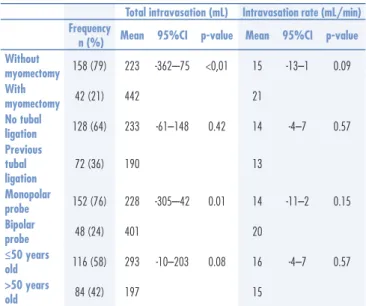
As expected, mean total intravasation was signiicantly higher when myomectomy was performed (442±616 versus 223±332 mL; p<0.01). However, despite mean intravasation rate has also been higher during myomectomy, the difference was not signiicant (21±25 versus 15±19 mL/min; p=0.09). Women with previous tubal ligation averaged comparable values for total intravasation (190±315 versus 233±332 mL; p=0.4) and intravasation rate (13±15 versus 14±19 mL/min; p=0.5) when compared to women with no tubal ligation. Total luid absorption was signiicantly lower when sur-geries were performed with monopolar probe (228±240 versus 401±568 mL; p=0.01), but difference between intravasation rate means was not statistically signiicant (15±19 versus 20±25 mL/min; p = 0.1). Comparing cases in which the functional ovarian status was considered poor (age>50 years old) with cases in which ovarian function was considered preserved (age≤50 years old), differences were not signiicant for intravasation (197±285 versus 293±421 mL; p=0.08) and intravasation rate (16±19 versus 15±21 mL; p=0.5). Considering the 15 surgeries in which total intravasation was >1,000 mL, only in 5 included myomectomy, although the mean total intravasation had been signiicantly higher when ibroid resection occurred. This issue suggests a noteworthy inluence of some other concomitant variables and justiied a multivariate statistical approach. These comparisons are summarized in Table 2.
According to parametric bivariate analysis (Pearson), total intravasation showed signiicant correlation with body surface area (r=0.5; p<0.01), hysterometry (r=0.5; p<0.01) and duration (r=0.65; p<0.01). Also, intravasa-tion rate showed signiicant correlaintravasa-tion with body surface area (r=0.61; p<0.01) and hysterometry (r=0.61; p<0.01).
Considering the Backward Stepwise our best proposed multivariate model for total intravasation (model 2: adjusted R2=0.44; p<0.01), the partial linear regression coeficients for the variables myomectomy (B=176.9; p<0.01) and duration (B=10.8; p<0.01) were the most important, as expected. Concerning the best proposed multivariate model for intravasation rate (model 4: R2=0.39; p<0.01), the main partial linear regression coeficients were found for the variables
Table 3. Multiple linear regression models through the origin (no intercept) and bivariate correlation analysis for total intravasation (mL; models 1 and 2) and intravasation rate (mL/min; models 3 and 4) as dependent variables (n = 200)
Predictors B 95%CI for B β p-value r (Pearson)
Model 1 (adjusted R2=0.43; p<0.01)
Age ≥50 years 9.9 -91–111 0.02 0.85
Tubal ligation -32.5 -137–72 -0.05 0.54
Bipolar energy 72.4 -59–204 0.08 0.28
Myomectomy 140.4 2–279 0.15 0.05
Surface area (m2) -13.1 -185–159 -0.06 0.88 0.58 [p<0.01]
Hysterometry (cm) 10.0 -27–47 0.23 0.54 0.59 [p<0.01]
Duration (min) 8.2 4–12 0.44 <0.01 0.65 [p<0.01]
Model 2 (adjusted R2=0.44; p<0.01)
Myomectomy 176.9 48–306 0.19 <0.01
Duration (min) 10.8 8–13 0.58 <0.01
Model 3 (adjusted R2=0.38; p<0.01)
Age ≥50 years 1.8 -5–9 0.05 0.60
Tubal ligation -1.8 -9–15 -0.05 0.60
Bipolar energy 1.4 -7–10 0.03 0.75
Myomectomy 10.8 2–20 0.18 0.02
Surface area (m2) 2.6 -9–14 0.19 0.44 0.61 [p<0.01]
Hysterometry (cm) 0.9 -1.4–3.3 0.33 0.43 0.61 [p<0.01]
Model 4 (adjusted R2=0.39; p<0.01)
Myomectomy 11.0 2–20 0.18 0.02
Hysterometry (cm) 1.5 1.1–1.9 0.54 <0.01
Models 1 and 3 (Enter) request a standard regression analysis; Models 2 and 4 (Backward Stepwise) exclude non-signiicant coeficients (one by one) and repeats the analysis for keeping only the signiicants; B: unstandardized coeficients;
β: standardized coeficients; 95%CI: 95% conidence interval; R2: coeficient
of determination for multivariate model; r: coeficient of correlation between two continuous variables.
Table 1. Characteristics of the sample (n=200)
Mean 95%CI Minimum Maximum
Age (years) 49.1 47.4–50.9 22 86
Weight (kg) 67.3 65.0–69.6 45 150
Height (cm) 159.3 158.1–160.4 143 186
BSA (m2) 1.7 1.69–1.75 1.4 2.7
Hysterometry (cm) 8.1 7.9–8.3 5 12
BSA: Body surface area = [weight (kg) x height (cm)/3,600]½; 95%CI: 95%
conidence interval.
Table 2. Total intravasation and intravasation rate in 200 consecutive operative hysteroscopies
Total intravasation (mL) Intravasation rate (mL/min) Frequency
n (%) Mean 95%CI p-value Mean 95%CI p-value
Without
myomectomy 158 (79) 223 -362–-75 <0,01 15 -13–1 0.09
With
myomectomy 42 (21) 442 21
No tubal
ligation 128 (64) 233 -61–148 0.42 14 -4–7 0.57
Previous tubal ligation
72 (36) 190 13
Monopolar
probe 152 (76) 228 -305–-42 0.01 14 -11–2 0.15
Bipolar
probe 48 (24) 401 20
≤50 years
old 116 (58) 293 -10–203 0.08 16 -4–7 0.57
>50 years
old 84 (42) 197 15
Comparison between means according to dichotomized variables (t-test); p: signiicance
(two-tailed); 95%CI: 95% conidence interval of the difference between means.
Discussion
In this preplanned prospective observational study with 200 cases, we veriied that a measurement of the size of the uterus (obtained using a hysterometer) also should be taken into account in operative hysteroscopy as an additional independent variable capable to, pre-operatively, alert the team for the risk of luid overload. Furthermore, the surgical lenght was conirmed to be the main predictor of total intravasation, particularly when a myomectomy (also a signiicant predictor) is performed.
Before multivariate analysis, the simple statistical
comparison between two means (t-test) erroneously
pointed a signiicant inluence of bipolar probe on total intravasation. This was probably due to confounding factors because there was no signiicant coeficient for bipolar probe use when the cases were considered in a MRLM. Therefore, our results corroborate the hypothesis of higher permissibility of surgical time when electrolytic solution is used; surgeries with longer durations have been the main foundation for higher total intravasa-tion with a bipolar probe. Our team thinks electrolytic luids are the safest distension media, especially for more complex hysteroscopic resections (i.e. multiple myomatosis or large/ample adhesiolysis). However, this safety should not be overestimated because cardio-vascular disturbances that indicate gaseous embolism during transcervical resection of myomas may occur despite the limitation of intravasation32 even if bipolar diathermia is used25.
There are uncommon uterine conditions, which can predispose patients to massive absorption and luid over-load. Taking into account the ESGE (European Society for Gynaecological Endoscopy) and STEPW (Size, Topography, Extension, Penetration, and Wall) classiications to sub-mucous myomas, the STEPW classiication allows bet-ter prediction of myoma removal, luid balance, length of surgery and surgical complications in hysteroscopic myomectomy than ESGE classiication33. Moreover, the location of the myomas does not matter when patient hasa uterus with multiple myomas and low compliance for luid distention and high vascularization. These condi-tions may be linked to a higher chance of transforming hysteroscopic surgery into a more complex and risky procedure2,14, 32, even when using a bipolar probe is used.
Our team has performed (and we do recommend) repeated luid balance and a frequent evaluation about the possibility of stopping surgery when/if a tendency toward high absorption is detected14. Also, according
to Defieux et al.34, if the luid deicit of 2,000 mL of ir-rigation is reached, surgery must be stopped. Actually, if the absorbed luid volume is continually monitored, time control becomes less important14. Although patients are different and there is no rule for deining a maximal luid input, pressure must be as minimal as possible in all cases, especially if the luid lacks sodium. In addition, it is important to pay attention to usual temperature of distension luid during OH because a cool luid is more viscous than a warm one35. Thus, it is possible that the choice of warm distension solutions increases the risk and does not allow longer surgical times26.
Some strength points in this study include the extent to which the results can be generalized to other situations and to other people (external validity). We can infer that our conclusions can be actually applied in other geographic locations, since the sample showed a wide heterogeneity. Moreover, considering the study design, observational studies may be better able to relect outcomes obtained in everyday practice36.
Despite all our efforts to prevent and mitigate both measurement bias and confounding, we recognize that some characteristics of design and methodology may have inluenced the application or interpretation of the results of our study. These limitations include inaccuracies when assessing hysterometry, measuring peri-operative luid volumes and when using a dichotomized surrogate variable (age>50y) in place of the actual ovarian status. Last, but not least, the possibility of inluence of some unknown variable cannot be rejected since the absorption occurs mainly into the vessels opened during the procedure37.
Considering the intrauterine pressure and duration constant, we veriied that myomectomy procedure and hysterometry were signiicant predictors for intravasa-tion rate during operative hysteroscopy whereas bipolar energy (compared to monopolar), fallopian tube patency, age ≤50 years and body surface area were not. Besides, we conclude that intra-operative intermittent monitoring of intravasation amount should be mandatory not only during longer myomectomies or large uterus, since high irrigating luid absorption might also occur during less complex procedures.
Acknowledgements
1. Julian TM. Hysteroscopic complications. J Low Genit Tract Dis. 2002;6(1):39-47.
2. Di Spiezio Sardo A, Mazzon I, Bramante S, Bettocchi S, Bifulco G, Guida M, et al. Hysteroscopic myomectomy: a comprehensive review of surgical techniques. Hum Reprod Update. 2008;14(2):101-19. 3. Indman PD, Brooks PG, Cooper JM, Loffer FD, Valle RF, Vancaillie
TG. Complications of luid overload from resectoscopic surgery. J Am Assoc Gynecol Laparosc. 1998;5(1):63-7.
4. Rassweiler J, Teber D, Kuntz R, Hofmann R. Complications of Transurethral Resection of the Prostate (TURP): incidence, management, and prevention. Eur Urol. 2006;50(5):969-79. 5. Sutton C. Hysteroscopic surgery. Best Pract Res Clin Obstet
Gynaecol. 2006;20(1):105-37.
6. AAGL Advancing Minimally Invasive Gynecology Worldwide. AAGL Practice Report: practice guidelines for the management of hysteroscopic distending media: (Replaces hysteroscopicm luid monitoring guidelines. J Am Assoc Gynecol Laparosc. 2000;7:167-8). J Minim Invasive Gynecol. 2013;20(2):137-48.
7. Camanni M, Bonino L, Delpiano EM, Ferrero B, Migliaretti G, Deltetto F. Hysteroscopic management of large symptomatic submucous uterine myomas. J Minim Invasive Gynecol. 2010;17(1):59-65. 8. Nezhat CH, Fisher DT, Datta S. Investigation of often-reported
ten percent hysteroscopy luid overill: is this accurate? J Minim Invasive Gynecol. 2007;14(4):489-93.
9. Kim AH, Keltz MD, Arici A, Rosenberg M, Olive DL. Dilutional hyponatremia during hysteroscopic myomectomy with sorbitol-mannitol distention medium. J Am Assoc Gynecol Laparosc. 1995;2(2):237-42.
10. Mushambi MC, Williamson K. Anaesthetic considerations for hysteroscopy surgery. Best Pract Res Clin Anaesthesiol. 2002;16(1):35-52.
11. Schäfer M, Von Ungern-Sternberg BS, Wight E, Schneider MC. Isotonic luid absorption during hysteroscopy resulting in severe hyperchloremic acidosis. Anesthesiology. 2005;103(1):203-4. 12. Brandstrup B. Fluid therapy for the surgical patient. Best Pract Res
Clin Anaesthesiol. 2006;20(2):265-83.
13. Fonseca MF, Nogueira EA, Gemal AE, Andrade JLG. Anestesia em videocirurgia: fundamentos para o cirurgião. In: Crispi CP (editor). Tratado de videoendoscopia ginecológica. 2a ed. São Paulo: Atheneu; 2006. p. 75-89.
14. Fonseca MF, Andrade Junior CM, Nogueira EA, Santos LCS, Crispi CP. Is time monitoring really necessary for preventing luid overload in hysteroscopic surgery? A case report. Braz J Video-Sur. 2008;1(3):128-32.
15. Adrogué HJ, Madias NE. Hyponatremia. N Engl J Med. 2000;342(21):1581-9.
16. Fukagawa M, Kurokawa K, Papadakis MA. Fluid & electrolyte disorders. In: Tierney LM Jr, McPhee SJ, Papadakis MA(editors). Current medical diagnosis & treatment. 45th ed. New York: McGraw-Hill; 2006. p. 865-95.
17. Ananthanarayan C, Paek W, Rolbin SH, Dhanidina K. Hysteroscopy and anaesthesia. Can J Anaesth. 1996;43(1):56-64.
18. Yaprak M, Turan MN, Tamer AF, Peker N, Demirci MS, Çırpan T, et al. How quickly can acute symptomatic hyponatremia be corrected? Int Urol Nephrol. 2013;45(6):1805-8.
19. Singh H, Desai MR, Shrivastav P, Vani K. Bipolar versus monopolar transurethral resection of prostate: randomized controlled study. J Endourol. 2005;19(3):333-8.
20. Ho HS, Cheng CW. Bipolar transurethral resection of prostate: a new reference standard. Curr Opin Urol. 2008;18(1):50-5. 21. Ramsay JW, Shepherd NA, Butler M, Gosling PT, Miller
RA, Wallace DM, et al. A comparison of bipolar and monopolar diathermy probes in experimental animals. Urol Res. 1985;13(2):99-102.
22. Varol N, Maher P, Vancaillie T, Cooper M, Carter J, Kwok A, et al. A literature review and update on the prevention and management of luid overload in endometrial resection and hysteroscopic surgery. Gynaecol Endosc. 2002;11(1):19-26.
23. Tuchschmid S, Bajka M, Szczerba D, Lloyd BA, Székely G, Harders M. Modelling intravasation of liquid distension media in surgical simulators. Med Image Comput Comput Assist Interv. 2007;10(Pt 1):717-24.
24. Molnar BG, Broadbent JA, Magos AL. Fluid overload risk score for endometrial resection. Gynaecol Endosc. 1992;1(3):133-8. 25. Dyrbye BA, Overdijk LE, van Kesteren PJ, de Haan P, Riezebos
RK, Bakkum EA, et al. Gas embolism during hysteroscopic surgery using bipolar or monopolar diathermia: a randomized controlled trial. Am J Obstet Gynecol. 2012;207(4):271.e1-6.
26. De Freitas Fonseca M, Andrade CM Jr, de Mello MJ, Crispi CP. Effect of temperature on luidity of irrigation luids. Br J Anaesth. 2011;106(1):51-6.
27. McKinlay SM, Brambilla DJ, Posner JG. The normal menopause transition. Maturitas. 1992;14(2):103-15.
28. Nelson HD. Menopause. Lancet. 2008;371(9614):760-70. 29. Cochran WG, Cox GM. Experimental designs. Chichester: John
Wiley & Sons; 1950.
30. Pocock SJ. Clinical trials: a practical approach. Chichester: John Wiley & Sons; 1983.
31. Kinnear PR, Gray CD. SPSS 15 made simple. Hove: Psychology Press; 2008.
32. Rademaker BM, van Kesteren PJ, de Haan P, Rademaker D, France C. How safe is the intravasation limit in hysteroscopic surgery? J Minim Invasive Gynecol. 2011;18(3):355-61.
33. Lasmar RB, Lasmar BP, Celeste RK, da Rosa DB, Depes DB, Lopes RG. A new system to classify submucous myomas: a Brazilian multicenter study. J Minim Invasive Gynecol. 2012;19(5):575-80.
34. Defieux X, Gauthier T, Menager N, Legendre G, Agostini A, Pierre F. Hysteroscopy: guidelines for clinical practice from the French College of Gynaecologists and Obstetricians. Eur J Obstet Gynecol Reprod Biol. 2014;178:114-22.
35. Faria MAF, Sá CF, Lima GR, Filho JIBC, Martins RJ, Cardoso MJEM, et al. Measurement of density and viscosity of binary 1-alkanol
systems (C8-C11) at 101 KPa and temperatures from (283.15 to
313.15) K. J Chem Eng Data. 2005;50(6):1938-43.
36. Papanikolaou PN, Christidi GD, Ioannidis JP. Comparison of evidence on harms of medical interventions in randomized and nonrandomized studies. CMAJ. 2006;174(5):635-41.
37. Istre O. Fluid balance during hysteroscopic surgery. Curr Opin Obstet Gynecol. 1997;9(4):219-25.