Performance of six diagnostic tests to screen for Chagas disease in blood banks and
prevalence of Trypanosoma cruzi infection among donors with inconclusive serology
screening based on the analysis of epidemiological variables
Introduction
Chagas disease, originally described by the Brazilian researcher, Carlos Justiniano Ribeiro Chagas, in 1909 is one of the most widely distributed infectious diseases on the American continent, especially in Latin America, with approximately 25 million people living in risk areas. An estimated 10 million individuals are infected worldwide mostly in Latin America(1). The gradual control of natural transmission, mainly due to eradication of the vector in various countries where the disease is endemic, demonstrates the presence of secondary mechanisms of Chagas disease transmission, especially transfusional transmission(2-5).
Scientiic-technical progress in the ight against Chagas disease intensiied in the 1980s. Thus, the intensiication and standardization of sanitary surveillance measures by public and private blood centers in endemic countries - that began in the late 1960s in some Latin American countries - markedly contributed to a reduction in the frequency of non-negative serology for Trypanosoma cruzi among blood donors. While in the 1980s the predominance of seropositive donors in Latin America was 6%, this index dropped to 1.28 % by 2006(2). Concomitantly, transfusional transmission cases of Chagas disease have occurred in North America, Europe, Japan and Australia(1,4). Thus Chagas disease, which until recently had been seen as a serious Latin-American public health problem, has become a global public health threat. Especially with respect to the quality control of serological screening for Chagas disease among blood donors, the occurrence of false-positive results may lead to unnecessary disposal of blood units and consequently compromise the blood supply at blood centers. In addition, there are psychological and social consequences for the ineligible donor who believes that he has a stigmatized chronic disease. On the other hand, the occurrence of false-negative results may lead to transfusional transmission of Chagas disease. The greatest challenge currently encountered by blood banks is the frequent occurrence of inconclusive reactions, most of which are observed among non-chagasic donors; this indicates failure in the speciicity of screening tests(6-8).
In view of the lack of consensus in the international literature regarding the diagnostic test that correctly classiies a subject as seropositive or seronegative for Chagas disease (100% sensitivity and speciicity), numerous researchers have proposed to improve the existing variations of the enzyme-linked immunosorbent assay (ELISA) - one technique recommended Gilberto de Araujo Pereira1
Francisco Louzada-Neto2 Valdirene de Fátima Barbosa1 Márcia Maria Ferreira-Silva1 Helio de Moraes-Souza1
Conlict-of-interest disclosure:
The authors declare no competing inancial
interest
Submitted: 9/16/2011 Accepted: 6/8/2012
Corresponding author:
Gilberto de Araujo Pereira Universidade Federal do Triângulo Mineiro - UFTM,
Departamento de Enfermagem em Educação
e Saúde Comunitária
Av. Frei Paulino, 30 - Bairro Abadia 38025-180 Uberaba, MG, Brazil Phone: 55 34 3318-5000
www.rbhh.org or www.scielo.br/rbhh
DOI: 10.5581/1516-8484.20120074
Objective: The frequent occurrence of inconclusive serology in blood banks and the absence of a gold standard
test for Chagas’ disease led us to examine the eficacy of the blood culture test and ive commercial tests (ELISA, IIF, HAI, c-ELISA, rec-ELISA) used in screening blood donors for Chagas disease, as well as to investigate the prevalence of Trypanosoma cruzi infection among donors with inconclusive serology screening in respect to
some epidemiological variables.
Methods: To obtain estimates of interest we considered a Bayesian latent class model with inclusion of covariates from the logit link.
Results: A better performance was observed with some categories of epidemiological variables. In addition,
all pairs of tests (excluding the blood culture test) presented as good alternatives for both screening (sensitivity > 99.96% in parallel testing) and for conirmation (speciicity > 99.93% in serial testing) of Chagas disease. The prevalence of 13.30% observed in the stratum of donors with inconclusive serology, means that probably most of these are non-reactive serology. In addition, depending on the level of speciic epidemiological variables, the absence of infection can be predicted with a probability of 100% in this group from the pairs of tests using
parallel testing.
Conclusion: The epidemiological variables can lead to improved test results and thus assist in the clariication
of inconclusive serology screening results. Moreover, all combinations of pairs using the ive commercial tests are good alternatives to conirm results.
Keywords: Blood donors; Chagas disease; Sensitivity and speciicity; Epidemiologic factors
1 Universidade Federal do Triângulo Mineiro -
UFTM, Uberaba, MG, Brazil
2 Universidade de São Paulo - USP, São Carlos,
by ANVISA, the Brazilian National Heath Surveillance Agency for screening donors - for example, by replacing natural T. cruzi antigens with recombinant antigen mixtures(9-12).
Several investigators have also proposed the inclusion of a clinical-epidemiological chart to assist in the investigation and deinition of the true serological proile of ineligible donors, especially those presenting inconclusive reactions(7,13-15). This chart would include questions regarding the place and type of residence, a family history of Chagas disease, a history of contact with the vector, and a history of blood transfusions and surgery. This procedure has been shown to be effective in the differentiation between donors with or without T. cruzi infection when used simultaneously with serological and/or molecular biology tests(7,14), and will certainly be an important tool for the selection and exclusion of blood donors at blood centers in countries or geographic regions where Chagas disease is not endemic(15).
Thus, the goal of this work is to evaluate the eficacy of the blood culture test and ive commercial tests (ELISA, IIF, HAI, c-ELISA, rec-ELISA) used in screening blood donors for Chagas disease, as well as to investigate the prevalence of T. cruzi infection among donors with inconclusive serology screening in respect to some epidemiological variables.
Methods
The target population of this study was stratiied from a total of 95,990 donations based on a retrospective study of the database of the Uberaba Regional Blood Center (URBC) conducted between January 2000 and December 2005. From 269 non-negative donors for Chagas disease (0.28%), 60 participants were randomly selected: Stratum II: 30 donors repeatedly positive using two screening tests (ELISA and IIF) and Stratum III: 30 donors with inconclusive serology in the ELISA screening test or with discordant results in two tests. Additionally 30 donors with more than ive negative donations at URBC over a six-year period (Stratum I) were included. This number was ixed due to the dificulty in contacting ineligible donors, especially those ineligible before 2003, which led to sample loss. The main reasons for this loss were changes of address and telephone number (30.4%), residing more than 120 km from Uberaba (26.4%), refusal to participate in the study (7%) and death (2%). All participants answered the following socio-epidemiological questionnaire: type of donor (irst time, repeat), age (< 30: > 30 years), gender (male: female), living in an endemic region (yes: no), contact with the vector transmitting Chagas disease (yes: no) and a family history of Chagas disease (yes: no). A 30-mL sample of blood was drawn for each participant to perform ive serological tests and a parasitological test.
In addition to the commercial ELISA test (ELISA cruzi® bioMérieux Diagnostica SA, Rio de Janeiro, Brazil), ive other immunodiagnostic screening tests were performed in the ninety donors invited to participate in the study including: the commercial ELISA test (ELISA Chagatest® Wiener Lab, Rosario, Argentina); indirect immunoluorescence test (IIF - Imunocruzi®, bioMerieux Diagnostics SA, Rio de Janeiro, Brazil); indirect hemagglutination (IHA - Chagatest®, Wiener Lab, Rosario, Argentina); conventional ELISA (c-ELISA) which uses antigens derived from T. cruzi lysate and recombinant ELISA (rec-ELISA)
using the recombinant antigens cytoplasmic repetitive antigen (CRA) and lagellar repetitive antigen (FRA) (EIE-Recombinant-Chagas Bio-Manguinhos®, Bio-Manguinhos Laboratory, Oswaldo Cruz Foundation / FIOCRUZ, Brazilian Ministry of Health) and the blood culture test (HEMO), the only test that is known to be 100% speciic as it demonstrates the presence of the parasite.
Statistical Analysis
Due to the absence of a gold standard for the diagnosis of Chagas disease, a Bayesian latent class statistical model was considered in this particular case of six diagnostic tests, six covariates in the logit model(16,17) considering the assumption proposed by Hui & Walter(18), with different prevalence rates for chagasic infection but with a similar test performance among strata (SI: negative, SII: positive and SIII: inconclusive serology in the screening). The numerical Bayesian algorithm (Metropolis-Hastings algorithm) and the convergence evaluation were implemented in package R, which is freely available from www.r-project.org. The codes designed for the present study can be requested by e-mail from the authors.
Ethical Aspects
The study was approved by the Ethics Committee of Universidade Federal do Triângulo Mineiro (UFTM - protocol # 464) and all participants signed consent forms.
Results
Table 1 shows the results of the six tests under investigation for each of the three strata according to the result of serological screening at the time of donation. It was observed that 90% of donors with negative and 80% with inconclusive screening results were negative in all six tests investigated. Among the 30 donors with positive screening results, 96.6% had ive or six positive results in the tests under investigation.
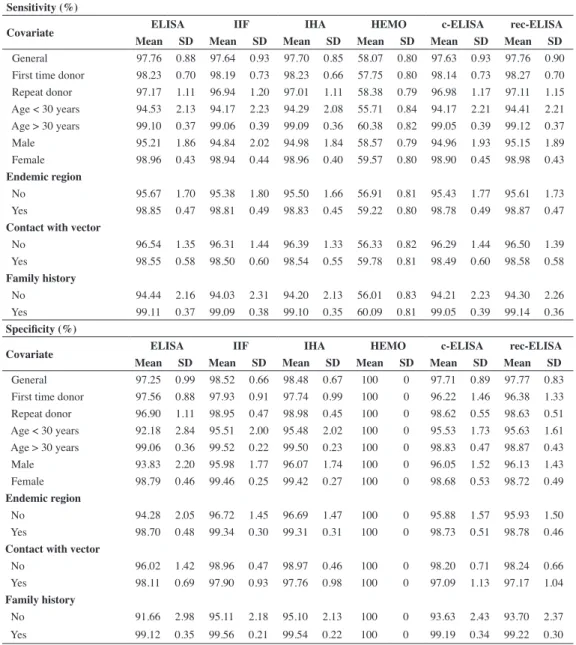
On analyzing the performance of tests without considering the covariates and the blood culture test, the general sensitivity between tests is very similar and higher than 97.63%. Two tests (IHA and IIF) were more speciic with rates of 98.48% and 98.52%, respectively (Table 2).
There was an increase in these rates when the covariates were taken into account, for example, all tests had sensitivities equal to or greater than 99.05% for donors older than 30 years and with a history of Chagas disease in the family; the ELISA, IIF and IHA tests had speciicity rates above 99.05% for these same categories (Table 2).
Table 1 - Results of the tests under investigation according to the result at the time of screening test
Screening results
Tests under investigation Negative Positive Inconclusive
ELISA IIF IHA HEMO c-ELISA rec-ELISA n(%) n(%) n(%)
- - - 27(90.0) 0 (0) 24 (80.0)
- - - - + - 2 (6.7) 0 (0) 5 (16.7)
+ - - - 1 (3.3) 0 (0) 1 (3.3)
+ + - - + - 0 (0) 1 (3.3) 0 (0)
+ + + - + + 0 (0) 17(56.7) 0 (0)
+ + + + + + 0 (0) 12 (40.0) 0 (0)
Total 30 (100) 30 (100) 30 (100)
ELISA: enzyme-linked immunosorbent assay; IIF: indirect immunoluorescence; IHA: indirect hemagglutination; HEMO: blood culture; c-ELISA: conventional ELISA using the Bio-Manguinhos kit; rec-ELISA (recombinant ELISA using the Bio-Manguinhos-FIOCRUZ kit and CRA and FRA antigens)
Table 2 - Sensitivity (%) and speciicity (%) of the six tests under investigation according to each level of the six
covariates involved
Sensitivity (%)
Covariate ELISA IIF IHA HEMO c-ELISA rec-ELISA
Mean SD Mean SD Mean SD Mean SD Mean SD Mean SD
General 97.76 0.88 97.64 0.93 97.70 0.85 58.07 0.80 97.63 0.93 97.76 0.90
First time donor 98.23 0.70 98.19 0.73 98.23 0.66 57.75 0.80 98.14 0.73 98.27 0.70 Repeat donor 97.17 1.11 96.94 1.20 97.01 1.11 58.38 0.79 96.98 1.17 97.11 1.15 Age < 30 years 94.53 2.13 94.17 2.23 94.29 2.08 55.71 0.84 94.17 2.21 94.41 2.21 Age > 30 years 99.10 0.37 99.06 0.39 99.09 0.36 60.38 0.82 99.05 0.39 99.12 0.37 Male 95.21 1.86 94.84 2.02 94.98 1.84 58.57 0.79 94.96 1.93 95.15 1.89
Female 98.96 0.43 98.94 0.44 98.96 0.40 59.57 0.80 98.90 0.45 98.98 0.43 Endemic region
No 95.67 1.70 95.38 1.80 95.50 1.66 56.91 0.81 95.43 1.77 95.61 1.73
Yes 98.85 0.47 98.81 0.49 98.83 0.45 59.22 0.80 98.78 0.49 98.87 0.47
Contact with vector
No 96.54 1.35 96.31 1.44 96.39 1.33 56.33 0.82 96.29 1.44 96.50 1.39
Yes 98.55 0.58 98.50 0.60 98.54 0.55 59.78 0.81 98.49 0.60 98.58 0.58
Family history
No 94.44 2.16 94.03 2.31 94.20 2.13 56.01 0.83 94.21 2.23 94.30 2.26
Yes 99.11 0.37 99.09 0.38 99.10 0.35 60.09 0.81 99.05 0.39 99.14 0.36
Speciicity (%)
Covariate ELISA IIF IHA HEMO c-ELISA rec-ELISA
Mean SD Mean SD Mean SD Mean SD Mean SD Mean SD
General 97.25 0.99 98.52 0.66 98.48 0.67 100 0 97.71 0.89 97.77 0.83
First time donor 97.56 0.88 97.93 0.91 97.74 0.99 100 0 96.22 1.46 96.38 1.33 Repeat donor 96.90 1.11 98.95 0.47 98.98 0.45 100 0 98.62 0.55 98.63 0.51 Age < 30 years 92.18 2.84 95.51 2.00 95.48 2.02 100 0 95.53 1.73 95.63 1.61 Age > 30 years 99.06 0.36 99.52 0.22 99.50 0.23 100 0 98.83 0.47 98.87 0.43
Male 93.83 2.20 95.98 1.77 96.07 1.74 100 0 96.05 1.52 96.13 1.43
Female 98.79 0.46 99.46 0.25 99.42 0.27 100 0 98.68 0.53 98.72 0.49 Endemic region
No 94.28 2.05 96.72 1.45 96.69 1.47 100 0 95.88 1.57 95.93 1.50
Yes 98.70 0.48 99.34 0.30 99.31 0.31 100 0 98.73 0.51 98.78 0.46
Contact with vector
No 96.02 1.42 98.96 0.47 98.97 0.46 100 0 98.20 0.71 98.24 0.66
Yes 98.11 0.69 97.90 0.93 97.76 0.98 100 0 97.09 1.13 97.17 1.04
Family history
No 91.66 2.98 95.11 2.18 95.10 2.13 100 0 93.63 2.43 93.70 2.37
Yes 99.12 0.35 99.56 0.21 99.54 0.22 100 0 99.19 0.34 99.22 0.30
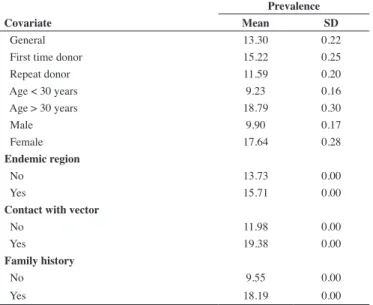
Table 3 - Prevalence rates (%) of Chagas disease for donors with inconclusive serology (Stratum III), according to the six covariates
Prevalence
Covariate Mean SD
General 13.30 0.22
First time donor 15.22 0.25
Repeat donor 11.59 0.20
Age < 30 years 9.23 0.16
Age > 30 years 18.79 0.30
Male 9.90 0.17
Female 17.64 0.28
Endemic region
No 13.73 0.00
Yes 15.71 0.00
Contact with vector
No 11.98 0.00
Yes 19.38 0.00
Family history
No 9.55 0.00
Yes 18.19 0.00
SD: Standard Deviation
Table 4 - Sensitivity (%) and speciicity (%) of the ive tests under
investigation (not including the blood culture test) with parallel and serial testing schemes
Parallel Serial
Sensitivity Speciicity Sensitivity Speciicity
Mean SD Mean SD Mean SD Mean SD
ELISA + IIF 99.96 0.06 95.23 2.33 95.98 2.44 99.94 0.06 ELISA + IHA 99.96 0.07 95.13 2.38 95.94 2.50 99.94 0.07 ELISA + c-ELISA 99.96 0.06 94.61 2.48 95.97 2.41 99.93 0.07 ELISA + rec-ELISA 99.96 0.05 94.70 2.46 96.10 2.30 99.93 0.06 IIF + IHA 99.96 0.06 95.72 1.92 95.87 2.46 99.95 0.05 IIF + c-ELISA 99.96 0.07 95.20 2.06 95.91 2.40 99.94 0.05 IIF + rec-ELISA 99.96 0.05 95.29 2.05 96.04 2.32 99.94 0.05 IHA + c-ELISA 99.96 0.05 95.10 2.10 95.86 2.39 99.94 0.06 IHA + rec-ELISA 99.96 0.06 95.20 2.12 96.00 2.35 99.94 0.06 c-ELISA + rec-ELISA 99.96 0.05 94.68 2.25 96.03 2.27 99.93 0.07 ELISA + IIF + IHA 100 0.00 94.41 2.01 93.23 2.00 100 0.00 SD: Standard Deviation; ELISA: enzyme-linked immunosorbent assay; IIF: indirect immunoluorescence; IHA: indirect hemagglutination; HEMO: blood culture; c-ELISA: conventional ELISA using the Bio-Manguinhos kit; rec-ELISA (recombinant ELISA using the Bio-Manguinhos-FIOCRUZ kit and CRA and FRA antigens)
Table 5 - Negative predictive value (%) for three pairs of tests according to the parallel and serial testing schemes as well as epidemiological variables for donors with inconclusive serology screening
Parallel Serial
ELISA/c-ELISA ELISA/rec-ELISA c-ELISA/rec-ELISA ELISA/c-ELISA ELISA/rec-ELISA c-ELISA/rec-ELISA
Mean SD Mean SD Mean SD Mean SD Mean SD Mean SD
General 99.98 0.03 99.98 0.02 99.98 0.02 98.36 1.11 98.42 1.01 98.38 1.06
First time donor 99.99 0.01 99.99 0.01 99.99 0.02 99.41 0.55 99.42 0.56 99.40 0.58
Repeat donor 99.99 0.06 99.99 0.03 100 0.03 98.86 1.99 98.93 1.75 98.95 1.73
Age < 30 years 99.63 0.58 99.67 0.43 99.66 0.45 89.82 5.67 90.17 5.42 90.01 5.45
Age > 30 years 100 0.00 100 0.00 100 0.00 99.82 0.23 99.82 0.22 99.81 0.25
Male 99.96 0.09 99.96 0.05 99.96 0.05 96.93 2.24 97.07 2.00 97.04 2.08
Female 100 0.00 100 0.00 100 0.00 99.84 0.18 99.84 0.20 99.83 0.20 Endemic region
No 99.93 0.10 99.94 0.08 99.94 0.08 97.11 1.70 97.19 1.65 97.20 1.50
Yes 99.99 0.03 99.99 0.02 99.99 0.02 98.67 1.16 98.72 1.04 98.67 1.14
Contact with vector
No 99.96 0.09 99.96 0.06 99.96 0.06 96.86 2.54 96.95 2.32 96.88 2.43
Yes 100 0.00 100 0.00 100 0.00 99.82 0.19 99.83 0.18 99.82 0.19
Family history
No 99.90 0.15 99.91 0.12 99.90 0.12 93.80 3.55 94.00 3.44 93.91 3.40
Yes 100 0.01 100 0.00 100 0.00 99.77 0.33 99.78 0.27 99.77 0.33
SD: Standard Deviation
With respect to the prevalence of Chagas disease, an overall estimate of 13.30% was observed among donors with inconclusive serology in the screening test at the time of blood donation but this rate varied considerably depending on the covariates (Table 3).
When we consider testing in series which is suitable for situations that require greater speciicity, where the diagnostic result is positive if all tests have positive results, we ind a speciicity of over 99.93% for all pairs of tests (not including the blood culture test) and 100% when we consider the ELISA, IIF, IHA tests together. While, the parallel scheme, indicated for urgent cases or for quality control as in blood banks, in which the set of tests is considered to be positive when at least one of the tests is positive, we found a sensitivity of over 99.96% for
all pairs of tests (not including the blood culture test) and 100% when we consider ELISA, IIF, IHA tests together (Table 4).
Discussion
In the present study, the general sensitivity rates were 97.76%, 97.70% and 97.64% and the speciicity was 97.25%, 98.48% and 98.52% for the ELISA, IHA and IIF tests, respectively. These results show performances similar to those found by Langui Junior et al.(19) but the sensitivity of IHA testing was higher in the present study. Studies on screening tests for Chagas disease reported sensitivity rates for the ELISA kit of bioMérieux ranging from 98.38% to 98.5% and speciicity rates from 94.30% to 99.93%.(20,21) Sensitivity rates ranging from 52.75% to 96.5% and speciicity from 87% to 100%(22-24) have been described for IIF. Sensitivity rates from 98.5% to 100% and speciicity between 99.69% and 100% have been reported for IHA.(19,20) Regarding the Bio-Manguinhos-FIOCRUZ kits, Gadelha et al.(22) found 100% sensitivity and speciicity for the c-ELISA kit and sensitivity of 98.2% for the rec-ELISA kit.
Hence, it is essential to continually assess the performance of commercial tests that are still not totally eficacious. Failures in Chagas disease screening, may occur due to cross reactions with other parasites, in particular those of the trypanosomatid genus such as Leishmania which may have many genetic similarities with T. cruzi antigens and the same epitopes to bind to antibodies present in the sera of infected patients(20,25).
The publication of government directives numbers 153 and 57 by ANVISA(26,27), made a single technique for the serological screening of blood donors for Chagas disease mandatory and that the blood bank must participate in external quality control programs. Thus it is important to seek screening methods by investigating speciic T. cruzi antigens which minimize or exclude cross reactions.
Cross reactions in blood banks may be a cause of persistent serological ineligibility due to Chagas disease; this may correspond to up to 80% of inconclusive or false-positive serological results. (8,11,20,28,29) Many studies report that inconclusive samples repeatedly
showed negative results on using other tests.(11,26)
As, in this study, the estimated prevalence of Chagas disease was 13.30% in the stratum of donors with inconclusive serology at screening, 86.70% of donors probably do not have Chagas infection. This prevalence rate is well below the rate reported by Furuchó et al.(10) who observed that 20.5% of donors in the inconclusive serology group were positive for Chagas disease. In addition, on considering epidemiological variables in this stratum, the absence of Chagas’ infection can be afirmed with a probability of 100% when two tests give negative results in all pairs of serological tests.
Studies in epidemiology and statistics show that an association of two tests increases the quality of diagnosis, thereby reducing the number of false results. The simplest way of forming a set of tests is by using in series or in parallel design(30) as used in this study.
Although there is no individual screening test for Chagas disease that has a sensitivity of 100%, sensitivity levels of 99.96% were found for several sets of tests in the parallel analysis. Additionally all pairs of tests (excluding HEMO) had speciicities in series testing greater than 99.93% and the set formed by the ELISA, IIF and IHA tests had speciicities of 100%, suggesting that this is the best alternative to conirm procedures.
Studies report that the combination of epidemiological data with results of high performance testing allows a more accurate view of the serologic status of donors(10,11).To conirm these data, we ind estimates for the sensitivity and speciicity close to 100% for certain epidemiological covariates suggesting that it is important to consider the inclusion of covariates in the structure of the model to evaluate the performance of the diagnostic tests.
In conclusion, commercial diagnostic tests (ELISA, IIF, HAI, c-ELISA, rec-ELISA) used to screen for Chagas disease, when used in pairs in serial testing schemes, proved to be an interesting alternative to conirm the procedure. In addition, epidemiological variables may contribute to improve the results of these tests and to clarify the true meaning of inconclusive serology screening. In search of a gold standard procedure and more reliable estimates, further studies are necessary with larger samples, clinical variables and further assume dependence between tests in statistical modeling.
Acknowledgements
We thank the Fundação Hemominas for providing the data and the Brazilian funding agencies Capes, ANVISA and CNPq for inancial support. We thank the Laboratory Bio-Manguinhos, especially Antônio Gomes Pinto, Yara de Miranda Gomes, Edimilson Domingos da Silva and Marcelle Bral de Mello for providing the c-ELISA and rec-ELISA kits as well as processing of samples from the respective techniques. We also thank the anonymous reviewers for their comments and criticisms.
References
1. WHO 2010. First WHO report on neglected tropical diseases: Working
to overcome the global impact of neglected tropical diseases (WHO/ HTM/NTD/2010.1) 2010 [cited 2012 March 20]; Available from: http://
whqlibdoc.who.int/publications/2010/9789241564090_eng.pdf 2. Organización Panamericana de la Salud. Estimación cuantitativa de la
enfermedad de Chagas en las Americas. Geneva, Switzerland: OPAS;
2006. 28p.
3. Souza HM. Mecanismos alternativos de transmissäo parenteral da
Doença de Chagas. Rev Méd Minas Gerais. 1993; 3(2):93-5
4. Schmunis GA. Tripanosomíase Americana: seu impacto nas Américas e
perspectivas de eliminação. In: Dias JC, Coura JR, organizadores. Clínica e terapêutica da doença de Chagas: uma abordagem prática para o clínico geral Rio de Janeiro: Fiocruz; 1997. p 11-24.
5. Dias JC. Elimination of Chagas disease transmission: perspectives Mem Inst Oswaldo Cruz. 2009;104(Suppl 1):41-5.
6. Schmunis GA. Epidemiology of Chagas disease in non-endemic countries: the role of international migration. Mem Inst Oswaldo Cruz.
2007; 102(Suppl 1):75-85.
7. Salles NA, Sabino EC, Cliquet MG, Eluf-Neto J, Mayer A, Almeida-Neto C, et al. Risk of exposure to Chagas disease among sero reactive Brazilian blood donors. Transfusion. 1996;36(11-12):969-73.
8. Melo AS, Lorena VM, Moraes AB, Pinto MB, Leão SC, Soares AK, et al.
The prevalence of chagasic infection among blood donors in the state of Pernambuco, Brazil. Rev Bras Hematol Hemoter. 2009;31(2):69-73.
10. Furuchó, CR, Umezawa, ES, Almeida, I, Freitas, VL, Bezerra, R, Nunes
EV, et al. Inconclusive results in conventional serological screening for Chagas’ disease in blood banks: evaluation of cellular and humoral
response. Trop Med Int Health. 2008;13(12):1527-33.
11. Ferreira-Silva MM, Pereira GA, Lages-Silva E, Moraes-Souza H.
Socioepidemiological screening of serologically ineligible blood donors
due to Chagas disease for the deinition of inconclusive cases. Mem Inst Oswaldo Cruz. 2010;105(6):800-5.
12. Meira WS, Galvão LM, Gontijo ED, Machado-Coelho GL, Norris KA,
Chiari E. Trypanosoma cruzi complement regulatory protein: a novel antigen for use in enzyme-linked immunosorbent assay for diagnosis of Chagas disease. J Clin Microbiol. 2002;40(10):3735-40.
13. Umezawa ES, Bastos SF, Coura JR, Levin MJ, Gonzalez A, Rangel-Aldao
R, et al. An improved serodiagnostic test for Chagas disease employing a mixture of Trypanosoma cruzi recombinant antigens. Transfusion. 2003;43(1):91-7.
14. Umezawa ES, Luquetti AO, Levitus G, Ponce C, Henriquez D, Revollo S, et al. Serodiagnosis of chronic and acute Chagas disease with Trypanosoma cruzi recombinant proteins: results of a collaborative study in six Latin American countries. J Clin Microbiol. 2004;42(1):449-52.
15. Cheng KY, Chang CD, Salbilla VA, Kirchhoff LV, Leiby DA,
Schohetman, Chat DO. Immunoblot assay using recombinant antigens as
a supplemental test to conirm the presence of antibodies to Trypanosoma cruzi. Clin Vaccine Immunol. 2007;14(4):355-61.
16. Hadgu A, Qu Y. A Biomedical application of latent class models with
random effects. Appl Stat. 1998;47(4):603-16.
17. Martinez EZ, Louzada-Neto F, Achcar JA, Syrjänen KJ, Derchain SF, Gontijo RC, et al. Bayesian Estimation of performance measures
of screening tests in the presence of covariates: an absence of a gold
standard. Braz J Probab Stat. 2009;23(1):68-81.
18. Hui SL, Walter SD. Estimating the error rates of diagnostic tests. Biometrics. 1980;36(1):167-71.
19. Langhi Junior DM, Bordin JO, Castelo A, Walter SD, Moraes-Souza H, Stumpf RJ. The application of latent class analysis for diagnostic test validation of chronic trypanosoma cruzi infection in blood donors. Braz
J Infect Dis. 2002;6(40):181-7.
20. Flores-Chávez M, Cruz I, Rodríguez M, Nieto J, Franco E, Gárate T, et al. Comparación de técnicas serológicas convencionales y no convencionales
para El diagnóstico de la enfermedad de Chagas importada en España. Enferm Infecc Microbiol Clin 2010;28(5):284-93. Spanish.
21. Praast G, Herzogenrath J, Bernhardt S, Christ H, Sickinger E. Evaluation of the Abbott ARCHITECT Chagas prototype assay. Diagn Microbiol
Infect Dis. 2011;69(1):74-81.
22. Gadelha AA, Verçosa AF, Lorena VM, Nakazawa M, Carvalho AB,
Souza WV, et al. Chagas disease diagnosis: comparative analysis of recombinant ELISA with conventional ELISA and the haemagglutination
test. Vox Sang. 2003;85(3):165-70.
23. Pirard M, Iihoshi N, Boelaert M, Basanta P, López F, der Stuyft P. The
validity of serologic tests for Trypanosoma cruzi and the effectiveness of transfusional screening strategies in a hyperendemic region. Transfusion. 2005;45(4):554-61.
24. Lunardelli A, Borges FP, Mello KF, Zeferino AS. Soroprevalência da doença de Chagas em candidatos a doadores de sangue. Rev Bras Anal
Clin. 2007;39(2):139-41.
25. Brasil PE, Castro L, Hasslocher-Moreno Am, Sangenis L, Braga JU. Elisa versus PCR for diagnosis of chronic Chagas disease: Systematic review and meta-analysis. BMC Infect Dis. 2010;10:337-53.
26. ANVISA. Agência Nacional de Vigilância Sanitária. Resolução RDC nº 153, de 14 de junho de 2004. Publicada no Diário Oicial da união de 24 de junho de 2004. [citado 2001 Out 11]. Available from:
http://e-legis.anvisa.gov.br/leisref/public/showAct. php?id=11662.
27. ANVISA. Agência Nacional de Vigilância Sanitária. Resolução RDC nº 57, de 17 de outubro de 2010. Publicada no Diário Oicial da União em
16 de dezembro de 2010. [citado 2011 Out 11]. Available from: http:// portal.anvisa.gov.br/.
28. Leiby DA, Herron RM Jr, Garratty G, Herwaldt BL. Trypanosoma cruzi parasitemia in: US Blood donors with serologic evidence of infection. J
Infect Dis. 2008;198(4):609-13
29. Sabino EC, Salles NA, Sarr M, Barreto AM, Oikawa M, Oliveira CD, Leao SC, Carneiro-Proietti AB, Custer B, Busch MP; NHLBI Retrovirus Epidemiology Donor Study-II (REDS-II), International Component.
Enhanced classiication of Chagas serologic results and epidemiologic
characteristics of seropositive donors at three large blood centers in
Brazil. Transfusion. 2010;50(12):2628-37.
30. Arango HG. Bioestatística: teórica e computacional. 2nd ed. Rio de Janeiro: Guanabara Koogan; 2005.