○ ○ ○ ○ ○ ○ ○ ○ ○ ○ ○ ○ABST RAC T○ ○ ○ ○ ○ ○
C
a
se
R
ep
o
rt
○ ○ ○ ○ ○ ○ ○ ○ ○ ○IN T RO D U C T IO N○ ○ ○ ○ ○ ○ ○ ○ ○ ○
T he use of parenteral nutrition via a central venous catheter has become a common practice in the neonatal intensive care setting. Some complications due to this procedure are well known, but extravasation of the infusate leading to an acute abdomen has only rarely been documented. T his report describes the case of a premature infant with a femoral catheter placed in the inferior vena cava, who developed an acute abdomen as a result of late retroperitoneal extravasation of parenteral nutrition.
○ ○ ○ ○ ○ ○ ○ ○ ○ ○ ○ ○ ○ ○ ○ ○ ○CA SE○ ○ ○
A 1380-gram premature male newborn, born at the 34th week of gestation, was admitted to the pediatric intensive care unit with a diagnosis of hyaline membrane disease. T his required exogenous surfactant therapy and mechanical ventilatory support.
On the 11th day of life, he underwent partial colectomy because of necrotizing enterocolitis and the use of vancomycin plus imipenem was started. A right femoral vein catheter (22GA, Becton Dickinson, Sandy, Utah, USA) was inserted by cut-down, with the tip placed below the renal veins in the inferior vena cava, and parenteral nutrition was instituted. The infant presented a good recovery after surgery. Bowel sounds were audible on the 2nd postoperative day and colostomy became functional on the third postoperative day.
On the fifth postoperative day, however, the infant suddenly deteriorated. T he abdomen became distended with diffuse
• Jaques Sztajnbok
• Eduardo Juan Troster
Acute abdomen due to late
retroperitoneal extravasation
from a femoral venous
catheter in a newborn
Pediatric Intensive Care Unit, Hospital Nossa Senhora da Penha and
Instituto da Criança, Hospital das Clinicas, Faculty of Medicine,
Universidade de São Paulo, São Paulo, Brazil
CO N TEX T: The use o f parenteral nutritio n via a central ve no us c a the te r is a c o mmo n pra c tic e in the neo natal intensive care setting . Extravasatio n o f the infusate leading to an acute abdo men is a co mplicatio n that has o nly rarely been do cumen-ted. This repo rt describes the case o f a premature infant with a femo ral catheter placed in the inferio r vena cava, who develo ped an acute abdo men as a result o f late retro perito neal extravasatio n o f parenteral nutritio n.
CASE REPO RT: A p re -te rm infa nt re c e iving to ta l parenteral nutritio n via a femo ral veno us catheter develo ped an acute abdo men five days after the c a theter pla c ement. Extra va sc ula r c a theter mi-g ra tio n to the re tro p e rito ne a l sp a c e a nd extravasatio n o f the infusate was diag no sed by co ntrast injectio n. W ithdrawal o f the catheter was fo llo wed by pro mpt cessatio n o f the sig ns and full reco very fro m the acute abdo men, witho ut the need fo r surg ery. A review o f the literature is presented, emphasizing the clinical and therapeutic aspects o f this unusual co mplicatio n fro m femo ral veno us catheterizatio n and parenteral nutritio n.
KEY W O RDS: Ac ute a b d o me n. Fe mo ra l ve no us catheterizatio n. Extravasatio n. Parenteral nutritio n. N ewbo rn.
tenderness and induration of the anterior abdominal wall. Bowel sounds were absent. T he child had a temperature of 38.2 ºC and an increased leukocyte count of 32,200/mm3 (2 metamyelocytes, 8 band forms, 7 1 segmented neutrophils, 12 lymphocytes, 4 eosinophils, and 3 monocytes), with a platelet count of 159,000/mm3.
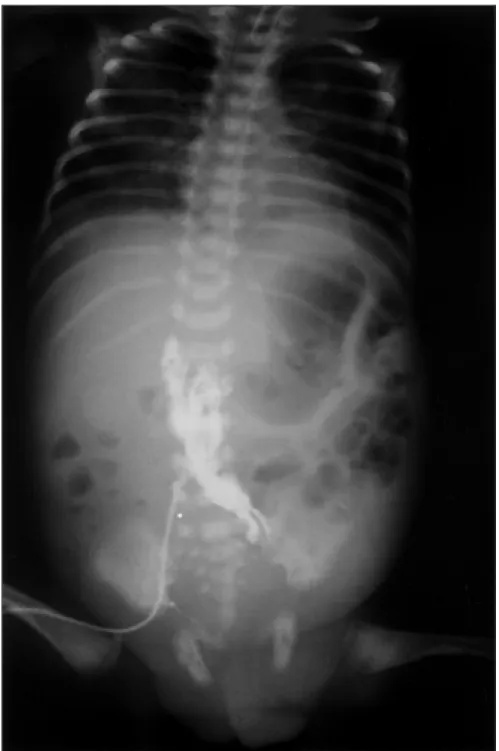
T he femoral catheter was aspirated without blood return and a contrast that was then injected through this catheter revealed retroperitoneal extravasation of the dye (Figure 1). T he right femoral catheter was removed and another one was then inserted into the left femoral vein via a distinct cut-down, so that parenteral nutrition could be maintained. Within 24 hours of the catheter removal, the infant had a soft abdomen and the return of gastrointestinal function. B oth the abdominal tenderness and the marked induration of the abdominal wall were completely resolved. The new catheter was well tolerated without any complication until its removal on the 10th day after its insertion.
○ ○ ○ ○ ○ ○ ○ ○ ○ ○ ○ ○ D ISC U SSIO N○ ○ ○ ○ ○ ○ ○ ○
Establishing central venous access is critical in the sick neonate. Patients in neonatal intensive care units require parenteral antibiotics for the treatment of infections. T hey need total parenteral nutrition when they cannot take in adequate nutrition by enteral means and parenteral access for life-support drugs. In addition, neonates experience large fluid losses because of their relatively large body surface area, and require reliable access for hydration.1
São Paulo M edical Journal - Revista Paulista de M edicina
60
changes of the lines.2
Peripherally inserted central venous catheters are more reliable than PIV lines. Factors indicating their placement include the need for access lasting longer than 3 days or a lack of alternative sites. T heir advantages over PIVs include increased caloric administration, decreased venipuncture and ease of mainte-nance. T he rate of insertion complications is T he placement of peripheral intravenous
lines (PIV) can provide the majority of the fluid and nutritional needs of the neonate. The primary problem with peripheral venous catheters is the difficulty in placing and maintaining them. T here are also several complications such as phlebitis and extravasation that lead to soft tissue necrosis and infection, usually requiring frequent
reduced in relation to standard venous lines.1 Such complications include mechanical problems, dislodgment, venous thrombosis and infection.1
Central venous lines are the last option when peripheral access is necessary. Placement is either by means of percutaneous techniques or cut-down. The most common sites are the internal jugular, subclavian, femoral, saphe-nous, facial and external jugular veins. Puncture of the subclavian or internal jugular veins is more difficult and is associated with an increased risk of pneumothorax. A groin line is easier to place because the patient can be restrained better and pneumothorax is not a concern there. The saphenous vein is preferred because there is a decreased risk of venous hypertension in the leg. The risk of infection may be higher with groin lines, but this issue remains controversial.1
The most commonly reported complica-tions include venous thrombosis and edema of the distal lower extremities.3 Extravasation from a femoral venous catheter is an exceedingly rare event, with only a few cases described to date.4-9 It appears that localized chemical phlebitis in-duced by the high osmolarity of the infusate, followed by subsequent catheter erosion, is the most likely cause of this complication.8 It has been suggested that previous or concomitant staphylococcal infection may play a role in this occurrence. 7
Extravasation has been reported as occurring both intraperitoneally and retro-peritoneally.4-9 Interestingly, regardless the ex-travasation site, most of these cases presented with acute abdomen and shared common fin-dings. T hese findings included abdominal tenderness and distention,4-9 fever,4 ,6 ,7 ,9 leukocytosis,4,6,7,9 a characteristic induration of the abdominal wall secondary to infiltration of its soft tissues,4-7 failure of the catheter to provide an adequate blood reflux when aspirated,4-9 and the fact that, in almost all of the cases, the catheters were being used for parenteral nutrition support.5,7-9 In most of these cases, the diagnosis of extravasation was ultimately confirmed by contrast injection into the catheter or by peritoneal paracentesis. All cases presented prompt recovery from both the laboratory and clinical changes, imme-diately after the cessation of infusions and the removal of the catheters.4-9 T hese findings indicate that the problems of femoral venous catheter extravasation during parenteral nutrition are self-correcting after the removal of the catheter, and that this removal is usually sufficient therapy.
Figure 1. Right femoral vein catheter. Contrast injection demonstrates retroperitoneal extravasation that occurred five days after
the catheter placement.
São Paulo M edical Journal - Revista Paulista de M edicina
61
Physicians need to be aware of such conditions when faced with a child showing signs and symptoms of acute abdomen. If the child has a femoral catheter, the possibility of catheter extravasation should be considered. Its position should be checked by contrast
injection and the catheter should be aspirated. If the catheter is failing to provide adequate blood reflux or the x-ray evidence shows extra-vasation of the dye, the catheter should then be removed. T his would usually be sufficient therapy in itself. Catheter extravasation should
also be included in the differential diagnosis of acute abdomen in infants or children who have femoral catheters positioned in the inferior vena cava. Its early recognition could prevent unnecessary laparotomy, thereby considerably reducing the risks for the patient.
CONT EXTO: A utilização de cateter femoral
para nutrição parenteral é uma prática comum em terapia intensiva pediátrica com algumas complicações relatadas. Uma dessas complicações raramente descritas é a migra-ção tardia do cateter femoral levando a extra-vasamento retroperitoneal da solução in-fundida, situação essa caracteristicamente acompanhada de quadro clínico e laboratorial de abdome agudo.
RELATO DE CASO: Recém-nascido pré-termo
recebendo nutrição parenteral total por cateter femoral apresentou quadro de abdome agudo no quinto dia após a introdução do
○ ○ ○ ○ ○ ○ ○ ○ ○ ○ ○ ○ ○ ○ ○ ○ ○ ○ ○ ○ ○ ○ ○ ○ ○ ○ ○ ○ ○ ○ ○ ○ ○ ○ ○ ○R ESU M O○ ○ ○ ○ ○ ○
Ja ques Szta jnbok , M D. Pediatric Intensive Care Unit, Ho spital N o ssa Senho ra da Penha and Instituto da Criança, Ho spital das Clinicas, Faculty o f Medicine, Universidade de São Paulo , São Paulo , Braz il.
Edua rdo Jua n Troster, M D, PhD. Pediatric Intensive Care Unit, Instituto da Criança, Ho spital das Clinicas, Faculty o f Medicine, Universidade de São Paulo , São Paulo , Braz il.
Sources of funding: N o t declared
Conflict of interest: N o t declared
Da te of first subm ission: 2 8 May 2 0 0 1
La st received: 1 9 September 2 0 0 1
Accepted: 1 1 O cto ber 2 0 0 1
Address for correspondence
Jaques Sz tajnbo k
Alameda Lo rena, 1 8 5 8 – Apto . 3 1 São Paulo / SP – Brasil - CEP 0 1 4 2 4 -0 0 2 Tel/ Fax: (1 1 ) 3 0 6 4 3 9 3 3 / 3 0 8 5 1 3 9 1 E-mail: jaquess@ icr.hcnet.usp.br
CO PYRIG HT© 2 0 0 2 , Asso ciação Paulista de Medicina
○ ○ Pu b l i sh i n g i n f o r m a t i o n○ ○ ○ ○ ○ ○ ○ ○ ○ ○ ○ ○ ○ ○ ○ ○ ○ ○
cateter. A migração extravascular da ponta do cateter com extravasamento retroperitoneal da solução foi diagnosticada por estudo contrastado. A simples retirada do cateter foi suficiente para a melhora do quadro clínico de abdome agudo, sem necessidade de cirur-gia. Os autores apresentam uma revisão de literatura com ênfase nos aspectos clínicos, diagnósticos e terapêuticos desta rara com-plicação tardia de cateterização venosa femo-ral e nutrição parentefemo-ral em crianças.
PALAVRAS-CHAVE: Abdome agudo.
Catete-rismo venoso femoral. Extravasamento. Hipe-ralimentação parenteral. Recém-nascido.
1. Hogan MJ. Neonatal vascular catheters and their complications. Radiol Clin North Am 1999;37:1109-25.
2. Cronin WA, Germanson TP, Donowitz LG. Intravascular catheter colonization and related bloodstream infection in critically ill
neonates. Infect Control Hosp Epidemiol 1990;11:301-8. 3. Kanter RK, Zimmerman JJ, Strauss RH, et al. Central venous
catheter insertion by femoral vein: safety and effectiveness for the pediatric patient. Pediatrics 1986;77:842-7.
○ ○ ○ ○ ○ ○ ○ ○ ○ ○ ○ ○ ○ ○ ○ ○ ○ ○ ○ ○ ○ ○ ○ ○ ○ ○ ○ ○ ○ ○ ○ ○ ○ ○ ○ ○ ○ ○ ○ ○ ○ ○ ○ ○ ○ ○ ○ ○ ○ ○ ○ ○ ○ ○ ○ ○ R EFER EN C ES○ ○ ○ ○ ○ ○ ○ ○
4. Bonadio WA, Losek JD , Melzer-Lange, M. An unusual complication from a femoral venous catheter. Pediatr Emerg
Care 1988;4:27-9.
5. Spriggs D W, B rantley R E. T horacic and abdominal
extravasation: a complication of hyperalimentation in infants. Am J Roentgenol 1977;128:419-22.
6. Krasna IH, Krause T. Life-threatening fluid extravasation of central venous catheters. J Pediatr Surg 1991;26:1346-8.
7. Bansal V, Strauss A, Gyepes M, et al. Central line perforation
associated with Staphylococcus epidermidis infection. J Pediatr Surg 1993;28:894-7.
8. Nour S, Puntis JW, Stringer MD. Intra-abdominal extravasation complicating parenteral nutrition in infants. Arch Dis Child
1995;72:207-8.
9. Moriarty KP, Konefal Jr SH, Ingold VJ. Acute abdomen from a
femoral venous catheter. Clin Pediatr (Phila) 1997;36:175-6.