Rev Odontol UNESP. 2017 July-Aug; 46(4): 203-207 © 2017 - ISSN 1807-2577
ORIGINAL ARTICLE
Doi: http://dx.doi.org/10.1590/1807-2577.16316
Cytotoxicity of three light-cured resin cements on 3T3 ibroblasts
Citotoxicidade de três cimentos resinosos fotopolimerizáveis sobre ibroblastos 3T3
Daniela Bastos TUMSCITZ
a*, Laisa Araujo Cortines LAXE
b, Aislan Cristina Rheder Fagundes PASCOAL
a,
Raphael HIRATA JUNIOR
c, Renata Ximenes LINS
aaUFF – Universidade Federal Fluminense, Nova Friburgo, RJ, Brasil
bUFJF – Universidade Federal de Juiz de Fora, Governador Valadares, MG, Brasil
cUERJ – Universidade do Estado do Rio de Janeiro, Rio de Janeiro, RJ, Brasil
Resumo
Introdução: Cimentos resinosos fotopolimerizáveis são materiais de eleição para a cimentação de facetas laminadas. Devem ser biocompatíveis oferencendo riscos mínimos ao uso clínico em pacientes. Objetivo: O objetivo desse trabalho foi avaliar in vitro a citotoxicidade de três cimentos resinosos: Variolink II (Ivoclar Vivadent), Allcem Veneer, (FGM) e Rely X Veneer (3M ESPE). Material e método: Vinte e quatro corpos de prova de cada cimento foram confeccionados em matrizes metálicas padronizadas e inseridos em placa de cultura de células de noventa e seis poços contendo fibroblastos da linhagem 3T3. As células foram cultivadas em meio de cultivo celular RPMI 1640 com 5% de soro fetal bovino, com 0,1% de penicilina/estreptomicina em estufa a 37°C, em atmosfera úmida com 5% de CO2. O grau de citotoxicidade de cada cimento foi avaliado após os tempos de contato de 24h, 48h e 72h através do método MTT (3-(4,5-dimetiltiazol-2yl)-2,5- difenil brometo de tetrazolina), que avalia a viabilidade celular pela função mitocondrial. Após os tempos estabelecidos, as amostras foram removidas, tratadas e levadas ao espectofotômetro de microplaca para leitura da absorbância em 570nm. Resultado: O cimento Variolink apresentou em 24h viabilidade de 72,24% (±6,80), em 48h de 83,92% (± 5,26) e de 92,77% (±5,59) em 72h. Allcem Veneer apresentou viabilidade de 70,46% (± 12,91) em 24h; 85,03% (± 21,4) em 48h e 70,46% (± 12,91) em 72h. O RelyX Veneer demonstrou viabilidade de 5,06% (± 0,88) em 24h; 5,84% (± 1,18) em 48h e 6,99% (± 1,34) em 72h. Conclusão: Estes resultados demonstraram que o cimento Rely-X se apresentou significativamente mais citotóxico nas condições testadas.
Descritores: Facetas dentárias; cimentos de resina; citotoxicidade; resinas compostas; sobrevivência celular.
Abstract
Introduction: Light-cured resin cements are the first choice for the cementation of laminate veneers. Ideally, they should be biocompatible and offer minimum risks to patients. Objective: The aim of this study was to evaluate, in vitro, the cytotoxicity of three resin cements: Variolink II, Ivoclar Vivadent (C1), Allcem Veneer, FGM (C2), and Rely X Veneer, 3M ESPE (C3). Material and method: Twenty four samples of each of the cements were fabricated in a standardized metal mold, light activated, and transferred to a 96-well cell plate with culture of fibroblasts. After 24, 48, and 72h of incubation, cytotoxicity was assessed and cell viability was calculated by the methyl-thiazol-tetrazolium (MTT) colorimetric assay. Absorbance was measured at 570 nm using a microplate spectrophotometer. Result: The following results were found: Variolink II presented viability of 72.24% (SD 6.80) after 24h, 83.92% (SD 5.26) after 48h, and 92.77% (SD 5.59) after 72h; Allcem Veneer exhibited viability of 70.46% (SD 12.91) after 24h, 85.03% (SD 21.4) after 48h, and 70.46% (SD 12.91) after 72h; Rely X Veneer showed viability of 5.06% (SD 0.88) after 24h, 5.84% (SD 1.18) after 48h, and 6.99% (SD 1.34) after 72h. Conclusion: Under these testing conditions, Rely X Veneer presented significantly higher cytotoxicity compared with those of the other light-cured resin cements assessed.
Descriptors: Dental veneers; resin cements; cytotoxicity; composite resins; cell survival.
INTRODUCTION
Special interest with regards to the biocompatibility of dental materials has brought increasing attention to both dental professionals and patients. he current demand for cosmetic dentistry is associated with the desire for a harmonious and esthetic smile, combining beauty and function. In this context, veneers appear as ceramic restorations of high aesthetic standard, biocompatibility, and color stability1,2.
Ideally, the cementation of veneers require biocompatible dental materials that do not present any possibility of cytotoxic efects or allergic reaction on oral tissues3,4. Resin cements have been widely
resin cements1,5. Among the several resin cements available in the
market, the light-cured ones are the irst choice for the cementation of veneers due to their higher color stability and working time5,6.
However, the polymerization reaction involves a free radical reaction in which the material is transformed from a viscous state to a rigid one. During this process, the terminal aliphatic C=C bonds are broken and converted to primary C-C covalent bonds. In vitro demonstrations found in the speciic scientiic literature show that monomer conversion is not complete and that at the end of the reaction part of the monomers are released from the material into the adjacent tissues, generating local and systemic adverse efects3,4,10,11. Gupta et al.10, in 2012, conducted a literature review on
the cytotoxic efect of composite resins. In vitro and in vivo studies have clearly identiied that some components released from the material are toxic. Moreover, according to literature, the release phenomenon begins during the polymerization reaction and can last up to 21 days. his process can lead to material degradation over time10. he amount of components released and the extension
of the polymerization reaction are related12. Previous studies
have found that the resin monomers A- glycidyl methacrylate (Bis-GMA), triethilene glycol dimetacrylate (TEGDMA), and urethane dimethacrylate (UDMA) present in the organic matrix are potentially toxic13,14.
he aim of the present in vitro study was to evaluate, in 3T3 ibroblasts, the cytotoxicity of three diferent light-cured resin cements used in the luting of laminate veneers for three diferent periods of time.
In vitro cytotoxicity tests are reproducible, cost-efective, ideal to predict clinical outcomes, and suitable for the evaluation of basic biological properties of dental materials6,15,16. he null hypothesis
of this study is that the tested cements present no cytotoxic efects on oral tissues.
MATERIAL AND METHOD
Sample Preparation
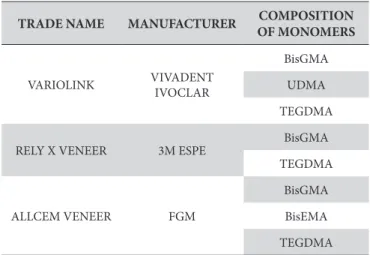
hree of the most commonly used light-cured resin cements were tested in this study and are described in Table 1. Twenty-four sample disks, 2mm thick and 3mm in diameter, of each of the uncured cements were inserted into metallic mold to be light-cured. Before polymerization, a transparent plastic matrix strip (TDV) was placed on the top of the molds to avoid the formation of an oxygen-inhibited supericial layer, and the molds were compressed
measured by colorimetric assay as described by Mosmann17.
A total of 5 x 10⁴ 3T3-Swiss albino (ATCCR CCl-92TM) cells/ml
were seeded in 96-well plates and were incubated in 5% CO2 atmosphere at 100% humidity and 37 °C in RPMI 1640, penicillin (100 U/mL) and streptomycin (100 mg/mL), supplemented with 5% fetal bovine serum. he inal volume of the medium in each well was 200 µL. Ater 24 hours of incubation, the culture medium was changed and the groups of samples were added to the wells in each experimental period tested (24h, 48h, and 72h). Ater insertion of the test specimens into the wells, the culture medium was not changed until the end of the assay. Cell viability was calculated as percentage of the control group and measured by the MTT assay based on the ability of a viable cell mitochondrial dehydrogenase to reduce the yellow MTT dye to insoluble blue formazan crystals. Ater adding the solvent, absorbance of the converted dye cells was measured using a microplate spectrophotometer at the wavelength of 570 nm. Cells cultured in culture medium were considered as 100% cell viability for 72h.
Statistical Analysis
Data were analyzed using analysis of variance (One-way ANOVA) followed by the Dunnett’s test for multiple comparisons compared to cells cultured in the presence of culture medium - 100% of viability. Results were considered statistically signiicant when p<0.05, n = 6.
Table 1. Tested cements and the composition of their monomers according to the manufacturers
TRADE NAME MANUFACTURER COMPOSITION OF MONOMERS VARIOLINK VIVADENT IVOCLAR BisGMA UDMA TEGDMA
RELY X VENEER 3M ESPE
BisGMA
TEGDMA
ALLCEM VENEER FGM
BisGMA
BisEMA
RESULT
Cytotoxicity was correlated with setting time and cement type factors. he percentages of viable cells of each experimental group were compared with those of the negative control - 3T3 cells were grown in culture medium supplemented with 5% fetal bovine serum for 72 hours. he results of the present study showed that Variolink II presented viability of 72.24% (SD=6.80) ater 24h, 83.92% (SD=5.26) ater 48h, and 92.77% (SD=5.59) ater 72h; AllCem Veneer exhibited viability of 70.46% (SD=12.91) ater 24h, 85.03% (SD=21.4) ater 48h, and 70.46% (SD=12.91) ater 72h; Rely X Veneer showed 5.06% (SD=0.88) ater 24h, 5.84% (SD=1.18) ater 48h, and 6.99% (SD=1.34) ater 72h. Values were considered statistically signiicant when p<0.05. Based on the results, Rely X Veneer proved to be the most cytotoxic cement at all contact times tested, followed by AllCem Veneer and Variolink II, respectively. Cell viability of the control and experimental groups at the three contact times (24, 48 and 72h) are shown in Figure 1.
DISCUSSION
It has been demonstrated that resin cements present toxic reaction in cell cultures by unreacted monomers released from the material during the polymerization reaction, which is related to thickness, light intensity, and photoactivation times of the material8,12. Is has
also been demonstrated that comonomers, additives, and reaction products are released from polymerized cements12,18. According to
Ferracane15, 2013, cytotoxic efects are associated with incomplete
polymerization reaction. he consequences of this process are degradation, opening of gaps, and failure of the laminate veneers19.
It is known that the greater the amount of unreacted monomers contained in a cured cement, the higher the toxic efects1. Furthermore,
it has been reported that the nature of the matrix monomers can signiicantly inluence the release of toxic components8.
he null hypothesis of the present study - tested cements present no cytotoxic efects on oral tissues - has to be rejected.
Our results showed that the tested cements presented varying degrees of cytotoxicity which decreased overtime and that Rely X Veneer was the most cytotoxic cement, but no signiicant diferences were observed between AllCem Veneer and Variolink II. his behavior can be explained by the diferent compositions of the cements, mainly related to the nature of the matrix monomers. Rely X Veneer is composed of only two monomers: BisGMA and TEGDMA, whereas Variolink II and AllCem Veneer present an additional monomer type, UDMA and BisEMA, respectively. A current study has demonstrated that TEGDMA and BisGMA present severe cytotoxicity according to the following rank order: BisGMA>UDMA>TEGDMA>BisEMA8. herefore, based on our
previous results, it is possible to suggest that the presence of a third monomer in the veneer composition may decrease their cytotoxic efect. Moreover, UDMA and BisEMA, present in Variolink II and in Allcem Veneer, respectively, are low-weight monomers that allow greater reactivity in forming the polymer chain, which can be considered another possibility to explain the lower cytotoxicity of these cements.
In 2009, Schmid-Schwap et al.3 tested several cements, including
Variolink II and Rely X Unicem, on their self- and dual-cured presentation forms. he authors reported that Rely X was more cytotoxic than Variolink II, corroborating the indings of this study. Furthermore, dual-cured specimens showed lower cytotoxicity than chemically cured specimens3. he authors suggested that light
activation could have interfered on their results by reducing the cytotoxic efects. his hypothesis was corroborated by Gupta et al.10,
who stated that cytotoxicity is inversely related to light activation and inluenced by the type of the light curing unit. hese authors also reported that any factor that limits or undermines the polymerization of cements, such as low light intensity, short light curing time, and longer distance between material surface and light source, may contribute to signiicantly increase their cytotoxic efects, and that fast curing using a high-power unit may be beneicial for composites to minimize the release of toxic substances10.
According to Trumpaite-Vanagiene et al.18, the irst hours ater
REFERENCES
1. Silami FDJ, Tonani R, Alandia-Román CC, Pires-de-Souza FCP. Influence of different types of resin luting agents on color stability of ceramic laminate veneers subjected to accelerated artificial aging. Braz Dent J. 2016 Feb;27(1):95-100. PMid:27007354. http://dx.doi.org/10.1590/0103-6440201600348.
2. Cunha LF, Pedroche LO, Gonzaga CC, Furuse AY. Esthetic, occlusal, and periodontal rehabilitation of anterior teeth with minimum thickness porcelain laminate veneer. J Prosthet Dent. 2014 Dec;112(6):1315-8. PMid:25156092. http://dx.doi.org/10.1016/j.prosdent.2014.05.028. 3. Schmid-Schwap M, Franz A, König F, Bristela M, Lucas T, Piehslinger E, et al. Citotoxicity of four categories of dental cements. Dent Mater.
2009 Mar;25(3):360-8. PMid:18849067. http://dx.doi.org/10.1016/j.dental.2008.08.002.
4. Geurtsen W, Lehmann F, Spahl W, Leyhausen G. Cytotoxicity of 35 dental resin composite monomers / additives in permanent 3T3 and three human primary fibroblast cultures. J Biomed Mater Res. 1998 Sep;41(3):474-80. PMid:9659618. http://dx.doi.org/10.1002/(SICI)1097-4636(19980905)41:3<474::AID-JBM18>3.0.CO;2-I.
5. Ladha K, Verma M. Conventional and contemporary luting cements: an overview. J Indian Prosthodont Soc. 2010 Jun;10(2):79-88. PMid:21629449. http://dx.doi.org/10.1007/s13191-010-0022-0.
6. Kong N, Jiang T, Zhou Z, Fu J. Cytotoxicity of polymerized resin cements on human dental pulp cells in vitro. Dent Mater. 2009 Nov;25(11):1371-5. PMid:19615734. http://dx.doi.org/10.1016/j.dental.2009.06.008.
7. D’Arcangelo C, De Angelis F, Vadini M, D’Amario M. Clinical evaluation on porcelain laminate veneers bonded with light-cured composite: results up to 7 years. Clin Oral Investig. 2012 Aug;16(4):1071-9. PMid:21773711. http://dx.doi.org/10.1007/s00784-011-0593-0.
8. Arslan Malkoç M, Demir N, Şengün A, Bozkurt ŞB, Hakki SS. Cytotoxicity evaluation of luting resin cements on bovine dental pulp-derived cells (bDPCs) by real-time cell analysis. Dent Mater J. 2015;34(2):154-60. PMid:25736260. http://dx.doi.org/10.4012/dmj.2014-167. 9. Delaviz Y, Finer Y, Santerre JP. Biodegradation of resin composites and adhesives by oral bacteria and saliva: a rationale for new material
designs that consider the clinical environment and treatment challenges. Dent Mater. 2014 Jan;30(1):16-32. PMid:24113132. http://dx.doi. org/10.1016/j.dental.2013.08.201.
10. Gupta SK, Saxena P, Pant VA, Pant AB. Release and toxicity of dental resin composite. Toxicol Int. 2012 Sep-Dec;19(3):225-34. PMid:23293458. http://dx.doi.org/10.4103/0971-6580.103652.
11. Noronha JD Fo, Brandão NL, Poskus LT, Guimarães JGA, Silva EM. A critical analysis of the degree of conversion of resin-based luting cements. J Appl Oral Sci. 2010 Sep-Oct;18(5):442-6. PMid:21085798. http://dx.doi.org/10.1590/S1678-77572010000500003.
12. Yalcin M, Ahmetoglu F, Sisman R, Bozkurt BS, Hakki S. Cytotoxicity of low-shrink composites with new monomer technology onbovine dental pulp-derived cells. Hum Exp Toxicol. 2015 Jan;34(1):93-9. PMid:24854397. http://dx.doi.org/10.1177/0960327113497773.
13. Fonseca Roberti Garcia L, Pontes EC, Basso FG, Hebling J, Souza Costa CA, Soares DG. Transdentinal cytotoxicity of resin-based luting cements to pulp cells. Clin Oral Investig. 2016 Sep;20(7):1559-66. PMid:26481234. http://dx.doi.org/10.1007/s00784-015-1630-1. 14. Yildirim-Bicer AZ, Ergun G, Egilmez F, Demirkoprulu H. In vitro cytotoxicity of indirect composite resins: Effect of storing in artificial
saliva. Indian J Dent Res. 2013 Jan-Feb;24(1):81-6. PMid:23852238. http://dx.doi.org/10.4103/0970-9290.114962.
15. Ferracane JL. Resin-based composite performance: are there some things we can’t predict? Dent Mater. 2013 Jan;29(1):51-8. PMid:22809582. http://dx.doi.org/10.1016/j.dental.2012.06.013.
16. De Deus G, Ximenes R, Gurgel-Filho ED, Plotkowski MC, Coutinho-Filho T. Cytotoxicity of MTA and Portland cement on human ECV 304 endothelial cells. Int Endod J. 2005 Sep;38(9):604-9. PMid:16104973. http://dx.doi.org/10.1111/j.1365-2591.2005.00987.x.
17. Mosmann T. Rapid colorimetric assay for cellular growth and survival: application to proliferation and cytotoxicity assays. J Immunol Methods. 1983 Dec;65(1-2):55-63. PMid:6606682. http://dx.doi.org/10.1016/0022-1759(83)90303-4.
19. Hass V, Luque-Martinez IV, Gutierrez MF, Moreira CG, Gotti VB, Feitosa VP, et al. Collagen cross-linkers on dentin bonding: stability of the adhesive interfaces, degree of conversion of the adhesive, cytotoxicity and in situ MMP inhibition. Dent Mater. 2016 Jun;32(6):732-41. PMid:27087688. http://dx.doi.org/10.1016/j.dental.2016.03.008.
20. Mahasti S, Sattari M, Romoozi E, Akbar-Zadeh Baghban A. Cytotoxicity comparison of harvard zinc phosphate cement versus Panavia F2 and Rely X Plus resin cements on Rat L929-fibroblasts. Cell J. 2011;13(3):163-8. PMid:23508355.
CONFLICTS OF INTERESTS
he authors declare no conlicts of interest.
*CORRESPONDING AUTHOR
Daniela Bastos Tumscitz, UFF – Universidade Federal Fluminense, Rua Dr. Silvio Henrique Braune, 22, Centro, 28625-650 Nova Friburgo - RJ, Brasil, e-mail: [email protected]