RELATIONSHIP BETWEEN ELDERLY BODY MASS INDEX AND MOTOR
PERFORMANCE IN PEER GROUPS
Thalita Andrade Oliveira1, Stenio Fernando Pimentel Duarte2, Luciana Araújo do Reis3
1 Graduate Physical Therapy student, Faculdade Independente do Nordeste (FAINOR). Vitória da Conquista, Bahia, Brazil. E-mail: [email protected]
2 Doctoral student in Clinical Physiopathology, Universidade Federal do Rio de Janeiro. Professor, FAINOR. Vitória da Conquista, Bahia, Brazil. E-mail: [email protected]
3 Ph.D. in Health Sciences. Professor, Universidade Estadual do Sudoeste da Bahia and FAINOR. Jequié, Bahia, Brazil. E-mail: [email protected]
ABSTRACT: This analytical, cross-sectional and quantitative study aimed at investigating the relationship between body mass index and motor performance of elderly who participated in a peer group. The study site was a elderly’ peer group that included 82 people, in the municipality of Vitória da Conquista-BA (Brazil). A statistically signiicant difference between the variables body mass index (above 27 kg/m2) and limited balance (p-value=0,008), and between body mass index (above 27 kg/m2) and limitation to squat and pick a pencil from the loor (p-value=0.004) was found by applying the Chi-square test. This study found that the body mass index (above 27 kg/m2) negatively inluenced the following activities in the elderly: balance and squat to pick up a pencil from the loor.
DESCRIPTORS: Ageing. Weight. Functionality.
RELAÇÃO ENTRE ÍNDICE DE MASSA CORPORAL E DESEMPENHO
MOTOR DE IDOSOS PERTENCENTES A GRUPOS DE CONVIVÊNCIA
RESUMO: O estudo teve como objetivo veriicar a relação entre índice de massa corporal e desempenho motor de idosos participantes de grupo de convivência. Trata-se de uma pesquisa do tipo analítica com delineamento transversal e abordagem quantitativa. O local de estudo foi um grupo de convivência de idosos, do município de Vitória da Conquista-BA (Brasil) com amostra de 82 idosos. Com a aplicação do teste qui-quadrado, constatou-se diferença estatística signiicativa entre as variáveis indice de massa corporal (acima de 27 kg/m2) e limitação do equilíbrio (p-valor=0,008), e entre índice de massa corporal (acima de 27 kg/m2) e limitação da atividade de agachar e pegar um lápis no chão (p-valor=0,004). Veriicou-se que o indice de massa corporal (acima de 27 kg/m2) inluencia de maneira negativa nas atividades de equilíbrio e agachar e pegar um lápis no chão dos idosos avaliados.
DESCRITORES: Envelhecimento. Peso. Funcionalidade.
RELACIÓN ENTRE EL ÍNDICE DE MASA CORPORAL Y EL DESEMPEÑO
MOTOR EN ANCIANOS qUE PERTENECEN A GRUPOS DE CONVIVENCIA
RESUMEN: El estudio objetivó veriicar la relación entre el indice de masa corporal y el rendimiento motor de ancianos que participan de un grupo de convivencia. Se trata de una investigación de tipo analítica con diseño transversal y enfoque cuantitativo. El contexto de estudio fue un grupo de convivencia de ancianos, en la ciudad de Vitória da Conquista-BA, (Brasil) con una muestra de 82 ancianos. Con la aplicación de la prueba de Chi-cuadrado, se constató una diferencia estadísticamente signiicativa entre las variables indice de masa corporal (más de 27 kg/m2) y limitación de equilibrio (p-valor= 0,008), y entre indice de masa corporal (más de 27 kg/m2) y limitación de la actividad de agacharse y recoger un lápiz del suelo (p-valor=0,004). En esta perspectiva, en el presente estudio, se veriicó que el indice de masa corporal (más de 27 kg/m2) afecta negativamente las actividades de equilibrio y de agacharse y recoger un lápiz en el suelo entre los ancianos evaluados.
INTRODUCTION
The elderly population has been growing in an accelerated and progressive rhythm, both in developed and in developing countries. The
Brazil-ian population is also ageing and within 65 years it will move from the 16th to the 6th position in the
world rank.1
Ageing is a natural process that is character-ized by the progressive reduction of the organic functional reserve and by physical, psychological and social changes that vary from individual to in-dividual. It occurs gradually for some and quickly for others.2 This process depends not only on our
genetic condition but also on the habits we acquire during our lives, such as diet and physical activity.
Inappropriate habits and sedentarism will signii -cantly contribute towards the increase of chronic diseases and incapacities.2
In old age, obesity is associated to
multifacto-rial diseases and is deined by the excess of fat tissue.
It arises from dietary excess, sedentarism, genetic, metabolic, social cultural and psychosocial factors.2
A person is considered obese when her body mass index (BMI) is equal to or greater than 30 kg/m2.
It is important to include an evaluation of the BMI with the elderly person’s overall health conditions, especially with regard to obesity, which generates
dificulties to move and perform tasks such as the
activities of daily living (ADLs) and instrumental activities of daily living (IADLs).
Obesity has functional repercussions on the elderly, and can lead to a reduction of their physi-cal abilities, associated to the ageing process. Mo-tor performance impairment is related to mobility and is greater in obese and overweight elders than in those with normal BMI. Functional impairment and a reduction of physiological reserves will affect the systems and cause a process of fragility that is associated with loss of autonomy, reduced quality of life and increased mortality.5
According to research performed by the World Health Organization (WHO) in 2002,6 obesity is a global epidemics and is among the ten major risks for human health. Obesity affects health, psychological well-being, longevity and quality of life (QL).7 It increases the risk of
mor-tality and worsens the QL indicators in groups of elderly people. Excess body fat can give rise
to cardiovascular, renal and digestive diseases, diabetes mellitus, kidney and orthopedic diseases and reduce motor performance.8
Decreased motor performance is evident with age progression and may be linked to the ageing process, degenerative pathologies, lifestyle or a combination of these factors. The ability to perform known functions such as the activities of daily liv-ing (ADLs) and the instrumental activities of daily living (IADLs) requires motor abilities related to
strength, lexibility, aerobic capacity and balance;
and the cognitive actions are related to executive functions, attention and memory.
The reduction of motor performance is fre-quently associated to the risk of incapacity and worse quality of life that leads to the loss of inde-pendence and autonomy to perform the activities of daily living and compromises the elderly person’s quality of life.5
Since there are a limited number of studies that discuss the relationship between obesity in old age and impaired motor performance, this study aimed at analyzing the relationship between body mass index and motor performance of senior citizens who participate in a peer group.
METHOD
This is an analytical, cross-section and quan-titative study. The study site was an elderly peer group, in the municipality of Vitória da Conquista-BA (Brazil), in the Southeastern region of the state of Bahia. Created in 1997, the group received 150
elders in 2014. The aim of the peer group is to value
the elder through activities in a crafts shop, literacy classes, dance workshops, events and tours, and medical care.
The study population consisted of 150 senior
citizens. Out of these, 68 were excluded (15 were
on wheelchairs, 17 used a walking cane, nine had
visual impairment, ive had hearing impairment, 22
did not attend the group during the data collection, and 15 did not present mental conditions to respond to the research tool). The study sample, therefore consisted of 82 senior citizens.
The study inclusion criteria were the
follow-ing: have preserved mental condition (score over 24
exclusion criteria were the following: not participate in the group during the data collection period and present hearing or visual impairment.
Data were collected from January to April
2014. The research tool was formed by six parts, as
follows:
Part 1 - Cognitive assessment using the MMSE,
a very useful tool to detect the cognitive deicits in
the elderly. It comprises ten questions that assess short- and long-term memory, orientation, infor-mation on daily routine and ability to calculate. It is possible to know whether the individual is able to participate in the rest of the rest of the study by the answers given to the MMSE.
Part 2 - Sociodemographic information: assessed using a questionnaire including the fol-lowing items: sex (male or female), age (collected as completed years), marital status (no compan-ion, married/living together/dating, single, separated/legally separated/divorced, widowed, does not know/did not answer), type of income, education (collected as years of study completed) and profession.
Part 3 - Health condition, which evaluated the following: presence and type of health
prob-lems; presence and type of sequelae, undergone
treatment, drug use and self-perception regarding health status.
Part 4 - Functional capacity (FC): activities
of daily living (Barthel Index) and instrumental activities of daily living (Lawton Scale). The Barthel index is used to assess functional capacity and is formed by ten activities: feeding, bathing, personal hygiene, dressing, intestines, bladder, transferring for intimate hygiene, transferring - chair and bed, walking and climbing stairs. The score corresponds to the sum of all the points obtained and is consid-ered no matter if the individual reaches the total score of 100 points. Scores less than 50 indicate dependence for the ADLs.10 The Lawton Scale is
used to assess FC, and includes more the complex activities required for a more autonomous social life, such as making phone calls, going shopping, preparing meals, organizing the house or
garden-ing, ixing the house, doing the washing and the
ironing, using transport, using medication and
con-trolling the private and/or home inances. For each question, the irst answer means independence,
the second means partial dependence or capacity
with support, and the third means dependence. The maximum score is 27.11
Part 5 - Motor performance assessment: this
uses the lexibility/mobility tests, the sit-stand test (SST), the 2.44 m walking test, balance and hand
grip strength.
Flexibility/Mobility: the “squat and pick a
pencil from the loor” test was proposed to observe the lexibility/mobility of the posterior leg muscles
and to verify the elder’s capacity of squatting and standing up. The individual would stand with both feet together, then squat and pick up a pencil 30 cm in front of his feet. He would return to the standing position within 30 seconds. The observation was whether the individual completed the test. If he did, how long it took him to complete it.12
Sit and Stand Test (SST): this test was used to measure the strength of elder’s lower limbs. The individual would start the test seated, with his back straight and arms crossed over his chest, his feet as wide as his shoulder width and completely on the ground. One of the feet should be slightly ahead of the other for balance. The individual would stand
up and sit ive times as quickly as possible, with no
pauses. The test was successful when performed in
60 seconds or less.12
Walking test - 2.44m: used to assess physical
mobility, velocity, agility and dynamic balance. The individual would walk on the trajectory marked on
the ground (2.44 m), at his normal speed, as if walk
-ing on the street. It was veriied whether he could
perform the test and how long it took him on the
irst and second times (in seconds).
Balance: used to assess static balance. The individual would initially stand for 10 seconds with his feet together and eyes open. He would then stand up for 10 seconds and place one heel in front of the other, keeping his eyes open. Next, the individual would remain standing and support himself on the other leg for 10 seconds without any type of support. Finally, the individual would remain standing up supporting himself on the op-posite leg for 10 seconds without any type of
sup-port. The individual was classiied as incapable if he could not perform any of the tasks; weak if he
was unable to perform task 1 only, average if he was able to perform only tasks 1 and 2, and good if he was able to perform only tasks 1 and 2 plus
Hand grip strength (HGS): thiswas assessed using a manual hydraulic dynamometer (SAEHAN model SH500). The device was adjusted to each individual’s hand size. Three measurements were taken from the left and right arm of the participants, alternated per segment. For each measurement, the individual was seated with his shoulder in a neutral position, elbow at 90º, forearm in neutral position and wrist between 0 and 30º extension and 0 to 15º ulnar deviation. The individual gripped the dynamometer with the strength of his hand. At the end, the strength was registered in kilogram/force (kg/f). Three attempts were made with a recovery period of one minute between them. The average of the three attempts is the HGS value.12 Senior
citizens submitted to surgery in the arm or hand within three months prior to data collection were excluded from the test.
Part 6 - Anthropometric data assessment. The
BMI data were obtained using a portable digital electronic scale. The individual was barefoot and wearing the least clothing possible. The height
was measured using an anthropometer ixed to
a portable dismountable aluminum support. The body mass was obtained in kilograms (Kg) and the height in meters (m). The body mass was divided by the square of the height to obtain the BMI (Kg/ m2). Low weight is equal to a BMI score<18.5kg/
m2; well nourished or adequate was equal to BMI
≥18.5kg/m2-24.9kg/m2; overweight was equal to
BMI≥25kg/m2 – 29.9kg/m2; and obese was equal
to BMI ≥30kg/m2.13
The quantitative variables were presented as average, standard deviation, minimum and maxi-mum values while the categorical variables were calculated as frequencies and percentages. The Chi-square test was applied to verify the relationship between body mass index and motor performance,
with a 5% signiicance level. The data were tabulated
and analyzed using the Statistical Package for the Social Sciences for Windows (SPSS, version 20.0).
The project was approved by the Ethical Re-search Committee for involving Human Beings of the Universidade Estadual do Sudoeste da Bahia (Opinion N. 177/2011), in accordance with the ethical norms
established by Resolution no. 466, 2012 Brazilian
National Board of Health, and included obtaining a signed Informed Consent Form from each participant.
RESULTS
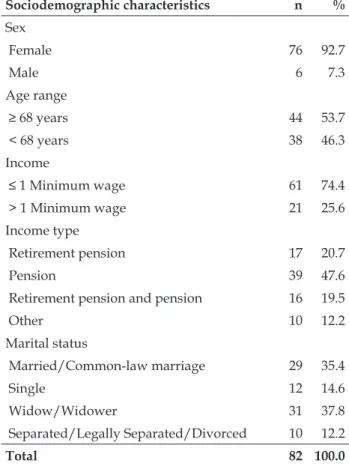
This study observed a greater distribution
of female senior citizens (92.7%), aged 60 years or
older (53.7%), with income equal to or less than a
minimum wage (74.4%), originating from a pension (47.6%), widow (37.8%) and homemaker (74.4%).
Table 1 - Sociodemographic characteristics of the elderly participating in a peer group. Vitória da Conquista-BA, Brazil, 2014
Sociodemographic characteristics n %
Sex
Female 76 92.7
Male 6 7.3
Age range
≥ 68 years 44 53.7
< 68 years 38 46.3
Income
≤ 1 Minimum wage 61 74.4
> 1 Minimum wage 21 25.6
Income type
Retirement pension 17 20.7
Pension 39 47.6
Retirement pension and pension 16 19.5
Other 10 12.2
Marital status
Married/Common-law marriage 29 35.4
Single 12 14.6
Widow/Widower 31 37.8
Separated/Legally Separated/Divorced 10 12.2
Total 82 100.0
The assessment of health conditions showed there was a greater frequency of senior citizens who had illnesses (80.5%), preserved cognitive
functions (76.8%), were independent for the activi -ties of daily living (87.8%) and dependent for the
instrumental activities of daily living (75.6%), felt pain (63.4%) and perceived their health was good in comparison with other people their age (35.4%). A total 74.5% of the senior citizens assessed their
Table 2 - Health conditions of the elderly participating in a peer group. Vitória da Conquista-BA, Brazil, 2014
n %
Presence of illness
Yes 66 80.5
No 16 19.5
Mini mental state exam
Preserved cognitive function 63 76.8 Cognitive abnormality not suggestive of
deicit 19 23.2
Basic activities of daily living
Independent 72 87.8
Dependent 10 12.2
Instrumental activities of daily living
Independent 20 24.4
Dependent 62 75.6
Presence of pain
Yes 52 63.4
No 30 36.6
Self perception of health
Excellent 14 17.0
Very good 18 22.0
Good 29 35.4
Reasonable 15 18.3
Poor 6 7.3
Total 82 100.0
The assessment of motor performance showed greater predominance of senior citizens with
lim-ited ability to squat and pick a pencil from the loor (85.4%), no limitation for the sit and stand activity (92.7%), no limitation in the walking test (96.3%), no
limitation in the hand grip strength (79.3%) and no limitation in the balance activity (81.7%).
Table 3 - Distribution of senior citizens according to motor performance activities. Vitória da Conquista-BA, Brazil, 2014
n %
Squat and pick a pencil from the loor
Limitation 70 85.4
No limitation 12 14.6
Sit/stand
Limitation 6 7.3
No limitation 76 92.7
Walking test
Limitation 3 3.7
No limitation 79 96.3
Hand grip strength
Limitation 17 20.7
No limitation 65 79.3
Balance
Limitation 15 18.3
No limitation 67 81.7
Total 82 100.0
Regarding BMI, there was greater frequency
of overweight senior citizens (54.9%), with BMI average of 25.54 (±9.23) kg.
Table 4 - senior citizen distribution according to the Body Mass Index. Vitória da Conquista-BA, Brazil, 2014
Body Mass Index n %
Insuficient weight (< 22 kg/m2) 6 7.3
Adequate weight (22-27 kg/m2) 31 37.8 Excess weight (>27 kg/m2) 45 54.9
Total 82 100.0
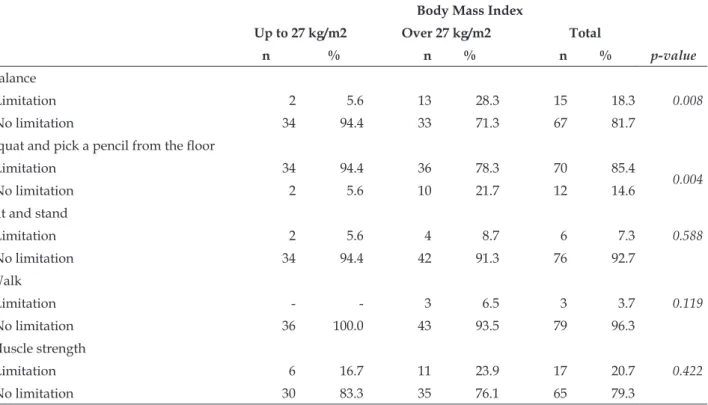
The application of the Chi-square test (x2)
showed a statistically signiicant difference between
the variables, BMI (over 27 kg/m2) and balance
limitation (p-value=0.008), and between BMI (over 27 kg/m2) and limitation to squat and get a pencil
Table 5 - Distribution of senior citizens’ BMI according to motor performance activities. Vitória da Conquista-BA, Brazil, 2014
Body Mass Index
Up to 27 kg/m2 Over 27 kg/m2 Total
p-value
n % n % n %
Balance
Limitation 2 5.6 13 28.3 15 18.3 0.008
No limitation 34 94.4 33 71.3 67 81.7
Squat and pick a pencil from the loor
Limitation 34 94.4 36 78.3 70 85.4
0.004
No limitation 2 5.6 10 21.7 12 14.6
Sit and stand
Limitation 2 5.6 4 8.7 6 7.3 0.588
No limitation 34 94.4 42 91.3 76 92.7
Walk
Limitation - - 3 6.5 3 3.7 0.119
No limitation 36 100.0 43 93.5 79 96.3
Muscle strength
Limitation 6 16.7 11 23.9 17 20.7 0.422
No limitation 30 83.3 35 76.1 65 79.3
DISCUSSION
This study investigated the changes related to the process of ageing regarding BMI and mo-tor performance in active senior citizens. Women were predominant in the senior citizens’ group. This corroborates the national studies that showed a marked phenomenon called feminization of the elderly population: in general, women have longer life expectancy than men for they are more active and more careful regarding health and self-care than men.14-15
Regarding age range, the distribution was
equal to or greater than 68 years old, and widows
were present. Given the higher life expectancy of women in Brazil, this data is similar to studies in which similar age ranges and marital status were observed. Women live on average eight years longer than men because they take more care of their health.15-16 Regarding the prevention and treatment of pathologies, women accept participa-tion in groups that discuss the subject, including peer groups, better than men in their search for a better quality of life and social and psychological well-being. The greater presence of widows in this group can be explained due to a rise in women’s
Regarding income, a monthly income less than the minimum wage, which refers to the pension, was observed. The data are comparable with a study in
which low income (≤1 minimum wage) is related to increasing age - it is dificult to get a job and so
the elderly person has to live off a pension from his relatives or from other types of pensions. This can be related to some types of pathologies that prevent this population from having productive lives and make them leave the work market early.
Regarding health conditions, the WHO deini -tion of health7 states that health is not lack of disease
but a situation of perfect physical, mental and social well-being. According to this perspective, the
classi-ication of health condition will vary from individual to individual and will not be deined only by the
presence or absence of any pathology. In the study, most participants presented some type of pathology. However, they had a positive perception of their
health condition and classiied it as good. A study
Regarding the activities of daily living, most
senior citizens in this study were classiied as in -dependent, corroborating a study which observed that the elderly had functional independence and performed the activities of daily living.17 In this
study, this independence can be related to the social inclusion that is offered by the peer groups and to the stimulus the individual receives to become more autonomous in performing his ADLs.
Regarding the instrumental activities of daily living, it was observed that most senior citizens
in this study were classiied as dependent. These
results are different from those found in a study performed in the municipality of
Camaragibe-PE (Brazil). The factors that can deine the senior
citizens’ dependence to perform the IADLs in this study can be related to changes in mobility that affect walking. This can limit the senior citizen from performing certain activities. Other changes resulting from the ageing process, such as visual and hearing abnormalities, also restrict them from performing more complex tasks18 but have not been
analyzed here.
This study observed no functional limitation in relation to HGS, which is different from a study
that showed a signiicant correlation between older age and muscle strength and the inluence of in
-creased BMI on lexibility. Therefore, no limitation
to motor performance associated to the strength of upper limbs was observed in this study.19
The walking test is performed to quickly and simply evaluate the mobility, velocity and dynamic balance capacity the senior citizen has.20 This test is
related to his capacity to perform daily life activities
in an independent and conident manner, without
fearing falls or other accidents related to mobility,
velocity and dynamic balance deicits. In this study,
most participants had no limitation to perform these tests, which matches the results of study20 –
this means that the reduced motor performance is negligible.
Physical skills are related to functional inde-pendence both for youngsters and for the elderly. However, senior citizens’ abilities suffer a decline generated by the natural process of ageing or due to other factors21 such as abnormal BMI, which is an
important indicator of the nutritional status of the elderly. In this study, there was a greater distribu-tion of overweight elderly people, corroborating a study that observed that the average BMI value
is directly related to a smaller functional capacity in active elderly people.22 Therefore, obesity and
overweight are negative factors for any age range, and generate extremely important implications both for health and general well-being.
A signiicant statistical difference was observed between “squat to pick a pencil from the loor” and
overweight, and between overweight and balance, similar to study,23 which showed that elderly people
with increased BMI have a greater prevalence of low motor performance as the greater amount of fat tis-sue can generate an excessive load on the body. This factor causes limitations to movement and overloads the joints that will be used to perform the movements
required for the “squat and pick a pencil” test and
to maintain body balance. Since balance anomalies cause great impacts on the social life of the elderly, they can reduce their autonomy and lead to changes in their daily lives and health condition. Reduced balance is related to a greater risk of falls.24 Excess
weight modiies the body’s geometry, increasing
the mass of the different segments and imposing functional limitations that result in the inability to perform basic everyday activities. Keeping thin been prevents the decline of motor ability whereas an increased BMI (obesity and overweight) generates a smaller amplitude of movement and causes func-tional biomechanical limitations and dependence for the activities of daily living.
This study had the following bias: it did not ask the elderly citizens about physical activity practice, the lack of which could be associated to overweight. Given the above, the association of motor
perfor-mance tests, “squat to pick a pencil” and balance
tests with overweight does not eliminate a possible association with other factors which were not studied or compared in this study and which may interfere in these senior citizens’ motor performance.
CONCLUSION
This study observed that the BMI (over 27 kg/ m2) negatively inluences the balance and squat to
REFERENCES
1. Baldoni AO, Pereira LRL. O impacto do envelhecimento populacional Brazileiro para o sistema de saúde sob
a óptica da farmacoepidemiologia: uma revisão narrativa. Rev Ciênc Farm Básica Aplicada [Internet]. 2011 [cited 2014 May 10]; 32(3):313-21. Available from:
http://www.unifal-mg.edu.br/cefal/sites/default/
iles/Baldoni,%20Pereira,%202011.pdf
2. C a r a r o l i n o J A , S o a r e s M L , C â n d i d o G A . Envelhecimento e cidadania: possibilidades de convivência no mundo contemporâneo. Qualit@s
Rev Eletr [Internet]. 2011 [cited 2014 May 10]; 1(1).
Available from: http://revista.uepb.edu.br/index. php/qualitas/article/viewFile/1182/597
3. Cavalcanti CL, Gonçalves MCR, Asciutti LSR,
Cavalcanti AL. Envelhecimento e obesidade: um
grande desaio no século XXI. Rev Bras Ciênc Saúde [Internet]. 2010 [cited 2014 May 10]; 14(2):87-92.
Available from: http://periodicos.ufpb.br/ojs/index. php/rbcs/article/viewFile/7230/5318
4. Lucio A, Bezerra MJC, Sousa SA, Miranda MLJ.
Características da capacidade funcional e sua relação
com o IMC em idosas ingressantes em um programa
de educação física. Rev Bras Ciênc Mov [Internet]. 2011 [cited 2014 May 10]; 19(2):13-8. Available from:
http://portalrevistas.ucb.br/index.php/RBCM/
article/view/2415/1894
5. Santos RR, Bicalho MAC, Mota P, Oliveira DR, Moraes EN. Obesidade em idosos. Rev Med Minas Gerais
[Internet]. 2013 [cited 2014 May 10]; 23(23):64-73. Avai
-lable from: http://rmmg.org/artigo/detalhes/12
6. World Health Organization, Food and Agriculture
Organization. Expert consultation on diet, nutrition and the prevention of chronic diseases. Geneva (CH):
WHO; 2002.
7. Tavares TB, Nunes SM, Santos MO. Obesidade e
qualidade de vida: revisão da literatura. Rev Med Minas Gerais. 2010; 20(3):359-66.
8. Moraes JM, Caregnato RCA, Schneider DS. Quality of life before and after bariatric surgery. Acta Paul
Enferm [Internet]. 2014 [cited 2014 May 10]; 27(2).
Available from:
http://dx.doi.org/10.1590/1982-0194201400028
9. Bertolucci PH, Brucki SM, Campacci SR, Juliano Y.
O mini-exame do estado mental em uma população
geral: impacto da escolaridade. Arq Neuropsiquiatr
[Internet]. 1994 [cited 2014 May 10]; 52(1):1-7 Available
from: http://www.scielo.br/pdf/anp/v52n1/01.pdf 10. Minosso JSM, Amendola F, Alvarenga MRM, Oliveira
MAC. Validação, no Brazil, do Índice de Barthel
em idosos atendidos em ambulatórios. Acta Paul
Enferm [Internet]. 2010 [cited 2014 May 10]; 23(2).
Available from: http://dx.doi.org/10.1590/S0103-21002010000200011
11. Lawton MP, Brody E. Assessment of older people:
living. The Gerontologist [Internet].1969 [cited 2014
May 10]; 9(3):179-86. Available from: http://www.
eurohex.eu/bibliography/pdf/Lawton_Geron-tol_1969-1502121986/Lawton_Gerontol_1969.pdf
12. Batista FS, Gomes GAO, Neri AL. Relationship between lower-limb muscle strength and frailty
among elderly people. Sao Paulo Med J [Internet]. 2012 [cited 2014 May 10]; 130(2):102-8. Available from: http://www.scielo.br/pdf/spmj/v130n2/06.pdf
13. Tribess S, Junior JSV; Petroski EL. Estado nutricional
e percepção da imagem corporal de mulheres idosas
residentes no nordeste do Brazil. Ciênc Saúde Coletiva
[Internet]. 2010 [cited 2014 May 10]; 15(1):31-8. Available from:
http://dx.doi.org/10.1590/S1413-81232010000100008
14. Benedetti TRB, Mazo GZ, Borges LJ. Condições de saúde e nível de atividade física em idosos participantes e não participantes de grupos de
convivência de Florianópolis. Ciênc Saúde Coletiva
[Internet]. 2012 [cited 2014 May 10]; 17(8):2087-093. Available from:
http://dx.doi.org/10.1590/S1413-81232012000800019
15. Leite MT, Winck MT, Hildebrandt LM, Kirchner
RM, Silva LAA. Qualidade de vida e nível cognitivo
de pessoas idosas participantes de grupos de
convivência. Rev Bras Geriatr Gerontol [Internet]. 2012 [cited 2014 May 10]; 15(3). Available from: http://
dx.doi.org/10.1590/S1809-98232012000300009
16. Silva HO, Carvalho IMAD, Lima FEL, Rodrigues
LV. Peril epidemiológico de idosos frequentadores de grupos de convivência no município de Iguatu, Ceará. Rev Bras Geriatr Gerontol [Internet]. 2011 [cited 2014 May 10]; 14(1). Available from: http://dx.doi.
org/10.1590/S1809-98232011000100013
17. Lenardt MH, Carneiro NHK, Albino J, Willig MH.
Qualidade de vida de idoso fragilizado da atenção primária. Acta Paulista de Enfermagem [Internet]. 2014 [cited 2014 May 10]; 27(5):399-404. Available
from: http://www.scielo.br/pdf/ape/v27n5/
pt_1982-0194-ape-027-005-0399.pdf
18. Albuquerque AG, Oliveira GSM, Silva VL, Nascimento
CB. Capacidade funcional e linguagem de idosos não-participantes e não-participantes de grupos de intervenção multidisciplinar na atenção primária à saúde. Rev CEFAC [Internet]. 2012 [cited 2014 May 10]; 14(5):952-62. Available from: http://dx.doi.org/10.1590/S1516-18462012005000019
19. Silva NAS, Menezes TN, Melo RLP, Pedraza DF. Força
de preensão manual e lexibilidade e suas relações com variáveis antropométricas em idosos. Rev Assoc Med Bras [Internet]. 2013 [cited 2014 May 10]; 59(2).
Available from: http://www.sciencedirect.com/
science/article/pii/S0104423013000031
20. Pinheiro PA, Passos TODO, Coqueiro RS, Fernandes
MH, Barbosa AR. Desempenho motor de idosos do
10]; 47(1). Available from: http://dx.doi.org/10.1590/ S0080-62342013000100016
21. Gonçalves LHT, Silva AH, Mazo GZ, Silva AH, Mazo
GZ, Benedetti TRB, et al. O idoso institucionalizado:
avaliação da capacidade funcional e aptidão física. Cad Saúde Pública [Internet]. 2010 [cited 2014 May 10]; 26(9):1738-46. Available from: http://dx.doi. org/10.1590/S0102-311X2010000900007
22. Rech CR, Cruz JLS, Araújo EDS, Kalinowski FG,
Dellagrana RA. Associação entre aptidão funcional
e excesso de peso em mulheres idosas. Motriz: Rev
Educ Fis [Internet]. 2010 [cited 2014 May 10]; 6(2).
Available from: http://www.revistamotricidade.
com/arquivo/2010_vol6_n2/v6n2a06.pdf
23. Carneiro JAO, Almeida DS; Coelho KHC, Pfrimer
K, Santos-Pontelli TEG, Carneiro AAO, et al.
Influência da obesidade e da força de preensão palmar no equilíbrio postural estático de idosas ativas. Motriz: Rev Educ Fis [Internet]. 2012 [cited 2014 May 10]; 18(3):432-40. Available from:
http://www.scielo.br/scielo.php?script=sci_
arttext&pid=S1980-65742012000300003
24. Barbosa AR, Souza JMP, Lebrão ML, Marucci MFN.
Estado nutricional e desempenho motor de idosos de
São Paulo. Rev Assoc Med Bras [Internet]. 2007 [cited
2014 May 10]; 53(1) Available from: http://dx.doi. org/10.1590/S0104-42302007000100024
Correspondence: Luciana Araújo dos Reis Universidade Estadual do Sudoeste da Bahia Rua José Moreira Sobrinho, S/N
45206-190 – Jequiezinho, Jequié, BA, Brazil
Received: June 20, 2015