504
Revista da Sociedade Brasileira de Medicina Tropical 43(5):504-507, set-out, 2010
Article/Artigo
1. Institute of Biology, Federal University of Bahia, Salvador, BA, Brazil. 2. Laboratory of Experimental Pathology, Gonçalo Moniz Research Center, Fundação Oswaldo Cruz, Salvador, BA, Brazil.
Address to: Dr. Zilton de Araújo Andrade. LAPEX/CPqGM/FIOCRUZ. Rua Valdemar Falcão 121, Brotas, 40295-001 Salvador, BA, Brazil.
Phone: 55 71 3176-2206 e-mail: [email protected] Received in 27/04/2010 Accepted in 27/07/2010
INTRODUCTION
Capillaria hepatica
-induced septal ibrosis in rats: a contribution to
the study of liver ibrogenesis
Contribuição para o estudo da ibrogenesis hepática em ratos infectados com
Capillaria
hepatica
Valter Lucas Chaves Barbosa
1and Zilton de Araújo Andrade
2ABSTACT
Introduction: Septal fibrosis of the liver regularly develops in rats infected with the nematode Capillaria hepatica. Curative treatment of the infection prevents the development of septal ibrosis when intervention occurs up to postinfection day (PID) 15, but not later. he present investigation aimed to demonstrate which parasitic factors are present when the process of septal ibrosis can no longer be prevented by curative treatment. Methods: Wistar rats were infected with 600 embryonated eggs of C. hepatica administered by gavage and treated with ivermectin and mebendazole in separate groups at PIDs 10, 12, 15, 17 or 20. Rats from each group and their nontreated controls, were killed and examined 40 days ater the end of treatment. Results: Findings by PID 15 were compatible with the stage of complete maturation of infection, when worms and eggs were fully developed and a complex host-parasite multifocal necroinlammatory reaction showed greater intensity, but with no signs of septal ibrosis, which appeared from PID 17 onward. Conclusions: Since the worms spontaneously died by PID 15, not only septal ibrosis production, but also its maintenance and further development appeared dependent on the presence of eggs, which were the only parasitic factor remaining thereater.
Key-words: Hepatic ibrosis. Pathogenesis. Capillaria hepatica.
RESUMO
Introdução: A ibrose septal do fígado se desenvolve regularmente em ratos infectados pelo nematódeo Capillaria hepatica. O tratamento curativo da infecção, feito antes do 15ºdia da infecção, mas não mais tarde, impediu o aparecimento da ibrose septal. O presente trabalho procura veriicar qual o estado do parasitismo aos 15 dias da infecção, crucial para patogenia da ibrose septal. Métodos: Ratos foram infectados por via digestiva com 600 ovos embrionados de C. hepatica e tratados com Ivermectina e mebendazol, em grupos separados, aos 10, 12, 15, 17 ou 20 dias após a infecção. O animal de cada grupo e seus respectivos controles foram mortos e examinados aos 40 dias após o im do tratamento. Resultados: Os achados aos 15 dias da infecção mostraram a maturação completa da parasitose, com presença de ovos e vermes, circundados por reação necro-inlamatória, mas ainda sem ibrose septal. Daí por diante, a ibrose septal se fez presente. Conclusões: Como os vermes morrem espontaneamente após o 15ºdia da infecção, não apenas a origem, mas o posterior crescimento e a manutenção da ibrose septal dependem da presença dos ovos acumulados no fígado, os quais são os únicos elementos parasitários presentes após o 15º dia da infecção por C. hepatica no rato.
Palavras-chaves: Fibrose hepática. Patogenia. Capillaria hepatica.
he experimental model for hepatic septal ibrosis, which invariably develops in rats following infection with the nematode Capillaria hepatica, has already been applied to the study of several aspects of the pathogenesis of hepatic ibrosis1-6 since its irst description in 19937.
One advantage of this experimental method lies on its regularity of development, since hepatic ibrosis starts around 16-20 days following infection, establishing portal to portal connections and soon involving the entire liver. he male and female adult worms and their products (larvae and eggs) are lodged within the liver parenchyma, not within portal spaces, which are the sites from where septal ibrosis takes origin8. hus,
some type of unknown chemical mediator or mediators seems to be at play in between the focal parenchymal parasite-dependent lesions and the portal spaces. Another curious detail is that, although the infection is self-limited, since the worms die and disintegrate soon ater egg-laying, the process of ibrosis continues to present signs of progression thereater. hese are intriguing aspects related to the pathogenesis of ibrosis in this model, which require investigation.
Santos et al9 investigated which of the parasite
evolving stage or stages played the key role in pathogenesis of C. hepatica-induced septal ibrosis of the rat liver. hey were unable to induce systemic septal ibrosis by means of a single parasitic element. Injections of eggs, either into the main portal vein or directly into the liver tissue, resulted in isolated periovular granulomatous reactions, but not septal portal fibrosis. Similarly, the presence of worms alone was not enough to induce septal ibrosis of the liver. However, when the parasite infection was fully developed, curative treatment did not interfere with the progression of septal ibrosis.
505
Barbosa VLC and Andrade ZA - Hepatic septal ibrosis pathogenesisMETHODS
RESULTS
ibrosis in this particular case. he present study follows this trend and explores a diferent approach. Since C. hepatica is a self-limited parasitic infection, all the worms spontaneously die and disintegrate a short time ater maturity and egg-laying, the present investigation tried to determine what the critical point is and which parasite factors are present, when curative treatment succeeds in preventing or fails to prevent further development of septal ibrosis.
Animals
A total of 37 female Wistar rats, weighing 160-200g were used. hey were maintained in large metallic boxes, in a well ventilated room, with free access to a commercial pellet feed for rats and drinking water, ad libitum.
Infection
Two rats were separated to serve as noninfected treated controls. All the others were submited to infection on the same day, with approximately 600 C. hepatica embryonated eggs, administered by gavage in 1ml saline. Of these 35 infected rats, 10 were maintained as infected-untreated controls and 25 were submited to antihelminthic treatment. Data on egg acquisition and counting and inoculum preparation are described elsewhere10.
Treatment
Two drugs were used for the treatment of all the rats: 1ª) ivermectin (Ivotan, Hoechst Roussel Vet. SA), was administered orally in a single dose of 0.2ml of a solution containing 1% of the drug; 2ª) mebendazol (Medley S.A) was administered by a gastric tube over 5 consecutive days at a daily dose of 5mg/kgbw. Treatment was well tolerated, with no evident changes in general appearance, activities and the weight of the rats.
Experimental groups
he rats were divided into 6 groups of 5 animals each. he sole diference among the groups consisted on the time elapsed from infection when treatment took place. he following groups were used:
group 1, treated on postinfection day (PID) 10; group 2, treated on PID 12; group 3, treated on PID 15; group 4, treated on PID 17; and
group 5, treated on PID 21.
Controls
Infection controls: two nontreated infected rats were killed together with each treated group. Treatment controls: two noninfected treated rats were killed 10 days ater the end of treatment.
Procedures
All the infected-treated rats were killed 40 days ater the end of treatment, together with their two respective nontreated controls. Killing was achieved by severing the abdominal aorta ater opening the abdominal wall at midline, under general anesthesia. Ater gross inspection of the organs, the liver was removed. Small blocks taken from diferent areas of the liver were immediately ixed in 10% bufered formalin for at least 24h. hese blocks were submited to dehydration and parain embedding. he 5µ-thin parain sections obtained were routinely stained with hematoxilyn and eosin and with Sirius-red for collagen.
Other blocks of liver tissue taken immediately following death were immersed into Tissue-Tek (OCT compound-Miles Inc, USA)
and snap frozen in liquid nitrogen. hese blocks were kept at –70ºC until the moment they were submited to sectioning in a cryostat at –201ºC. he 10-15µ thick cryostat sections obtained were submited to the indirect immunofluorescence technique to demonstrate laminin. Speciic anti-goat anti-laminin serum was kindly donated by Dr. Jean-Alexis Grimaud (Paris, France) and used at 1:100 dilution. he corresponding luoresceinated anti-goat-gamma-globulin was commercially obtained (Sigma - St. Louis, MO, USA) and was used at 1:40 dilution.
Investigation of parasite stages
At the moment of necropsy, small pieces of liver tissue were placed between two glass slides and smashed to determine microscopic identiication of C. hepatica stages (larvae, worms and eggs).
Liver sections from noninfected-treated rats exhibited an essentially normal histology. Evident signs of toxic liver-cell injury, such as faty change, cytoplasm balloonization, single-cell necrosis and apoptosis, were thoroughly investigated, but with negative results.
The nontreated-infected rats exhibited scattered foci of liver parenchymal inflammation, occasionally located close to disintegrating parasitic structures, from PID 10 onward, when disintegrating larvae could be observed within these foci. By PID 15, some worms were already differentiating and had become fully developed by PID 17, when numerous eggs were also present around them. From this point on, these focal parenchymal lesions, occasionally presenting focal necrosis associated with signs of larva, egg and worm disintegration, progressively increased in number and size. A mild, diffuse portal mononuclear infiltration and edema were also present.
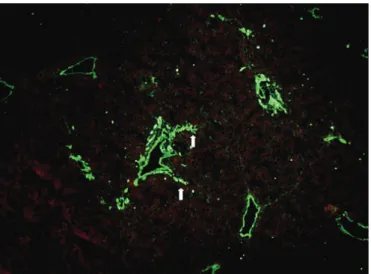
By PID 17, some portal spaces exhibited a radiated appearance due to the presence of a few short projections toward another neighboring space, though no connections were observed at this time (Figure 1). Some of these projections exhibited the presence of slender collagen ibrils, and signs of vascular proliferation, especially when the basement membrane of small blood vessels were revealed by the immunoluorescent technique for laminin (Figure 2).
506
Rev Soc Bras Med Trop 43(5):504-507, set-out, 2010
FIgURE 2 - Staining for laminin reveals the presence of blood vessel basement membranes and marks earlier septa developing from portal space. Rat liver at day 17 of Capillaria hepatica infection. Immunoluorescence technique, 100X.
his process of septal ibrosis became evident in specimens examined following day 17 of infection, when connections between portal to portal spaces occurred at several instances (Figure 3).
When examined 40 days ater the end of treatment, the infected and treated rats presented the focal parasite-induced lesions of a more or less advanced cicatricial stage. No evidence of septal ibrosis was observed in the livers of rats treated and examined 40 days later, following infections of 10, 12 or 15 day duration.
In contrast, rats treated ater PID 17 presented a characteristic picture of septal ibrosis, when examined 40 days ater treatment and cure. Septal ibrosis was still more evident in rats treated at PID 21 and examined 40 days later (Figure 3).
FIgURE 3 - Full developed process of septal ibrosis observed in the liver of a rat 40 days ater Ivermectin-Benmidazole treatment of a 17-day old Capillaria hepatica infection. Sirius-red for collagen, 200X.
Smash preparations showed the progressive appearance, diferentiation and degradation of larvae, worms and eggs, while the eggs were more stable and became gradually accumulated in focal areas. By PID 10 and 12, only a few developing larvae were identiied, but developing worms and a few immature eggs had appeared by PID 17. When examined on day 17 following infection, the livers of both untreated and treated rats revealed the prominent presence of fully
developed mature eggs, accumulated around intact and dying adult worms in the center of and encapsulated by chronic granulomatous inlammation. By PID 21, all adult worms were exhibiting signs of disintegration.
DISCUSSION
Data obtained from the present experiments indicated that septal ibrosis develops in C. hepatica-infected rats by postinfection day 17, when eggs plus living and disintegrating adult worms are clearly visible within foci of chronic granulomatous inlammation scatered within the liver parenchyma. At this time, parasite-related focal inlammatory lesions, which at an earlier stages contained larvae and a few immature worms, now exhibited mature adult live worms with fully developed eggs accumulated around them. No parasite forms were observed inside portal spaces, which are the sites from where septal ibrosis sprouts as ine rays toward the liver parenchyma, eventually connecting portal to portal spaces. herefore, the present data indicated that the process of septal ibrosis only initiates when
C. hepatica has reached full development. From this point on, ibrosis acquires full autonomy and curative treatment of the parasitic infection no longer interferes in its progressive development, at least for the next 4 to 6 months, when septal ibrosis gradually starts regressing4,5. Material from our laboratory has revealed that the
presence of eggs and septal ibrosis in the liver of rats with a single experimental C. hepatica infection can persist for up to two years (data not published).
In conclusion, the present data indicate that the onset of the process of hepatic septal ibrosis in C. hepatica-infected rats requires maturation of the infection, with the presence of adult worms and eggs. he maintenance and further progression of the septal ibrosis process probably depends on the presence of living eggs, which are the only parasitic element present within the liver ater the irst month of infection. hese eggs form large encapsulated collections within the liver parenchyma. Some of them may die and loose their capacity to embryonate when appropriately tested outside the liver. Unpublished data from our service indicates that these eggs are capable of embryonation up to 4-5 months ater infection, but no data thereater are as yet available. It is probable that many encapsulated eggs in the liver are still alive during prolonged infection (capable of embrionation), but others die without disintegrating. herefore, the present data are in agreement with that reported by Santos et al9, which airmed that C. hepatica
eggs play a key role in the pathogenesis of septal ibrosis of the liver, but the process of initiation seems more complex, initiating only when the infection reaches full maturity.
he authors declare that there is no conlict of interest.
CONFLICT OF INTEREST
REFERENCES
1. Andrade RG, Gotardo BM, Assis BCA, Mengel J, Andrade ZA. Immunological tolerance to pig-serum partially inhibits the formation of septal fibrosis of the liver in Capillaria hepatica-infected rats. Mem Inst Oswaldo Cruz 2004; 99:703-707.
507
3. Oliveira L, Souza MM, Andrade ZA. Capillaria hepatica-induced hepatic fibrosis in rats. (Paradoxical effect of repeated infections). Rev Soc Bras Med Trop 2004; 37:123-127.
4. Souza MM, Tolentino-Jr M, Assis BCA, Gonzalez ACO, Correia Silva TM, Andrade ZA. Pathogenesis of Septal Fibrosis of the Liver. (An experimental study with a new model). Path Res Pract 2006; 202:883-889.
5. Souza MM, Tolentino-Jr M, Assis BCA, Gonzalez ACO, Silva TMC, Andrade ZA. Significance and fate of septal fibrosis of the liver. Hepatol Res 2006; 35: 31-36.
6. Lemos QT, Magalhães-Santos IF, Andrade ZA. Immunological basis of septal ibrosis of the liver in Capillaria hepatica-infected rats. Braz J Med Biol Res 2003; 36:1201-1207.
7. Ferreira LA, Andrade ZA. Capillaria hepatica: a cause of septal ibrosis of the liver. Mem Inst Oswaldo Cruz 1993; 88:441-447.
8. Andrade ZA, Assis BCA, Souza MM. Capillaria hepatica: papel em patologia humana e potencial como modelo experimental. In: Coura JR, editor. Dinâmica das Doenças Infecciosas e Parasitárias, Rio de Janeiro: Guanabara-Koogan; 2005. p.1121-1132.
9. Santos AB, Tolentino-Jr. M, Andrade ZA. Pathogenesis of hepatic septal fibrosis associated with Capillaria hepatica infection of rats. Rev Soc Bras Med Trop 2001; 34:503-506.
10. Souza MM, Silva LM, Barbosa-Jr A, Oliveira IR, Paraná R, Andrade ZA. Hepatic capillariasis in rats: a new model for testing anti-fibrosis drugs. Braz J Med Biol Res 2000; 33:1329-1334.