496
Revista da Sociedade Brasileira de Medicina Tropical 43(5):496-499, set-out, 2010
Article/Artigo
1. Department of Cardiology and Cardiovascular Surgery, Base Hospital, Faculty of Medicine of São José do Rio Preto, São José do Rio Preto, SP, Brazil.
Address to: Dr. Reinaldo Bulgarelli Besteti. Setor de Eletrocardiograia/Hospital de Base. Av. Faria Lima 5544, 15090-000 São José do Rio Preto, SP, Brazil.
Fax: 55 17 3201-5065 e-mail: [email protected] Received in 11/03/2010 Accepted in 13/07/2010
INTRODUCTION
Digoxin serum levels in patients with Chagas’ cardiomyopathy and
heart failure
Níveis séricos de digoxina em pacientes com insuiciência cardíaca secundária à cardiomiopatia
da doença de Chagas
Samira Jorge Ferrari
1, Reinaldo Bulgarelli Besteti
1, Augusto Cardinalli-Neto
1and Talita Botan Bortoluzzi
1ABSTACT
Introduction: he purpose of this study was to determine digoxin serum concentrations in patients with Chagas’ cardiomyopathy with chronic heart failure, becauselitle is known concerning this laboratory test in patients with this condition. Methods: his study focuses on 29 (29%) out of 101 patients with chronic heart failure secondary to Chagas’ cardiomyopathy receiving digoxin therapy. Digoxin was measured by the immune-enzymatic method. Results:
New York Heart Association Functional Class III/IV was noted in 13 (45%) patients. he mean potassium serum level was 4.3± 0.5mEq/L, mean creatinine serum levels 1.4± 0.3dg/100ml, and let ventricular ejection fraction 34.7± 13.8%. he median digoxin serum level was 1.27 (0.55; 1.79)ng/ml. Sixteen (55%) patients had digoxin serum levels higher than 1.0ng/ml. Abnormal digoxin serum levels were veriied in 13 (45%) patients. Digoxin serum levels correlated moderately with creatinine serum levels (r = 0.39; p≤ 0.03) and negatively with sodium serum levels (r= -0.38; p= 0.03). Conclusions: Digoxin serum concentration should be measured in patients with Chagas’ cardiomyopathy with chronic heart failure receiving digoxin therapy due to the potential for digoxin toxicity.
Key-words: Chagas’ disease. Trypanosomiasis American. Chronic Heart failure. Digoxin. Cardiomyopathy.
RESUMO
Introdução: O propósito deste trabalho foi o de determinar a concentração sérica de digoxina em pacientes com insuficiência cardíaca crônica secundária à cardiomiopatia da doença de Chagas porque pouco se conhece sobre os níveis séricos desse fármaco em pacientes com tal condição clínica. Métodos: Foram recrutados 29(29%) de101 pacientes com insuiciência cardíaca crônica secundária à cardiomiopatia da doença de Chagas, os quais estavam sendo tratados com digoxina. Essa droga foi medida no soro desses pacientes pelo método imunoenzimático. Resultados: Treze (45%) pacientes estavam no grau III/ IV da Sociedade Nova-Iorquina de Cardiologia. Os níveis séricos de potássio médio foram 4,3± 0,5 mEq/L, a creatinina sérica média 1,4± 0,3dg/100ml, e a fração de ejeção do ventrículo esquerdo 34.7± 13. 8%. Os níveis séricos médios de digoxina foram 1,27 (0,55; 1,79)ng/ml. Dezesseis (55%) pacientes apresentaram níveis séricos de digoxina > 1,0ng/ml. Níveis séricos anormais de digoxina foram observados em 13 (45%) pacientes. Os níveis séricos de digoxina correlacionaram moderadamente com os de creatinina (r= 0,39; p≤ 0,03) e negativamente com os de sodium (r= -0,38; p= 0,03). Conclusões: Os níveis séricos de digoxina devem ser medidos em pacientes com insuiciência cardíaca crônica secundária à cardiomiopatia da doença de Chagas por causa do potencial para ocorrer toxicidade pela digoxina.
Palavras-chaves: Doença de Chagas. Trypanosomiasis americana. Insuiciência cardíaca crônica. Digoxina. Cardiomiopatia.
Chagas’ disease, a tropical disease caused by the protozoan Trypanosoma cruzi, is a major public health problem in Latin America, since it afects 18 million people and another 100 million are at risk of acquiring the disease1. In view of international
immigration, Chagas’ disease now afects almost 700,000 people outside Latin America2.
Chronic heart failure is a protean clinical manifestation of chronic Chagas’ disease. In fact, it is the leading cause of chronic heart failure in areas where the disease is endemic3, its prognosis is worse than that
observed in non-Chagas’ disease heart failure3,4 and
afects about 4% to 8% of outpatients living in rural areas and up to 76% of patients followed at a tertiary referral center5. Digoxin is an integral component of
the pharmacological armamentarium for the treatment of chronic systolic heart failure secondary to Chagas’ cardiomyopathy, particularly for patients in New York Heart Association Class III or IV5.
In patients with non-Chagas’ disease heart failure, chronic digoxin therapy has no impact on all-cause mortality, but decreases the combination of death or hospitalization6. However,Rathore et
al7 have shown that all-cause mortality is higher in
patients with serum digoxin concentration > 1.2ng/ ml in comparison to patients with serum digoxin concentrations ≤ 1.2ng/ml. More recently, studies have suggested that survival may be improved in patients in whom digoxin serum concentrations are lower (0.5 to 1.0ng/ml) than those previously recommended (0.8 to 2.0ng/ml)8-10.
497
Ferrari SJ et al - Digoxin in Chagas’ disease heart failure
METHODS
RESULTS
In addition, the peculiarities of histological aspects observed in this disease, conluent foci of ibrosis along with mononuclear cell iniltrate throughout the myocardium, similar to that which occurs in catecholamine cardiomyopathy11-12, may predispose Chagas’
disease patients receiving digoxin therapy to malignant ventricular arrhythmias and ultimately death. In fact, it has been shown that digoxin use may negatively afect survival in Chagas’ disease heart failure patients13.
herefore, this study, aimed to determine the prevalence of abnormal and/or high (> 1ng/ml) digoxin serum concentrations in patients with Chagas’ cardiomyopathy with chronic heart failure.
Patients
From January 2000 to October 2007, 231 patients with chronic heart failure secondary to Chagas’ cardiomyopathy were admitted to the outpatient Cardiomyopathy Service of Hospital de Base. he diagnosis of Chagas’ disease was conirmed based on positive serology. Approximately 120 (50%) patients died during the above period. Of the remaining 101 patients, 29 (29%) were receiving digoxin therapy.
Previous patient work-up consisted of anamnesis, physical examination, standard laboratory tests, 12-lead electrocardiogram, chest X-Ray and 2-dimensional trans-thoracic Doppler-echocardiography.
Digoxin was administered as previously described, in the morning, by oral route, according to age (0.125mg/day per patients aged > 65 years, and 0.25mg/day per patient aged < 65 years)8.
Digoxin study
All digoxin serum levels measurements were performed in the morning following 12-hour fasting by the patient. he last digoxin ingestion occurred 24 hours before measurement. A blood sample was collected from the antecubital vein from each patient. The blood was centrifuged, stored at -20º and measured by the immune-enzymatic method.
Statistical analysis
Continuous variables with normal distribution are expressed as mean ± standard deviation, whereas those with nonnormal distribution are presented as median (25% percentile, 75% percentile). Categorical variables are shown as proportions (%). One-way ANOVA was used to compare continuous variables when appropriate. Categorical variables were compared by the X2 test. he Spearman test was used to establish
correlations between continuous variables and digoxin serum levels. Correlation between two continuous variables was setled at an r level ≥0.30 and p value < 0.05. Differences for a p level < 0.05 were considered statistically signiicant.
Ethical
he study was approved by the local ethics in research commitee (Protocol 4464/2008). he small risk of complications associated with venous puncture was explained to each patient. Ater free, informed consent was obtained, digoxin measurement was performed.
Patient mean age was 60 ± 12 years-old, 18 (62%) were males. At the time of digoxin measurement, New York Heart Association Functional Class III/IV was registered for 13 (45%) patients. he
mean sodium serum level was 139.4 ± 3.9mEq/L, the mean potassium serum level was 4.3 ± 0.5mEq/L and the mean creatinine serum level was 1.4 ± 0.3dg/100ml. Angiotensin converting enzyme inhibitor or Losartan was administered to 23 (79%) patients, furosemide to 26 (90%), spironolactone to 18 (62%), amiodarone to 11 (38%), and B-blockers to 19 (66%) patients. he 12-lead ECG was available for 28 patients. Atrial ibrillation was veriied in 7 (25%) patients, right bundle branch block in 4 (14%), let anterior fascicular block in 10 (36%) and ventricular premature contractions in 11 (38%). patients. Regarding chest radiograph, available for 27 patients, pulmonary venous congestion was veriied in 12 (44%) patients. Concerning echocardiography, let atrium enlargement was detected in 22 (76%) patients and right ventricular enlargement in 6 (21%). he mean let ventricular systolic dimension was 54 ± 10.3mm, the mean let ventricular diastolic dimension was 62.3 ± 13.2mm and the mean let ventricular ejection fraction was 34.7 ± 13.8%.
The median digoxin serum level was 1.27 (0.55; 1.79)ng/ ml. Sixteen (55%) patients had digoxin serum levels ≥ 1.0ng/ml, 9 (31%) digoxin serum levels ≥ 1.5ng/ml (the upper limit) and 4 (14%) digoxin serum levels ≥ 2.5ng/ml (toxic efect in the DIG trial), as illustrated in Figure 1.
FIgURE 1 - Digoxin serum levels in patients with Chagas’ cardiomyopathy with chronic heart failure.
Digoxin serum levels correlated moderately with creatinine serum levels (r = 0.39; p < 0.03) and negatively with sodium serum levels (r = -0.38; p = 0.03). No correlation occurred between digoxin serum levels and potassium (r = -10; p > 0.05) and age (r = 0.26; p > 0.05). No correlation was veriied between digoxin serum levels and let ventricular systolic dimension (r = -0.17; p > 0.05), let ventricular diastolic dimension (r = 0.07; p > 0.05) or let ventricular ejection fraction (r = -0.22; p > 0.05).
498
Rev Soc Bras Med Trop 43(5):496-499, set-out, 2010
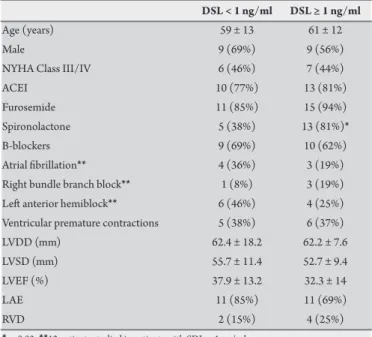
TABlE 1 - Comparison of clinical characteristics of patients with digoxin serum levels < 1 ng/ml (n=13) and with digoxin serum levels ≥ 1 ng/ml (n=16).
DSl < 1 ng/ml DSl ≥ 1 ng/ml
Age (years) 59 ± 13 61 ± 12
Male 9 (69%) 9 (56%)
NYHA Class III/IV 6 (46%) 7 (44%)
ACEI 10 (77%) 13 (81%)
Furosemide 11 (85%) 15 (94%)
Spironolactone 5 (38%) 13 (81%)*
B-blockers 9 (69%) 10 (62%)
Atrial ibrillation** 4 (36%) 3 (19%)
Right bundle branch block** 1 (8%) 3 (19%)
Let anterior hemiblock** 6 (46%) 4 (25%)
Ventricular premature contractions 5 (38%) 6 (37%)
LVDD (mm) 62.4 ± 18.2 62.2 ± 7.6
LVSD (mm) 55.7 ± 11.4 52.7 ± 9.4
LVEF (%) 37.9 ± 13.2 32.3 ± 14
LAE 11 (85%) 11 (69%)
RVD 2 (15%) 4 (25%)
*p=0.03, **12 patients studied in patients with SDL < 1 ng/ml.
DSl: digoxin serum levels, NYHA: New York Heart Association, ACEI: angiotensin converting enzyme inhibitors, lVDD: let ventricular diastolic dimension, lVSD: let ventricular systolic dimension, lVEF: let ventricular ejection fraction, lAE: let atrial enlargement, RVD: right ventricular dilatation.
DISCUSSION
his cross-sectional study shows that roughly half of Chagas’ disease patients with chronic heart failure in need of digoxin therapy present higher serum digoxin concentration than that currently recommended. his fact highlights the necessity of measuring digoxin in the serum of such patients to provide the best treatment available for patients with this condition.
Mean age was similar in patients with digoxin serum levels ≥ 1ng/ml and in those with digoxin serum concentrations < 1ng/ ml. In contrast, mean age was higher in patients with serum digoxin concentrations ≥ 1ng/ml in the DIG trial8. In this study, however,
mean age was slightly lower than that reported for the DIG trial8. It is
conceivable, therefore, that this diference accounts for the disparity observed between these studies.
The proportion of patients with pulmonary congestion, as shown by the chest radiograph, was similar in patients with serum digoxin concentration ≥ 1ng/ml and in those with serum digoxin concentration < 1ng/ml. his is in contrast with that has been veriied in non-Chagas’ disease heart failure8. Perhaps this discrepancy can
be explained by B-Blocker therapy, which is known to increase let ventricular ejection fraction and to decrease pulmonary congestion, but was not used at the time the DIG trial was conducted, but was used in the majority of patients enrolled in this study.
here was no diference in potassium serum levels in patients with digoxin serum concentration ≥ 1ng/ml in comparison to patients with digoxin serum concentration < 1ng/ml in our investigation, despite the fact that 90% of patients were receiving furosemide and 66% spironolactone at the time of digoxin measurement. Moreover, the mean potassium serum level was below the normal range. his fact is in agreement with that reported for the DIG trial8.
A key point in this investigation was the fact that about 66% of patients received B-blockers at targeted dose along with digoxin. In non-Chagas’ disease patients, B-blocker therapy beneits both patients administered and those not administered digoxin as treatment for chronic heart failure14. In the context of Chagas’
disease, B-blocker therapy has been shown to provide beneicial efects experimentally15, as well as in patients with chronic heart
failure16. Nonetheless, B-blocker therapy is not devoid of potential
complications in Chagas’ disease patients.
In fact, carvedilol increases digoxin serum concentration in non-Chagas’ disease patients with chronic heart failure, mainly in men17.
Given the presence of a high frequency of patients with bundle branch and fascicular blocks in Chagas’ disease with chronic heart failure, as detected in our study, such an increase in digoxin serum concentration could lead to the appearance of life-threatening arrhythmias18 due to
macroreentry and atrioventricular blocks19, cardinal manifestations
of digoxin toxicity. Nevertheless, the proportion of patients on B-blockers with digoxin serum concentrations ≥ 1ng/ml was similar to that veriied in patients on B-blockers with digoxin serum concentrations < 1ng/ml. Another property of B-blockers, therefore, might have counteracted this potential deleterious efect.
Carvedilol has been shown to decrease proinlammatory cytokine levels in non-Chagas’ disease patients with chronic heart failure on digoxin therapy20. Proinlammatory cytokines, particularly TNF,
are increased in patients with chronic heart failure secondary to Chagas’ cardiomyopathy21. The interplay of spasm in the small
intramyocardial coronary vessels, autoimmunity and parasympathetic impairment is believed to play a role in the pathogenesis of Chagas’ cardiomyopathy22. In Chagas’ disease patients, therefore, TNF could
lead to microvascular thrombosis-induced myocardial ischemia, as well as orchestrating chronic myocardial inlammation and ultimately reparative myocardial ibrosis11. hus, B-blocker therapy added to
patients with chronic heart failure with Chagas’ cardiomyopathy on digoxin therapy does not appear to be detrimental, as observed prior to the current era of heart failure therapy23.
Digoxin has not been routinely measured in patients with Chagas’ cardiomyopathy with chronic heart failure due to economic reasons, inasmuch as this laboratory test is not paid for by the National Health System. It has not also been determined in distant rural areas, where the disease is endemic, due to the unavailability of proper apparatus to perform the immune-enzymatic method. his study shows the necessity to measure digoxin serum levels in Chagas’ disease heart failure patients because of the potential for digoxin toxicity, as observed in non-Chagas’ disease heart failure patients.
he main limitation of the present investigation is the small sample size. hus, a multicentric study analyzing more patients with this condition would be necessary to conirm the results obtained in this work. Nonetheless, it must be emphasized that this investigation was conducted in a tertiary referral center where Chagas’ disease patients are routinely followed, thus relecting the reality of the proper treatment of such patients in daily practice.
In conclusion, the prevalence of abnormal digoxin serum concentration is high in patients with chronic heart failure secondary to Chagas’ cardiomyopathy. Further studies are necessary to conirm the results of this investigation.
he authors declare that there is no conlict of interest.
499
FINANCIAL SUPPORT
REFERENCES
From the Fundação de Amparo à Pesquisa do Estado de São Paulo (FAPESP). Samira Jorge Ferrari and Talita Bottan Bortoluzzi are recipients of Bolsa de Iniciação Cientíica from the Conselho Nacional de Pesquisa (CNPq).
1. Anonymous. A human rights-based approach to neglected tropical diseases. Available from: http:// apps.who.int/tdr/svc/publication/tdr.research publications/human rights/. (Accessed on August 20, 2009).
2. Schmunis GA. Epidemiology of Chagas disease in non-endemic countries: the role of international migration. Mem Inst Oswaldo Cruz 2007; 102(suppl1): 75-85.
3. Besteti RB, Muccillo G. Clinical course of Chagas' heart disease: a comparison with dilated cardiomyopathy. Int J Cardiol 1997; 60:187-193.
4. Freitas HFG, Chizzola PR, Paes AT, Lima ACP, Mansur AJ. Risk stratiication in a Brazilian hospital-based cohort of 1220 outpatients with heart failure: role of Chagas’ heart disease. Int J Cardiol 2005; 102:239-247.
5. Besteti RB, heodoropoulos TAD, Cardinalli-Neto A, Cury PM. Treatment of chronic systolic heart failure secondary to Chagas heart disease in the current era of heart failure therapy. Am Heart J 2008; 156:422-430.
6. DIG trial investigators. he efect of digoxin on mortality and morbidity in patients with heart failure. N Engl J Med 1997; 336:525-533.
7. Rathore S, Curtis JP, Wang Bristow MR, Krumholz HM. Association of serum digoxin concentration and outcomes in patients with heart failure. J Am Med Assoc 2003; 289:871-878.
8. Ahmed A, Rich MW, Love TE, Lloyd-Jones DM, Aban IB, Colucci WS, et al. Digoxin and reduction in mortality and hospitalization in heart failure: a comprehensive post hoc analysis of the DIG trial. Eur Heart J 2006; 27: 178-186.
9. Ahmed A, Pit B, Rahimtoola SH, Ahmed A, Waagstein F, White M, et al. Efects of digoxin at low serum concentrations on mortality and hospitalization in heart failure: a propensity-matched study of the DIG trial. Int J Cardiol 2008; 123:138-146. 10. Ahmed A, Waagenstein F, Pit B, White M, Zannad F, Young JB, et al. Efectiveness
of digoxin in reducing one-year mortality in chronic heart failure in the Digitalis investigation group trial. Am J Cardiol 2009; 103:82-87.
11. Rossi MA, Ramos SG, Besteti RB. Chagas' heart disease: clinical-pathological correlation. Front Biosci 2003; 8:e94-109.
12. Besteti RB, Ramos CP, Figueredo-Silva J, Sales-Neto VN, Oliveira JSM. Ability of the electrocardiogram to detect myocardial lesions in isoproterenol-induced rat cardiomyopathy. Cardiovasc Res 1987; 21:916-921.
13. heodoropoulos TAD, Besteti RB, Otaviano AP, Cordeiro JA, Rodrigues VC, Silva AC. Predictors of all-cause mortality in chronic Chagas' heart disease in the current era of heart failure therapy. Int J Cardiol 2008; 128:22-29.
14. Eichorn EJ, Lukas MA, Wu B, Shusterman N. Efect of concomitant digoxin and carvedilol therapy on mortality and morbidity in patients with chronic heart failure. Am J Cardiol 2000; 86:1032-1035.
15. Besteti RB, Sales-Neto VN, Pinto LZ, Soares EG, Muccillo G, Oliveira JS. Efects of long term metoprolol administration on the electrocardiogram of rats infected with T cruzi. Cardiovasc Res 1990; 24:521-527.
16. Issa VS, Amaral AF, Cruz FD, Ferreira SM, Guimarães GV, Chizzola PR, et al. Beta-blocker therapy and mortality of patients with Chagas cardiomyopathy: a subanalysis of the REMADHE prospective trial. Circ Heart Fail 2010; 3:82-88.
17. Baris N, Kalkan S, Guneri S, Bozdemir V, Guven H. Inluence of carvedilol on serum digoxin levels in heart failure: is there any gender diference? Eur J Clin Pharmacology 2006; 62:535-538.
18. Besteti RB, Santos CRF, Machado-Jr OB, Ariolli MT, Carmo JL, Costa NK, et al. Clinical proile of patients with Chagas' disease before and during ventricular tachycardia. Int J Cardiol 1990; 29:39-46.
19. Besteti RB, Cardinalli-Neto A. Sudden cardiac death in Chagas´ heart disease in the contemporary era. Int J Cardiol 2008; 131:9-17.
20. Tatli E, Kurum T, Aktoz M, Buyuklu M. Efects of carvedilol on right ventricular ejection fraction and cytokines levels in patients with systolic heart failure. Int J Cardiol 2008; 125:273-276.
21. Ferreira RC, Ianni BM, Abel LC, Buck P, Mady C, Kalil J, et al. Increased plasma levels of tumor necrosis factor alpha in asymptomatic “indeterminate” and Chagas’ disease cardiomyopathy patients. Mem Inst Oswaldo Cruz 2003; 98:407-411. 22. Besteti RB. Role of parasites in the pathogenesis of Chagas’ cardiomyopathy.
Lancet 1996; 347:913-914.
23. Barreto ACP, Pileggi FJC. Digital in Chagas’ cardiopathy. Arq Bras Cardiol 1982; 38:283-289.